Page last updated Mar 14, 2024
(Adding brief summaries and links to more detailed discussions for all Caldwell Objects)
Working C6
C1 (= NGC 188)
An open cluster in Cepheus; for anything else see NGC 188
Below, a 24 arcmin wide DSS image of the cluster

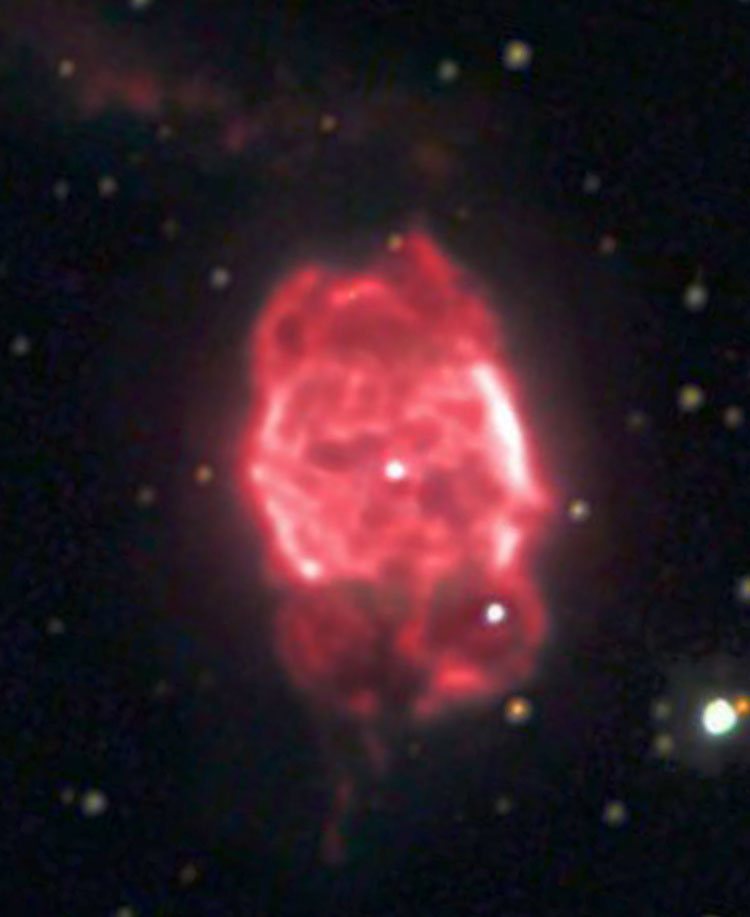
C2 (= NGC 40, the Bow-Tie Nebula)
A planetary nebula in Cepheus; for anything else see NGC 40
Below, a 1.8 by 2.2 arcmin wide image of NGC 40
(Credit & © Jim Misti, Misti Mountain Observatory, used by permission)
C3 (= NGC 4236)
A spiral galaxy in Draco; for anything else see NGC 4236
Below, a 24 arcmin wide DSS image of NGC 4236

C4 (= NGC 7023, the Iris Nebula)
A magnitude 6.8 star, open cluster and emission nebula in Cepheus; for anything else see NGC 7023
Below, a 1.2 degree wide image of the region (Image Credit Adam Block/Steward Observatory/University of Arizona); used by permission)

C5 (= IC 342, the "Hidden" Galaxy)
A spiral galaxy in Camelopardalis; for anything else, see IC 342
Below, a 24 arcmin wide DSS image of IC 342

C6 (= NGC 6543), the Cat's Eye Nebula = the Helical Nebula
A planetary nebula in Draco; for anything else, see NGC 6543
(Choosing which of several images to post here)
C7 (= )
C8 (= )
C9, the Cave Nebula
(= Sh2-155 = Sharpless 155)
First noted (1959) as a galactic emission nebula in the extended second edition of the Sharpless Catalogue
A magnitude 7.7 emission nebula in Cepheus (RA 22 57 17.1, Dec +62 28 33)
Note About The Nickname: The nickname was coined by Patrick Moore, "presumably derived from photographic images showing a curved arc of emission nebulosity" obscured by a foreground absorption nebula "corresponding to a cave mouth." Unfortunately, that appellation had been previously assigned to a brighter reflection nebula (also in Cepheus but unrelated to C9) known as Ced 201, and as a result, SIMBAD returns a search for the Cave Nebula with Ced 201, instead of Caldwell 9.
(Physical information and other images to be posted once all Caldwell objects have been added to this Catalog.)
 Above, a ? arcmin wide HST image of C9 Above, a ? arcmin wide HST image of C9
(Image Credit NASA, ESA, and K. Stapelfeldt (Jet Propulsion Laboratory); Processing: Gladys Kober (NASA/Catholic University of America)
(Note: The 'palette' used for this image is not the "standard" HST palette, so the colors are very different from other images of the nebula)
C10 (= )
C11 (= )
C12 (= )
C13 (= )
C14 (= )
C15 (= )
C16 (= )
C17 (= )
C18 (= )
C19 (= )
C20 (= )
C21 (= )
C22 (= )
C23 (= )
C24 (= )
C25 (= )
C26 (= )
C27 (= )
C28 (= )
C29 (= )
C30 (= NGC 7331)
(= PGC 69327 = UGC 12113 = CGCG 514-068 = MCG +06-49-045)
For now, see NGC 7331 for anything else
C41, the Hyades
(= Cr 50 = Mel 25)
Known in prehistory
Catalogued (1654) by Giovanni Hodierna
A magnitude 0.5 open cluster in Taurus (RA 04 27, Dec +15 52)
Physical Information: Shown to consist of stars moving together in the 1800's, and currently thought to have a common origin with the open cluster known as Praesepe, around 625 million years ago. (Additional physical information and other images to be posted once all Caldwell objects have been added to this Catalog.

Above, a 5 degree wide DSS image of the Hyades (most of the blue stars; the yellow star Aldebaran is a foreground object)
C43, the Little Sombrero Galaxy (= NGC 7814)
For anything else, see NGC 7814
C99, the Coalsack Nebula
Noted by several southern civilizations in prehistoric times
Reported (1499) by Spanish navigator Vicente Yáñez Pinzón
Also noted (date?) by Amerigo Vespucci
Modern name acquired (1899) due to Richard Hinckley Allen naming a northern absorption nebula
An absorption cloud primarily located in Crux (roughly centered near RA 12 50, Dec -62 30)
Historical References: Among the Australian aborigines, who like many primitive cultures used dark regions in the Milky Way as constellations, it was known as the head of the "emu in the sky". Vespucci referred to it as "the dark Canopus". It later became known as "Magellan's Spot", or the "Black Magellanic Cloud", as opposed to the bright Large and Small Magellanic Clouds (which are of course galaxies, and not part of the Milky Way). The term "coalsack" was long used for any dark region in the Milky Way, and what we now call the Coalsack Nebula only became the Coalsack Nebula in 1899, when Richard Hinckley Allen's Star-Names and Their Meaning (later republished as Star-Names -- Their lore and meaning) assigned "The Northern Coalsack Nebula" to an absorption feature in the Northern sky.
Physical Information: The nebula is a cloud of gas and dust less than 600 light-years from us, and although only about 30 to 35 light-years in size, its close proximity allows it to obscure a region about 7 by 5 degrees across, covering not only part of Crus, but also parts of Centaurus and Musca. It is slightly patchy, and although covering almost everything lying beyond it, there are places where more distant objects can be seen, and of course anything closer than the absorption nebula is also visible. Still, it is a very obvious and striking blot on the starry background of the Milky Way.

Above, a 10 by 12 degree wide ESO image of the Southern Cross and the Coalsack Nebula
Part of an image of Crux (Image Credit ESO, Brunier)
|