Scroll down or click on QuickLink to go directly to the object desired
QuickLinks:
1, 2, 3, 4, 5, 6, 7, 8, 9, 10, 11, 12, 13, 14, 15, 16, 17, 18, 19, 20, 21, 22, 23, 24, 25,
26, 27, 28, 29, 30, 31, 32, 33, 34, 35, 36, 37, 38, 39, 40, 41, 42, 43, 44, 45, 46, 47, 48, 49
Page last updated Sep 28, 2023 (correctly oriented and enhanced the image contrast for the Chandra image of NGC 40)
Page last updated July 9, 2023
Added Caldwell ID to NGC 40
Prior:
Did final check of positions and fixed a couple of blunders
Updated discovery information for NGC 5, 11, 22 and 38
Used DESI Legacy Survey for image of NGC 10; starting w/25, there are several others
Almost everything below may need to be checked again, but probably still AOK
Checked designations vs Steinicke's database (AOK)
Added minor notes about the de Vaucouleurs Atlas, link to Arp Atlas for Arp 235
Checked updated Corwin positions, fleshed out all entries for apparent "companions", added all appropriate designations
NEXT: (Meaning in the final iteration of this page, which may be months or years away)
(If you want an updated/completed entry for a particular object, contact me (see banner at top of page)
(1) Update all images for which better ones are now available
(2) Update Physical Information using 3K Vr, instead of heliocentric
(2a) Update Physical Information using the images to obtain apparent sizes
(3) Check updated Steinicke/Gottlieb/etc databases for any useful additions
NGC 1
(= PGC 564 = UGC 57 = CGCG 477-054 = CGCG 478-026 = MCG +04-01-025)
Discovered (Sep 30, 1861) by Heinrich d'Arrest
Also observed (Aug 20, 1873) by Lawrence Parsons, 4th Earl of Rosse
A magnitude 12.9 spiral galaxy (type SA(s)bc?) in Pegasus (RA 00 07 15.9, Dec +27 42 29)
Historical Identification: Per Dreyer, NGC 1 (= GC 1, d'Arrest, 1860 RA 00 00 04, NPD 63 04.3) is "faint, small, round, between 11th and 14th magnitude stars". The position precesses to (2000) RA 00 07 15.8, Dec +27 42 28, within 0.1 arcmin of the center of the galaxy listed above, and there are appropriate stars to the northeast and southwest, so the identification is certain.
Historical Notes: Dreyer's description is identical to that in the GC, but the position is slightly different (the GC lists 1860 RA 00 00 05, NPD 63 04 00). Neither position agrees exactly with d'Arrest's four observations, which fall slightly but not significantly northeast of the NGC position. However, the 4th Lord Rosse's summary of observations made between 1848 and 1878 notes the presence of a companion almost exactly 2 arcmin south southeast (= NGC 2), and although that paper gives no indication of the actual position of either object, Dreyer's 1877 Supplement to the GC lists a position for NGC 2 (as observed by Lord Rosse) which is identical to the one in its NGC entry. So the NGC position for NGC 1 was probably also taken from the measurements at Birr Castle.
Physical Information: Based on a recessional velocity of 4550 km/sec (and H0 = 70 km/sec/Mpc), NGC 1 is about 210 to 215 million light-years away, in good agreement with redshift-independent distance estimates of 175 to 245 million light-years. (Another recessional velocity measurement of 2215 km/sec would place the galaxy only about 100 million light-years away, which seems unlikely given the redshift-independent results, so it is probably a misattributed value for a different galaxy, one reason for the effort made on this site to determine what galaxy corresponds to a given designation.) Given that and its apparent size of about 2.25 by 2.0 arcmin (counting the fainter outer regions, as seen in the images below), it is about 135 to 140 thousand light-years across. Note: Although close in the sky (see the wide-field image below), NGC 1 and 2 are at very different distances; if stars, they would be called an "optical double".
Use By The de Vaucouleurs Atlas: NGC 1 is used by the de Vaucouleurs Atlas of Galaxies as an example of type SA(s)b.

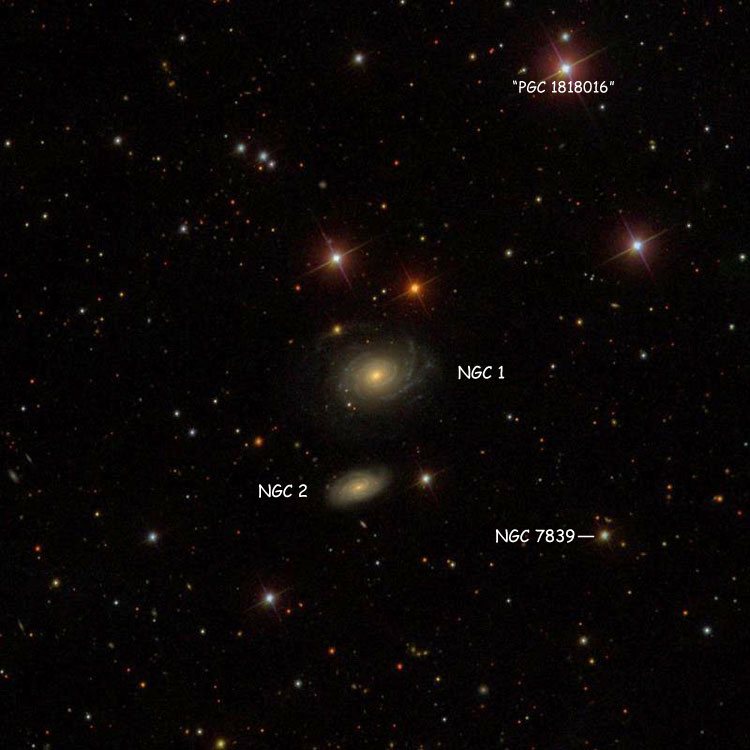
Above, a 12 arcmin SDSS image centered on NGC 1, also showing NGC 2 and 7839
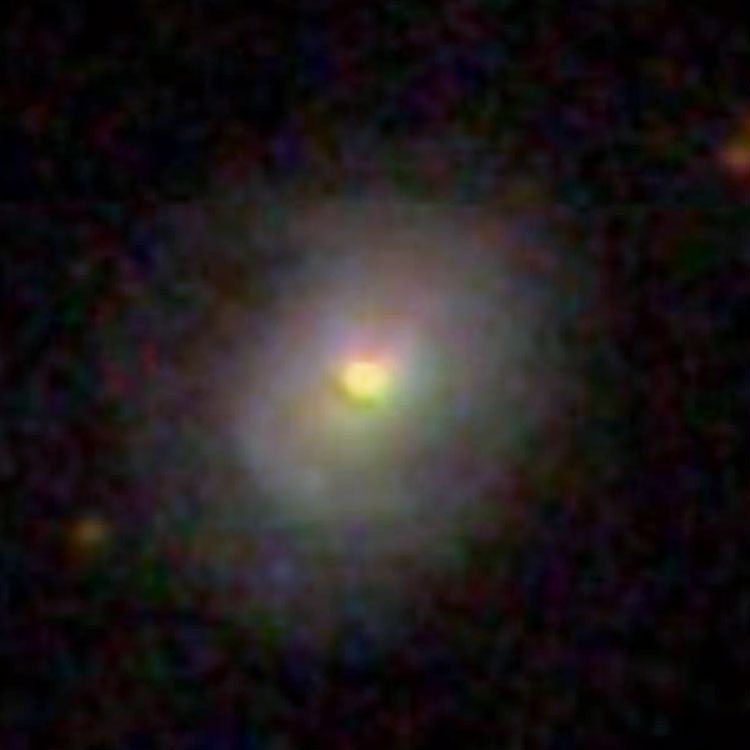
Below, a 2.8 arcmin wide SDSS image of the galaxy

Below, a 12 arcmin SDSS image centered on NGC 1, also showing NGC 2 and 7839 and PGC 1818016
NGC 2
(= PGC 567 = UGC 59 = CGCG 477-055 = CGCG 478-027 = MCG +04-01-026)
Discovered (Aug 20, 1873) by Lawrence Parsons, 4th Earl of Rosse
A magnitude 14.2 spiral galaxy (type SABbc?) in Pegasus (RA 00 07 17.1, Dec +27 40 42)
Historical Identification: Per Dreyer, NGC 2 (= GC 6246, 4th Lord Rosse, 1860 RA 00 00 06, NPD 63 06.0) is "very faint, small, south of GC 1" (GC 1 being NGC 1). The position precesses to (2000) RA 00 07 17.8, Dec +27 40 46, within 0.2 arcmin of the center of the galaxy listed above, and the galaxy is south of NGC 1, so the identification is certain.
Historical Note: GC 6246 is an addendum to Dreyer's 1877 Supplement to the GC, and the description and position in the NGC are exactly the same as in that publication. The Supplement also notes that (as shown in Lord Rosse's 1878 paper), the appearance and position of the "nova" was verified by an observation at Birr Castle on Oct 29, 1877.
Physical Information: Based on a recessional velocity of 7560 km/sec (and H0 = 70 km/sec/Mpc), a straightforward calculation indicates that NGC 2 is about 350 to 355 million light-years away, in good agreement with widely varying redshift-independent distance estimates of 260 to 400 million light-years. However, for objects at such distances we should take into account the expansion of the Universe during the time it took their light to reach us. Doing that shows that the galaxy was about 340 million light-years away at the time the light by which we see it was emitted, about 345 million years ago (the difference between the two numbers being due to the expansion of the intervening space during the light-travel time). Given that and its apparent size of about 1.15 by 0.55 arcmin (from the images below), it is about 110 to 115 thousand light-years across. Note: Although close in the sky, NGC 1 and 2 are at very different distances; if stars, they would be called an "optical double".
Above, a 12 arcmin SDSS image centered on NGC 1, also showing NGC 2 and 7839
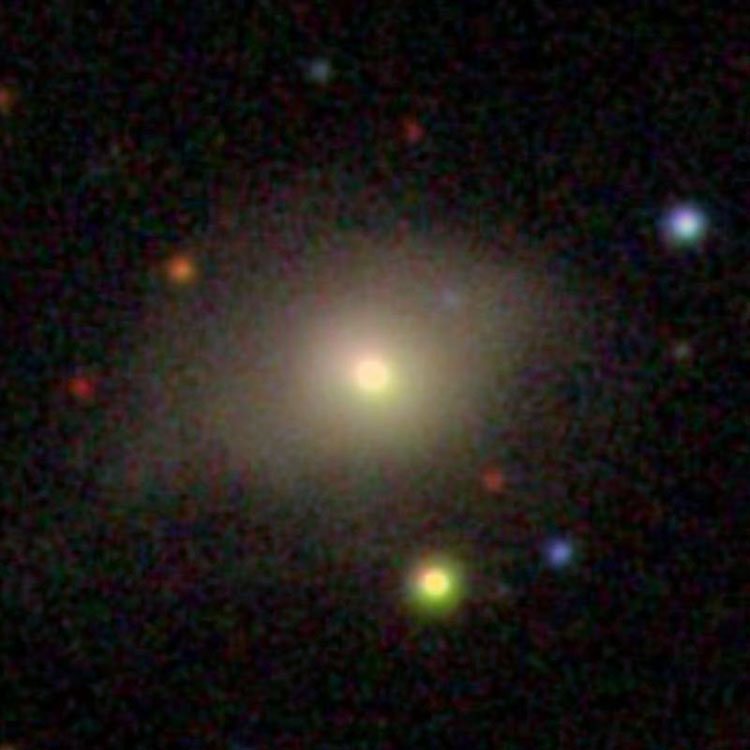
Below, a 1.25 arcmin wide SDSS image of NGC 2

NGC 3
(= PGC 565 = UGC 58 = CGCG 408-035 = MCG +01-01-037)
Discovered (Nov 29, 1864) by Albert Marth
A magnitude 13.3 spiral galaxy (type SAB(rs)a? pec) in Pisces (RA 00 07 16.8, Dec +08 18 06)
Historical Identification: Per Dreyer, NGC 3 (= GC 5080, Marth #1, 1860 RA 00 00 06, NPD 82 28) is "faint, very small, round, almost stellar". The position precesses to (2000) RA 00 07 16.7, Dec +08 18 46, only 0.7 arcmin north of the galaxy listed above and there is nothing else nearby, so the identification is certain.
Historical Note: The NGC entry is copied from Lassell's 1866 paper about observations at Malta, which included Marth's discoveries.
Physical Information: Based on a recessional velocity of 3900 km/sec (and H0 = 70 km/sec/Mpc), NGC 3 is about 180 to 185 million light-years away. Given that and its apparent size of about 0.95 by 0.65 arcmin (from the images below), it is about 50 thousand light-years across.
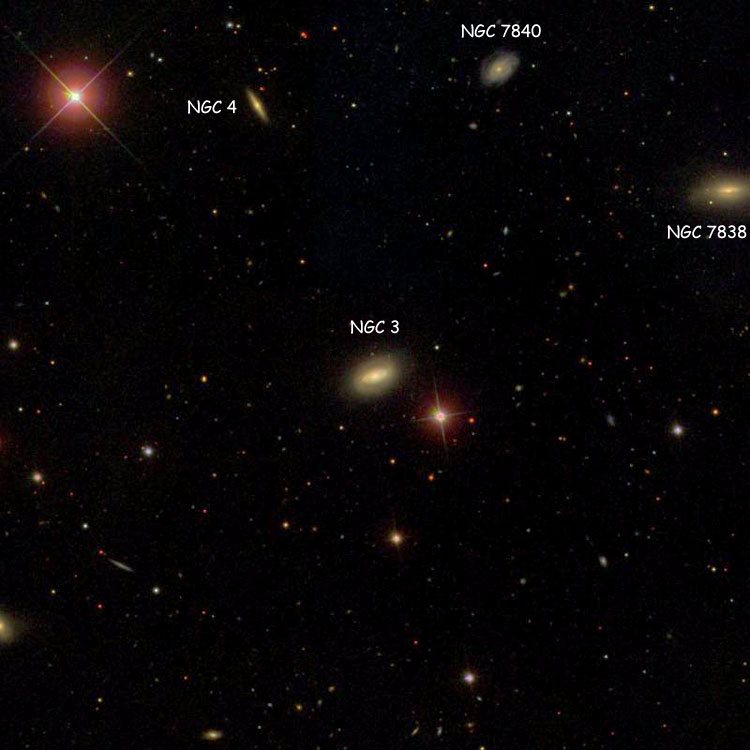
Above, a 12 arcmin wide SDSS image centered on NGC 3, also showing NGC 4, 7838 and 7840
Below, a 1.2 arcmin wide SDSS image of the galaxy

Below, a 12 arcmin wide SDSS image centered on NGC 3
Also shown are NGC 4, 7838 and 7840, and PGC 1341667 and 1342413

NGC 4
(= PGC 212468)
Discovered (Nov 29, 1864) by Albert Marth
A magnitude 15.9 lenticular galaxy (type S0/a?) in Pisces (RA 00 07 24.4, Dec +08 22 26)
Historical Identification: Per Dreyer, NGC 4 (= GC 5081, Marth #2, 1860 RA 00 00 16, NPD 82 23) is "extremely faint". The position precesses to (2000) RA 00 07 26.7, Dec +08 23 46, over an arcmin north northeast of the galaxy listed above, but there is nothing else nearby and the offset is similar to that of NGC 3 (observed by Marth on the same night), so the identification is certain. However (per Corwin), at one time LEDA listed PGC 620 as NGC 4 because the catalogers did not realize that Marth could see an object as faint as PGC 212468; but Marth was using a telescope of 48 inches aperture (second only to Lord Rosse's 72 inch Leviathan at the time), and he really could see a 16th magnitude galaxy. The error in the LEDA database has been corrected, but awareness of the correction is not universal; so for any search the PGC 212468 designation or its coordinates should be used to ensure an accurate identification of NGC 4, and its incorrect identification as PGC 620 is discussed immediately below as a warning about such things.
Historical Note: The NGC entry is copied from Lassell's 1866 paper about observations at Malta, which included Marth's discoveries.
Physical Information: NGC 4's apparent size is about 0.6 by 0.15 arcmin (from the images below), but its distance is unknown, so its physical size is also unknown.

Above, a 12 arcmin wide SDSS image centered on NGC 4, also showing NGC 3 and 7840
Below, a 0.6 arcmin wide closeup of the galaxy

Below, a 12 arcmin wide SDSS image centered on NGC 4; also shown are NGC 3 and 7840, and PGC 73256

PGC 620 (not = NGC 4)
Not an NGC object but listed here since sometimes misidentified as NGC 4
A magnitude 17(?) spiral galaxy (type (R)SAB(rs)a? pec) in Pisces (RA 00 08 18.9, Dec +08 07 16)
Historical Misidentification: As noted in the entry for NGC 4, PGC 620 is sometimes misidentified as that object; so the purpose of this entry is to provide a warning about that.
Physical Information: Based on a recessional velocity of 5320 km/sec (and H0 = 70 km/sec/Mpc), PGC 620 is about 245 to 250 million light-years away. Given that and its apparent size of about 0.55 by 0.45 arcmin (from the images below), it is about 40 thousand light-years across. Its bright core suggests that it might be a Seyfert galaxy.

Above, a 12 arcmin wide SDSS image centered on PGC 620
Below, a 0.75 arcmin wide SDSS image of the galaxy
NGC 5
(= PGC 595 = UGC 62 = CGCG 517-017 = CGCG 518-012 = MCG +06-01-013)
Discovered (Sep 18, 1871) by Édouard Stephan (but not published)
Re-observed (Oct 21, 1881) by Édouard Stephan (and later listed as NGC 5)
A magnitude 13.3 lenticular galaxy (type E/S0? pec) in Andromeda (RA 00 07 48.9, Dec +35 21 44)
Historical Identification: Per Dreyer, NGC 5 (Stephan list XII (#1), 1860 RA 00 00 37, NPD 55 25.0) is "very faint, very small, nucleus equivalent to a 13th or 14th magnitude star". The position precesses to (2000) RA 00 07 49.7, Dec +35 21 46, only 0.2 arcmin west of the nucleus of the galaxy listed above and within its outer glow, and the nucleus has the stated brightness, so the identification is certain.
Historical Note: Dreyer's description is a good translation of Stephan's description, and save for round-off errors the NGC position is identical to Stephan's position.
Discovery Note: Stephan's date of discovery based on his published data is Oct 21, 1881, which represents the date when he made what he considered an adequate micrometric measurement; but based on Stephan's original notes, Yann Pothier has shown that he actually made his first observation of what became NGC 5 on Sep 18, 1871, as shown above.
Physical Information: Based on a recessional velocity of 5110 km/sec (and H0 = 70 km/sec/Mpc), NGC 5 is about 235 to 240 million light-years away. Given that and its apparent size of about 1.15 by 0.8 arcmin (from the images below), it is about 80 thousand light-years across.

Above, a 12 arcmin wide SDSS image centered on NGC 5
Below, a 1.5 arcmin wide SDSS image of the galaxy
NGC 6 (probably = NGC 20)
(= PGC 679 = UGC 84 = CGCG 498-082 = CGCG 499-054 = MCG +05-01-036)
Discovered (Sep 18, 1857) by R. J. Mitchell (and later listed as NGC 20)
Also observed (Oct 16, 1866) by Herman Schultz (and later listed as NGC 20)
Recorded (Sep 20, 1885) by Lewis Swift (and later listed as NGC 6)
A magnitude 13.1 lenticular galaxy (type E/S0?) in Andromeda (RA 00 09 32.7, Dec +33 18 31)
Historical Identification: Per Dreyer, NGC 6 (Swift list II (#3), 1860 RA 00 01 05, NPD 58 15.6) is "extremely faint, very small, considerably extended". The position precesses to (2000) RA 00 08 17.7, Dec +32 31 10, but there is nothing there. However (per Corwin), on the night in question Swift discovered four other nebulae ( NGC 19, 21, 7831 and 7836) with an average measurement error of 70 seconds of time too far west and 8' 8" too far south, presumably due to improperly setting the setting circles he used to make his measurements at the start of the evening (another galaxy found later that night had a completely different error in position, suggesting that Swift finally realized that the setting circles were "off" and "re-zeroed" them). Applying a corresponding correction to Swift's original measurement yields a position of RA 00 09 28.3, Dec +32 39 17, only a few seconds west of Mitchell's essentially perfect position for NGC 20, but still 39 arcmin too far south of that galaxy. Since Swift used setting circles to measure positions and often misread them, that could be explained by assuming he made an error of 40 arcmin in reading the declination circle. Corwin says it appears that was probably the case here, because Swift's paper states that "one of 5 stars which point to it is pretty near", and there is such a line of stars directly east of NGC 20, the nearest of which is so close to the galaxy that it perfectly fits Mitchell's description of the nebula as having an "attached" star; so he feels that the equality of the two entries is reasonably certain, and I can't help but agree, as indicated by the heading for this entry.
Physical Information: Duplicate entries are usually listed under the lowest NGC number, so some references refer to this object as NGC 6; but because of the uncertainty involved in identifying it as PGC 679, the galaxy is more often referred to as NGC 20, so see that entry for anything else.
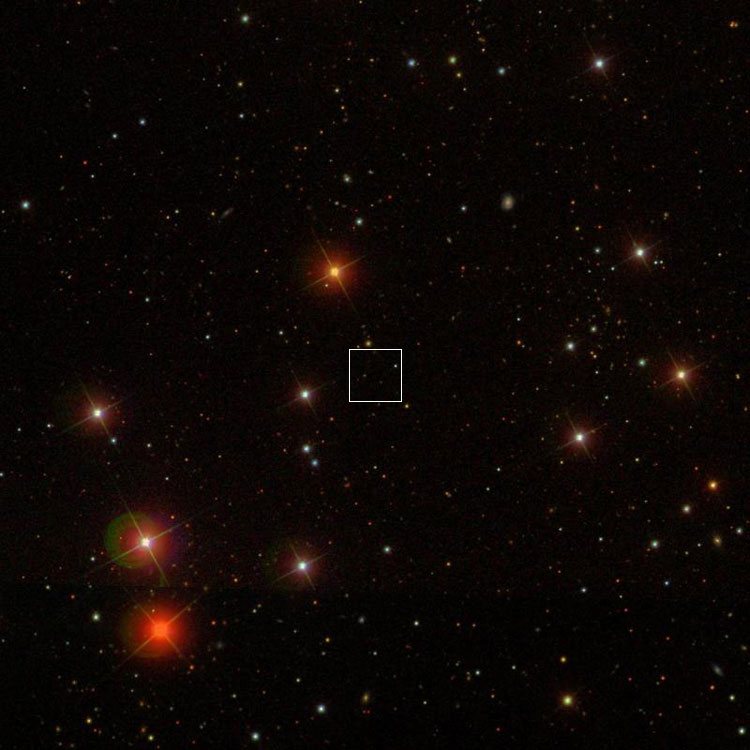
Above, a 12 arcmin wide SDSS image centered on Dreyer's position for NGC 6
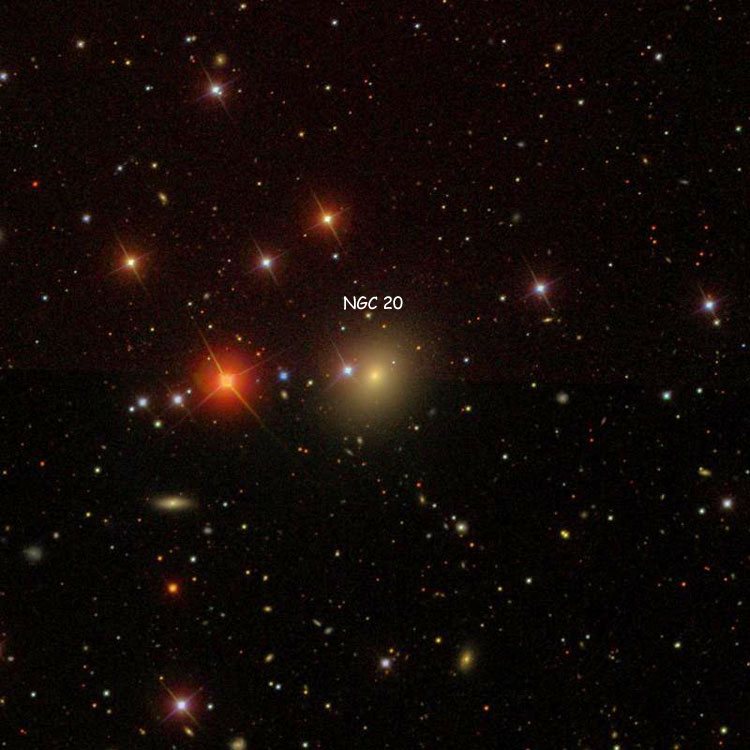
Below, a 12 arcmin wide SDSS image centered on NGC 20, which is almost certainly NGC 6
NGC 7
(= PGC 627 = ESO 409-022 = MCG -05-01-037)
Discovered (Sep 27, 1834) by John Herschel
A magnitude 13.9 spiral galaxy (type SB(s)cd?) in Sculptor (RA 00 08 20.8, Dec -29 54 55)
Historical Identification: Per Dreyer, NGC 7 (= GC 2 = JH 4014, 1860 RA 00 01 14, NPD 120 41.2) is "extremely faint, considerably large, much extended, very gradually very little brighter middle". The position precesses to (2000) RA 00 08 22.0, Dec -29 54 26, only 0.7 arcmin northeast of the center of the galaxy listed above and within its northern outline, so the identification is certain.
Historical Note: Save for round-off errors in the position, the NGC entry is identical to the GC entry.
Physical Information: Based on a recessional velocity of 1495 km/sec (and H0 = 70 km/sec/Mpc), NGC 7 is about 70 million light-years away, in good agreement with redshift-independent distance estimates of 65 to 75 million light-years. Given that and its apparent size of about 2.25 by 0.4 arcmin (from the images below), it is about 45 to 50 thousand light-years across.
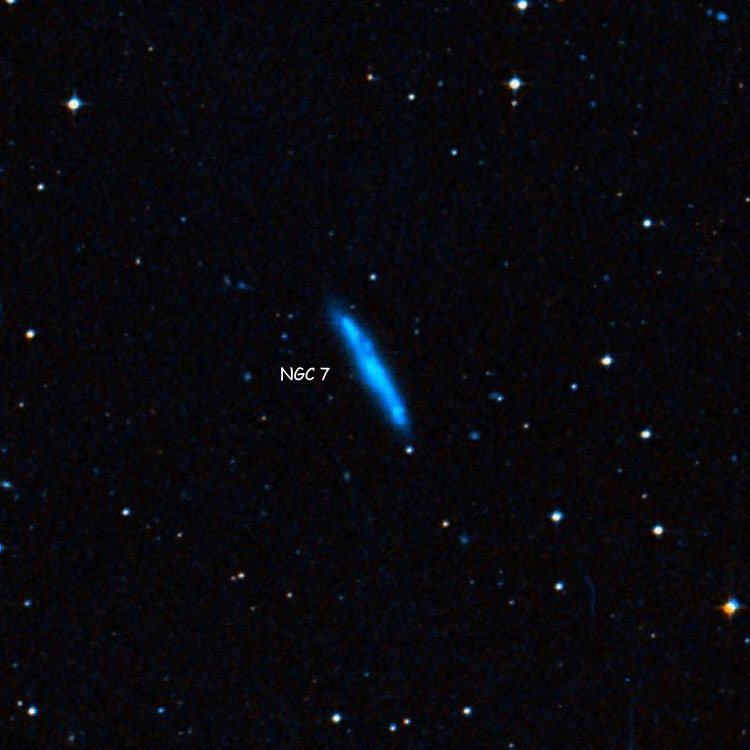
Above, a 12 arcmin wide DSS image centered on NGC 7
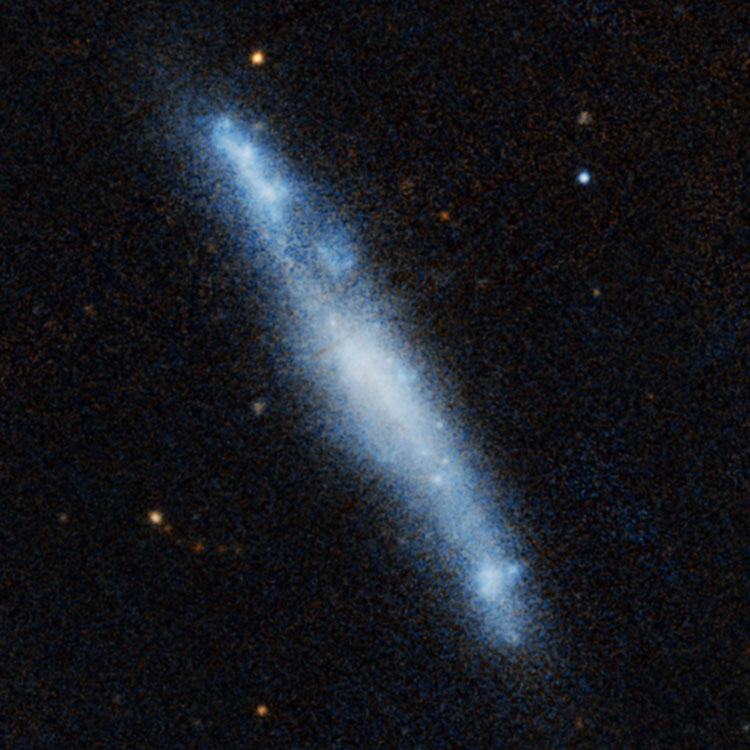
Below, a 2.4 arcmin wide DSS image of the galaxy

Below, a 2.4 arcmin wide PanSTARRS image of the galaxy
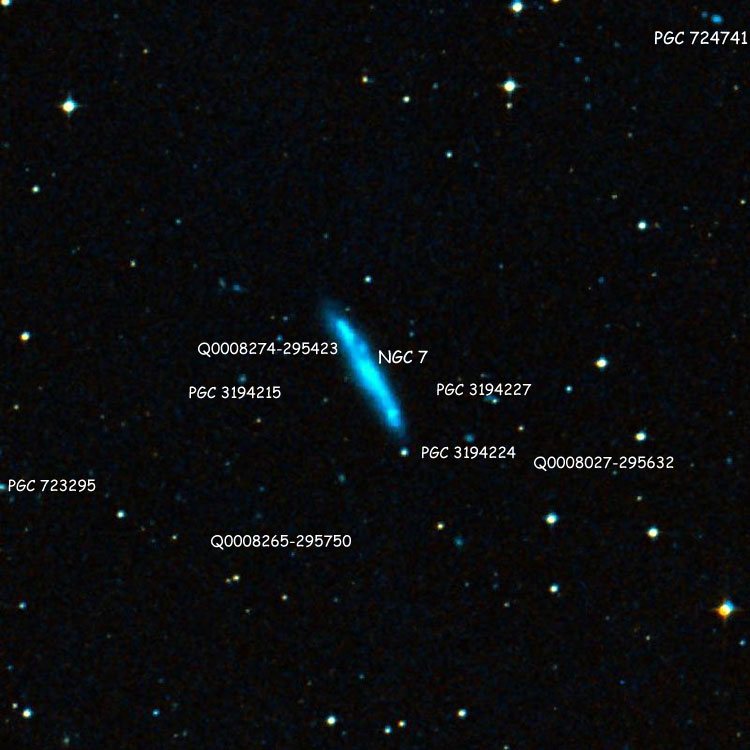
Below, the 12 arcmin wide DSS image at top with labels for other objects in the field of view:
PGC 723295, 724741, 3194215, 3194224 and 3194227, and three quasars:
Q0008027-295632 refers to 2QZJ000802.7-295632, a 20th magnitude quasar with z = 1.590
Q0008265-295750 refers to 2QZJ000826.4-295750, a 21st magnitude quasar with z = 2.038
Q0008274-295423 refers to 2QZJ000827.4-295423, a 20th magnitude quasar with z = 2.061
NGC 8
(= PGC 648)
Recorded (Sep 29, 1865) by Otto Struve
A magnitude 15.2 and 16.5 double star in Pegasus (RA 00 08 45.4, Dec +23 50 19)
Historical Identification: Per Dreyer, NGC 8 (= GC 5082, O Struve, 1860 RA 00 01 17, NPD 66 59) is "very faint, nucleus in north end". The position precesses to (2000) RA 00 08 29.0, Dec +23 47 46, but there is nothing near the position that is obviously identifiable as Struve's object. However (per Corwin), the pair of stars listed above can be positively identified as NGC 8 by virtue of a comparison with Struve's observation of NGC 9 ( which see for an image of both NGC objects), which he discovered two nights earlier. If it is assumed that the positional error for NGC 8 is similar to that for NGC 9, the position falls right on the pair of stars, so the identification is essentially certain.
Historical Note: The NGC entry is identical to the entry for GC 5082 near the end of Dreyer's 1877 Supplement to the GC.
NGC 9
(= PGC 652 = UGC 78 = CGCG 477-059 = CGCG 478-031 = MCG +04-01-030)
Discovered (Sep 27, 1865) by Otto Struve
A magnitude 13.5 spiral galaxy (type SBab? pec) in Pegasus (RA 00 08 54.7, Dec +23 49 01)
Historical Identification: Per Dreyer, NGC 9 (= GC 5083, O Struve, 1860 RA 00 01 27, NPD 67 00) is "faint, round, 9th or 10th magnitude star to southeast". The position precesses to (2000) RA 00 08 39.1, Dec +23 46 46, but there is nothing there that is obviously identifiable as Struve's object. However, 15 seconds of time to the east and about 2 arcmin to the north, the galaxy listed above seems a reasonable candidate, and (per Corwin) Struve's measurement of the 9th magnitude star 6 arcmin east southeast of the galaxy (the bright star just below center on the left edge of the wide-field image below) makes the identification with that galaxy certain. (It is this identification of NGC 9 with PGC 652 that allows the identification of NGC 8 described in its entry.)
Historical Note: The NGC entry is identical to the entry for GC 5083 near the end of Dreyer's 1877 Supplement to the GC.
Physical Information: Based on a recessional velocity of 4530 km/sec (and H0 = 70 km/sec/Mpc), NGC 9 is about 210 million light-years away, in fair agreement with redshift-independent distance estimates of 115 to 185 million light-years. Given that and its apparent size of about 1.05 by 0.5 arcmin (from the images below), it is about 65 thousand light-years across, but its actual size is as uncertain as its distance.

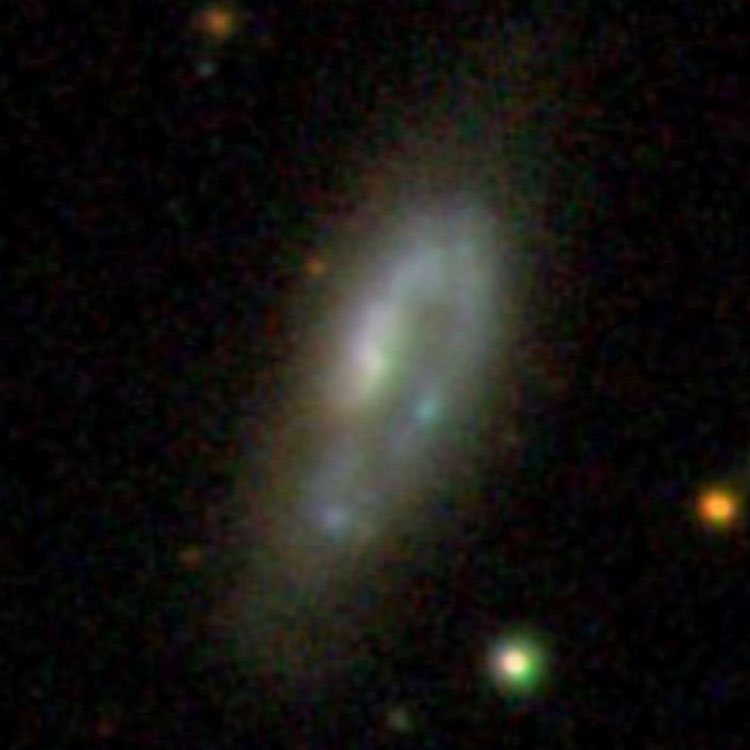
Above, a 12 arcmin wide SDSS image centered on NGC 9, also showing the double star listed as NGC 8
Below, a 1.4 arcmin wide SDSS image of the galaxy
NGC 10
(= PGC 634 = ESO 349-032 = MCG -06-01-024)
Discovered (Sep 25, 1834) by John Herschel
A magnitude 12.5 spiral galaxy (type SAB(rs)bc?) in Sculptor (RA 00 08 34.5, Dec -33 51 30)
Historical Identification: Per Dreyer, NGC 10 (= GC 3 = JH 4015, 1860 RA 00 01 28, NPD 124 38.9) is "faint, considerably large, very little extended, gradually a little brighter middle". The position precesses to (2000) RA 00 08 35.5, Dec -33 52 08, only one second of time east and 0.7 arcmin south of the center of the galaxy listed above and nearly within its outline, so the identification is certain.
Historical Note: Save for round-off errors in the position, the NGC entry is identical to the GC entry.
Physical Information: Based on its recessional velocity of 6810 km/sec, NGC 10 is about 315 to 320 million light-years away, in good agreement with redshift-independent distance estimates of 235 to 365 million light-years. Given that and its apparent size of about 2.55 by 1.4 arcmin (from the images below), it is about 215 to 220 thousand light-years across.
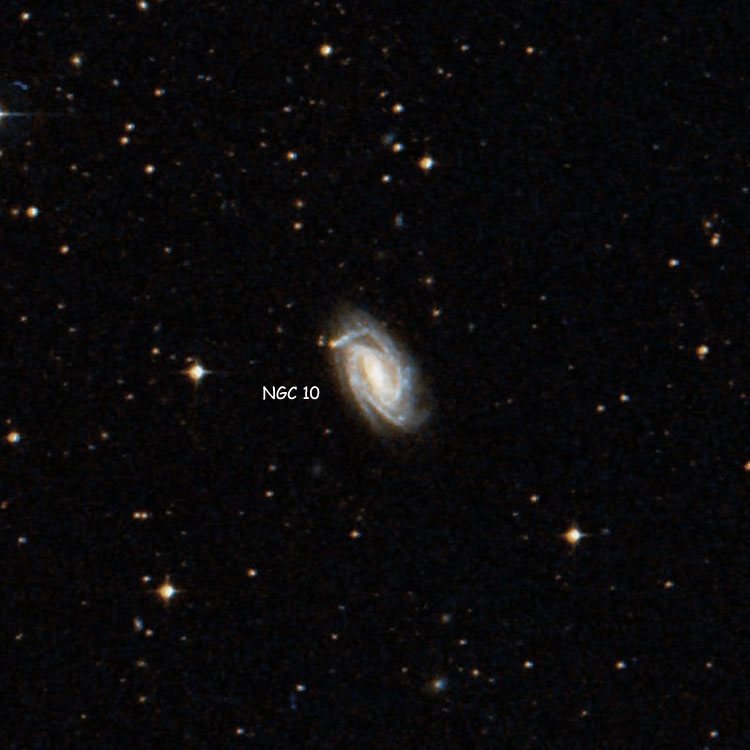
Above, a 12 arcmin wide DSS image centered on NGC 10
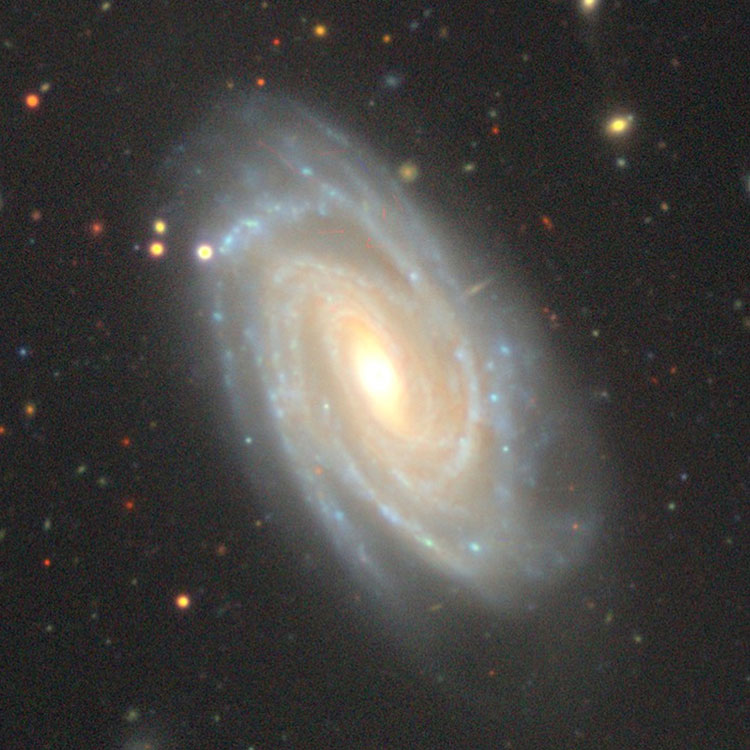
Below, a 3 arcmin wide image of the galaxy (Image Credit DESI Legacy Survey; enter NGC 10)
Below, the 12 arcmin wide DSS image at top, also showing a number of PGC objects
(PGC 669409, 671426, 3168904, 3168909 and 3168915)

NGC 11
(= PGC 642 = UGC 73 = CGCG 517-020 = CGCG 518-015 = MCG +06-01-015)
Discovered (Sep 28, 1867) by Édouard Stephan (but not published)
Re-observed (Oct 24, 1881) by Édouard Stephan (and later listed as NGC 11)
A magnitude 13.7 spiral galaxy (type Sa?) in Andromeda (RA 00 08 42.5, Dec +37 26 53)
Historical Identification: Per Dreyer, NGC 11 (Stephan list XII (#2), 1860 RA 00 01 29, NPD 53 19.9) is "very faint, very small, very little extended, 2 very faint stars involved". The position precesses to (2000) RA 00 08 42.4, Dec +37 26 52, right on the galaxy listed above, so the identification is certain.
Historical Notes: Dreyer's description is a reasonable translation, but Stephan states that the nebula is an irregular oval extending southeast to northwest, which is a more accurate description of the appearance. Save for round-off errors the NGC position is identical to Stephan's position.
Discovery Note: Stephan's date of discovery based on his published data is Oct 24, 1881, which represents the date when he made what he considered an adequate micrometric measurement; but based on Stephan's original notes, Yann Pothier has shown that he actually made his first observation of what became NGC 11 on Sep 28, 1867, as shown above.
Physical Information: Based on a recessional velocity of 4390 km/sec (and H0 = 70 km/sec/Mpc), NGC 11 is about 205 million light-years away, in fair agreement with redshift-independent distance estimates of 165 to 195 million light-years. Given that and its apparent size of about 1.7 by 0.4 arcmin (from the images below), it is about 100 to 105 thousand light-years across.

Above, a SDSS image overlaid on a 12 arcmin wide DSS image centered on NGC 11
Below, a 2 arcmin wide SDSS image of the galaxy
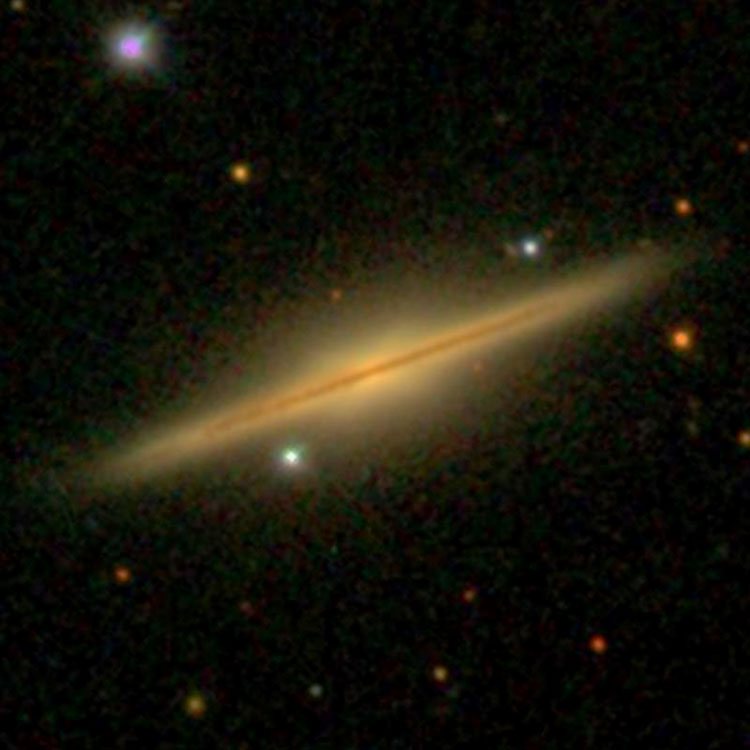
NGC 12
(= PGC 645 = UGC 74 = CGCG 408-038 = MCG +01-01-040)
Discovered (Dec 6, 1790) by William Herschel
Also observed (Oct 16, 1827) by John Herschel
A magnitude 13.1 spiral galaxy (type SAB(rs)bc?) in Pisces (RA 00 08 44.7, Dec +04 36 45)
Historical Identification: Per Dreyer, NGC 12 (= GC 4 = JH 1 = WH III 868, 1860 RA 00 01 34, NPD 86 10.2) is "extremely faint, pretty large, very gradually a little brighter middle". The position precesses to (2000) RA 00 08 44.6, Dec +04 36 34, within 0.2 arcmin of the center of the galaxy listed above and well within its outline, so the identification is certain.
Physical Information: Based on a recessional velocity of 3940 km/sec (and H0 = 70 km/sec/Mpc), NGC 12 is about 180 to 185 million light-years away, in fair agreement with a single redshift-independent distance estimate of 155 million light-years. Given that and its apparent size of about 1.7 by 1.35 arcmin (from the images below), it is about 90 thousand light-years across.
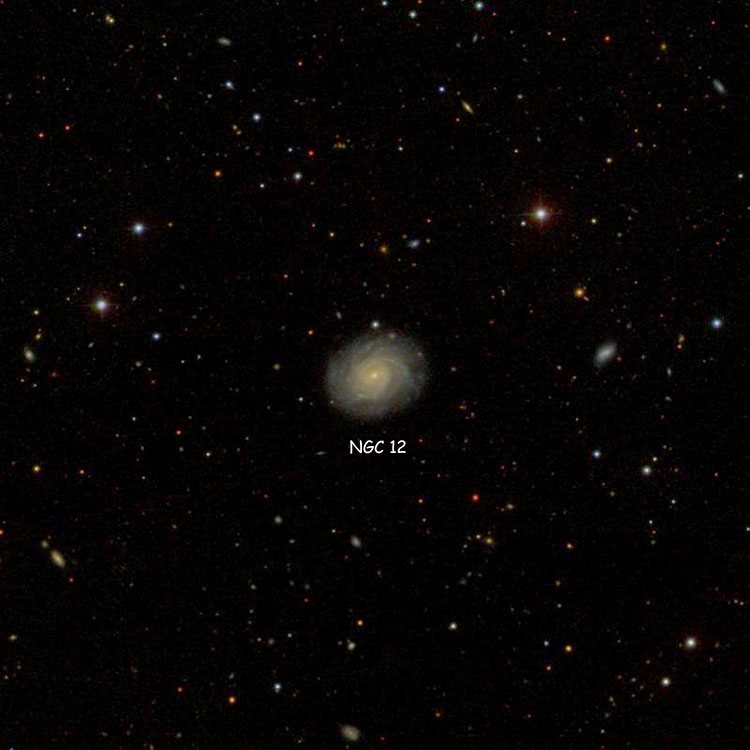
Above, a 12 arcmin wide SDSS image centered on NGC 12
Below, a 2 arcmin wide SDSS image of the galaxy
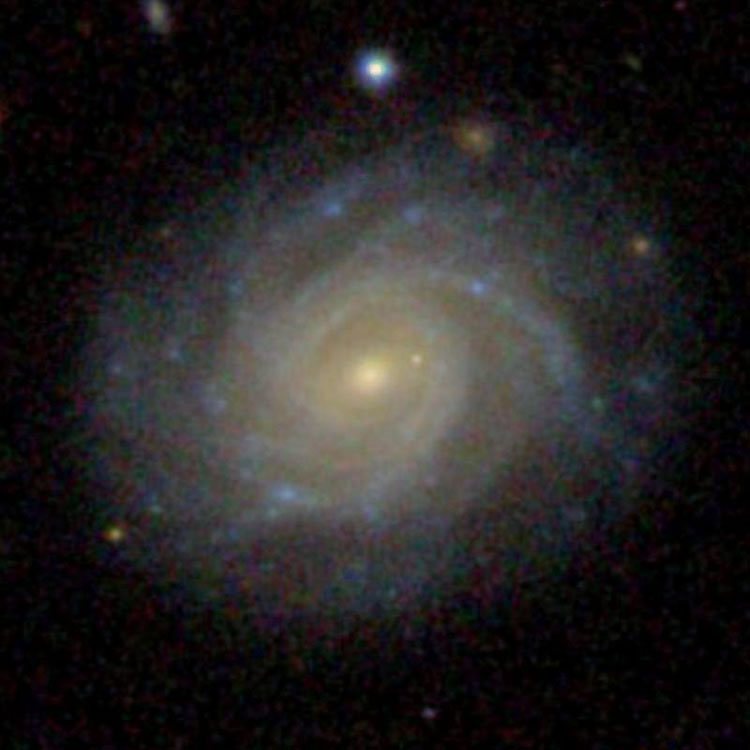
Below, a 12 arcmin wide SDSS image centered on NGC 12, also showing PGC 212475 and 1269991

NGC 13
(= PGC 650 = UGC 77 = CGCG 498-081 = CGCG 499-053 = MCG +05-01-034)
Discovered (Nov 26, 1790) by William Herschel
Also observed (Nov 16, 1827) by John Herschel
A magnitude 13.2 spiral galaxy (type (R)S(rs)ab?) in Andromeda (RA 00 08 47.7, Dec +33 26 00)
Historical Identification: Per Dreyer, NGC 13 (= GC 5 = JH 2 = WH III 866, 1860 RA 00 01 35, NPD 57 20.8) is "very faint, very small, small star plus nebulosity". The position precesses to (2000) RA 00 08 48.0, Dec +33 25 58, within 0.1 arcmin of the center of the galaxy listed above, so the identification is certain.
Physical Information: Based on a recessional velocity of 4810 km/sec (and H0 = 70 km/sec/Mpc), NGC 13 is about 225 million light-years distant, in reasonable agreement with redshift-independent distance estimates of 180 to 215 million light-years. Given that and its apparent size of about 2.2 by 0.4 arcmin (from the images below), it is about 140 to 145 thousand light-years across.

Above, a 12 arcmin wide SDSS image centered on NGC 13
Below, a 2.4 arcmin wide SDSS image of the galaxy

NGC 14 (= Arp 235)
(= PGC 647 = UGC 75 = CGCG 456-034 = MCG +03-01-026)
Discovered (Sep 18, 1786) by William Herschel
Also observed (Nov 2, 1823) by John Herschel
A magnitude 12.1 irregular galaxy (type (R)IB(s)m? pec) in Pegasus (RA 00 08 46.2, Dec +15 48 58)
Historical Identification: Per Dreyer, NGC 14 (= GC 7 = JH 3 = WH II 591, 1860 RA 00 01 37, NPD 74 57.9) is "very faint, pretty small, round, gradually a little brighter middle". The position precesses to (2000) RA 00 08 48.5, Dec +15 48 52, two seconds of time east of the center of the galaxy listed above but within its outline, so the identification is certain.
Physical Information: Based on a recessional velocity of 865 km/sec (and H0 = 70 km/sec/Mpc), NGC 14 is about 40 million light-years distant, in perfect agreement with a single redshift-independent distance estimate of the same value. Given that and its apparent size of about 2.4 by 2.1 arcmin (from the images below), it is about 25 to 30 thousand light-years across. Its structure is ill-defined, but it appears to be either an irregular galaxy or a weakly barred "diffuse" spiral galaxy.
Use By The Arp Atlas: NGC 14 is used by the Arp Atlas of Peculiar Galaxies as an example of a galaxy with the appearance of fission, with the note "Faint outer oval and resolution into stars."
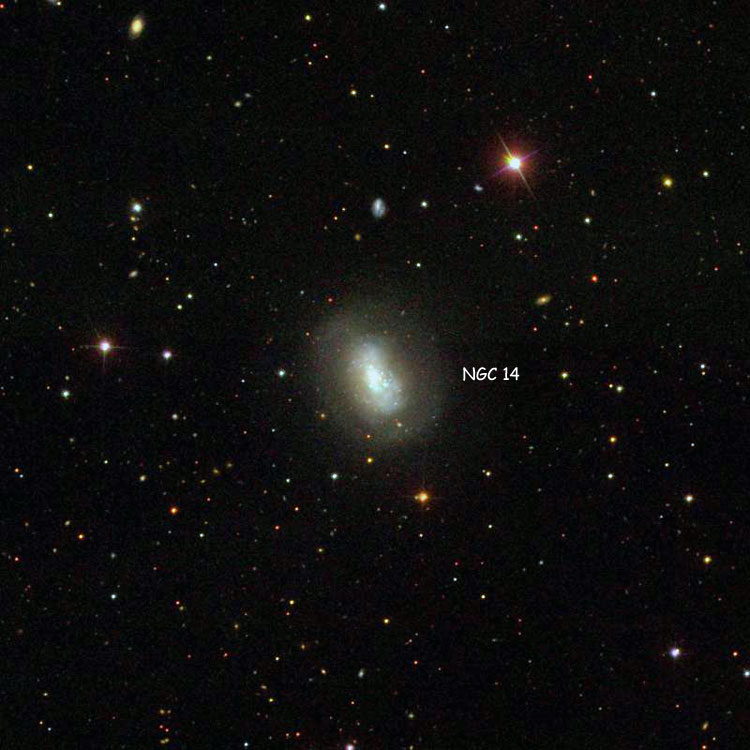
Above, a 12 arcmin wide SDSS image centered on NGC 14
Below, a 3 arcmin wide SDSS image of the galaxy

Below, a 1 by 1.3 arcmin wide "raw" HST image of part of the galaxy (Image Credit Hubble Legacy Archive)

Below, the 12 arcmin wide SDSS image above with labels for several fainter galaxies and a quasar:
Q0008568+155046 refers to SDSSJ000856.79+155045.7, a 19th magnitude quasar with z = 1.691

NGC 15
(= PGC 661 = UGC 82 = CGCG 456-035 = MCG +03-01-027)
Discovered (Oct 30, 1864) by Albert Marth
A magnitude 13.8 spiral galaxy (type SAB(r)a?) in Pegasus (RA 00 09 02.5, Dec +21 37 28)
Historical Identification: Per Dreyer, NGC 15 (= GC 5084, Marth #3, 1860 RA 00 01 50, NPD 69 10) is "very faint, very small, round, brighter middle". The position precesses to (2000) RA 00 09 02.0, Dec +21 36 46, only 0.7 arcmin south of the galaxy listed above and there is nothing else nearby, so the identification is certain.
Historical Note: The NGC entry is copied from Lassell's 1866 paper about observations at Malta, which included Marth's discoveries.
Physical Information: Based on a recessional velocity of 6330 km/sec (and H0 = 70 km/sec/Mpc), NGC 15 is about 295 million light-years away, in good agreement with redshift-independent distance estimates of 295 to 415 million light-years. Given that and its apparent size of about 1.05 by 0.6 arcmin (from the images below), it is about 90 thousand light-years across.
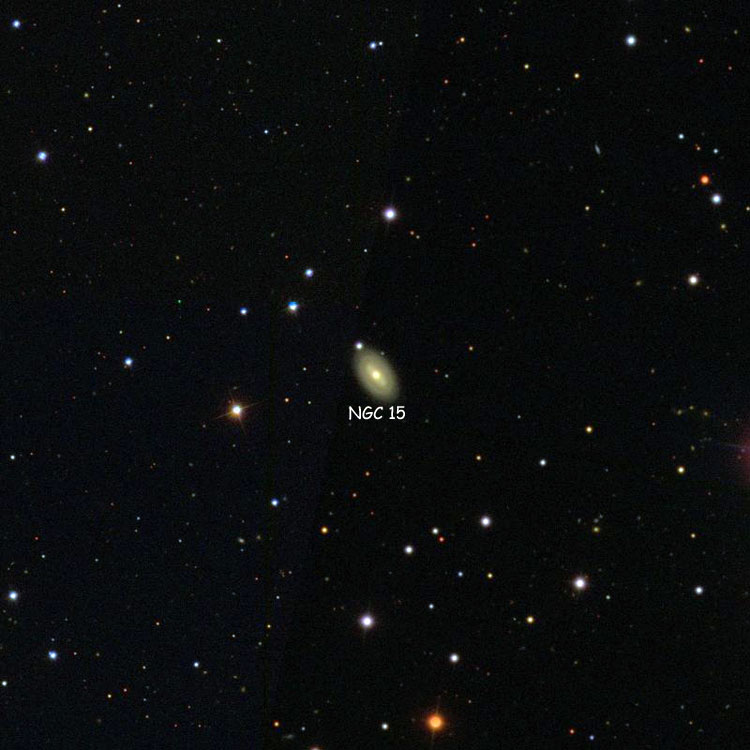
Above, a 12 arcmin wide SDSS image centered on NGC 15
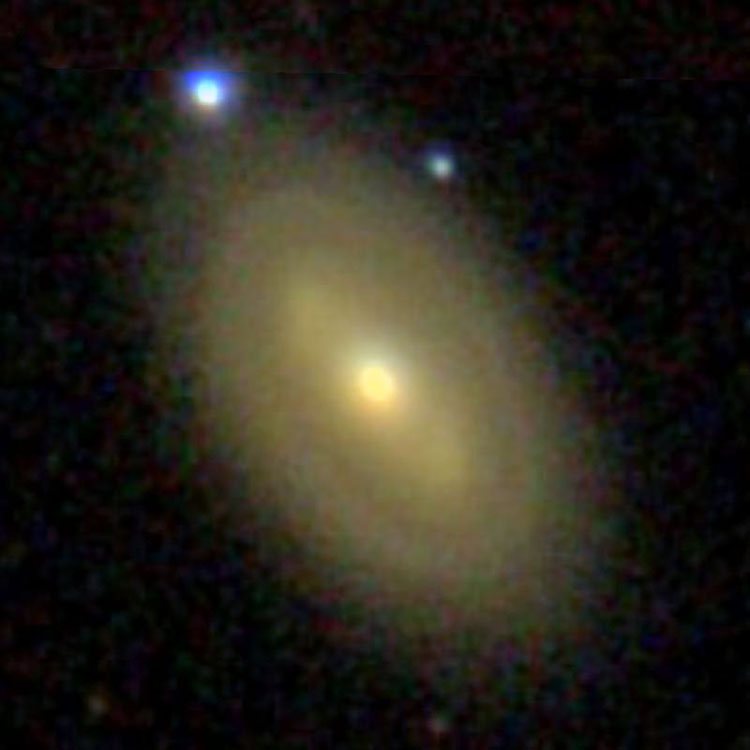
Below, a 1.2 arcmin wide SDSS image of the galaxy
NGC 16
(= PGC 660 = UGC 80 = CGCG 477-061 = CGCG 478-033 = MCG +04-01-032)
Discovered (Sep 8, 1784) by William Herschel
Also observed (Sep 5, 1828) by John Herschel
Also observed (Aug 22, 1862) by Heinrich d'Arrest
A magnitude 12.0 lenticular galaxy (type E/SAB0?) in Pegasus (RA 00 09 04.3, Dec +27 43 46)
Historical Identification: Per Dreyer, NGC 16 (= GC 8 = GC 12 = JH 4 = JH 5 = WH IV 15, 1860 RA 00 01 52, NPD 63 03.0) is "pretty bright, small, round, brighter middle". The equivalence of GC 8 (= JH 4) and GC 12 (= JH 5) is discussed in a note at the end of the NGC: "(John Herschel's) h5 (= GC 12) was not seen by d'Arrest and Stephan (per a note in his list XIII); it is = h4 (= GC 8) as they were observed in different sweeps." The position precesses to (2000) RA 00 09 04.6, Dec +27 43 46, almost dead center on the galaxy listed above, so the identification is certain.
Discovery Notes: When John Herschel published his General Catalog he listed GC 8 as JH 4 and GC 12 as JH 5, and assumed the latter was equal to WH IV 15. However, d'Arrest equated JH 4 with WH IV 15, and stated that the position of JH 5 was certainly erroneous (per a failure to observe it on Sep 30, 1861), though as critiqued by JH, d'Arrest failed to record a position that could justify that claim (not that d'Arrest could have given a position if he couldn't find the object). On Oct 2, 1882, while observing what became NGC 22, Édouard Stephan concluded that GC 12 (= JH 5) was not in the published position, lending credence to d'Arrest's remarks. Sorting things out for the NGC in 1887, Dreyer decided that JH 4 = JH 5 = WH IV 5 as shown above, and in his 1912 analysis of William Herschel's observations Dreyer stated that WH IV 5 was certainly JH4 (= NGC 16), but with a 1 minute 20 seconds of time error in the right ascension, probably due at least in part to a 1 minute of time error in recording the right ascension. Adding further confusion to the century-old discussion, in 2014 Steinicke suggested that JH 5 and WH IV 15 are not observations of NGC 16, but of some faint star or perhaps even NGC 22. However, as discussed in the lengthy analysis below that suggestion is certainly wrong; and in any event the identification of NGC 16 as PGC 660 is unaffected by any discussion of JH 5 and WH IV 5. So if you want, you can skip that discussion by clicking here.
Analysis of John Herschel's GC 8 = JH 4: John Herschel's GC lists GC 8 = JH 4 as "pretty bright, small, round, brighter middle", with a position of (1860) RA 00 01 52.1, NPD 63 03 27.5, which precesses to (2000) RA 00 09 04.7, Dec +27 43 18, less than half an arcmin south of the center of PGC 660 and within its southern outline, so the identification of GC 8 (and NGC 16) with that object is certain. And since JH 4 is the earlier of the two observations in question, its date of observation (Sep 5, 1828) is the correct one for John Herschel's first observation of NGC 16, regardless of the status of JH 5.
Analysis of William Herschel's IV 15: Per William Herschel's first catalog of 1000 nebulae and clusters, WH IV 15 was observed on Sep 8, 1784 as "Stellar, or rather like a faint star with a small chevelure and 2 burs. Faint, small," at a position 2m 6s east and 1° 21' south of 21 (α) Andromedae, or Alpheratz. However, Dr. Corwin has provided me with a copy of the last five observations Herschel took on the night in question, from a "fair copy" made by his sister, Caroline Herschel. That shows that he actually recorded offsets of 2m 6s east and 1° 23' south of 21 Andromeda, and adds other items of interest. Specifically, he noted the rising of the nearly last quarter Moon about half an hour before he stopped observing (because even at that phase the Moon's light would make it difficult to see the faintest objects visible under dark-sky conditions, and the last thing he observed was the very faint object listed as WH IV 15). In the interim Herschel observed three stars: a 7th magnitude star, 21 Andromedae and 85 Pegasi. Since the positions of 21 And and 85 Peg are known, they can both be used to calculate the position of WH IV 15, and in the process provide some information about how consistent Herschel's measurements were on the night in question.
Calculations Using 21 Andromedae: For 21 Andromedae the offsets are 2m 6s east and 1° 23' south. The modern position of Alpheratz is RA 00 08 23.3, Dec +29 05 26, with proper motions of +0.13746"/year in right ascension and -0.16344"/year in declination. This means that in 1784 its J2000 position was 2.0s west and 35" north of its present position, or at RA 00 08 21.3, Dec +29 06 01. This precesses to (1784) RA 23 57 15.7, Dec +27 53 51, and applying Herschel's offsets for IV 15, whatever he observed should be located near (1784) RA 23 59 21.7, Dec +26 30 51. This precesses to (2000) RA 00 10 28.6, Dec +27 43 00, in a completely stellar region about 1m 24s east and 0.8 arcmin south of NGC 16, and about 40s east and 7 arcmin south of NGC 22.
Calculations Using 85 Pegasi, and a Comparison of the Results: For 85 Pegasi, the offsets for IV 15 are 8m 18s east and 34' north. The modern position of 85 Pegasi is RA 00 02 10.2, Dec +27 04 56, with proper motions of +0.78022"/year in right ascension and -0.91775"/year in declination, meaning that in 1784 its J2000 position was 11.2s west and 3' 7" north of its present position, or at RA 00 01 59.0, Dec +27 08 03. This precesses to (1784) RA 23 50 57.5, Dec +25 55 54, and applying Herschel's offsets, whatever he observed should be located near (1784) RA 23 59 15.5, Dec +26 29 54. This precesses to (2000) RA 00 10 22.2, Dec +27 42 03, only a few seconds of time and an arcmin away from the position obtained from comparison with 21 Andromedae, and since William Herschel only recorded right ascensions to the nearest tenth of a minute of time and declinations to the nearest arcmin, errors of up to 0.2 minutes of right ascension and 2 arcmin of declination could be recorded even if the observations themselves were absolutely perfect. As an example, consider the 7th-magnitude star recorded by Herschel 1.5 minutes before 85 Pegasi, at an NPD 15' south of that star. That must be the magnitude 6.5 star HD 224758, which had a position in 1784 (using similar methods of calculation and rounding to the same accuracy as Herschel's measurements) 1.5 minutes west and 13' south of 85 Pegasi, within the range of rounding errors stated above, verifying that for all practical purposes the position of WH IV 15 is exactly the same regardless of which comparison star is used.
Analysis of John Herschel's GC 12 = JH 5 (declared = WH IV 15 in the GC): John Herschel's GC lists GC 12 = JH 5 = WH IV 15 as "very faint, very small, stellar" with a position of (1860) RA 00 03 14.6, NPD 63 04 58.5, which precesses to (2000) RA 00 10 27.8, Dec +27 41 46, in the same completely stellar region as the elder Herschel's positions, and less than an arcmin from the average position (RA 00 10 25.4, Dec +27 42 31) of the two values for WH IV 15 calculated above, making its position exactly the same to the accuracy of the earlier observations. So there can be no doubt that JH 5 = WH IV 15, as stated in the GC.
So What Is GC 12 = JH 5 = WH IV 15?: NGC 16 and NGC 22 are the only objects reasonably close to the positions obtained above, so one of those galaxies is almost certainly what the Herschels observed. And the answer is almost certainly NGC 16, since its declination is almost exactly the same as that measured by the Herschels, while NGC 22 is over 7 arcmin to the north, which is a far less likely error than a minute or so of right ascension in historical observations, and NGC 16 is far brighter. Although the listed luminosities of NGC 16 and 22 only differ by a factor of four, that includes the faint outer regions only visible in photographs. For visual observers only the bright core is visible, and the large bright core of NGC 16 is many times brighter than the much smaller, fainter core of NGC 22. In fact, there is considerable doubt whether William Herschel could have seen NGC 22 even under the best of conditions, let alone in the growing light accompanying the nearly quarter Moon rising in the eastern sky. So we are left with three options: (1) Assume that GC 12 represents an observation of a nonexistent object, despite the fact that the Herschels' essentially identical positions suggest they must have seen something, (2) assume that GC 12 represents an observation of NGC 22, despite the fact that it was probably just as hard for them to see as a nonexistent object and the large error in declination is hard to accept, or (3) assume as Dreyer did that GC 12 = GC 8 = NGC 16. Given these choices neither Corwin nor I see any reason to abandon Dreyer's suggestion, and feel reasonably comfortable accepting the probable fact that GC 12 is simply one of many examples in which the Herschels misrecorded the right ascension of an object.
Physical Information: Based on a recessional velocity of 3100 km/sec (and H0 = 70 km/sec/Mpc), NGC 16 is about 145 million light-years away, in fair agreement with redshift-independent distance estimates of 105 to 120 million light-years. Given that and its apparent size of about 2.3 by 1.3 arcmin (from the images below), it is about 95 to 100 thousand light-years across. NGC 16 appears to be a completely isolated galaxy, at least 20 million light-years from any other galaxy of significant size.
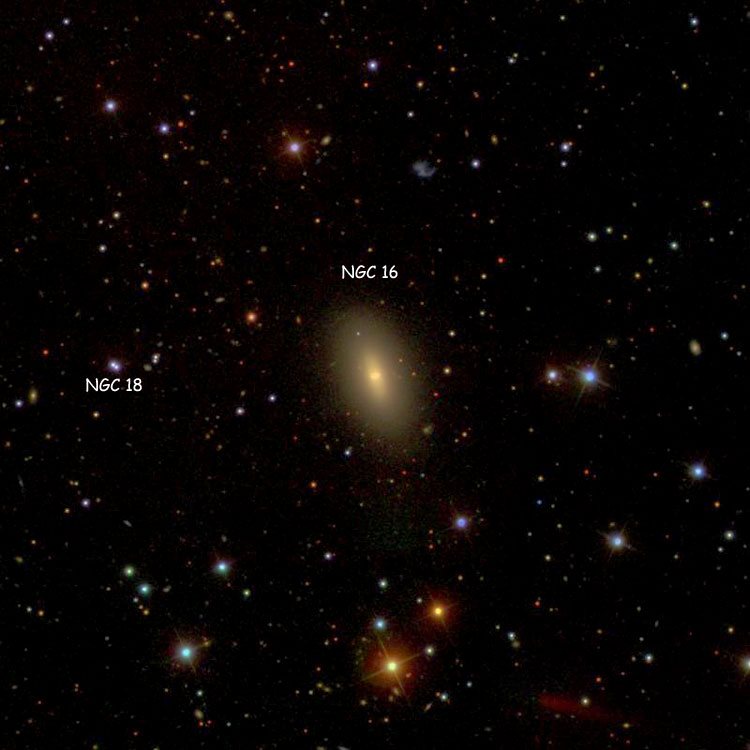
Above, a 12 arcmin wide SDSS image centered on NGC 16, also showing the double star listed as NGC 18
Below, a 2.6 arcmin wide SDSS image of the galaxy

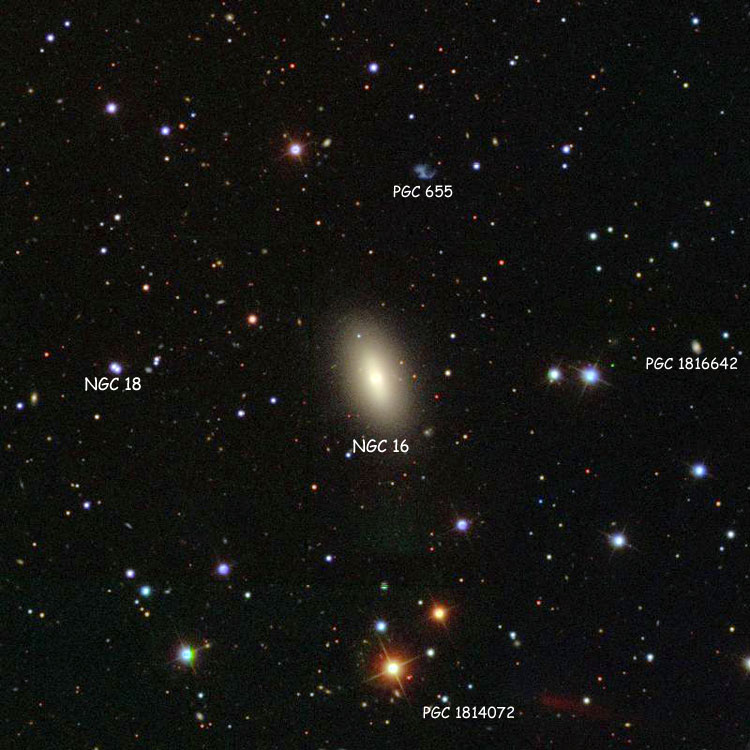
Below, a 12 arcmin wide SDSS image centered on NGC 16
Also shown are NGC 18, PGC 655 and PGC 1814072 and 1816642
NGC 17 (= NGC 34)
(= PGC 781 = MCG -02-01-032)
Discovered (1886) by Frank Muller (and later listed as NGC 17)
Discovered (Nov 21, 1886) by Lewis Swift (and later listed as NGC 34)
Also observed (Jul 1, 1899 to Jun 30, 1900) by Herbert Howe (proving NGC 17 = NGC 34)
A magnitude 14.4 spiral galaxy (type S? pec) in Cetus (RA 00 11 06.6, Dec -12 06 28)
Historical Identification: Per Dreyer, NGC 17 (Muller list II (#276), 1860 RA 00 01 58, NPD 102 54.0) is "very faint, extremely small, irregularly round, double star 2 arcmin to west". The position precesses to (2000) RA 00 09 07.3, Dec -12 07 14, which is 2 minutes of right ascension (about half a degree) west and nearly an arcmin south of the galaxy listed above, but (per Howe) the double star two arcmin west of the galaxy firmly establishes its identity with NGC 34 (which see for a discussion of the double listing).
Note About A Supposed Companion: In lower-quality images the northwestern cloud of stars torn away from the galaxy looks like it might be a faint companion, and it is listed as such in Corwin's table of positions for NGC objects; but as the HST images below show, the "companion" is only an extended cloud.
Physical Information: Based on a recessional velocity of 5880 km/sec (and H0 = 70 km/sec/Mpc), NGC 17 is about 270 to 275 million light-years away. Given that and its apparent size of about 0.75 by 0.6 arcmin for the central galaxy and its northwestern extension, about 1.7 by 0.6 arcmin including its bright northern tail and about 2.5 by 0.7 arcmin including the much fainter southern tail (all sizes from the images below), the central region is about 60 thousand light-years across, the northern tail is about 85 to 90 thousand light-years long, the southern tail is about 60 to 65 thousand light-years long, and the entire structure spans about 200 thousand light-years. NGC 17 is the result of a collision between two (presumably) spiral galaxies. The galaxies appear to have nearly completed their merger, as the central region contains only one nucleus, but long tails of stars scattered into intergalactic space and moderate starburst activity near the center of the merged galaxy give ample testament to the collision. Note: NGC 17 and 35 are only a few arcmin apart, and given their apparently common distance may be less than half a million light-years apart. If so, they could be gravitationally bound.

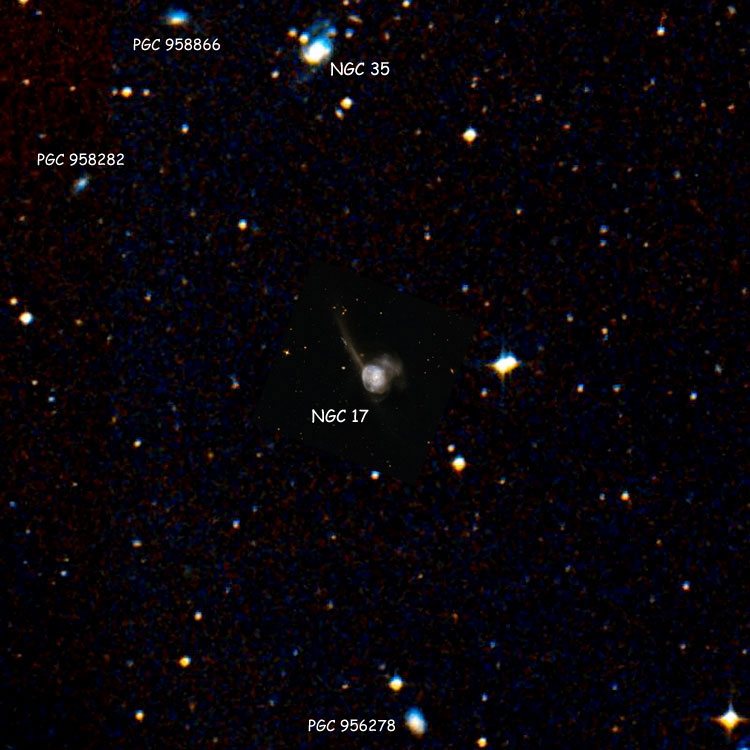
Above, a 12 arcmin wide DSS image centered on NGC 17, also showing NGC 35
(NGC 17 is shown by an overlay of the HST images below, which see for credits)
Below, a 1.8 by 2.6 arcmin wide exaggerated-contrast HST image of NGC 17 and its tails

Below, a 1 by 2 arcmin wide image of the bright tail and core of the galaxy, rotated to show greater detail
(Credit for all versions of the HST image: NASA, ESA, the Hubble Heritage (STScI/AURA)-ESA/Hubble Collaboration,
and A. Evans (University of Virginia, Charlottesville/NRAO/Stony Brook University), HubbleSite)

Below, a 0.75 arcmin wide HST view of the central galaxy, with normal orientation (Image Credit as above)

Below, a 12 arcmin wide DSS image centered on NGC 17, overlaid by an HST image of the galaxy
Also shown are NGC 35 and PGC 956278, 958282, and 958866
NGC 18
(= "PGC 5067692")
Recorded (Oct 15, 1866) by Herman Schultz
Looked for (Oct 2, 1882) but not found by Édouard Stephan
Also observed (Nov 18, 1886) by Guillaume Bigourdan
A magnitude 13.4 and 13.6 double star in Pegasus (RA 00 09 23.1, Dec +27 43 55)
Historical Identification: Per Dreyer, NGC 18 (= GC 5085, Schultz (Nova I), 1860 RA 00 02 11, NPD 63 02.8) is "faint, very small, irregularly round, much brighter middle, h 4 19s to west", (JH) 4 being NGC 16 (which see for an image of NGC 18). A note at the end of the NGC indicates the likelihood that the object was not nebulous: "18: GC 5085, nova Schultz. Not seen by Stephan (list XIII (Remark 1)); does not occur in d'Arrest's nor in Lord Rosse's observations." (Rosse or his assistants observed Schultz's Nova II = GC 6 = NGC 29 in 1857 and 1867, but made no mention of Schultz' Nova I.) Though not mentioned by Dreyer, Bigourdan did see the object, but declared it merely stellar (which it is). The NGC position precesses to (2000) RA 00 09 23.7, Dec +27 43 58, within 0.1 arcmin of the pair of stars listed above, and NGC 16 lies 18 seconds to the west, so the identification is certain.
Discovery Note: Stephan's list XIII Remark 1 states that not only GC 5085 (= NGC 18) was not in the GC position, but also GC 12 (= JH 5 = NGC 16). The date shown for his failure to observe either object is based on the fact that he found NGC 22 on the same night that he failed to observe the other objects.
Note About PGC Designation: As for most NGC objects, LEDA assigns a PGC designation for this entry even though it is not a galaxy. However, a search of the database for that designation returns no result, so it is shown in quotes.

Above, a 12 arcmin wide SDSS image centered on NGC 18, also showing NGC 16 and part of NGC 22
NGC 19
(= PGC 759 = UGC 98 = CGCG 499-065 = MCG +05-01-046)
Discovered (Sep 20, 1885) by Lewis Swift
A magnitude 13.3 spiral galaxy (type SB(rs)bc?) in Andromeda (RA 00 10 40.9, Dec +32 58 59)
Historical Identification: Per Dreyer, NGC 19 (Swift list II (#4), 1860 RA 00 02 13, NPD 57 55.6) is "most extremely faint, a little extended, 3 very faint stars around". The position precesses to (2000) RA 00 09 26.3, Dec +32 51 09, but there is nothing there. However, as noted in the discussion of NGC 6, this is one of several galaxies discovered by Swift on the same night which mostly share an average error of 70 seconds of time too far west and 8' 12" too far south. Applying that correction, Swift's position for his II-4 precesses to (2000) RA 00 10 36.8, Dec +32 59 23, less than an arcmin west northwest of the galaxy listed above, and Swift's detailed description of the star field, "in center of 3 very faint stars forming an equilatoral ( sic) triangle, two of them double", exactly matches the nearby stars, so the identification is certain.
Note About Confusion With NGC 21: NGC 21 is almost due north of NGC 19, and Swift's incorrect declination for NGC 21 lies about halfway between them. Unfortunately, several catalogs rapidly put together in the 1970's misidentified the southern galaxy as NGC 21. It was only fairly recently that studies of the original observations of NGC objects showed that the southern galaxy was actually NGC 19. So although almost all modern references have corrected the error, a warning about a possible misidentification of NGC 19 as NGC 21 is still appropriate.
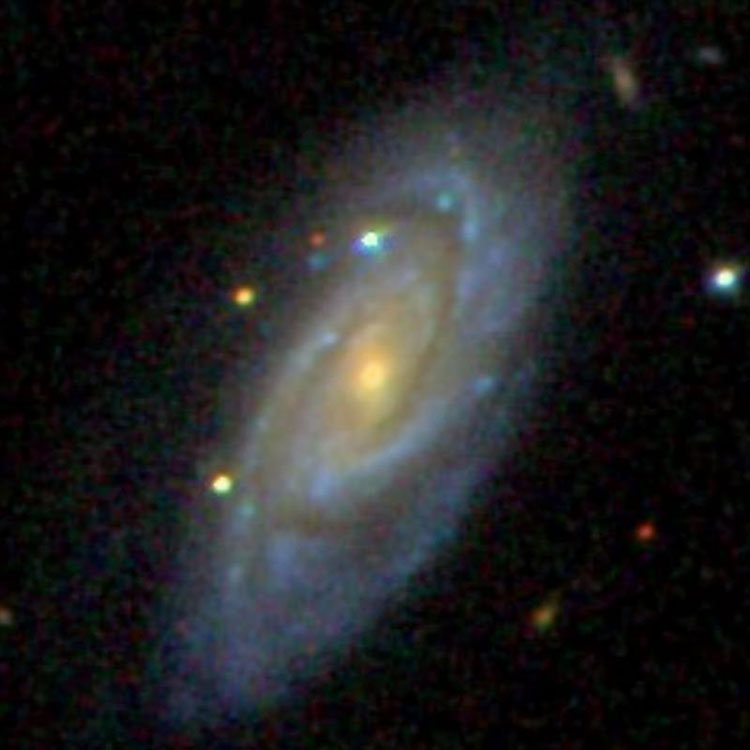
Physical Information: Based on a recessional velocity of 4790 km/sec (and H0 = 70 km/sec/Mpc), NGC 19 is about 220 to 225 million light-years away, in good agreement with redshift-independent distance estimates of 185 to 235 million light-years. Given that and its apparent size of about 1.15 by 0.6 arcmin (from the images below), it is about 75 thousand light-years across.

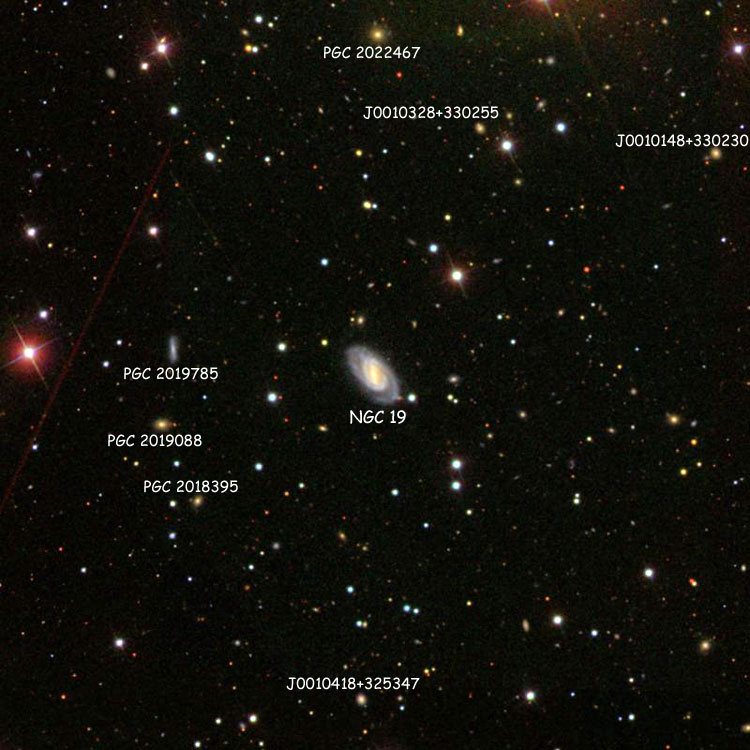
Above, a 12 arcmin wide SDSS image centered on NGC 19
Below, a 1.2 arcmin wide SDSS image of the galaxy

Below, a 12 arcmin wide SDSS image centered on NGC 19, showing a number of fainter galaxies,
including PGC 2018395, 2019088, 2019785 and 2022467
NGC 20 (= NGC 6)
(= PGC 679 = UGC 84 = CGCG 498-082 = CGCG 499-054 = MCG +05-01-036)
Discovered (Sep 18, 1857) by R. J. Mitchell (and later listed as NGC 20)
Also observed (Oct 16, 1866) by Herman Schultz (and later listed as NGC 20)
Recorded (Sep 20, 1885) by Lewis Swift (and later listed as NGC 6)
A magnitude 13.1 lenticular galaxy (type E/S0?) in Andromeda (RA 00 09 32.7, Dec +33 18 31)
Historical Identification: Per Dreyer, NGC 20 (= GC 6 = GC 5086, 3rd Lord Rosse, Schultz (Nova II), 1860 RA 00 02 21, NPD 57 28.2) is "faint, 10th magnitude star attached". The position precesses to (2000) RA 00 09 34.4, Dec +33 18 34, only 2 seconds of time east of the center of the galaxy listed above, between the galaxy and the 10th magnitude star that lies almost in front of it, so the identification is certain.
Note About The Duplicate Entry With NGC 6: As noted in the discussion of NGC 6, Swift had a large positional error for several objects observed by him on Sep 20, 1885, so Dreyer had no reason to believe that Swift's and Mitchell's objects were were in any way related, leading to duplicate entries for what turned out to be the same object. In such a case, the lower NGC number is usually given preference; but since the identification of NGC 6 as a duplicate entry for NGC 20 was long-delayed, PGC 679 is referred to as NGC 20 about as often as NGC 6.
Discovery Notes: Although Dreyer credits the discovery to William Parsons, 3rd Earl of Rosse, he notes that many of Rosse's nebular discoveries were actually made by one of his assistants, in this case R. J. Mitchell.
Physical Information: Based on a recessional velocity of 4970 km/sec (and H0 = 70 km/sec/Mpc), NGC 20 is about 230 to 235 million light-years away. Given that and its apparent size of about 1.9 by 1.5 arcmin (from the images below), it is about 125 to 130 thousand light-years across.
Above, a 12 arcmin wide SDSS image centered on NGC 20
Below, a 2.4 arcmin wide SDSS image of the galaxy

Below, a 12 arcmin wide SDSS image centered on NGC 20;
also shown are PGC 212477, 2026460 and 2027085

NGC 21 (= NGC 29)
(= PGC 767 = UGC 100 = CGCG 499-066 = MCG +05-01-048)
Discovered (Nov 26, 1790) by William Herschel (and later listed as NGC 29)
Also observed (Nov 11, 1827) by John Herschel (and later listed as NGC 29)
Recorded (Sep 20, 1885) by Lewis Swift (and later listed as NGC 21)
A magnitude 12.7 spiral galaxy (type SAB(s)bc?) in Andromeda (RA 00 10 46.9, Dec +33 21 10)
Historical Identification: Per Dreyer, NGC 21 (Swift list II (#5), 1860 RA 00 02 25, NPD 57 34.1) is "extremely faint, small, a little extended". Swift's position precesses to (2000) RA 00 09 38.5, Dec +33 12 39, but there is nothing there. However, as noted in the discussion of NGC 6, this is one of several galaxies discovered by Swift on the same night which mostly share an average error of 70 seconds of time too far west and 8' 12" too far south. Applying that correction, Swift's position for his II-5 precesses to (2000) RA 00 10 48.9, Dec +33 20 53, on the southeastern rim of the galaxy listed above and the description fits, so the identification is considered certain. The duplicate entry is due to the fact that with such a large error in Swift's position, there was no way for Dreyer to realize that it was an observation of a previously discovered nebula.
Note About Frequent Confusion With NGC 19: NGC 21 is almost due north of NGC 19, and Swift's incorrect declination for NGC 21 lies about halfway between them. Unfortunately, several catalogs rapidly put together in the 1970's misidentified the southern galaxy as NGC 21. It was only fairly recently that studies of the original observations of NGC objects showed that the southern galaxy was actually NGC 19. So although almost all modern references have corrected the error, a warning about a possible misidentification of NGC 19 as NGC 21 is still appropriate.
Physical Information: Based on a recessional velocity of 4770 km/sec (and H0 = 70 km/sec/Mpc), NGC 21 is about 220 to 225 million light-years away, in good agreement with redshift-independent distance estimates of 200 to 270 million light-years. Given that and its apparent size of about 1.65 by 0.75 arcmin (from the images below, counting the faint extension of the eastern spiral arm), it is about 105 to 110 thousand light-years across.

Above, a 12 arcmin wide SDSS image centered on NGC 21
Below, a 1.6 arcmin wide SDSS image of the galaxy
NGC 22
(= PGC 690 = UGC 86 = CGCG 499-055 = MCG +05-01-039)
Not observed (Sep 8, 1784) by William Herschel (see NGC 16)
Also not observed (Sep 5, 1828) by John Herschel (see NGC 16)
Discovered (Sep 28, 1867) by Édouard Stephan (but not listed)
Re-observed (Oct 2, 1883) by Édouard Stephan (and later listed as NGC 22)
A magnitude 13.6 spiral galaxy (type Sb?) in Andromeda (RA 00 09 48.2, Dec +27 49 56)
Historical Identification: Per Dreyer, NGC 22 (Stephan list XIII (#1), 1860 RA 00 02 36, NPD 62 56.9) is "very faint, pretty small, round, a little brighter middle, mottled but not resolved". The position precesses to (2000) RA 00 09 48.9, Dec +27 49 52, within 0.2 arcmin of the center of the galaxy listed above and well within its outline, so the identification is certain.
Discovery Notes: When John Herschel published his General Catalog, GC 8 was listed as JH 4 and GC 12 was listed as JH 5 and WH IV 15; and ever since Dreyer published the NGC it was assumed that GC 12 = GC 8 = NGC 16 (as discussed in detail in the entry for NGC 16). However, in 2014 Steinicke suggested that JH 5 and WH IV 15 are not observations of NGC 16, but of some faint star or perhaps even NGC 22. As discussed in the entry for NGC 16 that is incorrect, so this note serves as a warning to ignore any suggestion that the Herschels had anything to do with the discovery of NGC 22.
Discovery Note: Stephan's date of discovery based on his published data is Oct 2, 1883, which represents the date when he made what he considered an adequate micrometric measurement; but based on Stephan's original notes, Yann Pothier has shown that he actually made his first observation of what became NGC 22 on Sep 28, 1867, as shown above.
Physical Information: Based on a recessional velocity of 8310 km/sec (and H0 = 70 km/sec/Mpc), a straightforward calculation indicates that NGC 22 is about 385 to 390 million light-years away, in good agreement with redshift-independent distance estimates of 335 to 435 million light-years. However, for objects at such distances we should take into account the expansion of the Universe during the time it took their light to reach us. Doing that shows that the galaxy was about 375 million light-years away at the time the light by which we see it was emitted, about 380 million years ago (the difference between the two numbers being due to the expansion of the intervening space during the light-travel time). Given that and its apparent size of about 1.6 by 1.0 arcmin (from the images below), the galaxy is about 175 thousand light-years across.

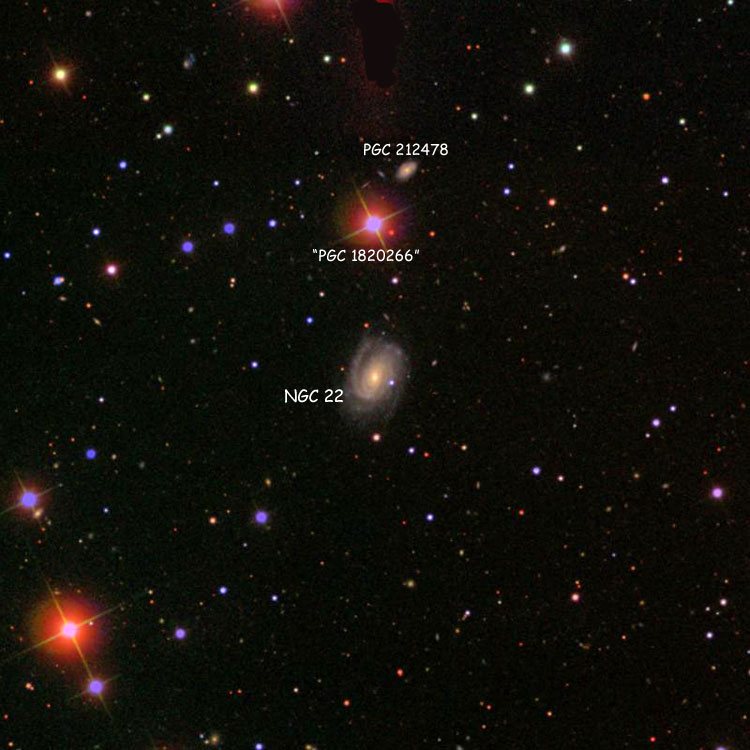
Above, a 12 arcmin wide SDSS image centered on NGC 22
Below, a 2.0 arcmin wide SDSS image of the galaxy

Below, a 12 arcmin wide SDSS image centered on NGC 22, also showing PGC 212478 and 1820266
NGC 23
(= PGC 698 = UGC 89 = CGCG 477-062 = CGCG 478-034 = MCG +04-01-033)
Discovered (Sep 10, 1784) by William Herschel
A magnitude 12.0 spiral galaxy (type SB(rs)ab?) in Pegasus (RA 00 09 53.4, Dec +25 55 26)
Historical Identification: Per Dreyer, NGC 23 (= GC 9 = WH III 147, 1860 RA 00 02 41, NPD 64 51.0) is "3 small stars plus nebulosity". The position precesses to (2000) RA 00 09 53.7, Dec +25 55 46, only 0.3 arcmin north of the center of the galaxy listed above and well within its outline, so the identification is certain.
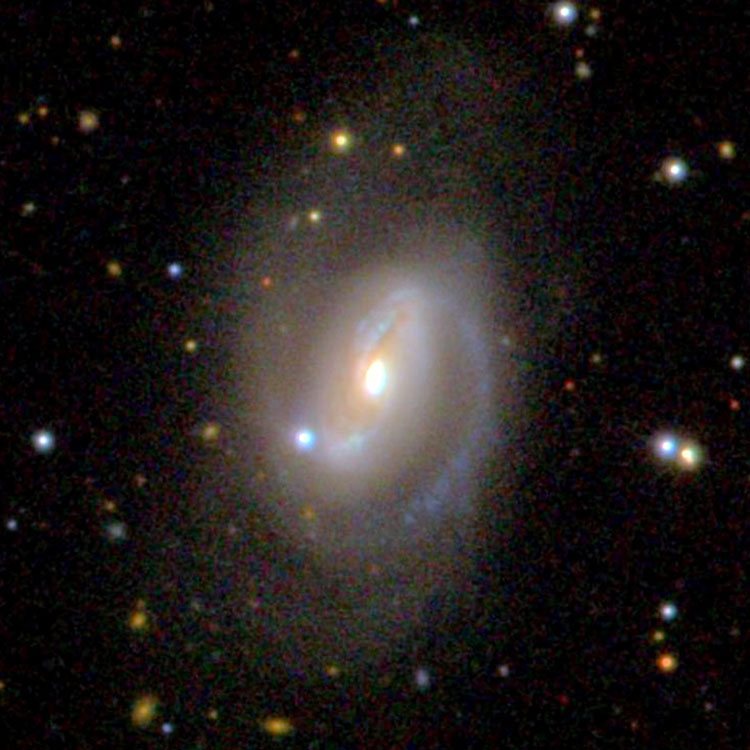
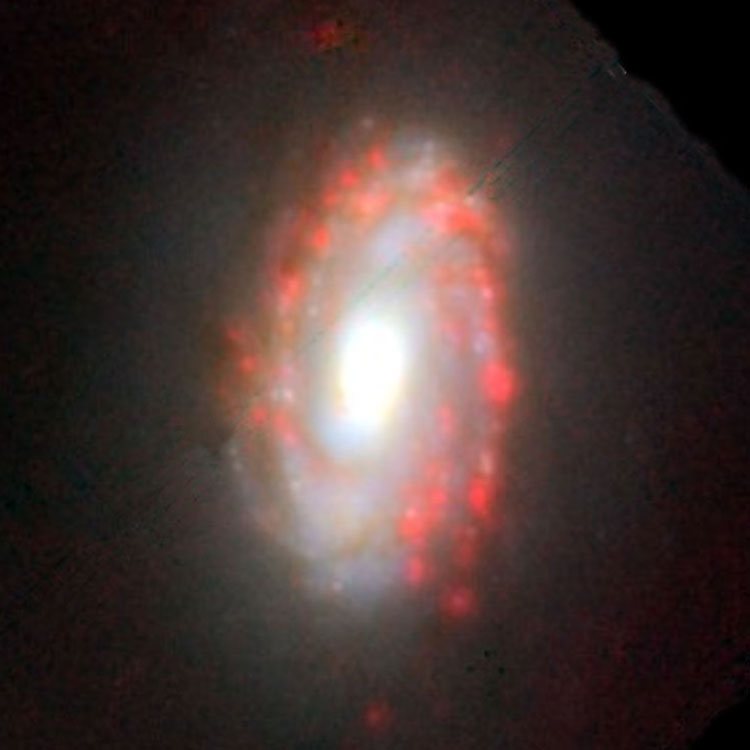
Physical Information: Based on a recessional velocity of 4565 km/sec (and H0 = 70 km/sec/Mpc), NGC 23 is about 210 to 215 million light-years distant, in good agreement with redshift-independent distance estimates of 175 to 210 million light-years. Given that and its apparent size of about 3.1 by 1.65 arcmin (from the images below), it is about 190 to 195 thousand light-years across. NGC 23 is listed as a starburst galaxy.

Above, a 12 arcmin wide SDSS image centered on NGC 23
Below, a 3.5 arcmin wide SDSS image of the galaxy
Below, a 14 arcsec wide HST image of the active core of the galaxy (Image Credit Hubble Legacy Archive)
Below, a 12 arcmin wide SDSS image centered on NGC 23, also showing PGC 1754508 and 1757813
A distant cluster of galaxies lies to the southeast, but its faint members are not listed in most catalogs

NGC 24
(= PGC 701 = UGCA 2 = ESO 472-016 = MCG -04-01-018)
Discovered (Oct 27, 1785) by William Herschel
Also observed (Sep 12, 1836) by John Herschel
A magnitude 11.6 spiral galaxy (type SA(s)c?) in Sculptor (RA 00 09 56.3, Dec -24 57 49)
Historical Identification: Per Dreyer, NGC 24 (= GC 10 = JH 2308 = WH III 461, 1860 RA 00 02 47, NPD 115 45.0) is "very faint, considerably large, much extended, gradually brighter middle". The position precesses to (2000) RA 00 09 54.8, Dec -24 58 14, only 0.5 arcmin southwest of the center of the galaxy listed above and well within its outline, so the identification is certain.
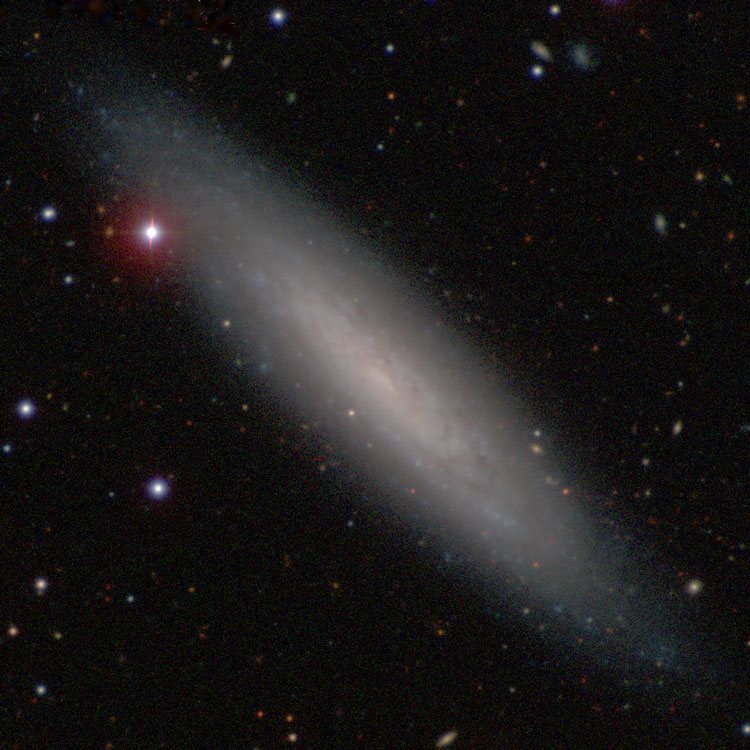
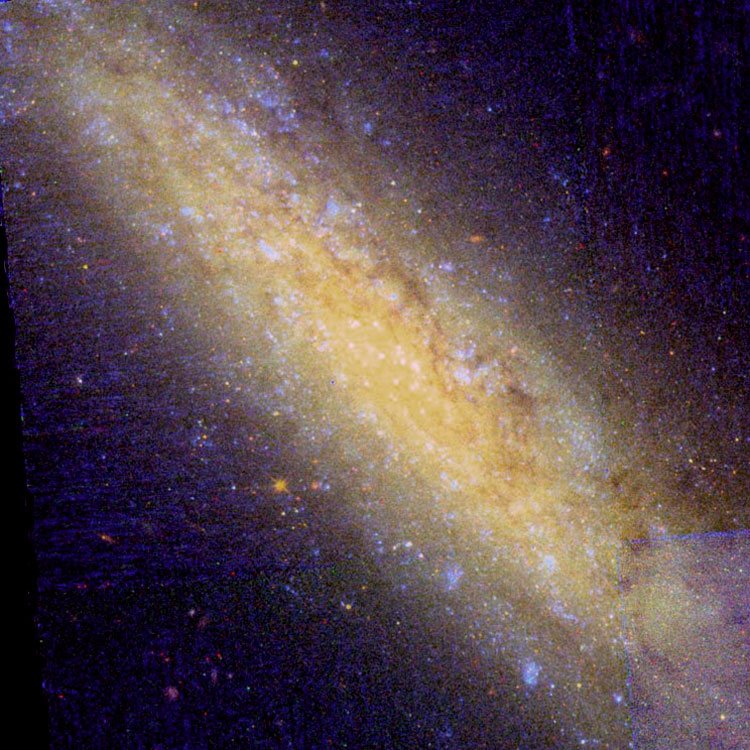
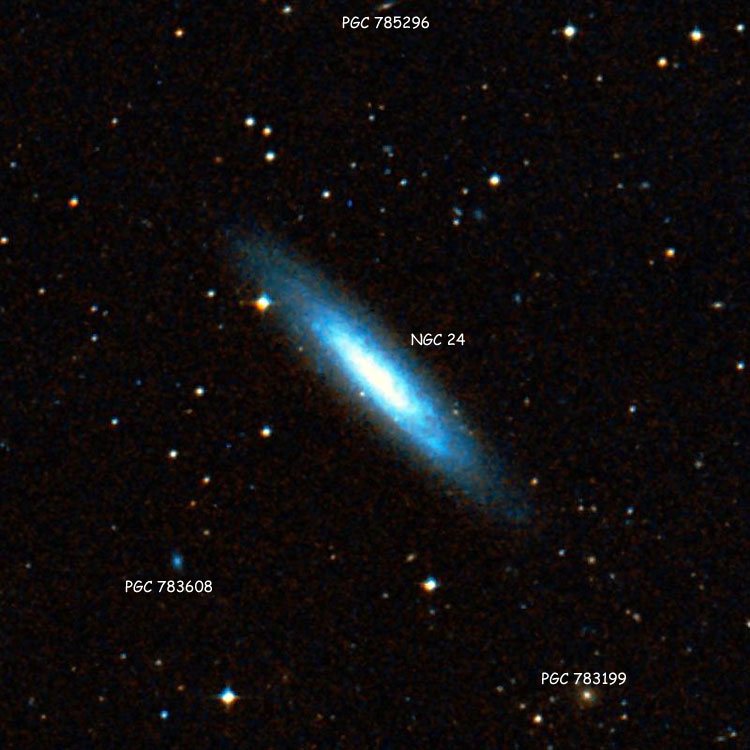
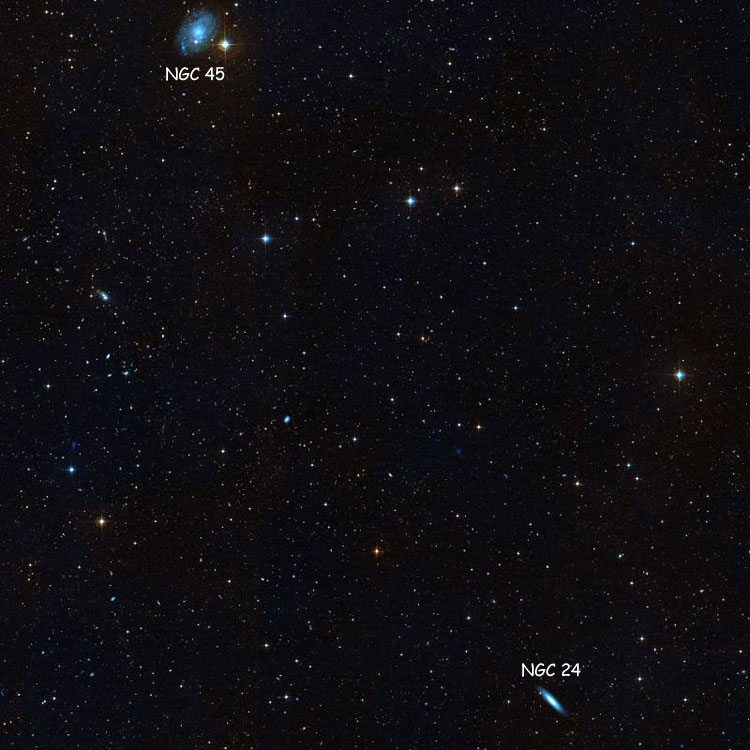
Physical Information: Based on a recessional velocity of 555 km/sec (and H0 = 70 km/sec/Mpc), NGC 24 is about 25 to 30 million light-years away, but for such distances peculiar (non-Hubble-redshift) velocities can significantly affect the accuracy of the distance estimate. Unfortunately, redshift-independent estimates range from as little as 3 million to as much as 35 million light-years, inspiring far less confidence. However, the galaxy's apparent size of about 6.9 by 1.5 arcmin (from the images below) makes most sense if its distance is in the 25 million light-year range, in which case it would be about 50 to 55 thousand light-years across. It has been suggested that NGC 24 and 45 are a pair, as they have similar recessional velocities and if at similar distances their two degree separation corresponds to less than a million light-years. The latter galaxy is more certainly about 25 million light-years away, so if they really are a pair it would confirm the estimate made in this entry; but both galaxies' distances are sufficiently uncertain that the suggestion that they are a pair cannot inspire much confidence. Update: The discussion of the 2.7 arcmin wide HST image below (released on Sep 26, 2016) states that the distance of the galaxy is about 25 million light-years, it is about 40 thousand light-years across, and about 80% of the mass of its halo is so-called "dark matter"; so the distance and size estimates in this entry appear to be more or less in agreement with most current thinking.

Above, a 12 arcmin wide DSS image centered on NGC 24
Below, a 6 arcmin wide image of the galaxy (Image Credit & © Carnegie-Irvine Survey; used by permission)
Below, a 2.7 arcmin wide HST image of the inner half of the galaxy (Image Credit ESA/Hubble & NASA)

Below, a 1.6 arcmin wide image of the central part of the galaxy (Image Credit Hubble Legacy Archive)
Below, a 12 arcmin wide DSS image centered on NGC 24, also showing PGC 783199, 783608 and 785296
Below, a 2 degree wide DSS image centered between possible companions NGC 24 and 45
(The image is centered at RA 00 00 12.0, Dec -24 06 00)
NGC 25
(= PGC 706 = ESO 149-019)
Discovered (Oct 28, 1834) by John Herschel
A magnitude 13.0 lenticular galaxy (type E/SB0? pec) in Phoenix (RA 00 09 59.2, Dec -57 01 15)
Historical Identification: Per Dreyer, NGC 25 (= GC 11 = JH 2309, 1860 RA 00 02 57, NPD 147 48.2) is "very faint, small, round". The position precesses to (2000) RA 00 09 59.1, Dec -57 01 26, within 0.2 arcmin of the center of the galaxy listed above and well within its outline, so the identification is certain.
Physical Information: Based on a recessional velocity of 9465 km/sec (and H0 = 70 km/sec/Mpc), a straightforward calculation indicates that NGC 25 is about 440 million light-years away. However, for objects at such distances we should take into account the expansion of the Universe during the time it took their light to reach us. Doing that shows that the galaxy was about 425 million light-years away at the time the light by which we see it was emitted, about 430 million years ago (the difference between the two numbers being due to the expansion of the intervening space during the light-travel time). Given that and its apparent size of about 2.0 by 1.3 arcmin (from the images below), it is about 245 to 250 thousand light-years across. The galaxy is the brightest member of Abell 2731, a rich cluster of galaxies with an average recessional velocity of 9350 km/sec and an apparent size of 35 arcmin (corresponding to a physical diameter for the cluster of more than 4 million light-years).
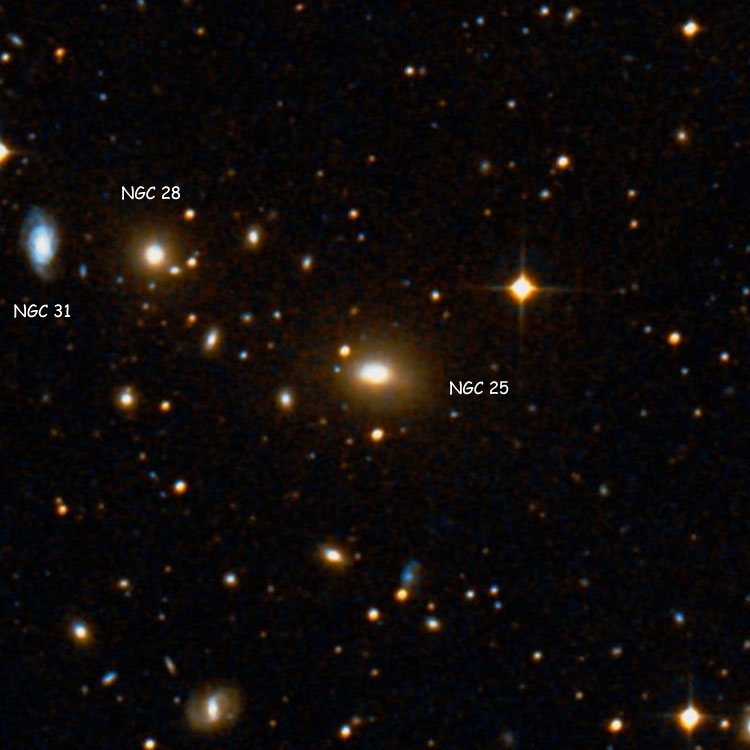
Above, a 12 arcmin wide DSS image centered on NGC 25, also showing NGC 28 and 31
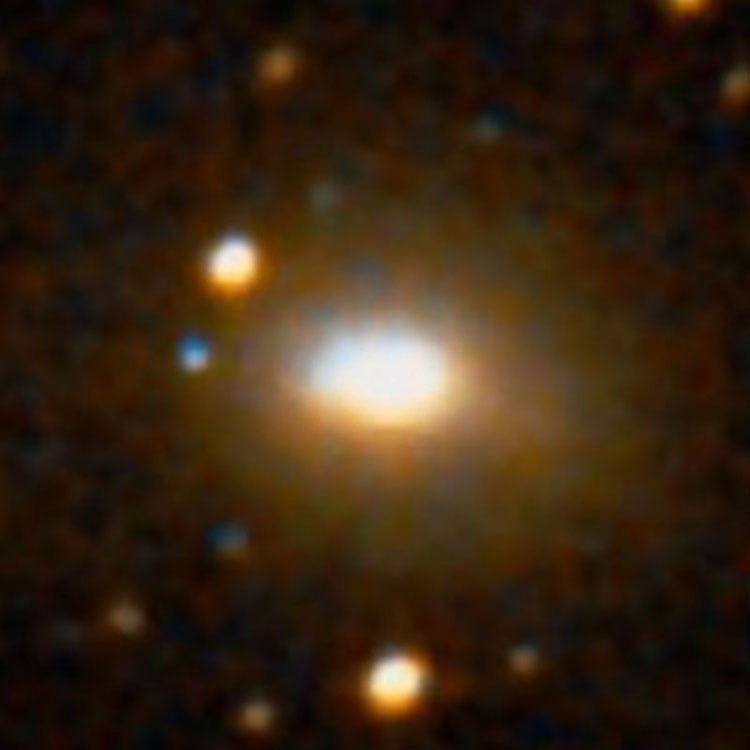
Below, a 2.4 arcmin wide DSS image of the galaxy
Below, a 12 arcmin wide DSS image centered on NGC 25, also showing NGC 28 and 31
Also shown are sixteen PGC objects

Below, a 6 arcmin wide DSS image of the region between NGC 25 and NGC 31
Also shown are NGC 28 and PGC 394783, 394784, 394941, 394997, 395139 and 395226

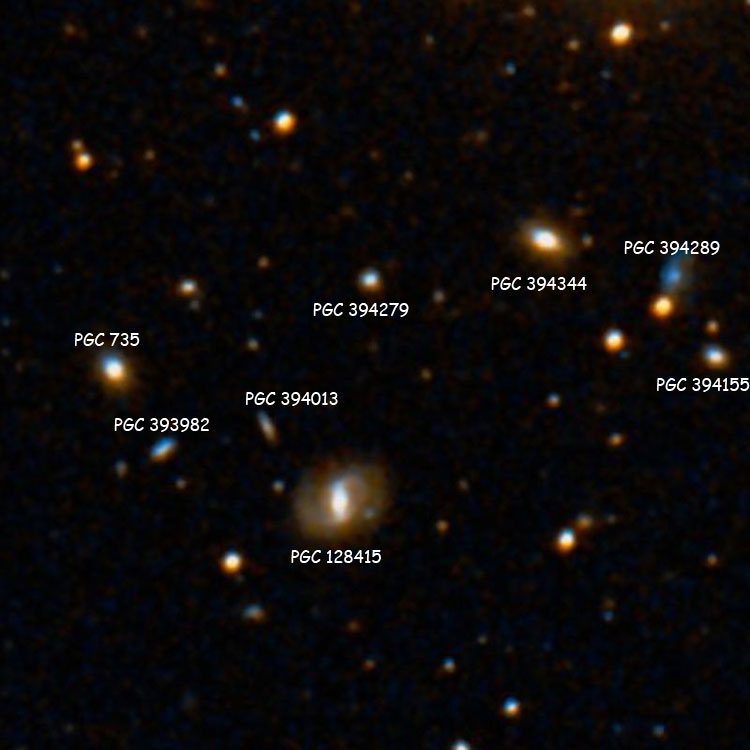
Below, a 6 arcmin wide DSS image showing objects to the southeast of NGC 25:
Galaxies labeled are PGC 735, 128415, 393982, 394013, 394155, 394279, 394289 and 394344
PGC 394344
Not an NGC object but listed here as an apparent companion of NGC 25
A magnitude 15.5(?) galaxy (type ?) in Phoenix (RA 00 10 04.3, Dec -57 04 09)
Physical Information:
LEDA B 16.0, I 13.9, (V) 15.5(?); NED mag 16.53 (no bandwidth given), Vr 11352 km/sec, 3K Vr 11196 km/sec, z 0.037344656448
Given the large difference in Vr, not an actual companion of NGC 25, but a background galaxy
PGC 394783
Not an NGC object but listed here as an apparent companion of NGC 25
A magnitude 16(?) galaxy (type ?) in Phoenix (RA 00 10 09.8, Dec -57 01 39)
Physical Information:
LEDA B 16.6, I 14.9, (V) 16(?); NED mag 17.17 (no bandwidth given), Vr 12178 km/sec, 3K Vr 12022 km/sec, z 0.04010163278
Given the large difference in Vr, not an actual companion of NGC 25, but a background galaxy
PGC 394784
Not an NGC object but listed here as a probable companion of NGC 25
A magnitude 15.5(?) galaxy (type ?) in Phoenix (RA 00 10 28.6, Dec -57 01 39)
Physical Information:
LEDA B 16.4, I 14.3, (V) 16(?); NED mag 16.85 (no bandwidth given), Vr 9286 km/sec, 3K Vr 9130 km/sec, z 0.030454636
Given the Vr, a possible (and indeed probable) companion of NGC 25
PGC 394941
Not an NGC object but listed here as a possible/probable companion of NGC 25
A magnitude 16(?) galaxy (type ?) in Phoenix (RA 00 10 18.6, Dec -57 00 42)
Physical Information:
LEDA B 16.7, I 14.7, (V) 16(?); NED mag 17.08 (no bandwidth given), Vr 9129 km/sec, 3K Vr 8973 km/sec, z 0.0299306
Given the Vr, a possible companion of NGC 25 (the difference in recessional velocities is large enough that any connection is speculative, but in clusters, "peculiar velocities" (random motions of galaxies relative to their neighbors) often exceed the difference, so there is a good chance that the galaxies are, even if not gravitationally bound, at least members of the same cluster).
PGC 395226
Not an NGC object but listed here as an apparent companion of NGC 25
A magnitude 16(?) galaxy (type ?) in Phoenix (RA 00 10 13.6, Dec -56 59 04)
Physical Information:
LEDA B 16.6, I 14.8, (V) 16(?); NED mag 17.24 (no bandwidth given), Vr 11089 km/sec, 3K Vr 10933 km/sec, z 0.0364686389
Given the large difference in Vr, not an actual companion of NGC 25, but a background galaxy
NGC 26
(= PGC 732 = UGC 94 = CGCG 477-064 = CGCG 478-036 = MCG +04-01-034)
Discovered (Sep 14, 1865) by Heinrich d'Arrest
A magnitude 12.9 spiral galaxy (type SA(rs)ab?) in Pegasus (RA 00 10 25.9, Dec +25 49 55)
Historical Identification: Per Dreyer, NGC 26 (= GC 5087, d'Arrest, 1860 RA 00 03 14, NPD 64 56.2) is "very faint, pretty large, round, 2 faint stars to north". The position precesses to (2000) RA 00 10 26.9, Dec +25 50 33, about 0.7 arcmin north northeast of the center of the galaxy listed above, near its northern edge, and there are two faint stars just north of it, so the identification is certain.
Physical Information: Based on a recessional velocity of 4590 km/sec (and H0 = 70 km/sec/Mpc), NGC 26 is about 210 to 215 million light-years away, in good agreement with redshift-independent distance estimates of 185 to 260 million light-years. Given that and its apparent size of about 2.25 by 1.25 arcmin (from the images below, including the faint extension of the western spiral arm), it is about 140 thousand light-years across.

Above, a 12 arcmin wide SDSS image centered on NGC 26
Below, a 2.5 arcmin wide SDSS image of the galaxy

NGC 27
(= PGC 742 = UGC 96 = CGCG 499-063 = MCG +05-01-044)
Discovered (Aug 3, 1884) by Lewis Swift
A magnitude 13.5 spiral galaxy (type Sbc?) in Andromeda (RA 00 10 32.8, Dec +28 59 46)
Historical Identification: Per Dreyer, NGC 27 (Swift list I (#1), 1860 RA 00 03 15, NPD 61 47.3) is "extremely faint, very small, extended, bright star near". The position precesses to (2000) RA 00 10 28.3, Dec +28 59 27, only an arcmin southwest of the galaxy listed above, and less than half an arcmin from its apparent companion, PGC 731. The bright star directly below PGC 742 makes the identification of NGC 27 with one of the two galaxies certain, and although Swift's position is closer to PGC 731 than PGC 742, the two magnitude difference in their brightness makes it certain that what Swift observed was the brighter galaxy.
Observational Note: Although the modern photographs below make it look like Swift could just as easily have seen both galaxies as only the brighter one, the fact that galaxies are much fainter as visual objects than stars makes it extremely unlikely that he could have seen the fainter one. To show how difficult (or even impossible) it would have been for Swift to see PGC 731, the last image for this entry is a simulation of the 33 arcmin field of view used by him, more nearly as seen visually than in a photograph. But even though Swift almost certainly could not see the fainter galaxy, since it is so obvious in modern photographs it is discussed immediately following this entry.
Physical Information: Based on a recessional velocity of 7035 km/sec (and H0 = 70 km/sec/Mpc), a straightforward calculation indicates that NGC 27 is about 325 to 330 million light-years away, in good agreement with redshift-independent distance estimates of 270 to 320 million light-years. However, for objects at such distances we should take into account the expansion of the Universe during the time it took their light to reach us. Doing that shows that the galaxy was about 315 to 320 million light-years away at the time the light by which we see it was emitted, about 320 to 325 million years ago (the slight difference between the two numbers being due to the expansion of the intervening space during the light-travel time). Given that and its apparent size of about 1.15 by 0.5 arcmin (from the images below), it is about 105 to 110 thousand light-years across.
NED lists a second recessional velocity measurement of 7850 km/sec, but that is undoubtedly a misassigned value for PGC 731, and a good example of why it is necessary to be careful in identifying galaxies by one designation or another. Although NGC 27 and PGC 731 appear to be close to each other, the fainter galaxy is probably 40 million light-years further away, making them merely an optical double.

Above, a 12 arcmin wide SDSS image centered on NGC 27, also showing PGC 731
Below, a 1.2 arcmin wide SDSS image of PGC 742 (= NGC 27)

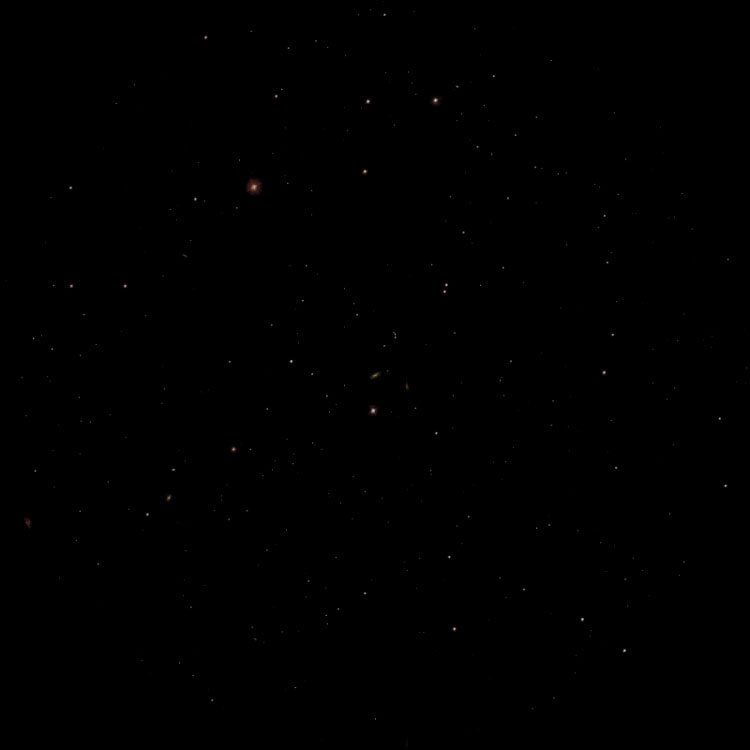
Below, a 33 arcmin wide SDSS image simulating the appearance of Swift's field of view
NGC 27 is the faint object in the center of the image, just above a "bright" star
PGC 731
(= UGC 95 = CGCG 499-062 = MCG +05-01-043)
Not an NGC object but listed here as an apparent companion of (and mentioned in the entry for) NGC 27
A magnitude 15.5(?) spiral galaxy (type Sc?) in Andromeda (RA 00 10 26.4, Dec +28 59 17)
Historical Identification: As discussed in the entry for NGC 27, Swift could not have seen PGC 731, despite its reasonably impressive appearance in modern photographs. So it is discussed here only because it is so obvious in such photographs.
Physical Information: Based on a recessional velocity of 7850 km/sec (and H0 = 70 km/sec/Mpc), a straightforward calculation indicates that PGC 731 is about 365 million light-years away, in good agreement with redshift-independent distance estimates of 340 to 500 million light-years. However, for objects at such distances we should take into account the expansion of the Universe during the time it took their light to reach us. Doing that shows that the galaxy was about 355 million light-years away at the time the light by which we see it was emitted, about 360 million years ago (the difference between the two numbers being due to the expansion of the intervening space during the light-travel time). Given that and its apparent size of about 1.75 by 0.2 arcmin (from the image below), it is about 180 thousand light-years across. Although NGC 27 and PGC 731 appear to be close to each other, the fainter galaxy is probably 40 million light-years further away, making them most likely merely optical companions.

Above, a 2.0 arcmin wide SDSS image of PGC 731; for a wider view, see NGC 27
NGC 28
(= PGC 730 = PGC 395160)
Discovered (Oct 28, 1834) by John Herschel
A magnitude 13.8 elliptical galaxy (type E1?) in Phoenix (RA 00 10 25.2, Dec -56 59 21)
Historical Identification: Per Dreyer, NGC 28 (= GC 13 = JH 2310, 1860 RA 00 03 25, NPD 147 46.4) is "extremely faint, the preceding (western) of 2", the other being NGC 31. The position precesses to (2000) RA 00 10 26.5, Dec -56 59 38, which is 0.4 arcmin southeast of the center of the galaxy listed above and within its outer glow, and it does precede NGC 31 (which lies just to its east), so the identification is certain. Unfortunately, as noted by Corwin, at one time some catalogs misidentified NGC 28 as NGC 31, and vice-versa; so the reader may still see their PGC designations reversed in some places.
Physical Information: Based on a recessional velocity of 9595 km/sec (and H0 = 70 km/sec/Mpc), a straightforward calculation indicates that NGC 28 is about 445 to 450 million light-years away. However, for objects at such distances we should take into account the expansion of the Universe during the time it took their light to reach us. Doing that shows that the galaxy was about 430 million light-years away at the time the light by which we see it was emitted, about 435 to 440 million years ago (the difference between the two numbers being due to the expansion of the intervening space during the light-travel time). Given that and its apparent size of about 0.95 by 0.9 arcmin (from the images below), it is about 120 thousand light-years across. Unlike nearby NGC 25, which is listed as a member of Abell 2371, NGC 28 is not listed as such, and could be slightly behind the cluster. But the difference in their recessional velocities is well within the range of peculiar (non-Hubble-expansion) velocities for such clusters, so odds are that NGC 28 is also a member of the cluster. Regardless of its association with the cluster (or not), it and NGC 31's essentially identical recessional velocities suggest that they may be physical companions.

Above, a 12 arcmin wide DSS image centered on NGC 31, also showing NGC 25, 28 and 37
Below, a 1.4 arcmin wide DSS image of NGC 28

PGC 394784
Not an NGC object but listed here as a probable companion/cluster member with NGC 28
A magnitude 15.5(?) galaxy (type ?) in Phoenix (RA 00 10 28.6, Dec -57 01 39)
Physical Information:
LEDA B 16.4, I 14.3, (V) 15.5(?); NED Vr 9286 km/sec, 3K Vr 9130 km/sec, z 0.030454636
If, as has been suggested, NGC 28 is a member of a rich cluster of galaxies, PGC 394784 is probably a member of the cluster as well, although whether it is in any way a companion of NGC 28 is another matter, entirely.
PGC 394941
Not an NGC object but listed here as a probable companion/cluster member with NGC 28
A magnitude 15.5(?) galaxy (type ?) in Phoenix (RA 00 10 18.6, Dec -57 00 42)
Physical Information:
LEDA B 16.7, I 14.7, (V) 16(?); NED Vr 9129 km/sec, 3K Vr 8973 km/sec, z 0.0299306
As in the case of PGC 394784, probably a member of the same cluster as NGC 28, but not necessarily a "companion" of that galaxy.
PGC 395226
Not an NGC object but listed here as an apparent companion of NGC 28
A magnitude 15.5(?) galaxy (type ?) in Phoenix (RA 00 10 13.6, Dec -56 59 03)
Physical Information:
LEDA B 16.6, I 14.8, (V) 16(?); NED Vr 11089 km/sec, 3K Vr 10933 km/sec, z 0.0364686389
Almost certainly a background galaxy, and not part of the cluster containing NGC 28.
"PGC 3590652"
(= 2MASXJ00102292-5659349)
Not an NGC object but listed here as an apparent companion of NGC 28
A magnitude ? galaxy (type ?) in Phoenix (RA 00 10 22.9, Dec -56 59 35)
Note About The PGC Designation: HyperLEDA assigns a PGC designation to this object, but a search of the database for that designation returns no result, hence its being in quotes. In fact, the 2MASX designation is the only one that returns a result in HyperLEDA; it also works for an NED search, but neither site contains any useful information about the object.
Physical Information: Since there doesn't appear to be any information available other than what is shown here, nothing truly useful can be written about the object.
NGC 29 (= NGC 21)
(= PGC 767 = UGC 100 = CGCG 499-066 = MCG +05-01-048)
Discovered (Nov 26, 1790) by William Herschel (and later listed as NGC 29)
Also observed (Nov 11, 1827) by John Herschel (and later listed as NGC 29)
Recorded (Sep 20, 1885) by Lewis Swift (and later listed as NGC 21)
A magnitude 12.7 spiral galaxy (type SAB(s)bc?) in Andromeda (RA 00 10 46.9, Dec +33 21 10)
Historical Identification: Per Dreyer, NGC 29 (= GC 14 = JH 6 = WH II 853, 1860 RA 00 03 32, NPD 57 25.6) is "pretty bright, pretty large, extended 0º". The position precesses to (2000) RA 00 10 46.1, Dec +33 21 09, within 0.2 arcmin of the center of the galaxy listed above and well within its outline.
Physical Information: The galaxy is sometimes called NGC 29, but since the lower NGC number is usually used for duplicate entries, see NGC 21 for anything else.
NGC 30
(= "PGC 5067665")
Recorded (Oct 30, 1864) by Albert Marth
A magnitude 14.8 and 15.0 double star in Pegasus (RA 00 10 50.7, Dec +21 58 38)
Historical Identification: Per Dreyer, NGC 30 (= GC 5088, Marth #4, 1860 RA 00 03 38, NPD 68 49) is "a 13th magnitude nebulous star". The position precesses to (2000) RA 00 10 50.6, Dec +21 57 45, an arcmin south of the pair listed above. Per Corwin, there are no galaxies within 10 arcmin, and the close double would appear nebulous under less than perfect seeing, so the description confirms the identification.
Historical Note: The NGC entry is copied from Lassell's 1866 paper about observations at Malta, which included Marth's discoveries.
Note About PGC Designation: As for most NGC objects, LEDA assigns a PGC designation for this entry even though it isn't a galaxy. However, a search of the database for PGC 5067665 returns no result, so designation is shown in quotes.

Above, a 12 arcmin wide SDSS image centered on NGC 30
NGC 31
(= PGC 751 = ESO 149-020)
Discovered (Oct 28, 1834) by John Herschel
A magnitude 13.9 spiral galaxy (type SAB(rs)cd?) in Phoenix (RA 00 10 38.4, Dec -56 59 11)
Historical Identification: Per Dreyer, NGC 31 (= GC 15 = JH 2311, 1860 RA 00 03 39, NPD 147 46.4) is "most extremely faint, small, round, following (eastern) of 2", the other being NGC 28. The position precesses to (2000) RA 00 10 40.2, Dec -56 59 38, which is, as for NGC 28, a little southeast of the center of the galaxy listed above (in this case about 0.6 arcmin), but still near the outline of the galaxy. It definitely "follows" NGC 28, which lies just to its west, so the identification is certain. However, as noted by Corwin, at one time some catalogs misidentified NGC 28 as NGC 31, and vice-versa; so the reader may still see their PGC designations reversed in some places. (It is interesting to note the difference between interpretations based on modern photographic images, and the direct observational techniques of the 19th century. Nowadays the ability to photograph the faint outer regions of the galaxy makes NGC 31 appear much larger than and just as bright as NGC 28; but Herschel saw only the bright core of NGC 31, making it appear to be substantially fainter than NGC 28.)
Physical Information: Based on a recessional velocity of 9600 km/sec (and H0 = 70 km/sec/Mpc), a straightforward calculation indicates that NGC 31 is about 445 to 450 million light-years away. However, for objects at such distances we should take into account the expansion of the Universe during the time it took their light to reach us. Doing that shows that the galaxy was about 430 million light-years away at the time the light by which we see it was emitted, about 435 to 440 million years ago (the difference between the two numbers being due to the expansion of the intervening space during the light-travel time). Given that and its apparent size of about 1.2 by 0.65 arcmin (from the images below), it is about 150 thousand light-years across. Like nearby NGC 28, it may be an unlisted member of Abell 2731, and since the two galaxies have nearly identical recessional velocities, regardless of their association with the cluster (or not), they may be physical companions.
Above, a 12 arcmin wide DSS image centered on NGC 31, also showing NGC 25, 28 and 37
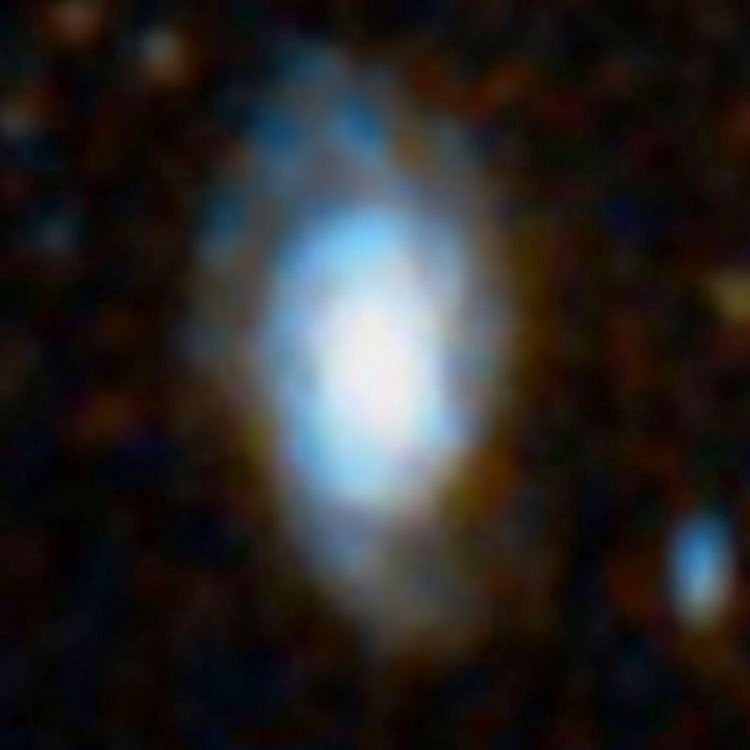
Below, a 1.5 arcmin wide DSS image of the galaxy
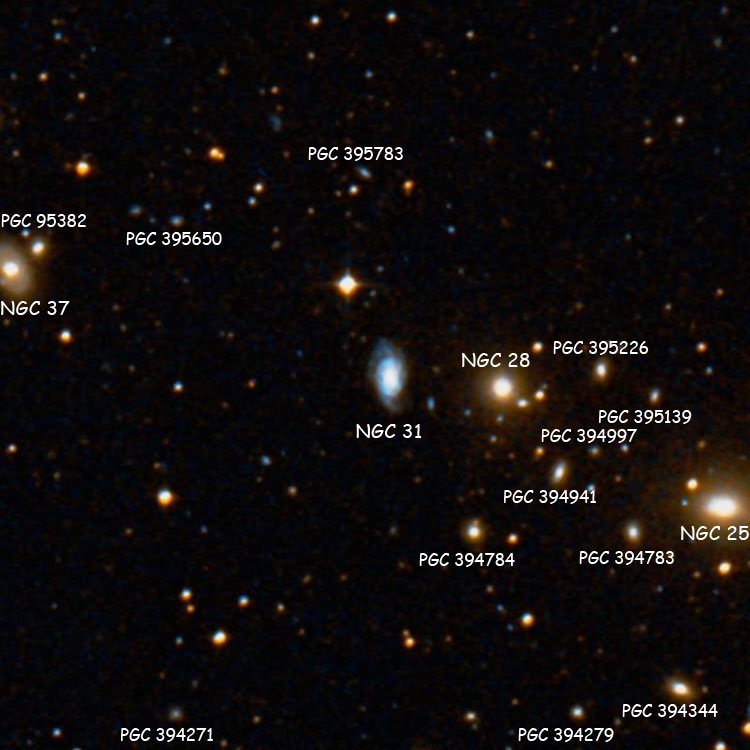
Below, a 12 arcmin wide DSS image centered near the galaxy, also showing NGC 25, 28 and 37
Also shown are a dozen PGC objects (see NGC 25 for more detailed images)
NGC 32
(= "PGC 5067693")
Recorded (Oct 10, 1861) by Julius Schmidt
A magnitude 13.5 star in Pegasus (RA 00 10 53.6, Dec +18 47 46)
Historical Identification: Per Dreyer, NGC 32 (= GC 16, J Schmidt, 1860 RA 00 03 42, NPD 71 59.0) is "faint (Auwers 1)". The listed position precesses to (2000) RA 00 10 54.3, Dec +18 47 45, which is only 0.3 arcmin northeast of the star listed above, and as noted by Corwin, Auwers' record of Schmidt's original observation precesses to (2000) RA 00 10 54.0, Dec +18 47 45, within 3 arcsec of the star, so the identification is certain.
Discovery Notes: Dreyer's reference to Arthur von Auwers does not mean that Auwers observed this object. A catalog of all known nebulae published by Auwers in 1862 was one of the sources for John Herschel's GC, which was the basis for the NGC. In this case "(Auwers 1)" means that in Herschel's entry for GC 16 he cites #1 in Auwers' table of nebulae discovered by various observers (mostly after 1845) as the source for his information about Schmidt's discovery (just as I used Auwers' catalog to obtain the position stated in the historical identification).
Note About PGC Designation: As for most NGC objects, LEDA assigns a PGC designation for this entry even though it isn't a galaxy. However, a search of the database for the designation returns no result, so it is shown in quotes).

Above, a 12 arcmin wide SDSS image centered on NGC 32; also shown are PGC 1570691 and 1573666
NGC 33
(= "PGC 5067595")
Recorded (Sep 9, 1864) by Albert Marth
A magnitude 15.5 and 15.8 double star in Pisces (RA 00 10 56.6, Dec +03 40 34)
Historical Identification: Per Dreyer, NGC 33 (= GC 5089, Marth #5, 1860 RA 00 03 45, NPD 87 06) is "extremely faint, very small, or nebulous star". The position precesses to (2000) RA 00 10 55.6, Dec +03 40 45, only 0.3 arcmin northwest of the pair of stars listed above, and there is nothing else nearby. As in the case of NGC 30, such a double could have appeared nebulous under normal conditions, so the identification is certain.
Historical Note: The NGC entry is copied from Lassell's 1866 paper about observations at Malta, which included Marth's discoveries.
Note About PGC Designation: As for most NGC objects, LEDA assigns a PGC designation for this entry even though it isn't a galaxy. However, a search of the database for the designation returns no result, so it is shown in quotes).

Above, a 12 arcmin wide SDSS image centered on NGC 33
NGC 34 (= NGC 17)
(= PGC 781 = MCG -02-01-032)
Discovered (Nov 21, 1886) by Lewis Swift (and later listed as NGC 34)
Also discovered (1886) by Frank Muller (and later listed as NGC 17)
Also observed (Jul 1, 1899 to Jun 30, 1900) by Herbert Howe (proving NGC 17 = NGC 34)
A magnitude 14.4 spiral galaxy (type S? pec) in Cetus (RA 00 11 06.6, Dec -12 06 28)
Historical Identification: Per Dreyer, NGC 34 (Swift list VI (#1), 1860 RA 00 03 53, NPD 102 53.2) is "pretty faint, small, round, 2 stars near". The position precesses to (2000) RA 00 11 01.9, Dec -12 06 27, about 5 seconds of time west of the galaxy listed above, but there is nothing comparable nearby and the double star west of the galaxy makes the identification certain. The double listing is due to the fact that Muller's and Swift's positions differ by nearly half a degree (being 5 seconds off for Swift and 2 minutes for Muller), so Dreyer had no reason to suspect the identity of the two nebulae. However, on the basis of the nearby stars mentioned by both observers, Howe discovered the equality of the two observations in 1899/1900, causing Dreyer to state "NGC 17 = 34 (Howe)" in the corrections for NGC objects published in the Second Index Catalog; so the duplicate entry has been known about for more than a century.
Physical Information: Although Swift had the far better position, tradition assigns the numerically earlier designation to duplicate entries, so see NGC 17 for anything else.
NGC 35
(= PGC 784 = MCG -02-01-033)
Discovered (Nov 21, 1886) by Lewis Swift
Independently discovered (1886) by Frank Muller
A magnitude 14.1 spiral galaxy (type Sbc? pec) in Cetus (RA 00 11 10.5, Dec -12 01 15)
Historical Identification: Per Dreyer, NGC 35 (Swift list VI (#2), Muller list II (#277), 1860 RA 00 04 03, NPD 102 47.2) is "most extremely faint, pretty small, round". The position precesses to (2000) RA 00 11 11.9, Dec -12 00 27, less than an arcmin northeast of the galaxy listed above and there is nothing comparable nearby, so the identification is certain.
Physical Information: Based on a recessional velocity of 5965 km/sec (and H0 = 70 km/sec/Mpc), NGC 35 is about 275 to 280 million light-years away. Given that and its apparent size of about 0.75 by 0.45 arcmin (from the images below), it is about 60 thousand light-years across. Note: NGC 35 and 17 are only a few arcmin apart, and given their apparently common distance, may be less than half a million light-years apart. If so, they would be gravitationally bound, and their distorted appearance may involve a gravitational interaction.

Above, a 12 arcmin wide DSS image centered on NGC 35, also showing NGC 17
Below, a 0.9 arcmin wide DSS image of NGC 35

Below, a 0.9 arcmin wide PanSTARRS image of NGC 35

Below, a 33 arcsec wide HST image of star-forming regions in the galaxy (Image Credit Hubble Legacy Archive)
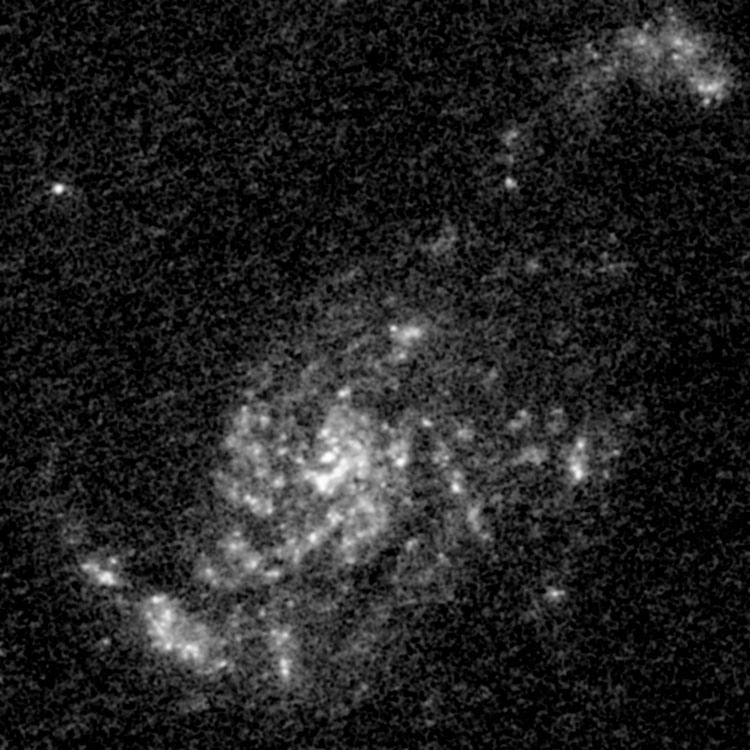
Below, a 12 arcmin wide DSS image centered on NGC 35
Also shown are NGC 17 and PGC 957826, 958282 and 958866

NGC 36
(= PGC 798 = UGC 106 = CGCG 408-040 = MCG +01-01-043)
Discovered (Oct 25, 1785) by William Herschel
Also observed (Oct 5, 1864) by Heinrich d'Arrest
A magnitude 13.3 spiral galaxy (type SAB(rs)bc?) in Pisces (RA 00 11 22.3, Dec +06 23 22)
Historical Identification: Per Dreyer, NGC 36 (= GC 19 = WH III 456, d'Arrest, 1860 RA 00 04 11, NPD 84 24.2) is "very faint, pretty small, irregular figure". The position precesses to (2000) RA 00 11 21.9, Dec +06 22 33, only 0.8 arcmin south of the center of the galaxy listed above and still within its outline, so the identification is certain.
Discovery Notes: In Dreyer's 1877 Supplement to Sir John Herschel's "General Catalog of Nebulae and Clusters of Stars" he states that d'Arrest's measurements place the nebula 1 minute of time to the west of the GC position, and the position in the NGC agrees with that correction.
Physical Information: Based on a recessional velocity of 6030 km/sec (and H0 = 70 km/sec/Mpc), NGC 36 is about 280 million light-years away, in reasonable agreement with redshift-independent distance estimates of 220 to 270 million light-years. Given that and its apparent size of about 3.35 by 1.35 arcmin (from the images below), it is about 275 thousand light-years across.

Above, a 12 arcmin wide SDSS image centered on NGC 36
Below, a 3.0 by 3.6 arcmin wide SDSS image of NGC 36 and PGC 797
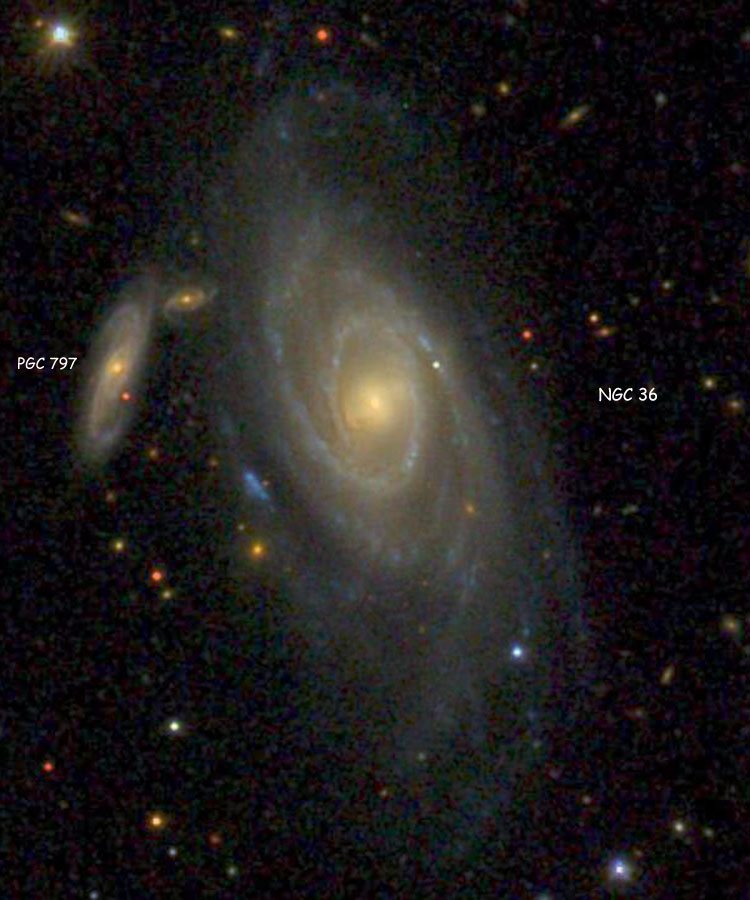
Below, a 12 arcmin wide SDSS image centered on NGC 36, also showing PGC 797 and PGC 212482

PGC 797
(= MCG +01-01-044)
Not an NGC object but listed here as an apparent companion of NGC 36
A magnitude 16(?) spiral galaxy (type S?) in Pisces (RA 00 11 26.4, Dec +06 23 30)
Physical Information: NED 3K Vr 16601 km/sec, z 0.055373536; so a far more distant object
"PGC 3591026"
(= WISEA J001125.32+062346.3)
Not an NGC object but listed here as an "apparent companion" of NGC 36
A magnitude ? spiral galaxy (type S?) in Pisces (RA 00 11 25.3, Dec +06 23 46)
Justification Of This Entry: This object lies between NGC 36 and PGC 797 (which is listed as an apparent companion of NGC 36, even though it isn't an actual companion of the NGC object). Given that position, it seems appropriate to say what can be said about it, in case anyone wonders what, if anything, is known about it. Unfortunately, as noted in the following paragraph, essentially nothing is known, other than what it looks like, as shown in the images on this page. Given its small apparent size, it is almost certainly a far more distant object than either of its "companions", but how much more distant cannot be known without further study.
Note About PGC Designation: Although LEDA assigns a PGC designation for this object, a search of the database returns no result, so the designation is in quotes. The WISEA designation will return a result in both the LEDA and NED databases, but neither page contains any useful information, so essentially nothing is known about it except what is shown here.
NGC 37
(= PGC 801 = PGC 395521 = ESO 149-022)
Discovered (Oct 2, 1836) by John Herschel
A magnitude 13.7 lenticular galaxy (type (RL)SAB(s)0/a?) in Phoenix (RA 00 11 22.9, Dec -56 57 26)
Historical Identification: Per Dreyer, NGC 37 (= GC 17 = JH 2312, 1860 RA 00 04 22, NPD 147 43.8) is "extremely faint, small, round". The position precesses to (2000) RA 00 11 22.3, Dec -56 57 03, only 0.4 arcmin north northwest of the center of the galaxy listed above and within its outline, so the identification is certain.
Physical Information: Based on a recessional velocity of 9775 km/sec (and H0 = 70 km/sec/Mpc), a straightforward calculation indicates that NGC 37 is about 455 million light-years away. However, for objects at such distances we should take into account the expansion of the Universe during the time it took their light to reach us. Doing that shows that the galaxy was about 440 million light-years away at the time the light by which we see it was emitted, a little over 445 million years ago (the difference between the two numbers being due to the expansion of the intervening space during the light-travel time). Given that and its apparent size of about 1.25 by 0.7 arcmin (from the images below), the galaxy is about 160 thousand light-years across.

Above, a 12 arcmin wide DSS image centered on NGC 37, also showing NGC 31
Below, a 1.5 arcmin wide DSS image of NGC 37, also showing PGC 95382

Below, a 12 arcmin wide DSS image centered on NGC 37, also showing NGC 31
Also shown are PGC 95382, 128413, 128414, 395650, 395783, 396047, 396284 and 396380

PGC 95382
Not an NGC object but listed here as an apparent companion of NGC 37
A magnitude 16(?) lenticular galaxy (type E/S0?) in Phoenix (RA 00 11 19.8, Dec -56 57 06)
Physical Information:
NED 3K Vr 8859 km/sec, z 0.0295506366, mag 17.11(?); LEDA E/S0, B 16.7, K 12.5, (V) 16(?)
3K Vr for NGC 37 is 9653 km/sec, so PGC 95382 might be a companion, but could just as easily be 30 to 40 million light-years closer to us than NGC 37.
NGC 38
(= PGC 818 = MCG -01-01-047)
Discovered (Sep 30, 1867) by Édouard Stephan (but not published)
Re-observed (Oct 25, 1881) by Édouard Stephan (and later listed as NGC 38)
A magnitude 13.3 spiral galaxy (type (R)SA(s)a?) in Pisces (RA 00 11 47.0, Dec -05 35 11)
Historical Identification: Per Dreyer, NGC 38 (Stephan list XII (#3), 1860 RA 00 04 38, NPD 96 22.0) is "faint, small, round, much brighter middle". The position precesses to (2000) RA 00 11 47.6, Dec -05 35 15, only 0.2 arcmin from the center of the galaxy listed above and well within its outline, so the identification is certain.
Discovery Note: Stephan's date of discovery based on his published data is Oct 25, 1881, which represents the date when he made what he considered an adequate micrometric measurement; but based on Stephan's original notes, Yann Pothier has shown that he actually made his first observation of what became NGC 38 on Sep 30, 1867, as shown above.
Physical Information: Based on a recessional velocity of 8035 km/sec (and H0 = 70 km/sec/Mpc), a straightforward calculation indicates that NGC 38 is about 375 million light-years away. However, for objects at such distances we should take into account the expansion of the Universe during the time it took their light to reach us. Doing that shows that the galaxy was about 360 to 365 million light-years away at the time the light by which we see it was emitted, about 365 to 370 million years ago (the difference between the two numbers being due to the expansion of the intervening space during the light-travel time). Given that and its apparent size of about 1.1 by 1.1 arcmin (from the images below), the galaxy is about 115 to 120 thousand light-years across.

Above, a 12 arcmin wide SDSS image centered on NGC 38
Below, a 1.5 arcmin wide SDSS image of the galaxy

Below, a 12 arcmin wide SDSS image centered on NGC 38
Also shown are PGC 1042100, 1042151, 1042790 and 1043800
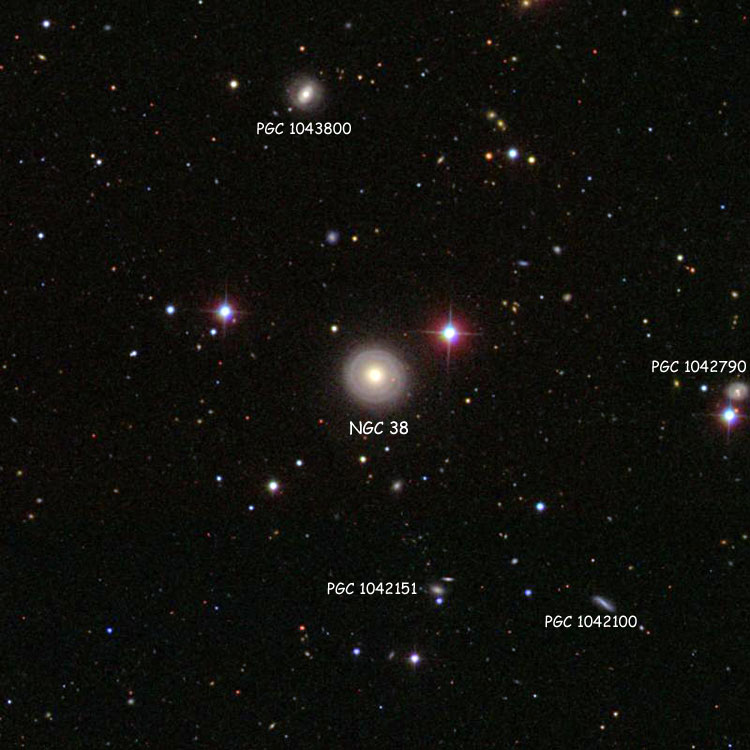
NGC 39
(= PGC 852 = UGC 114 = CGCG 499-076 = MCG +05-01-052)
Discovered (Nov 2, 1790) by William Herschel
Also observed (Nov 16, 1827) by John Herschel
A magnitude 13.5 spiral galaxy (type SA(rs)c?) in Andromeda (RA 00 12 18.9, Dec +31 03 40)
Historical Identification: Per Dreyer, NGC 39 (= GC 18 = JH 7 = WH III 861, 1860 RA 00 05 04, NPD 59 41.4) is "very faint, pretty small, round". The position precesses to (2000) RA 00 12 18.5, Dec +31 05 21, almost 2 arcmin north of the galaxy listed above, but there is nothing else within 10 arcmin and the description fits, so the identification is certain.
Physical Information: Based on a recessional velocity of 4855 km/sec (and H0 = 70 km/sec/Mpc), NGC 39 is about 225 million light-years away. Given that and its apparent size of about 1.2 by 1.0 arcmin (from the images below), it is about 80 thousand light-years across.
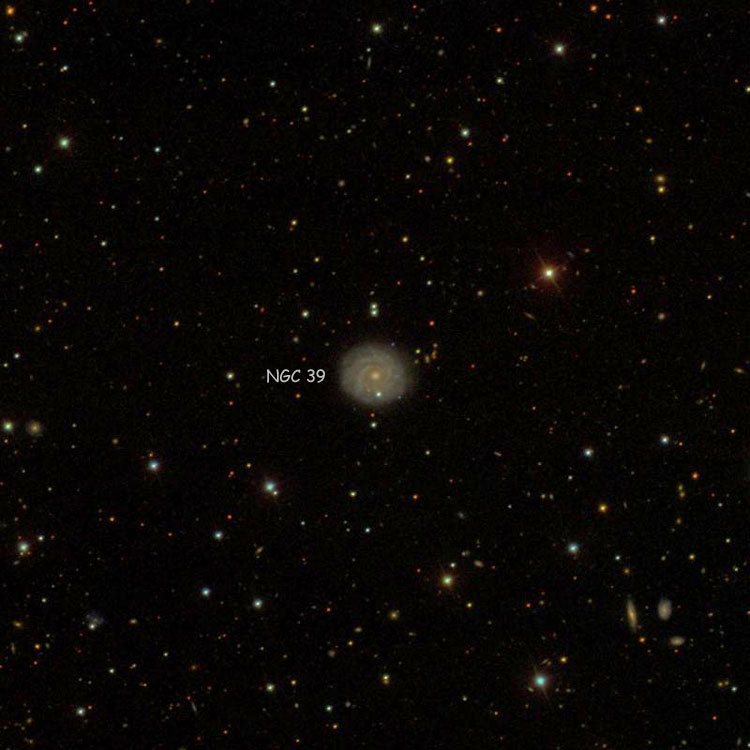
Above, a 12 arcmin wide SDSS image centered on NGC 39
Below, a 1.4 arcmin wide SDSS image of the galaxy

Below, a 12 arcmin wide SDSS image centered on NGC 39, also showing PGC 1927012 and 1927069
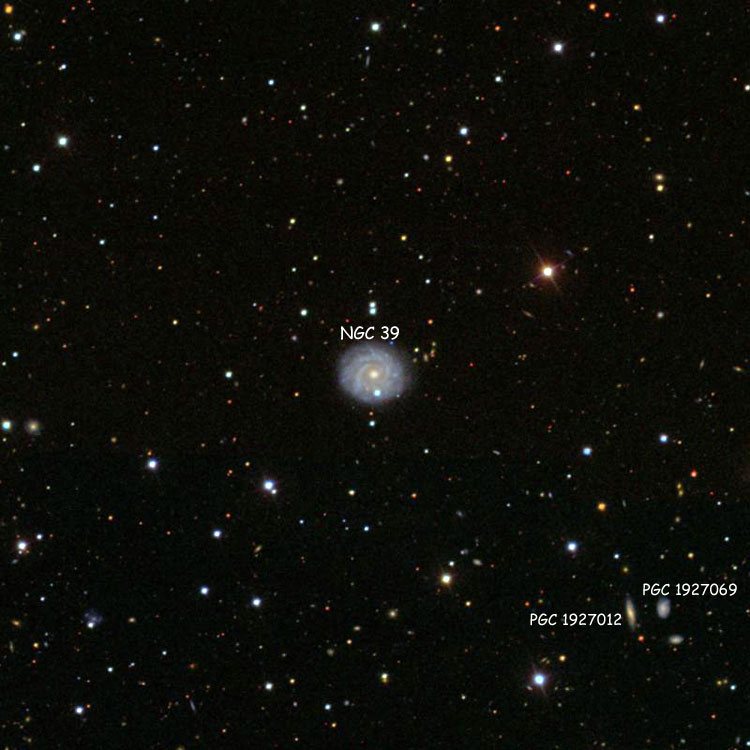
NGC 40, the Bow-Tie Nebula
(= C2 = PK 120+09.1 = "PGC 2923327")
Discovered (Nov 25, 1788) by William Herschel
Also observed (Nov 20, 1829) by John Herschel
A magnitude 12.3 planetary nebula in Cepheus (RA 00 13 01.0, Dec +72 31 19)
Historical Identification: Per Dreyer, NGC 40 (= GC 20 = JH 8 = WH IV 58, 1860 RA 00 05 27, NPD 18 15.4) is "faint, very small, round, very suddenly much brighter middle, 12th magnitude star to southwest." The position precesses to (2000) RA 00 13 00.7, Dec +72 31 20, dead center on the nebula listed above, and there is an appropriate star to the southwest, so the identification is certain.
Note About PGC Designation: As for most NGC objects, HyperLEDA assigned a PGC designation for this entry even though it isn't a galaxy. However, a search of the database for that designation returns no result, so it is shown in quotes.
Physical Information: NGC 40 is the result of a sunlike star ejecting material into space, during its transformation from a red giant (or "dying" star) to a white dwarf (or "dead" star). The central star in the nebula is a recently formed, very hot (about 100 thousand Fahrenheit degrees) proto-white dwarf. The nebula is about 3500 light-years away, and based on an apparent size of about 1.2 by 0.75 arcmin for the bright central portion of the nebula (from the images below) it is about 1.2 light-years across, while the outermost region of gases expelled by the star in the distant past spans four or five times that distance. Most of the radiation from the nebula is given off by clouds of gas heated to about 20 thousand (Fahrenheit) degrees by the light of the star, but there are also regions which have been heated to millions of degrees by compressive forces generated by the collision of interstellar material and previously ejected gases with a 2 million mile/hour stellar wind emitted by the dying star. Over a period of 30 or 40 thousand years the radiation and stellar wind from the white dwarf will fade away, and the nebula will disappear from view. This is the blink of an eye in astronomical terms, but about one planetary nebula is formed in our galaxy each year, so at any given time there are tens of thousands of them scattered across the galaxy. NGC 40 is sometimes referred to as the "Bow-Tie Nebula" due to the faint extensions to the northwest and south, as shown in the wide-field images.
Image Note: A very "deep", "wide" image of the region shows a network of faint emission nebulae apparently centered on NGC 40; but they represent a "supernova remnant" (CTA1) created by the death of a far more massive star that lies 1000 light-years beyond NGC 40, and since they are unrelated to NGC 40, the image is linked here, but not shown.

Above, a 12 arcmin DSS image centered on NGC 40, using a high-quality overlay of the nebula itself
(Credit & © for overlay image Jim Misti, Misti Mountain Observatory; used by permission)
Below, a 5 arcmin wide DSS image of the nebula overexposed to show all of the "bow-tie"
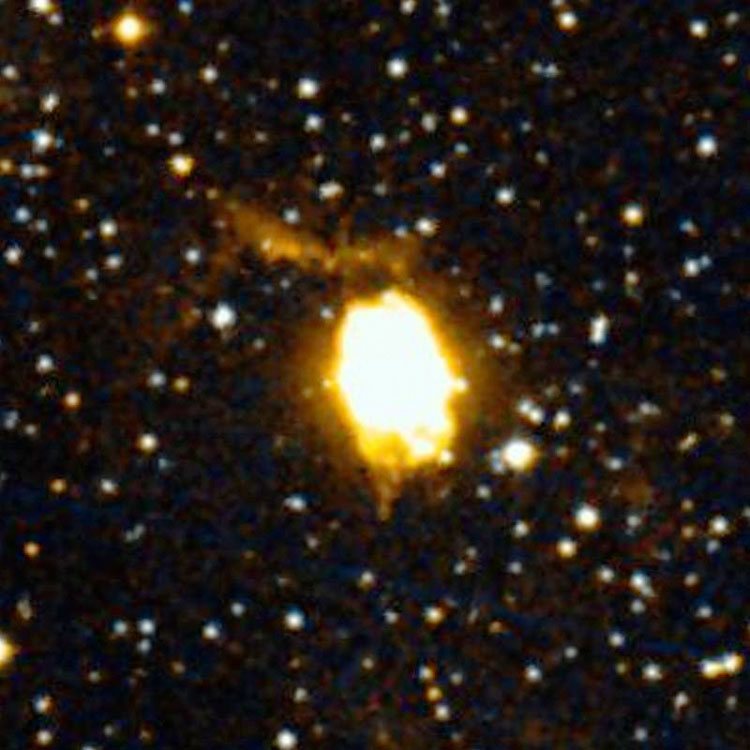
Below, a 1.8 by 2.2 arcmin wide image of NGC 40
(Credit & © Jim Misti, Misti Mountain Observatory, used by permission)
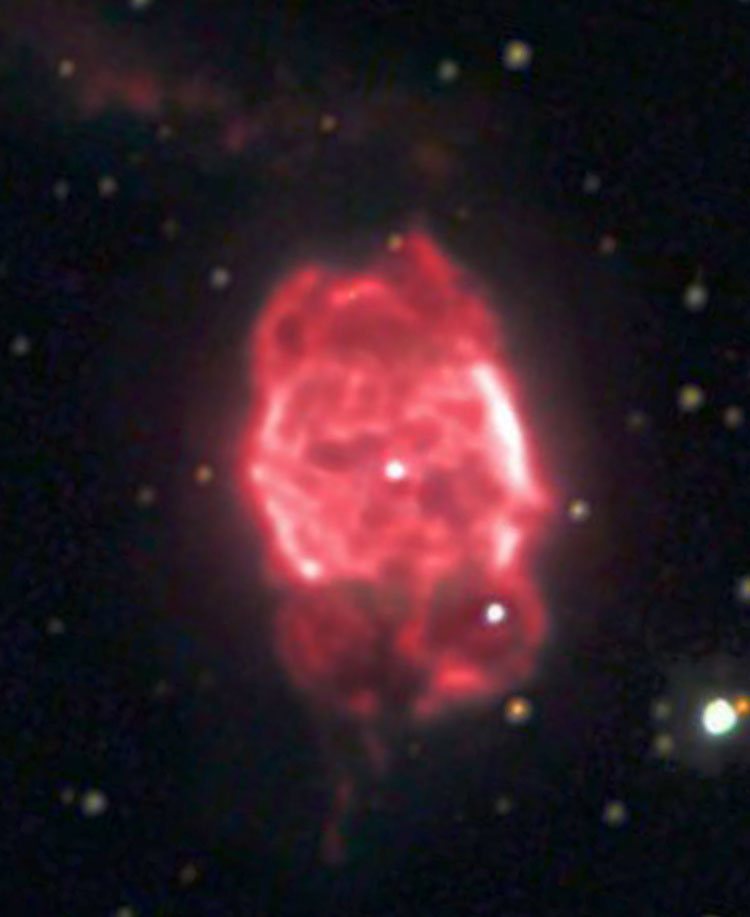
Below, a 1.0 by 1.1 X-ray image (in blue) of collisionally heated regions superimposed on a visible-light image
(Credits: X-ray: NASA/CXC/RIT/J.Kastner & R.Montez.; Optical: NSF/AURA/NOAO/WIYN, Chandra)
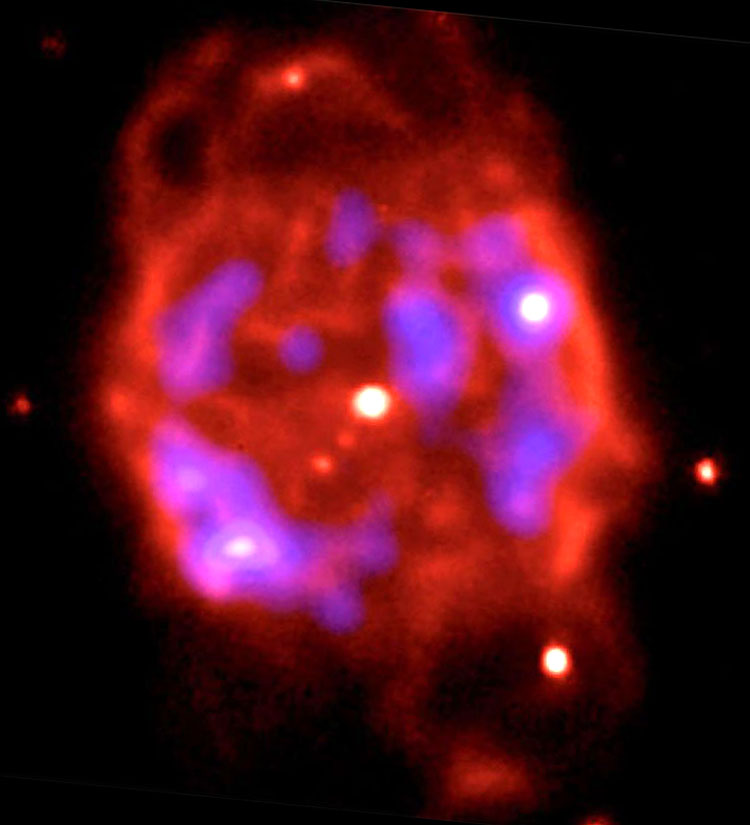
NGC 41
(= PGC 865 = CGCG 478-042 = MCG +04-01-039)
Discovered (Oct 30, 1864) by Albert Marth
A magnitude 13.7 spiral galaxy (type Sc?) in Pegasus (RA 00 12 48.0, Dec +22 01 25)
Historical Identification: Per Dreyer, NGC 41 (= GC 5090, Marth #6, 1860 RA 00 05 33, NPD 68 46) is "pretty faint, small, a little extended, gradually brighter middle". The position precesses to (2000) RA 00 12 46.3, Dec +22 00 44, only 0.8 arcmin southwest of the galaxy listed above and there is nothing else nearby, so the identification is certain.
Physical Information: Based on a recessional velocity of 5950 km/sec (and H0 = 70 km/sec/Mpc), NGC 41 is about 275 to 280 million light-years away, in reasonable agreement with redshift-independent distance estimates of 245 to 270 million light-years. Given that and its apparent size of about 0.95 by 0.5 arcmin (from the images below), it is about 75 to 80 thousand light-years across. NGC 41 and 42 are only a few arcmin apart and appear to be at the same distance, so they may be physical companions.
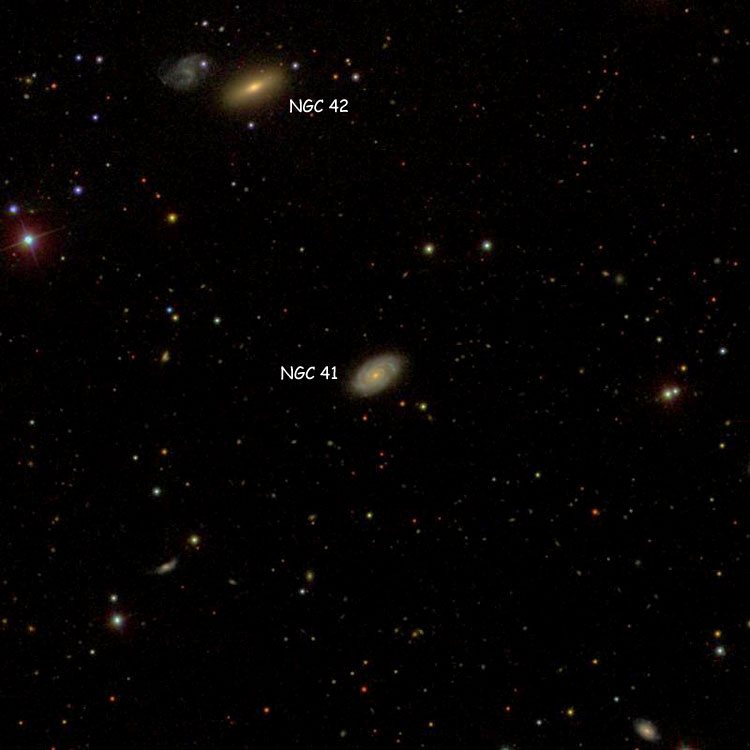
Above, a 12 arcmin wide SDSS image centered on NGC 41, also showing NGC 42
Below, a 1 arcmin wide SDSS image of the galaxy
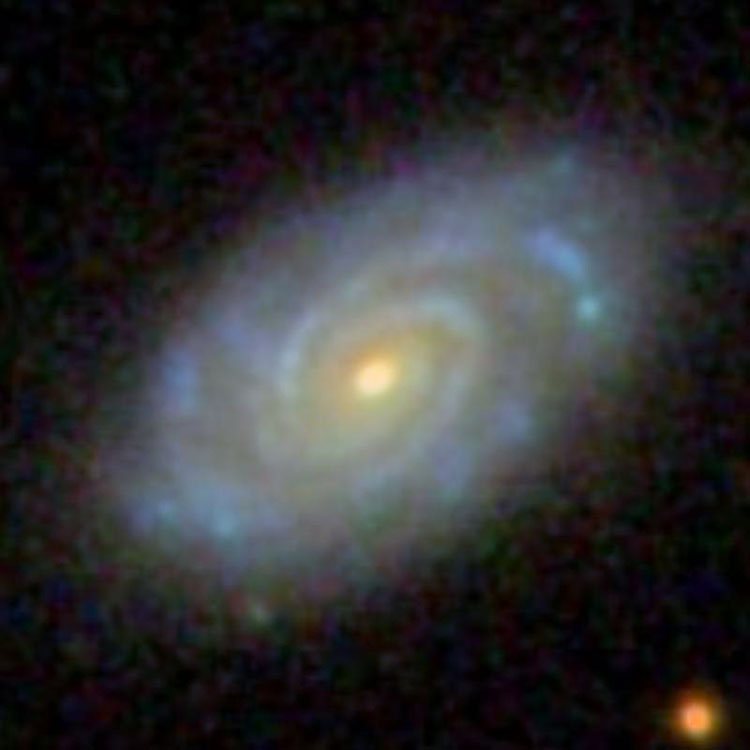
Below, a 12 arcmin wide SDSS image centered on NGC 41
Also shown are NGC 42 and PGC 855, 212483 and 1660999

NGC 42
(= PGC 867 = UGC 118 = CGCG 478-043 = MCG +04-01-041)
Discovered (Oct 30, 1864) by Albert Marth
A magnitude 13.8 lenticular galaxy (type E/S0?) in Pegasus (RA 00 12 56.3, Dec +22 06 01)
Historical Identification: Per Dreyer, NGC 42 (= GC 5091, Marth #7, 1860 RA 00 05 42, NPD 68 41) is "faint, very small, stellar". The position precesses to (2000) RA 00 12 55.3, Dec +22 05 44, only 0.4 arcmin southwest of the galaxy listed above and there is nothing comparable nearby, so the identification is certain.
Physical Information: Based on a recessional velocity of 5980 km/sec (and H0 = 70 km/sec/Mpc), NGC 42 is about 275 to 280 million light-years away. Given that and its apparent size of about 1.1 by 0.5 arcmin (from the images below), it is about 90 thousand light-years across. NGC 42 and 41 are only a few arcmin apart and appear to be at about the same distance, so they may be physical companions. However, PGC 212483 is a much closer dwarf galaxy and has no relationship to either of the other galaxies.

Above, a 12 arcmin wide SDSS image centered on NGC 42, also showing NGC 41
Below, a 1.2 arcmin wide SDSS image of NGC 42

Below, a 12 arcmin wide SDSS image centered on NGC 42
Also shown are NGC 41 and PGC 212483 and 1665065
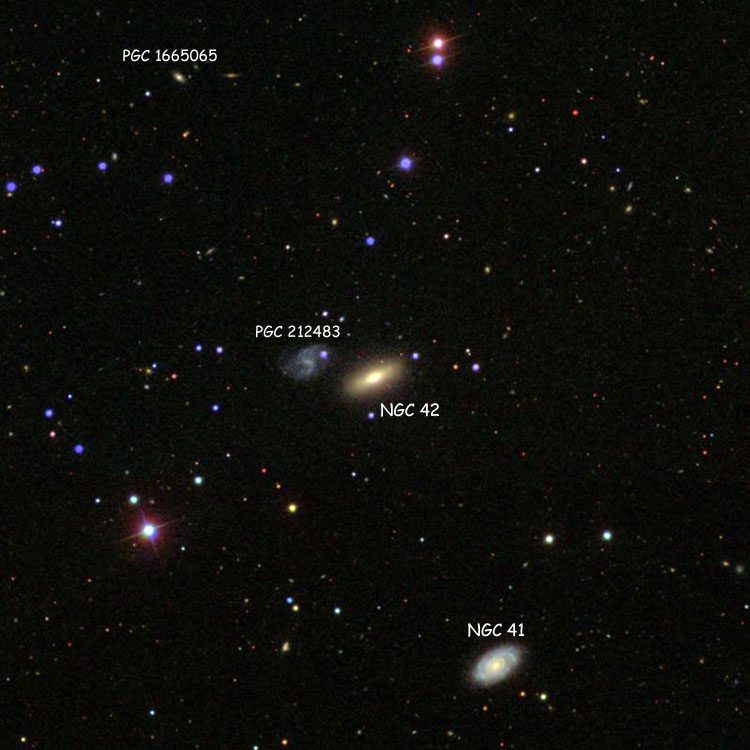
NGC 43
(= PGC 875 = UGC 120 = CGCG 499-079 = MCG +05-01-054)
Discovered (Nov 11, 1827) by John Herschel
A magnitude 12.6 lenticular galaxy (type SAB0?) in Andromeda (RA 00 13 00.8, Dec +30 54 55)
Historical Identification: Per Dreyer, NGC 43 (= GC 21 = JH 9, 1860 RA 00 05 46, NPD 59 49.8) is "extremely faint, 12th magnitude star 45 arcsec to northwest". The position precesses to (2000) RA 00 13 00.8, Dec +30 56 56, about 2 arcmin north of the galaxy listed above, the star to its northwest fits the description and there is no other candidate in the region, so the identification is considered certain.
Discovery Notes: A note at the end of the NGC adds: "43: (John Herschel's) h9. (Herman) Schultz says: 'An extremely faint nebula suspected northwest between star DM 30° 20 and a faint star to the north.'" This suggests that Dreyer thought Schultz' observation might have been of NGC 43; but that is to the west southwest of DM 30° 20, not the northwest, and there is nothing of interest to the northwest of DM 30° 20, so whether Schultz observed this object or anything at all is uncertain at best.
Physical Information: Based on a recessional velocity of 4785 km/sec (and H0 = 70 km/sec/Mpc), NGC 43 is about 220 to 225 million light-years distant. Given that and its apparent size of about 1.35 by 1.3 arcmin (from the images below), it is about 85 to 90 thousand light-years across.

Above, a 12 arcmin wide SDSS image centered on NGC 43
Below, a 1.8 arcmin wide SDSS image of NGC 43

Below, the 12 arcmin wide SDSS image showing several fainter galaxies, including PGC 1924587
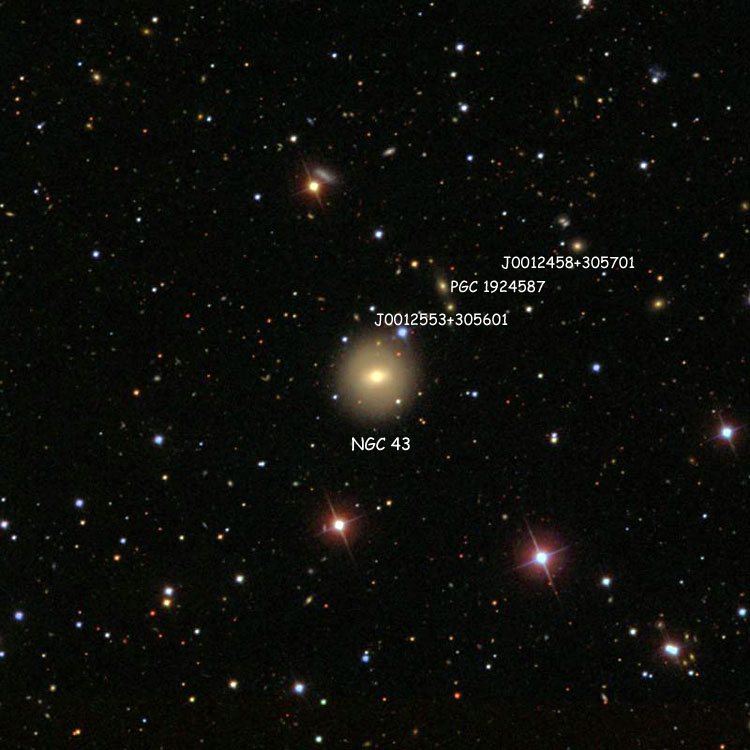
NGC 44
(= "PGC 5067760")
Recorded (Nov 22, 1827) by John Herschel
A magnitude 14.6 double star in Andromeda (RA 00 13 13.4, Dec +31 17 10)
Historical Identification: Per Dreyer, NGC 44 (= GC 22 = JH 10, 1860 RA 00 05 59, NPD 59 29.3) is "extremely faint, very small" (per Corwin, Herschel adds "not to be seen but in the clearest night", indicating that the object was at the limit of observation). The position precesses to (2000) RA 00 13 14.0, Dec +31 17 26, only 15 arcsec northeast of the pair of stars listed above, and since the description is apt, the identification is considered certain.
Note About PGC Designation: As for most NGC objects, LEDA assigns a PGC designation for this entry even though it isn't a galaxy. However, a search of the database for that designation returns no result, so it is shown in quotes.

Above, a 12 arcmin wide region centered on NGC 44, also showing PGC 1943513
NGC 45
(= PGC 930 = UGCA 4 = ESO 473-001 = MCG -04-01-021)
Discovered (Nov 11, 1835) by John Herschel
Also observed (Jul 1, 1899 to Jun 30, 1900) by Herbert Howe
A magnitude 10.6 spiral galaxy (type SA(s)dm?) in Cetus (RA 00 14 04.0, Dec -23 10 55)
Historical Identification: Per Dreyer, NGC 45 (= GC 23 = JH 2313, 1860 RA 00 06 48, NPD 113 57.2) is "extremely faint, large, very gradually a very little brighter middle, large (bright) star in contact following (to the east)". The position precesses to (2000) RA 00 13 54.6, Dec -23 10 28, about 9 seconds of time west of the center of the galaxy listed above but well within its outline, so the identification is certain.
Discovery Notes: The diffuse nature of the galaxy must have presented problems in determining its position, as not only is Herschel's position to the west of center, but the brightest star in the field, 7th magnitude HD 941, is to the southwest of the galaxy, not east; but since telescopic fields are usually inverted in some way Herschel may have gotten confused about relative directions. Howe's observation is noted above (though not by any of his contemporaries) because he stated that the NGC right ascension was 10 seconds of time too small, so his position was nearly dead-center on the modern position for the galaxy.
Physical Information: Based on a recessional velocity of 465 km/sec (and H0 = 70 km/sec/Mpc), NGC 45 is only 22 million light-years away, at the lower end of redshift-independent distance estimates of 20 to 40 million light-years. Given that and its apparent size of about 9.2 by 6.1 arcmin (from the images below), it is about 55 to 60 thousand light-years across. It has been suggested NGC 45 and 24 (which see for a view of the region between the galaxies) are a pair, as they are not far apart (about two degrees, which would correspond to less than a million light-years at their probable distance), and have similar recessional velocities. The latter galaxy is probably 20 to 30 million light-years away, so if they really are a pair, it would support the distance estimate in this entry; but both galaxies' distances are very uncertain, so the presumption that they are a pair cannot be viewed with confidence.
Use By The de Vaucouleurs Atlas: NGC 45 is used by the de Vaucouleurs Atlas of Galaxies as an example of type SA(s)d.

Above, a 12 arcmin wide image centered on NGC 45 (Image credit: Uploaded to Wikisky by Jim Riffle)
Below, an 8 arcmin wide image of the galaxy (Image Credit & © Carnegie-Irvine Survey; used by permission)

Below, an 8 by 9.5 arcmin wide image of NGC 45, also showing several fainter galaxies (Wikisky/Riffle)

Below, a labeled version of the image above, showing PGC 803099, 804519, 804799 and 3094764

Below, a 12 arcmin wide image centered on the galaxy; the "bright" star is 7th magnitude HD 941
Additional galaxies shown include PGC 3097980 (Wikisky/Riffle)
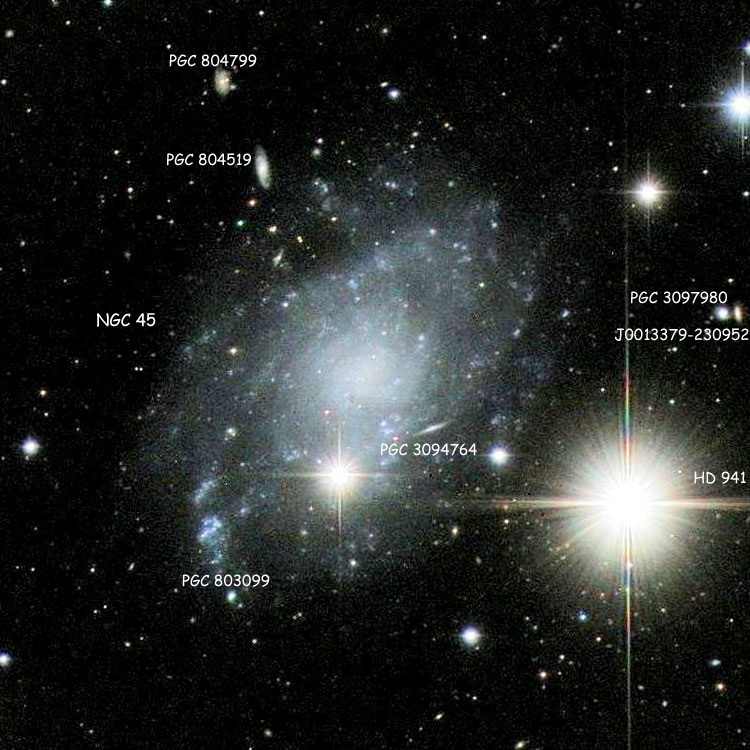
PGC 804519
Not an NGC object but listed here as an apparent companion of NGC 45
A magnitude 16(?) spiral galaxy (type Sbc?) in Cetus (RA 00 14 11.0, Dec -23 07 32)
Physical Information:
LEDA B 16.4, I 14.5, (V) 16(?); NED 3K Vr 19916 km/sec, z 0.06643229. A far more distant object than NGC 45, so only an optical double.
PGC 3094764
Not an NGC object but listed here as an apparent companion of NGC 45
A magnitude 17.5(?) spiral galaxy (type Scd?) in Cetus (RA RA 00 13 59.1, Dec -23 11 42)
Physical Information:
LEDA I 16.3, (V) 17.5(?); NED no information at all, but certainly a very distant background object.
NGC 46
(= "PGC 5067596")
Recorded (Oct 22, 1852) by Edward Cooper
Also observed (Sep 28, 1861) by Arthur von Auwers
A magnitude 11.7 star in Pisces (RA 00 14 09.9, Dec +05 59 16)
Historical Identification: Per Dreyer, NGC 46 (= GC 24, Markree Catalog, 1860 RA 00 06 59, NPD 84 47.5) is "a nebula (Auwers 2)". The position precesses to (2000) RA 00 14 10.1, Dec +05 59 14, exactly on the star listed above, so despite its not being a nebular object the identification is certain. Note: A Wikisky search for NGC 46 incorrectly shows NGC 469 (fortunately, correctly labeled as NGC 469), so the position must be used to see the correct object (there is a fairly common problem with Wikisky searches involving the number 9 either being added to or removed from search strings).
Discovery Notes: Dreyer's note "(Auwers 2)" only means that John Herschel used Auwers' catalog as the source for his entry for GC 24, and in some cases being included in Auwers' list of objects mostly discovered after 1845 does not mean that he actually observed the object. However, in his note for this entry Auwers stated "... I saw in that position on 1861 Sept 28 and 30 a completely sharp, nebulous star of 11th magnitude (9 arcmin north and 1 min 29 sec west of a star of 7.8 magnitude)." The (actually 7th magnitude) star in question (HD 1133) is exactly where Auwers placed it relative to Cooper's position, confirming that he and Cooper observed the same thing.
Note About PGC Designation: As for most NGC objects, LEDA assigns a PGC designation for this entry even though it isn't a galaxy. However, a search of the database for that designation returns no result, so it is shown in quotes.

Above, a 12 arcmin wide region centered on NGC 46, also showing PGC 1292715
NGC 47 (= NGC 58)
(= PGC 967 = MCG -01-01-055)
Discovered (1886) by Wilhelm Tempel (and later listed as NGC 47)
Discovered (Oct 21, 1886) by Lewis Swift (and later listed as NGC 58)
Looked for (late September to the end of 1897) by Herbert Howe (while listed as NGC 58)
A magnitude 13.1 spiral galaxy (type SB(rs)bc?) in Cetus (RA 00 14 30.6, Dec -07 10 03)
Historical Identification: Per Dreyer, NGC 47 (Tempel, 1860 RA 00 07 22, NPD 97 56.6) is "very faint, very small". The position precesses to (2000) RA 00 14 31.1, Dec -07 09 52, well within the outline of the galaxy listed above, so the identification is certain. See NGC 58 for a discussion of the duplicate listing and additional images of the region.
Physical Information: Based on a recessional velocity of 5700 km/sec (and H0 = 70 km/sec/Mpc), NGC 47 is about 265 million light-years away. Given that and its apparent size of about 2.3 by 2.0 arcmin (from the images below), it is about 175 to 180 thousand light-years across.

Above, a 12 arcmin wide SDSS image centered on NGC 47
Below, a 2.7 arcmin wide SDSS image of the galaxy
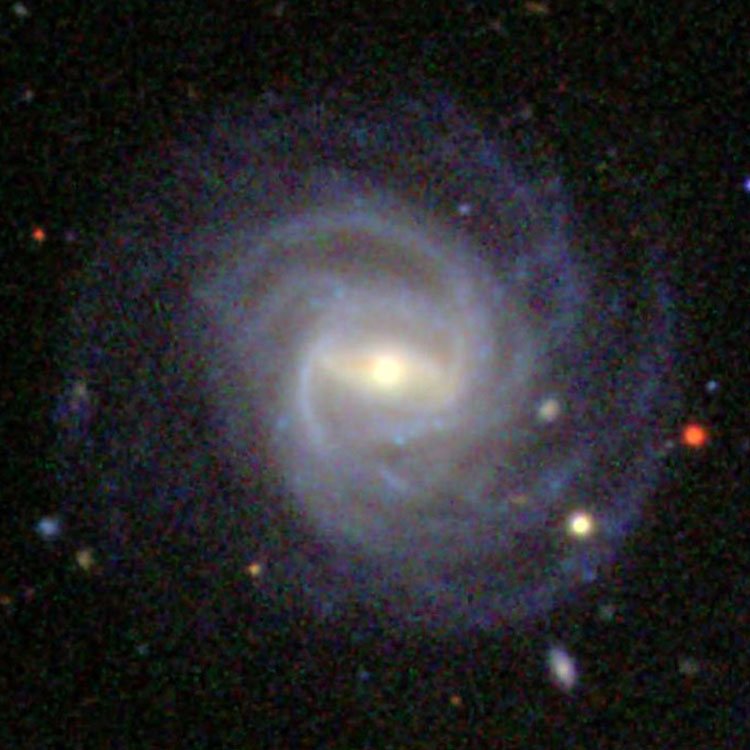
Below, a 12 arcmin wide SDSS image centered on NGC 47
Also shown are PGC 1022508, 1023173, 1023515, 1024587 and 1024725
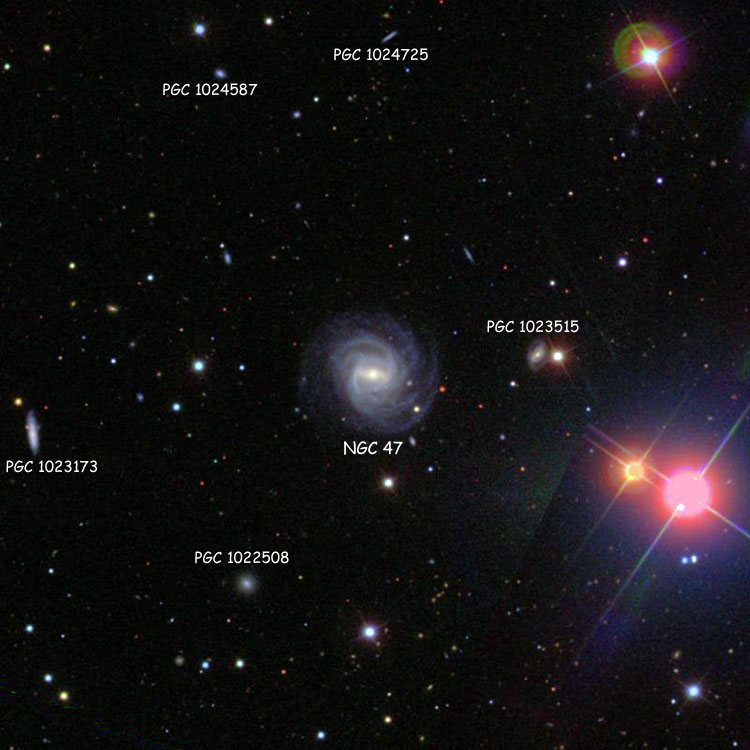
NGC 48
(= PGC 929 = UGC 133 = CGCG 549-027 = MCG +08-01-031)
Discovered (Sep 7, 1885) by Lewis Swift
Also observed (Jul 6, 1888) by Edward Barnard
Also observed (Oct 13, 1890) by Guillaume Bigourdan
A magnitude 13.6 spiral galaxy (type SB(s)bc? pec) in Andromeda (RA 00 14 02.2, Dec +48 14 05)
Historical Identification: Per Dreyer, NGC 48 (Swift list II (#6), 1860 RA 00 07 27, NPD 42 31.8) is "most extremely faint, pretty large, round, very difficult". The second Index Catalog lists a corrected RA (per Bigourdan and Barnard) of 00 06 42; using that and the original NPD the position precesses to (2000) RA 00 14 01.6, Dec +48 14 56, only about 0.8 arcmin north of the center of the galaxy listed above and close to its northern end, so the identification is certain.
Discovery Note: Barnard's observations of NGC 48, 49 and 51 (and several other nebulae), though made in 1888, were not recorded in a paper until 1897, and the envelope containing the paper was mislaid for nine years, so it wasn't published until 1906!
Physical Information: NED lists two recessional velocities for NGC 48 (1775 and 5250 km/sec), but (per Corwin) the lower value is based on a radio survey of such poor spatial resolution that what, if anything, that value applies to is unknown; while the higher value was a visual observation with a very good signal to noise ratio and is the appropriate one to use to determine the Hubble distance for the galaxy. Based on a recessional velocity of 5250 km/sec (and H0 = 70 km/sec/Mpc), NGC 48 is about 245 million light-years away, in reasonable agreement with widely varying redshift-independent distance estimates of 85 to 200 million light-years. Given that and its apparent size of about 1.3 by 0.65 arcmin (from the images below), the galaxy is about 90 to 95 thousand light-years across.
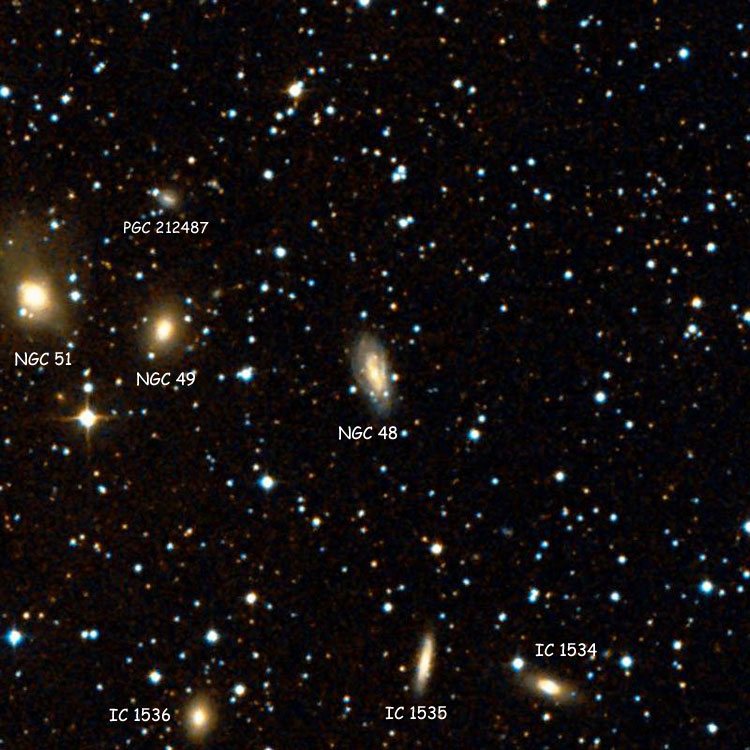
Above, a 12 arcmin wide DSS image centered on NGC 48, also showing NGC 49 and 51
Also shown are IC 1534, 1535 and 1536, and PGC 212487
Below, a 1.5 arcmin wide DSS image of NGC 48

Below, a 1.5 arcmin wide PanSTARRS image of NGC 48
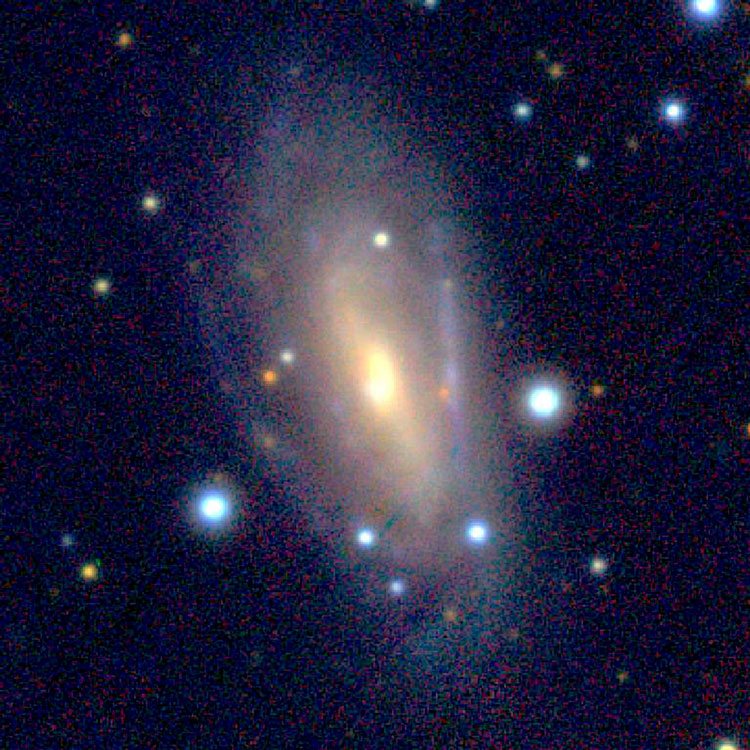
NGC 49
(= PGC 952 = UGC 136 = CGCG 549-029 = MCG +08-01-033)
Discovered (Sep 7, 1885) by Lewis Swift
Also observed (Jul 6, 1888) by Edward Barnard
Also observed (Oct 13, 1890) by Guillaume Bigourdan
A magnitude 13.7 lenticular galaxy (type S0?) in Andromeda (RA 00 14 22.4, Dec +48 14 47)
Historical Identification: Per Dreyer, NGC 49 (Swift list II (#7), 1860 RA 00 07 37, NPD 42 31.3) is "most extremely faint, small, round, 2nd of 3", the others being NGC 48 and 51. The second Index Catalog lists a corrected RA (per Bigourdan and Barnard) of 00 07 02; using that and the original NPD the position precesses to (2000) RA 00 14 21.9, Dec +48 15 25, about 0.6 arcmin north of the center of the galaxy listed above, and not far from its northern border. Aside from that, it is obviously the "2nd of 3", or the middle galaxy among NGC 48, 49 and 51, so the identification is certain.
Discovery Note: Barnard's observations of NGC 48, 49 and 51 (and several other nebulae), though made in 1888, were not recorded in a paper until 1897, and the envelope containing the paper was mislaid for nine years, so it wasn't published until 1906!
Physical Information: Based on a recessional velocity of 4775 km/sec (and H0 = 70 km/sec/Mpc), NGC 49 is about 220 million light-years away. Given that and its apparent size of about 1.0 by 0.7 arcmin (from the images below), it is about 70 thousand light-years across.
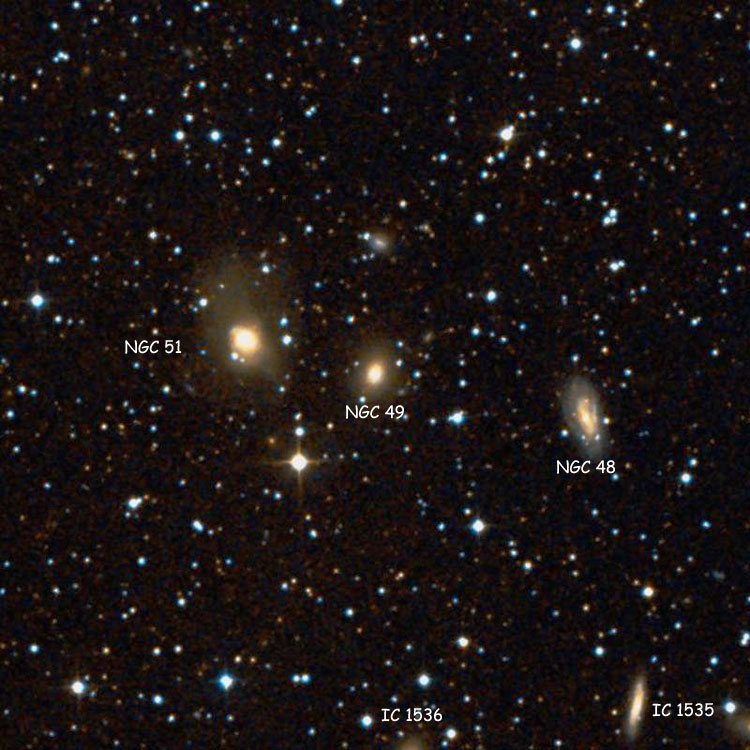
Above, a 12 arcmin wide DSS image centered on NGC 49, also showing ??
Below, a 1.2 arcmin wide DSS image of the galaxy
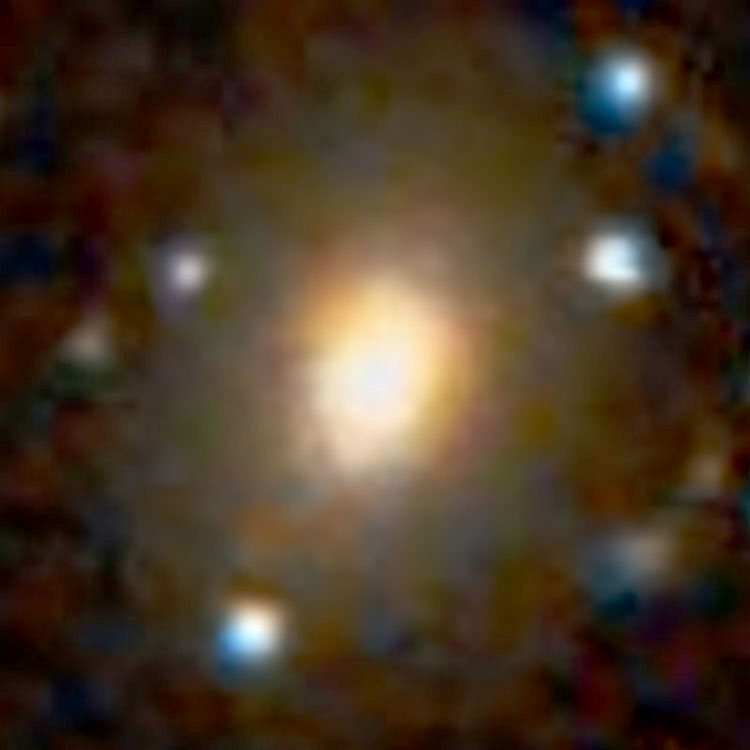
Below, a 0.75 arcmin wide PanSTARRS image of the nucleus of the galaxy

|