QuickLinks:
50, 51, 52, 53, 54, 55, 56, 57, 58, 59, 60, 61, 62, 63, 64, 65, 66, 67, 68, 69, 70, 71, 72, 73, 74,
75, 76, 77, 78, 79, 80, 81, 82, 83, 84, 85, 86, 87, 88, 89, 90, 91, 92, 93, 94, 95, 96, 97, 98, 99
Page last updated Aug 23, 2023 (Added Caldwell & other IDs to NGC 55)
Page last updated Apr 9, 2022
Did final check of positions and found no errors
Checked designations vs Steinicke database
Added minor notes about the de Vaucouleurs Atlas, various Arp objects
Re-checked/updated Corwin positions, companions
Updated designations, most formatting
Last prior update 2017:
Checked historical references, Dreyer NGC entries, corrected a couple of minor errors
WORKING 72/72A, 90-91: Checking everything for clarity/accuracy/completeness
NGC 50
(= PGC 983 = MCG -01-01-058)
Discovered (1865) by Gaspare Ferrari
Reported (1866) by Angelo Secchi
Also observed (1886) by Wilhelm Tempel
Also observed (Oct 21, 1886) by Lewis Swift
A magnitude 12.3 lenticular galaxy (type E/SAB0?) in Cetus (RA 00 14 44.6, Dec -07 20 42)
Historical Identification: Per Dreyer, NGC 50 (= GC 5092, Secchi (#13), 1860 RA 00 07 39, NPD 98 08.8) is "very faint". The position precesses to RA 00 14 48.0, Dec -07 22 05, about 1.8 arcmin southeast of the center of the galaxy listed above and close to its southeastern border, and there is nothing else nearby, so the identification is certain.
Discovery Notes: Although Ferrari discovered the nebula, its observation was published by Secchi, whence Dreyer's attribution. Tempel's observation of this region was never published, but he must have sent his results to Dreyer, as he noted Tempel's observations of NGC 47 and 54; but since NGC 50 is the brightest of the three galaxies in the region Tempel must have seen it as well, and (per Corwin and Steinicke) Dreyer's failure to credit Tempel with an observation of NGC 50 was probably an oversight. (Though it might have been deliberate, since he also ignored Swift's nearly contemporaneous observation in the NGC entry.)
Swift recorded this object as his list V #1, stating that it was "pretty bright, pretty small, round, very much brighter middle, 1st of 3". His position precesses to RA 00 14 57.4, Dec -07 21 08, about 3 arcmin east of the galaxy, and a comparison with his observation of NGC 54 (his "2nd of 3") shows a similar positional error. Given Ferrari's earlier observation, Dreyer's not mentioning Swift's observation is not surprising, but it bears mentioning here as his "1st of 3" in connection with his observations of NGC 54 and 58 (his "3rd of 3", though actually the westernmost).
Physical Information: Based on a recessional velocity of 5700 km/sec (and H0 = 70 km/sec/Mpc), NGC 50 is about 265 million light years away. Given that and its apparent size of about 2.8 by 2.2 arcmin (from the images below, counting its extensive halo), it is about 215 to 220 thousand light years across.

Above, a 12 arcmin wide SDSS image centered on NGC 50
Also see NGC 58 for a wide-field view of NGC 50, 54 and 47 (= NGC 58)
Below, a 3 arcmin wide SDSS image of the galaxy

Below, a 12 arcmin wide SDSS image centered on NGC 50
Also shown are PGC 943, 971, 972 and 996, and PGC objects 1018921, 1021293 and 1021824

PGC 971
(= MCG -01-01-057)
Not an NGC object but listed here as a possible companion of NGC 50
A magnitude 14.5(?) galaxy (type S0/a?) in Cetus (RA 00 14 40.4, Dec -07 17 45)
Physical Information:
LEDA S0/a, B 15.3, I 13.2, (V) 14.5(?); NED 3K Vr 5015 km/sec; the heliocentric Vr is about 340 km/sec less than for NGC 50, so PGC 971 may be a foreground galaxy; but depending on the peculiar velocities of the two galaxies, they might be companions.
PGC 972
(= MCG -01-01-056)
Not an NGC object but listed here as an apparent/possible companion of NGC 50
A magnitude 15.5(?) galaxy (type S pec? E?) in Cetus (RA 00 14 41.1, Dec -07 16 47)
Physical Information:
LEDA B 16.1, I 17.6(??), K 12.8; NED 16(no bandwidth listed), 3K Vr 4798 km/sec; probably a foreground galaxy
NGC 51
(= PGC 974 = UGC 138 = CGCG 549-031 = MCG +08-01-035)
Discovered (Sep 7, 1885) by Lewis Swift
Also observed (Jul 6, 1888) by Edward Barnard
Also observed (Oct 13, 1890) by Guillaume Bigourdan
A magnitude 13.1 lenticular galaxy (type S0(rs)a? pec) in Andromeda (RA 00 14 34.9, Dec +48 15 20)
Historical Identification: Per Dreyer, NGC 51 (Swift list II (#8), 1860 RA 00 07 47, NPD 42 31.6) is "pretty faint, pretty small, round, brighter middle". The second Index Catalog lists a corrected 1860 RA (per Bigourdan and Barnard) of 00 07 15; using that and the original NPD the position precesses to RA 00 14 35.1, Dec +48 15 07, only 0.2 arcmin from the center of the galaxy listed above, so the identification is certain.
Discovery Note: Barnard's observations of NGC 48, 49 and 51 (and several other nebulae), though made in 1888, were not recorded in a paper until 1897, and the envelope containing the paper was mislaid for nine years, so it wasn't published until 1906!
Physical Information: Based on a recessional velocity of 5350 km/sec (and H0 = 70 km/sec/Mpc), NGC 51 is about 250 million light years away. Given that and its apparent size of about 2.35 by 1.4 arcmin (from the images below, including its distorted extensions), it is about 170 thousand light years across.

Above, a 12 arcmin wide SDSS image centered on NGC 51, also showing NGC 48 and 49 and PGC 212487
Below, a 2.6 arcmin wide DSS image of the galaxy

Below, a 1.25 arcmin wide PanSTARRS image of the nucleus of the galaxy

NGC 52
(= PGC 978 = UGC 140 = CGCG 456-042 = MCG +03-01-030)
Discovered (Sep 18, 1784) by William Herschel
Also observed (Aug 26, 1827) by John Herschel
Also observed (Nov 13, 1889) by Guillaume Bigourdan
A magnitude 13.4 spiral galaxy (type Sbc?) in Pegasus (RA 00 14 40.1, Dec +18 34 55)
Historical Identification: Per Dreyer, NGC 52 (= GC 25 = JH 11 = WH III 183, 1860 RA 00 07 48, NPD 72 14.3) is "very faint, small, extended". The second Index Catalog lists a corrected RA (per Bigourdan) of 00 07 28; using that and the original NPD, the position precesses to RA 00 14 41.4, Dec +18 32 25, nearly 2 arcmin south of the galaxy listed above, there is nothing else nearby and the elongated appearance of its brighter portion confirms the identification.
Physical Information: Based on a recessional velocity of 5390 km/sec (and H0 = 70 km/sec/Mpc), NGC 52 is about 250 to 255 million light years away, in good agreement with redshift-independent distance estimates of 210 to 285 million light years. Given that and its apparent size of about 2.2 by 0.35 arcmin (from the images below), it is about 160 thousand light years across.

Above, a 12 arcmin wide SDSS image centered on NGC 52
Below, a 2.4 arcmin wide SDSS image of the galaxy, also showing PGC 1563523

Below, a 12 arcmin wide centered on NGC 52
Also shown are PGC objects 212489, 1561202, 1563523, 1564261 and 1565741

PGC 1563523
Not an NGC object but listed here as an apparent companion of NGC 52
A magnitude 16(?) galaxy (type ?) in Pegasus (RA 00 14 37.3, Dec +18 34 23)
Physical Information:
LEDA B 16.8; NED 3K Vr 5836 km/sec (800 km/sec less than NGC 52, so probably a foreground galaxy)
NGC 53
(= PGC 982 = ESO 111-020)
Discovered (Sep 15, 1836) by John Herschel
A magnitude 12.6 spiral galaxy (type (R)SB(r)ab) in Tucana (RA 00 14 42.9, Dec -60 19 42)
Historical Identification: Per Dreyer, NGC 53 (= GC 26 = JH 2314, 1860 RA 00 07 53, NPD 151 06.2) is "extremely faint, small, round, brighter middle". The position precesses to RA 00 14 46.8, Dec -60 19 28, less than an arcmin east of the center of the galaxy listed above and within its outline, so the identification is certain.
Warning About Apparent Companion "PGC 977": As shown in the second image below, NGC 53 has a double star near its northeastern rim, and a faint object (J0014404.-601838) which appears to be an extension of one of its spiral arms near its northern rim. J0014404-601838 is actually a very distant galaxy (completely unrelated to NGC 53), which is often misidentified as PGC 977 (which is the double star to the northeast of NGC 53 and is also unrelated to NGC 53, since like all stars visible in such images it is inside our own galaxy). Because of the misidentification of J0014404-601838 as PGC 977, its physical attributes are often mistakenly attached to the double star.
Physical Information: Based on a recessional velocity of 4570 km/sec (and H0 = 70 km/sec/Mpc), NGC 53 is about 210 to 215 million light years away. Given that and its apparent size of about 2.15 by 1.7 arcmin (from the images below), it is about 130 thousand light years across.
Use By The de Vaucouleurs Atlas: NGC 53 is used by the de Vaucouleurs Atlas of Galaxies as an example of type (R')SB(r)ab.

Above, a 12 arcmin wide DSS image centered on NGC 53
Below, a 2.7 arcmin wide DSS image of NGC 53, PGC 977 and J001440.4-601838

Below, a 2.2 by 2.5 arcmin wide image shows PGC 977 as merely a double star (de Vaucouleurs Atlas of Galaxies)

Below, a 12 arcmin wide region centered on the galaxy, also showing PGC objects 977, 364114 and 364446

WISEA J001440.54-601838.7
Not an NGC object but listed here as an apparent companion of NGC 53
A magnitude 19(?) galaxy (type ?) in Tucana (RA 00 14 40.5, Dec -60 18 39)
Physical Information: Not listed in LEDA; NED misidentifies as PGC 977, magnitude 19.1 (bandwidth?), 3K Vr 37166 km/sec, z 0.12397235; definitely an extremely distant background galaxy, and not a companion of NGC 53
NGC 54
(= PGC 1011 = MCG -01-01-060)
Discovered (1886) by Wilhelm Tempel
Also observed (Oct 21, 1886) by Lewis Swift
A magnitude 13.4 spiral galaxy (type SAB(r)ab?) in Cetus (RA 00 15 07.7, Dec -07 06 24)
Historical Identification: Per Dreyer, NGC 54 (Tempel, Swift list V (#2), 1860 RA 00 07 58, NPD 97 54.3) is "very faint, pretty small, round, 5092 to southwest", (GC) 5092 being NGC 50. The position precesses to RA 00 15 07.0, Dec -07 07 35, only an arcmin south of the galaxy listed above, there is nothing else nearby and as shown in the widefield image for NGC 58 (= NGC 47), NGC 50 is to the southwest, so the identification is certain.
Discovery Notes: This is the "2nd of 3" noted by Swift in his list V, and his position falls to the east of the galaxy, just as his positions for NGC 50 and 58 fall to the east of those galaxies (though not by the same amount in the case of NGC 58), confirming that he really did observe all three galaxies on the night in question.
Physical Information: Based on a recessional velocity of 5335 km/sec (and H0 = 70 km/sec/Mpc), NGC 54 is about 245 to 250 million light years away. Given that and its apparent size of about 1.05 by 0.35 arcmin (based on the images below), it is about 75 thousand light years across.

Above, a 12 arcmin wide SDSS image centered on NGC 54
Below, a 1.4 arcmin wide SDSS image of the galaxy

Below, a 12 arcmin wide SDSS image centered on NGC 54, also showing PGC objects 1023173 and 1024961

NGC 55, the "Whale" Galaxy
(= C72 = PGC 1014 = ESO 293-050 = MCG -07-01-013)
Discovered (Jul 7, 1826) by James Dunlop
Also observed (Sep 4, 1834) by John Herschel
A magnitude 7.9 spiral galaxy (type SB(s)m?) in Sculptor (RA 00 14 53.9, Dec -39 11 54)
Historical Identification: Per Dreyer, NGC 55 (= GC 27 = JH 2315, Dunlop 507, 1860 RA 00 08 00, NPD 129 59.6) is "very bright, very large, very much extended, triple nucleus". The position precesses to RA 00 15 02.5, Dec -39 12 53, well within the central part of the galaxy listed above, so the identification is certain.
IC 1537: As indicated by Dreyer's description, the galaxy contains several regions which could be seen as separate objects due to the galaxy's relatively small distance. One of the eastern star-forming regions, well separated from the brighter western part of the galaxy, was later designated IC 1537 (as shown in two of the images below, and in a large-scale image viewable on a separate page).
Note About Nickname: Although this galaxy is sometimes called the Whale Galaxy, that term is more often used to refer to NGC 4631 (= C32), hence my putting it in quotes. .
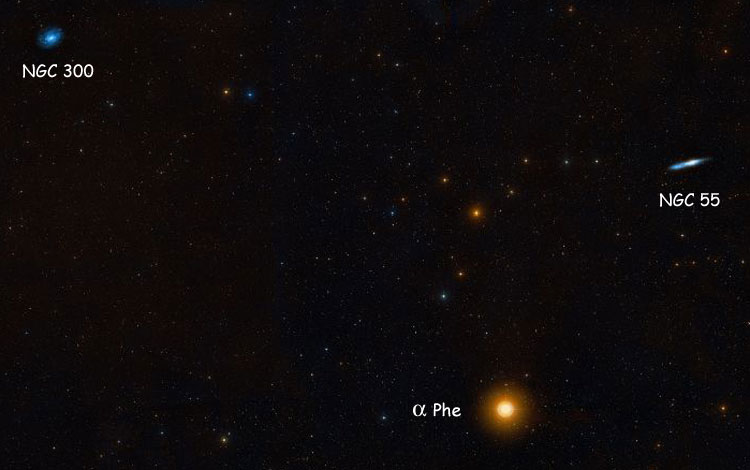
Physical Information: NGC 55 is an apparently irregular galaxy, but more likely an edge-on barred spiral. Its recessional velocity is only 130 km/sec, too small to be a reliable indicator of distance, though the 6 million light year distance corresponding to that redshift (using H0 = 70 km/sec/Mpc) is in the middle of redshift-independent distance estimates ranging from 4 to 8 million light years. Given that and its apparent size of about 30 by 4 arcmin (from the images below), it is about 55 thousand light years across. NGC 55 and NGC 300 are only a million or so light years apart, and are thought be a gravitationally bound pair (the bottom image shows their relative positions). Until recently they were considered members of the Sculptor group of galaxies, but are now known to be foreground galaxies.

Above, a half degree wide image of NGC 55 (Image Credit above and below ESO)
Click here or on the image above for a 3 megapixel version
Below, a quarter degree wide image of the western portion of the galaxy
Also shown are PGC objects 124782, 599244 and 601905

Below, a quarter degree image of the eastern portion of NGC 55
Star-forming region IC 1537 is also shown (Image Credit as above)

Below, the image above with labels for many other galaxies, including PGC objects 107623, 124643,
124647, 171726, 599357, 600275, 600628, 601019, 601041, and 601552

Below, a 9 degree wide DSS image of the region between NGC 55 and NGC 300
The bright star at the bottom is Ankaa, or α Phoenicis
NGC 56
(= "PGC 5067597")
Recorded (Oct 13, 1825) by John Herschel
An apparently nonexistent object in Pisces (RA 00 15 21.2, Dec +12 26 44)
Historical Identification: Per Dreyer, NGC 56 (= GC 28 = JH 12, 1860 RA 00 08 09, NPD 78 20.0) is "extremely faint, extremely large, diffuse". The position precesses to RA 00 15 21.3, Dec +12 26 43, but there is nothing there. Sometimes Dreyer's rounded-off values are a bit off the original position, but in this case Herschel's position (1860 RA 00 08 08.9, NPD 78 19 58.8) is so nearly identical that it makes virtually no difference (as shown by the nearly identical position listed above, obtained by precessing Herschel's position). Per Corwin, the other objects observed by Herschel in the same "sweep" of the sky are where he recorded them, so it is unlikely that the position is in error. Instead, Corwin suggests that Herschel observed an internal telescope reflection due to the glare of Algenib (γ Pegasi), which lies about two degrees to the north, but whatever Herschel thought he saw is either lost, or more likely nonexistent. ( Corwin's website contains a long discussion of other possibilities raised over the years, such as one extended nebulosity or another, or even the gegenschein, giving a good explanation of why none of them are reasonable, so the net result is the same; there is nothing real that Herschel could have seen anywhere near his position.)
Note About PGC Designation: As in the case of most NGC objects, HyperLEDA assigns a PGC designation to this "object", even though it apparently doesn't exist; but a search of the database for that designation returns no result, so it is shown in quotes.

Above, a 12 arcmin DSS image centered on the supposed position of NGC 56 (shown by a box)
NGC 57
(= PGC 1037 = UGC 145 = CGCG 456-046 = MCG +03-01-031)
Discovered (Oct 8, 1784) by William Herschel
Also observed (Aug 26, 1827) by John Herschel
A magnitude 11.6 elliptical galaxy (type E1?) in Pisces (RA 00 15 30.9, Dec +17 19 42)
Historical Identification: Per Dreyer, NGC 57 (= GC 29 = JH 13 = WH II 241 = WH II 243, 1860 RA 00 08 18, NPD 73 26.9) is "faint, small, round, suddenly brighter middle". The position precesses to RA 00 15 31.2, Dec +17 19 49, within 0.1 arcmin of the center of the galaxy listed above, so the identification is certain. However, there has been a long history of confusion about the identity of WH II 241 and 243, so the proof of their equality is shown below (if you would like to skip the gory details, click here).
Recent Confusion About WH II 241/243: In late 2014, Steinicke's database for all NGC/IC observations listed William Herschel's date of observation for NGC 57 as Oct 8, 1784, but his database for John Herschel's observations listed the date of William Herschel's observation as Oct 11, 1784. The difference was caused by the historical confusion involving WH II 241 and WH II 243, which were observed on Oct 8 and 11, 1784, respectively. More recently updated versions of Steinicke's databases equate the two (as Dreyer did in the NGC), and only list Oct 8 as the date of the elder Herschel's observation of this object.
Historical Confusion About WH II 241/243: In his General Catalog John Herschel states that a manuscript note by his father equates WH II 241 and 243, and in the notes for the NGC Dreyer quotes John Herschel as follows: "57: h13 = II 241 = II 243. In P.T. (Philosophical Transactions) the determining star is omitted, and in the statement of the places of these nebulae there is much confusion (see list of errata. P.T. 1864, p.44). Auwers has threaded the intricacies of this maze with singular felicity, but has been misled in the case of II 243 into assigning to it a totally erroneous place. — J.H.". Unfortunately, as shown below, the errata also contained an error.
Examining William Herschel's Catalog (Philosophical Transactions 1786, p. 478): WH II 238 through 243 are listed in Herschel's first catalog of a thousand nebulae and clusters as shown here:
| # | Date | Comparison Star | Δ RA | | Δ Dec | Obs. | Notes |
238
239
240
241
242
243 | Oct 6
7
8
—
11
— | 26 (β) Persei
27 (κ) Persei
48 (μ) Pegasi
— — | p
p
p
f | 28 34
8 27
39 50
6 27 | | f
n
f
f | 0
0
0
0 | 10
2
54
54 | 2
1
1
1
2
2 | pB. mE. near par. mbM. 4' l 1' b.
The 1st of 2. pB. pS. r.
pF. pL. iR. er.
pS. C.
F. S. iR. near and p. 2 or 3 st.
F. S. iR. |
The dash in the date column for #241 and 243 means they were observed on the same date as the previous entry (all the dates being for 1784). The double dash in the line for the comparison star for #243 means it used the same comparison star as the previous entry. A "p" in the offset for right ascension (Δ RA) means that the object was to the west of the comparison star, while an "f" means it was to the east; the following numbers indicate the minutes and seconds of time for that offset. An "f" in the offset for declination (Δ Dec) means that the object was to the south of the comparison star (the letter "f" usually being used in place of "s" in ancient English texts), while an "n" means it was to the north; the following numbers indicate the degrees and arcminutes for that offset. "Obs." indicates how many times Herschel observed the object, and the notes at the end are in the style used by Herschel and later observers to describe the object's appearance in an abbreviated form. For instance, the note for #238 means "pretty bright, much extended near parallel (that is, along the declination line), much brighter middle, 4 arcmin long and 1 arcmin broad".
The problem with these entries is that no comparison star or offset is listed for #240 and 241, which makes it impossible to know where they are, and what celestial objects they correspond to. Those are the "errata" mentioned by John Herschel in Dreyer's NGC Note.
Examining John Herschel's Catalog (Philosophical Transactions 1864, pp. 44-45): On page 45 of Herschel's Catalogue of Nebulae and Clusters of Stars, almost always called the "General Catalog" or GC, he states "The following nebulae are declared in MS. notes to be identical", presumably referring to unpublished handwritten notes by William Herschel, among which we find "II. 243 = II. 241". This is the source of the equality listed in the GC for entry #29, and by Dreyer for NGC 57. However, Herschel also makes the following corrections to his father's catalog (on page 44 of the GC):
| WH II | | GC | | Error and Correction |
239
240
241
242
243 | | 634
5046
29
4973
29 | |
for 27 (κ) Persei p. 8m 20s, n. 0° 2' read 30 Persei p. 14m 41s, n. 0° 51'
for ....................... read 39 Pisc. p. 2m 24s, n. 1° 0'
for ....................... read 39 Pisc. p. 14m 24s, s. 0° 11'
for 48 (μ) Pegasi read 87 (υ) Pegasi
(not listed, but supposed to be the same comparison star as #242) |
A Perplexing Analysis: Since the question here is whether WH II 243 = WH II 241 = NGC 57, I will only consider the Errors and Corrections in John Herschel's table that affect those objects. The simpler calculation involves WH II 243, which (per WH's catalog) is 6m 27s of time to the east and 54' to the south of its comparison star, which (per JH's catalog) was 87 Pegasi (the same star as the one used for WH II 242). The modern (J2000) position of that star is RA 00 09 02.4, Dec +18 12 43. The star has a moderately large proper motion (+0.140"/year in right ascension and -0.0256"/year in declination), so in the 216 years between 1784 and 2000 it has moved 2.0s of time to the east and 6" to the south, meaning that in modern coordinates its position in 1784 was RA 00 09 00.4, Dec +18 12 49. Precessing that to the equinox of 1784, when William Herschel used it as a comparison star, its position was (1784) RA 23 57 55.3, Dec +17 00 39. Applying the offsets for WH II 243, that object should have been somewhere near (1784) RA 00 04 22.3, Dec +16 06 39. This precesses to J2000 RA 00 15 29.7, Dec +17 18 45, less than an arcmin south southwest of NGC 57 and within its southwestern outline, so WH II 243 must be NGC 57.
Now let's do the same thing for WH II 241. The modern position of its comparison star (39 Piscium) is J2000 RA 00 17 50.0, Dec +16 19 52. It also has a moderately high proper motion (+0.220"/year in right ascension and -0.0282"/year in declination), so in the 216 years between 1784 and 2000 it has moved 3.2s of time to the east and 3" to the south, meaning that in modern coordinates its position in 1784 was RA 00 17 46.8, Dec +16 19 55. Precessing that to the equinox of 1784, when William Herschel used it as a comparison star, its position was (1784) RA 00 06 38.8, Dec +15 07 51. Applying the offsets for WH II 241 given in JH's Errors and Corrections, that object should have been somewhere near (1784) RA 23 52 14.8, Dec +14 56 51. This precesses to J2000 RA 00 03 17.7, Dec +16 09 01, which lies on the eastern rim of NGC 7814(!?!). But if that were true, WH II 241 would lie 12 minutes of time and more than a degree south of WH II 243, and if so, how could William Herschel have possibly thought the two observations were of the same object?
(Finally!) A Simple Solution: There is a simple way to explain the strange result above. Namely, John Herschel must have mixed up the corrections for WH II 240 and WH II 241. Doing that would mean that WH II 240 is NGC 7814 (which is how it is listed in the GC and NGC), and given the difference in the position listed for WH II 240 and WH II 241 in the GC's Errors and Corrections, the 1784 position of WH II 241 would be 12m of time to the east and 1° 11' to the north of the one calculated in the last paragraph (namely, somewhere near (1784) RA 00 04 14.8, Dec +16 07 51). That would give WH II 241 a modern position near J2000 RA 00 15 22.2, Dec +17 19 57, about 2 arcmin west northwest of NGC 57, and since there is nothing else nearby, make WH II 241 = WH II 243 = GC 29 = NGC 57, as stated in one way or another by the Herschels and Dreyer. So WH's statement that WH II 241 = II 243 was correct, and JH's corrections to his father's catalog were correct except that he inadvertently switched the corrections for WH II 240 and 241. And since NGC 57 was observed as WH II 241 on Oct 8, 1784, that is the correct discovery date.
Physical Information: Based on a recessional velocity of 5440 km/sec (and H0 = 70 km/sec/Mpc), NGC 57 is about 250 to 255 million light years away, in good agreement with redshift-independent distance estimates of 230 to 275 million light years. Given that and its apparent size of about 2.3 by 1.8 arcmin (from the images below), it is about 170 thousand light years across.

Above, a 12 arcmin wide SDSS image centered on NGC 57
Below, a 2.7 arcmin wide SDSS image of the galaxy

NGC 58 (= NGC 47)
(= PGC 967 = MCG -01-01-055)
Discovered (1886) by Wilhelm Tempel (and later listed as NGC 47)
Discovered (Oct 21, 1886) by Lewis Swift (and later listed as NGC 58)
Also observed (late September to Dec 31, 1897) by Herbert Howe (while listed as NGC 58)
A magnitude 13.1 spiral galaxy (type SB(rs)bc?) in Cetus (RA 00 14 30.6, Dec -07 10 03)
Historical Identification: Per Dreyer, NGC 58 (Swift list V (#3), 1860 RA 00 08 28, NPD 97 56.8) is "very faint, pretty small, round". The position precesses to RA 00 15 37.0, Dec -07 10 05, but there is nothing there. However, in his list of objects observed in late 1897 Herbert Howe wrote, "58. I cannot find this, having hunted diligently for it on two nights. Its neighbours 47 and 54 are easily seen. Probably the R.A. given for 58 is just a minute too great, and it is really identical with 47, which is a Tempel nebula." Dreyer accepted the suggestion, stating in the IC2, "Not found twice by Howe. Probably = (NGC) 47". Applying Howe's suggested correction the position precesses to RA 00 14 37.1, Dec -07 10 05, less than 7 seconds of time to the east of NGC 47. Given the fact that this is Swift's "3rd of 3" observed on Oct 21, 1886, and with Howe's correction all of Swift's positions for that night fall a reasonably similar distance to the east of the objects presumed to be what he observed, the equality of NGC 58 with NGC 47 is considered certain.
Discovery Note: Swift apparently labeled the galaxies he discovered on the night in question according to his recorded positions, and since the position for his V-3 was a minute of time too far to the east he listed it as "3rd of 3"; but since it is actually a minute of time to the west of his position, it is actually the "1st of 3", being the westernmost of the three galaxies ( NGC 50, 54 and 47 (= NGC 58)) that he observed on that evening (as shown in the image below).
Physical Information: Given the duplicate entry, see NGC 47 for anything else.

Above, an 18 arcmin wide SDSS image showing the galaxies (NGC 47, 50 and 54) observed by Swift
Below, a similar image also showing numerous PGC objects:
(PGC 971, 972, 996, 1020898, 1021293, 1021824, 1022508, 1023173, 1023515 & 1024587)

NGC 59
(= PGC 1034 = ESO 539-004 = MCG -04-01-026)
Discovered (Nov 10, 1885) by Ormond Stone
A magnitude 12.4 spiral galaxy (type SA(rs)a? pec) in Cetus (RA 00 15 25.1, Dec -21 26 39)
Historical Identification: Per Dreyer, NGC 59 (Ormond Stone list I (#1), 1860 RA 00 08 30, NPD 112 13) is "very faint, pretty small, irregularly round, gradually brighter middle". The position precesses to RA 00 15 36.3, Dec -21 26 17, about 3 arcmin east of the galaxy listed above, but there is nothing else nearby and (per Corwin) Stone made a sketch of the area which matches the surrounding stars, so the identification is certain.
Physical Information: The recessional velocity of NGC 59 is only 362 km/sec, too small in comparison to peculiar (non-Hubble expansion) velocities to guarantee a reasonable estimate of its distance, but the 17 million light year distance derived from the recessional velocity (and H0 = 70 km/sec/Mpc) is in good agreement with redshift-independent distance estimates of 14 to 17 million light years. Given that and its apparent size of about 2.9 by 1.5 arcmin (from the images below), NGC 59 is about 14 thousand light years across, making it a dwarf galaxy. It is probably a member of the Sculptor Group of galaxies, a loosely bound cluster near the south galactic pole. The nucleus of the galaxy contains an extended region of stellar activity, including two very bright star-forming regions, suggesting that something unusual happened to the galaxy in the relatively recent past.
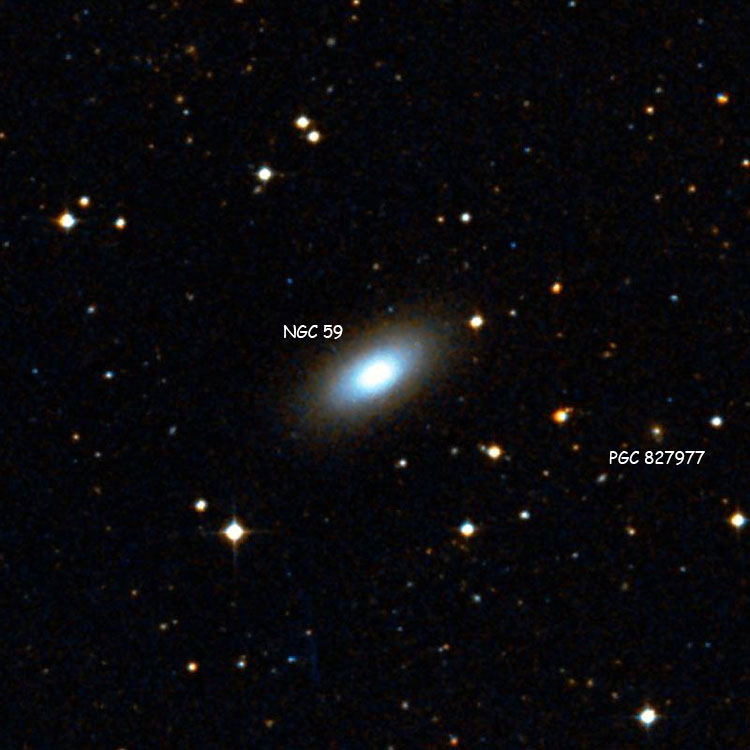
Above, a 12 arcmin wide DSS image centered on NGC 59, also showing PGC 827977
Below, a 3 arcmin wide DSS image of the galaxy

Below, a 0.6 arcmin wide monochrome PanSTARRS image of the nucleus of the galaxy

NGC 60
(= PGC 1058 = UGC 150 = CGCG 382-037 = MCG +00-01-048)
Discovered (Nov 2, 1882) by Édouard Stephan
A magnitude 14.1 spiral galaxy (type SA(rs)cd? pec) in Pisces (RA 00 15 58.2, Dec -00 18 13)
Historical Identification: Per Dreyer, NGC 60 (Stephan list XII (#4), 1860 RA 00 08 48, NPD 91 04.9) is "extremely faint, very small, round, a little brighter middle". The position precesses to RA 00 15 58.2, Dec -00 18 11, dead center on the galaxy listed above, so the identification is certain.
Physical Information: Based on a recessional velocity of 11825 km/sec (and H0 = 70 km/sec/Mpc), a straightforward calculation indicates that NGC 60 is about 550 million light years away. However, for objects at such distances we should take into account the expansion of the Universe during the time it took their light to reach us. Doing that shows that the galaxy was about 525 million light years away at the time the light by which we see it was emitted, about 535 million years ago (the difference between the two numbers being due to the expansion of the intervening space during the light-travel time). Given that and its apparent size of about 1.3 by 1.1 arcmin (from the images below), it is about 200 thousand light years across. The distorted shape of NGC 60 is typical of galaxies gravitationally interacting with other galaxies. The most likely culprit is PGC 3111352, the small galaxy near the eastern edge of the NGC 60, as it has a very similar recessional velocity.

Above, a 12 arcmin wide SDSS image centered on NGC 60
Below, a 1.5 arcmin wide SDSS image of the galaxy

Below, a version of the image above also showing PGC 3111352 and 4676913

Below, a 12 arcmin wide SDSS image centered on the galaxy, also showing PGC 1060, 212494,
1145124, 1147628, 2822104, 3111347, 3111396 and 3111611, two of which are quasars
Q0016026-002035 refers to SDSSJ001602.63-002035.4, a 20th magnitude quasar with z = 2.249
PGC 1060 is an 18th magnitude quasar with z = 2.087, and PGC 2822104 is a 20th magnitude quasar with z = 1.575

PGC 3111352
Not an NGC object but listed here as a probable companion of NGC 60
A magnitude 17(?) lenticular galaxy (type S0/a?) in Pisces (RA 00 15 59.7, Dec -00 18 18)
Physical Information:
LEDA S0/a, B 17.7, I 16.5, (V) 17(?); NED 3K Vr 11529 km/sec (helio 11883 km/sec), z 0.03845619565766; almost certainly an actual companion of NGC 60
NGC 61
(= "PGC 3166356" [= PGC 1083 (= MCG -01-01-062) + PGC 1085 (= MCG -01-01-063)])
Discovered (Sep 10, 1785) by William Herschel
Also observed (Oct 9, 1828) by John Herschel
A pair of galaxies in Cetus (avg position RA 00 16 24.2, Dec -06 19 11)
PGC 1083 = A magnitude 13.8 lenticular galaxy (type S0/a? pec) at RA 00 16 24.4, Dec -06 19 19
PGC 1085 = A magnitude 14.3 lenticular galaxy (type S0? pec) at RA 00 16 24.1, Dec -06 19 03
Historical Identification: Per Dreyer, NGC 61 (= GC 30 = JH 14 = WH III 428, 1860 RA 00 09 15, NPD 97 05.8) is "very faint, small, irregularly round, pretty suddenly a very little brighter middle". The position precesses to RA 00 16 24.0, Dec -06 19 06, right on the northern member of the pair of galaxies listed above, so the identification is certain.
Discovery Notes: Since the Herschels would have more easily seen the brighter galaxy, the southern member of the pair (PGC 1083) is often considered to be all that they observed. But between the NGC's "irregularly round" and the elder Herschel's description of III 428's "irregular figure", the observations were probably affected by the fainter galaxy as well, whence my decision to list the pair as the NGC object, instead of only the brighter galaxy.
Note About The PGC Designations: As shown in the title of this entry, NGC 61 consists of a pair of galaxies, each of which has its own PGC designation; but HyperLEDA also assigned a PGC designation to the pair (= NGC 61), and a search for that designation returns no result, hence its being shown in quotes (a search for NGC 61 or the individual PGC designations works perfectly well).
Physical Information: Based on a recessional velocity of 7945 km/sec (and H0 = 70 km/sec/Mpc), a straightforward calculation indicates that PGC 1083 is about 370 million light years away, while PGC's recessional velocity of 8150 km/sec corresponds to 380 million light years' distance. However, their distorted shapes suggest that the apparent pair is also a physical pair and is gravitationally interacting, so the difference in their radial velocities is probably due to their motion relative to each other (that is, their "peculiar velocities"), and they would actually be at the same distance (of about 375 million light years). However, for objects at such distances we should take into account the expansion of the Universe during the time it took their light to reach us. Doing that using the average of their recessional velocities shows that the pair was about 360 to 365 million light years away at the time the light by which we see it was emitted, about 365 to 370 million years ago (the difference between the two numbers being due to the expansion of the intervening space during the light-travel time). Given that, PGC 1083's apparent size of about 1.2 by 0.5 arcmin corresponds to about 125 to 130 thousand light years, while PGC 1085's apparent size of 0.7 by 0.45 arcmin corresponds to about 75 thousand light years, and the overall size of the pair of about 1.5 by 1.3 arcmin corresponds to about 155 to 160 thousand light years (all apparent sizes from the images below). Note: Each galaxy is sometimes misidentified as the other, and even when correctly identified it is not unusual for the brighter southeastern galaxy to be listed as being the fainter one. Given that confusion, it might be better to treat the pair as the NGC object even if the Herschels didn't see both galaxies.

Above, a 12 arcmin wide SDSS image centered on NGC 61
Below, a 1.9 arcmin wide SDSS image of the pair

Below, a 12 arcmin wide SDSS image centered on the pair, also showing PGC 1034411 and 1034445

NGC 62
(= PGC 1125 = MCG -02-01-043)
Discovered (Oct 8, 1883) by Édouard Stephan
Also observed (1886) by Francis Leavenworth
A magnitude 13.2 spiral galaxy (type (R)SAB(r)ab?) in Cetus (RA 00 17 05.4, Dec -13 29 14)
Historical Identification: Per Dreyer, NGC 62 (Stephan list XIII (#2), Ormond Stone list I (#2), 1860 RA 00 09 57, NPD 104 15.9) is "faint, very small, round, gradually a little brighter middle". The position precesses to RA 00 17 04.5, Dec -13 29 12, only 0.2 arcmin west of the center of the galaxy listed above and well within its outline, so the identification is certain.
Discovery Notes: Although Dreyer credits Ormond Stone's paper, the paper states that Francis Leavenworth did the actual observation.
Physical Information: Based on a recessional velocity of 6465 km/sec (and H0 = 70 km/sec/Mpc), NGC 62 is about 300 million light years away. Given that and its apparent size of about 0.95 by 0.65 arcmin (from the images below, counting its faint outer regions), it is about 80 to 85 thousand light years across.

Above, a 12 arcmin wide SDSS image centered on NGC 62
Below, a 1 arcmin wide SDSS image of the galaxy

NGC 63
(= PGC 1160 = UGC 167 = CGCG 433-042 = MCG +02-01-030)
Discovered (Aug 27, 1865) by Heinrich d'Arrest
Independently discovered (Sep 30, 1867) by Truman Safford
Also observed (Aug 16, 1868) by Hermann Vogel
A magnitude 11.7 spiral galaxy (type SAB(rs)a? pec) in Pisces (RA 00 17 45.5, Dec +11 27 01)
Historical Identification: Per Dreyer, NGC 63 (= GC 5093, d'Arrest, 1860 RA 00 10 33, NPD 79 19.7) is "pretty faint, small, round, suddenly brighter middle". The position precesses to RA 00 17 45.5, Dec +11 26 59, dead center on the galaxy listed above, so the identification is certain.
Discovery Notes: Safford's observations were not published until 1887, at which time it was too late to include them in the NGC. Dreyer did add a selection of his observations in an appendix to the NGC, but it was impractical to change the individual entries. Vogel's observation was listed in an 1876 paper as a reobservation of a "d'Arrest Nova", so there was no reason for Dreyer to credit Vogel as a co-discoverer.
Physical Information: Based on a recessional velocity of 1160 km/sec (and H0 = 70 km/sec/Mpc), NGC 63 is about 55 million light years away, in reasonable agreement with redshift-independent distance estimates of 60 to 62 million light years. Given that and its apparent size of about 1.55 by 0.9 arcmin (from the images below), it is about 25 thousand light years across.

Above, a 12 arcmin wide SDSS image centered on NGC 63
Below, a 1.8 arcmin wide SDSS image of the galaxy

Below, a 12 arcmin wide SDSS image centered on NGC 63, also showing PGC 138155, 138157 and 1394994

NGC 64
(= PGC 1149 = MCG -01-01-068)
Discovered (Oct 21, 1886) by Lewis Swift
Also observed (Jul 1, 1899 to Jun 30, 1900) by Herbert Howe
A magnitude 13.2 spiral galaxy (type SB(s)bc?) in Cetus (RA 00 17 30.4, Dec -06 49 29)
Historical Identification: Per Dreyer, NGC 64 (Swift list V (#4), 1860 RA 00 10 38, NPD 97 34.6) is "most extremely faint, very small, round, very difficult". The second Index Catalog lists a corrected RA (per Howe) of 00 10 22; using that and the original NPD, the position precesses to RA 00 17 30.8, Dec -06 47 54, about 1.6 arcmin north of the galaxy listed above and there is nothing else nearby, so the identification is certain.
Physical Information: Based on a recessional velocity of 7310 km/sec (and H0 = 70 km/sec/Mpc), a straightforward calculation indicates that NGC 64 is about 340 million light years distant, in good agreement with redshift-independent distance estimates of 275 to 340 million light years. However, for objects at such distances we should take into account the expansion of the Universe during the time it took their light to reach us. Doing that shows that the galaxy was about 330 million light years away at the time the light by which we see it was emitted, about 335 million years ago (the difference between the two numbers being due to the expansion of the intervening space during the light-travel time). Given that and its apparent size of about 1.85 by 0.85 arcmin (from the images below), it is about 175 to 180 thousand light years across. The distance of its apparent companion PGC 1028361 is unknown, so whether it is an actual companion or merely an optical double is also unknown.

Below, a 2 arcmin wide SDSS image of the galaxy, also showing PGC 1028361

Below, a 12 arcmin SDSS image centered on NGC 64
Also shown are PGC 1027063, 1028429, 1028632 and 1029004

PGC 1028361
Not an NGC object but listed here as an apparent companion of NGC 64
A magnitude 16(?) lenticular galaxy (type E/S0?) in Cetus (RA 00 17 31.3, Dec -06 48 45)
Physical Information:
LEDA B 17.2, K 13.5, (V) 16(?); NED no information except its position and apparent size, so whether an actual companion cannot be known.
NGC 65
(= PGC 1229 = ESO 473-010A = MCG -04-02-001)
Discovered (1886) by Frank Muller
Also observed (Jul 1, 1899 to Jun 30, 1900) by Herbert Howe
A magnitude 13.9 lenticular galaxy (type SAB0? pec?) in Cetus (RA 00 18 58.7, Dec -22 52 49)
Historical Identification: Per Dreyer, NGC 65 (Muller list II (#278), 1860 RA 00 10 53, NPD 113 40.0) is "extremely faint, very small, round, gradually brighter middle, western of 2", the other being NGC 66. The second Index Catalog lists a corrected RA (per Howe) of 00 11 54; using that and the original NPD the position precesses to RA 00 18 58.9, Dec -22 53 20, about 0.5 arcmin south of the center of the galaxy listed above and close to its southern border; and since it is the western of two, the identification is certain.
Physical Information: Based on a recessional velocity of 7295 km/sec (and H0 = 70 km/sec/Mpc), a straightforward calculation indicates that NGC 65 is about 340 million light years away. However, for objects at such distances we should take into account the expansion of the Universe during the time it took their light to reach us. Doing that shows that the galaxy was about 330 million light years away at the time the light by which we see it was emitted, about 335 million years ago (the difference between the two numbers being due to the expansion of the intervening space during the light-travel time). Given that and its apparent size of about 0.9 by 0.7 arcmin (from the images below), it is about 85 to 90 thousand light years across.

Above, a 12 arcmin wide DSS image centered on NGC 65, also showing NGC 66
Below, a 1.2 arcmin wide DSS image of the galaxy

Below, a 0.75 arcmin wide PanSTARRS image of the nucleus of the galaxy

Below, a 12 arcmin DSS image centered on NGC 65, also showing NGC 66, PGC 1246, 807393 and 808383

NGC 66
(= PGC 1236 = ESO 473-010 = MCG -04-02-002)
Discovered (1886) by Frank Muller
Also observed (Jul 1, 1899 to Jun 30, 1900) by Herbert Howe
A magnitude 13.5 spiral galaxy (type SB(rs)b? pec) in Cetus (RA 00 19 04.9, Dec -22 56 11)
Historical Identification: Per Dreyer, NGC 66 (Muller list II (#279), 1860 RA 00 10 59, NPD 113 44.0) is "extremely faint, pretty small, extended 225°, 9th magnitude star 1 arcmin to north, eastern of 2", the other being NGC 65. The second Index Catalog lists a corrected RA (per Howe) of 00 12 00; using that and the original NPD the position precesses to RA 00 19 04.8, Dec -22 57 20, only about an arcmin south of the galaxy listed above, there is a 9th magnitude star just over an arcmin to the north and it is the eastern of two, so the identification is certain.
Physical Information: Based on a recessional velocity of 7605 km/sec (and H0 = 70 km/sec/Mpc), a straightforward calculation indicates that NGC 66 is about 355 million light years away, in fair agreement with redshift-independent distance estimates of 280 to 325 million light years. However, for objects at such distances we should take into account the expansion of the Universe during the time it took their light to reach us. Doing that shows that the galaxy was about 340 to 345 million light years away at the time the light by which we see it was emitted, about 345 to 350 million years ago (the difference between the two numbers being due to the expansion of the intervening space during the light-travel time). Given that and its apparent size of about 1.3 by 0.8 arcmin (from the images below), it is about 130 thousand light years across.

Above, a 12 arcmin wide DSS image centered on NGC 66, also showing NGC 65
Below, a 1.5 arcmin wide DSS image of NGC 66

Below, a 1.25 arcmin wide PanSTARRS image of NGC 66

Below, a 12 arcmin wide DSS image centered on NGC 66, also showing NGC 65, PGC 806274 and 807393

NGC 67 (part of Arp 113)
(= PGC 138159)
(Arp 113 = NGC 67, "67A", 68, 69, 70, 71 and 72)
Discovered (Oct 7, 1855) by R. J. Mitchell
A magnitude 14.2 lenticular galaxy (type E/S0?) in Andromeda (RA 00 18 12.2, Dec +30 03 20)
Historical Identification: Per Dreyer, NGC 67 (= GC 32, 3rd Lord Rosse, 1860 RA 00 10 59, NPD 60 43.0) is "extremely faint, very small, round". The position precesses to RA 00 18 16.1, Dec +30 03 41, just over an arcmin northeast of the galaxy listed above, and only 0.4 arcmin southeast of " NGC 67A", and therefore less than half as far from that galaxy as from NGC 67. Perhaps that is why most catalogs list "NGC 67A" as NGC 67, and vice-versa; but (per Corwin) Lord Rosse published a sketch of the region which clearly shows that NGC 67 is the westernmost of the galaxies in the area, while the galaxy to its east (PGC 1185) was recorded as a star, and is therefore not an NGC object. All the galaxies in the Group seem to have a similar error in position, so their relative positions are correct; but the sketch alone would be enough to make the identification of NGC 67 with PGC 138159 certain. However, since NGC 67 and "67A" have been so thoroughly confused, the only way to be certain of observing the correct one is to use the galaxies' PGC numbers or coordinates.
Discovery Notes: Although Dreyer credits the discovery to William Parsons, 3rd Earl of Rosse, he notes that many of Rosse's nebular discoveries were actually made by one of his assistants, in this case R. J. Mitchell.
Physical Information: Based on a recessional velocity of 6215 km/sec (and H0 = 70 km/sec/Mpc), NGC 67 is about 290 million light years away. Given that and its apparent size of about 0.4 by 0.2 arcmin (from the images below), it is about 30 to 35 thousand light years across. It is a member of the NGC 68 Group of galaxies (a substantial portion of that group is listed as Arp 113).
Use By The Arp Atlas: As shown in the title for this entry, NGC 67, " 67A", 68, 69, 70, 71 and 72 are used by the Arp Atlas of Peculiar Galaxies as an example of elliptical galaxies close to and perturbing spiral galaxies, along with the note "NGC 70". In other words, only NGC 70 is actually noted as being part of Arp 113; however, that is probably because it is the spiral galaxy supposedly being perturbed by elliptical (and lenticular) neighbors, and most lists of the galaxies that should be part of Arp 113 include all the other galaxies in the list as those neighbors.

Above, a 12 arcmin wide SDSS image centered on NGC 68, also showing NGC 67, 69, 70, 71 and 72
Below, a 2.4 arcmin wide SDSS image of NGC 67, PGC 1185 (= "NGC 67A"), and NGC 68

Below, a 0.6 arcmin wide SDSS image of NGC 67

PGC 1185 (part of Arp 113, but not = NGC 67)
(= PGC 138160 = CGCG 499-104 = MCG +05-01-064 = "NGC 67A")
(Arp 113 = NGC 67, "67A", 68, 69, 70, 71 and 72)
Not an NGC object, but listed here since often called "NGC 67A" or misidentified as NGC 67
Recorded as a star (Oct 7, 1855) by R. J. Mitchell
A magnitude 14.7 elliptical galaxy (type E2?) in Andromeda (RA 00 18 14.8, Dec +30 03 47)
Discovery Notes: Between NGC 67 and NGC 68 is a galaxy (PGC 1185) recorded by Mitchell as a star. As discussed in the entry for NGC 67, Mitchell's "star" is often misidentified as NGC 67, and the actual NGC 67 as NGC 67A. Given that confusion, the galaxies' PGC numbers or coordinates should be used in searching databases to ensure reliable results.
Physical Information: Based on a recessional velocity of 6645 km/sec (and H0 = 70 km/sec/Mpc), PGC 1185 is about 310 million light years away, indicating that it is almost certainly a member of the NGC 68 Group of galaxies (a substantial portion of the group is listed as Arp 113). Given that and an apparent size of about 0.3 by 0.25 arcmin (from the images below), it is about 25 to 30 thousand light years across.
Use By The Arp Atlas: As shown in the title for this entry, NGC 67, "67A", 68, 69, 70, 71 and 72 are used by the Arp Atlas of Peculiar Galaxies as an example of elliptical galaxies close to and perturbing spiral galaxies, along with the note "NGC 70". In other words, only NGC 70 is actually noted as being part of Arp 113; however, that is probably because it is the spiral galaxy supposedly being perturbed by elliptical (and lenticular) neighbors, and most lists of the galaxies that should be part of Arp 113 include all the other galaxies in the list as those neighbors.
Above, a 12 arcmin wide SDSS image centered on NGC 68, also showing NGC 67, 69, 70, 71 and 72
Below, a 2.4 arcmin wide SDSS image of NGC 67, PGC 1185 (= "NGC 67A") and NGC 68
Below, a 0.6 arcmin wide SDSS image of PGC 1185

NGC 68 (part of Arp 113)
(= PGC 1187 = UGC 170 = CGCG 499-106 = MCG +05-01-065)
(Arp 113 = NGC 67, "67A", 68, 69, 70, 71 and 72)
Discovered (Sep 11, 1784) by William Herschel
Also observed (Sep 16, 1828) by John Herschel
A magnitude 12.9 lenticular galaxy (type E/SA0?) in Andromeda (RA 00 18 18.5, Dec +30 04 18)
Historical Identification: Per Dreyer, NGC 68 (= GC 31 = JH 15 = WH V 16, 1860 RA 00 11 05, NPD 60 42.2) is "extremely faint, large, 3 or 4 stars plus nebulosity". The position precesses to RA 00 18 22.1, Dec +30 04 29, an arcmin east of the galaxy listed above, and closer to PGC 1194 (= NGC 70) than any other object. If only Herschel's measurement was used to define NGC 68, PGC 1194 might be considered the appropriate object for this entry, because (per Corwin) Herschel probably saw the merged light from NGC 68, 70 and 71, and his position corresponds to the middle of the three nebulae, which is closest to the object now listed as NGC 70. However, the 3rd Lord Rosse published a sketch of seven of the galaxies in this region over 30 years before Dreyer prepared the NGC, and since all the positions measured for those galaxies are about an arcmin east of their correct position, between their positions and Rosse's sketch the identification of NGC 68 as PGC 1187 is certain.
Physical Information: Based on a recessional velocity of 5735 km/sec (and H0 = 70 km/sec/Mpc), NGC 68 is about 265 to 270 million light years away. Given that and its apparent size of about 1.35 by 1.2 arcmin (from the images below), it is about 105 thousand light years across. The galaxy is the namesake of the 265 to 330 million light year distant NGC 68 Group, which includes NGC 67, " 67A", 68, 69, 70, 71, 72, 72A and 74 (a substantial portion of that group is listed as Arp 113).
Use By The Arp Atlas: As shown in the title for this entry, NGC 67, " 67A", 68, 69, 70, 71 and 72 are used by the Arp Atlas of Peculiar Galaxies as an example of elliptical galaxies close to and perturbing spiral galaxies, along with the note "NGC 70". In other words, only NGC 70 is actually noted as being part of Arp 113; however, that is probably because it is the spiral galaxy supposedly being perturbed by elliptical (and lenticular) neighbors, and most lists of the galaxies that should be part of Arp 113 include all the other galaxies in the list as those neighbors.
Above, a 12 arcmin wide SDSS image centered on NGC 68, also showing NGC 67, 69, 70, 71 and 72
Below, the image above also showing PGC 1185 (= "NGC 67A") and PGC 1208 (= "NGC 72A")

Below, a 1.2 arcmin wide SDSS image of NGC 68, also showing part of NGC 70 at upper left

Below, a 3.2 arcmin wide SDSS image of NGC 68, also showing 67, PGC 1185 (= "67A"), NGC 70 and 71

Below, a 6 arcmin wide SDSS image showing those galaxies and NGC 69 & 72, and PGC 1889390

Below, an unlabeled 4.5 arcmin wide SDSS image of the galaxies that comprise Arp 113

Below, a 12 arcmin wide region centered on NGC 68, showing the above-mentioned galaxies,
and PGC 1208 (= "NGC 72A"), PGC 1886234, 1887599, 1887687, 1889183 and 1891312

Below, a 9 arcmin wide SDSS image of the NGC 68 group, from NGC 67 to NGC 74 (PGC 1185 is shown as NGC 67A and PGC 1208 is shown as NGC 72A, since they are listed that way in the table below)

The NGC 68 Group of Galaxies (shown immediately above)
(Whether any of the PGC galaxies in the image are members of the Group is unknown) |
| NGC # |
Position |
Radial velocity |
Hubble distance |
67
"67A"
68
69
70
71
72
"72A"
74 |
RA 00 18 12.2, Dec +30 03 20
RA 00 18 14.8, Dec +30 03 48
RA 00 18 18.5, Dec +30 04 18
RA 00 18 20.5, Dec +30 02 24
RA 00 18 22.6, Dec +30 04 46
RA 00 18 23.6, Dec +30 03 48
RA 00 18 28.3, Dec +30 02 26
RA 00 18 34.3, Dec +30 02 11
RA 00 18 49.4, Dec +30 03 42 |
6215 km/sec
6645 km/sec
5735 km/sec
6680 km/sec
7165 km/sec
6695 km/sec
7260 km/sec
6715 km/sec
7090 km/sec | 290 Mly
310 Mly
265 Mly
310 Mly
325 Mly
310 Mly
330 Mly
315 Mly
320 Mly |
Note: A portion of the radial velocities of group members is undoubtedly "peculiar velocities" of the galaxies relative to each other. Galaxies with apparently larger distances are probably closer than indicated, but moving away from us relative to the others; while galaxies with apparently smaller distances are probably further away than indicated, but moving toward us relative to the others. The overall apparent size of the Group (about 9 arcmin) corresponds to less than a million light years, so the Group should be no larger than a million light years in any dimension. (Of course, some of the "members" may actually be background or foreground galaxies, but that cannot be determined from currently available data.) |
NGC 69 (part of Arp 113)
(= PGC 1191 = CGCG 499-105 = MCG +05-01-066)
(Arp 113 = NGC 67, "67A", 68, 69, 70, 71 and 72)
Discovered (Oct 7, 1855) by R. J. Mitchell
A magnitude 14.7 lenticular galaxy (type SB0(rs)a?) in Andromeda (RA 00 18 20.5, Dec +30 02 24)
Historical Identification: Per Dreyer, NGC 69 (= GC 33, 3rd Lord Rosse, 1860 RA 00 11 07, NPD 60 44.1) is "extremely faint, very small, round". The position precesses to RA 00 18 24.1, Dec +30 02 35, almost an arcmin east of the galaxy listed above, but this is a shared error for all seven objects observed by Lord Rosse and his assistants, and as in the case of all the others the sketch published by Lord Rosse makes the identity certain.
Discovery Notes: Although Dreyer credits the discovery to William Parsons, 3rd Earl of Rosse, he notes that many of Rosse's nebular discoveries were actually made by one of his assistants, in this case R. J. Mitchell.
Physical Information: Based on a recessional velocity of 6680 km/sec (and H0 = 70 km/sec/Mpc), NGC 69 is about 310 to 315 million light years away. Given that and its apparent size of about 0.5 by 0.5 arcmin (from the image below), it is about 45 thousand light years across. It is a member of the NGC 68 Group of galaxies (a substantial portion of that group is listed as Arp 113).
Use By The Arp Atlas: As shown in the title for this entry, NGC 67, " 67A", 68, 69, 70, 71 and 72 are used by the Arp Atlas of Peculiar Galaxies as an example of elliptical galaxies close to and perturbing spiral galaxies, along with the note "NGC 70". In other words, only NGC 70 is actually noted as being part of Arp 113; however, that is probably because it is the spiral galaxy supposedly being perturbed by elliptical (and lenticular) neighbors, and most lists of the galaxies that should be part of Arp 113 include all the other galaxies in the list as those neighbors.

Above, a 0.8 arcmin wide SDSS image of NGC 69; see NGC 68 for more images
NGC 70 (= IC 1539, and part of Arp 113)
(= PGC 1194 = UGC 174 = CGCG 499-108 = MCG +05-01-067)
(Arp 113 = NGC 67, "67A", 68, 69, 70, 71 and 72)
Discovered (Oct 7, 1855) by R. J. Mitchell (and later listed as NGC 70)
Recorded (Dec 19, 1897) by Guillaume Bigourdan (and later listed as IC 1539)
A magnitude 13.5 spiral galaxy (type SA(rs)c?) in Andromeda (RA 00 18 22.6, Dec +30 04 46)
Historical Identification: Per Dreyer, NGC 70 (= GC 34, 3rd Lord Rosse, 1860 RA 00 11 10, NPD 60 41.8) is "extremely faint, very small, round, between 2 faint stars". The position precesses to RA 00 18 27.2, Dec +30 04 53, just over an arcmin east of the galaxy listed above, which in such a crowded field could be a problem. But as in the case of NGC 67 through 74, the sketch published by Lord Rosse (and in this case the two stars above and below the galaxy) makes the identity certain. For a discussion of the duplicate entry see IC 1539.
Discovery Notes: Although Dreyer credits the discovery to William Parsons, 3rd Earl of Rosse, he notes that many of Rosse's nebular discoveries were actually made by one of his assistants, in this case R. J. Mitchell.
Physical Information: Based on a recessional velocity of 7165 km/sec (and H0 = 70 km/sec/Mpc), a straightforward calculation indicates that NGC 70 is about 330 to 335 million light years away. However, for objects at such distances we should take into account the expansion of the Universe during the time it took their light to reach us. Doing that shows that the galaxy was about 325 million light years away at the time the light by which we see it was emitted, almost 330 million years ago (the difference between the two numbers being due to the expansion of the intervening space during the light-travel time). Given that and its apparent size of about 1.95 by 1.45 arcmin (from the image below), it is about 185 thousand light years across. It is a member of the NGC 68 Group of galaxies (a substantial portion of that group is listed as Arp 113).
Use By The Arp Atlas: As shown in the title for this entry, NGC 67, " 67A", 68, 69, 70, 71 and 72 are used by the Arp Atlas of Peculiar Galaxies as an example of elliptical galaxies close to and perturbing spiral galaxies, along with the note "NGC 70". In other words, only NGC 70 is actually noted as being part of Arp 113; however, that is probably because it is the spiral galaxy supposedly being perturbed by elliptical (and lenticular) neighbors, and most lists of the galaxies that should be part of Arp 113 include all the other galaxies in the list as those neighbors.

Above, a 2.4 arcmin wide SDSS image of NGC 70, also showing NGC 68 & 71 (which see for more images)
NGC 71 (part of Arp 113)
(= PGC 1197 = UGC 173 = CGCG 499-107 = MCG +05-01-068)
(Arp 113 = NGC 67, "67A", 68, 69, 70, 71 and 72)
Discovered (Oct 7, 1855) by R. J. Mitchell
Also observed (Sep 23, 1865) by Heinrich d'Arrest
A magnitude 13.2 lenticular galaxy (type E/SA0?) in Andromeda (RA 00 18 23.6, Dec +30 03 48)
Historical Identification: Per Dreyer, NGC 71 (= GC 35, 3rd Lord Rosse, d'Arrest, 1860 RA 00 11 11, NPD 60 42.7) is "extremely faint, very small, round". The position precesses to RA 00 18 28.2, Dec +30 03 59, just over an arcmin east of the galaxy listed above, which in such a crowded field could be a problem. But as in the case of NGC 67 through 74, the sketch published by Lord Rosse makes the identity certain.
Discovery Notes: Although Dreyer credits the discovery to William Parsons, 3rd Earl of Rosse, he notes that many of Rosse's nebular discoveries were actually made by one of his assistants, in this case R. J. Mitchell.
Physical Information: Based on a recessional velocity of 6695 km/sec (and H0 = 70 km/sec/Mpc), NGC 71 is about 310 to 315 million light years away. Given that and its apparent size of about 1.25 by 0.85 arcmin (from the image below), it is about 110 to 115 thousand light years across. It is a member of the NGC 68 Group of galaxies (a substantial portion of that group is listed as Arp 113). NGC 71 is listed as a Seyfert galaxy (type Sy 2).
Use By The Arp Atlas: As shown in the title for this entry, NGC 67, " 67A", 68, 69, 70, 71 and 72 are used by the Arp Atlas of Peculiar Galaxies as an example of elliptical galaxies close to and perturbing spiral galaxies, along with the note "NGC 70". In other words, only NGC 70 is actually noted as being part of Arp 113; however, that is probably because it is the spiral galaxy supposedly being perturbed by elliptical (and lenticular) neighbors, and most lists of the galaxies that should be part of Arp 113 include all the other galaxies in the list as those neighbors.

Above, a 1.5 arcmin wide closeup of NGC 71, also showing (at top) part of NGC 70
(For more images, see NGC 68)
NGC 72 (part of Arp 113)
(= PGC 1204 = UGC 176 = CGCG 499-109 = MCG +05-01-069)
(Arp 113 = NGC 67, "67A", 68, 69, 70, 71 and 72)
Discovered (Oct 7, 1855) by R. J. Mitchell
A magnitude 13.5 spiral galaxy (type SB(rs)ab?) in Andromeda (RA 00 18 28.3, Dec +30 02 26)
Historical Identification: Per Dreyer, NGC 72 (= GC 36, 3rd Lord Rosse, 1860 RA 00 11 16, NPD 60 44.1) is "extremely faint, very small, round". The position precesses to RA 00 18 33.2, Dec +30 02 35, just over an arcmin east of the galaxy listed above, which in such a crowded field could be a problem. But as in the case of NGC 67 through 74, the error in the position is consistent, and the sketch published by Lord Rosse makes the identification certain.
Discovery Notes: Although Dreyer credits the discovery to William Parsons, 3rd Earl of Rosse, he notes that many of Rosse's nebular discoveries were actually made by one of his assistants, in this case R. J. Mitchell.
Physical Information: Based on a recessional velocity of 7260 km/sec (and H0 = 70 km/sec/Mpc), a straightforward calculation indicates that NGC 72 is about 340 million light years away. However, for objects at such distances we should take into account the expansion of the Universe during the time it took their light to reach us. Doing that shows that the galaxy was about 330 million light years away at the time the light by which we see it was emitted, about 335 million years ago (the difference between the two numbers being due to the expansion of the intervening space during the light-travel time). Given that and its apparent size of 1.0 by 0.9 arcmin, it is about 95 thousand light years across. It is a member of the NGC 68 Group of galaxies (a substantial portion of that group is listed as Arp 113).
Use By The Arp Atlas: As shown in the title for this entry, NGC 67, " 67A", 68, 69, 70, 71 and 72 are used by the Arp Atlas of Peculiar Galaxies as an example of elliptical galaxies close to and perturbing spiral galaxies, along with the note "NGC 70". In other words, only NGC 70 is actually noted as being part of Arp 113; however, that is probably because it is the spiral galaxy supposedly being perturbed by elliptical (and lenticular) neighbors, and most lists of the galaxies that should be part of Arp 113 include all the other galaxies in the list as those neighbors.

Above, a 1.4 arcmin wide SDSS image of NGC 72; see NGC 68 for more images
PGC 1208
(= CGCG 499-110 = MCG +05-01-070 = "NGC 72A")
Not an NGC object but listed here because often called NGC 72A
A magnitude 14.7 elliptical galaxy (type E4?) in Andromeda (RA 00 18 34.3, Dec +30 02 11)
Physical Information: Based on a recessional velocity of 6715 km/sec (and H0 = 70 km/sec/Mpc), PGC 1208 is about 310 million light years away. Given that and its apparent size of 0.35 by 0.2 arcmin, it is about 30 thousand light years across. It is a member of the NGC 68 Group of galaxies.

Above, a 1.2 arcmin wide SDSS image of PGC 1208, also showing PGC 1887599 and 1887687
(See NGC 68 for more images)
PGC 1887599
Not an NGC object but listed here as an apparent companion of "NGC 72A"
A magnitude 16(?) lenticular galaxy (type E/S0?) in Andromeda (RA 00 18 36.0, Dec +30 02 05)
Physical Information:
LEDA B 16.9, K 12.7, (V) 16(?); NED 3K Vr 12540 km/sec, z 0.041829884986; so a far more distant background galaxy
NGC 73
(= PGC 1211 = MCG -03-01-026)
Discovered (Oct 21, 1886) by Lewis Swift
A magnitude 13.7 spiral galaxy (type SAB(rs)bc? pec) in Cetus (RA 00 18 39.0, Dec -15 19 21)
Historical Identification: Per Dreyer, NGC 73 (Swift list V (#5), 1860 RA 00 11 36, NPD 106 05.5) is "very faint, small, round, extremely faint double star close to east". The position precesses to RA 00 18 42.8, Dec -15 18 49, about an arcmin to the northeast of the center of the galaxy listed above but near its northeastern outline, and the stars to its east make the identification certain.
Physical Information: Based on a recessional velocity of 7760 km/sec (and H0 = 70 km/sec/Mpc), a straightforward calculation indicates that NGC 73 is about 360 million light years away, in good agreement with redshift-independent distance estimates of 350 to 365 million light years. However, for objects at such distances we should take into account the expansion of the Universe during the time it took their light to reach us. Doing that shows that the galaxy was about 350 million light years away (also in good agreement with the redshift-independent distance estimates) at the time the light by which we see it was emitted, about 355 million years ago (the difference between the two numbers being due to the expansion of the intervening space during the light-travel time). Given that and an apparent size of about 1.9 by 1.15 arcmin (from the images below), NGC 73 is about 200 thousand light years across. An interesting feature of the galaxy is a faint extended arm sweeping around its western side (on the right in the DSS images below, which have been digitally enhanced to try to more clearly show the arm, at the cost of making them grainier); the arm's apparent length of more than 3 arcmin corresponds to more than 300 thousand light years.

Above, a 12 arcmin wide DSS image centered on NGC 73, also showing PGC 913731
Below, a 3.6 arcmin wide DSS image of the galaxy

Below, a 1.8 by 2.2 arcmin wide PanSTARRS image of the main part of the galaxy

NGC 74
(= PGC 1219 = MCG +05-01-071)
Discovered (Oct 7, 1855) by R. J. Mitchell
A magnitude 14.8 lenticular galaxy (type (R)SB0(rs)a?) in Andromeda (RA 00 18 49.4, Dec +30 03 42)
Historical Identification: Per Dreyer, NGC 74 (= GC 37, 3rd Lord Rosse, 1860 RA 00 11 42, NPD 60 43.7) is "extremely faint, small, extended, last of 6", the others being NGC 67, 69, 70, 71 and 72. The position precesses to RA 00 18 59.4, Dec +30 02 58, about 2.3 arcmin east southeast of the galaxy listed above, there is nothing comparable nearby, and as in the case of NGC 67 through 72, the sketch published by Lord Rosse confirms the identification.
Discovery Notes: Although Dreyer credits the discovery to William Parsons, 3rd Earl of Rosse, he notes that many of Rosse's nebular discoveries were actually made by one of his assistants, in this case R. J. Mitchell.
Physical Information: Based on a recessional velocity of 7090 km/sec, a straightforward calculation indicates that NGC 74 is about 330 million light years away. However, for objects at such distances we should take into account the expansion of the Universe during the time it took their light to reach us. Doing that shows that the galaxy was about 320 million light years away at the time the light by which we see it was emitted, about 325 million years ago (the difference between the two numbers being due to the expansion of the intervening space during the light-travel time). Given that and its apparent size of about 0.85 by 0.25 arcmin (from the images below), it is about 80 thousand light years across. NGC 74 is a member of the NGC 68 Group of galaxies.

Above, a 12 arcmin wide region centered on NGC 74, also showing NGC 70, 71 and 72
Below, a 1 arcmin wide SDSS image of the galaxy

Below, a 12 arcmin wide SDSS image centered on NGC 74, also showing NGC 70, 71, 72 and "72A"
Additional galaxies shown here but not on the NGC 68 images are PGC 1885526 and 1886792

NGC 75
(= PGC 1255 = UGC 182 = CGCG 408-048 = MCG +01-01-051)
Discovered (Oct 22, 1886) by Lewis Swift
A magnitude 13.2 lenticular galaxy (type S0?) in Pisces (RA 00 19 26.3, Dec +06 26 58)
Historical Identification: Per Dreyer, NGC 75 (Swift list V (#6), 1860 RA 00 12 08, NPD 84 18.9) is "very faint, very small, round". The position precesses to RA 00 19 19.6, Dec +06 27 46, about 2 arcmin west northwest of the galaxy listed above and there is nothing else nearby, so the identification is considered certain.
Physical Information: Based on a recessional velocity of 5800 km/sec (and H0 = 70 km/sec/Mpc), NGC 75 is about 270 million light years away. Given that and its apparent size of about 1.0 by 1.0 arcmin (from the images below), it is about 75 to 80 thousand light years across.

Above, a 12 arcmin wide SDSS image centered on NGC 75
Below, a 1.2 arcmin wide SDSS image of the galaxy

Below, a 12 arcmin wide region centered on NGC 75
Also shown are PGC 212500, 1299078, 1300090, 1301720 and 3091777

NGC 76
(= PGC 1267 = UGC 185 = CGCG 499-111 = MCG +05-01-072)
Discovered (Sep 22, 1884) by Guillaume Bigourdan
A magnitude 13.1 lenticular galaxy (type E/SA0?) in Andromeda (RA 00 19 37.8, Dec +29 56 02)
Historical Identification: Per Dreyer, NGC 76 (Bigourdan (list I #1), 1860 RA 00 12 27, NPD 60 51) is "very faint, small, brighter middle". The position precesses to RA 00 19 44.7, Dec +29 55 40, about 2 arcmin east of the galaxy listed above and there is nothing comparable nearby, so the identification is considered certain.
Physical Information: Based on a recessional velocity of 7325 km/sec (and H0 = 70 km/sec/Mpc), a straightforward calculation indicates that NGC 76 is about 340 million light years away. However, for objects at such distances we should take into account the expansion of the Universe during the time it took their light to reach us. Doing that shows that the galaxy was about 330 million light years away at the time the light by which we see it was emitted, about 335 million years ago (the difference between the two numbers being due to the expansion of the intervening space during the light-travel time). Given that and its apparent size of about 1.25 by 0.9 arcmin (from the images below), it is about 105 thousand light years across. Its apparent companion ( PGC 1266) has a radial velocity of only 6695 km/sec, so it is probably 20 to 30 million light years closer to us, and if so they are merely an optical double.

Above, a 12 arcmin wide SDSS image centered on NGC 76
Below, a 2.4 arcmin wide SDSS image of the galaxy and PGC 1266

Below, a 1.6 arcmin wide SDSS image of NGC 76

Below, a 12 arcmin wide SDSS image centered on NGC 76 and PGC 1266
Also shown are PGC 1880257, 1883375, 1885526 and 1886792

PGC 1266
(= MCG +05-01-073)
Not an NGC object but listed here as an apparent companion of NGC 76
A magnitude 14.5(?) spiral galaxy (type S?) in Andromeda (RA 00 19 43.1, Dec +29 56 07)
Physical Information: LEDA B 15.3, K 12.5, (V) 14.5(?); NED 3K Vr 6369 km/sec
PGC 1883375
Not an NGC object but listed here as an apparent companion of NGC 76
A magnitude 16.5(?) ? galaxy (type E/S0?) in Andromeda (RA 00 19 29.1, Dec +29 55 33)
Physical Information: LEDA B 17.3, K 13.7, (V) 16.5(?); NED absolutely nothing except need to search for 2MASXJ00192910+2955337
NGC 77
(= PGC 1290 = PGC 198147 = ESO 473-015)
Discovered (1886) by Frank Muller
Also observed (Jul 1, 1899 to Jun 30, 1900) by Herbert Howe
A magnitude 14.8 lenticular galaxy (type E/S0?) in Cetus (RA 00 20 01.6, Dec -22 31 56)
Historical Identification: Per Dreyer, NGC 77 (Muller list II (#280), 1860 RA 00 12 30, NPD 113 18.0) is "extremely faint, very small, irregular figure (due to a star?), 9th magnitude star 3 arcmin to the west". The second Index Catalog lists a corrected RA (per Howe) of 00 12 57; using that and the original NPD the position precesses to RA 00 20 02.0, Dec -22 31 20, only 0.6 arcmin north of the galaxy listed above, and the 11th magnitude star 3 arcmin to the west makes the identification certain.
Physical Information: Based on a recessional velocity of 18905 km/sec (and H0 = 70 km/sec/Mpc), a straightforward calculation indicates that NGC 77 is about 880 million light years away. However, for objects at such distances we should take into account the expansion of the Universe during the time it took their light to reach us. Doing that shows that the galaxy was about 815 to 820 million light years away at the time the light by which we see it was emitted, about 840 to 845 million years ago (the difference between the two numbers being due to the expansion of the intervening space during the light-travel time). Given that and its apparent size of about 0.45 by 0.4 arcmin (from the images below), it is about 105 to 110 thousand light years across.

Above, a 12 arcmin wide DSS image centered on NGC 77
Below, a 0.75 arcmin wide DSS image of the galaxy

Below, a 0.75 arcmin wide PanSTARRS image of the galaxy

Below, a 12 arcmin wide DSS image centered on NGC 77, also showing PGC 811764 and 812965

NGC 78
(= PGC 1309 = UGC 194 = MCG +00-02-005 = "NGC 78B")
(listed in HyperLEDA as "PGC 3166370" = CGCG 383-001, and including PGC 1306)
Discovered (no later than 1876) by Frederick Pechüle
A magnitude 13.5 lenticular galaxy (type E/S0?) in Pisces (RA 00 20 27.5, Dec +00 50 01)
Historical Identification: Per Dreyer, NGC 78 (= GC 5094, Pechüle, 1860 RA 00 13 17, NPD 89 55.3) is "very faint, small, round". Its position precesses to RA 00 20 27.4, Dec +00 51 21, about 1.4 arcmin north of the galaxy listed above and there is nothing nearby save its southwestern apparent companion, so the identification of one or both members of the pair as NGC 78 is certain. The question is, should NGC 78 be thought of as only one member of the apparent pair of galaxies, or should both galaxies be considered part of the NGC entry? That depends on what Pechüle saw. In modern photographs the southwestern galaxy ( PGC 1306) seems just as large and almost as bright as the northeastern galaxy; but for visual observers of the 1800's only the bright cores of the galaxies were observable, and the larger brighter core of PGC 1309 would have far outshone the smaller fainter core of PGC 1306. Also, if Pechüle had been able to see the light of both objects, instead of describing the nebula as "round", he would probably have stated that it had an "irregular figure" or was "extended northeast-southwest". Given these considerations, the (per Corwin) general assumption that only PGC 1309 should be listed as NGC 78 is probably the best choice, so I have followed that here. However, the galaxies are often referred to by the non-standard designations NGC 78A and 78B, so PGC 1306 is also discussed, in the entry immediately below.
Discovery Note: (Per Steinicke) Pechüle never published his observation of this object, so he must have sent a note about it to Dreyer sometime before 1877, as it was not listed in John Herschel's General Catalog, but was listed in Dreyer's Supplement to the General Catalog (published in 1878, but "read" in February 1877). Steinicke lists a discovery date of 1876, and that is the most likely date for when Pechüle wrote to Dreyer; but for all we know he might have observed the nebula at any time prior to that.
Physical Information: Based on a recessional velocity of 5525 km/sec (and H0 = 70 km/sec/Mpc), PGC 1309 is about 255 to 260 million light years away. Given that and its apparent size of about 1.0 by 0.6 arcmin (from the images below), it is about 75 thousand light years across. Since PGC 1306 is probably about 20 million light years closer to us and there is no obvious sign of distortion due to any interaction between it and NGC 78, the apparent "pair" is probably only an optical double.

Above, a 12 arcmin wide SDSS image centered on NGC 78, also showing PGC 1306
Below, a 1.6 arcmin wide SDSS image of NGC 78 and PGC 1306

Below, a 12 arcmin wide SDSS image centered on the apparent pair
Other galaxies include PGC 1176170, 1176995, 1177393, 1178564 and 1178830, and a quasar:
Q0020329+005521 refers toSDSSJ002032.92+005521.3, a 19th magnitude quasar with z = 1.830

PGC 1306 (probably not part of NGC 78)
(= PGC 1306 = UGC 193 = part of CGCG 383-001 = MCG +00-02-004 = "NGC 78A")
Probably not an NGC object but listed here since often called NGC 78A
A magnitude 13.7 lenticular galaxy (type SB(r's)0/a? pec) in Pisces (RA 00 20 25.8, Dec +00 49 35)
Historical Identification: As noted in the entry for NGC 78 (which see for images), PGC 1306 is probably not part of that NGC object, but it is often referred to as NGC 78A, so it seems appropriate to discuss it here.
Physical Information: Based on a recessional velocity of 5080 km/sec (and H0 = 70 km/sec/Mpc), PGC 1306 is about 235 to 240 million light years away. Given that and its apparent size of about 1.0 by 0.55 arcmin (from the image below), it is about 65 to 70 thousand light years across. Since NGC 78 is probably about 20 million light years further away and there is no obvious sign of distortion due to any interaction between it and PGC 1306, the apparent "pair" is probably only an optical double.
Above, a 1.6 arcmin wide SDSS image of PGC 1306 and NGC 78, which see for wide-field images
NGC 79
(= PGC 1340 = CGCG 479-003 = MCG +04-02-003)
Discovered (Nov 14, 1884) by Guillaume Bigourdan
A magnitude 14.0 elliptical galaxy (type E0?) in Andromeda (RA 00 21 02.9, Dec +22 34 00)
Historical Identification: Per Dreyer, NGC 79 (Bigourdan (list I #2), 1860 RA 00 13 45, NPD 68 12.5) is "very faint, small, a very little brighter middle". The position precesses to RA 00 21 01.1, Dec +22 34 09, only 0.4 arcmin west of the center of the galaxy listed above and there is nothing else nearby, so the identification is certain.
Physical Information: Based on a recessional velocity of 5485 km/sec (and H0 = 70 km/sec/Mpc), NGC 79 is about 255 million light years away. Given that and its apparent size of about 0.7 by 0.7 arcmin (from the images below), it is about 50 to 55 thousand light years across.

Above, a 12 arcmin wide SDSS image centered on NGC 79
Also shown are NGC 84, 85 and 86, IC 1542 and 1546
Below, a 1 arcmin wide SDSS image of the galaxy

Below, a 12 arcmin wide region centered on NGC 79
Also shown are NGC 84, 85 and 86, IC 1542 and 1546, and PGC 1672554

NGC 80
(= PGC 1351 = UGC 203 = CGCG 479-006 = MCG +04-02-004)
Discovered (Aug 17, 1828) by John Herschel
A magnitude 12.1 lenticular galaxy (type E/S0?) in Andromeda (RA 00 21 10.8, Dec +22 21 26)
Historical Identification: Per Dreyer, NGC 80 (= GC 38 = JH 16, 1860 RA 00 13 55, NPD 68 25.2) is "faint, small, round, pretty suddenly brighter middle". The position precesses to RA 00 21 11.1, Dec +22 21 26, dead center on the galaxy listed above, so the identification is certain.
Physical Information: Based on a recessional velocity of 5700 km/sec (and H0 = 70 km/sec/Mpc), NGC 80 is about 265 million light years away, in good agreement with redshift-independent distance estimates of 260 to 330 million light years. Given that and its apparent size of about 1.7 by 1.7 arcmin (from the images below), it is about 130 to 135 thousand light years across.

Above, a 12 arcmin wide SDSS image centered on NGC 80, also showing NGC 81 and 83
Below, a 2.4 arcmin wide SDSS image of the galaxy, also showing PGC 1668790 and 3594311

Below, a 12 arcmin wide SDSS image centered on the galaxy
Also shown are NGC 81 and 83, and PGC 1666503, 1667882, 1668596, 1668790 and 3594311

PGC 1668790
Not an NGC object but listed here because an apparent companion of NGC 80
A magnitude 16(?) spiral galaxy (type S?) in Andromeda (RA 00 21 08.3, Dec +22 22 40)
Physical Information: LEDA B 17.2, (V) 16(?); NED 3K Vr 5367 km/sec
PGC 1667882
Not an NGC object but listed here because an apparent companion of NGC 80
A magnitude 16(?) lenticular? galaxy (type ?) in Andromeda (RA 00 21 10.1, Dec +22 19 41)
Physical Information: LEDA B 17.1, (V) 16(?); NED 3K Vr 5693 km/sec
"PGC 3594311"
(= 2MASXJ00211353+2220461)
Not an NGC object but listed here because an apparent companion of NGC 80
A magnitude ? galaxy (type E?) in Andromeda (RA 00 21 13.5, Dec +22 20 47)
Note About PGC Designation: Although HyperLEDA assigned a PGC designation to this galaxy, a search of the database for that designation returns no result, so it is shown in quotes. A search in either LEDA or NED requires use of the 2MASX designation.
Physical Information: LEDA nothing of use; NED 3K Vr 5030 km/sec
NGC 81
(= PGC 1352)
Discovered (Nov 15, 1873) by Ralph Copeland
Misidentified (Nov 25, 1897) by Guillaume Bigourdan
A magnitude 15.7 lenticular galaxy (type S0?) in Andromeda (RA 00 21 13.3, Dec +22 22 58)
Historical Identification: Per Dreyer, NGC 81 (Copeland using Lord Rosse's 72 inch telescope, 1860 RA 00 13 57, NPD 68 23.7) is "most extremely faint, southwest of h 17", (JH) 17 being NGC 83. The position precesses to RA 00 21 13.1, Dec +22 22 56, within 0.1 arcmin of the center of the galaxy listed above, and it is southwest of NGC 83, so the identification is certain.
Discovery Note: Bigourdan mistakenly identified the magnitude 14.6 star 0.75 arcmin north northwest of the galaxy as NGC 81; but fortunately, Dreyer discounted his observation and did not publish a "correction" in the second Index Catalog.
Physical Information: Based on a recessional velocity of 6130 km/sec (and H0 = 70 km/sec/Mpc), NGC 81 is about 285 million light years away. Given that and its apparent size of about 0.35 by 0.2 arcmin (from the images below), it is about 30 thousand light years across.
Above, a 12 arcmin wide SDSS image centered on NGC 80, also showing NGC 81 and 83
Below, a 0.6 arcmin wide SDSS image of NGC 81

NGC 82
(= "PGC 5067598")
Recorded (Oct 23, 1884) by Guillaume Bigourdan
A magnitude 14.6 star in Andromeda (RA 00 21 17.5, Dec +22 27 38)
Historical Identification: Per Dreyer, NGC 82 (Bigourdan (list I #3), 1860 RA 00 14 02, NPD 68 18.9) is "extremely faint, stellar". The position precesses to RA 00 21 18.1, Dec +22 27 44, within 0.1 arcmin of the truly stellar object listed above, so the identification is certain.
Note About PGC Designation: As for most NGC objects, HyperLEDA assigns a PGC designation for this entry even though it isn't a galaxy. However, a search of the database for that designation returns no result, so it is shown in quotes.

Above, a 12 arcmin wide SDSS image centered on NGC 82
Also shown are NGC 80, 81, 83, 85 and 86, and IC 1546
NGC 83
(= PGC 1371 = UGC 206 = CGCG 479-008 = MCG +04-02-005)
Discovered (Aug 17, 1828) by John Herschel
A magnitude 12.5 lenticular galaxy (type (R)S0?) in Andromeda (RA 00 21 22.4, Dec +22 26 01)
Historical Identification: Per Dreyer, NGC 83 (= GC 39 = JH 17, 1860 RA 00 14 05, NPD 68 20.6) is "extended, binuclear, 3 bright stars near". The position precesses to RA 00 21 21.1, Dec +22 26 02, only 0.3 arcmin west of the center of the galaxy listed above and within its outline, and there are three 11th magnitude stars to the east, so the identification is certain.
Physical Information: Based on a recessional velocity of 6225 km/sec (and H0 = 70 km/sec/Mpc), NGC 83 is about 290 million light years away, in good agreement with redshift-independent distance estimates of 285 to 330 million light years. Given that and its apparent size of about 1.55 by 1.4 arcmin (from the images below), it is about 130 thousand light years across.

Above, a 12 arcmin wide SDSS image centered on NGC 83
Also shown are NGC 80, 81, 82 and 85, and IC 1546
Below, a 1.8 arcmin wide SDSS image of the galaxy

Below, a 12 arcmin wide SDSS image centered on NGC 83
Also shown are NGC 80, 81, 82 and 85, IC 1546, and PGC 1668790, 1669552, 1670877 and 3594311

NGC 84
(= PGC 3325897)
Recorded (Nov 14, 1884) by Guillaume Bigourdan
A magnitude 15.0 star in Andromeda (RA 00 21 21.2, Dec +22 37 08)
Historical Identification: Per Dreyer, NGC 84 (Bigourdan (list I #4), 1860 RA 00 14 05, NPD 68 09.7) is "extremely faint, star and nebulosity". The position precesses to RA 00 21 21.2, Dec +22 36 56, within 0.2 arcmin of the star listed above, so although the "and nebulosity" was wrong, the identification is certain. (Note: Wikisky misidentifies PGC 1384 as NGC 84; so use the coordinates to see the correct object).
Note About PGC Designation: As for most NGC objects, HyperLEDA assigns a PGC designation for this entry even though it isn't a galaxy. Usually, in such cases a search for that designation returns no result, and I enclose it in quotes; but a search for this designation does return a brief entry, so I've treated it like any other PGC designation.

Above, a 12 arcmin wide region centered on the star listed as NGC 84
Also shown are NGC 79 and 86, and PGC 1384, 1671888, 1672554, 1674202 and 1674356
PGC 1384 (not = NGC 84)
(= MCG +04-02-010)
Not an NGC object but listed here because it is sometimes misidentified as NGC 84
A magnitude 15(?) spiral galaxy (type Sab? pec) in Andromeda (RA 00 21 33.5, Dec +22 35 31)
Historical Identification: As noted in the entry for NGC 84, there is no doubt of its identity; but there must be some reference that mistakenly identifies it as PGC 1384, as a search for NGC 84 in Wikisky shows PGC 1384 instead of the correct object (the star listed as PGC 3325897). This entry serves as a warning about the possible misidentification.
Physical Information: Based on a recessional velocity of 6630 km/sec (and H0 = 70 km/sec/Mpc), PGC 1384 is about 305 to 310 million light years away, in reasonable agreement with redshift-independent distance estimates of 320 to 340 million light years. Given that and its apparent size of about 1.0 by 0.3 arcmin for the main galaxy and about 2.15 by 0.3 arcmin for the considerably extended disk (from the images below), the main galaxy is about 90 thousand light years across, and the extended disk spans about 190 to 195 thousand light years. PGC 1384 is listed as a starburst galaxy.

Above, a 12 arcmin wide SDSS image centered on PGC 1384, showing NGC 84, 85 and 86 and IC 1546
Below, a 2.4 arcmin wide image of the galaxy showing its extended disk
(Image Credit & © Adam Block/Mount Lemmon SkyCenter/University of Arizona; used by permission)

Below, a 1.2 arcmin wide image of the galaxy (Image Credit as above)

NGC 85
(= PGC 1375 = CGCG 479-009 = MCG +04-02-007 = "NGC 85A")
Discovered (Nov 15, 1873) by Ralph Copeland
A magnitude 14.8 lenticular galaxy (type SB0(rs)a?) in Andromeda (RA 00 21 25.5, Dec +22 30 42)
Historical Identification: Per Dreyer, NGC 85 (= GC 5095, Copeland using Lord Rosse's 72 inch telescope, 1860 RA 00 14 08, NPD 68 15.8) is "most extremely faint, considerably large, round". The position precesses to RA 00 21 24.2, Dec +22 30 50, about 0.3 arcmin northwest of the center of the galaxy listed above and within its outline, so the identification is certain. (Due to an error in the MCG, NGC 85 is often referred to as NGC 85A and the galaxy to its east as NGC 85B. The second galaxy is more properly referred to as IC 1546, as shown in the images below.)
Physical Information: Based on a recessional velocity of 6205 km/sec (and H0 = 70 km/sec/Mpc), NGC 85 is about 285 to 290 million light years away. Given that and its apparent size of about 0.9 by 0.6 arcmin (from the images below), it is about 75 thousand light years across. (An earlier recessional velocity measurement of 5515 km/sec yields a smaller distance and size, but the recessional velocities for various galaxies given in the paper seem to have large random variances relative to other studies, and may be somewhat suspect.)

Above, a 12 arcmin wide image centered on NGC 85, also showing NGC 79, 82, 83 & 86 and IC 1546
(Image Credit & © above and below Adam Block/Mount Lemmon SkyCenter/University of Arizona; used by permission)
Below, a 1.8 arcmin wide image centered on NGC 85 and IC 1546

Below, a 0.7 arcmin wide image of NGC 85 (Image Credit Mount Lemmon Skycenter, as above)

Below, a 12 arcmin wide SDSS image centered on NGC 85 (Image Credit Mount Lemmon Skycenter, as above)
Also shown are NGC 79, 82, 83 and 86, IC 1546, and PGC 1384, 1669552, 1670877 and 1671888

IC 1546
(= PGC 1382 = PGC 1671211 = CGCG 479-010 = MCG +04-02-008 = "NGC 85B")
Not an NGC object but listed here because often called NGC 85B
A magnitude 14.7 spiral galaxy (type Sbc?) in Andromeda (RA 00 21 29.0, Dec +22 30 21)
Warning About Non-Standard Designations: As noted in many places in this catalog, the use of letter designations for NGC/IC objects has no standards, and as a result, it is common for a given galaxy to have more than one such letter designation, and for different galaxies to have the same designation, which is bound to cause confusion, so such non-standard designataions should never be used except in warnings such as this one (this case is particularly egregious, since IC 1546 already has a perfectly good IC designation of its own, and assigning it a non-standard designation is not only wrong, but also pointless).
Physical Information: Since this galaxy already has an IC designation, see IC 1546 for anything else.
NGC 86
(= PGC 1383 = CGCG 479-011 = MCG +04-02-009)
Discovered (Nov 14, 1884) by Guillaume Bigourdan
A magnitude 14.8 lenticular galaxy (type S0/a?) in Andromeda (RA 00 21 28.5, Dec +22 33 23)
Historical Identification: Per Dreyer, NGC 86 (Bigourdan (list I #5), 1860 RA 00 14 11, NPD 68 13.1) is "extremely faint, very small, a little brighter middle". The position precesses to RA 00 21 27.2, Dec +22 33 32, only 0.4 arcmin west of the galaxy listed above and there is nothing else nearby, so the identification is certain.
Physical Information: Based on a recessional velocity of 5590 km/sec (and H0 = 70 km/sec/Mpc), NGC 86 is about 260 million light years away, in reasonable agreement with redshift-independent distance estimates of 275 to 300 million light years. Given that and its apparent size of about 0.85 by 0.25 arcmin (from the images below), it is about 65 thousand light years across.

Above, a Mount Lemmon SkyCenter image over a 12 arcmin wide SDSS image centered on NGC 86
Also shown are NGC 79, 82 and 85, and IC 1546
(Image Credit & © above and below Adam Block/Mount Lemmon SkyCenter/University of Arizona; used by permission)
Below, a 1 arcmin wide image of NGC 86

NGC 87, part of "Robert's" Quartet (= NGC 87, 88, 89 and 92)
(= PGC 1357 = ESO 194-008)
Discovered (Sep 30, 1834) by John Herschel
A magnitude 14.3 irregular galaxy (type IBm? pec) in Phoenix (RA 00 21 14.2, Dec -48 37 43)
Historical Identification: Per Dreyer, NGC 87 (= GC 43 = JH 2316, 1860 RA 00 14 19, NPD 139 24.7) is "extremely faint, small, round, gradually brighter middle, 1st of 4", the others being NGC 88, 89 and 92. The position precesses to RA 00 21 12.6, Dec -48 38 03, only 0.5 arcmin southwest of the center of the galaxy listed above and not far from its outline, and if nothing else, the "1st of 4" would make the identification certain.
A Note About "Robert's" Quartet: It might be presumed that the four galaxies in the Quartet should be named after their discoverer, John Herschel, since he described each as the " nth of 4"; but the name is a joking tribute perpetrated by the authors (Halton Arp and Barry Madore) of A Catalogue of Southern Peculiar Galaxies and Associations. Various groups of galaxies in the catalog are named after one of the authors, his wife, her brother (the Robert in question, who provided updated positions for many of the galaxies), and so on. Astronomers are people, after all, and as prone to playful pranks as anyone else.
Physical Information: Based on a recessional velocity of 3490 km/sec (and H0 = 70 km/sec/Mpc), NGC 87 is about 160 to 165 million light years away. However, it is believed that Robert's Quartet is a compact group spanning not much more than 200 thousand light years, in which case all four galaxies should be at essentially identical distances. If so, the distances calculated from their recessional velocities are "contaminated" with peculiar (non-Hubble expansion) velocities of up to 150 km/sec relative to their average recessional velocity of 3365 km/sec, which corresponds to a Hubble distance of about 155 to 160 million light years. Given that and its apparent size of about 0.85 by 0.6 arcmin (from the images below), NGC 87 is about 35 to 40 thousand light years across.

Above, a 12 arcmin wide image centered on NGC 87, also showing NGC 88, 89 and 92
(Image Credit: An ESO image of the Quartet superimposed on a DSS background)
Below, a 1 arcmin wide image of NGC 87 (part of ESO image)

Below, a 4.8 arcmin wide image of "Robert's" Quartet (part of ESO image)

NGC 88, part of "Robert's" Quartet (= NGC 87, 88, 89 and 92)
(= PGC 1370 = ESO 194-010)
Discovered (Sep 30, 1834) by John Herschel
A magnitude 14.4 spiral galaxy (type Sd? pec) in Phoenix (RA 00 21 22.0, Dec -48 38 24)
Historical Identification: Per Dreyer, NGC 88 (= GC 44 = JH 2317, 1860 RA 00 14 28, NPD 139 25.2) is "extremely faint, very small, round, 2nd of 4", the others being NGC 87, 89 and 92. The position precesses to RA 21 21.5, Dec -48 38 33, about 0.2 arcmin southwest of the center of the galaxy listed above and within its outline; and if nothing else, the "2nd of 4" would make the identification certain.
A Note About "Robert's" Quartet: It might be presumed that the four galaxies in the Quartet should be named after their discoverer, John Herschel, since he described each as the " nth of 4"; but the name is a joking tribute perpetrated by the authors (Halton Arp and Barry Madore) of A Catalogue of Southern Peculiar Galaxies and Associations. Various groups of galaxies in the catalog are named after one of the authors, his wife, her brother (the Robert in question, who provided updated positions for many of the galaxies), and so on. Astronomers are people, after all, and as prone to playful pranks as anyone else.
Physical Information: Based on a recessional velocity of 3435 km/sec (and H0 = 70 km/sec/Mpc), NGC 88 is about 160 million light years away. However, it is believed that Robert's Quartet is a compact group spanning not much more than 200 thousand light years, in which case all four galaxies should be at essentially identical distances. If so, the distances calculated from their recessional velocities are "contaminated" with peculiar (non-Hubble expansion) velocities of up to 150 km/sec relative to their average recessional velocity of 3365 km/sec, which corresponds to a Hubble distance of about 155 to 160 million light years. Given that and its apparent size of about 0.7 by 0.45 arcmin (from the images below), NGC 88 is about 30 to 35 thousand light years across.
Above, a 12 arcmin wide image centered on NGC 87, also showing NGC 88, 89 and 92
(Image Credit: An ESO image of the Quartet superimposed on a DSS background)
Below, a 0.8 arcmin wide image of NGC 88 (Image Credit ESO)

Below, a 4.8 arcmin wide image of "Robert's" Quartet (part of ESO image)
NGC 89, part of "Robert's" Quartet (= NGC 87, 88, 89 and 92)
(= PGC 1374 = ESO 194-011)
Discovered (Sep 30, 1834) by John Herschel
A magnitude 13.5 spiral galaxy (type SB(rs)ab? pec) in Phoenix (RA 00 21 24.4, Dec -48 39 55)
Historical Identification: Per Dreyer, NGC 89 (= GC 45 = JH 2318, 1860 RA 00 14 30, NPD 139 26.6) is "very faint, small, round, gradually brighter middle, 3rd of 4", the others being NGC 87, 88 and 92. The position precesses to RA 00 21 23.4, Dec -48 39 57, about 0.2 arcmin west of the center of the galaxy listed above, but well within its outline; and in any event, the "3rd of 4" would make the identification certain.
A Note About "Robert's" Quartet: It might be presumed that the four galaxies in the Quartet should be named after their discoverer, John Herschel, since he described each as the " nth of 4"; but the name is a joking tribute perpetrated by the authors (Halton Arp and Barry Madore) of A Catalogue of Southern Peculiar Galaxies and Associations. Various groups of galaxies in the catalog are named after one of the authors, his wife, her brother (the Robert in question, who provided updated positions for many of the galaxies), and so on. Astronomers are people, after all, and as prone to playful pranks as anyone else.
Physical Information: Robert's Quartet consists of four galaxies crammed into a not much more than 200 thousand light year wide region. Based on its recessional velocity of 3320 km/sec (and H0 = 70 km/sec/Mpc), NGC 89 is about 155 million light years away, about the same as the average distance (155 to 160 million light years) calculated for the group (as discussed in the entries for the other members of the group). Given that and its apparent size of about 1.2 by 0.65 arcmin (from the images below), it is about 55 thousand light years across. (NED lists a second radial velocity measurement of 3825 km/sec for NGC 89, but it must be about the same distance as the rest of the group, so any difference in its recessional velocity relative to the average recessional velocity of the Quartet must be a "peculiar" (non-Hubble expansion) velocity.)
Above, a 12 arcmin wide image centered on NGC 87, also showing NGC 88, 89 and 92
(Image Credit: An ESO image of the Quartet superimposed on a DSS background)
Below, a 1.25 arcmin wide image of NGC 89 (Image Credit ESO)

Below, a 4.8 arcmin wide image of "Robert's" Quartet (part of ESO image)
NGC 90 (= Arp 65)
(= PGC 1405 = UGC 208 = CGCG 479-013 = MCG +04-01-011)
Discovered (Oct 26, 1854) by R. J. Mitchell (and later listed as NGC 90)
Also observed (Oct 5, 1864) by Heinrich d'Arrest (but listed by Dreyer as NGC 91)
Also observed (Oct 17, 1866) by Herman Schultz (and later listed as NGC 90)
A magnitude 13.7 spiral galaxy (type SAB(s)b? pec) in Andromeda (RA 00 21 51.4, Dec +22 24 00)
Historical Identification: Per Dreyer, NGC 90 (= GC 40 = GC 5096, 3rd Lord Rosse, Schultz, 1860 RA 00 14 35, NPD 68 21.2) is "very faint, a little extended." Mitchell's position precesses to RA 00 21 51.3, Dec +22 25 26, nearly 1.5 arcmin north of the galaxy listed above, but far closer to this remarkable object than to any other galaxy, and (per Corwin) Schultz' measurement is dead on, so the identification is certain.
Discovery Notes: Although Dreyer credits the discovery to William Parsons, 3rd Earl of Rosse, he notes that many of Rosse's nebular discoveries were actually made by one of his assistants, in this case R. J. Mitchell. Corwin notes that d'Arrest also observed this object, with a position that falls on the southwestern arm of the galaxy, so the date of his first observation of NGC 90 is noted above; but Dreyer mixed up some of the observations of NGC 90 and 91, so d'Arrest's observation was listed by Dreyer in the entry for NGC 91, instead of for NGC 90. Presumably as a result of Dreyer's confusion, a Wikisky search for NGC 90 or NGC 91 shows NGC 90, labeled as NGC 91 (the wide-field images below show the correct labels).
Use By The Arp Atlas: NGC 90 is used by The Arp Atlas of Peculiar Galaxies as an example of a spiral galaxy (NGC 90) with a small high surface brightness companion, with the note "Position of open spiral. Comps. lie off projected ends of both spiral arms." The only object to the southeast of the southeastern arm is the relatively faint object J0022007+222222, but there are two objects near the end of the northwestern arm: relatively bright PGC 1669552, and much fainter J0021452+2225003, so although PGC 1669552 is probably the companion Arp was referring to, that isn't absolutely certain. In any event, the object responsible for the appearance of NGC 90 is probably none of the small galaxies just mentioned, but the much larger (and also obviously disturbed) galaxy to the east, NGC 93 (which see), which is almost certainly a physical companion of NGC 90.
Physical Information: Based on a recessional velocity of 5355 km/sec (and H0 = 70 km/sec/Mpc), NGC 90 is about 250 million light years away. Given that and its apparent size of 3.1 by 0.95 arcmin (counting its extended arms), NGC 90 is about 225 thousand light years across. The Arp Atlas listing is for a spiral galaxy with a small high brightness companion (Arp's note states that companions lie off the projected ends of both spiral arms: to the west, that should be PGC 1669552; to the east, it must be J0022007+222222).

Above, a 12 arcmin wide image centered on NGC 90, also showing NGC 91, 93 and 94
(Image Credit & © above and below Adam Block/Mount Lemmon SkyCenter/University of Arizona; used by permission)
Below, a 3 arcmin wide image of the galaxy

Above, a 3 arcmin wide closeup of NGC 90
Below, a 12 arcmin wide SDSS image centered on NGC 90, also showing NGC 91, 93 and 94
(Also shown are numerous PGC objects)

NGC 91
(= PGC 3325956)
Not observed (Oct 26, 1854) by R. J. Mitchell (actually observed NGC 90)
Not observed (Oct 5, 1864) by Heinrich d'Arrest (actually observed NGC 90)
Recorded (Oct 17, 1866) by Herman Schultz (but not listed by Dreyer)
Also observed (Nov 15, 1884) by Guillaume Bigourdan
A magnitude 14.4 star in Andromeda (RA 00 21 51.6, Dec +22 22 06)
Historical Identification: Per Dreyer, NGC 91 (= GC 41 = GC 5097, 3rd Lord Rosse, d'Arrest, 1860 RA 00 14 36, NPD 68 22.9) is "very faint, very small, 13th magnitude star to southwest." The position precesses to RA 00 21 52.3, Dec +22 23 44, on the southeastern arm of NGC 90, and there is a star southwest of that galaxy, so it is certain that the observations by Mitchell (listed by Dreyer as the discoverer of this object) and d'Arrest (listed by Dreyer as a secondary observer) were actually of NGC 90 (hence my placing their observations with that entry instead of this one). In fact (per Corwin), Mitchell and d'Arrest mention only two objects in this region (NGC 90 and 93), so of Dreyer's three entries in this region (NGC 90, 91 and 93), the only observation of NGC 91 made by any of the observers mentioned by Dreyer was by Schultz, making him the actual "discoverer" of NGC 91 (as shown above). In support of that assignment of credit for the discovery, Bigourdan also listed Schultz' star as NGC 91, and both his and Schultz' positions are (per Corwin) nearly dead center on the star, so the identification of that star as NGC 91 is certain. However, as noted in the entry for NGC 90, thanks to Dreyer's confusion about NGC 90 and 91, a Wikisky search for either object shows NGC 90, labeled as NGC 91 (see the images of NGC 90 for the correct labels).
Discovery Notes: Although Dreyer credits the discovery to William Parsons, 3rd Earl of Rosse, he notes that many of Rosse's nebular discoveries were actually made by one of his assistants, in this case R. J. Mitchell, who is listed as the discoverer in the NGC; though as noted above, since his observation was actually of NGC 90, he is not listed here as the discoverer of NGC 91.
Note About PGC Designation: As for most NGC object, HyperLEDA assigns a PGC designation for this entry even though it isn't a galaxy. Usually, in such a case a search of the LEDA database returns no result and I enclose it in quotes; but a search for PGC 3325956 does return a brief entry about the star, so I've treated it like any other PGC designation.
See NGC 90 for images of this region
NGC 92, part of "Robert's" Quartet (= NGC 87, 88, 89 and 92)
(= PGC 1388 = ESO 194-012)
Discovered (Sep 30, 1834) by John Herschel
A magnitude 13.1 spiral galaxy (type SAa? pec) in Phoenix (RA 00 21 31.7, Dec -48 37 29)
Historical Identification: Per Dreyer, NGC 92 (= GC 46 = JH 2319, 1860 RA 00 14 37, NPD 139 24.4) is "faint, small, round, gradually brighter middle, 4th of 4", the others being NGC 87, 88 and 89. The position precesses to RA 00 21 30.3, Dec -48 37 46, only 0.4 arcmin southwest of the center of the galaxy listed above, and within its outline; and in any event, the "4th of 4" makes the identification certain.
A Note About "Robert's" Quartet: It might be presumed that the four galaxies in the Quartet should be named after their discoverer, John Herschel, since he described each as the " nth of 4"; but the name is a joking tribute perpetrated by the authors (Halton Arp and Barry Madore) of A Catalogue of Southern Peculiar Galaxies and Associations. Various groups of galaxies in the catalog are named after one of the authors, his wife, her brother (the Robert in question, who provided updated positions for many of the galaxies), and so on. Astronomers are people, after all, and as prone to playful pranks as anyone else.
Physical Information: Based on a recessional velocity of 3220 km/sec (and H0 = 70 km/sec/Mpc), NGC 92 is about 150 million light years away. However, it is believed that Robert's Quartet is a compact group spanning not much more than 200 thousand light years, in which case all four galaxies should be at essentially identical distances. If so, the distances calculated from their recessional velocities are "contaminated" with peculiar (non-Hubble expansion) velocities of up to 150 km/sec relative to their average recessional velocity of 3365 km/sec, which corresponds to a Hubble distance of about 155 million light years. Given that and NGC 92's apparent size of about 3.4 by 0.9 arcmin (from the images below, counting its extended southern arm), it is about 155 thousand light years across. As in the case of its companions, its distorted appearance is almost certainly due to gravitational interactions with those companions.

Above, a 12 arcmin wide image centered on NGC 92, also showing NGC 87, 88 and 89
(Image Credit: An ESO image of the Quartet superimposed on a DSS background)
Below, a 2.5 by 3.0 arcmin wide image of NGC 92 (part of ESO image)

Below, a 4.8 arcmin wide image of "Robert's" Quartet (part of ESO image)
NGC 93
(= PGC 1412 = UGC 209 = CGCG 479-015 = MCG +04-02-012)
Discovered (Oct 26, 1854) by R. J. Mitchell
Also observed (Oct 5, 1864) by Heinrich d'Arrest
A magnitude 13.2 spiral galaxy (type Sab? pec) in Andromeda (RA 00 22 03.2, Dec +22 24 29)
Historical Identification: Per Dreyer, NGC 93 (= GC 42 = GC 5098, 3rd Lord Rosse, d'Arrest, 1860 RA 00 14 47, NPD 68 22.1) is "very faint, very small". The position precesses to RA 00 22 03.4, Dec +22 24 32, right on the galaxy listed above, so the identification is certain.
Discovery Notes: Although Dreyer credits the discovery to William Parsons, 3rd Earl of Rosse, he notes that many of Rosse's nebular discoveries were actually made by one of his assistants, in this case R. J. Mitchell.
Non-Use By The Arp Atlas: Perhaps because NGC 93 is almost certainly a physical companion of NGC 90 (which see), Steinicke lists NGC 93 as part of Arp 65; but there is nothing in the Arp Atlas to suggest that, and there is no way that NGC 93 could possibly qualify as a small high surface brightness companion, so it cannot be part of Arp 65.
Physical Information: Based on a recessional velocity of 5380 km/sec (and H0 = 70 km/sec/Mpc), NGC 93 is about 250 million light years away, in good agreement with widely varying redshift-independent distance estimates of 155 to 360 million light years. Given that and its apparent size of about 1.4 by 0.7 arcmin (from the images below), it is about 100 to 105 thousand light years across. Note: The spiral galaxy to the north of NGC 93 is not a physical companion, as it is nearly ten times further away.

Above, a 12 arcmin wide composite image centered on NGC 93, also showing NGC 90, 91 and 94
(Image Credit & © above & below Adam Block/Mount Lemmon SkyCenter/University of Arizona; used by permission)
(Composite image above is a Mount Lemmon image overlaid on a SDSS background to fill in eastern edge)
Below, a 1.75 arcmin wide image of NGC 93

PGC 1669768
Not an NGC object but listed here as an apparent companion of NGC 93
A magnitude 16(?) lenticular galaxy (type SAB0/a?) in Andromeda (RA 00 22 02.1, Dec +22 25 54)
Physical Information:
LEDA B 16.9, (V) 16(?); NED 3K Vr 21082 km/sec, z 0.070322207, so only an extremely distant background galaxy.
NGC 94
(= PGC 1423 = CGCG 479-017)
Discovered (Nov 14, 1884) by Guillaume Bigourdan
A magnitude 14.6 lenticular galaxy (type S0(s)a?) in Andromeda (RA 00 22 13.5, Dec +22 28 59)
Historical Identification: Per Dreyer, NGC 94 (Bigourdan (list I #6), 1860 RA 00 14 58, NPD 68 16.9) is "extremely faint, very small". The position precesses to RA 00 22 14.5, Dec +22 29 43, only 0.7 arcmin north of the galaxy listed above, and it is easily the brightest object in the region, so the identification is certain. (Note: A Wikisky search for NGC 94 shows the correct object, but it isn't labeled as either an NGC or PGC object.)
Physical Information: Based on a recessional velocity of 5875 km/sec (and H0 = 70 km/sec/Mpc), NGC 94 is about 270 to 275 million light years away. Given that and its apparent size of about 0.75 by 0.35 arcmin (from the images below), it is about 60 thousand light years across. Given the very similar recessional velocity of PGC 1670567, the two galaxies are probably companions, and perhaps a gravitationally bound pair.

Above, a 12 arcmin wide image centered on NGC 94, also showing NGC 90, 93 and 96
(Image Credit & © above and below Adam Block/Mount Lemmon SkyCenter/University of Arizona; used by permission)
(overlaid on an SDSS background to show regions not covered by the Mount Lemmon image)
Below, a 1.4 arcmin wide image of NGC 94 and its probable companion, PGC 1670567
(superposition of SDSS and Mount Lemmon Skycenter images)

Below, a 0.8 arcmin wide image of NGC 94 (superposition of SDSS and Mount Lemmon Skycenter images)

Below, a 12 arcmin wide image centered on NGC 94, also showing NGC 90, 93 and 96
Also shown are several PGC objects (Image Credit Mount Lemmon SkyCenter, as at top)

PGC 1670567
Not an NGC object but listed here as a probable companion of NGC 94
A magnitude 15.5 lenticular galaxy (type S0?) in Andromeda (RA 00 22 13.9, Dec +22 28 24)
Physical Information: Sometimes treated as part of NGC 94? *Steinicke lists as component 2; check other references*
LEDA B 16.5, (V) 16(?); NED E0 (obviously wrong), 3K Vr 5511 km/sec
NGC 95
(= PGC 1426 = UGC 214 = CGCG 434-003 = MCG +02-02-003)
Discovered (Oct 18, 1784) by William Herschel
Also observed (Oct 17, 1825) by John Herschel
A magnitude 12.5 spiral galaxy (type SAB(rs)c? pec) in Pisces (RA 00 22 13.5, Dec +10 29 30)
Historical Identification: Per Dreyer, NGC 95 (= GC 47 = JH 19 = WH II 257, 1860 RA 00 15 01, NPD 80 17.8) is "faint, pretty large, round, gradually brighter middle". The position precesses to RA 00 22 14.0, Dec +10 28 49, about 0.7 arcmin south of the galaxy listed above and there is nothing else nearby, so the identification is certain.
Physical Information: Based on a recessional velocity of 5380 km/sec (and H0 = 70 km/sec/Mpc), NGC 95 is about 250 million light years away, in reasonable agreement with a redshift-independent distance estimate of 175 to 230 million light years. Given that and its apparent size of about 1.8 by 1.2 arcmin (from the images below), it is about 130 to 135 thousand light years across.

Above, a 12 arcmin wide SDSS image centered on NGC 95, also showing PGC 1381426
Below, a 2.1 arcmin wide SDSS image of the galaxy

NGC 96
(= PGC 1429 = MCG +04-02-014)
Discovered (Oct 24, 1884) by Guillaume Bigourdan
A magnitude 14.6 lenticular galaxy (type SB0?) in Andromeda (RA 00 22 17.7, Dec +22 32 47)
Historical Identification: Per Dreyer, NGC 96 (Bigourdan (list I #7), 1860 RA 00 15 02, NPD 68 13.0) is "very faint, small, a very little brighter middle". The position precesses to RA 00 22 18.5, Dec +22 33 37, only 0.8 arcmin north of the galaxy listed above and there is nothing else nearby, so the identification is certain.
Physical Information: Based on a recessional velocity of 6185 km/sec (and H0 = 70 km/sec/Mpc), NGC 96 is about 285 to 290 million light years away. Given that and its apparent size of 0.8 by 0.75 arcmin, it is about 65 to 70 thousand light years across.

Above, a 12 arcmin wide image centered on NGC 96, also showing NGC 94
(Image Credit & © above and below Adam Block/Mount Lemmon SkyCenter/University of Arizona; used by permission)
(overlaid on an SDSS background to show regions not covered by the Mount Lemmon image)
Below, a 1 arcmin wide image of NGC 96 (superposition of SDSS and Mount Lemmon SkyCenter images)

Below, a 12 arcmin wide SDSS image centered on NGC 96, also showing NGC 94
Also shown are some PGC objects

NGC 97
(= PGC 1442 = UGC 216 = CGCG 500-009 = MCG +05-02-007)
Discovered (Sep 16, 1828) by John Herschel
A magnitude 12.3 elliptical galaxy (type E0?) in Andromeda (RA 00 22 30.0, Dec +29 44 43)
Historical Identification: Per Dreyer, NGC 97 (= GC 48 = JH 18, 1860 RA 00 15 11, NPD 61 01.5) is "faint, very small, round, gradually brighter middle". The position precesses to RA 00 22 29.9, Dec +29 45 07, only 0.4 arcmin north of the center of the galaxy listed above and well within its outline, so the identification is certain.
Physical Information: Based on a recessional velocity of 4765 km/sec (and H0 = 70 km/sec/Mpc), NGC 97 is about 220 to 225 million light years away, in good agreement with redshift-independent distance estimates of 220 to 240 million light years. Given that and its apparent size of about 1.4 by 1.4 arcmin (from the images below), it is about 90 thousand light years across.

Above, a 12 arcmin wide SDSS image centered on NGC 97
Below, a 1.75 arcmin wide SDSS image of the galaxy

Below, a 12 arcmin wide SDSS image centered on the galaxy, also showing several PGC objects

NGC 98
(= PGC 1463 = ESO 242-005)
Discovered (Sep 6, 1834) by John Herschel
A magnitude 12.7 spiral galaxy (type SB(rs)bc?) in Phoenix (RA 00 22 49.6, Dec -45 16 09)
Historical Identification: Per Dreyer, NGC 98 (= GC 49 = JH 2320, 1860 RA 00 15 56, NPD 136 03.2), "very faint, pretty small, round, brighter middle, mottled but not resolved". The position precesses to RA 00 22 50.1, Dec -45 16 35, only 0.5 arcmin south of the center of the galaxy listed above and within its outline, so the identification is certain.
Physical Information: Based on a recessional velocity of 6175 km/sec (and H0 = 70 km/sec/Mpc), NGC 98 is about 285 to 290 million light years away. Given that and its apparent size of about 2.2 by 2.0 arcmin (from the images below), it is about 185 thousand light years across.

Above, a 12 arcmin wide DSS image centered on NGC 98
Below, a 2.4 arcmin wide DSS image of the galaxy

Below, a 12 arcmin wide DSS image centered on the galaxy, also showing some PGC objects

NGC 99
(= PGC 1523 = UGC 230 = CGCG 434-006 = CGCG 457-011 = MCG +02-02-006)
Discovered (Oct 8, 1883) by Édouard Stephan
A magnitude 13.7 spiral galaxy (type SABcd?) in Pisces (RA 00 23 59.4, Dec +15 46 13)
Historical Identification: Per Dreyer, NGC 99 (Stephan list XIII (#3), 1860 RA 00 16 45, NPD 75 00.4) is "very faint, pretty large, round, gradually brighter middle". The position precesses to RA 00 23 59.9, Dec +15 46 12, within 0.1 arcmin of the center of the galaxy listed above, so the identification is certain.
Physical Information: Based on a recessional velocity of 5310 km/sec (and H0 = 70 km/sec/Mpc), NGC 99 is about 245 to 250 million light years away. Given that and its apparent size of about 0.95 by 0.95 arcmin (from the images below), it is about 65 to 70 thousand light years across.

Above, a 12 arcmin wide SDSS image centered on NGC 99
Below, a 1.2 arcmin wide SDSS image of the galaxy

Below, a 12 arcmin wide SDSS image centered on the galaxy, also showing some non-NGC objects
Q0023566+154405 refers to SDSSJ002356.61+154404.8, a 19th magnitude quasar with z = 1.333

|