QuickLinks:
100, 101, 102, 103, 104, 105, 106, 107, 108, 109, 110, 111, 112, 113, 114, 115, 116,
117, 118, 119, 120, 121, 122, 123, 124, 125, 126, 127, 128, 129, 130, 131, 132, 133,
134, 135, 136, 137, 138, 139, 140, 141, 142, 143, 144, 145, 146, 147, 148, 149
Page last updated Sep 25, 2023
(Added Caldwell Catalog ID to the entry for NGC 104)
Page last updated Aug 13, 2023
(Added Caldwell Catalog ID to the entry for NGC 147)
Page last updated Jan 30, 2022
Did final check of positions, resulting in a number of very minor changes
(Prior updates below may also need a final check)
Checked designations vs Steinicke database (AOK)
Added links for Arp objects, and added a few PanSTARRS closeup images
Checked Corwin's "final" positions, companions, etc, updated designations, some pix strictly for classification purposes
Prior (early 2021) updates:
Rechecked all Corwin positions, Steinicke's updated Historical NGC/IC database, Dreyer's NGC entries
105: Checking PGC status
WORKING: other historical references, identifications
NGC 100
(= PGC 1525 = UGC 231 = CGCG 457-012 = MCG +03-02-009)
Discovered (Nov 10, 1885) by Lewis Swift
Also observed (Jul 1, 1899 to Jun 30, 1900) by Herbert Howe
A magnitude 13.3 spiral galaxy (type Scd?) in Pisces (RA 00 24 02.9, Dec +16 29 12)
Historical Information: Per Dreyer, NGC 100 (Swift list III (#1), 1860 RA 00 16 48, NPD 74 17.7) is "very faint, pretty small, much extended". The second Index Catalog adds (per Howe) "is 2 arcmin long". The position precesses to RA 00 24 03.1, Dec +16 28 54, only 0.3 arcmin southeast of the center of the galaxy listed above, the description fits and there is nothing else nearby, so the identification is certain.
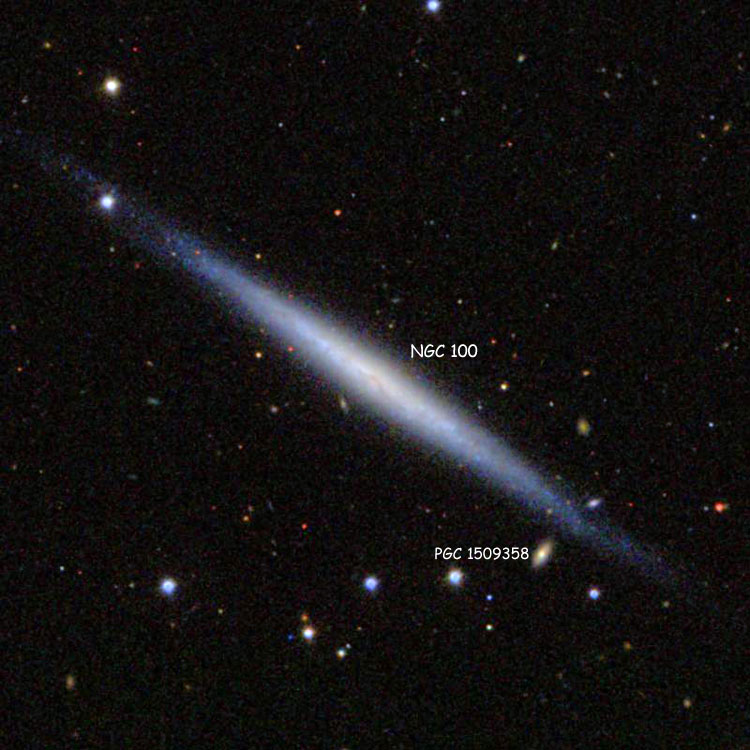
Physical Information: Based on a recessional velocity of 840 km/sec, NGC 100 is about 40 million light-years away, in good agreement with redshift-independent distances of 40 to 70 million light-years, especially since peculiar (non-Hubble expansion) velocities can be a significant factor for such low redshifts. Given that and its apparent size of 6.1 by 0.5 arcmin (Howe's comment corresponds to only the brighter central region), the galaxy is about 70 thousand light-years across. NGC 100 is an exceptionally elongated galaxy, with a very small nucleus in comparison to its overall size. Such galaxies are sometimes called "superthin" galaxies.
*Note*: = FGC 42 (Ferguson Galaxy Catalog of galaxies near the Fornax cluster); see if that is confirmed elsewhere before finalizing page.
Use By The de Vaucouleurs Atlas: NGC 150 is used by the de Vaucouleurs Atlas of Galaxies as an example of type SB(s)b pec.
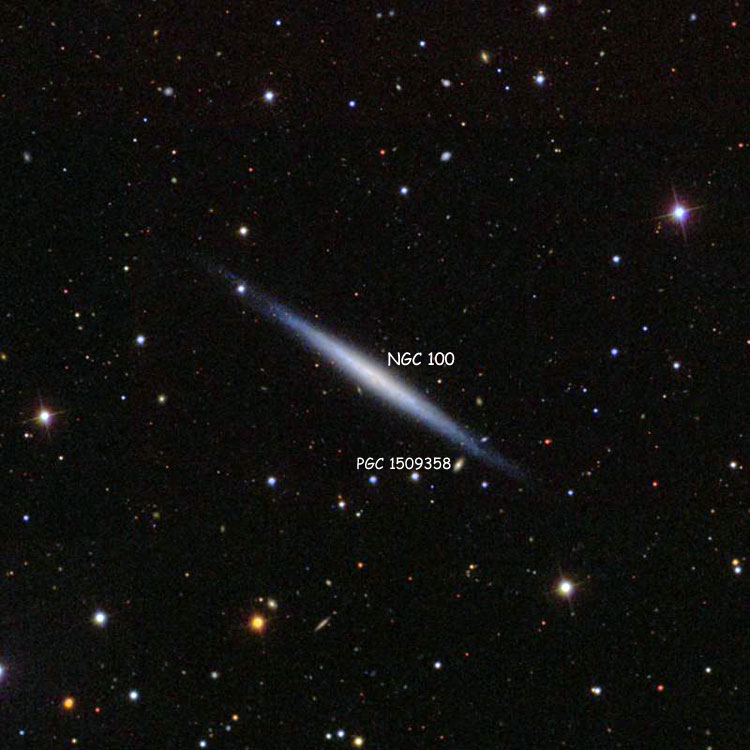
Above, a 12 arcmin wide SDSS image centered on NGC 100
Below, a 6 arcmin wide SDSS image of the galaxy, also showing PGC 1509358
NGC 101
(= PGC 1518 = ESO 350-014 = MCG -05-02-003)
Discovered (Sep 25, 1834) by John Herschel
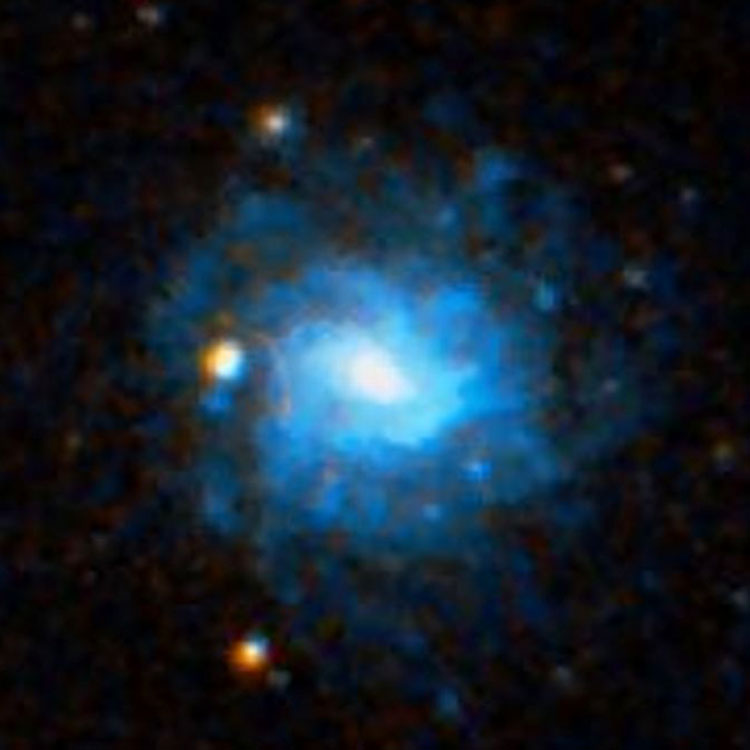
A magnitude 12.8 spiral galaxy (type SAB(rs)c?) in Sculptor (RA 00 23 54.6, Dec -32 32 10)
Historical Information: Per Dreyer, NGC 101 (= GC 50 = JH 2321, 1860 RA 00 16 56, NPD 123 19.4) is "pretty bright, pretty large, a little extended, 14th magnitude star to east". The position precesses to RA 00 23 55.5, Dec -32 32 48, about 0.6 arcmin southeast of the center of the galaxy listed above and well within its outline, so the identification is certain.
Physical Information: Based on a recessional velocity of 3385 km/sec, NGC 101 is about 160 million light-years away. Given that and its apparent size of 2.4 by 2.3 arcmin, it is about 110 thousand light-years across.

Above, a 12 arcmin wide DSS image centered on NGC 101
Below, a 3 arcmin wide DSS image of the galaxy
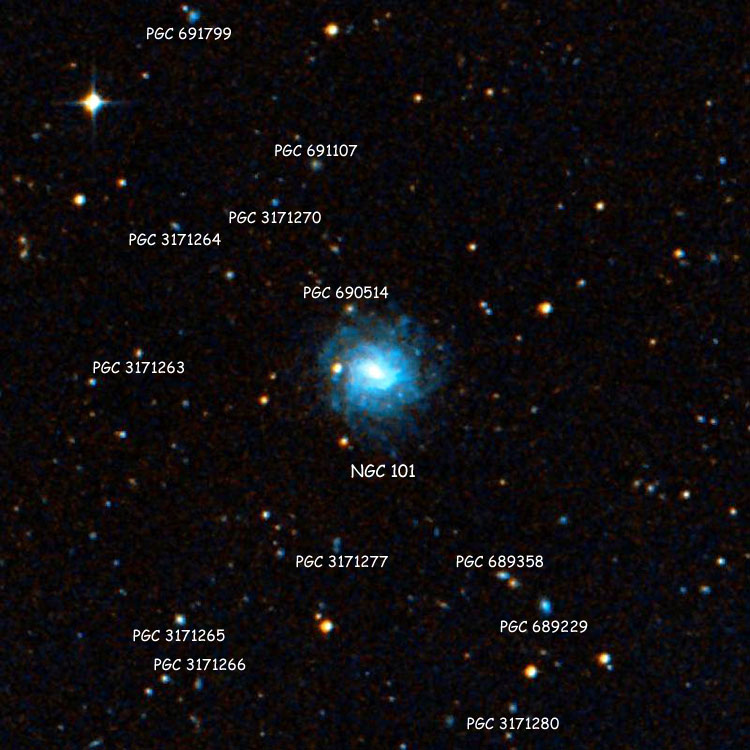
Below, a 12 arcmin wide DSS image centered on NGC 101, also showing PGC 689229, 689358,
690514, 691107, 691799, 3171263, 3171264, 3171265, 3171266, 3171270, 3171277 and 3171280
NGC 102
(= PGC 1542 = MCG -02-02-011)
Discovered (1886) by Francis Leavenworth
A magnitude 13.5 lenticular galaxy (type (R)SB0/a?) in Cetus (RA 00 24 36.5, Dec -13 57 23)
Historical Information: Per Dreyer, NGC 102 (Leavenworth list I (#3), 1860 RA 00 17 30, NPD 104 45) is "extremely faint, very small, round". The position precesses to RA 00 24 35.9, Dec -13 58 25, only about an arcmin south of the galaxy listed above and there is nothing else nearby, so the identification is certain.
Physical Information: Based on a recessional velocity of 7330 km/sec, a straightforward calculation indicates that NGC 102 is about 340 million light-years away. However, for objects at such distances we should take into account the expansion of the Universe during the time it took their light to reach us. Doing that shows that the galaxy was about 330 million light-years away at the time the light by which we see it was emitted, about 335 million years ago (the difference between the two numbers being due to the expansion of the intervening space during the light-travel time). Given that and its apparent size of 0.9 by 0.6 arcmin, the bright central portion of the galaxy is about 85 thousand light-years across, while the much fainter outer ring's apparent size of 1.6 by 0.9 arcmin corresponds to about 155 thousand light-years.

Above, a 12 arcmin wide SDSS image centered on NGC 102
Below, a 1.6 arcmin wide SDSS image of the galaxy
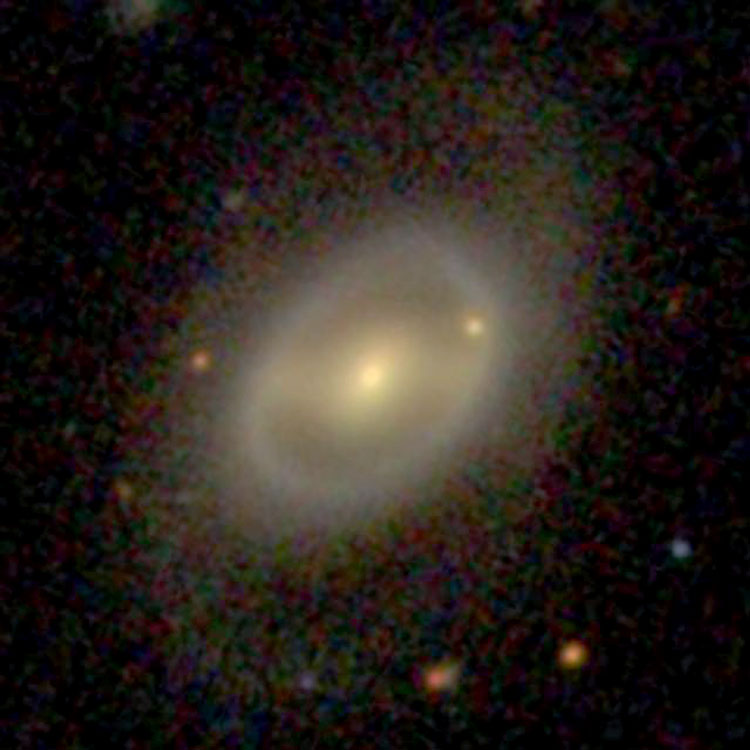
Below, a 12 arcmin wide SDSS image centered on NGC 102; among other galaxies shown is PGC 929748

NGC 103
(= OCL 291 = "PGC 3517827")
Discovered (Nov 26, 1788) by William Herschel
Discovered (Oct 5, 1829) by John Herschel
A magnitude 9.8 open cluster (type II2p) in Cassiopeia (RA 00 25 17.0, Dec +61 19 18)
Historical Information: Per Dreyer, NGC 103 (= GC 51 = JH 20, 1860 RA 00 17 38, NPD 29 26.7) is "a cluster, pretty small, pretty compressed, stars from 11th to 18th magnitude". The position precesses to RA 00 25 19.8, Dec +61 19 52, well within the boundary of the cluster listed above and only three quarters of an arcmin northeast of its listed position, so the identification is certain.
Discovery Note: Although William Herschel observed this object in 1788 and mentioned it (among a number of other objects observed in the late 1700's) in Astronomical Observations to investigate the Local Arrangement of the Celestial Bodies in Space and the Milky Way (1817), he did not include it in any of his published lists of clusters and nebulae, so both his son and Dreyer failed to note the discovery. But Yann Pothier reports that WH's position for the cluster lies very close to its northeastern border, so it is certain that he did observe it (as shown above).
Note About PGC Designation: As for most NGC objects HyperLEDA assigned a PGC designation for the object even though it isn't a galaxy. However, a search of the database for that designation returns no result, so it is shown in quotes.
Physical Information: NGC 103 consists of several dozen stars scattered across a region a little over 5 arcmin across, and is well within the reach of a small telescope. George Alter's 1941 study of about three dozen stars yielded a distance of about 1500 parsecs, or about 5 thousand light-years; but Johannes Hadorp's 1960 study of more than a hundred cluster members yielded a distance of nearly 3000 parsecs, or about 10 thousand light-years. Depending upon which (if either) of the distance estimates is correct, the 5+ arcmin size of the cluster corresponds to 8 to 16 light-years' mean diameter.

Above, a 12 arcmin wide DSS image centered on NGC 103, also showing PGC 2614819 (which is just a star)
NGC 104, the 47 Tucanae Cluster
(= GCL 1 = C106 = PGC 2802612 = ESO 050-SC009)
Discovered (1751) by Nicolas Lacaille
Listed (1801) in his Uranographia by Johann Bode as 47 Tucanae
Also observed (Aug 1, 1826) by James Dunlop
Also observed (Apr 11, 1834) by John Herschel
A magnitude 4.1 globular cluster (type III) in Tucana (RA 00 24 05.7, Dec -72 04 53)
Historical Information: Per Dreyer, NGC 104 (= GC 52 = JH 2322, Lacaille list I #1, Dunlop #18, 1860 RA 00 17 47, NPD 162 51.6) is "a globular cluster, very remarkable, very bright, very large, very much compressed middle." The position precesses to RA 00 24 03.4, Dec -72 05 01, only 0.5 arcmin west of the center of the 31 arcmin wide cluster listed above, so the identification is certain.
Observational Notes: With the naked eye, the cluster looks like a 4th magnitude star, hence Bode's designation as 47 Tucanae. Lacaille discovered its "nebular" nature with a half-inch(!) telescope, with an appearance "like the nucleus of a fairly bright comet." With his 9-inch reflector Dunlop could tell that it was "a beautiful large round nebula... easily resolved into stars...", and John Herschel's numerous comments were filled with admiration for its bright core and spectacular appearance. Modern observers using far better instruments are pretty much gobsmacked, as there are very few "field" stars near the cluster, so its appearance is not only spectacular in its own right, but also enhanced by the contrast with its surroundings.
Note About PGC Designation: For purposes of completeness, LEDA assigns a PGC designation for most NGC/IC objects, even when they aren't galaxies. Usually, in such a case a search of the LEDA database returns no result, but a search for PGC 2802612 does return a brief entry about the cluster.
Physical Information: Because of its brightness NGC 104 is visible without optical aid in a dark sky, and was therefore first labeled as a stellar object, 47 Tucanae. It is the second brightest globular cluster in our galaxy, exceeded only by Omega Centauri ( NGC 5139). Even at a distance of about 15 thousand light-years, its 140 light-year diameter has an apparent size of 32 arcmin, slightly larger than the full moon, and contains several million (mostly low-mass) stars (a count of extremely faint low-mass stars that make no obvious difference in its visual appearance suggests an actual size of about 50 arcmin, or about 220 light-years). If the Sun were in the center of the cluster our sky would be filled with brilliant stars, with more than ten thousand stars lying within the 4 light-year distance to our current nearest neighbor (this ignores the fact that with so many stars packed so closely together, the passage of nearby stars would tear any planets away from the Sun and leave those bodies wandering freely between the stars, with temperatures close to absolute zero except for when they passed near one of those stars).
Based on studies of its Main Sequence turnoff point, the age of 47 Tucanae is estimated at just over 13 billion years, meaning that it formed only six or seven hundred thousand years after the Universe itself. This is the result of a 2010 study; earlier estimates of its age were just under 12 billion years. The older age seems to be supported by the failure of efforts to look for evidence of the imaginary planets mentioned above, either close to or far from its center. It is thought that one reason for that is that being so old, its stars formed out of the same nearly pure hydrogen and helium that originally made up all of the normal matter in the Universe, and can't contain enough heavy atoms for planets to form.
NGC 104 was recently used to prove a theory of stellar mass sorting by globular clusters. More massive stars tend to settle to the center of the cluster, while less massive (and therefore fainter) ones spread out over a larger region (as noted above). To prove that, 130 thousand stars within the central 12 light-years of the cluster were studied for seven years, using techniques that allowed movements as small as 1/100th of an HST image pixel to be detected. "Blue stragglers", Main Sequence stars located well above the cluster's turnoff point, were shown to be moving more slowly than stars of more normal mass. (The "stragglers" are believed to be produced by stellar mergers, which are virtually impossible in normal regions of stellar space, but are fairly common in the densely packed cores of globular clusters.) Aside from showing that the heavier stars were moving more slowly, the study ruled out the possibility of a supermassive black hole in the cluster (which would have led to faster speeds for nearby stars).
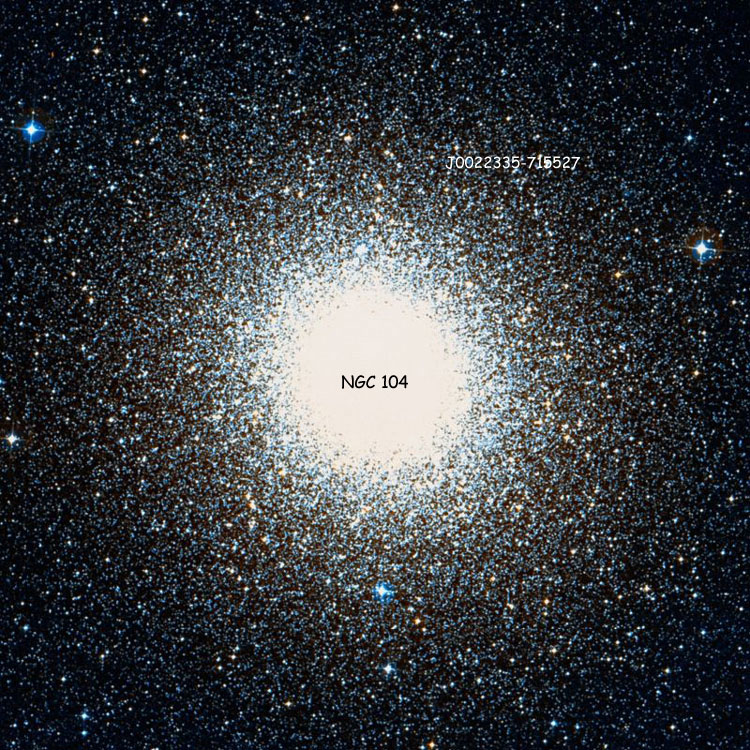
Above, a 36 arcmin wide DSS image centered on NGC 104
Hidden behind the multitude of stars are some galaxies, such as the insignificant speck, J0022335-715527
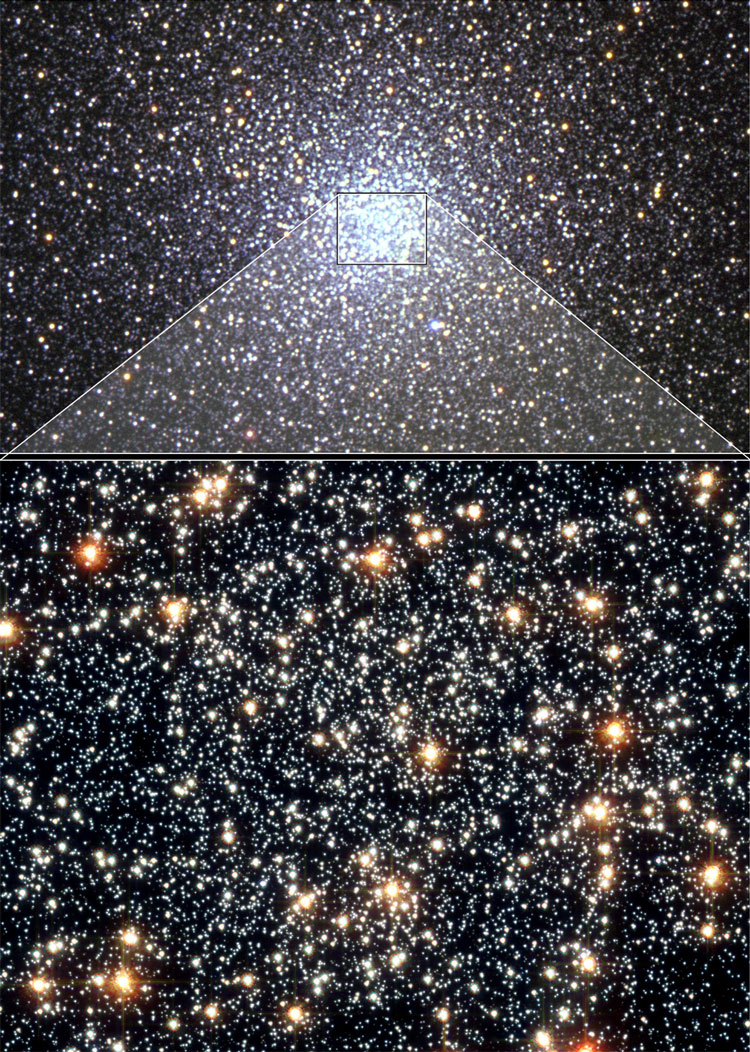
Below, a 7 arcmin wide image of the cluster core (North is about 30° to the right of up; Image Credit ESO)

Below, the region studied in detail with the HST to measure stellar motions in the cluster's core
(North is about 30° to the right of up; Image Credits: Ground-based image at top, VLT, R. Kotak & H. Boffin, ESO;
2/3 arcmin wide HST closeup at bottom, ESA, G. Meylan (Ecole Polytechnique Federale de Lausanne), NASA)
Below, a 25 by 37 arcmin wide view of nearly the entire cluster (North is nearly at the top in this image)
(Credit & © Daniel Verschatse, Observatorio Antilhue, Chile; used by permission)
(Verschatse recently died, and the link above is broken; a new URL will be provided ASAP)

Below, a 4 degree wide DSS image of the region near NGC 220 and NGC 222,
showing the relative position of NGC 104 and the Small Magellanic Cloud

2MASX J00223353-7155268
Not an NGC object but listed here since seen through NGC 104
A magnitude 17.5(?) lenticular? galaxy (type E/S0??) in Tucana (RA 00 22 33.5, Dec -71 55 27)
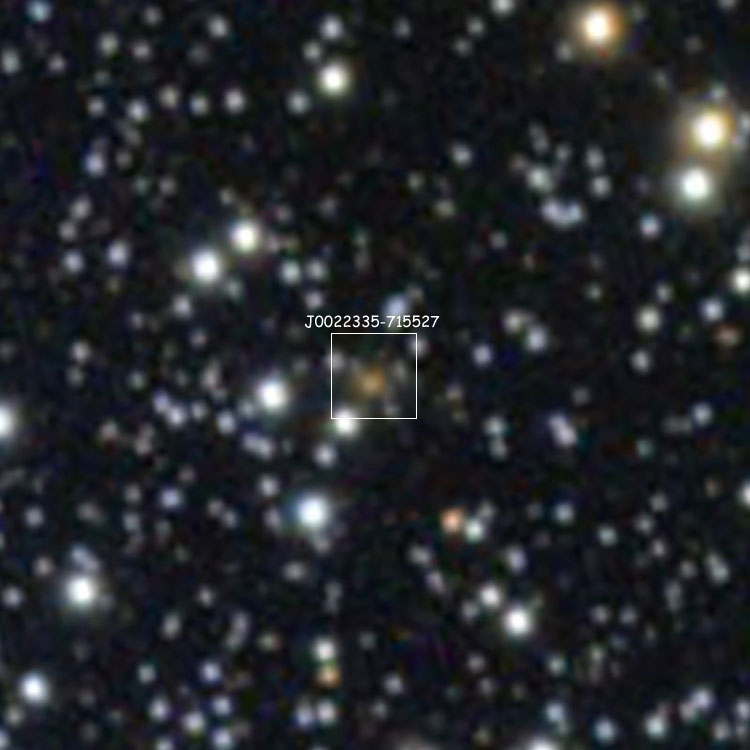
Physical Information: Based on a recessional velocity relative to the Cosmic Background Radiation of 36310 km/sec (and H0 = 70 km/sec/Mpc), a straightforward calculation indicates that 2MASX J00223353-7155268 is about 1690 million light-years away. However, for objects at such distances we should take into account the expansion of the Universe during the time it took their light to reach us. Doing that shows that the galaxy was about 1470 million light-years away at the time the light by which we see it was emitted, about 1555 to 1560 million years ago (the difference between the two numbers being due to the expansion of the intervening space during the light-travel time). Given that and its apparent size of about 0.11 by 0.08 arcmin (from the images below), the galaxy is about ? thousand light-years across.

Above, a 12 arcmin wide image centered on the galaxy (DSS image used to fill in missing areas)
(Image Credit & © above and below Daniel Verschatse, Observatorio Antilhue, Chile; used by permission)
Below, a 2.4 arcmin wide image of 2MASX J00223353-7155268 (the smudge at the center of the box)
NGC 105
(= PGC 1583 = UGC 241 = CGCG 434-009 = MCG +02-02-008)
Discovered (Oct 15, 1884) by Édouard Stephan
Also observed (Oct 31, 1886) by Lewis Swift
A magnitude 13.2 spiral galaxy (type Sab?) in Pisces (RA 00 25 16.8, Dec +12 53 02)
Historical Information: Per Dreyer, NGC 105 (Stephan list XIII (#4), Swift list V (#7), 1860 RA 00 18 03, NPD 77 53.4) is "very faint, small, round, a very little brighter middle." The position precesses to RA 00 25 17.2, Dec +12 53 10, within 0.2 arcmin of the center of the galaxy listed above, so the identification is certain.
Physical Information: Based on a recessional velocity relative to the Cosmic Microwave Background radiation of 4940 km/sec (and H0 = 70 km/sec/Mpc), NGC 105 is about 230 million light-years away, in good agreement with redshift-independent distance estimates of about 155 to 265 million light-years (the HST press release uses a distance of 215 million light-years). Given that and its apparent size of about 1.1 by 0.8 arcmin (from the images below), the galaxy is about 70 to 75 thousand light-years across if at the Hubble Flow distance, and very slightly smaller if at the HST press release distance. Although NGC 105 is usually listed as a multiple galaxy because of its apparent companion, PGC 212515, they are only an optical double, since PGC 212515 is actually a much more distant background object.

Above, a 12 arcmin wide SDSS image centered on NGC 105
Below, a 1.5 arcmin wide SDSS image of NGC 105 and PGC 212515
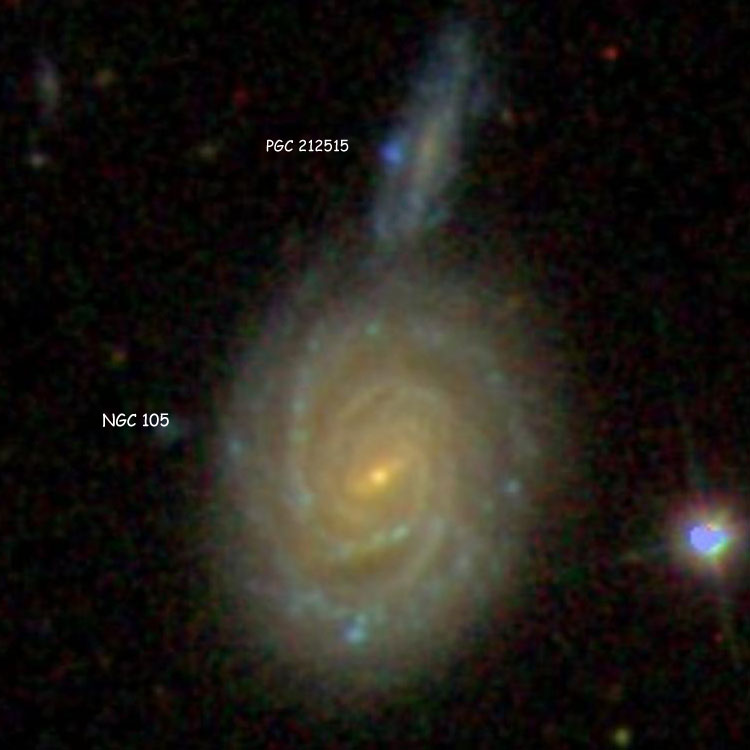
Below, a 1.2 arcmin wide SDSS image of NGC 105

Below, a 1.2 by 1.75 arcmin wide image of NGC 105 and PGC 212515
(Image Credit ESA/Hubble & NASA, D. Jones, A. Riess et al.; Acknowledgement R. Colombari)
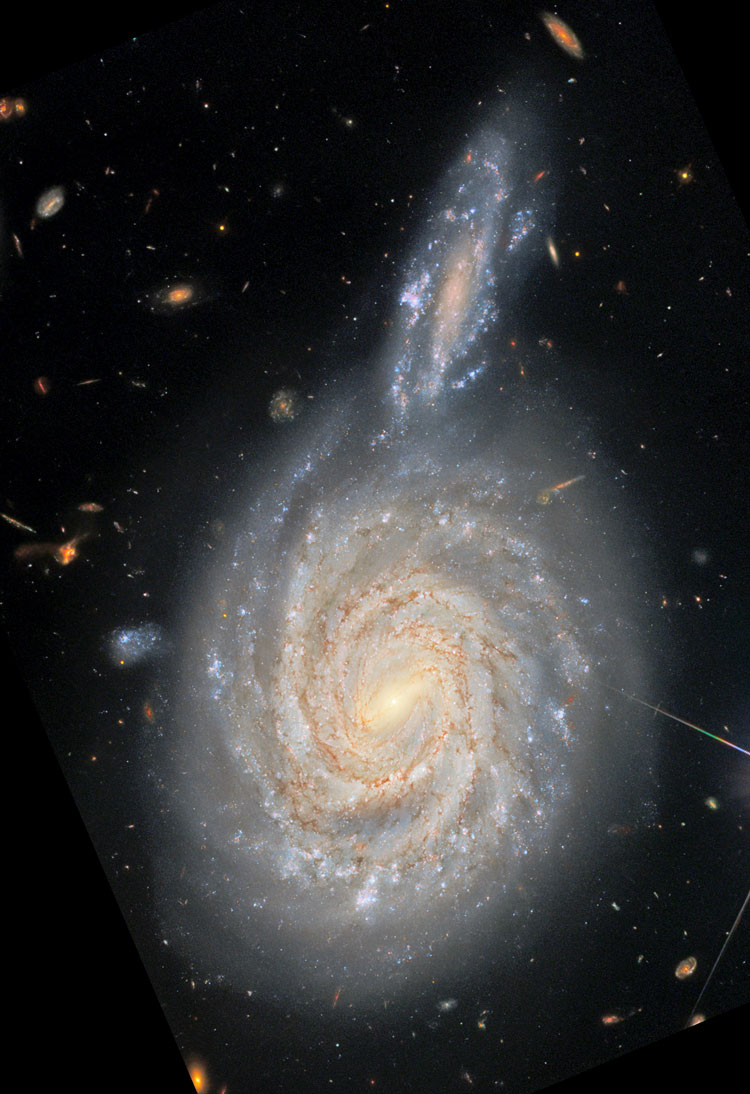
Below, a 0.9 by 1.15 arcmin wide image of NGC 105 (Image Credit as above)

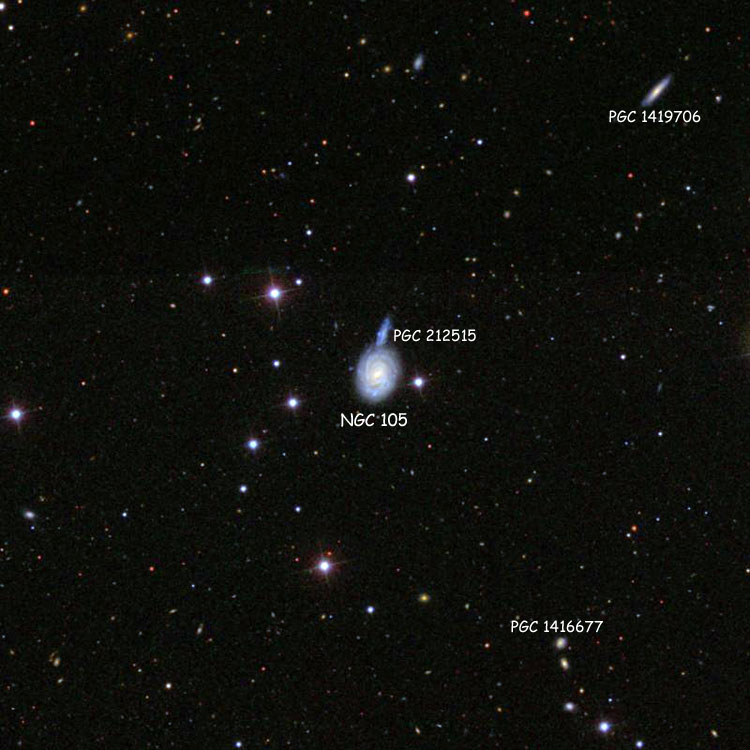
Below, a 12 arcmin wide SDSS image centered on NGC 105, also showing PGC 212515, 1416677 & 1419706
PGC 212515
Not an NGC object but listed here as an apparent companion of NGC 105
A magnitude 16(??) spiral galaxy (type SBbc?) in Pisces (RA 00 25 16.4, Dec +12 53 41)
Reason For This Entry: As noted in the entry for NGC 105, PGC 212515 just happens to more or less behind the NGC object, and has no connection to it; but it is often listed as an apparent companion, and many catalogs incorrectly list NGC 105 as a multiple galaxy because of its "companion".
Physical Information: There appears to be no measurement of the brightness of this galaxy except at the 21 cm radio wavelength, so the visual magnitude listed above is merely an educated guess. Based on a recessional velocity relative to the Cosmic Background Radiation of 7230 km/sec (and H0 = 70 km/sec/Mpc), a straightforward calculation indicates that PGC 212515 is about 335 to 340 million light-years away. However, for objects at such distances we should take into account the expansion of the Universe during the time it took their light to reach us. Doing that shows that the galaxy was about 325 to 330 million light-years away at the time the light by which we see it was emitted, about 330 to 335 million years ago (the difference between the two numbers being due to the expansion of the intervening space during the light-travel time). Given that and its apparent size of about 0.65 by 0.2 arcmin (from the image below), the galaxy is about 60 thousand light-years across.
Below, a 0.75 arcmin wide image of PGC 212515, and the northern part of NGC 105 (which see for more images)
(Image Credit ESA/Hubble & NASA, D. Jones, A. Riess et al.; Acknowledgement R. Colombari)

NGC 106
(= PGC 1551)
Discovered (1886) by Francis Leavenworth
Also observed (Nov 6, 1890) by N. M. Parrish
A magnitude 13.7 lenticular galaxy (type SB(r)0/a?) in Pisces (RA 00 24 43.7, Dec -05 08 55)
Historical Information: Per Dreyer, NGC 106 (Leavenworth list I (#4), 1860 RA 00 18 30, NPD 95 56) is "pretty faint, very small, round, a little brighter middle". The first Index Catalog lists a corrected RA (per Ormond Stone) of 00 17 35; using that and the original NPD, the position precesses to RA 00 24 43.6, Dec -05 09 25, only about 0.5 arcmin south of the galaxy listed above and there is nothing else nearby, so the identification is certain.
Discovery Notes: The IC note crediting Stone is based on a 1915 list of Southern Nebulae for which Stone was the author, but the entry for the object lists Parrish as the actual observer.
Physical Information: Based on a recessional velocity of 6060 km/sec, NGC 106 is about 280 million light-years away. Given that and its apparent size of 0.7 by 0.5 arcmin, it is about 55 thousand light-years across.

Above, a 12 arcmin wide SDSS image centered on NGC 106, also showing PGC 171993
Below, a 1 arcmin wide SDSS image of the galaxy

NGC 107
(= PGC 1606 = MCG -02-02-014)
Discovered (Jan 14, 1866) by Otto Struve
A magnitude 14.2 spiral galaxy (type SBbc? pec?) in Cetus (RA 00 25 42.2, Dec -08 16 57)
Historical Information: Per Dreyer, NGC 107 (= GC 5099, O Struve, 1860 RA 00 18 40, NPD 99 03) is "faint, pretty large, 7th magnitude star 5 arcmin to southeast". The position precesses to RA 00 25 47.5, Dec -08 16 26, over an arcmin northeast of the galaxy listed above, but there is nothing else nearby and 7th magnitude HD 2195, located exactly where stated, confirms the identification.
Physical Information: Based on a recessional velocity of 6290 km/sec, NGC is about 295 million light-years away. Given that and its apparent size of 0.7 by 0.45 arcmin, it is about 60 thousand light-years across.

Above, a 12 arcmin wide SDSS image centered on NGC 107
Below, a 1 arcmin wide SDSS image of the galaxy
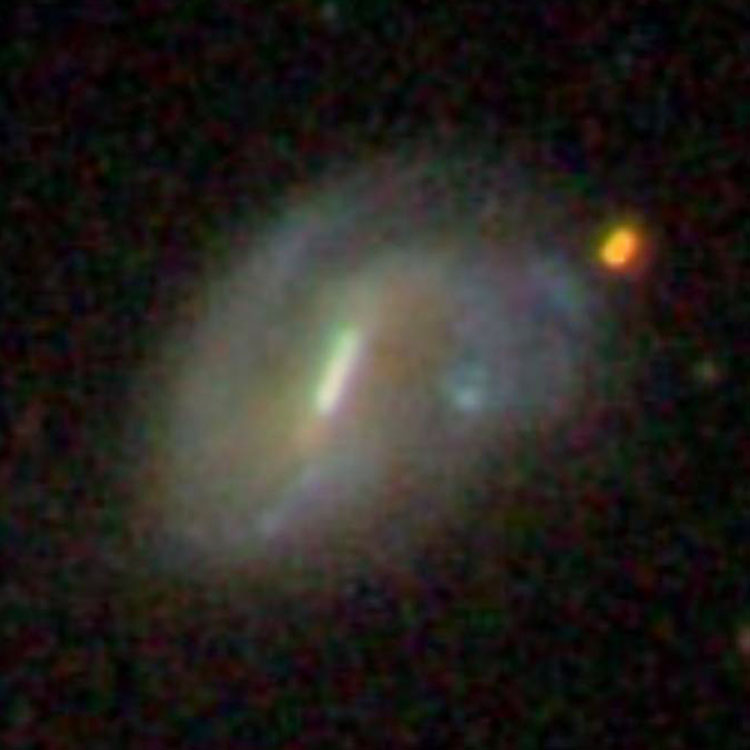
Below, a 12 arcmin wide SDSS image centered on NGC 107, also showing PGC 1602 and 143534

PGC 143534
Not an NGC object but listed here as a probable companion of NGC 107
A magnitude 16(?) spiral galaxy (type Sd?) in Cetus (RA 00 25 45.6, Dec -08 20 10)
Physical Information:
LEDA B 16.4, I 14.2, (V) 16(?), 3K Vr 5945 km/sec; NED 3K Vr 5944 km/sec, nearly the same as for NGC 107, so probably an actual companion.
NGC 108
(= PGC 1619 = UGC 246 = CGCG 500-020 = MCG +05-02-012)
Discovered (Sep 11, 1784) by William Herschel
Also observed (Dec 23, 1827) by John Herschel
A magnitude 12.1 lenticular galaxy (type (R)SB(r)0/a?) in Andromeda (RA 00 25 59.7, Dec +29 12 43)
Historical Information: Per Dreyer, NGC 108 (= GC 53 = JH 21 = WH III 148, 1860 RA 00 18 40, NPD 61 33.8) is "pretty faint, pretty large, round, pretty suddenly a little brighter middle". The position precesses to RA 00 26 00.3, Dec +29 12 45, within 0.2 arcmin of the center of the galaxy listed above and there is nothing else nearby, so the identification is certain.
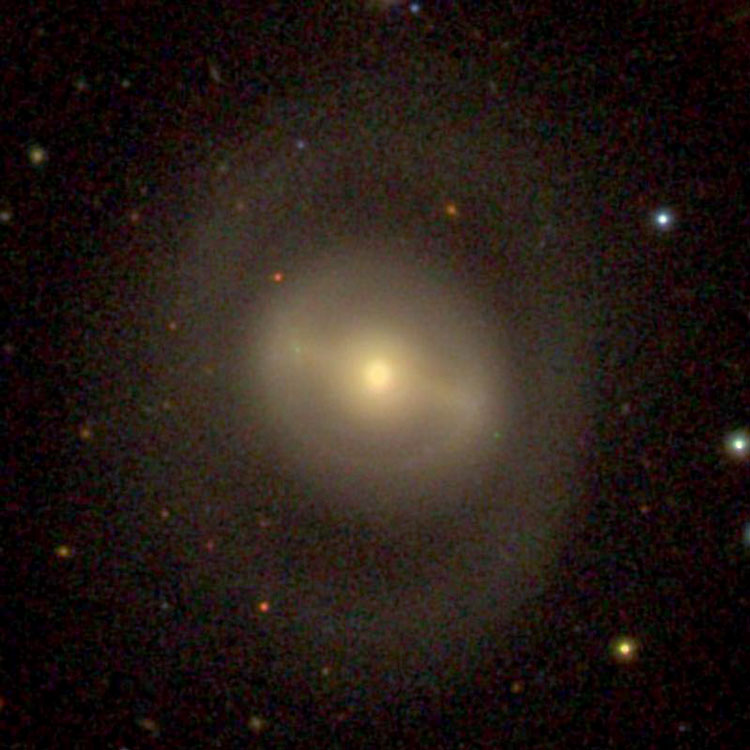
Physical Information: Based on a recessional velocity of 4735 km/sec, NGC 108 is about 220 million light-years away. Given that and the 1.15 by 1.05 arcmin wide apparent size of its brighter central region, it is about 75 thousand light-years across, while the 2.7 by 1.9 arcmin wide apparent size of the fainter outer ring corresponds to about 170 thousand light-years.
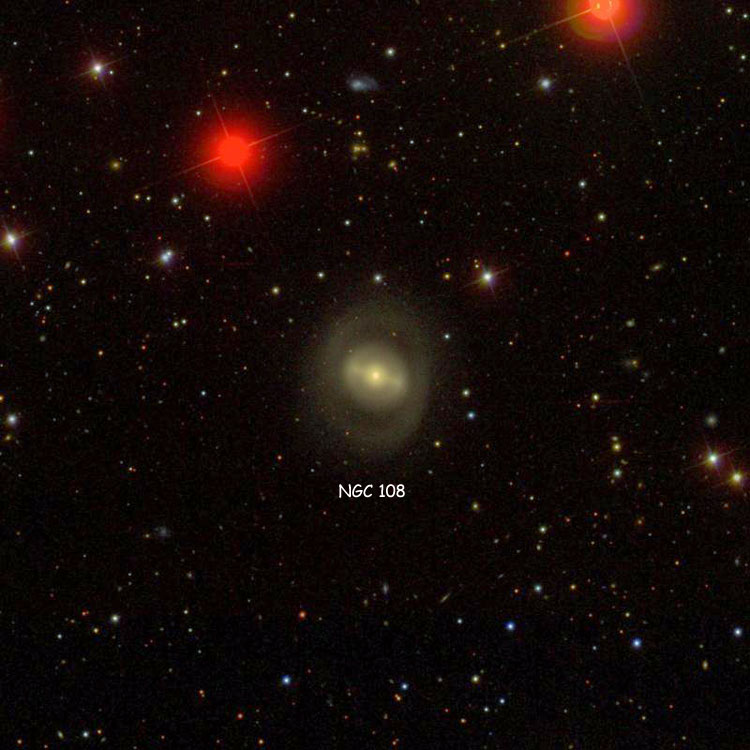
Above, a 12 arcmin wide SDSS image centered on the galaxy
Below, a 3 arcmin wide SDSS image of the galaxy
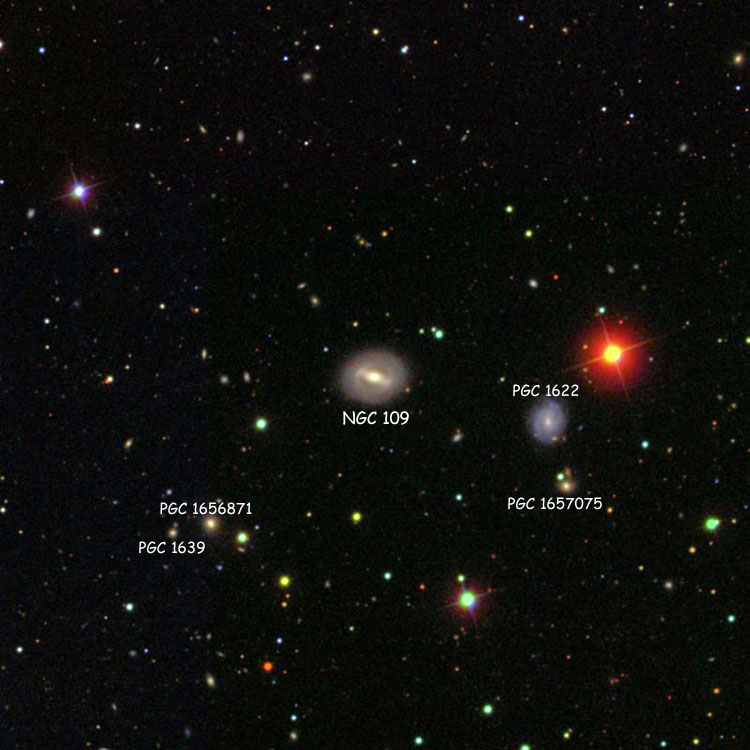
NGC 109
(= PGC 1633 = UGC 251 = CGCG 479-031 = MCG +04-02-020)
Discovered (Oct 8, 1861) by Heinrich d'Arrest
A magnitude 13.7 lenticular galaxy (type SB(r)0/a?) in Andromeda (RA 00 26 14.7, Dec +21 48 26)
Historical Information: Per Dreyer, NGC 109 (= GC 54, d'Arrest, 1860 RA 00 18 51, NPD 68 58.3), is "very faint, small, 3 stars near". The position precesses to RA 00 26 08.5, Dec +21 48 15, approximately midway between the galaxy listed above and PGC 1622, but there is no way that d'Arrest would have seen the fainter galaxy and not seen the brighter one, so the identification with the brighter galaxy is certain.
Physical Information: Based on a recessional velocity of 5460 km/sec, NGC 109 is about 255 million light-years away, in reasonable agreement with redshift-independent distance estimates of 195 to 240 million light-years. Given that and its apparent size of 1.05 by 0.85 arcmin, it is about 80 thousand light-years across.

Above, a 12 arcmin wide SDSS image centered on NGC 109, also showing PGC 1622
Below, a 1.5 arcmin wide SDSS image of the galaxy

Below, a 12 arcmin wide region centered on NGC 109, also showing PGC 1622, 1639, 1656871 & 1657075
PGC 1622
(= CGCG 479-028 = MCG +04-02-019)
Not an NGC object but listed here as a probable companion of NGC 109
A magnitude 15(?) spiral galaxy (type SAB(s)c?) in Andromeda (RA 00 26 02.7, Dec +21 47 42)
Physical Information:
LEDA SABc, B 15.7, K 12.3, (V) 15(?); NED RIDE 44.0 - 73.9 Mpc, Sd, 3K Vr 5242 km/sec, only 140 km/sec more than NGC 109, so probably an actual companion.
NGC 110
(= OCL 300 = "PGC 3517828")
Discovered (Oct 29, 1831) by John Herschel
A magnitude 9 open cluster (type IV1p) in Cassiopeia (RA 00 27 25.0, Dec +71 23 30)
Historical Information: Per Dreyer, NGC 110 (= GC 55 = JH 22, 1860 RA 00 19 19, NPD 19 23.0) is "a cluster, pretty round, a little compressed, stars from 9th to 12th magnitude". The position precesses to RA 00 27 24.6, Dec +71 23 32, within 0.2 arcmin of the central star of the cluster listed above, so the identification is certain.
Note About PGC Designation: As for most NGC objects, HyperLEDA assigns a PGC designation to this object, even though it isn't a galaxy. However, a search of the database for that designation returns no result, so it is shown in quotes.
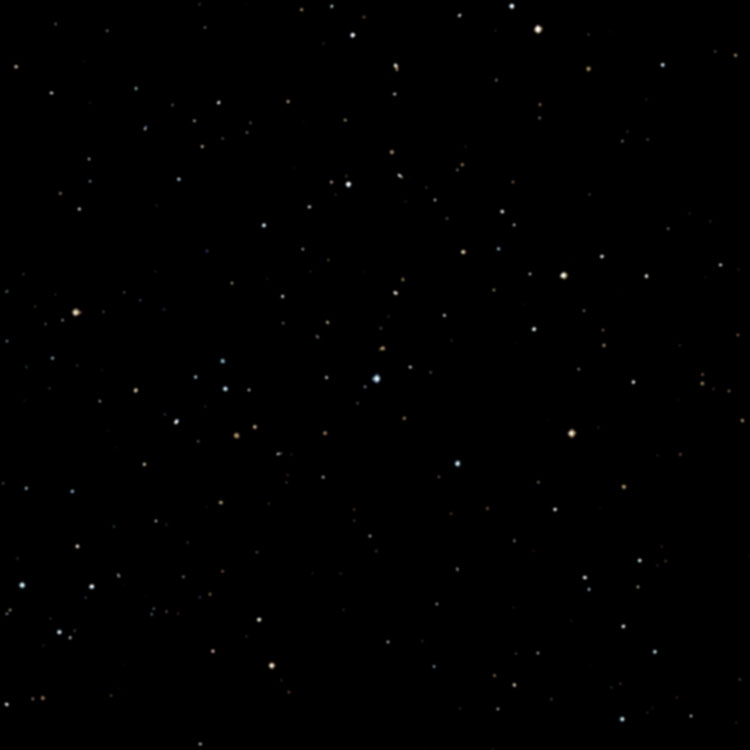
Physical Information: The cluster consists of less than two dozen moderately bright stars scattered across a 20 arcmin wide region centered on a 10th magnitude star (which is mistakenly listed in the Principal Galaxy Catalog as PGC 2742876, though the current version of the Catalog does acknowledge that it is a star). In the "normal" DSS image below, the cluster seems lost in the multitude of Milky Way stars surrounding it; however, per Corwin, a visual examination of the region with a small telescope shows that the brighter stars in the group do stand out against the fainter background of the Milky Way, as shown in the simulation of what the field looks like to a visual observer. So although not an obvious or perhaps even a real cluster, it was reasonable for Herschel to list it in the General Catalog, and as a result necessary for Dreyer to list it in the NGC.

Above, a half-degree wide DSS image of NGC 110 centered on its brightest member, "PGC 2742876"
Below, a simulation of what the region above might look like to a visual observer
NGC 111 (perhaps = NGC 758?)
(and if so, = PGC 7198)
Recorded (1886) by Francis Leavenworth (and later listed as NGC 111)
Perhaps also observed (1886) by Francis Leavenworth (and later listed as NGC 758)
Almost certainly a lost or nonexistent object in Cetus (RA 00 26 37.3, Dec -02 37 27)
or perhaps a 14th magnitude lenticular galaxy (type S0?) in Cetus (RA 01 55 42.1, Dec -03 03 59)
Historical Information: Per Dreyer, NGC 111 (Leavenworth list II (#281), 1860 RA 00 19 30±, NPD 93 24.0) is "very faint, small, round, a little brighter middle, 8.5 magnitude star 36 seconds of time to west and 2 arcmin to north (? = 5100)", the query meaning that perhaps Leavenworth's object was GC 5100 (= NGC 113); but that has no star in the appropriate position and is not thought to what Leavenworth recorded. The position precesses to RA 00 26 39.3, Dec -02 37 28, but there is nothing there, no star in the appropriate position, and no one has found anything matching the observation. In such a situation it sometimes helps to use the original observation, even though Leavenworth's statement that the right ascension is doubtful doesn't inspire much confidence in his original position. Precessing Leavenworth's 1890 position yields a modern position RA 00 26 37.3, Dec -02 37 27 (whence the position listed above), which is essentially the same as Dreyer's "rounded-off" value, so there is still no way to identify what Leavenworth observed. Per Corwin, it is possible that a search along the declination circle may lead to a rediscovery, but since he was unable to find anything suitable within 5 degrees of Leavenworth's position, NGC 111 may always be listed as lost or nonexistent.
Additional Note of July 5, 2016: John Ponting has suggested that perhaps NGC 111 is NGC 758, which perfectly fits the description of Leavenworth's #281, but is "off" by an hour and a half in right ascension and 20 arcmin in declination. Such a huge error makes any identification of NGC 111 as a misrecorded observation of NGC 758 highly unlikely, but as noted by Corwin, if NGC 111 really exists, it must have an unusually large error in its position. So we are left with the possibility (by far the most likely one) that NGC 111 is irretrievably lost, or (a very uncertain possibility, but the only currently existing one that makes any sense) that Ponting is right; but even if he is, the appropriate place to discuss this object is in the entry for NGC 758, so there is no point in discussing it further here.
Note About Alternate PGC Designation: Although not shown above because of the (very) tentative identification of NGC 111 as NGC 758, as for most NGC objects, HyperLEDA assigned a designation of "PGC 5067599" for the presumably lost or nonexistent NGC object. However, as might be expected in such a situation, a search of the database for that designation returns no result, so it is placed in quotes in this paragraph, and not mentioned at all in the rest of this entry.

Above, a 12 arcmin wide SDSS image with a box centered on Leavenworth's position for NGC 111
Also shown are PGC 1086333 and 3307945
NGC 112
(= PGC 1654 = UGC 255 = CGCG 500-021 = MCG +05-02-013)
Discovered (Sep 17, 1885) by Lewis Swift
A magnitude 13.6 spiral galaxy (type SB(rs)bc?) in Andromeda (RA 00 26 48.8, Dec +31 42 12)
Historical Information: Per Dreyer, NGC 112 (Swift list II (#9), RA 00 19 32, NPD +59 04.1) is "extremely faint, very small, round". The position precesses to RA 00 26 53.8, Dec +31 42 26, about 1.3 arcmin northeast of the galaxy listed above, but there is nothing else near, so the identification is certain.
Physical Information: Based on a recessional velocity of 6285 km/sec, NGC 112 is about 295 million light-years away, in good agreement with redshift-independent distance estimates of 250 to 340 million light-years. Given that and its apparent size of 0.9 by 0.35 arcmin (not counting a slight extension on its western side), it is about 75 thousand light-years across.

Above, a 12 arcmin wide SDSS image centered on NGC 112, also showing PGC 212520
Below, a 1.4 arcmin wide SDSS image of the galaxy

NGC 113
(= PGC 1656 = MCG -01-02-016)
Discovered (Aug 27, 1876) by Wilhelm Tempel
A magnitude 13.1 lenticular galaxy (type E/SA0?) in Cetus (RA 00 26 54.6, Dec -02 30 03)
Historical Information: Per Dreyer, NGC 113 (= GC 5100, Tempel list I (#1 = list IV #1), 1860 RA 00 19 46, NPD 93 16.6) is "very faint, small, suddenly brighter middle". The position precesses to RA 00 26 55.3, Dec -02 30 04, within 0.2 arcmin of the center of the galaxy listed above, so the identification is certain.
Physical Information: Based on a recessional velocity of 4460 km/sec, NGC 113 is about 210 million light-years away. Given that and its apparent size of 1.3 by 1.3 arcmin, it is about 80 thousand light-years across.
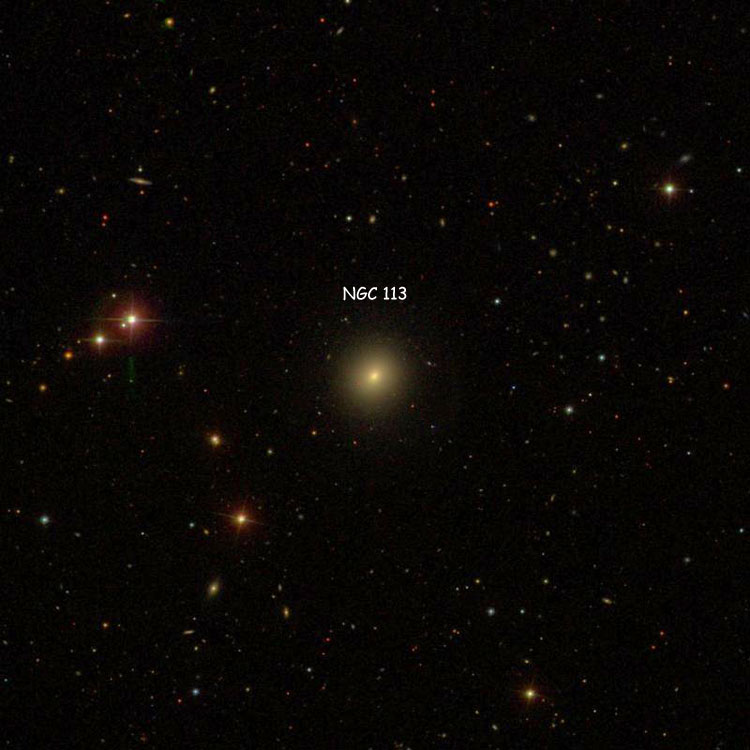
Above, a 12 arcmin wide SDSS image centered on NGC 113
Below, a 2 arcmin wide SDSS image of the galaxy

Below, a 12 arcmin wide SDSS image centered on NGC 113
Also shown are PGC 1088684, 1091698, 1091872, 3307936 and 3307945
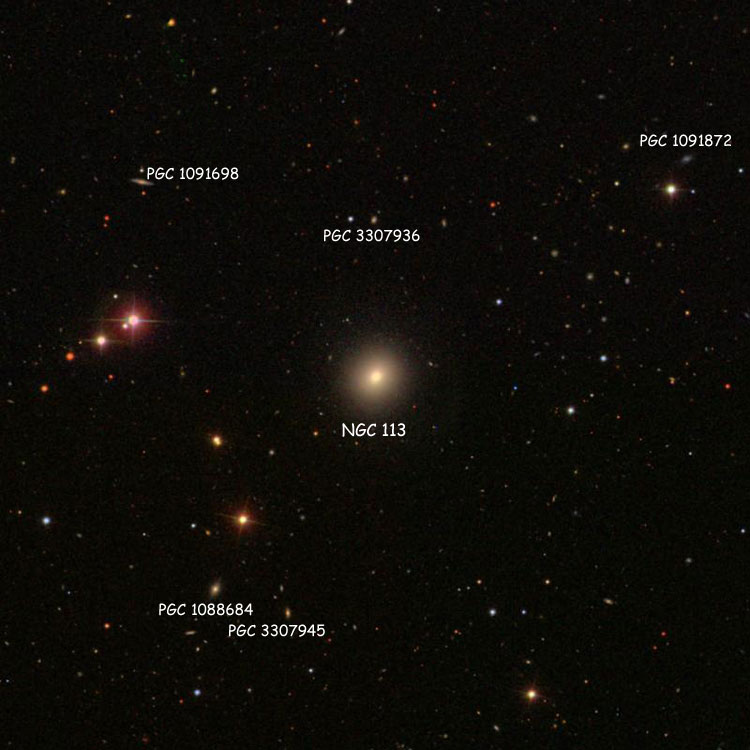
NGC 114
(= PGC 1660 = UGC 259 = CGCG 383-014 = MCG +00-02-027)
Discovered (Sep 23, 1867) by Truman Safford
Discovered (Sep 27, 1880) by Wilhelm Tempel
A magnitude 13.8 lenticular galaxy (type SB0(rs)?) in Cetus (RA 00 26 58.2, Dec -01 47 10)
Historical Information: Per Dreyer, NGC 114 (Tempel list IV (#2), (Safford #90), 1860 RA 00 19 49, NPD 92 33.8) is "very faint, small star in center, western of 2", the other being NGC 118. The position precesses to RA 00 26 58.5, Dec -01 47 16, barely southeast of the center of the galaxy listed above, well within its outline, and there is nothing else nearby so the identification is certain.
Discovery Notes: Dreyer was not aware of Safford's observations at the time he compiled the NGC, as they were published as an appendix to an obscure paper at the time Dreyer was editing his paper for publication, and although he did list a number of Safford's observations in an appendix to the NGC, it was not practical to alter the individual entries; so Safford #90 was not actually shown in the entry for NGC 114 (which is why it is in parentheses).
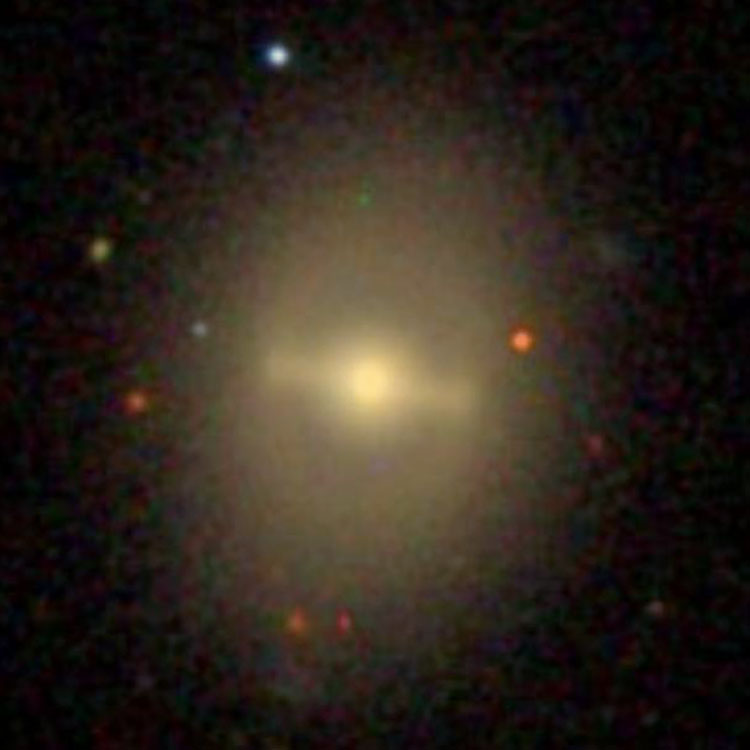
Physical Information: Based on a recessional velocity of 4160 km/sec, NGC is about 195 million light-years away. Given that and its apparent size of 0.95 by 0.7 arcmin (from image below), it is about 55 thousand light-years across. It is listed as a possible group member with NGC 124 in NED, and if at the same distance from us, is separated from that galaxy by less than a million light-years.
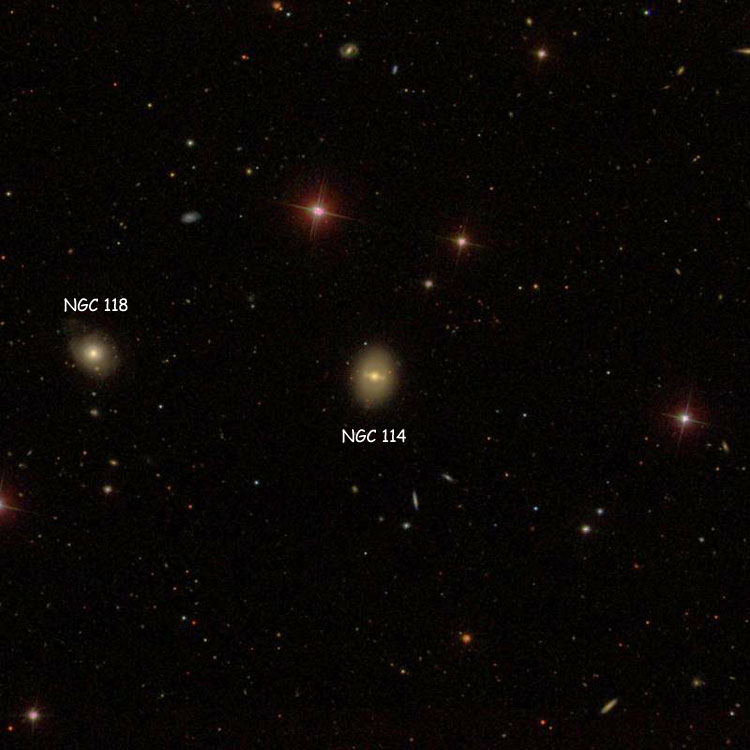
Above, a 12 arcmin wide SDSS image of NGC 114, also showing NGC 118
Below, a 1.2 arcmin wide SDSS image of the galaxy
Below, a 12 arcmin wide SDSS image centered on NGC 114, and to its east, NGC 118
Also shown are PGC 1107669, 1109199, 1111262, 1112419 and 1112422

Below, a 15 arcmin wide SDSS image centered between NGC 114 and NGC 124, also showing NGC 118

NGC 115
(= PGC 1651 = ESO 350-017 = MCG -06-02-006)
Discovered (Sep 25, 1834) by John Herschel
A magnitude 13.1 spiral galaxy (type SB(s)bc?) in Sculptor (RA 00 26 46.3, Dec -33 40 38)
Historical Information: Per Dreyer, NGC 115 (= GC 56 = JH 2323, 1860 RA 00 19 51, NPD 124 27.4) is "very faint, pretty large, a little extended, double star 2 arcmin to northwest". The position precesses to RA 00 26 48.4, Dec -33 40 52, only 0.7 arcmin southeast of the center of the galaxy listed above and well within its outline, and there is a double star in the specified position, so the identification is certain.
Physical Information: Based on a recessional velocity of 1825 km/sec, NGC 115 is about 85 million light-years away, in good agreement with redshift-independent distance estimates of 75 to 130 million light-years. Given that and its apparent size of 2.05 by 0.7 arcmin, it is about 50 thousand light-years across. NGC 115 is listed as a member of the NGC 134 Group of galaxies, which includes NGC 131, 148 and 150, PGC 2000 (erroneously identified as IC 1554) and IC 1555, and PGC 2044. Several of these are also listed as members of a group of galaxies in or near Sculptor with recessional velocities of about 1500 to 1800 km/sec (this is not "the" Sculptor Group, a close neighbor to our Local Group, with an average recessional velocity of less than 300 km/sec); so all NGC 134 group members are presumably members of the larger group.
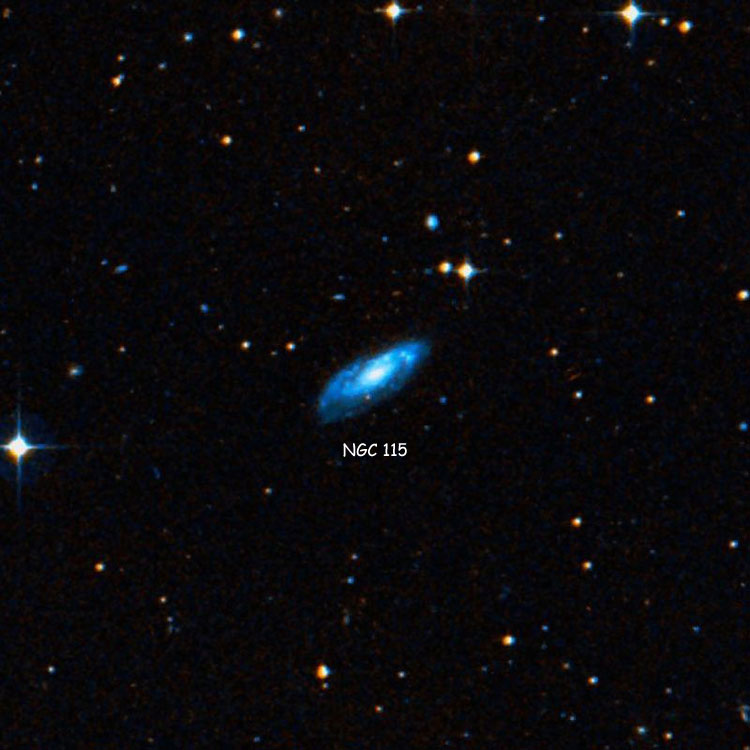
Above, a 12 arcmin wide DSS image centered on NGC 115
Below, a 2.1 arcmin wide DSS image of the galaxy

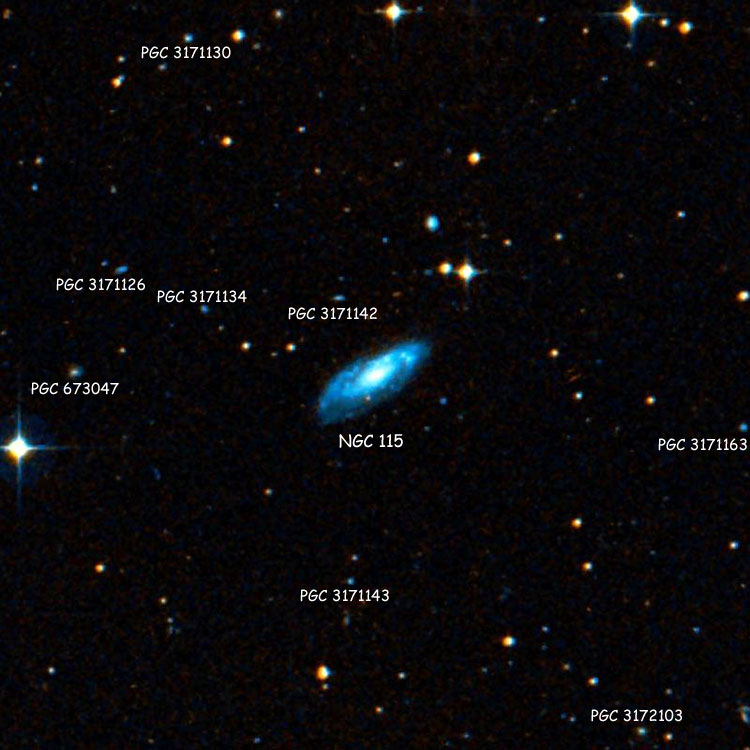
Below, a 12 arcmin wide DSS image centered on NGC 115
Also shown are PGC 673047, 3171126, 3171130, 3171134, 3171142, 3171143, 3171163 and 3172103
Corwin lists Secchi's position for NGC 116 as RA 00 27 09, Dec -07 56 18
PGC 1671 (perhaps = NGC 116?)
(= MCG -01-02-017)
Discovered (1865) by Gaspare Ferrari
A magnitude 14(?) lenticular galaxy (type SB0(r)a?) in Cetus (RA 00 27 05.2, Dec -07 40 06)
Historical Information: Per Dreyer, NGC 116 (= GC 5101, Secchi (#14), 1860 RA 00 19 59, NPD 98 43.2) is "very faint". (Dreyer's listing credits Father Angelo Secchi with the discovery, but in this and more than a dozen other cases Secchi was reporting a discovery actually made by Brother Ferrari.) The position precesses to RA 00 27 06.5, Dec -07 56 40, but there is nothing near that position, so the object could be listed as lost or nonexistent. However, Corwin has noted two galaxies in the region that are reasonable candidates for what Ferrari observed, and acknowledged my suggestion for a third candidate. The brightest one, PGC 1671, about a quarter degree due north of Ferrari's position, is generally listed as NGC 116 (for example, in LEDA, Wikisky and NED), though with considerable uncertainty, and is covered in this entry; while the next brightest, PGC 1677, about half that far slightly west of north, is not usually listed as NGC 116, but is shown as a possible candidate in the next entry; and a similarly bright one, PGC 169989, about 6 arcmin due west of Ferrari's position, is discussed in the final entry of the three. There are reasonable arguments that could be made for any of the three, but which if any of them is what Ferrari observed cannot be known with any certainty, so "perhaps = NGC 116" is the most that can really be said about any of them.
Argument For PGC 1671 Being NGC 116: As noted above, PGC 1671 is the brightest galaxy "near" Ferrari's position, and being nearly due north of his position makes the error in position relatively simple. However, without any description save for "very faint" and the large error in its position, whether its identification as NGC 116 is even reasonable, let alone likely, is very uncertain.
Physical Information: Based on a recessional velocity of 7575 km/sec, a straightforward calculation indicates that PGC 1671 is about 355 million light-years away. However, for objects at such distances we should take into account the expansion of the Universe during the time it took their light to reach us. Doing that shows that the galaxy was about 340 million light-years away at the time the light by which we see it was emitted, about 345 million years ago (the difference between the two numbers being due to the expansion of the intervening space during the light-travel time). Given that and its apparent size of 0.95 by 0.35 arcmin, it is about 95 thousand light-years across.

Above, a 12 arcmin wide SDSS image centered on PGC 1671, which is usually assumed to be NGC 116
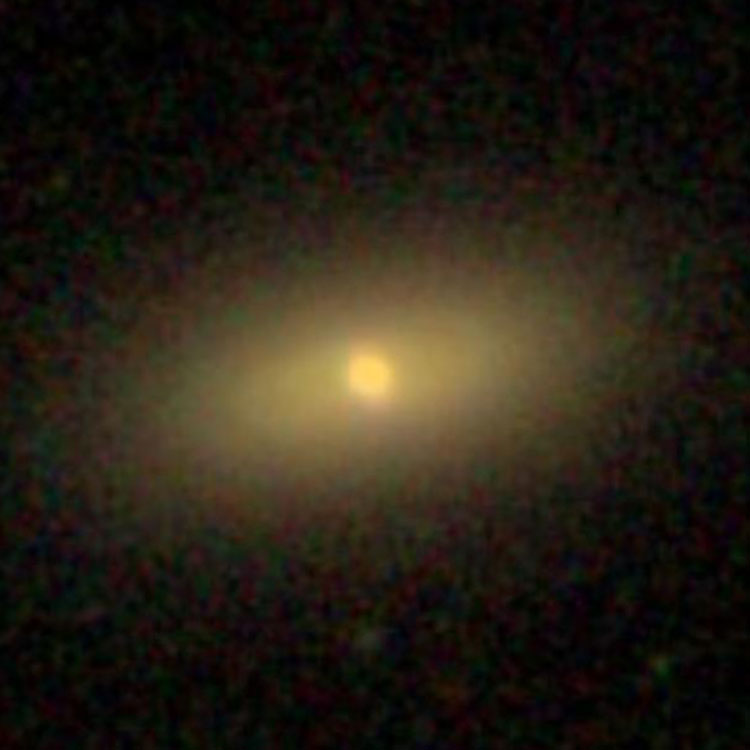
Below, a 1.2 arcmin wide SDSS image of the galaxy
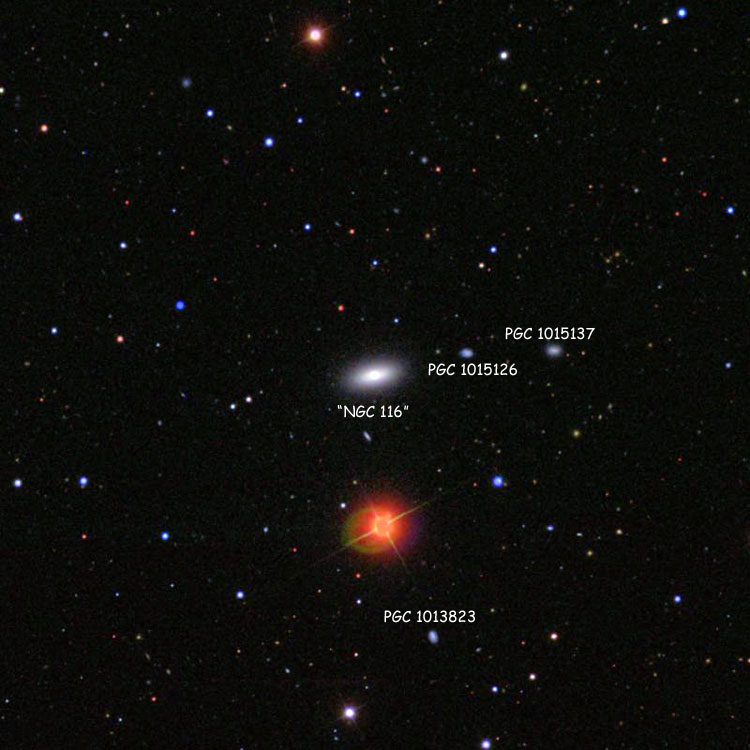
Below, a 12 arcmin wide SDSS image near the galaxy, also showing PGC 1013823, 1015126 and 1015137
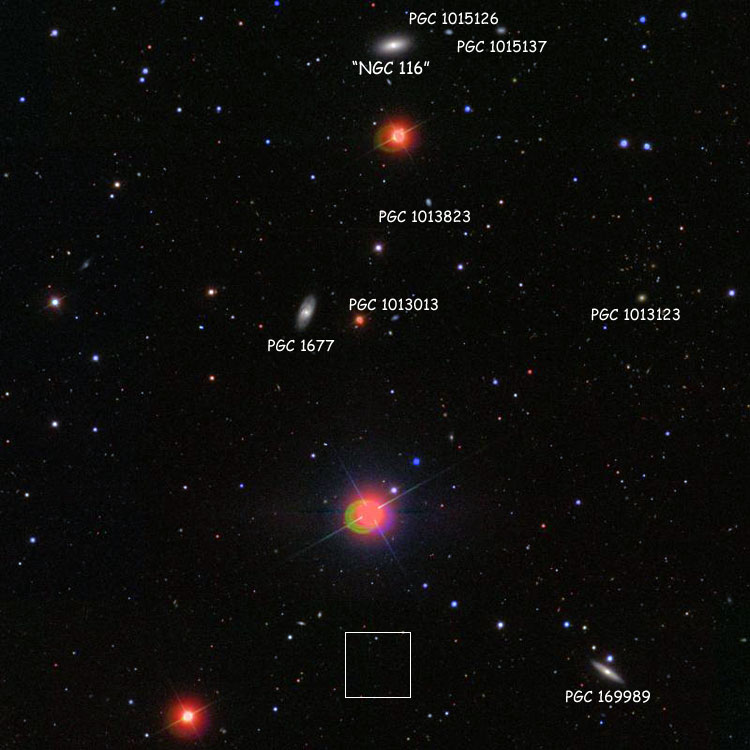
Below, a 20 arcmin SDSS image of Ferrari's position (box at bottom), PGC 1677 and 1671 ("NGC 116")
Also shown are PGC 169989, 1013013, 1013123, 1013823, 1015126 and 1015137
PGC 1677 (perhaps = NGC 116??)
(= PGC 1013083 = MCG -01-02-018)
A magnitude 14.5(?) spiral galaxy (type SAB(rs)ab?) in Cetus (RA 00 27 14.6, Dec -07 47 13)
Historical Information: As discussed above, PGC 1671 is generally considered to be Gaspare Ferrari's NGC 116; but either PGC 1677 or PGC 169989 are almost equally good candidates for that title. The main argument against one of the fainter galaxies being Ferrari's object is that if he saw one of them he ought to have seen the brighter PGC 1671, as well; but observing objects at the limit of telescopic and sky conditions is an iffy thing, so there is no guarantee that the brighter galaxy is the correct one. It therefore seems appropriate to give the fainter galaxies a similar discussion, hence this entry and the following one.
Argument For PGC 1677 Being NGC 116: Although a little fainter than PGC 1671, PGC 1677 is much closer to Ferrari's position, and although being closer to a poor position is often a poor indicator of whether an object is the correct one, there is at least a remote possibility that PGC 1677 is actually what Ferrari observed; however, there is no way that we can be certain whether this is the object in question.
Physical Information: Based on a recessional velocity of 7715 km/sec, a straightforward calculation indicates that PGC 1677 is about 360 million light-years away. However, for objects at such distances we should take into account the expansion of the Universe during the time it took their light to reach us. Doing that shows that the galaxy was about 350 million light-years away at the time the light by which we see it was emitted, about 355 million years ago (the difference between the two numbers being due to the expansion of the intervening space during the light-travel time). Given that and its apparent size of 0.9 by 0.35 arcmin, PGC 1677 is about 90 thousand light-years across.

Above, a 1.2 arcmin wide SDSS image of PGC 1677; also see the widest-field image of NGC 116
PGC 169989 (perhaps = NGC 116???)
A magnitude 14.5(?) lenticular galaxy (type S0?) in Cetus (RA 00 26 42.2, Dec -07 56 48)
Historical Information: As discussed above, PGC 1671 is generally considered to be Gaspare Ferrari's NGC 116; but either PGC 1677 or PGC 169989 are almost equally good candidates for that title. The main argument against one of the fainter galaxies being Ferrari's object is that if he saw one of them, he ought to have seen the brighter PGC 1671, as well; but observing objects at the limit of telescopic and sky conditions is an iffy thing, so there is no guarantee that the brighter galaxy is the correct one. It therefore seems appropriate to give the fainter galaxies a similar discussion, hence this entry and the preceding one.
Argument For PGC 169989 Being NGC 116: Of the three galaxies in question, PGC 169989 is the closest to Ferrari's position, and if it were what he saw, the error would be only in right ascension, which is the most common type of error in historical NGC observations. In fact if we were dealing with almost any other observer, the nearly perfect declination for PGC 169989 would make its identification as NGC 116 nearly certain; but since Ferrari's errors for other objects are all over the place, we cannot place any certainty in such an identification. So although it is tempting to say this might be the best candidate for NGC 116, all we can correctly say is that it is no worse a candidate than either of the others.
Physical Information: Based on a recessional velocity of 7435 km/sec, a straightforward calculation indicates that PGC 169989 is about 345 million light-years away. However, for objects at such distances we should take into account the expansion of the Universe during the time it took their light to reach us. Doing that shows that the galaxy was about 335 million light-years away at the time the light by which we see it was emitted, about 340 million years ago (the difference between the two numbers being due to the expansion of the intervening space during the light-travel time). Given that and its apparent size of 0.9 by 0.2 arcmin, it is about 90 thousand light-years across.

Above, a 12 arcmin wide SDSS image centered on PGC 169989; also see the widest-field image of NGC 116
(Ferrari's position for NGC 116 is due east of PGC 169989, almost directly below 8th magnitude HD 2333)
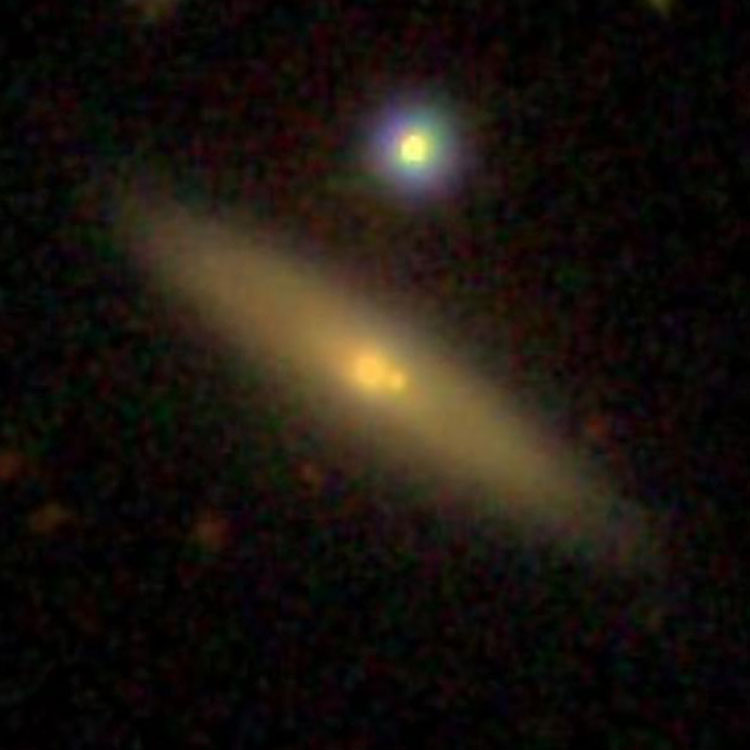
Below, a 1.2 arcmin wide SDSS image of the galaxy
NGC 117
(= PGC 1674 = CGCG 383-015 = MCG +00-02-029)
Discovered (Sep 13, 1863) by Albert Marth
A magnitude 14.3 lenticular galaxy (type S(rl)0/a?) in Cetus (RA 00 27 11.1, Dec +01 20 01)
Historical Information: Per Dreyer, NGC 117 (= GC 5102, Marth #8, 1860 RA 00 20 00, NPD 89 27) is "faint, very small". The position precesses to RA 00 27 10.6, Dec +01 19 32, only 0.5 arcmin south of the galaxy listed above and there is nothing else nearby, so the identification is certain.
Physical Information: Based on a recessional velocity of 5365 km/sec, NGC 117 is about 250 million light-years away. Given that and its apparent size of 0.8 by 0.25 arcmin, it is about 60 thousand light-years across.

Above, a 12 arcmin wide SDSS image centered on NGC 117
Below, a 1 arcmin wide SDSS image of the galaxy

Below, a 12 arcmin wide SDSS image centered on NGC 117;
also shown are PGC 212522, 1189318 and 1190562

NGC 118
(= PGC 1678 = UGC 264 = CGCG 383-016 = MCG +00-02-032)
Discovered (Sep 23, 1867) by Truman Safford
Discovered (Sep 27, 1880) by Wilhelm Tempel
A magnitude 13.6 spiral galaxy (type S(rs)a? pec) in Cetus (RA 00 27 16.2, Dec -01 46 49)
Historical Information: Per Dreyer, NGC 118 (Tempel list IV (#3), (Safford #91), 1860 RA 00 20 07, NPD 92 33.3) is "very faint, small star in centre, eastern of 2", the other being NGC 114. The position precesses to RA 00 27 16.5, Dec -01 46 46, within 0.1 arcmin of the center of the galaxy listed above, so the identification is certain.
Discovery Notes: Dreyer was not aware of Safford's observations at the time he compiled the NGC, as they were published as an appendix to an obscure paper at the time Dreyer was editing his paper for publication, and although he did list a number of Safford's observations in an appendix to the NGC, it was not practical to alter the individual entries; so Safford #91 was not actually shown in the entry for NGC 118 (which is why it is in parentheses).
Physical Information: The "small star in centre" is the galaxy's exceptionally bright nucleus, which makes it a Seyfert galaxy (type Sy2). Based on a recessional velocity of 11250 km/sec, a straightforward calculation indicates that NGC 118 is about 525 million light-years away. However, for objects at such distances we should take into account the expansion of the Universe during the time it took their light to reach us. Doing that shows that the galaxy was about 500 million light-years away at the time the light by which we see it was emitted, about 510 million years ago (the difference between the two numbers being due to the expansion of the intervening space during the light-travel time). Given that and its apparent size of 1.15 by 0.75 arcmin, it is about 170 thousand light-years across.

Above, a 12 arcmin wide SDSS image centered on NGC 118, also showing NGC 114
Below, a 1.4 arcmin wide SDSS image of the galaxy

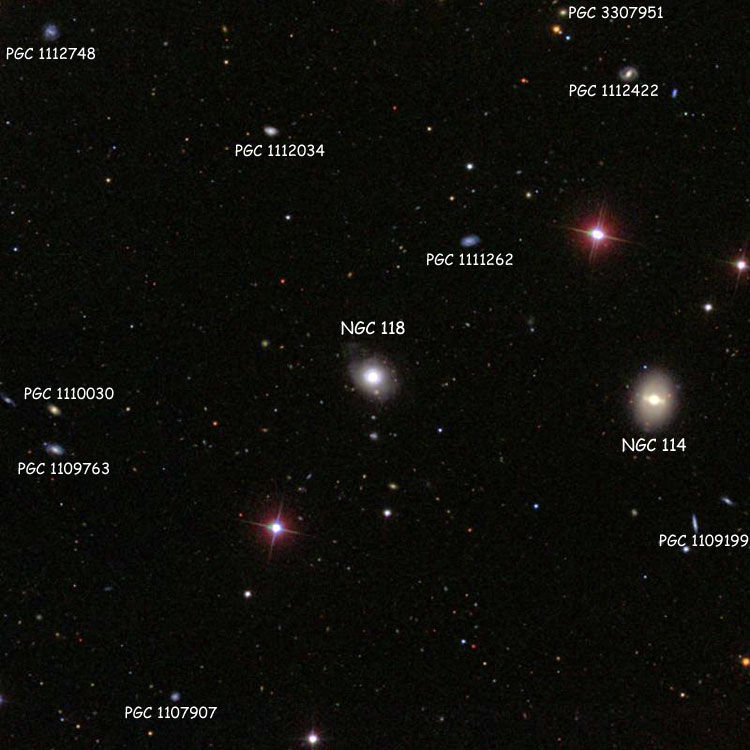
Below, a 12 arcmin wide SDSS image centered on NGC 118, also showing NGC 114
Also shown are PGC 1107907, 1109199, 1109763, 1110030, 1111262, 1112034, 1112422, 1112748 & 3307951
NGC 119
(= PGC 1659 = ESO 150-008)
Discovered (Oct 28, 1834) by John Herschel
A magnitude 13.0 lenticular galaxy (type E/SA0? pec) in Phoenix (RA 00 26 57.6, Dec -56 58 41)
Historical Information: Per Dreyer, NGC 119 (= GC 57 = JH 2324, 1860 RA 00 20 17, NPD 147 45.4) is "pretty bright, small, round, much brighter middle". The position precesses to RA 00 26 57.3, Dec -56 58 52, within 0.2 arcmin of the center of the galaxy listed above, so the identification is certain.
Physical Information: Based on a recessional velocity of 7430 km/sec, a straightforward calculation indicates that NGC 119 is about 345 million light-years away. However, for objects at such distances we should take into account the expansion of the Universe during the time it took their light to reach us. Doing that shows that the galaxy was about 335 million light-years away at the time the light by which we see it was emitted, about 340 million years ago (the difference between the two numbers being due to the expansion of the intervening space during the light-travel time). Given that and its apparent size of 0.9 by 0.9 arcmin, it is about 90 thousand light-years across.

Above, a 12 arcmin wide DSS image centered on NGC 119
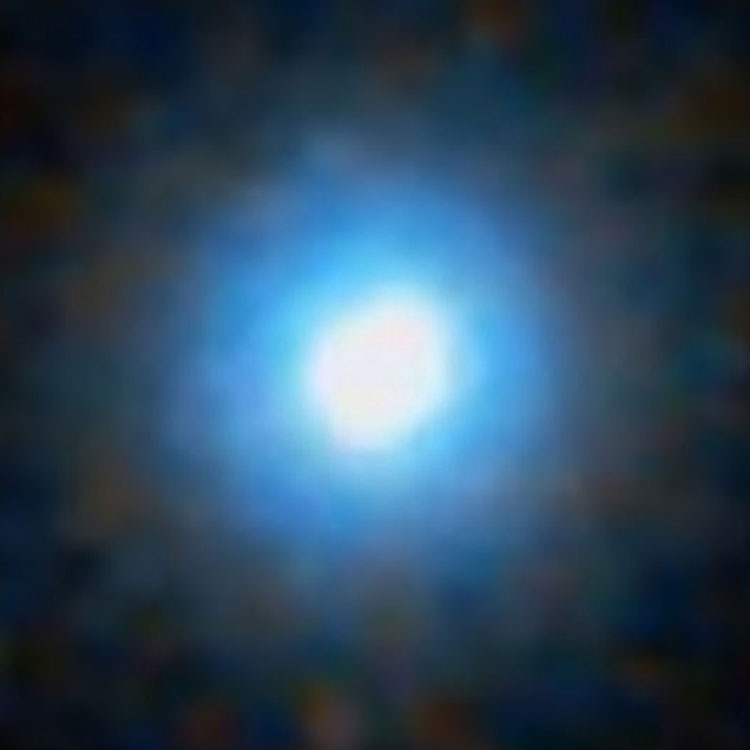
Below, a 1.2 arcmin wide DSS image of the galaxy
Below, a 12 arcmin wide DSS image centered on NGC 119
Also shown are PGC 394477, 394878, 395310 and 396201

NGC 120
(= PGC 1693 = UGC 267 = CGCG 383-017 = MCG +00-02-033)
Discovered (Sep 27, 1880) by Wilhelm Tempel
Also observed (Nov 16, 1890) by Guillaume Bigourdan
A magnitude 13.4 lenticular galaxy (type SB0?) in Cetus (RA 00 27 30.1, Dec -01 30 48)
Historical Information: Per Dreyer, NGC 120 (Tempel list IV (#4a), 1860 RA 00 20 20, NPD 92 12) is "a nebulous star". The second Index Catalog lists a corrected NPD (per Bigourdan) of 92 17; using that and the original right ascension, the position precesses to RA 00 27 29.6, Dec -01 30 28, only 0.4 arcmin northwest of the center of the galaxy listed above, so the identification is certain.
Discovery Notes: On the evening of Sep 27, 1880 Tempel observed half a dozen nebulae in the region near "Santini 28", a star in Giovanni Santini's catalog of Equatorial stars now known as HD 2413, and on the following night accurately measured the positions of three of them, which were published in his list IV as the second, third and fourth entries, and were later entered in the NGC as NGC 114, 118 and 124. However, he did not measure the position of the other three nebulae, merely stating in a note inserted between the fourth and fifth entries in his published list (for which reason I have designated them as list IV #4a, 4b and 4c) that there was a pair about 3 or 4 arcmin north of Santini 28, and a third about 10 arcmin north of the same star. Those three nebulae became NGC 120, 122 and 123, with (per Corwin) positions presumably sent to Dreyer by private communication from Tempel, as there is no record of their positions save in Dreyer's NGC entries. (Whether Tempel's later communication placed NGC 120 fifteen arcmin north of HD 2413 or Dreyer made a transcription error is unknown, but Tempel's original estimate of 10 arcmin was correct, as shown by Bigourdan's observation.)
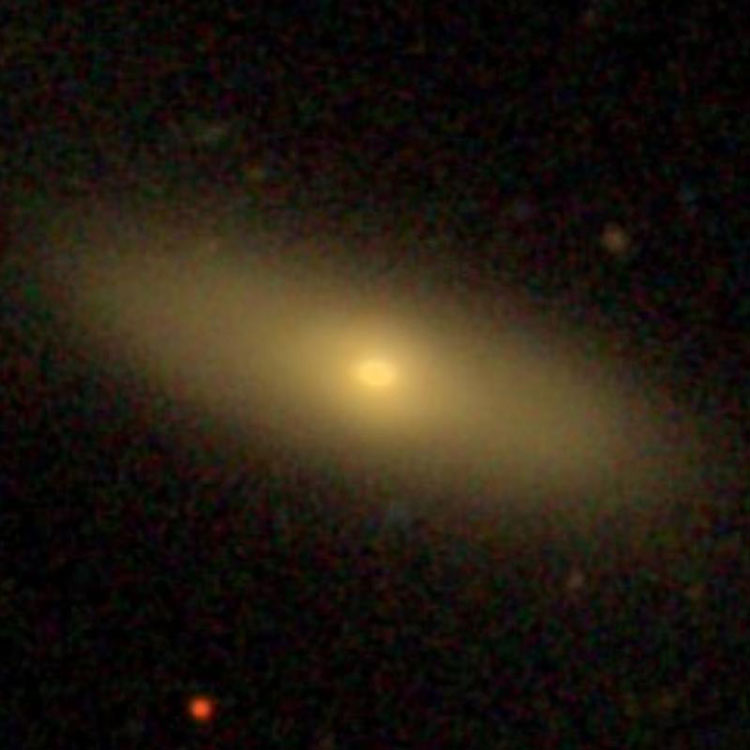
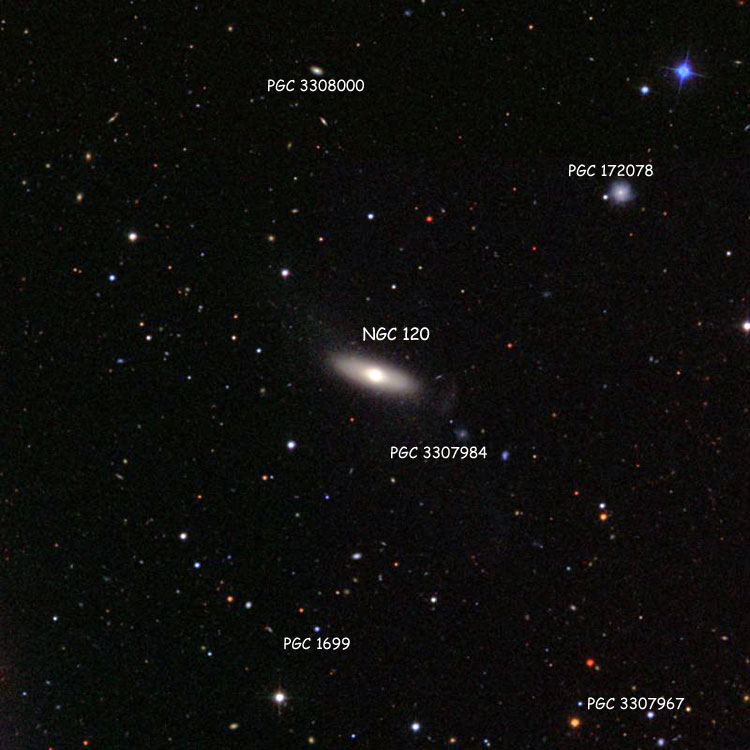
Physical Information: Based on a recessional velocity of 3985 km/sec, NGC 120 is about 185 million light-years away. Given that and its apparent size of 1.55 by 0.5 arcmin, it is about 85 thousand light-years across. In the slightly overexposed image showing numerous PGC objects there appear to be faint extensions to the northeast, west and southwest of NGC 120, which if real might indicate a major episode of disturbance, and could justify a multi-wavelength study of the galaxy.

Above, a 12 arcmin wide SDSS image centered on NGC 120
Below, a 1.6 arcmin wide SDSS image of the galaxy
Below, a 12 arcmin wide SDSS image centered on NGC 120
Also shown are PGC 1699, 172078, 3307967, 3307984 and 3308000
NGC 121, in the Small Magellanic Cloud
(= PGC 2802613 = ESO 050-SC012)
Discovered (Sep 20, 1835) by John Herschel
A magnitude 11.2 globular cluster in Tucana (RA 00 26 48.5, Dec -71 32 08)
Historical Information: Per Dreyer, NGC 121 (= GC 58 = JH 2325, 1860 RA 00 20 25, NPD 162 18.4) is "pretty bright, pretty small, a little extended, very gradually brighter middle". The position precesses to RA 00 26 36.7, Dec -71 31 52, about an arcmin west northwest of the center of the globular cluster listed above but within its western outline, so the identification is certain.
Physical Information: NGC 121 is about 200 thousand light-years away, and is definitely a member of the Small Magellanic Cloud. It is about 3 by 2 arcmin in diameter, which corresponds to about 175 light-years. Based on the cluster fitting of its Main Sequence and the turnoff point for its Main Sequence it is the oldest globular cluster in the SMC, with an estimated age of about 11 billion years, almost 3 billion years older than other SMC globulars, but 2 to 3 billion years younger than Milky Way globulars of similar composition. Like most globular clusters, all of its stars appear to have formed at the same time. The odd thing is that usually the oldest clusters in a galaxy are "metal"-poor, atoms other than hydrogen and helium not yet having had time to be formed due to the death of older stars; but despite its age, NGC 121 has, like other clusters in the SMC, a relatively high content of materials other than hydroen and helium, suggesting that for some reason, the development of globular clusters in the SMC occurred relatively late compared to their formation in other nearby galaxies.
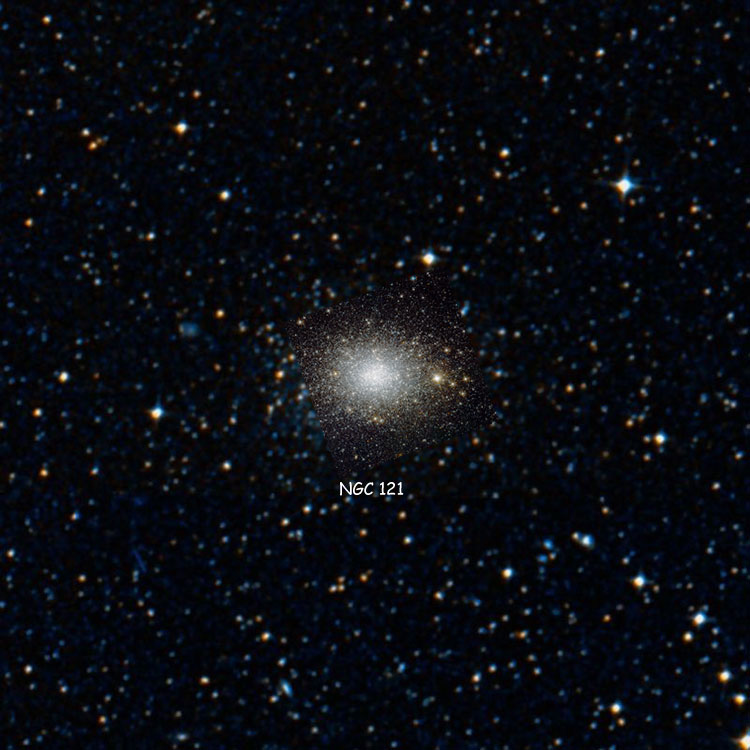
Above, a 12 arcmin wide DSS image centered on NGC 121, with an HST overlay of the cluster itself
(HST Image Credit above and below ESA/Hubble & NASA, Acknowlegement: Stefano Campani)
Below, a 2 arcmin wide HST image of the globular cluster

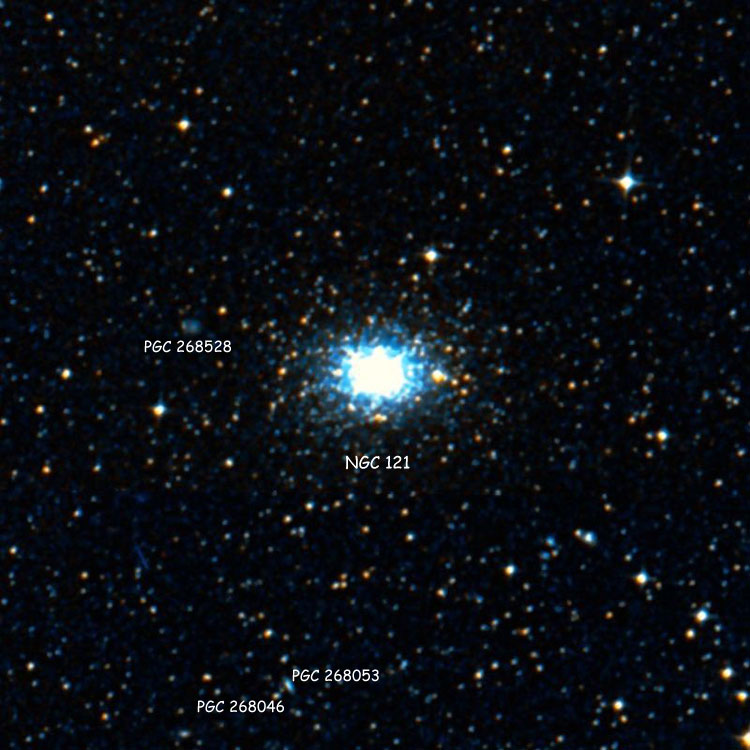
Below, a 12 arcmin wide DSS image centered on the cluster;
also shown are PGC 268046, 268053 and 268528
NGC 122
(= "PGC 5067720")
Recorded (Sep 27, 1880) by Wilhelm Tempel
Also recorded (Nov 16, 1890) by Guillaume Bigourdan
An apparently nonexistent object in Cetus (RA 00 27 42.6, Dec -01 37 29)
or traditionally per Bigourdan a magnitude 15.4 star at RA 00 27 40.0, Dec -01 37 40
or perhaps per Corwin a magnitude 15.0 double star at RA 00 27 38.3, Dec -01 38 26
Historical Information: Per Dreyer, NGC 122 (Tempel list IV (#4b), 1860 RA 00 20 33, NPD 92 24) is one of "2 very faint nebulae 4 to 5 arcmin northwest of 8.5 magnitude star", the other being NGC 123. The position precesses to RA 00 27 42.6, Dec -01 37 29 (whence the first position above), but there is nothing nearby, hence its description as "nonexistent".
Discovery Notes: On the evening of Sep 27, 1880 Tempel observed half a dozen nebulae in the region near "Santini 28", a star in Giovanni Santini's catalog of Equatorial stars now known as HD 2413, and the following night accurately measured the positions of three of them, which were published in his list IV as the second, third and fourth entries, and were later entered in the NGC as NGC 114, 118 and 124. However, he did not measure the position of the other three nebulae, merely stating in a note inserted between the fourth and fifth entries in his published list (for which reason I have designated them as 4a, 4b and 4c) that there was a pair about 3 or 4 arcmin northward from Santini 28, and a third about 10 arcmin northward from the same star. Those three nebulae became NGC 120, 122 and 123, with (per Corwin) positions presumably sent to Dreyer by private communication from Tempel, as there is no record of their positions save in Dreyer's NGC entries.
The fact that Tempel's original note states that the pair of nebulae now listed as NGC 122 and NGC 123 were 3 to 4 arcmin northward from Santini 28, while Dreyer's NGC entries state that they were 4 to 5 arcmin northwest of that star suggests that the positions provided to Dreyer by Tempel were a little further to the northwest than his original estimate. The images below are centered on the NGC position for NGC 122, while the red square's northwest and southeast corners represent positions 5 and 3 arcmin northwest of HD 2413. The positions presumably sent to Dreyer by Tempel are shown by smaller white squares, marked "Dreyer NGC 122" and Dreyer NGC 123", respectively.
As noted in the discovery information for the two objects, Bigourdan looked for them on Nov 16, 1890 (he also looked for them on Dec 17, 1897, but usually only the original date of observation is shown in discussions of NGC/IC objects). In both cases he used HD 2413 as his comparison star, so its position is needed for a reduction of his results. The J2000 position of the star is RA 00 27 55.3, Dec -01 40 54, with proper motions of only +0.01567"/year in right ascension and -0.00086"/year in declination. That means that in 1890 the star was only 0.1 second of time to the west of its modern position, and converting to 1900 coordinates, lay at RA 00 22 48.3, Dec -02 14 06, less than 4 arcsec due north of the position used by Bigourdan. Applying the average offsets measured by Bigourdan, NGC 122 should have been at (1900) RA 00 22 32.6, Dec -02 10 53, which precesses to J2000 RA 00 27 39.5, Dec -01 37 41, just west of the star listed above as "traditionally (per Bigourdan)". The offsets for what Bigourdan presumed to be NGC 123 place it at (1900) RA 00 22 36.9, Dec -02 11 17, which precesses to J2000 RA 00 27 43.8, Dec -01 38 05, just east of the star listed for NGC 123 as "traditionally (per Bigourdan)". However, there is no way that Bigourdan could have seen the nearly 17th magnitude star near his position for NGC 123, and its position (southeast of his position for NGC 122) is completely at odds with Tempel's relative positions for the two objects, which place NGC well to the northeast of NGC 122. As a result, it is often said that there is nothing at Bigourdan's position for NGC 123, more accurately meaning nothing he could have seen. (In the first image below, the stars nearest Bigourdan's positions are marked "B122" and "B123"; note that this is shorthand for "Bigourdan's position for NGC 122/123", and is not the same as B122 and B123, which are completely separate "novae" observed by Bigourdan.)
Given the problems with Tempel's positions (which do not correspond to anything) and Bigourdan's (which are in the wrong position relative to each other), Corwin has suggested that Bigourdan's NGC 122 is actually Tempel's NGC 123, and the double star to its southwest is Tempel's NGC 122 (whence the positions shown in the two entries). Presuming Tempel actually saw anything, this seems a reasonable suggestion; but it is equally possible that NGC 122 and 123 were simply the result of looking too hard for things that weren't really there.
In Conclusion: Whether NGC 122 or NGC 123 represent real objects is not at all certain. If real, the stars suggested by Corwin are probably the best candidates for what Tempel saw; but it seems equally likely that they are simply nonexistent objects. In any event, they are certainly not clusters or nebulae, so as far as the original purpose of the NGC is concerned, it hardly makes any difference what they are (or not).
Note About PGC Designation: As for most NGC objects, HyperLEDA assigned a PGC designation for this object even though it probably doesn't exist. Needless to say, under such circumstances a search of the database for that designation returns no result, so it is shown in quotes.
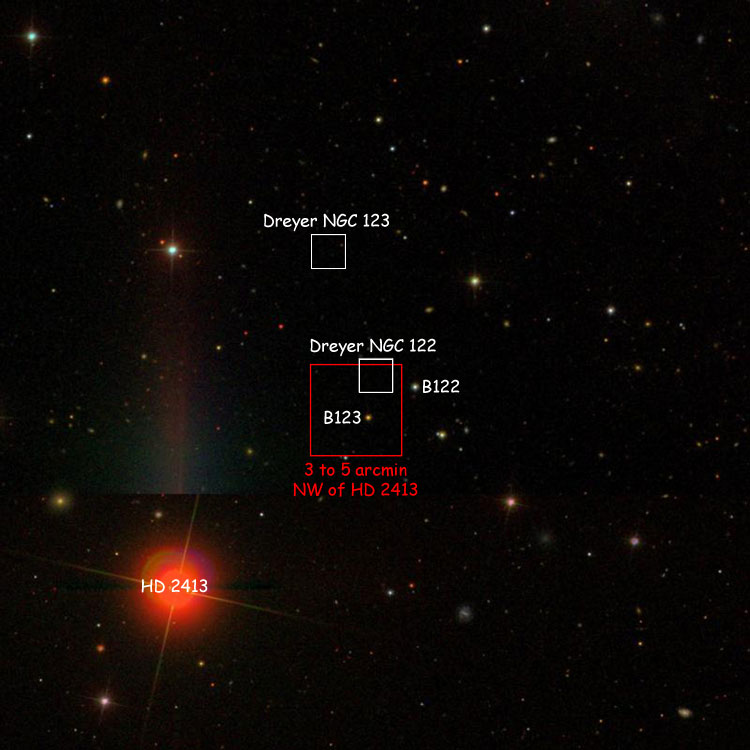
Above, a 12 arcmin wide SDSS image centered on the NGC position for NGC 122
Also shown are the NGC position for NGC 123, and a region 3 to 5 arcmin northwest of HD 2413
Also shown are the stars nearest Bigourdan's positions for NGC 122 and NGC 123
Below, the same SDSS image, labeling only the stars suggested by Corwin as NGC 122 and NGC 123

NGC 123
(= "PGC 5067600")
Recorded (Sep 27, 1880) by Wilhelm Tempel
Also recorded (Nov 16, 1890) by Guillaume Bigourdan
An apparently nonexistent object in Cetus (RA 00 27 45.6, Dec -01 35 29)
or very unlikely per Bigourdan a magnitude 16.7 star at RA 00 27 42.9, Dec -01 38 09
or perhaps per Corwin a magnitude 15.4 star at RA 00 27 40.0, Dec -01 37 40
or possibly but unlikely per Corwin a magnitude 13.8 star at RA 00 27 36.2, Dec -01 35 58
Historical Information: Per Dreyer, NGC 123 (= Tempel's list IV (#4c), 1860 RA 00 20 36, NPD 92 22) is one of "2 very faint nebulae 4 to 5 arcmin northwest of 8.5 magnitude star", the other being NGC 122. The position precesses to RA 00 27 45.6, Dec -01 35 29 (whence the first position above), but there is nothing nearby, hence its description as "nonexistent".
Discovery Notes: A discussion of what NGC 123 might be is in the Discovery Notes for NGC 122.
Note About PGC Designation: As for most NGC objects, HyperLEDA assigned a PGC designation for this object even though it probably doesn't exist. Needless to say, under such circumstances a search of the database for that designation returns no result, so it is shown in quotes.
NGC 124
(= PGC 1715 = UGC 271 = CGCG 383-018 = MCG +00-02-038)
Discovered (Sep 23, 1867) by Truman Safford
Discovered (Sep 27, 1880) by Wilhelm Tempel
A magnitude 13.0 spiral galaxy (type SA(s)c?) in Cetus (RA 00 27 52.4, Dec -01 48 37)
Historical Identification: Per Dreyer, NGC 124 (Tempel list IV (#4), (Safford #92), 1860 RA 00 20 43, NPD 92 35.7) is "very faint, large, diffuse, 2 faint stars to northwest". (Note: Dreyer was not aware of Safford's observations at the time he compiled the NGC, as they were published as an appendix to an obscure paper; but he did list a number of Safford's observations in an appendix to the NGC. Unfortunately, he only listed those objects not already in the NGC, so in those cases where Safford was the discoverer of an object already credited to someone else, his prior discovery went unmentioned. Steinicke's book has a complete listing of the objects for which Safford deserves priority, hence his listing as the discoverer of this object, and its number in Safford's list.) Tempel's position precesses to RA 00 27 52.5, Dec -01 49 11, about 0.6 arcmin south of the center of the galaxy, but still within the southern border of the galaxy, and there are two faint stars to the northwest, so the identification is certain.
Physical Information: Based on the recessional velocity of 4060 km/sec, about 180 million light-years away. Given that and the apparent size of 1.3 by 0.75 arcmin (from closeup image below), about 65 to 70 thousand light-years across. It is listed as a possible group member with NGC 114, which see for a view of their relative positions, and if at the same distance from us, is separated from that galaxy by less than a million light-years.

Above, a 12 arcmin wide SDSS image centered on NGC 124 (also see the wider view at NGC 114)
Below, a 1.5 arcmin wide SDSS image of the galaxy

Below, a 12 arcmin wide SDSS centered on the galaxy, showing numerous PGC objects:
PGC 1107411, 1107664, 1107907, 1109763, 1110030, 1110744 and 1111303

NGC 125
(= PGC 1772 = UGC 286 = CGCG 383-027 = MCG +00-02-048)
Discovered (Dec 25, 1790) by William Herschel
Also observed (Oct 12, 1827) by John Herschel
A magnitude 12.1 lenticular galaxy (type (R)SA0/a? pec) in Pisces (RA 00 28 50.2, Dec +02 50 20)
Historical Identification: Per Dreyer, NGC 125 (= GC 59 = JH 23 = WH III 869, 1860 RA 00 21 41, NPD 87 56.1) is "very faint, small, brighter middle, double star to southwest". The position precesses to RA 00 28 52.2, Dec +02 50 24, about 0.5 arcmin east of the center of the galaxy, but within its eastern border, and there is a double star southwest of the nucleus, so the identification is certain.
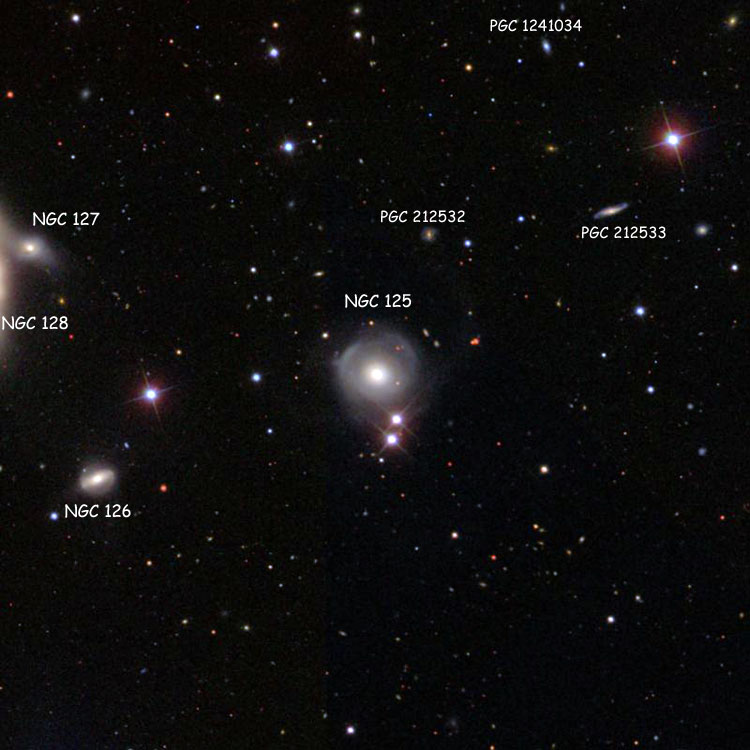
Physical Information: Based on the recessional velocity of 5305 km/sec, about 235 million light-years away. Given that and its apparent size of 1.7 by 1.5 arcmin, about 115 thousand light-years across. (Note: the approximate size just listed is only for the central galaxy and its bright outer ring; there is a much fainter half-ring extending eastward from its southern rim toward the star due east of it, and westward then northward toward the galaxy at the top of the 4.8 arcmin wide image below, which is faintly visible in that image and in the 12 arcmin wide image at the top.) NED lists it as part of a pair, apparently with NGC 128; but the recessional velocities of the two galaxies differ by more than a thousand km/sec, so NGC 125 is probably around 50 million light-years further away, and not connected to the other galaxy.
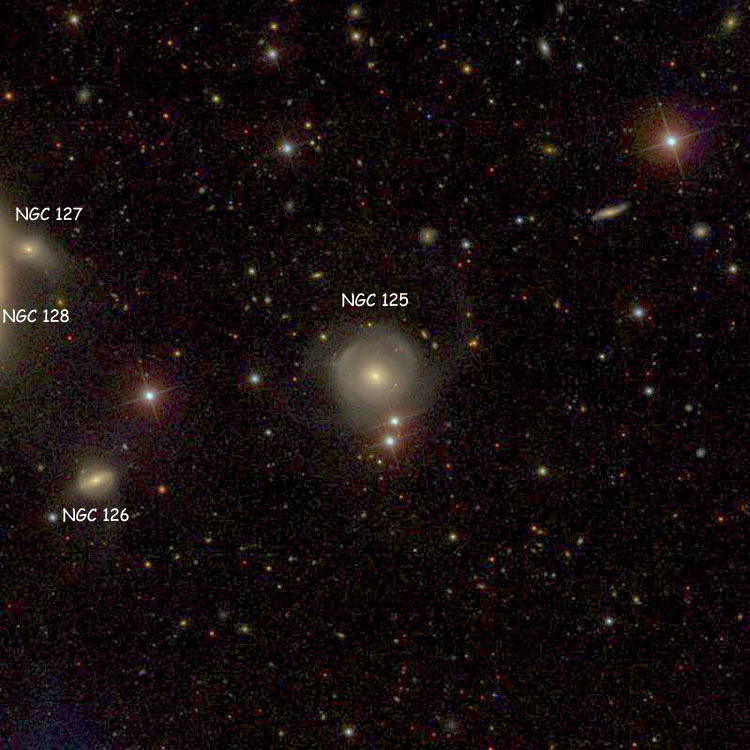
Above, a 12 arcmin wide SDSS image centered on NGC 125, also showing NGC 126, 127 and 128
Below, a 2 arcmin wide SDSS image of the galaxy

Below, a 4.8 arcmin wide SDSS image of the galaxy, using exaggerated contrast to show its outer regions

Below, a 12 arcmin wide SDSS image centered on NGC 125
Also shown are NGC 126, 127 and part of NGC 128, and PGC 212532, 212533 and 1241034
NGC 126
(= PGC 1784 = CGCG 383-028 = MCG +00-02-049)
Discovered (Nov 4, 1850) by Bindon Stoney
Also observed (Sep 19, 1865) by Heinrich d'Arrest
A magnitude 14.2 lenticular galaxy (type (R')SB0/a?) in Pisces (RA 00 29 08.1, Dec +02 48 40)
Historical Identification: Per Dreyer, NGC 126 (= GC 60, 3rd Lord Rosse, d'Arrest, 1860 RA 00 21 54, NPD 87 58.1) is "very faint, small, a little extended". The position precesses to RA 00 29 05.2, Dec +02 48 23, about 0.8 arcmin southwest of the galaxy and there is nothing else nearby, so the identification is reasonably certain.
Discovery Notes: Although Dreyer credits the discovery to William Parsons, 3rd Earl of Rosse, he notes that many of Rosse's nebular discoveries were actually made by one of his assistants, in this case Bindon Stoney.
Physical Information: Based on the recessional velocity of 4045 km/sec, about 180 million light-years away. Given that and its apparent size of about 0.6 by 0.55 arcmin (from the images below), about 30 to 35 thousand light-years across. Its direction and recessional velocity indicate that it is a member of the NGC 128 Group of galaxies, which also includes NGC 127 and 130.
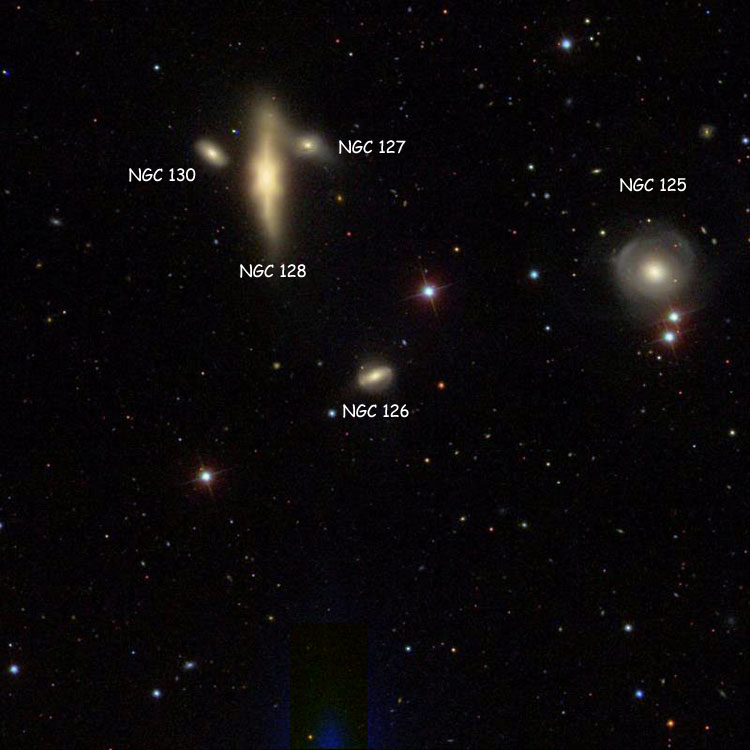
Above, a 12 arcmin wide SDSS image centered on NGC 126, also showing NGC 125, 127, 128 and 130
Below, a 0.8 arcmin wide SDSS image of the galaxy

Below, the 12 arcmin wide image at top, also showing PGC 212532

NGC 127
(= PGC 1787 = CGCG 383-029: = MCG +00-02-050)
The colon after CGCG 383-029 is there because that designation includes NGC 128 and 130
Discovered (Nov 4, 1850) by Bindon Stoney
A magnitude 14.8 spiral galaxy (type SA(rs)a? pec) in Pisces (RA 00 29 12.4, Dec +02 52 21)
Historical Identification: Per Dreyer, NGC 127 (= GC 61, 3rd Lord Rosse, 1860 RA 00 22 01, NPD 87 54.1) is "very faint, very small, round, west of h 25", (JH) 25 being NGC 128. The position precesses to RA 00 29 12.2, Dec +02 52 23, right on the galaxy's nucleus, and it is west of "h 25", so the identification is certain.
Discovery Notes: Although Dreyer credits the discovery to William Parsons, 3rd Earl of Rosse, he notes that many of Rosse's nebular discoveries were actually made by one of his assistants, in this case Bindon Stoney.
Physical Information: Based on the recessional velocity of 4095 km/sec, about 180 million light-years away. Given that and its apparent size of about 0.85 by 0.45 arcmin, about ? thousand light-years across. Its direction and recessional velocity indicate that it is a member of the NGC 128 group of galaxies, which also includes NGC 126 and 130 (in fact, images seem to indicate that it is physically interacting with NGC 128).
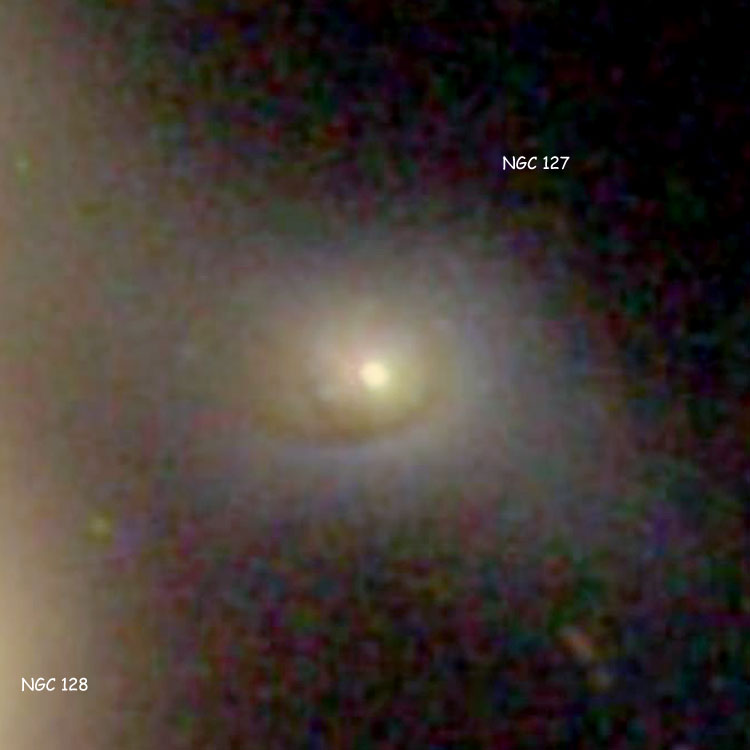
Above, a 1 arcmin wide SDSS image centered on NGC 127, also showing NGC 128, which see
NGC 128
(= PGC 1791 = UGC 292 = CGCG 383-029: = MCG +00-02-051)
The colon after CGCG 383-029 is there because that designation includes NGC 127 and 130
Discovered (Dec 25, 1790) by William Herschel
Also observed (Oct 12, 1827) by John Herschel
A magnitude 11.8 lenticular galaxy (type SB0? pec) in Pisces (RA 00 29 15.0, Dec +02 51 51)
Historical Identification: Per Dreyer, NGC 128 (= GC 62 = JH 25 = WH II 854, 1860 RA 00 22 05, NPD 87 54.6) is "pretty bright, pretty small, a little extended 2°, brighter middle". The position precesses to RA 00 29 16.2, Dec +02 51 53, only 0.3 arcmin from the center of the galaxy listed above, so the identification is certain.
Physical Information: Based on the recessional velocity of 4240 km/sec, about 190 million light-years away. Given that and its apparent size of 3.0 by 0.9 arcmin, about 165 thousand light-years across. The largest member and namesake of the NGC 128 Group of galaxies (which also includes NGC 126, 127 and 130, NGC 128 has a strange "peanut"-shaped halo, presumably caused by gravitational effects due to its companions (it appears to be interacting with NGC 127); however, the large nucleus appears relatively normal, and it is possible that more detailed study of the galaxy may considerably change interpretations of its structure.

Above, a 12 arcmin wide SDSS image centered on NGC 128
Also shown are NGC 126, 127, 130 and part of NGC 125
Below, a 3 arcmin wide SDSS image of the galaxy, also showing NGC 127 and 130

Below, a ? by ? arcmin wide 'raw' HST image of part of NGC 128 (Credit Hubble Legacy Archive, Courtney Seligman)

NGC 129
(= OCL 294 = "PGC 3517829")
Discovered (Dec 16, 1788) by William Herschel
Also observed (Sep 29, 1829) by John Herschel
A magnitude 6.5 open cluster (type IV2p) in Cassiopeia (RA 00 29 58.0, Dec +60 12 42)
Corwin lists the position of the core as RA 00 30 09.0, Dec +60 11 00
Historical Identification: Per Dreyer, NGC 129 (= GC 63 = JH 24 = WH VIII 79, 1860 RA 00 22 06, NPD 30 33.1) is "a cluster, very large, pretty round, a little compressed, stars from 9th to 13th magnitude". The position precesses to RA 00 29 52.7, Dec +60 13 23, about 1.5 arcmin northwest of the "standard" position for the cluster; but for a loosely scattered collection of stars more than 20 arcmin across, the "position" is a matter of opinion (for that reason, the value listed above has been rounded off to whole arcmin), and the "error" in the position insignificant; so the identification is certain.
Note About The PGC Designation: As for most NGC objects, HyperLEDA assigned a PGC designation to this object even though it isn't a galaxy; but a search of the database for that designation returns no result, so it is shown in quotes.
Physical Information: The cluster appears to consist of approximately three dozen 9th to 11th magnitude stars scattered across a region approximately 30 light-years across, 5000 to 5500 light-years distant, with an estimated age (based on the luminosity of hot, bright upper Main Sequence stars) of about 75 to 80 million years, making it one of the youngest clusters in our vicinity. Note: Fainter middle and lower Main Sequence stars are difficult to distinguish from the numerous background stars, so the actual number of cluster members is considerably larger than the number of easily observable brighter stars. Which stars are cluster members can be estimated from the radial velocity of the cluster, which is approaching us at about 40 km/sec; stars with very different radial velocities are probably not cluster members. The difficulty of doing the spectroscopic observations required rapidly increases with decreasing brightness, but as of a 1992 study, nearly a hundred stars had been confirmed as cluster members. Despite its relatively young age, a few cluster members have already ended their Main Sequence lives and swelled up to become supergiants. One of those is the Cepheid variable DL Cassiopeiae, a spectroscopic binary with an orbital period of a little less than two years. The presence of a Cepheid variable in such a "close" cluster provides a useful tool for determining the approximate distance of the cluster, and as more accurate determinations become possible, for calibrating the Cepheid variable distance scale; as a result, NGC 129 is one of the four or five clusters most often studied for such purposes (the nearest being the Pleiades). 
Above, a 30 arcmin wide DSS image centered on NGC 129; labels are shown for PGC 136980,
6th-magnitude HD 2626 (not a cluster member), and 9th-magnitude DL Cassiopeiae
NGC 130
(= PGC 1794 = CGCG 383-029: = MCG +00-02-052)
The colon after CGCG 383-029 is there because that designation includes NGC 127 and 128
Discovered (Nov 4, 1850) by Bindon Stoney
A magnitude 14.4 lenticular galaxy (type E/SA0?) in Pisces (RA 00 29 18.5, Dec +02 52 14)
Historical Identification: Per Dreyer, NGC 130 (= GC 64, 3rd Lord Rosse, 1860 RA 00 22 09, NPD 87 54.1) is "very faint, very small, round, east of h 25", (JH) 25 being NGC 128. The position precesses to RA 00 29 20.2, Dec +02 52 23, about 0.4 arcmin northeast of the center of the galaxy, a little beyond its northeastern extension; but even if the position were off a bit more, its position directly to the east of "h25" would make the identification certain.
Discovery Notes: Although Dreyer credits the discovery to William Parsons, 3rd Earl of Rosse, he notes that many of Rosse's nebular discoveries were actually made by one of his assistants, in this case Bindon Stoney.
Physical Information: Based on the recessional velocity of 4435 km/sec, about 200 million light-years away. Given that and its apparent size of 0.65 by 0.35 arcmin (from image below), about 40(?) thousand light-years across. Despite its slightly greater recessional velocity, there is little doubt that it is a member of the NGC 128 Group of galaxies, which also includes NGC 126 and 127.
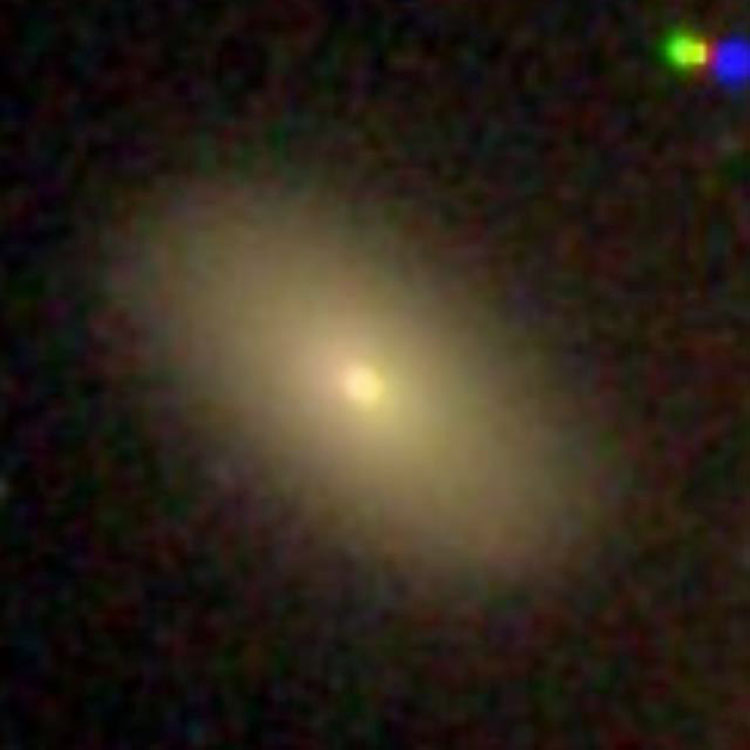
Above, a 0.8 arcmin wide SDSS image of NGC 130; for other images see NGC 128
NGC 131
(= PGC 1813 = PGC 199360 = ESO 350-021 = MCG -06-02-010)
Discovered (Sep 25, 1834) by John Herschel
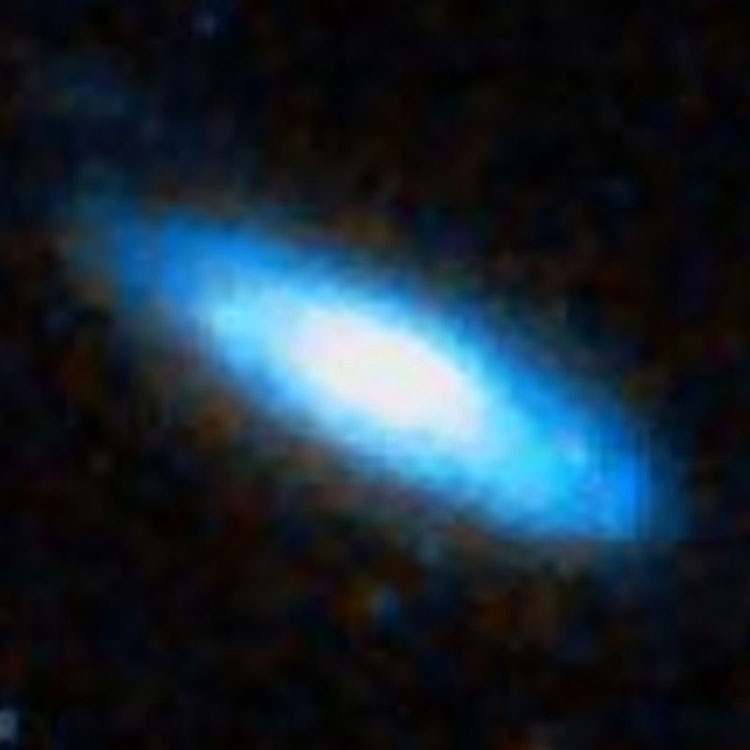
A magnitude 13.2 spiral galaxy (type SB(s)b?) in Sculptor (RA 00 29 38.5, Dec -33 15 36)
Historical Identification: Per Dreyer, NGC 131 (= GC 65 = JH 2326, 1860 RA 00 22 43, NPD 124 02.0) is "faint, pretty large, pretty much extended, very gradually brighter middle, western of 2", the other being NGC 134.
Physical Information: Apparent size of about 1.65 by 0.45 arcmin (from images below). NGC 131 is listed as a member of the NGC 134 Group of galaxies, which includes NGC 115, 148 and 150, PGC 2000 (often misidentified as IC 1554) and IC 1555, and PGC 2044. Several of these are also listed as members of a group of galaxies in or near Sculptor with recessional velocities of about 1500 to 1800 km/sec (this is not "the" Sculptor Group, a close neighbor to our Local Group, with an average recessional velocity of less than 300 km/sec); so all NGC 134 group members are presumably members of the larger group.

Above, a 12 arcmin wide DSS image centered on NGC 131
Below, a 1.8 arcmin wide DSS image of the galaxy
NGC 132
(= PGC 1844 = UGC 301 = CGCG 383-032 = MCG +00-02-063)
Discovered (Dec 25, 1790) by William Herschel
Also observed (Oct 12, 1827) by John Herschel
A magnitude 12.6 spiral galaxy (type SAB(s)bc?) in Cetus (RA 00 30 10.7, Dec +02 05 36)
Historical Identification: Per Dreyer, NGC 132 (= GC 66 = JH 26 = WH II 855, 1860 RA 00 23 00, NPD 88 40.9) is "pretty faint, considerably large, round, very gradually a little brighter middle, mottled but not resolved".
Physical Information: Apparent size of about 1.95 by 1.3 arcmin (from images below)

Above, a 12 arcmin wide SDSS image centered on NGC 132
Below, a 2.0 by 2.4 arcmin wide SDSS image of the galaxy

NGC 133
(= OCL 296 = "PGC 3518636")
Discovered (Feb 4, 1865) by Heinrich d'Arrest
A magnitude 9.4 open cluster (type IV1p) in Cassiopeia (RA 00 31 16.0, Dec +63 21 12)
Historical Identification: Per Dreyer, NGC 133 (= GC 5103, d'Arrest, 1860 RA 00 23 21, NPD 27 25.7) is "a cluster, pretty large, stars from 10th magnitude, double star involved".
Note About PGC Designation: As for most NGC objects HyperLEDA assigned a PGC designation to this object even though it isn't a galaxy; but a search of the database for that designation returns no result, so it is shown in quotes.
Physical Information:

Above, a 12 arcmin region centered on NGC 133
NGC 134
(= PGC 1851 = ESO 350-023 = MCG -06-02-012)
Discovered (Jul 7, 1826) by James Dunlop (his #590 = his #599)
Also observed (Sep 25, 1834) by John Herschel
A magnitude 10.4 spiral galaxy (type SAB(s)bc) in Sculptor (RA 00 30 21.9, Dec -33 14 38)
Historical Identification: Per Dreyer, NGC 134 (= GC 67 = JH 2327, 1860 RA 00 23 28, NPD 124 01.8) is "very bright, large, very much extended 47°, pretty suddenly brighter middle, eastern of 2, 10th magnitude star 45 arcsec to northwest", the "western of 2" being NGC 131.
Discovery Notes: Although Dreyer failed to credit Dunlop with the discovery, his observations were published before Herschel started his southern hemisphere observations.
Physical Information: NGC 134 is the namesake of the NGC 134 Group of galaxies, which includes NGC 115, 131, 148 and 150, PGC 2000 (often misidentified as IC 1554) and IC 1555, and PGC 2044. Several of these are also listed as members of a group of galaxies in or near Sculptor with recessional velocities of about 1500 to 1800 km/sec (this is not "the" Sculptor Group, a close neighbor to our Local Group, with an average recessional velocity of less than 300 km/sec); so all NGC 134 group members are presumably members of the larger group.

Above, a 12 arcmin wide ESO image centered on NGC 134 (superimposed on a DSS image to fill in missing areas)
(Image Credit above and below ESO)
Below, an approximately 5 arcmin wide ESO image of the galaxy

NGC 135 (= IC 26)
(= PGC 2010 = PGC 138192)
Discovered (Oct 2, 1886) by Francis Leavenworth (and later listed as NGC 135)
Rediscovered (Nov 4, 1891) by Stephane Javelle (and later listed as IC 26)
Also observed (about 1900) by Herbert Howe (as NGC 135)
A magnitude 15.1 spiral galaxy (type (R')SB(rs)b?) in Cetus (RA 00 31 45.9, Dec -13 20 15)
Historical Identification: Per Dreyer, NGC 135 (Leavenworth list I (#5), 1860 RA 00 23 30, NPD 104 08.0) is "very faint, very small, round". The position precesses to RA 00 30 34.9, Dec -13 21 33, but there is nothing there, so when Javelle made an accurate measurement of the position of the galaxy listed above, Dreyer listed it as a separate object ( IC 26, which see for a discussion of its discovery) in the first Index Catalog. Around 1900, Howe also observed the object (which he presumed was NGC 135), measuring a position of (1900) RA 00 26 43, Dec -13 53.3, leading Dreyer to add a note to the second Index Catalog stating that the (1860) RA of NGC 135 was 00 24 41 (why he didn't also list Howe's corrected NPD is not obvious). Howe's position precesses to RA 00 31 46.3, Dec -13 20 10, right on the galaxy, making it certain that he observed the same object as Javelle. Whether it was actually the same as the one Leavenworth observed (as presumed by Howe and Dreyer) is another matter, but per Corwin there are very good reasons for believing it was. First, the error in Leavenworth's position is typical of those made at Leander McCormick observatory (well to the west in right ascension, but fairly close in declination), and most tellingly, Leavenworth made a sketch of the region near the object which perfectly fits the field near the galaxy listed above; so despite the confused history of observation and measurement, there is no doubt that what Leavenworth observed was the same object observed by Javelle and Howe, so NGC 135 and IC 26 are the same, and the same as the object listed here.
Physical Information: Based on a recessional velocity of 7190 km/sec, a straightforward calculation indicates that NGC 135 is about 335 million light-years away. However, for objects at such distances we should take into account the expansion of the Universe during the time it took their light to reach us. Doing that shows that the galaxy was about 325 million light-years away at the time the light by which we see it was emitted, about 330 million years ago (the difference between the two numbers being due to the expansion of the intervening space during the light-travel time). Given that and its apparent size of 0.42 by 0.42 arcmin (from the images below), the galaxy is about 40 thousand light-years across.
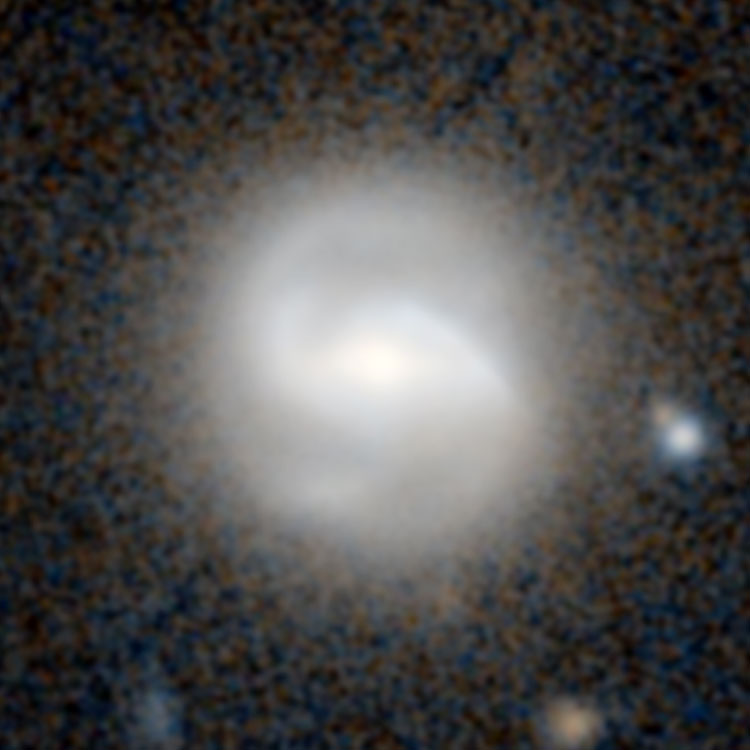
Classification Note: This galaxy is usually listed as a lenticular (and looks like an E0 in the overexposed wide-field DSS2 image, which will be replaced or supplemented by a PanSTARRS image in the next iteration of this page), but as the PanSTARRS closeup shows, it has a very complex structure, and arguments could be made for several slightly different classifications, with the one shown in the description line as the best educated guess I could make. Being uncertain about that, I reached out to Corwin (an expert in the field), who states that different factors argue for slightly different classifications, but notes that the near-infrared DSS image shows the bar and spiral structure and writes that the type shown above is the best compromise that can be made.

Above, a 12 arcmin wide DSS image centered on NGC 135
Below, a 0.75 arcmin wide PanSTARRS image of the galaxy
NGC 136
(= OCL 295 = "PGC 3517830")
Discovered (Nov 26, 1788) by William Herschel
A magnitude 11.5 open cluster (type II2p) in Cassiopeia (RA 00 31 31.0, Dec +61 30 36)
Historical Identification: Per Dreyer, NGC 136 (= GC 68 = WH VI 35, 1860 RA 00 23 41, NPD 29 15.8) is "a globular cluster, very faint, small, extremely compressed".
Note About PGC Designation: As for most NGC objects, HyperLEDA assigned a PGC designation to this object even though it isn't a galaxy; but a search of the database for that designation returns no result, so it is shown in quotes.
Physical Information:

Above, a 12 arcmin wide DSS image centered on NGC 136
Below, a 6 arcmin wide DSS image of the cluster

NGC 137
(= PGC 1888 = UGC 309 = CGCG 434-019 = MCG +02-02-017)
Discovered (Nov 23, 1785) by William Herschel
Also observed (Oct 3, 1864) by Heinrich d'Arrest
A magnitude 12.8 lenticular galaxy (type S0?) in Pisces (RA 00 30 58.1, Dec +10 12 30)
Historical Identification: Per Dreyer, NGC 137 (= GC 69 = WH II 471, d'Arrest, 1860 RA 00 23 43, NPD 80 34.0) is "faint, irregular figure, a little brighter middle".
Physical Information:

Above, a 12 arcmin wide SDSS image centered on NGC 137
Below, a 2.4 arcmin wide SDSS image of the galaxy
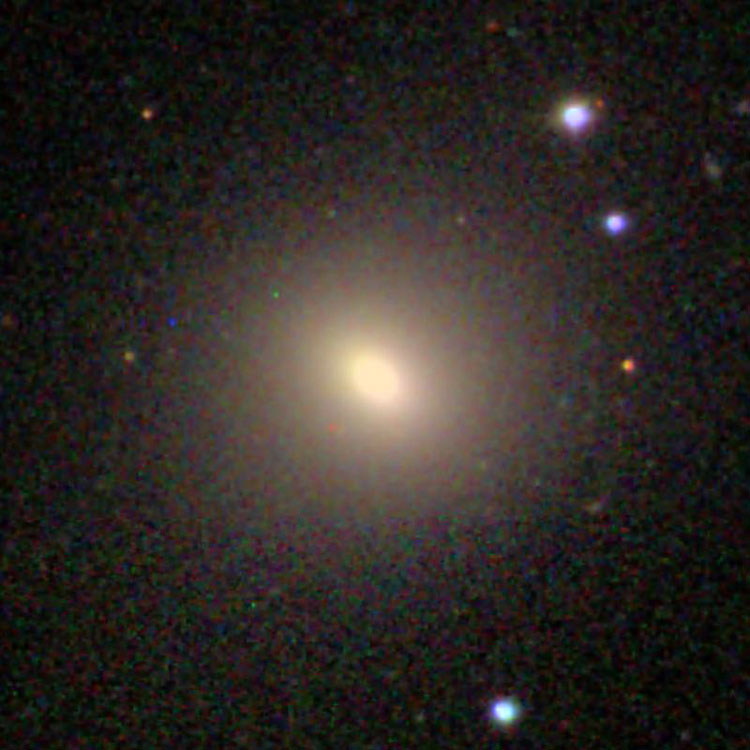
NGC 138
(= PGC 1889 = UGC 308 = CGCG 409-023 = MCG +01-02-016)
Discovered (Aug 29, 1864) by Albert Marth
A magnitude 13.7 lenticular galaxy (type SAB0/a pec?) in Pisces (RA 00 30 59.2, Dec +05 09 35)
Historical Identification: Per Dreyer, NGC 138 (= GC 5104, Marth #9, 1860 RA 00 23 47, NPD 85 37) is "faint, extremely small, suddenly brighter middle." The position precesses to RA 00 30 59.1, Dec +05 09 27, just south of the nucleus of the galaxy listed above and well within its outline, the description fits and there is nothing comparable nearby, so the identifiation is certain.
Physical Information: Based on a recessional velocity relative to the Cosmic Background Radiation of 11650 km/sec (and H0 = 70 km/sec/Mpc), a straightforward calculation indicates that NGC 138 is about 540 to 545 million light-years away. However, for objects at such distances we should take into account the expansion of the Universe during the time it took their light to reach us. Doing that shows that the galaxy was about 515 to 520 million light-years away at the time the light by which we see it was emitted, about 525 to 530 million years ago (the difference between the two numbers being due to the expansion of the intervening space during the light-travel time). Given that and its apparent size of about 1.55 by 0.6 arcmin including its distorted extensions (from the images below), the galaxy spans about 70 to 75 thousand light-years.
Classification Note: LEDA and NED both list this as type Sa, albeit with a question mark or colon to indicate uncertainty about that classification. To me, its images look more like a distorted lenticular galaxy (type S0/a pec), but Corwin suggests SB0/a pec. The "pec" obviously refers to the strangely uneven distribution of material near the northeastern and southwestern ends of the galaxy, and since I don't see clear signs of a bar myself, I added an "A" and underlined the "B" to indicate that it is probably a barred galaxy, but that I don't feel as confident about that as Corwin does.

Above, a 12 arcmin wide SDSS image centered on NGC 138, also showing NGC 139 and 141
Below, a 1.8 arcmin wide SDSS image of the galaxy, also showing PGC 212536

Below, the 12 arcmin wide SDSS image at the top, also showing PGC 212536 and 212537

PGC 212536
Not an NGC object but listed here as an apparent companion of NGC 138
A magnitude 17(?) lenticular galaxy (type S0: sp?) in Pisces (RA 00 31 01.1, Dec +05 09 11)
Physical Information: Based on a recessional velocity relative to the Cosmic Background Radiation of 18495 km/sec (and H0 = 70 km/sec/Mpc), a straightforward calculation indicates that PGC 212536 is about 860 million light-years away. However, for objects at such distances we should take into account the expansion of the Universe during the time it took their light to reach us. Doing that shows that the galaxy was about 800 to 805 million light-years away at the time the light by which we see it was emitted, about 825 million years ago (the difference between the two numbers being due to the expansion of the intervening space during the light-travel time). Given that and its apparent size of about ? arcmin (from the images below), the galaxy is about ? thousand light-years across.
Note About This "Companion": Since this glaxy is nearly 300 million light-years further away than NGC 138 it is not a companion of that galaxy, but merely a very distant background galaxy (that is, an optical double).
Classification Note: Corwin was kind enough to provide the classification shown above. The colon means that the type is uncertain, "sp" stands for "spindle" (or edge-on), and I've added the question mark simply because the type is uncertain.
(Images and apparent and actual physical size to be added in the next iteration of this page; see NGC 138 for a labeled image)
PGC 212537
Not an NGC object but listed here as an apparent/possible companion of NGC 138
A magnitude 16(?) spiral galaxy (type SB:(s?)a: sp?) in Pisces (RA 00 30 45.7, Dec +05 09 48)
Physical Information: Based on a recessional velocity relative to the Cosmic Background Radiation of 19510 km/sec (and H0 = 70 km/sec/Mpc), a straightforward calculation indicates that PGC 212537 is about 905 to 910 million light-years away. However, for objects at such distances we should take into account the expansion of the Universe during the time it took their light to reach us. Doing that shows that the galaxy was about 840 to 845 million light-years away at the time the light by which we see it was emitted, about 870 million years ago (the difference between the two numbers being due to the expansion of the intervening space during the light-travel time). Given that and its apparent size of about ? arcmin (from the images below), the galaxy is about ? thousand light-years across.
An Alternative Recessional Velocity: The recessional velocities for PGC 212537 and 212536 were measured at the same time as the one for NGC 138; but a later LAMOST survey lists a recessional velocity relative to the Cosmic Microwave Background of only 11460 km/sec for PGC 212537. If the older value is correct, then as in the case of PGC 212536, PGC 212537 is simply a very distant background galaxy; but if the LAMOST survey value is correct, then PGC 212537 was only about about 510 million light-years away at the time the light by which we see it was emitted, about 520 million years ago (the difference between the two numbers being due to the expansion of the intervening space during the light-travel time), which would make it a possible physical companion of NGC 138. It would also mean that its apparent size of about ? arcmin (from the images below) only corresponds to about ? thousand light-years.
Classification Note: Corwin was kind enough to provide the classification shown above. The colons mean that those parts of the type are uncertain, (s?) means that there is a hint of a spiral structure in the nucleus, "sp" means "spindle" (or edge-on), and I added the question mark at the end simply because there are so many colons and question marks that any classification is uncertain.
(Images and apparent and actual physical sizes to be added in the next iteration of this page; see NGC 138 for a labeled image)
NGC 139
(= PGC 1900 = CGCG 409-022)
Discovered (Aug 29, 1864) by Albert Marth
A magnitude 14.4 spiral galaxy (type SB(rs)ab? pec) in Pisces (RA 00 31 06.4, Dec +05 04 44)
Historical Identification: Per Dreyer, NGC 139 (= GC 5105, Marth #10, 1860 RA 00 23 54, NPD 85 39) is "extremely faint, small".
Physical Information: Apparent size of about 0.8 by 0.5 arcmin (from images below), including outer extensions
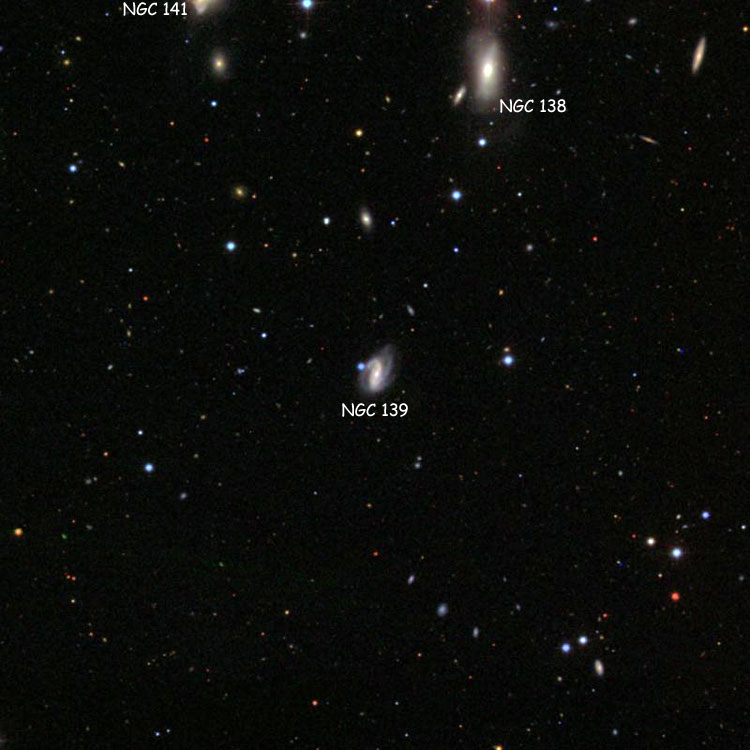
Above, a 12 arcmin wide SDSS image centered on NGC 139, also showing NGC 138 and 141
Below, a 1 arcmin wide SDSS image of the galaxy
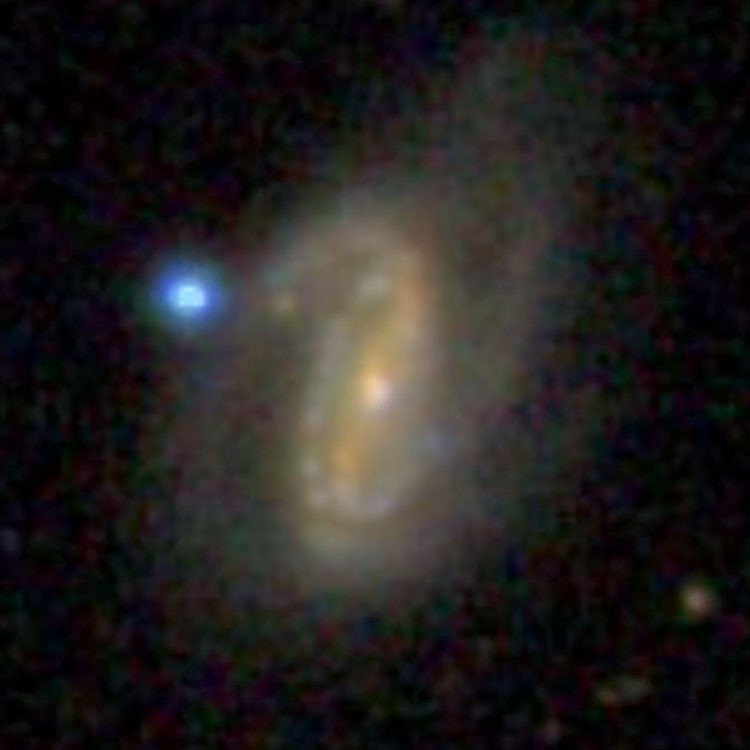
NGC 140
(= PGC 1916 = UGC 311 = CGCG 500-038 = MCG +05-02-021)
Discovered (Oct 8, 1866) by Truman Safford
Discovered (Nov 5, 1882) by Édouard Stephan
A magnitude 13.2 spiral galaxy (type S(rs)bc?) in Andromeda (RA 00 31 20.4, Dec +30 47 33)
Historical Identification: Per Dreyer, NGC 140 (= Stephan list XII (#5), (Safford #60), 1860 RA 00 23 57, NPD 59 58.9) is "very faint, small, round, gradually brighter middle". (Note: Stephan was not aware of Safford's observations, which were published as an appendix to an obscure paper, nor was Dreyer when he first compiled the NGC, so although Dreyer added a list of some of Safford's observations to an appendix to the NGC, he did not correct the discovery information in the NGC itself. So in those cases where Safford was the discoverer of an object already credited to someone else, his prior discovery went unmentioned. Steinicke's book has a complete listing of the objects for which Safford deserves priority, whence his listing as the discoverer of this object, and its inclusion (in parentheses) in the NGC entry shown here.) Stephan's position precesses to RA 00 31 20.5, Dec +30 47 32, right on the galaxy, so the identification is certain.
Physical Information: Apparent size of about 1.35 by 1.15 arcmin (from image below)

Above, a 12 arcmin wide SDSS image centered on NGC 140, also showing the double star listed as IC 24
Below, a 1.8 arcmin wide SDSS image of the galaxy
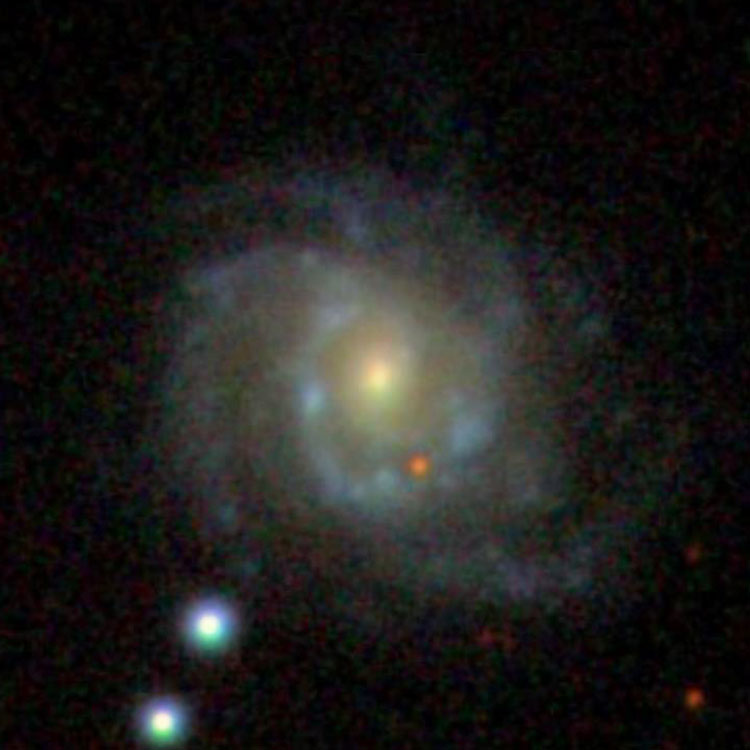
NGC 141
(= PGC 1918 = CGCG 409-027)
Discovered (Aug 29, 1864) by Albert Marth
A magnitude 14.5 pair of interacting galaxies (type SAB(s)b? pec) in Pisces (RA 00 31 17.5, Dec +05 10 46)
Historical Identification: Per Dreyer, NGC 141 (= GC 5106, Marth #11, 1860 RA 00 24 06, NPD 85 35) is "very faint, very small, irregularly round". (Northwestern galaxy is at RA 00 31 17.4, Dec +05 10 47; southeastern at RA 00 31 17.6, Dec +05 10 45)
Physical Information: Based on a recessional velocity relative to the Cosmic Background Radiation of 11410 km/sec (and H0 = 70 km/sec/Mpc), a straightforward calculation indicates that NGC 141 is about 530 million light-years away. However, for objects at such distances we should take into account the expansion of the Universe during the time it took their light to reach us. Doing that shows that the galaxy was about 505 to 510 million light-years away at the time the light by which we see it was emitted, about 515 to 520 million years ago (the difference between the two numbers being due to the expansion of the intervening space during the light-travel time). Given that and an apparent size of about 0.75 by 0.7 arcmin (from the images below), the pair of galaxies and their ejected material spans about 110 thousand light-years.
Classification Note: Each of the two galaxies appears to be a severely distorted lenticular galaxy, but as whole, they and the material ejected from them by their merger give the impression of a peculiar spiral with a double nucleus, and it is their combined appearance that is the basis of the "type" shown in the description line.

Above, a 12 arcmin wide SDSS image centered on NGC 141, also showing NGC 138 and 139
Below, a 1 arcmin wide SDSS/PanSTARRS composite image of the galaxy

NGC 142
(= PGC 1901 = PGC 811378 = PGC 811410 = ESO 473-021 = MCG -04-02-014)
Discovered (1886) by Frank Muller
Also observed (date?) by Herbert Howe
A magnitude 13.8 spiral galaxy (type SAB(rs)bc? pec) in Cetus (RA 00 31 08.1, Dec -22 37 07)
Historical Identification: Per Dreyer, NGC 142 (Muller list II (#282), 1860 RA 00 24 30, NPD 113 24.0) is "extremely faint, small, a little extended, 1st of 3", the others being NGC 143 and 144. The second Index Catalog lists a corrected RA (per Howe) of 00 24 08, and adds "the faintest" to the description.
Physical Information: Apparent size of about 1.0 by 0.5 arcmin (from images below)
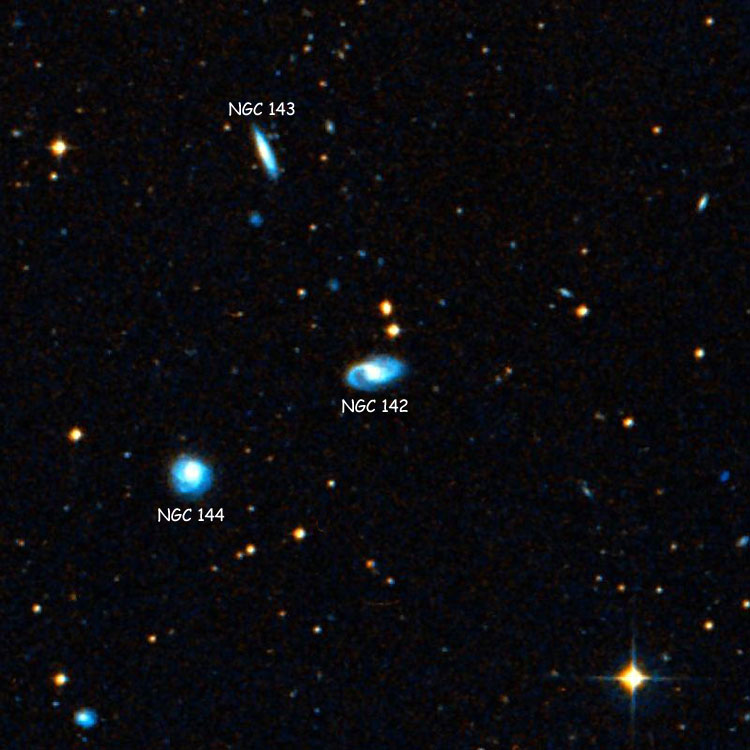
Above, a 12 arcmin wide DSS image centered on NGC 142, also showing NGC 143 and 144
Below, a 1.25 arcmin wide PanSTARRS image of the galaxy
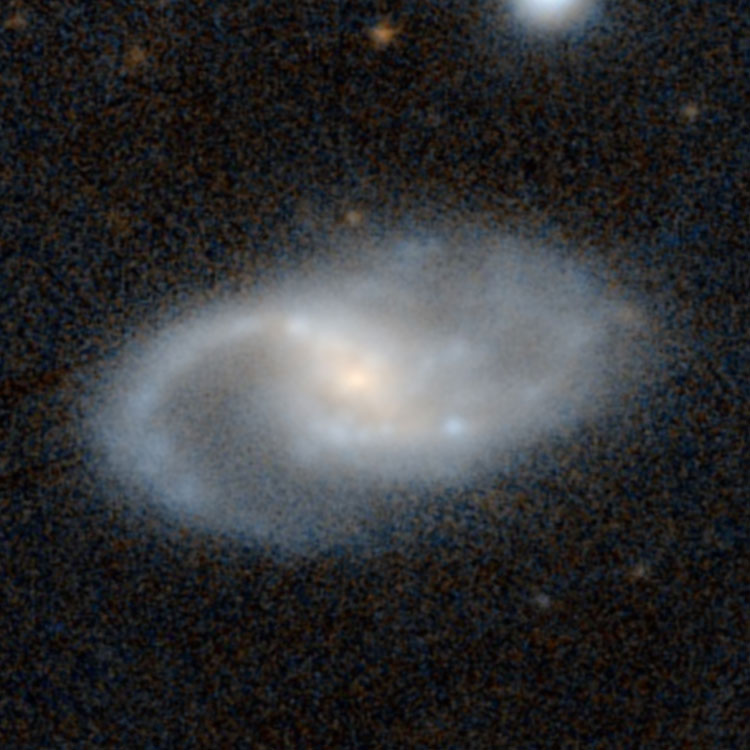
NGC 143
(= PGC 1911 = PGC 198145 = ESO 473-022 = MCG -04-02-015)
Discovered (1886) by Frank Muller
Also observed (date?) by Herbert Howe
A magnitude 14.4 spiral galaxy (type SB(sr)b? edge-on pec?) in Cetus (RA 00 31 15.6, Dec -22 33 36)
Historical Identification: Per Dreyer, NGC 143 (Muller list II (#283), 1860 RA 00 24 30, NPD 113 21.0) is "extremely faint, small, much extended, 2nd of 3", the others being NGC 142 and 144. The second Index Catalog lists a corrected RA (per Howe) of 00 24 16.
Physical Information: Apparent size of about 1.05 by 0.25 arcmin (from images below)

Above, a 12 arcmin wide DSS image centered on NGC 143, also showing NGC 142 and 144
Below, a 1.2 arcmin wide PanSTARRS image of the galaxy
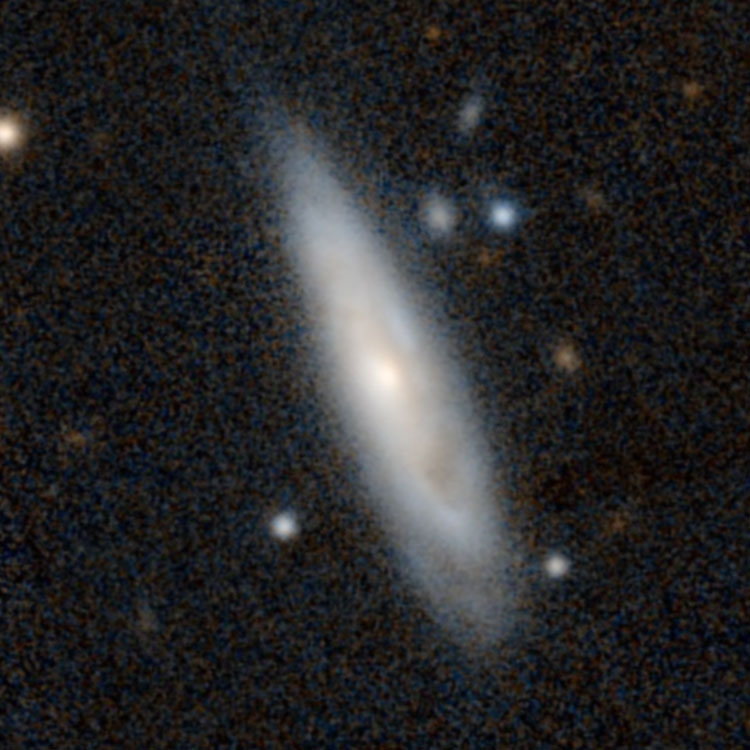
NGC 144
(= PGC 1917 = ESO 473-023 = MCG -04-02-016)
Discovered (1886) by Frank Muller
Also observed (date?) by Herbert Howe
A magnitude 13.8 spiral galaxy (type SA(rs)bc? pec) in Cetus (RA 00 31 20.7, Dec -22 38 44)
Historical Identification: Per Dreyer, NGC 144 (Muller list II (#284), 1860 RA 00 24 30, NPD 113 26.0) is "extremely faint, very small, round, 3rd of 3", the others being NGC 142 and 143. The second Index Catalog lists a corrected RA (per Howe) of 00 24 20, and the additional note "the brightest, pretty small".
Physical Information: Apparent size of about 0.7 by 0.6 arcmin (from images below)
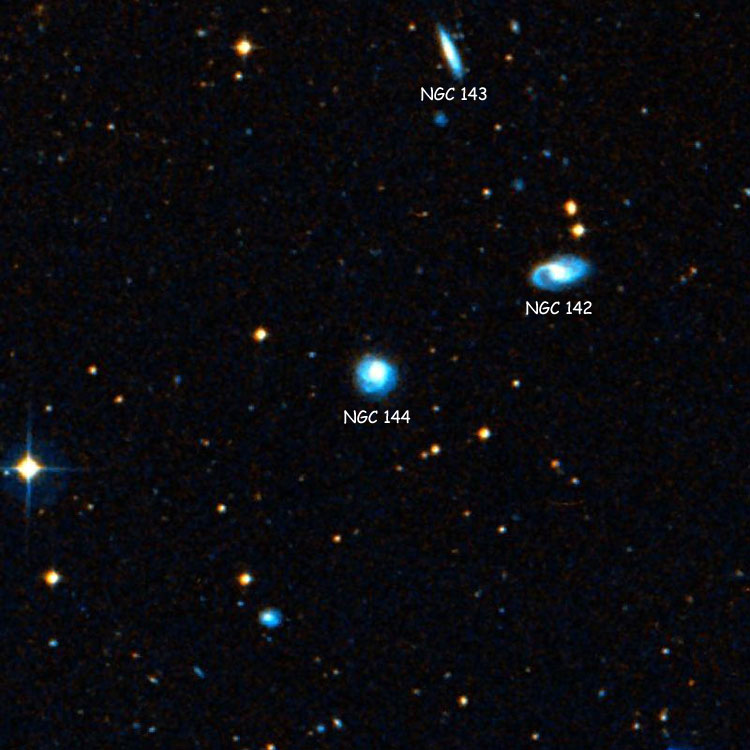
Above, a 12 arcmin wide DSS image centered on NGC 144, also showing NGC 142 and 143
Below, a 0.9 arcmin wide PanSTARRS image of the galaxy
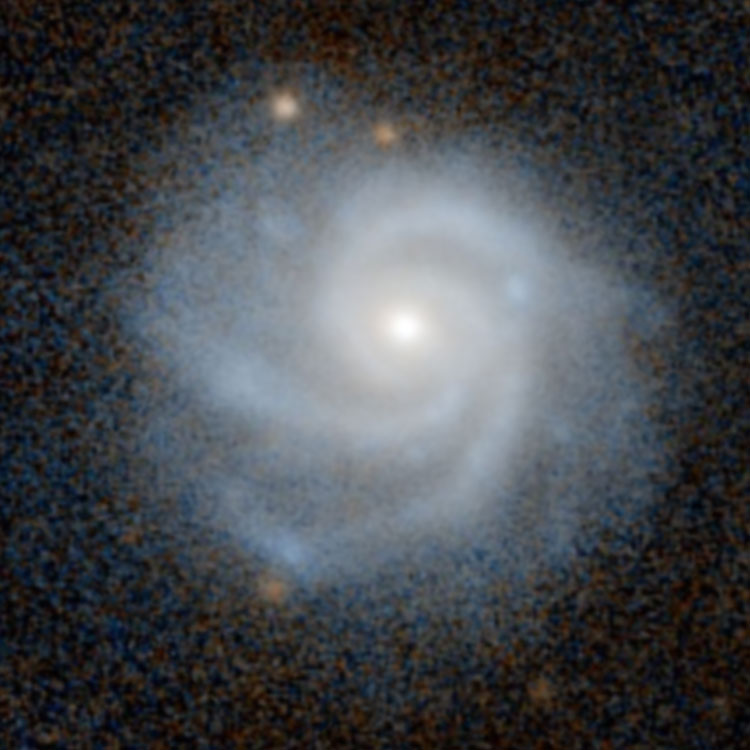
NGC 145 (= Arp 19)
(= PGC 1941 = MCG -01-02-027)
Discovered (Oct 9, 1828) by John Herschel
Also observed (Oct 5, 1836) by John Herschel
A magnitude 12.7 spiral galaxy (type SB(s)dm?) in Cetus (RA 00 31 45.8, Dec -05 09 08)
Historical Identification: Per Dreyer, NGC 145 (= GC 70 = JH 27 = JH 2328, 1860 RA 00 24 38, NPD 95 55.6) is "faint, pretty large, very little extended, very gradually brighter middle, 8th or 9th magnitude star 5 arcmin to east".
Physical Information: Based on recessional velocity of 4140 km/sec, about 185 million light-years away. However, redshift-independent distance estimates are only 40 to 50 million light-years, so there is a serious error somewhere. If the lower distance is correct, the apparent size of 1.8 by 1.55 arcmin (from the images below) would imply a size of 25 thousand light-years, while the larger distance would require a size of nearly 100 thousand light-years. Given the generally diffuse nature of the galaxy, the smaller values may be more reasonable, but the prominent arms suggest the larger values may be more accurate; so the issue cannot be settled without further observations.
Use By The Arp Atlas: NGC 145 is used by The Arp Atlas of Peculiar Galaxies as an example of a three-armed spiral galaxy, with no other note.
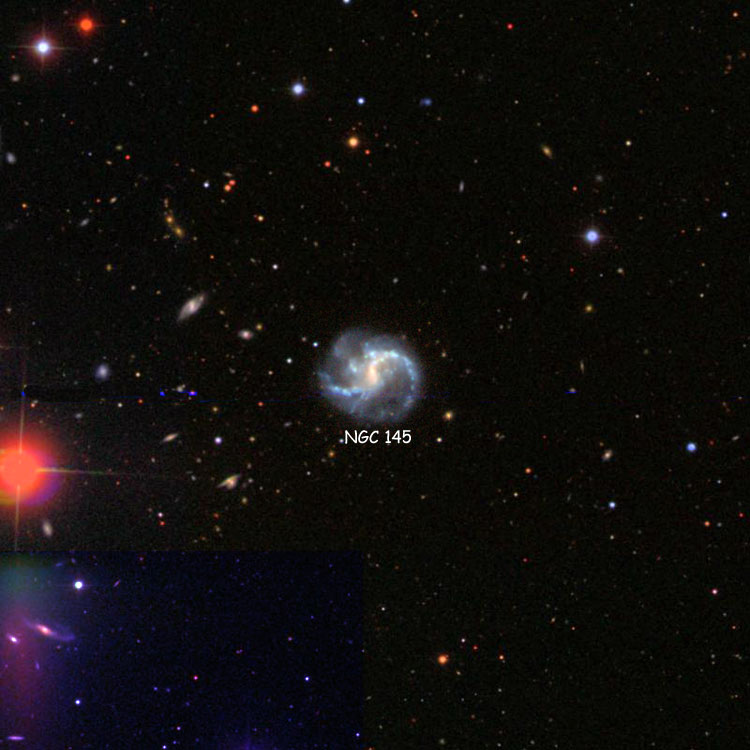
Above, a 12 arcmin wide SDSS image centered on NGC 145
Below, a 2 arcmin wide SDSS image of the galaxy (partially removed a serious artifact running across the bottom)

NGC 146
(= OCL 299 = "PGC 3517831")
Discovered (Oct 27, 1829) by John Herschel
A magnitude 9.1 open cluster (type IV3p) in Cassiopeia (RA 00 33 01.0, Dec +63 18 42)
Historical Identification: Per Dreyer, NGC 146 (= GC 71 = JH 28, 1860 RA 00 25 13, NPD 27 29.3) is "a cluster, pretty large, a little compressed, stars from 11th to 12th magnitude, double star".
Note About PGC Designation: As for most NGC objects, HyperLEDA assigned a PGC designation to this object, even though it isn't a galaxy; but a search of the database for that designation returns no result, so it is shown in quotes.
Physical Information: Apparent size 5.0 arcmin?

Above, a 12 arcmin wide DSS image centered on NGC 146
NGC 147
(= C17 = PGC 2004 = UGC 326 = CGCG 550-006 = MCG +08-02-005)
Discovered (Sep 8, 1829) by John Herschel
A magnitude 9.5 elliptical galaxy (type E5? pec) in Cassiopeia (RA 00 33 12.2, Dec +48 30 32)
Historical Identification: Per Dreyer, NGC 147 (= GC 72 = JH 29, 1860 RA 00 25 32, NPD 42 16.5) is "very faint, very large, irregularly round, gradually then suddenly much brighter middle equal to 11th magnitude star".
Physical Information: NGC 147 is a dwarf spheroidal member of the Andromeda Galaxy group. As such, its peculiar (non-Hubble-expansion) velocity is too large for its radial velocity to yield any estimate of its distance (in fact, it is approaching us at 195 km/sec, which would yield a negative distance if used without thinking). Redshift-independent distance estimates range from 1.9 to 2.5 million light-years, primarily based on the galaxy's Hertzsprung-Russell Diagram (individual stars are easily resolved with current technology). Given its apparent separation from the Andromeda Galaxy (about 7.5 degrees), it is probably about 300 thousand light-years from its much larger neighbor (about the same distance as between the Milky Way and the Large Magellanic Cloud). Its apparent size of 13.2 by 7.8 arcmin corresponds to about 8 thousand light-years along its largest dimension.

Above, a 20 arcmin wide DSS image centered on NGC 147
Below, a 12 arcmin wide DSS image of the galaxy

Below, a 1.2 degree wide region centered between NGC 147 and NGC 185, another M31 Group galaxy
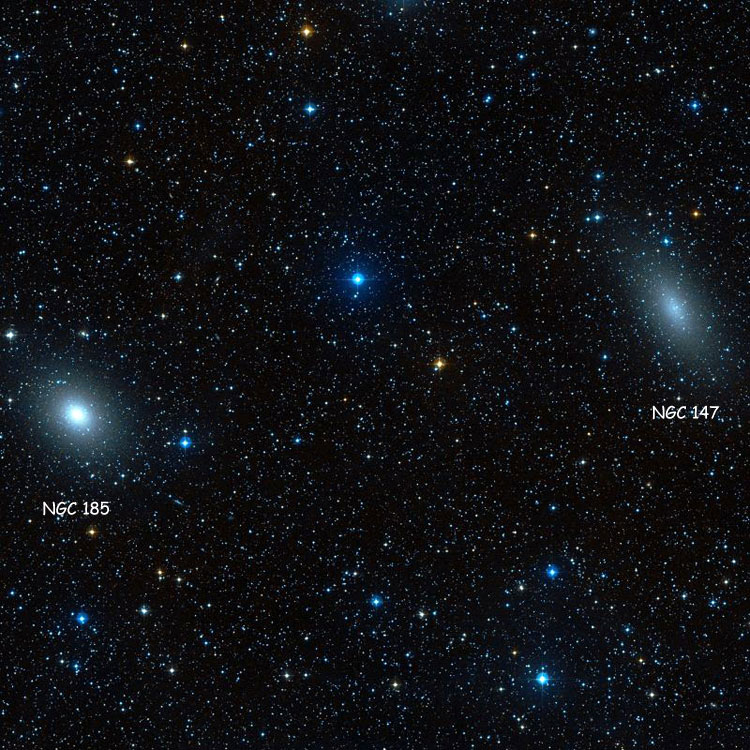
Below, a 7.5 degree wide region showing the relative positions of M31 and NGC 147
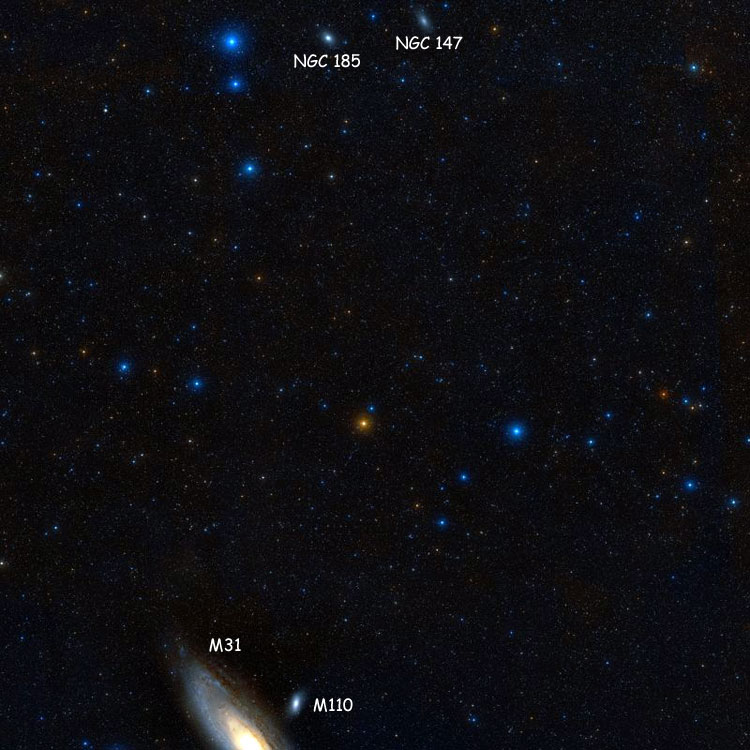
NGC 148
(= PGC 2053 = ESO 410-020 = MCG -05-02-017)
Discovered (Sep 27, 1834) by John Herschel
A magnitude 12.2 lenticular galaxy (type S0?) in Sculptor (RA 00 34 15.5, Dec -31 47 10)
Historical Identification: Per Dreyer, NGC 148 (= GC 73 = JH 2329, 1860 RA 00 26 22, NPD 122 34.0) is "very bright, small, a little extended 90°, suddenly much brighter middle equal to 11th magnitude star".
Physical Information: Based on recessional velocity of 1515 km/sec, about 70 million light-years away, in reasonable agreement with a redshift-independent distance estimate of 60 million light-years. Given that and its apparent size of 2.0 by 0.8 arcmin, about 40 thousand light-years across. NGC 148 is listed as a member of the NGC 134 Group of galaxies, which includes NGC 115, 131 and 150, PGC 2000 (erroneously identified as IC 1554) and IC 1555, and PGC 2044. Several of these are also listed as members of a group of galaxies in or near Sculptor with recessional velocities of about 1500 to 1800 km/sec (this is not "the" Sculptor Group, a close neighbor to our Local Group, with an average recessional velocity of less than 300 km/sec); so all NGC 134 group members are presumably members of the larger group.
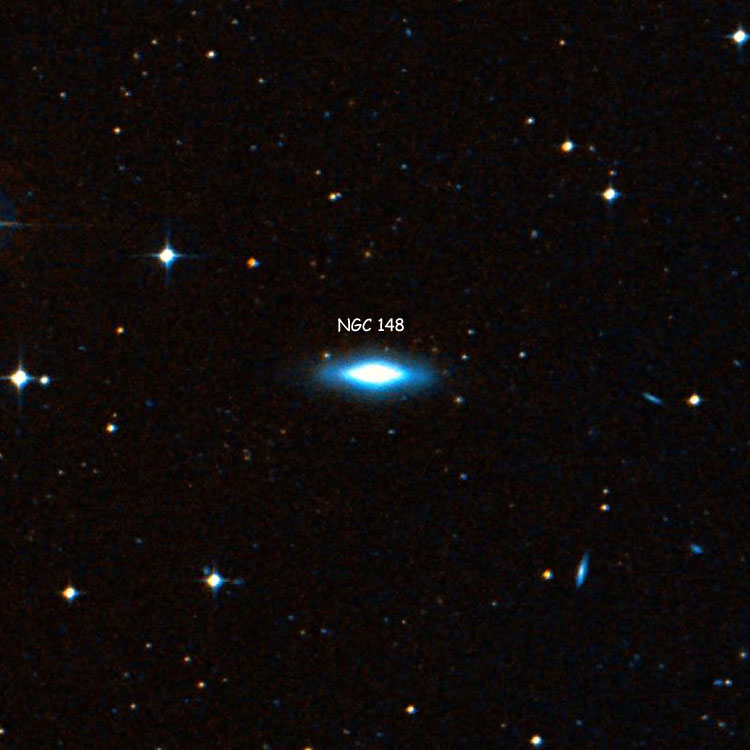
Above, a 12 arcmin wide DSS image centered on NGC 148
Below, a 2.4 arcmin wide DSS image of the galaxy
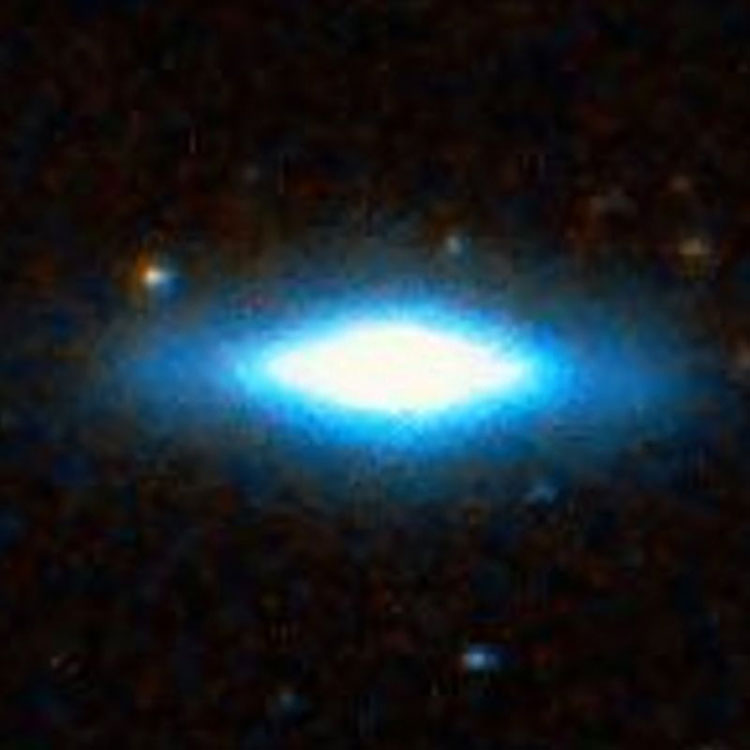
NGC 149
(= PGC 2028 = UGC 332 = CGCG 500-044 = MCG +05-02-024)
Discovered (Oct 4, 1883) by Édouard Stephan
A magnitude 13.7 lenticular galaxy (type S0?) in Andromeda (RA 00 33 50.3, Dec +30 43 24)
Historical Identification: Per Dreyer, NGC 149 (Stephan list XIII (#5), 1860 RA 00 26 26, NPD 60 02.9) is "very faint, very small, round, gradually brighter middle equal to 14th magnitude star, 12th magnitude star to southwest".
Physical Information: Based on a recessional velocity of 4845 km/sec, about 215 to 220 million light-years away. Given that and its apparent size of 0.95 by 0.65 arcmin (from images below), about 60 thousand light-years across.
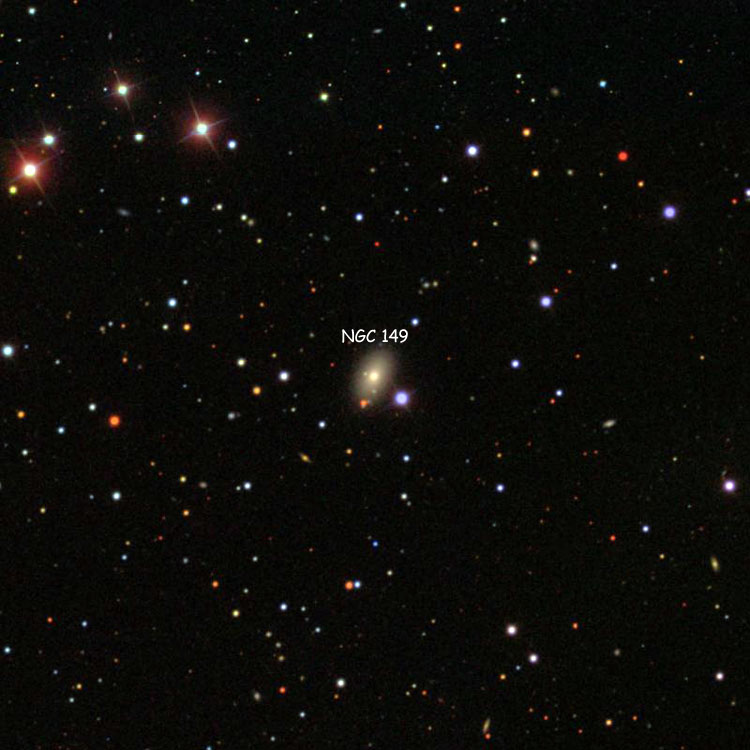
Above, a 12 arcmin wide SDSS image centered on NGC 149
Below, a 1.2 arcmin wide SDSS image of the galaxy

|