QuickLinks:
2050, 2051, 2052, 2053, 2054, 2055, 2056, 2057, 2058, 2059, 2060, 2061, 2062,
2063, 2064, 2065, 2066,2067, 2068, 2069, 2070, 2071, 2072, 2073, 2074, 2075,
2076, 2077, 2078, 2079, 2080, 2081, 2082, 2083, 2084, 2085, 2086, 2087, 2088,
2089, 2090, 2091, 2092, 2093, 2094, 2095, 2096, 2097, 2098, 2099
Page last updated Sep 24, 2023 (Added Caldwell & other IDs for NGC 2070)
Page last updated Dec 11, 2019
Need to add more/new pix of NGC 2070 (the Tarantula Nebula) per Jan 30 ESO press release
Checked Corwin's updated positions, Steinicke's 2018 historical database updates
Checked for mis-spelling of DeLisle Stewart
WORKING 2050/52/55, 2057+: Check IDs, add basic pix, tags, captions
WORKING HERE: Identification not at all certain
NGC 2050 (= an OCL in the LMC)
Discovered (probably in Nov 1834 or Dec 1835) by John Herschel
A magnitude 9.3 open cluster in Dorado (RA 05 36 44.2, Dec -69 23 03)
Historical Identification: Per Dreyer, NGC 2050 (= GC 1252 = JH 2928 = JH (628), 1860 RA 05 37 55, NPD 159 28.2) is a "cluster plus nebula, much compressed, irregular figure, stars very small", "JH (628)" referring to the object's inclusion in a supplementary catalog of objects observed by Herschel in the Large Magellanic Cloud. The position corresponds to RA 05 36 49.0, Dec -69 23 35, but what if anything in the complex stellar and nebular field corresponds to the object is unclear.
(The discussion here is a bit of a mess, because the situation is even more of a mess, and I'm in the middle of trying to figure out what to do about this entry.)
Per Corwin, the only thing near Herschel's position is a scattered star cloud in the LMC, but Herschel's description is of a far more interesting object ("Cl VI [very compressed and rich], very faint stars and nebulosity of irregular branching figure, or rather 3 clusters connected"), which does not match anything near his position. That suggests that the "standard" identification is wrong, but Herschel's positions of objects shown in the diagrams are otherwise very good, so it is hard to know what else he could have observed. As a result, though the identification is uncertain, it is the best currently available. But perhaps it is a duplicate observation of NGC 2092, which is a good match for the description.
Discovery Notes: Some of the objects listed in Herschel's 1847 "Results of Astronomical Observations Made During the Years 1834, 5, 6, 7, 8, At the Cape of Good Hope" do not have a discovery date listed, and NGC 2050 is one such object. However, its inclusion in the supplementary catalog of objects observed in the Large Magellanic Cloud, involving observations carried out between Nov 2, 1836 and Mar 26, 1837 means that it cannot have been discovered later than that; and since it is bright enough to have been observed with a much smaller telescope than the one used for the LMC observations, it was probably discovered before then. Herschel's notes about the supplementary catalog for the LMC state that he made detailed sketches of the region of 30 Doradus (NGC 2070) on various nights in late 1834 and 1835, and although some dates are mentioned during which he worked on the sketches, no specific date is given for the discovery of objects whose positions were estimated from the sketches, of which this is one. (Steinicke lists the date as 1835 in his NGC database, but gives no date in his JH database.)
Physical Information: In the Large Magellanic Cloud. Apparent size 1.0? arcmin.
NGC 2051 (= an OCL in the LMC)
Discovered (Dec 23, 1834) by John Herschel
A magnitude 11.7 open cluster in Mensa (RA 05 36 08.5, Dec -71 00 43)
Historical Identification: Per Dreyer, NGC 2051 (= GC 1253 = JH 2930, 1860 RA 05 38 03, NPD 161 05.4) is "pretty bright, small, round, gradually brighter middle". The position precesses to RA 05 36 10.9, Dec -71 00 44, on the eastern rim of the cluster listed above and there is nothing else nearby that fits the description, so the identification is certain.
Discovery Notes: Steinicke previously listed the date of discovery as Dec 24, 1834; but has changed all observations made in JH's sweep 523 to Dec 23.
Physical Information: In the Large Magellanic Cloud. Apparent size about 1.1 by 1.0 arcmin.
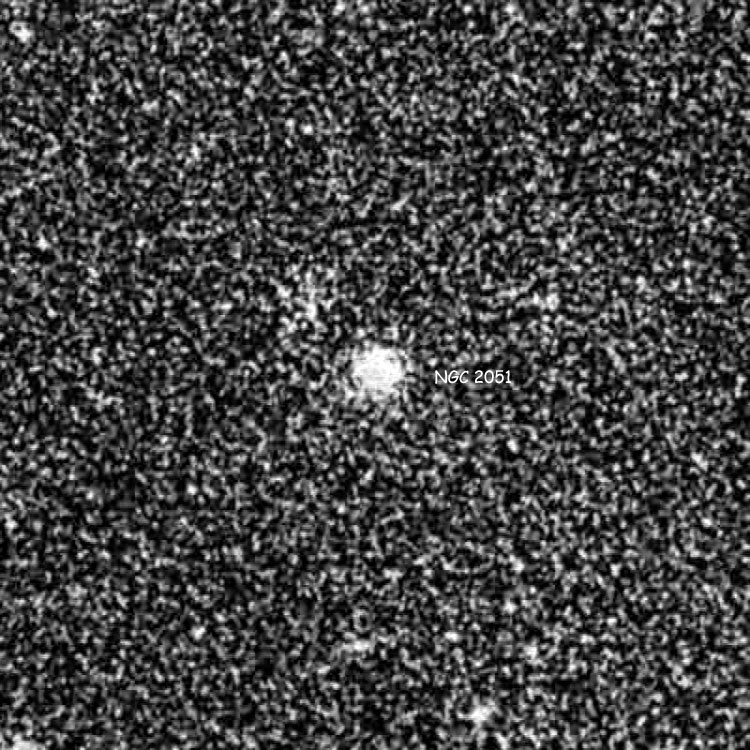
Above, a 12 arcmin wide DSS image centered on NGC 2051
Below, a 3 arcmin wide DSS image of the cluster

Below, a 3 arcmin wide color image of the cluster (Image Credit as for following image)

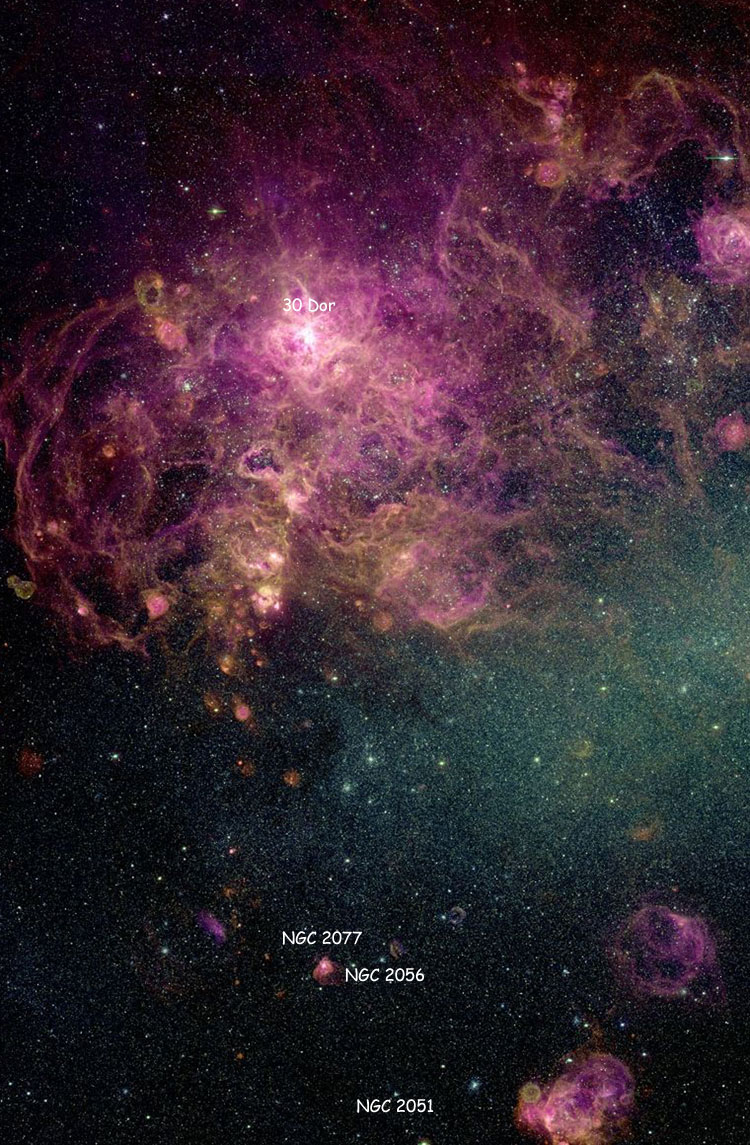
Below, a 1.9 by 2.9 degree wide image showing the position of NGC 2051, 2056 and 2077 relative to 30 Dor
(Image Credit S. Points, C. Smith, R. Leiton, C. Aguilera and NOAO/AURA/NSF)
WORKING HERE: Identification not at all certain
NGC 2052 (= EN in LMC)
Discovered (probably in Nov 1834 or Dec 1835) by John Herschel
An emission nebula in Dorado (RA 05 37 15.8, Dec -69 46 03)
Historical Identification: Per Dreyer, NGC 2052 (= GC 1254 = JH 2929, 1860 RA 05 38 03, NPD 159 52.2) is "extremely faint, very very small, very gradually a little brighter middle". The position precesses to RA 05 36 46.3, Dec -69 47 36, (Corwin suggests RA 05 34 45, Dec -69 48.5 (or less likely, RA 05 37 16.5, Dec -69 46 02), notes that JH's original description was very very large, and suspects the change in that description from the Cape Catalog to the GC is probably a typographical error, in which case the large chevron-shaped emission nebula to the west of JH's position may be JH 2929. However, the object is not shown in any of the charts so-far examined, so as of this (harried and hurried) writing the identification is completely up in the air.)
Discovery Notes: Some of the objects listed in Herschel's 1847 "Results of Astronomical Observations Made During the Years 1834, 5, 6, 7, 8, At the Cape of Good Hope" do not have a discovery date listed, and NGC 2052 is one such object. However, its inclusion in the supplementary catalog of objects observed in the Large Magellanic Cloud, involving observations carried out between Nov 2, 1836 and Mar 26, 1837 means that it cannot have been discovered later than that; and since it is bright enough to have been observed with a much smaller telescope than the one used for the LMC observations, it was probably discovered before then. Steinicke gives no date for this object in his JH database, but lists the date as 1835 in his NGC database. (Cf Corwin for more about this)
Physical Information:
In the Large Magellanic Cloud. Apparent size 18 by 12? arcmin. Steinicke's position is for an arcmin sized object, but his size estimate corresponds to the chevron to its west; so there is a problem with internal consistency in his identification.
NGC 2053 (= an OCL in the LMC)
Discovered (Jan 2, 1837) by John Herschel
A magnitude 12.2 open cluster in Dorado (RA 05 37 40.9, Dec -67 24 55)
Historical Identification: Per Dreyer, NGC 2053 (= GC 1255 = JH 2927, 1860 RA 05 38 04, NPD 157 30.1) is "faint, pretty large, a little extended, gradually brighter middle". The position precesses to RA 05 37 45.4, Dec -67 25 36, just off the southeastern rim of the cluster listed above, and there is nothing else nearby that fits the description, so the identification is certain.
Physical Information:
In the Large Magellanic Cloud. Apparent size 1.15 by 0.95 arcmin.
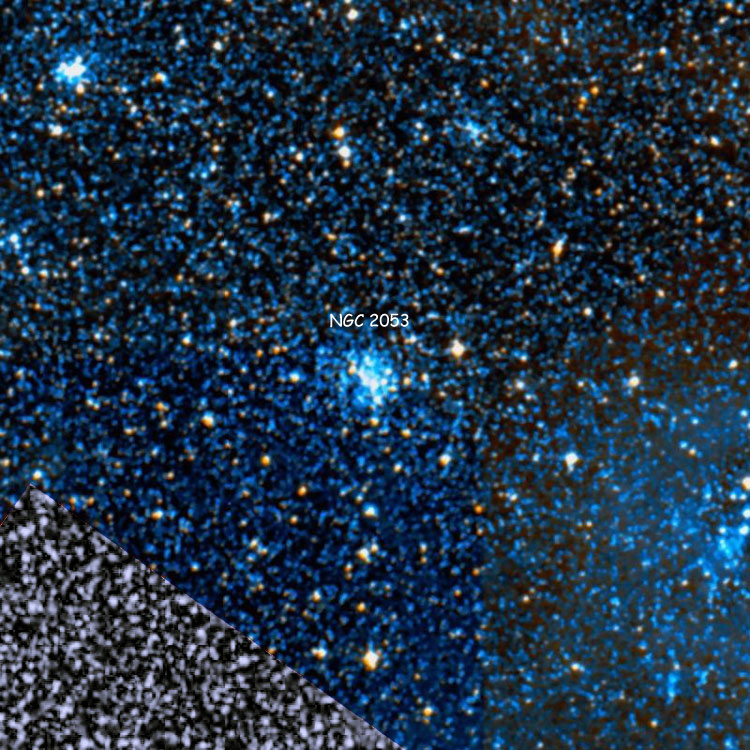
Above, a 12 arcmin wide DSS image centered on NGC 2053
Below, a 3 arcmin wide DSS image of the cluster
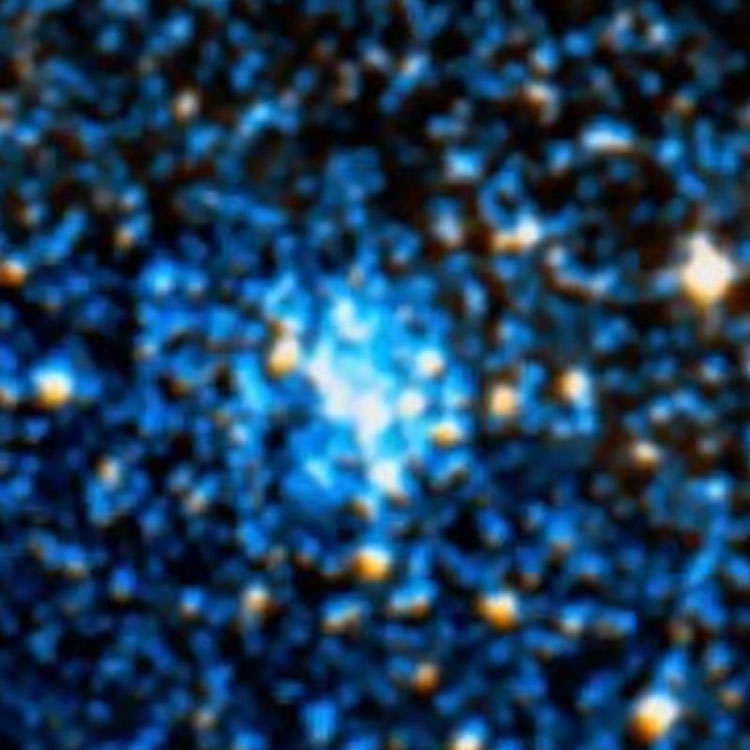
Below, a 1.6 by 2.4 degree wide DSS image showing the position of NGC 2053 relative to 30 Dor

NGC 2054
Recorded (Oct 6, 1850) by George Bond (29, HN3)
Also observed (Jan 13, 1877) by John Dreyer
Also observed (date?) by Guillaume Bigourdan
Also observed (date?) by Herbert Howe
Four or five stars in Orion (RA 05 45 15.7, Dec -10 04 58)
Historical Identification: Per Dreyer, NGC 2054 (= GC 5354, G. P. Bond, 1860 RA 05 38 11, NPD 100 08.3) is "very faint, pretty small, irregularly round, mottled but not resolved?, 9th to magnitude 10.7 star 7 arcmin to north". The second IC lists a corrected RA (per Bigourdan) of 05 38 36, and description (per Howe) "Only 3 stars and no nebulosity", and (per Dreyer) "(In 1877 I thought at times it was a very small cluster)". The corrected position precesses to RA 05 45 13.0, Dec -10 04 37, only 0.7 arcmin northwest of the group of stars listed above and there is nothing else nearby that fits the description, so the identification would be reasonably certain even without the confirmation provided by the star to the north of the group.

Above, a 12 arcmin wide DSS image centered on NGC 2054
WORKING HERE: Identification very doubtful
NGC 2055 (= an OCL in the LMC)
Discovered (Sep 24, 1826) by James Dunlop
Discovered (Nov 24, 1834) by John Herschel
A magnitude 8.4 open cluster in Dorado (RA 05 37 06.0, Dec -69 24 54)
Historical Identification: Per Dreyer, NGC 2055 (= GC 1256 = JH 2931, (Dunlop 145), 1860 RA 05 38 15, NPD 159 30.0) is a "cluster, very large, rich, stars from 10th to 15th magnitude". The position precesses to RA 05 37 08.1, Dec -69 25 27, but there is nothing there that appears to match the description, so this entry will have to be left incomplete until further information can be unearthed.
NED shows the supposed object at RA 05 36 44.7, Dec -69 29 55; but I have no idea where that identification comes from.
Physical Information:
In the Large Magellanic Cloud. Steinicke's apparent size is 0.6 arcmin, but that cannot correspond to Herschel's object, as "very large" meant many times larger than that.
NGC 2056 (= an OCL in the LMC)
Discovered (Dec 23, 1834) by John Herschel
A magnitude 12.3 open cluster in Mensa (RA 05 36 34.7, Dec -70 40 14)
Historical Identification: Per Dreyer, NGC 2056 (= GC 1257 = JH 2932, 1860 RA 05 38 18, NPD 160 45.3) is "pretty bright, round, brighter middle, preceding (western) of 2 (the other being NGC 2075), 9th magnitude star between (them)". The position corresponds to RA 05 36 36.0, Dec -70 40 42, on the southern outskirts of the cluster listed above, there is nothing else comparable nearby, and the description of the field (namely the 9th magnitude star to the east southeast and beyond it, NGC 2075) perfectly fits, so the identification is certain.
Discovery Notes: Steinicke previously listed the date of discovery as Dec 24, 1834; but has changed all observations made in JH's sweep 523 to Dec 23.
Physical Information:
In the Large Magellanic Cloud. Apparent size 1.05 by 0.95 arcmin.
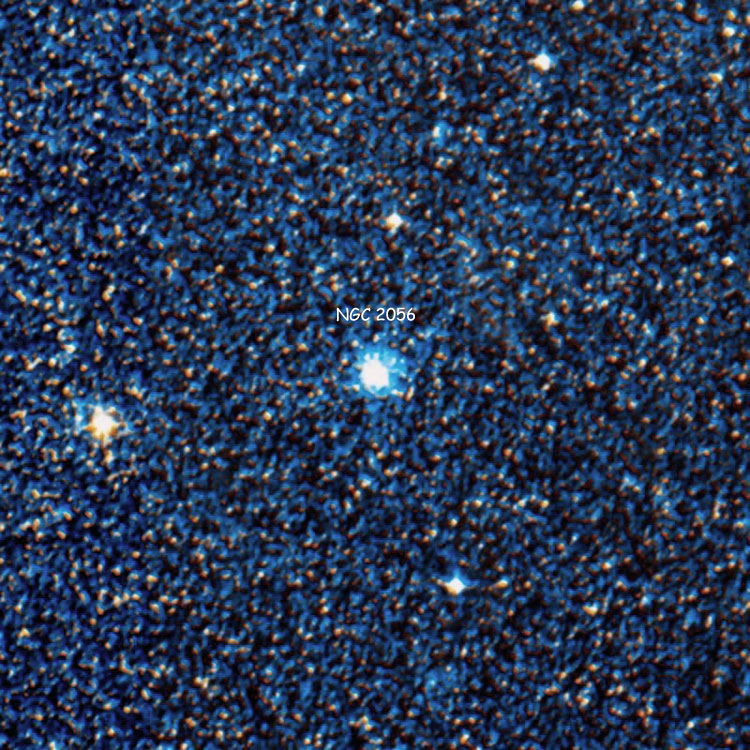
Above, a 12 arcmin DSS image centered on NGC 2056
Below, a 3 arcmin wide DSS image of the cluster
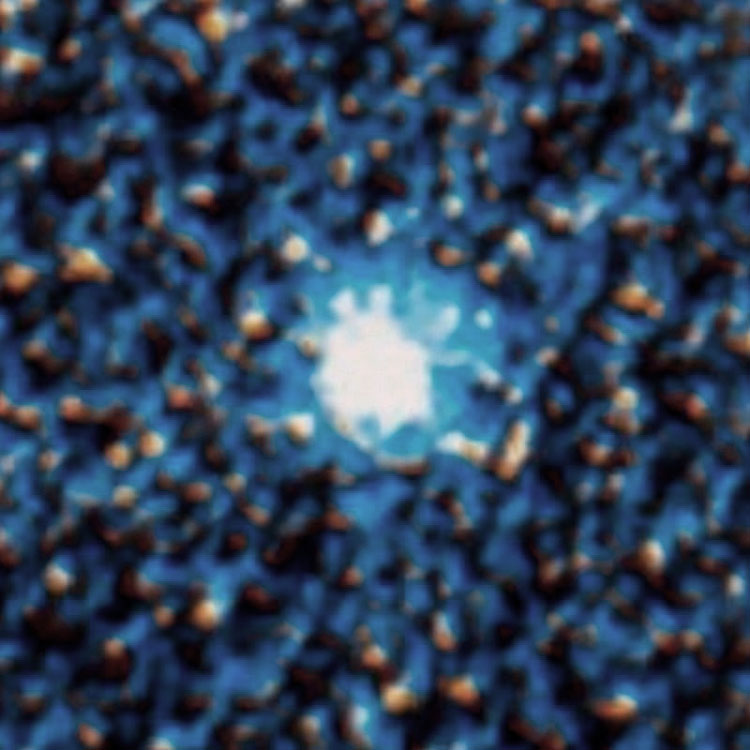
Below, a 3 arcmin wide color image of the cluster (Image Credit as for following image)
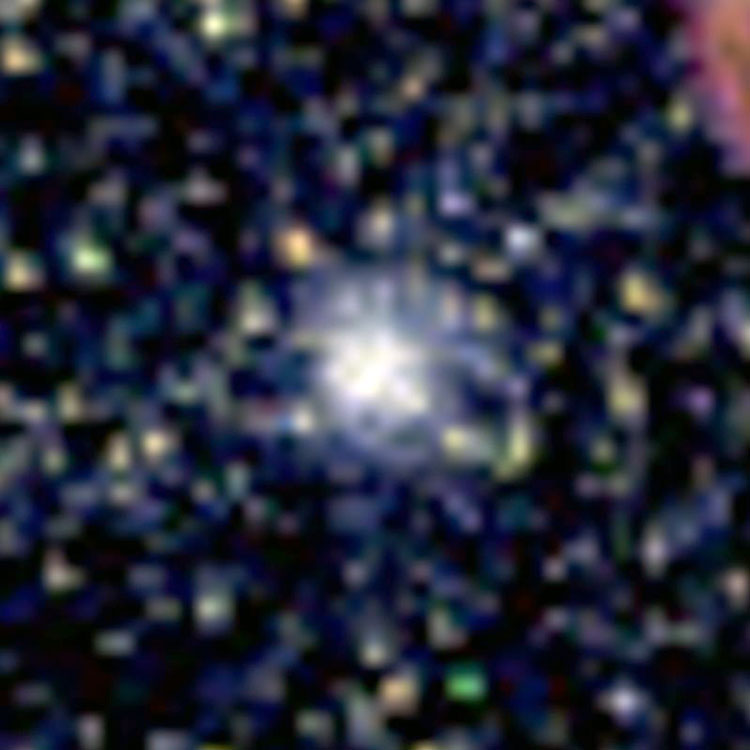
Below, a 1.9 by 2.9 degree wide image showing the position of NGC 2051 & 2056 relative to 30 Dor
(Image Credit S. Points, C. Smith, R. Leiton, C. Aguilera and NOAO/AURA/NSF)
WORKING HERE
NGC 2057 (= OCL in LMC)
Discovered (Sep 24, 1826) by James Dunlop
Discovered (Nov 11, 1836) by John Herschel
A magnitude 12.2 open cluster in Mensa (RA 05 36 56.0, Dec -70 16 10)
Historical Identification: Per Dreyer, NGC 2057 (= GC 1258 = JH 2935, (Dunlop 104), 1860 RA 05 38 24, NPD 160 20.7) is "pretty faint, small, round, gradually brighter middle, 3rd of 7", the 2nd and 4th of 7 being NGC 2047 and 2058.
Physical Information:
In the Large Magellanic Cloud. Apparent size 1.8? arcmin.
NGC 2058 (= OCL in LMC)
Discovered (Sep 24, 1826) by James Dunlop
Also observed (Nov 11, 1836) by John Herschel
A magnitude 11.9 open cluster in Mensa (RA 05 36 54.6, Dec -70 09 46)
Historical Identification: Per Dreyer, NGC 2058 (= GC 1259 = JH 2933, Dunlop 102, 1860 RA 05 38 25, NPD 160 14.6) is "very bright, pretty large, round, gradually brighter middle, 4th of 7", the 3rd and 5th of 7 being NGC 2057 and 2059. (JH and Dreyer state this is Dunlop 102; Steinicke states that it is Dunlop 103.)
Physical Information:
In the Large Magellanic Cloud. Apparent size 1.8? arcmin.
NGC 2059 (= OCL in LMC)
Discovered (Nov 11, 1836) by John Herschel
A magnitude 12.9 open cluster in Mensa (RA 05 37 00.2, Dec -70 07 44)
Historical Identification: Per Dreyer, NGC 2059 (= GC 1260 = JH 2936, 1860 RA 05 38 27, NPD 160 12.4) is "very faint, 5th of 7", the 4th and 6th of 7 being NGC 2058 and 2065.
Physical Information:
In the Large Magellanic Cloud. Apparent size 1.0? arcmin.
NGC 2060 (= SNR in LMC)
Discovered (between Nov 2, 1836 and Mar 26, 1837) by John Herschel
A magnitude 9.6 supernova remnant in Dorado (RA 05 37 48.0, Dec -69 10 24)
Historical Identification: Per Dreyer, NGC 2060 (= GC 1261, JH (642), 1860 RA 05 38 43, NPD 159 14.6) is a "nebula, no description, in Nubecula major", Nubecula major being the Large Magellanic Cloud, and the parentheses in "JH (642)" being used to indicate an object in a supplementary list of nebulae in the LMC. Herschel's record in the Cape Catalog reads "642, Nebula, 1830 RA 05 38 56, NPD 159 15 33, Zone 20". This precesses to 1860 RA 05 38 42.7, NPD 159 14 37, essentially the same as Dreyer's position, and thence to J2000 RA 05 37 42.4, Dec -69 10 11, right on that part of the Tarantula Nebula that is listed as NGC 2060, so the identification is certain.
Discovery Notes: Some of the objects listed in Herschel's 1847 "Results of Astronomical Observations Made During the Years 1834, 5, 6, 7, 8, At the Cape of Good Hope" do not have a discovery date listed, and NGC 2060 is one such object. However, given its inclusion in the supplementary catalog of objects observed in the Large Magellanic Cloud, involving observations carried out between Nov 2, 1836 and Mar 26, 1837, and was not given a "standard" entry in Herschel's catalog (which would have implied a discovery date unrelated to the supplementary observations), it must have been found during the observations for "Zone 20", sometime between those two dates. (Steinicke doesn't even list this discovery in his JH database, but lists 1835 as the date in his NGC database.)
Physical Information:
NGC 2061
Discovered (Jan 9, 1836) by John Herschel
A group of stars in Columba (RA 05 42 50.0, Dec -33 58 24)
Historical Identification: Per Dreyer, NGC 2061 (= GC 1262 = JH 2924, 1860 RA 05 38 49, NPD 124 01.1) is a "cluster, large, a little compressed, stars of 13th magnitude".
Physical Information:
Apparent size 8 by 8? arcmin.
NGC 2062 (= OCL in LMC)
Discovered (Jan 3, 1837) by John Herschel
A magnitude 12.7 open cluster in Dorado (RA 05 40 03.7, Dec -66 52 37)
Historical Identification: Per Dreyer, NGC 2062 (= GC 1263 - JH 2937, 18860 RA 05 38 57, NPD 156 56.8) is "very faint, pretty small, extended, gradually a little brighter middle, two 10th magnitude stars to south".
Physical Information:
In the Large Magellanic Cloud. Apparent size 0.9? arcmin.
NGC 2063
Discovered (Dec 28, 1785) by William Herschel
A group of stars in Orion (RA 05 46 44.0, Dec +08 46 54)
Corwin also lists a (more probable?) identification as a group at RA 05 46 48.0, Dec +08 39 12
Historical Identification: Per Dreyer, NGC 2063 (= GC 1264 = WH VIII 2, 1860 RA 05 39 07, NPD 81 16.6) is a "cluster, poor, small scattered stars".
Mea Culpa: An early version of this entry inadvertently gave the discovery date for WH VIII 3 = NGC 2251.
Physical Information:
Apparent size 9? arcmin.
NGC 2064 (= LBN 1627 = part of M78)
Discovered (Jan 11, 1864) by Heinrich d'Arrest
A reflection nebula in Orion (RA 05 46 18.0, Dec +00 00 21)
Historical Identification: Per Dreyer, NGC 2064 (= GC 5355, d'Arrest, 1860 RA 05 39 10, NPD 90 03.8) is "extremely faint, very small, 9th or 10th magnitude star 4 arcmin to northwest".
Physical Information:
Apparent size 1.0 by 1.0? arcmin.
NGC 2065
Discovered (Sep 24, 1826) by James Dunlop
Discovered (Nov 11, 1836) by John Herschel
A magnitude 11.2 open cluster in Mensa (RA 05 37 36.5, Dec -70 14 10)
Historical Identification: Per Dreyer, NGC 2065 (= GC 1265 = JH 2938 = Dunlop 103?, 1860 RA 05 39 11, NPD 160 18.4) is "bright, round, 6th of 7", the 5th and 7th being NGC 2059 and NGC 2066. (Steinicke lists this as Dunlop 105.)
Physical Information:
Apparent size 2.6? arcmin.
NGC 2066 (= OCL in LMC??)
Discovered (Nov 12, 1836) by John Herschel
A magnitude 13.1 open cluster in Mensa (RA 05 37 41.5, Dec -70 09 55)
Historical Identification: Per Dreyer, NGC 2066 (= GC 1266 = JH 2939, 1860 RA 05 39 21, NPD 160 15.1) is "very faint, very small, extended, 7th of 7", the 6th of 7 being NGC 2065.
Physical Information:
Apparent size 0.7? arcmin.
NGC 2067 (= part of M78)
Discovered (1876) by Wilhelm Tempel
A reflection nebula in Orion (RA 05 46 29.0, Dec +00 06 24)
Corwin lists this as two portions (ne at RA 05 46 30, Dec +00 07 54, and sw at RA 05 46 26.3, Dec +00 05 42)
Historical Identification: Per Dreyer, NGC 2067 (= GC 5356, Tempel list I ( A. N. 2139, #17), 1860 RA 05 39 22, NPD 89 57) is "faint, pretty large, M78 to the south". In the image below, M78 is the bright nebula near the center. Its brighter portion, framed by a semi-circular dust lane, is NGC 2068. The fainter portion to the north of the dust lane (on the right side of the image) is NGC 2067.
Physical Information: Apparent size 8 by 3? arcmin.
NGC 2068 (= M78)
Discovered (March, 1780) by Pierre Méchain
Recorded (Dec 17, 1780) by Charles Messier (as M78)
Also observed (Nov 23, 1827) by John Herschel
A magnitude 8(?) reflection nebula in Orion (RA 05 46 45.0, Dec +00 04 42)
Historical Identification: Per Dreyer, NGC 2068 (= GC 1267 = JH 368, Méchain, M78, 1860 RA 05 39 34, NPD 90 00.3) is "bright, large, wispy, gradually much brighter nucleus, 3 stars involved, mottled but not resolved".
Physical Information: NGC 2068 is a portion of M78, a bright reflection nebula in the Orion molecular complex, about 1600 light years from Earth. In the image below, it is the bright bluish nebula near center. Its apparent size of 8 by 6? arcmin corresponds to about 5 light years across. Unlike most such bright nebulae it is not shining itself, but merely scattering the light of hot, young blue giants behind it, and similar stars hidden from view by the dust clouds beside it. For NGC catalog purposes, M78 is divided into two parts. The brighter region, framed by the semi-circular dark dust lane surrounding the left portion, is NGC 2068. The fainter region, to the north of the dust lane (in this image, to the right), is NGC 2067 (which see). The reflection nebula at the top of the image is referred to as NGC 2071. (T. A. Rector/University of Alaska Anchorage, H. Schweiker/WIYN and AURA/NSF/NOAO)

NGC 2069 (= part of NGC 2070, the Tarantula Nebula, in LMC)
Discovered (Aug 3, 1826) by James Dunlop
Also observed (Nov 24, 1834) by John Herschel
An emission nebula in Dorado (RA 05 38 37.7, Dec -69 00 49)
Historical Identification: Per Dreyer, NGC 2069 (= GC 1268 = JH 2940, Dunlop 143, 1860 RA 05 39 38, NPD 159 04.7) is "faint, large, extended".
Physical Information:
Part of NGC 2070, the Tarantula Nebula, in the Large Magellanic Cloud.
NGC 2070, the Tarantula Nebula (in the Large Magellanic Cloud)
(= C103 = 30 Doradus = ESO 057-EN006 = "PGC 3517631")
Discovered (1751) by Nicolas Lacaille
Listed (1801) in his Uranographia by Johann Bode as 30 Doradus
Also observed (Aug 3, 1826) by James Dunlop
Also observed (Nov 2, 1834) by John Herschel
A magnitude 8 emission nebula (lit by magnitude 9.5 star cluster R136) in Dorado (RA 05 38 42.4, Dec -69 06 03)
Historical Identification: Per Dreyer, NGC 2070 (= GC 1269 = JH 2941, Lacaille list I #2, Dunlop #142, 1860 RA 05 39 41, NPD 159 10.3) is "a magnificent or otherwise interesting object, very bright, very large, looped." (To be completed as I finish with the Caldwell Catalogue.)
Nomenclature: Lacaille's list I is for nebulae not showing any obvious stars. "30 Doradus", which would normally be the number of a star in Dorado, was assigned by Bode in his 1801 atlas, but he stated that it was nebulous, despite its "stellar" designation. Wikipedia mistakenly lists NGC 2070 as the star cluster near the center of the nebula, which is the source of the radiation that lights up the nebula; but historically the cluster was treated as 30 Doradus, and in modern literature it is referred to as R136. So the proper description of NGC 2070 is the entire nebula, not the star cluster which causes it to glow.
PGC Designation Note: As usual for NGC objects, HyperLEDA assigned a PGC designation to this object, even though it isn't a galaxy; but also as usual under such circumstances a search of the database for that designation returns no result, hence its being in quotes.
Physical Information: Apparent size 30 by 20 arcmin?? One of the most spectacular star-forming regions known, and by far the brightest in the Large Magellanic Cloud; if as close as the Orion Nebula, it would cast shadows, like the Moon.
More to follow; for now, refer to The Tarantula Nebula.
 Above, a 7.5 arcmin wide ESO VLT (Very Large Telescope) image of NGC 2070, using the AOF (Adaptive Optics Facility) laser array and computer-driven multiple-mirror adjustment combination to sharpen the images, both in visual light and infrared radiation imaged with the HAWK-I (High Acuity Wide-field K-band Imager); in other words, this a combination of visual and infrared images, and therefore a false-color image. (There is a detailed discussion of the state-of-the-art technology involved in taking the image at the page linked by the following image credit. (Image Credit ESO)
NGC 2071 (= LBN 938)
Discovered (Jan 1, 1786) by William Herschel
A magnitude 8(?) reflection nebula in Orion (RA 05 47 07.8, Dec +00 17 48)
Historical Identification: Per Dreyer, NGC 2071 (= GC 1270 = WH IV 36, 1860 RA 05 39 57, NPD 89 45.4) is a "double star (10th and 14th magnitudes) with very faint large chevelure", chevelure meaning a hairlike envelope.
Physical Information: Apparent size 7 by 5? arcmin.
(For images, see NGC 2068)
NGC 2072 (= OCL in LMC??)
Discovered (Dec 18, 1884) by Pietro Baracchi
A magnitude 13.2 open cluster in Mensa (RA 05 38 24.0, Dec -70 14 01)
Historical Identification: Per Dreyer, NGC 2072 (Melbourne Observatory, 1860 RA 05 39 58, NPD 160 17.8) is "very faint, small".
Physical Information:
Apparent size 1.3? arcmin.
NGC 2073 (= PGC 17772)
Discovered (Nov 20, 1784) by William Herschel
Also observed (Nov 21, 1835) by John Herschel
A magnitude 12.5 lenticular galaxy (type E/S0??) in Lepus (RA 05 45 53.9, Dec -21 59 57)
Historical Identification: Per Dreyer, NGC 2073 (= GC 1271 = JH 2934 = WH III 241, 1860 RA 05 40 00, NPD 112 04.0) is "extremely faint, very small, round, gradually brighter middle".
Physical Information:
Apparent size 1.5 by 1.4? arcmin.
NGC 2074 (= part of NGC 2070, the Tarantula Nebula, in LMC)
Discovered (Aug 3, 1826) by James Dunlop
Discovered (probably between Mar 5, 1834 and Nov 2, 1836) by John Herschel
Steinicke gives the date of Herschel's observation as 1835
A magnitude 8(?) emission nebula in Dorado (RA 05 39 03.0, Dec -69 29 54)
Historical Identification: Per Dreyer, NGC 2074 (= GC 1272 = JH 2942, (Dunlop 146), 1860 RA 05 40 01, NPD 159 33.6) is "pretty bright, pretty large, much extended, 5 stars involved".
Discovery Notes: Some of the objects listed in Herschel's 1847 "Results of Astronomical Observations Made During the Years 1834, 5, 6, 7, 8, At the Cape of Good Hope" do not have a discovery date listed, and NGC 2074 is one such object. However, its inclusion in the supplementary catalog of objects observed in the Large Magellanic Cloud, involving observations carried out between Nov 2, 1836 and Mar 26, 1837 means that it cannot have been discovered later than that; and since it is bright enough to have been observed with a much smaller telescope than the one used for the LMC observations, it was probably discovered before then. (Steinicke does not list a date for Herschel's observation in his JH database, but lists it as 1835 in his NGC database.)
Discovery Notes (2): Dunlop's observation was not identified as this object until recently; hence its inclusion in the NGC entry in parentheses.
Physical Information:
In the Large Magellanic Cloud. Part of the Tarantula Nebula, NGC 2070.
NGC 2075
Discovered (Dec 23, 1834) by John Herschel
A magnitude 11.5 open cluster and emission nebula in Mensa (RA 05 38 21.2, Dec -70 41 04)
Historical Identification: Per Dreyer, NGC 2075 (= GC 1273 = JH 2943, 1860 RA 05 40 09, NPD 160 45.3) is "bright, round, brighter middle, partially resolved, some stars seen, following (eastern) of 2", the other being NGC 2056.
Physical Information:
Apparent size 2.0? arcmin.
WORKING HERE: Updating Steinicke's historical database entries
NGC 2076 (= PGC 17804)
Discovered (Feb 4, 1785) by William Herschel
A magnitude 13.0 lenticular galaxy (type S0/a??) in Lepus (RA 05 46 47.4, Dec -16 46 58)
Historical Identification: Per Dreyer, NGC 2076 (= GC 1274 = WH III 267, 1860 RA 05 40 35, NPD 106 48.2) is"very faint, pretty small, irregularly extended, brighter middle".
Physical Information:
Apparent size 2.2 by 1.3? arcmin.
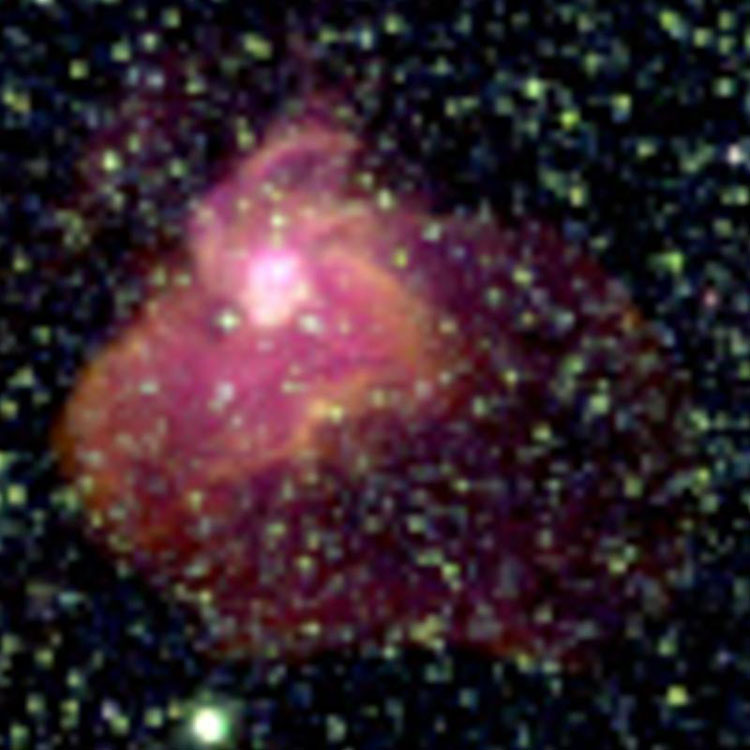
NGC 2077 (= EN in LMC)
Discovered (Sep 24, 1826) by James Dunlop (145)
Discovered (Dec 23, 1834) by John Herschel
An emission nebula in Dorado (RA 05 39 35.8, Dec -69 39 11)
Brightest region (several stars and a brighter emission nebula) at RA 05 38 20.8, Dec -70 40 58
Historical Identification: Per Dreyer, NGC 2077 (= GC 1275 = JH 2947, 1860 RA 05 40 50, NPD 159 43.8) is "faint, round, preceding (western) of double nebula", the other being NGC 2080.
Discovery Information: As for many other NGC objects observed in Herschel's sweep 523, Steinicke's NGC database lists the date of Herschel's observation as Dec 24, 1834; but his JH database states that it was observed on Dec 23, as shown above.
Physical Information:
In the Large Magellanic Cloud. Apparent size 5 or 6 arcmin?
Above, a 1.9 by 2.9 degree image showing the position of NGC 2077, 2051 and 2056 relative to 30 Dor
(Image Credit S. Points, C. Smith, R. Leiton, C. Aguilera and NOAO/AURA/NSF)
Below, a 12 arcmin wide version of the above image, centered on NGC 2077

Below, a 6 arcmin wide version of the above image
NGC 2078 (EN in the LMC)
Discovered (Sep 24, 1826) by James Dunlop (149)
Discovered (Dec 23, 1834) by John Herschel
An emission nebula in Dorado (RA 05 39 40.0, Dec -69 44 34)
Historical Identification: Per Dreyer, NGC 2078 (= GC 1276 = JH 2948, 1860 RA 05 40 53, NPD 159 48.9) is a "nebula, northwestern of group of 7".
Note: The position above is that of magnitude 12.1 B3Ia (supergiant) RMC 148, the brightest star in the group lighting up the nebula.
Physical Information:
One of several nebulae in the " NGC 2079 Group"
Corwin lists a possible companion () at RA 05 39 37.0, Dec -69 43 46
and another () at RA 05 39 40.0, Dec -69 43 52
and another () at RA 05 39 37.1, Dec -69 43 45
and another () at RA 05 39 33.7, Dec -69 43 45
all of which are emission nebulae of uncertain name and position
NGC 2079
Possibly observed (1826) by James Dunlop
Discovered (Dec 23, 1834) by John Herschel
An emission nebula in Dorado (RA 05 39 39.9, Dec -69 46 19)
Historical Identification: Per Dreyer, NGC 2079 (= GC 1277 = JH 2949, Dunlop 152??, 1860 RA 05 40 54, NPD 159 50.7) is a "nebula, southwestern of group of 7".
Discovery Information: As for many other NGC objects observed in Herschel's sweep 523, Steinicke's NGC database lists the date of Herschel's observation as Dec 24, 1834; but his JH database states that it was observed on Dec 23, as shown above.
Physical Information:
One of several nebulae in the "NGC 2079 Group"
NGC 2080 (= EN in LMC), the Ghost Head Nebula
Possibly discovered (1826) by James Dunlop
Discovered (Dec 23, 1834) by John Herschel
An emission nebula in Dorado (RA 05 39 44.2, Dec -69 38 45)
Historical Identification: Per Dreyer, NGC 2080 (= GC 1278 = JH 2950, (Dunlop 150), 1860 RA 05 40 57, NPD 159 43.4) is "bright, round, following (eastern) of double nebula", theother being NGC 2077.
Discovery Information: As for many other NGC objects observed in Herschel's sweep 523, Steinicke's NGC database lists the date of Herschel's observation as Dec 24, 1834; but his JH database states that it was observed on Dec 23, as shown above.
Physical Information: NGC 2080 is a star forming region in the 170 thousand light years distant Large Magellanic Cloud. Its youngest stars have yet to disperse the clouds of gas and dust out of which they formed, and must be less than ten thousand years old (more to follow; in the meantime, use the HST link below).
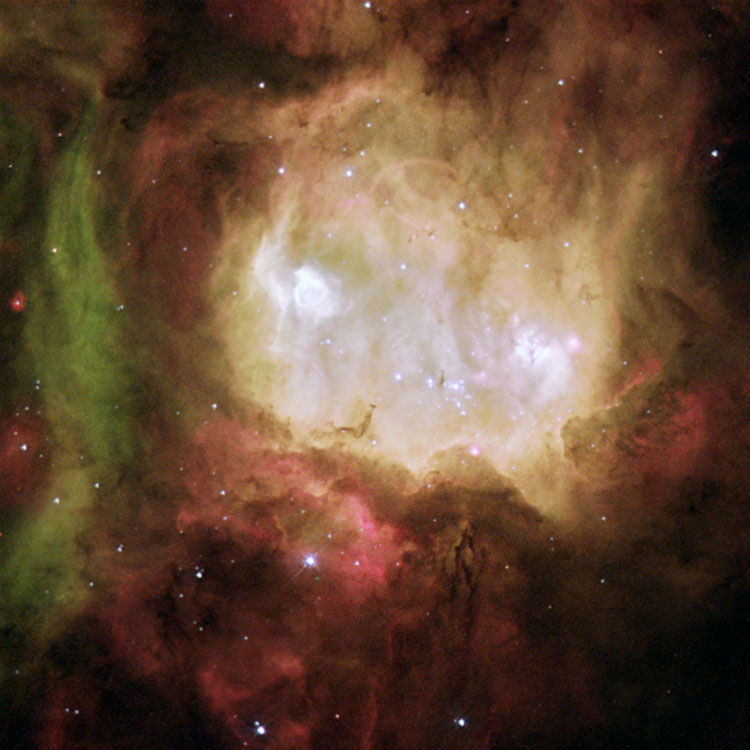
Above, a 50 light year wide HST view of NGC 2080
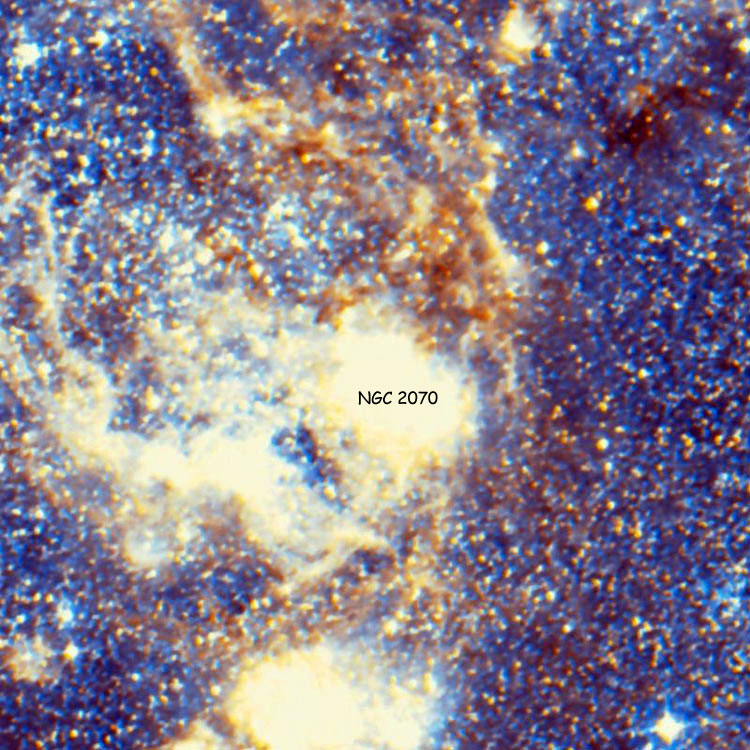
Below, a 12 arcmin wide region centered on the nebula
NGC 2081 (= OCL + EN in LMC)
Discovered (probably between Mar 5, 1834 and Nov 2, 1836) by John Herschel
An open cluster and emission nebula in Dorado (RA 05 40 01.5, Dec -69 23 42)
Historical Identification: Per Dreyer, NGC 2081 (= GC 1279 = JH 2951, 1860 RA 05 41 11, NPD 159 28.3) is a "cluster, very faint, much compressed, stars plus nebulosity".
Discovery Notes: Some of the objects listed in Herschel's 1847 "Results of Astronomical Observations Made During the Years 1834, 5, 6, 7, 8, At the Cape of Good Hope" do not have a discovery date listed, and NGC 2081 is one such object. However, its inclusion in the supplementary catalog of objects observed in the Large Magellanic Cloud, involving observations carried out between Nov 2, 1836 and Mar 26, 1837 means that it cannot have been discovered later than that; and since it is bright enough to have been observed with a much smaller telescope than the one used for the LMC observations, it was probably discovered before then. (Steinicke's JH database shows no date for this observation; but his NGC database lists the date as 1835.)
Physical Information:
NGC 2082 (= PGC 17609)
Discovered (Nov 30, 1834) by John Herschel
A magnitude 12.1 spiral galaxy (type SBb??) in Dorado (RA 05 41 51.1, Dec -64 18 04)
Historical Identification: Per Dreyer, NGC 2082 (= GC 1280 = JH 2945, 1860 RA 05 41 11, NPD 154 21.6) is "pretty faint, large, round, gradually a little brighter middle".
Physical Information:
Apparent size 1.3 by 1.2 arcmin.
NGC 2083
Discovered (Sep 24, 1826) by James Dunlop
Discovered (Dec 23, 1834) by John Herschel
An emission nebula in Dorado (RA 05 39 58.7, Dec -69 44 04)
Historical Identification: Per Dreyer, NGC 2083 (= GC 1281 = JH 2952, (Dunlop 149), 1860 RA 05 41 12, NPD 159 48.4) is a "nebula, northeastern of group of 7".
Discovery Notes: Dunlop's observation of this object was not identified until recently, hence its inclusion in the NGC entry in parentheses.
Physical Information:
One of several nebulae in the " NGC 2079 Group"
NGC 2084
Possibly discovered (Sep 24, 1826) by James Dunlop
Discovered (Jan 1, 1835) by John Herschel
An emission nebula in Dorado (RA 05 40 07.5, Dec -69 45 26)
Historical Identification: Per Dreyer, NGC 2084 (= GC 1282 = JH 2953, (Dunlop 149), 1860 RA 05 41 16, NPD 159 49.9) is a "nebula, southeastern of group of 7".
Discovery Notes: Dunlop's observation of this object was not identified until recently, hence its inclusion in the NGC entry in parentheses. (Steinicke's NGC database lists the date of Herschel's observation as December 1834; but his JH database states that the observation was done on Jan 1, 1835, as shown above.)
Physical Information:
One of several nebulae in the " NGC 2079 Group"
Corwin lists several apparent "companions":
() at RA 05 40 18.6, Dec -69 44 58
() at RA 05 40 00.8, Dec -69 47 11
() at RA 05 39 52.5, Dec -69 45 19
All emission nebulae of uncertain designation and position?
NGC 2085
Possible discovered (Sep 24, 1826) by James Dunlop (145)
Discovered (Dec 23, 1834) by John Herschel
An emission nebula in Dorado (RA 05 40 09.2, Dec -69 40 22)
Historical Identification: Per Dreyer, NGC 2085 (= GC 1283 = JH 2954, (Dunlop 145), 1860 RA 05 41 19, NPD 159 45.0) is"very faint, round, 10th magnitude star very near".
Discovery Notes: Dunlop's observation of this object was not identified until recently, hence its inclusion in the NGC entry in parentheses.
Physical Information:
NGC 2086 (= IC 2145)
Possibly discovered (Sep 24, 1826) by James Dunlop (and later listed as NGC 2086)
Discovered (Jan 1, 1835) by John Herschel (and later listed as NGC 2086)
Discovered (1901) by Williamina Fleming (and later listed as IC 2145)
An emission nebula in Dorado (RA 05 40 24.7, Dec -69 40 13)
Historical Identification: Per Dreyer, NGC 2086 (= GC 1284 = JH 2956, (Dunlop 145), 1860 RA 05 41 34, NPD 159 44.5) is "bright, pretty small, round, a little brighter middle, 10th magnitude star to west".
Discovery Notes: Dunlop's observation of this object was not identified until recently, hence its inclusion in the NGC entry in parentheses. (Steinicke's NGC database lists the date of Herschel's observation as December 1834; but his JH database states that the observation was done on Jan 1, 1835, as shown above.)
Physical Information:
NGC 2087 (= PGC 17684)
Discovered (Dec 6, 1834) by John Herschel
A magnitude 13.6 spiral galaxy (type SBa??) in Pictor (RA 05 44 16.2, Dec -55 31 57)
Historical Identification: Per Dreyer, NGC 2087 (= GC 1285 = JH 2946, 1860 RA 05 41 39, NPD 145 35.5) is "extremely faint, pretty small, round, very little brighter middle".
Physical Information:
Apparent size 0.8 by 0.6? arcmin.
NGC 2088 (= OCL in LMC)
Discovered (Jan 31, 1835) by John Herschel
A magnitude 12.5 open cluster in Dorado (RA 05 40 59.9, Dec -68 27 53)
Historical Identification: Per Dreyer, NGC 2088 (= GC 1286 = JH 2955, 1860 RA 05 41 40, NPD 158 31.7) is "very faint, small, round".
Physical Information:
In the Large Magellanic Cloud. Apparent size 1.7? arcmin.
NGC 2089 (= PGC 17860)
Discovered (Feb 6, 1785) by William Herschel
A magnitude 12.0 lenticular galaxy (type E/SB0??) in Lepus (RA 05 47 51.4, Dec -17 36 08)
Historical Identification: Per Dreyer, NGC 2089 (= GC 1287 = WH III 270, 1860 RA 05 41 44, NPD 107 39.3) is "very faint, extremely small, stellar".
Physical Information:
Apparent size 1.9 by 1.2? arcmin
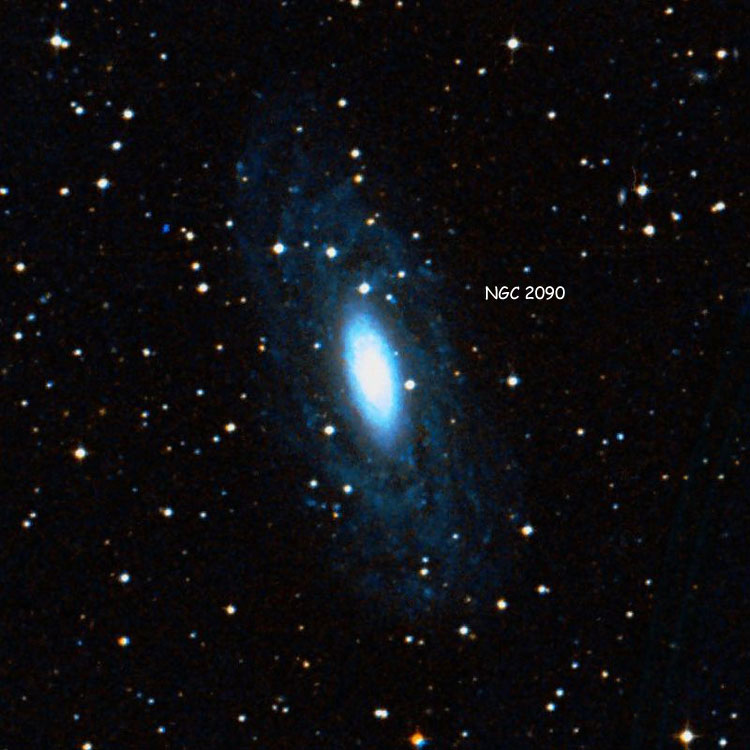
NGC 2090 (= PGC 17819)
Discovered (Oct 29, 1826) by James Dunlop
Discovered (Jan 8, 1836) by John Herschel
Also observed (date?) by DeLisle Stewart
A magnitude 11.2 spiral galaxy (type Sc??) in Columba (RA 05 47 01.8, Dec -34 15 02)
Historical Identification: Per Dreyer, NGC 2090 (= GC 1288 = JH 2944, Dunlop 594, 1860 RA 05 41 57, NPD 124 18.4) is a "globular cluster, bright, pretty large, irregularly round, gradually brighter middle". The second IC notes (per DeLisle Stewart) "Not a globular cluster; considerably extended 10°, stellar nucleus".
Physical Information: Apparent size 7.5 by 3.0? arcmin. Used by the de Vaucouleurs Atlas of Galaxies as an example of galaxy type SA(rs)c.

Above, an 8 arcmin wide closeup of NGC 2090
Below, a 12 arcmin wide region centered on the galaxy
NGC 2091 (= OCL in LMC)
Discovered (probably between Mar 5, 1834 and Nov 2, 1836) by John Herschel
A magnitude 12.1 open cluster in Dorado (RA 05 40 58.7, Dec -69 26 10)
Historical Identification: Per Dreyer, NGC 2091 (= GC 1289 = JH 2957, 1860 RA 05 42 05, NPD 159 31.1) is "very faint, small, much extended, gradually a little brighter middle, perhaps double?".
Discovery Notes: Some of the objects listed in Herschel's 1847 "Results of Astronomical Observations Made During the Years 1834, 5, 6, 7, 8, At the Cape of Good Hope" do not have a discovery date listed, and NGC 2091 is one such object. However, its inclusion in the supplementary catalog of objects observed in the Large Magellanic Cloud, involving observations carried out between Nov 2, 1836 and Mar 26, 1837 means that it cannot have been discovered later than that; and since it is bright enough to have been observed with a much smaller telescope than the one used for the LMC observations, it was probably discovered before then. (Steinicke's JH database shows no date for this observation; but his NGC database lists the date as 1835.)
Physical Information:
In the Large Magellanic Cloud. Apparent size 1.7? arcmin.
NGC 2092 (= OCL in LMC)
Discovered (probably between Mar 5, 1834 and Nov 2, 1836) by John Herschel
An open cluster in Dorado (RA 05 41 21.5, Dec -69 13 23)
Historical Identification: Per Dreyer, NGC 2092 (= GC 1290 = JH 2962, 1860 RA 05 42 39, NPD 159 16.6) is "very faint, pretty large, round, partially resolved, some stars seen".
Discovery Notes: Some of the objects listed in Herschel's 1847 "Results of Astronomical Observations Made During the Years 1834, 5, 6, 7, 8, At the Cape of Good Hope" do not have a discovery date listed, and NGC 2092 is one such object. However, its inclusion in his supplementary catalog of objects observed in the Large Magellanic Cloud, involving observations carried out between Nov 2, 1836 and Mar 26, 1837 means that it cannot have been discovered later than that; and since it is bright enough to have been observed with a much smaller telescope than the one used for the LMC observations, it was probably discovered before then. (Steinicke's JH database shows no date for this observation; but his NGC database lists the date as 1835.)
Physical Information: In the Large Magellanic Cloud. Apparent size 1.2? arcmin.
NGC 2093 (= OCL in LMC)
Discovered (1826) by James Dunlop
Discovered (Dec 30, 1836) by John Herschel
(Dec 20 in Steinicke's NGC database)
A magnitude 11.6 open cluster in Dorado (RA 05 41 49.0, Dec -68 55 15)
Historical Identification: Per Dreyer, NGC 2093 (= GC 1291 = JH 2963, Dunlop 184??, 1860 RA 05 42 43, NPD 158 59.3) is "very faint, small, round". (Steinicke states equal to Dunlop 144.)
Discovery Notes: Steinicke's NGC database gives the date of Herschel's observation as Dec 20, 1836; but his JH database says it was observed on Dec 30, as shown above.
Physical Information:
In the Large Magellanic Cloud. Apparent size 1.7? arcmin.
NGC 2094 (= OCL in LMC)
Discovered (Jan 31, 1835) by John Herschel
An open cluster in Dorado (RA 05 42 07.1, Dec -68 21 49)
Historical Identification: Per Dreyer, NGC 2094 (= GC 1292 = JH 2959, 1860 RA 05 42 46, NPD 158 25.7) is "very faint, small, round".
Physical Information:
In the Large Magellanic Cloud.
NGC 2095 (= OCL in LMC)
Possibly discovered (1826) by James Dunlop
Discovered (Dec 20, 1835) by John Herschel
A magnitude 13.1 open cluster in Dorado (RA 05 42 37.0, Dec -67 19 12)
Corwin lists the 9th magnitude star at RA 05 42 29.1, Dec -67 19 42 and the eastern "clump" at RA 05 42 51.9, Dec -67 19 17
Historical Identification: Per Dreyer, NGC 2095 (= GC 1293 = JH 2961, (Dunlop 198), 1860 RA 05 42 48, NPD 157 23.4) is a "cluster, faint, considerably small, irregular".
Physical Information:
In the Large Magellanic Cloud. Apparent size 0.8? arcmin.
NGC 2096 (= OCL in LMC)
Discovered (between Nov 2, 1836 and Mar 26, 1837) by John Herschel
A magnitude 11.3 open cluster in Dorado (RA 05 42 16.5, Dec -68 27 29)
Historical Identification: Per Dreyer, NGC 2096 (= GC 1294 = JH (725), 1860 RA 05 43 02, NPD 158 32.7) is a "nebula, no description, in Nubecula major", Nubecula major being the LMC, and "JH (725)" indicating that the object was listed in Herschel's supplementary catalog of the LMC, and was not part of his standard catalog.
Discovery Notes: Some of the objects listed in Herschel's 1847 "Results of Astronomical Observations Made During the Years 1834, 5, 6, 7, 8, At the Cape of Good Hope" do not have a discovery date listed, and NGC 2060 is one such object. However, given its inclusion in the supplementary catalog of objects observed in the Large Magellanic Cloud, involving observations carried out between Nov 2, 1836 and Mar 26, 1837, and was not given a "standard" entry in Herschel's catalog (which would have implied a discovery date unrelated to the supplementary observations), it must have been found during the observations for "Zone xx", sometime between those two dates. (Steinicke's JH database shows no date for this observation; but his NGC database lists the date as 1835.)
Physical Information:
In the Large Magellanic Cloud. Apparent size 1.2? arcmin.
NGC 2097 (= OCL in LMC)
Discovered (Dec 26, 1834) by John Herschel
A magnitude 13.7 open cluster in Dorado (RA 05 44 15.4, Dec -62 47 08)
Historical Identification: Per Dreyer, NGC 2097 (= GC 1296 = JH 2960, 1860 RA 05 43 06, NPD 152 50.6) is "very faint, pretty small, irregularly round, pretty suddenly a little brighter middle equivalent to a 16th magnitude star".
Physical Information:
In the Large Magellanic Cloud. Apparent size 1.8? arcmin.
NGC 2098 (= OCL in LMC)
Discovered (1826) by James Dunlop
Discovered (Jan 31, 1835) by John Herschel
A magnitude 10.7 open cluster in Dorado (RA 05 42 29.4, Dec -68 16 26)
Historical Identification: Per Dreyer, NGC 2098 (= GC 2098 = JH 2965, Dunlop 185??, 1860 RA 05 43 07, NPD 158 20.2) is a "globular cluster, bright, small, partially resolved, some stars seen". (Steinicke agrees with Dreyer's attribution to Dunlop 185.)
Physical Information:
In the Large Magellanic Cloud. Apparent size 1.6? arcmin.
NGC 2099 (= M37 = OCL 451)
Recorded (1654) by Giovanni Hodierna
Discovered (Sep 2, 1764) by Charles Messier
Also observed (Nov 2, 1774) by Johann Bode
Also observed (Jan 22, 1827) by John Herschel
A magnitude 5.6 open cluster (type II1r) in Auriga (RA 05 52 18.0, Dec +32 33 12)
Historical Identification: Per Dreyer, NGC 2099 (= GC 1295 = JH 369, M37, 1860 RA 05 43 08, NPD 57 29.6) is a "cluster, rich, pretty compressed middle, stars large and small".
Discovery Notes: Click on Hodierna's name (in the list of discoverers above) for an explanation of why he was not credited by Dreyer with the discovery of this object.
Physical Information: Apparent size 15? arcmin.
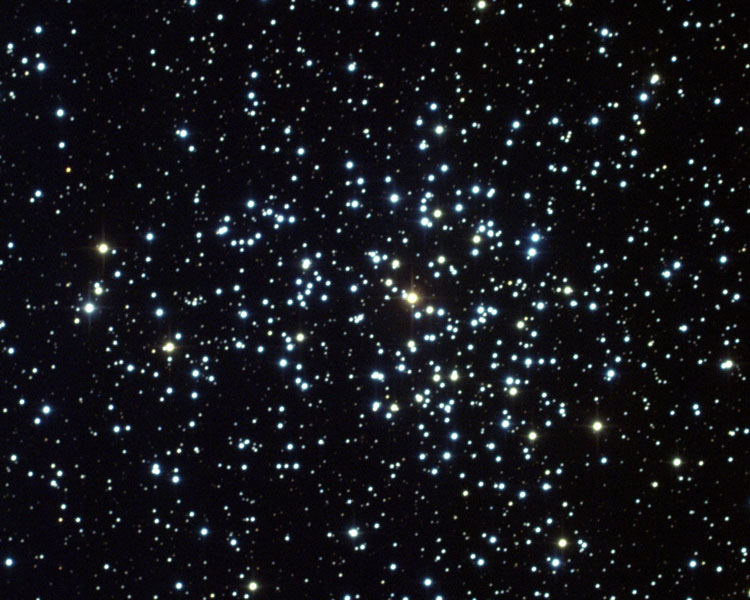
Above, a view of M37 (Image Credit: AURA/NSF/NOAO)
|