QuickLinks:
250, 251, 252, 253, 254, 255, 256, 257, 258, 259, 260, 261, 262, 263, 264, 265, 266,
267, 268, 269, 270, 271, 272, 273, 274, 275, 276, 277, 278, 279, 280, 281, 282, 283,
284, 285, 286, 287, 288, 289, 290, 291, 292, 293, 294, 295, 296, 297, 298, 299
Page last updated Aug 23, 2023 (Added Caldwell & other IDs for NGC 253)
Page last updated Feb 1, 2022
Did final check of positions, with no significant change
All prior updates listed below may need re-checking
Completed updated physical information for NGC 295 (historical discussion still out of date)
Completed minor updates for deVaucouleurs/Arp entries
Updated basic galaxy types, designations, formatting, some pix, UGC pages
Checked Steinicke's updated historical database
Checked original Dreyer entries, most other historical references
WORKING: Finish updating to current formatting. Check historical IDs (Corwin+Steinicke)
NGC 250
(= PGC 2765 = UGC 487 = CGCG 410-005 = MCG +01-03-002)
Discovered (Nov 10, 1885) by Lewis Swift
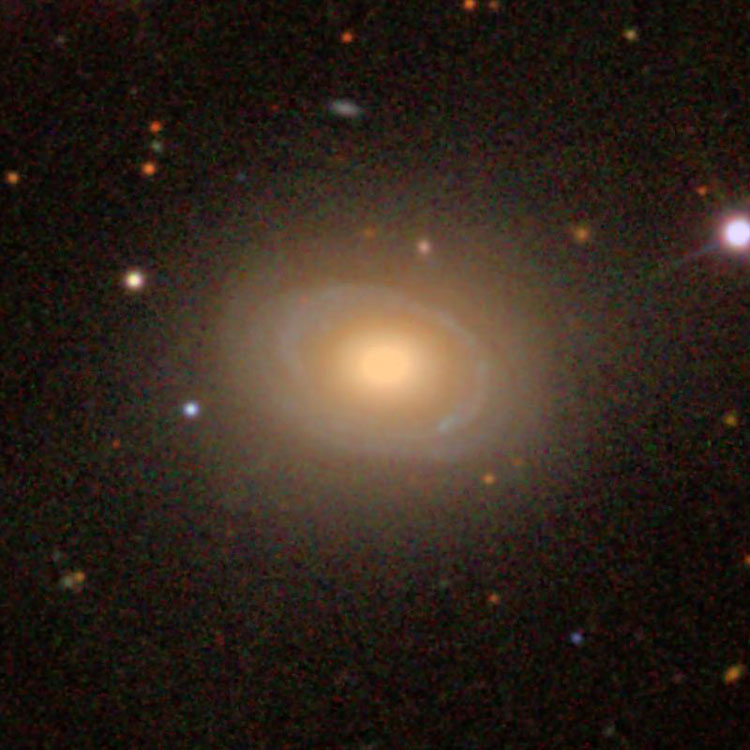
A magnitude 13.8 lenticular galaxy (type S0/a(rs) pec?) in Pisces (RA 00 47 16.0, Dec +07 54 36)
Historical Identification: Per Dreyer, NGC 250 (Swift list III (#2), 1860 RA 00 40 18, NPD 82 52.0) is "extremely faint, very small, round, among 3 stars." The position precesses to RA 00 47 33.0, Dec +07 53 55, a little over 4 arcmin east of the galaxy listed above, but the position of the galaxy (near the center of a right triangle formed by three stars) so perfectly matches the description that the identification is certain.
Physical Information: Apparent size 1.1 by 0.6 arcmin?

Above, a 12 arcmin wide SDSS image centered on NGC 250, also showing Swift's position
Below, a 2.4 arcmin wide SDSS image of the galaxy

NGC 251
(= PGC 2806 = UGC 490 = CGCG 458-005 = MCG +03-03-003)
Discovered (Oct 15, 1784) by William Herschel
Also observed (Dec 18, 1830) by John Herschel
A magnitude 13.2 spiral galaxy (type Sc?) in Pisces (RA 00 47 54.0, Dec +19 35 49)
Historical Identification: Per Dreyer, NGC 251 (= GC 135 = JH 58 = WH III 204, 1860 RA 00 40 32, NPD 71 09.5) is "very faint, small, round, a little brighter middle, star involved, 2 very small (faint) stars following (to the east)."
Physical Information: Apparent size 2.4 by 1.9 arcmin?

Above, a 12 arcmin wide SDSS image centered on NGC 251
Below, a 3 arcmin wide SDSS image of the galaxy

NGC 252
(= PGC 2819 = UGC 491 = CGCG 480-007 = MCG +04-03-004)
Discovered (Oct 26, 1786) by William Herschel
Also observed (Dec 23, 1827) by John Herschel
A magnitude 12.4 lenticular galaxy (type S0/(r)a?) in Andromeda (RA 00 48 01.5, Dec +27 37 26)
Historical Identification: Per Dreyer, NGC 252 (= GC 136 = GC 139 = JH 59 = JH 60 = WH II 609, 1860 RA 00 40 33, NPD 63 08.6) is "pretty bright, small, round, pretty much brighter middle, mottled but not resolved, double star preceding (to the west)." The position precesses to RA 00 48 01.8, Dec +27 37 18, almost dead center on the galaxy, so the identification is certain.
Physical Information: Apparent size 2.1 by 1.5 arcmin?

Above, a 12 arcmin wide SDSS image centered on NGC 252, also showing NGC 258
Below, a 3 arcmin wide SDSS image of the galaxy
NGC 253, the Sculptor Galaxy, the Silver Dollar Galaxy, the Silver Coin Galaxy
(= C65 = PGC 2789 = UGCA 13 = ESO 474-029 = MCG -04-03-009)
Discovered (Sep 23, 1783) by Caroline Herschel
Also observed (Oct 30, 1783) by William Herschel
Also observed (Oct 14, 1830) by John Herschel
A magnitude 7.2 spiral galaxy (type SAB(s)c) in Sculptor (RA 00 47 33.1, Dec -25 17 18)
Historical Identification: Per Dreyer, NGC 253 (= GC 138 = JH 61 = JH 2345 = WH V 1, Caroline Herschel, 1860 RA 00 40 38, NPD 116 03.7) is "a most remarkable object, very very bright, very very large, very much extended 54°, gradually brighter middle."
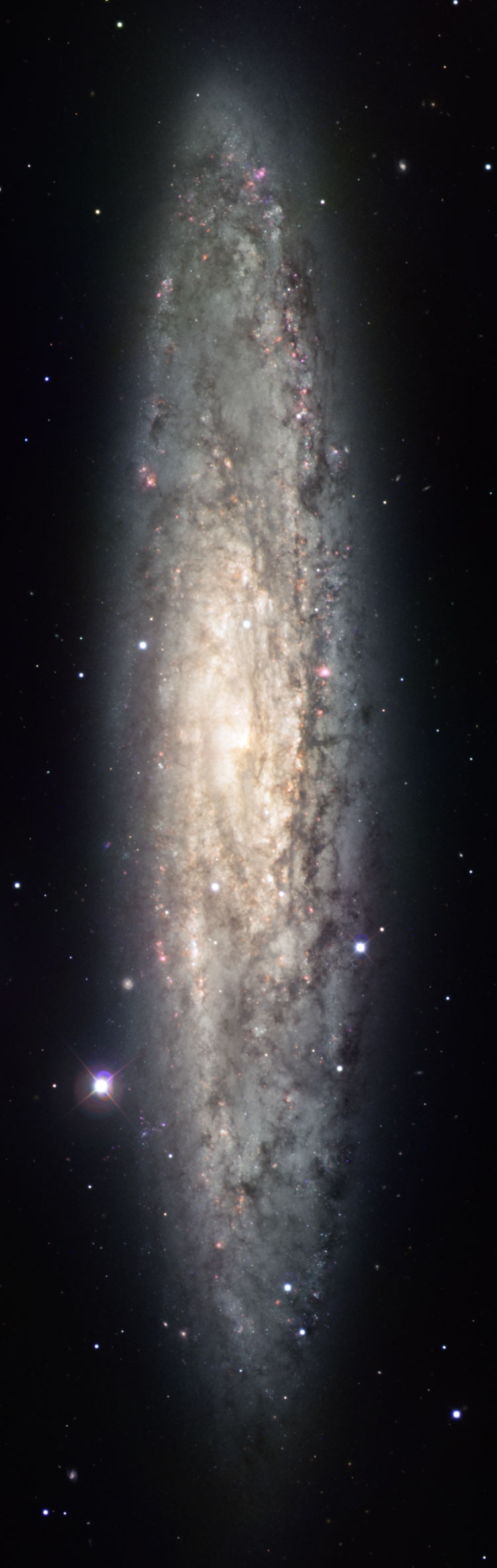
Physical Information: Apparent size 25 by 5.5 arcmin.
Use By The de Vaucouleurs Atlas: NGC 253 is used by the de Vaucouleurs Atlas of Galaxies as an example of galaxy type SAB(s)c.
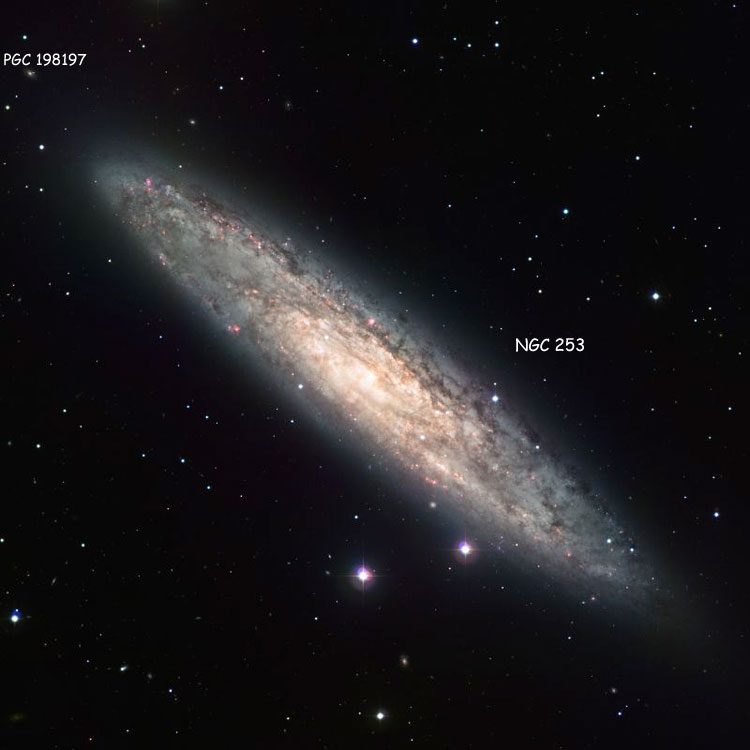
Above, a 24 arcmin wide image centered on NGC 253, also showing PGC 198197 (Image Credit ESO)
Below, a rotated image of the the galaxy to allow for more detail (Image Credit as above)
NGC 254
(= PGC 2778 = ESO 411-015 = MCG -05-03-005)
Discovered (Sep 27, 1834) by John Herschel
A magnitude 11.7 lenticular galaxy (type (R)SAB0(r)a?) in Sculptor (RA 00 47 27.6, Dec -31 25 19)
Historical Identification: Per Dreyer, NGC 254 (= GC 140 = JH 2347, 1860 RA 00 40 41, NPD 122 11.5) is "very bright, pretty small, a little extended, suddenly much brighter middle, 8th magnitude star 5 arcmin north-following (to the northeast)."
Physical Information: Apparent size 2.1 by 1.7 arcmin (from the images below)

Above, a 12 arcmin wide DSS image centered on NGC 254
Below, a 2.7 arcmin wide DSS image of the galaxy (Post-processing Aladin, Photoshop CS4, Courtney Seligman)

NGC 255
(= PGC 2802 = MCG -02-03-017)
Discovered (Nov 27, 1785) by William Herschel
Also observed (Sep 10, 1831) by John Herschel
A magnitude 11.9 spiral galaxy (type SAB(rs)bc) in Cetus (RA 00 47 47.2, Dec -11 28 08)
Historical Identification: Per Dreyer, NGC 255 (= GC 141 = JH 62 = WH II 472, 1860 RA 00 40 44, NPD 102 14.7) is "faint, pretty small, round, gradually brighter middle."
Physical Information: Apparent size 3.1 by 2.7 arcmin?.
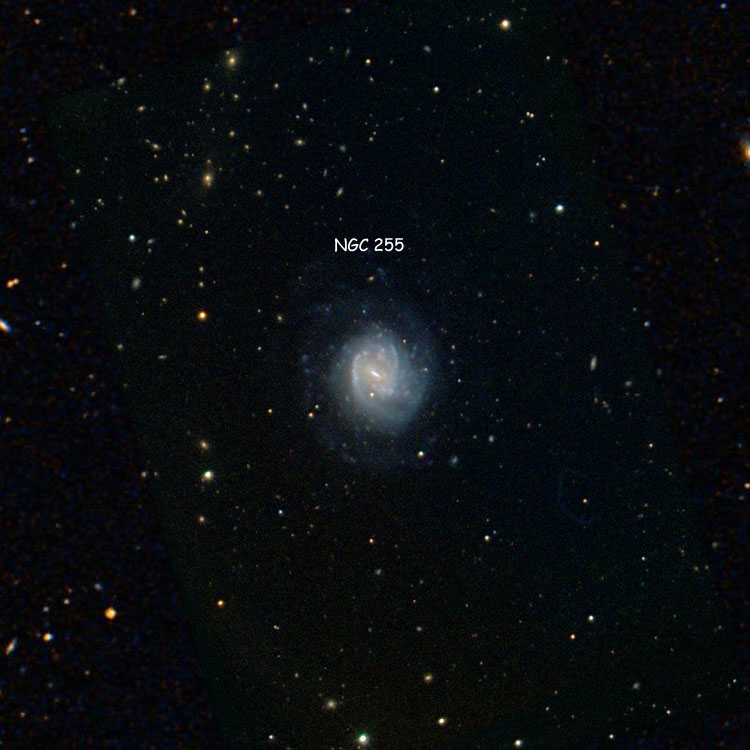
Above, a 12 arcmin wide image centered on NGC 255
(Image Credit Adam Block/NOAO/AURA/NSF, superimposed on a DSS background to fill in missing areas)
Below, a 3.6 arcmin wide image of the galaxy (Image Credit as above)
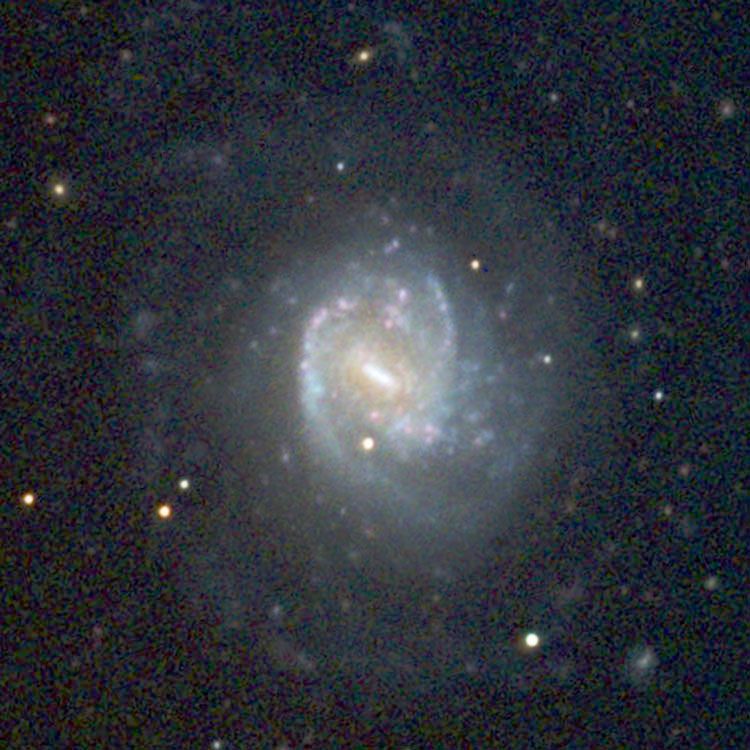
NGC 256 (in the Small Magellanic Cloud)
(= "PGC 3517842" = ESO 029-SC011)
Discovered (Apr 11, 1834) by John Herschel
A magnitude 12.7 open cluster in Tucana (RA 00 45 54.1, Dec -73 30 24)
Historical Identification: Per Dreyer, NGC 256 (= GC 142 = JH 2348, 1860 RA 00 40 44, NPD 164 16.7) is "faint, small, round, gradually brighter middle, 9th magnitude star 40 arcsec north-following (to the northeast)."
Note About PGC Designation: As in the case of most NGC objects, HyperLEDA assigned a PGC designation to this object, even though it isn't a galaxy; however, a search of the database for that designation returns no result, so it is shown in quotes.
Physical Information: Apparent size 0.6 arcmin?
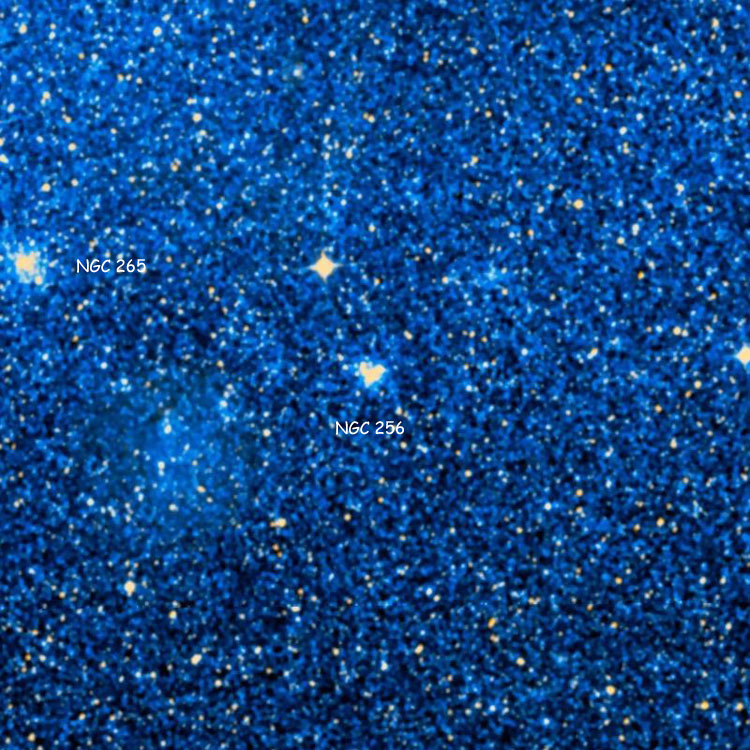
Above, a 12 arcmin wide DSS image centered on NGC 256, also showing NGC 265
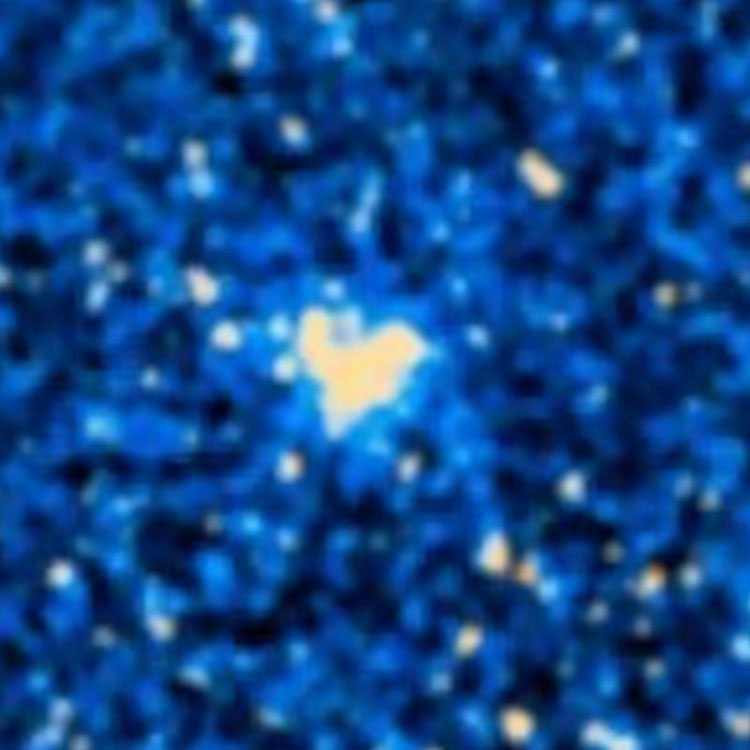
Below, a 2.4 arcmin wide DSS image of the open cluster
NGC 257
(= PGC 2818 = UGC 493 = CGCG 410-006 = MCG +01-03-003)
Discovered (Dec 29, 1790) by William Herschel
A magnitude 12.6 spiral galaxy (type Sc?) in Pisces (RA 00 48 01.5, Dec +08 17 50)
Historical Identification: Per Dreyer, NGC 257 (= GC 143 = WH II 863, 1860 RA 00 40 47, NPD 82 27.2) is "pretty large, a little extended, gradually brighter middle, mottled but not resolved."
Physical Information: Apparent size 1.9 by 1.3 arcmin?

Above, a 12 arcmin wide SDSS image centered on NGC 257
Below, a 2.4 arcmin wide SDSS image of the galaxy

NGC 258
(= PGC 2829 = MCG +04-03-005)
Discovered (Dec 22, 1848) by George Stoney
A magnitude 14.2 lenticular galaxy (type SAB0/a?) in Andromeda (RA 00 48 12.8, Dec +27 39 26)
Historical Identification: Per Dreyer, NGC 258 (= GC 137, 3rd Lord Rosse, 1860 RA 00 40 50, NPD 63 07) is "extremely faint, small, very faint star close." The position precesses to RA 00 48 18.9, Dec +27 38 54, about one and a half arcmin southeast of the galaxy, but there is nothing else nearby, and the nearby star makes the identification certain.
Discovery Notes: Although Dreyer credits the discovery to William Parsons, 3rd Earl of Rosse, he notes that many of Rosse's nebular discoveries were actually made by one of his assistants, in this case George Stoney.
Physical Information: Apparent size of about 0.65 by 0.55 arcmin (based on image below).
LEDA Sbc, NED 3K Vr 5599 km/sec

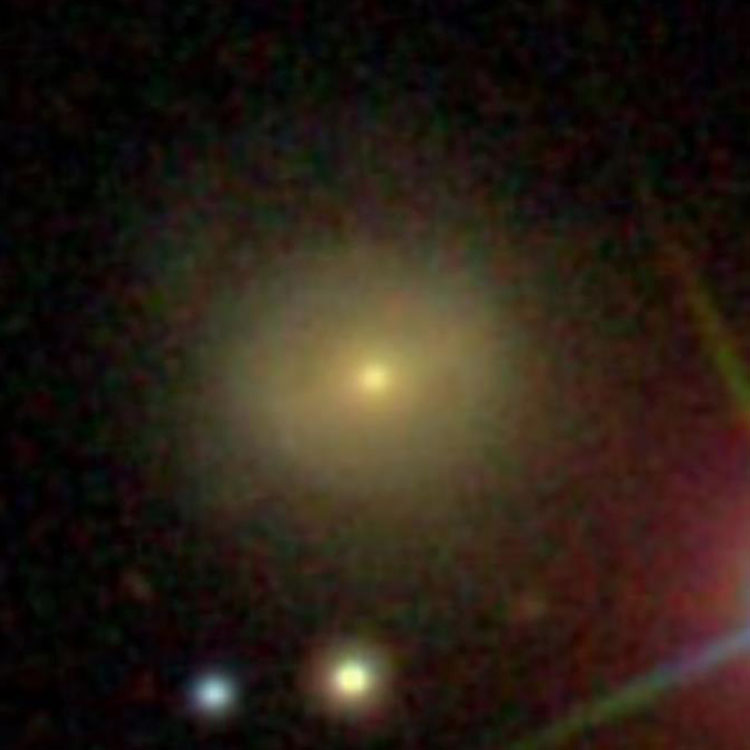
Below, a 12 arcmin wide SDSS image centered on NGC 258, also showing NGC 252 and 260
Below, a 1 arcmin wide SDSS image of the galaxy
NGC 259
(= PGC 2820 = MCG -01-03-015)
Discovered (Dec 13, 1786) by William Herschel
Also observed (Oct 16, 1827) by John Herschel
A magnitude 12.8 spiral galaxy (type Sbc?) in Cetus (RA 00 48 03.3, Dec -02 46 32)
Historical Identification: Per Dreyer, NGC 259 (= GC 144 = GC 145 = JH 63 = JH 64 = WH II 703 = WH II 621, 1860 RA 00 40 54, NPD 93 32.7) is "faint, small, extended 135°, a little brighter middle."
Physical Information: Apparent size 2.9 by 0.6 arcmin?

Above, a 12 arcmin wide SDSS image centered on NGC 259
Below, a 2.4 arcmin wide SDSS image of the galaxy

NGC 260
(= PGC 2844 = UGC 497 = CGCG 480-009 = MCG +04-03-006)
Discovered (Dec 22, 1848) by George Stoney
Discovered (Aug 27, 1865) by Heinrich d'Arrest
A magnitude 13.5 spiral galaxy (type Scd pec?) in Andromeda (RA 00 48 34.7, Dec +27 41 33)
Historical Identification: Per Dreyer, NGC 260 (= GC 5118, d'Arrest, 1860 RA 00 41 08, NPD 63 04.8) is "extremely faint, pretty small, a little extended." The position precesses to RA 00 48 37.1, Dec +27 41 05, only about half an arcmin southeast of the galaxy listed above, so the identification is certain.
Physical Information: Apparent size of about 0.8 by 0.65 arcmin (from image below).

Above, a 12 arcmin wide SDSS image centered on NGC 260, also showing NGC 258
Below, a 1 arcmin wide SDSS image of the galaxy

NGC 261, in the Small Magellanic Cloud
(= "PGC 3517577" = ESO 029-EN012)
Discovered (Sep 5, 1826) by James Dunlop
Also observed (Sep 20, 1835) by John Herschel
A magnitude 12 emission nebula in Tucana (RA 00 46 32.6, Dec -73 06 06)
Historical Identification: Per Dreyer, NGC 261 (= GC 146 = JH 2349, Dunlop 3, 4, 21?, 1860 RA 00 41 24, NPD 163 52.1) is "faint, pretty large, round, gradually brighter middle equivalent to 13th magnitude star."
Discovery Notes: Although Herschel thought this might be related to Dunlop's #3, 4 and 21, current thinking is that only Dunlop 4 and 21 correspond to this object.
Note About PGC Designation: As in the case of most NGC objects, HyperLEDA assigned a PGC designation to this object, even though it isn't a galaxy; however, a search of the database for that designation returns no result, so it is shown in quotes.
Physical Information: Apparent size of about 2.1 by 2.1 arcmin (from image below).

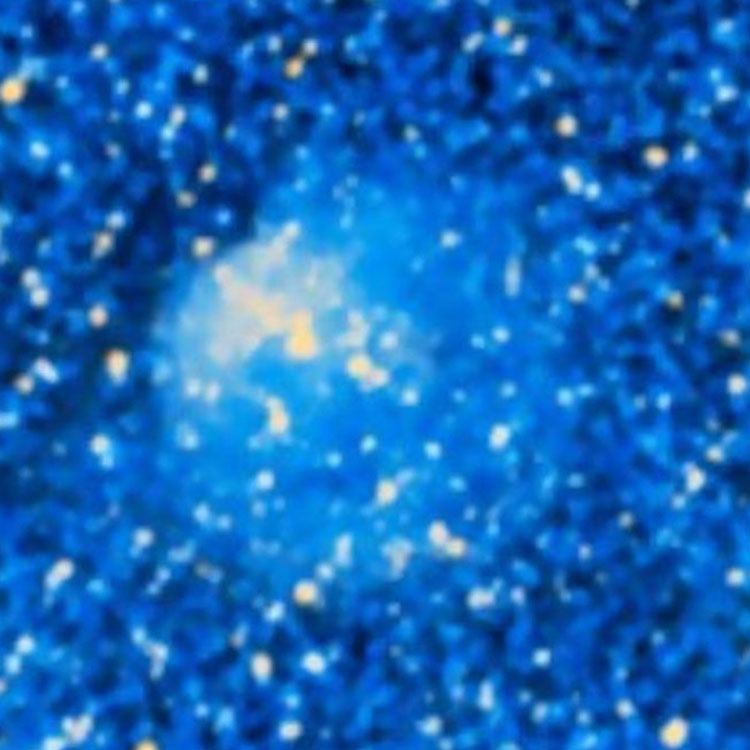
Above, a 12 arcmin wide DSS image centered on NGC 261, also showing NGC 249
Below, a 3.5 arcmin wide DSS image of the emission nebula
NGC 262
(= PGC 2855 = UGC 499 = CGCG 501-020 = MCG +05-03-008)
Discovered (Sep 17, 1885) by Lewis Swift
Also observed (Oct 13, 1890) by Guillaume Bigourdan
A magnitude 13.1 lenticular galaxy (type (R1')SA(rs)0/a?) in Andromeda (RA 00 48 47.1, Dec +31 57 25)
Historical Identification: Per Dreyer, NGC 262 (Swift list II (#10), 1860 RA 00 41 29, NPD 58 48.4) is "extremely faint, very small, round, very difficult." The second Index Catalog lists a corrected RA (per Bigourdan) of 00 41 15. The corrected position precesses to RA 00 48 47.7, Dec +31 57 29, right on the galaxy, so the identification is certain.
Physical Information: Apparent size of about 2.1 by 1.9 arcmin (from image below)
LEDA: S0/a, Sy1h; NED SA(s)0/a:, Sy2, RIDE1 21.5 Mpc, 3K Vr 4198 km/sec
Classification Note: The (R1') indicates an outer partial pseudoring, in this case formed by spiral arms extending from the inner ring (indicated by "(rs)") and forming a half circle.

Above, a 12 arcmin wide SDSS image centered on NGC 262
Below, a 2.4 arcmin wide SDSS image of the galaxy

PGC 212599
Not an NGC object but listed here as an apparent companion of NGC 262
A magnitude 17(?) spiral galaxy (type Sa?) in Andromeda (00 48 44.3, +31 58 16)
Physical Information:
LEDA "galaxy", B 17.8 -> V 17(?); NED 3K Vr 22738 km/sec, z 0.075844307285, so only an extremely distant (about 970 million light-years distant when the light by which we see it left it, about 1005 million years ago) background galaxy (type very uncertain; from PanSTARRS image to be posted later)
PGC 212600
Not an NGC object but listed here as an apparent companion of NGC 262
A magnitude 15(?) lenticular galaxy (type E/S0?) in Andromeda (RA 00 48 52.8, Dec +31 57 31)
Physical Information:
LEDA B 15.8 -> V 15(?); NED 3K Vr 10665 km/sec, z 0.035574296, so only a distant background galaxy
NGC 263
(= PGC 2856 = MCG -02-03-021)
Discovered (1886) by Francis Leavenworth
A magnitude 14.3 spiral galaxy (type SABbc? pec) in Cetus (RA 00 48 48.4, Dec -13 06 27)
Historical Identification: Per Dreyer, NGC 263 (Leavenworth list I (#13), 1860 RA 00 41 30, NPD 103 53.9) is "extremely faint, very small, a little extended 30°."
Physical Information: Apparent size of about 0.85 by 0.35 arcmin (from PanSTARR image below)
Classification Note: The PanSTARRS image shows that this is a three-armed spiral with a weak central bar, so although definitely a barred spiral (hence the underlined B), it is somewhat intermediate between barred and unbarred (whence the additional "A").

Above, a 12 arcmin wide DSS image centered on NGC 263
Below, a 1 arcmin wide PanSTARRS image of the galaxy

NGC 264
(= PGC 2831 = ESO 295-006 = MCG -07-02-016)
Discovered (Aug 30, 1834) by John Herschel
A magnitude 13.5 lenticular galaxy (type SB0?) in Sculptor (RA 00 48 21.0, Dec -38 14 04)
Historical Identification: Per Dreyer, NGC 264 (= GC 147 = JH 2350, 1860 RA 00 41 42, NPD 129 00.3) is "faint, small, round, very suddenly very much brighter middle equal to 13th magnitude star."
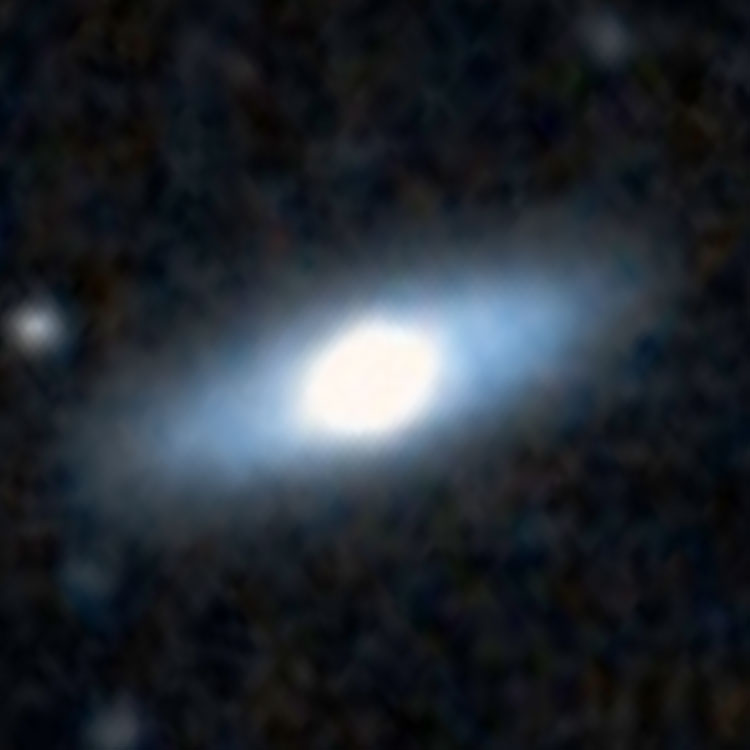
Physical Information: Apparent size of about 1.05 by 0.35 arcmin (from images below)
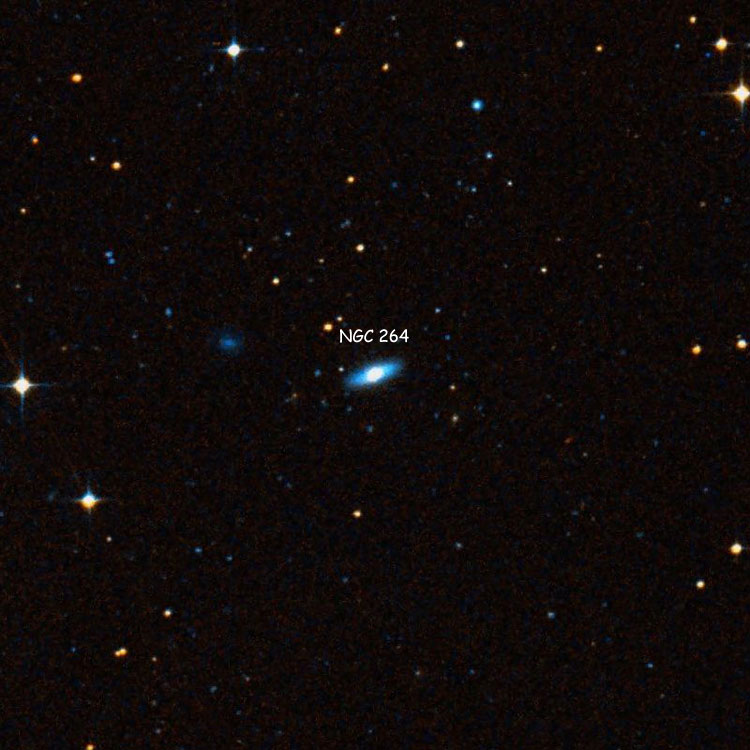
Above, a 12 arcmin wide DSS image centered on NGC 264
Below, a 1.5 arcmin wide DSS image of the galaxy (Post-processing Aladin, Photoshop CS4, Courtney Seligman)
NGC 265, in the Small Magellanic Cloud
(= "PGC 3517843" = ESO 029-SC014)
Discovered (Apr 11, 1834) by John Herschel
A magnitude 12.2 open cluster in Tucana (RA 00 47 11.6, Dec -73 28 38)
Historical Identification: Per Dreyer, NGC 265 (= GC 148 = JH 2351, 1860 RA 00 42 04, NPD 164 15.1) is "faint, pretty small, round."
Note About PGC Designation: As in the case of most NGC objects, HyperLEDA assigned a PGC designation to this object, even though it isn't a galaxy; however, a search of the database for that designation returns no result, so it is shown in quotes.
Physical Information: Apparent size about 0.9 by 0.8 arcmin (from images below) About two hundred thousand light-years distant, in the Small Magellanic Cloud, are the 12th magnitude open clusters NGC 265 and NGC 290. Each cluster spans about 65 light-years, and contains hundreds or thousands of brilliant young stars. Most of the stars in the HST image are not cluster members, but lie in front of (in our own galaxy or the Small Magellanic Cloud) or behind (in the Small Magellanic Cloud) the clusters.

Above, a 12 arcmin wide DSS unage centered on NGC 265, also showing NGC 256 and 269
Below, a 1.6 arcmin wide DSS image of the open cluster
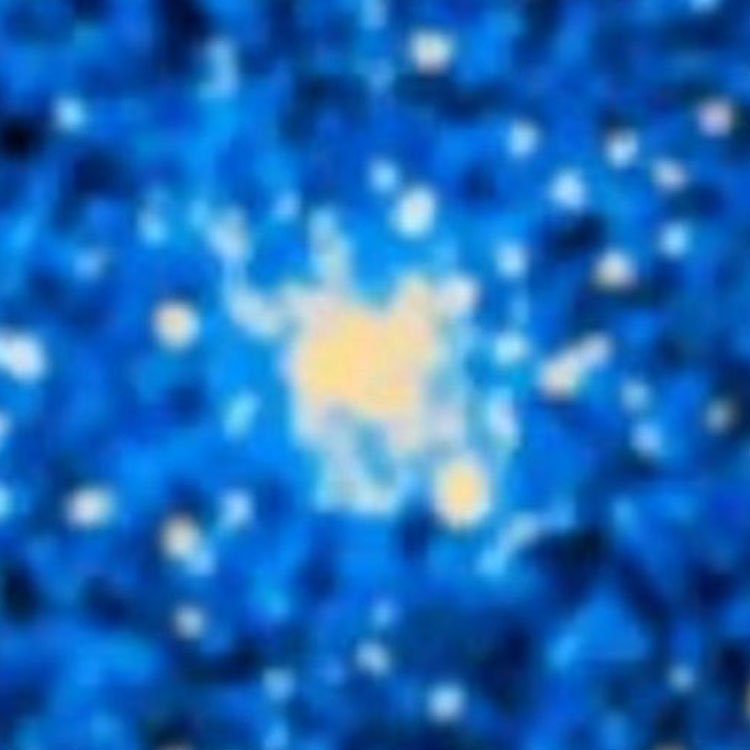
Below, a roughly 1.2 arcmin wide HST image (Image Credit E. Olszewski (U. Arizona), HST, ESA, NASA, Hubble Site)

NGC 266
(= PGC 2901 = UGC 508 = CGCG 501-022 = MCG +05-03-009)
Discovered (Sep 12, 1784) by William Herschel
Also observed (Nov 11, 1827) by John Herschel
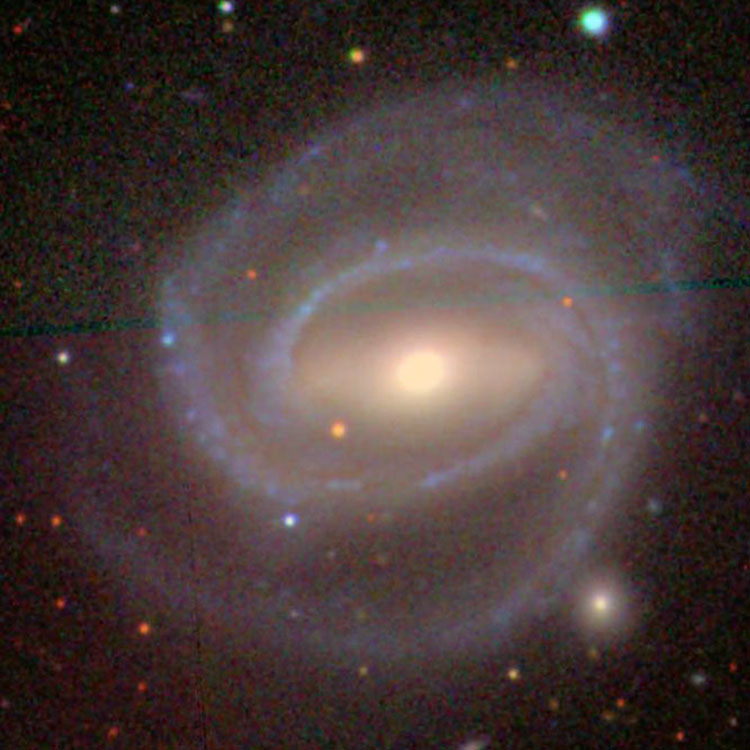
A magnitude 11.6 spiral galaxy (type SB(rs)ab) in Pisces (RA 00 49 47.8, Dec +32 16 40)
Historical Identification: Per Dreyer, NGC 266 (= GC 149 = JH 65 = WH III 153, 1860 RA 00 42 14, NPD 58 29.2) is "pretty bright, pretty small, a little extended, pretty suddenly brighter middle, mottled but not resolved, 8th magnitude star 4 arcmin south-following (to the southeast)."
Physical Information: Apparent size of about 3.1 by 2.2 arcmin (from image below).
Use By The de Vaucouleurs Atlas: NGC 266 is used by the de Vaucouleurs Atlas of Galaxies as an example of galaxy type SB(rs)ab.
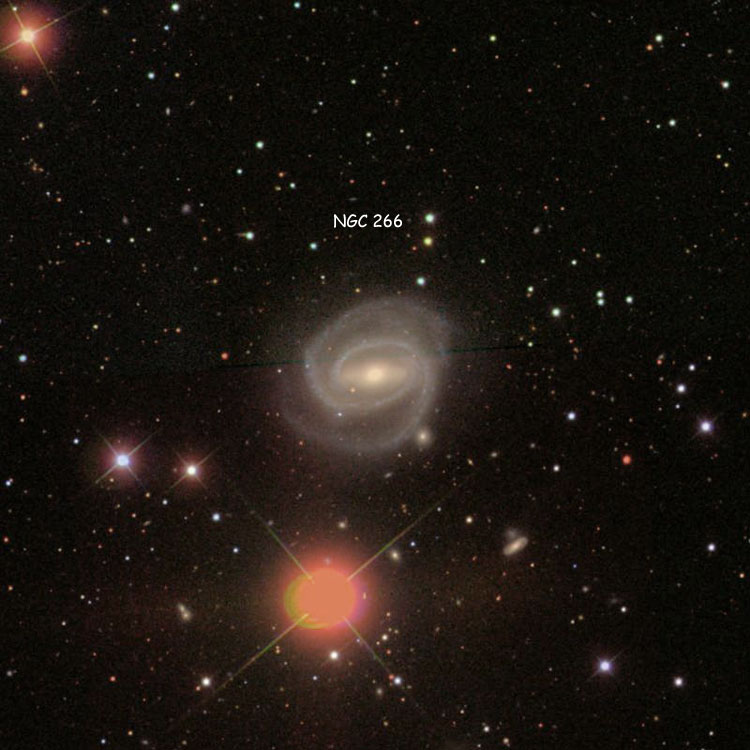
Above, a 12 arcmin wide SDSS image centered on NGC 266
Below, a 3.2 arcmin wide SDSS image of the galaxy
"PGC 3603752"
(= 2MASXJ00494416+3215398)
Not an NGC object but listed here as an apparent companion of NGC 266
A magnitude ? elliptical galaxy (type E0?) in Pisces (RA 00 49 44.2, Dec +32 15 40)
Note About PGC Designation: Although HyperLEDA assigned a PGC designation to this object, a search of the database for that designation returns no result, so it is shown in quotes; so only a search by position or its 2MASX designation returns any result, and as noted below, for all practical purposes, that is no result at all.
Physical Information: Listed but without any information except its designation and position in various databases; so other than things that can be determined from an image (to be posted at a later date), nothing can be said about this galaxy, so although it appears to be a companion of NGC 266, whether it actually is, is unknown.
NGC 267, in the Small Magellanic Cloud
(= "PGC 3517844" = ESO 029-SC015)
Discovered (Oct 4, 1836) by John Herschel
An open cluster in Tucana (RA 00 48 02.0, Dec -73 16 24)
Historical Identification: Per Dreyer, NGC 267 (= GC 150 = JH 2352, 1860 RA 00 42 50, NPD 164 02.6) is "a cluster, faint, pretty large, stars very small (faint)."
Note About PGC Designation: As in the case of most NGC objects, HyperLEDA assigned a PGC designation to this object, even though it isn't a galaxy; however, a search of the database for that designation returns no result, so it is shown in quotes.
Physical Information: Apparent size of about 2.1 by 1.65 arcmin (from images below)
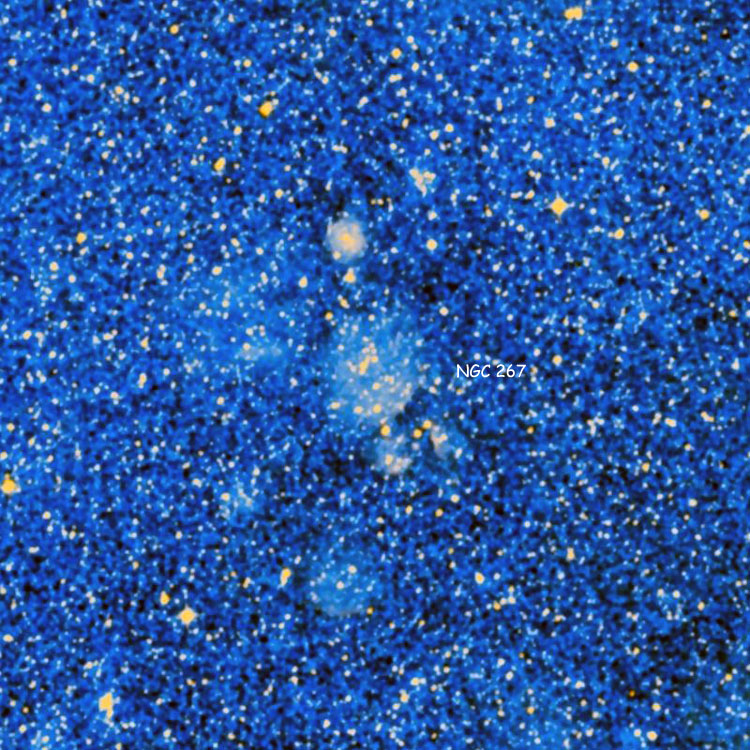
Above, a 12 arcmin wide DSS image centered on NGC 267
Below, a 3.2 arcmin wide DSS image of the open cluster

NGC 268
(= PGC 2927 = MCG -01-03-017)
Discovered (Nov 22, 1785) by William Herschel
Also observed (Jan 2, 1827) by John Herschel
A magnitude 13.1 spiral galaxy (type SB(s)bc?) in Cetus (RA 00 50 09.5, Dec -05 11 37)
Historical Identification: Per Dreyer, NGC 268 (= GC 151 = JH 66 = WH III 463, 1860 RA 00 43 01, NPD 95 58.0) is "very faint, pretty small, irregularly a little extended, mottled but not resolved."
Physical Information: Apparent size of about 1.3 by 0.9 arcmin (from image below)

Above, a 12 arcmin wide SDSS image centered on NGC 268
Below, a 1.6 arcmin wide SDSS image of the galaxy

NGC 269, in the Small Magellanic Cloud
(= "PGC 3517845" = ESO 029-SC016)
Discovered (Nov 5, 1836) by John Herschel
A magnitude 13.3 open cluster in Tucana (RA 00 48 21.3, Dec -73 31 48)
Historical Identification: Per Dreyer, NGC 269 (= GC 152 = JH 2353, 1860 RA 00 43 21, NPD 164 18.0) is "very faint, small, round."
Note About PGC Designation: As in the case of most NGC objects, HyperLEDA assigned a PGC designation to this object, even though it isn't a galaxy; however, a search of the database for that designation returns no result, so it is shown in quotes.
Physical Information: Apparent size of about 0.6 by 0.6 arcmin (from image below)

Above, a 12 arcmin wide DSS image centered on NGC 269, also showing NGC 265
Below, a 1.5 arcmin wide DSS image of the cluster
NGC 270
(= PGC 2938 = MCG -02-03-027)
Discovered (Dec 10, 1798) by William Herschel
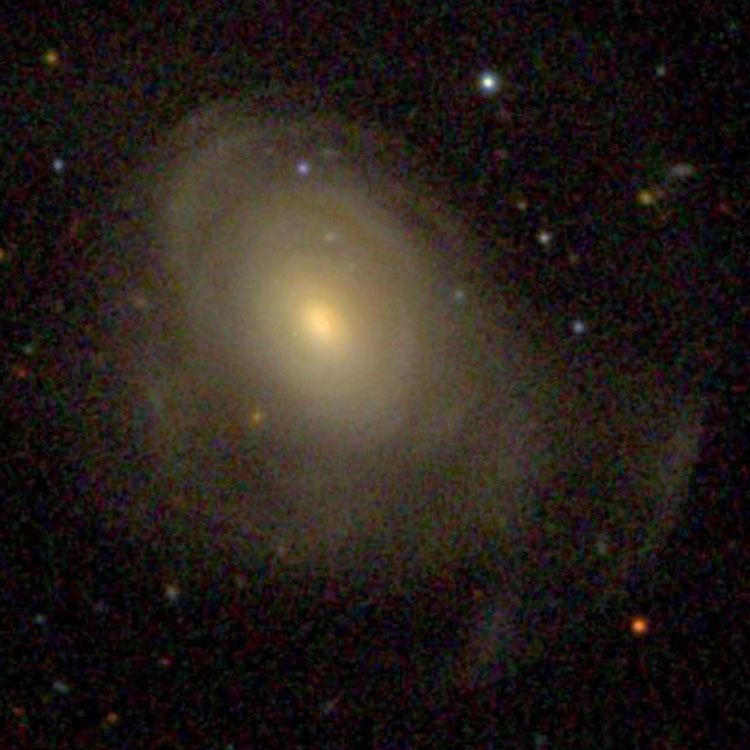
A magnitude 12.9 lenticular galaxy (type SA(rs)0/a? pec) in Cetus (RA 00 50 32.5, Dec -08 39 06)
Historical Identification: Per Dreyer, NGC 270 (= GC 153 = WH III 955, 1860 RA 00 43 29, NPD 99 25.7) is "pretty faint, very small, irregularly round, pretty gradually brighter middle."
Physical Information: Apparent size of about 2.45 by 1.9 arcmin (from image below)
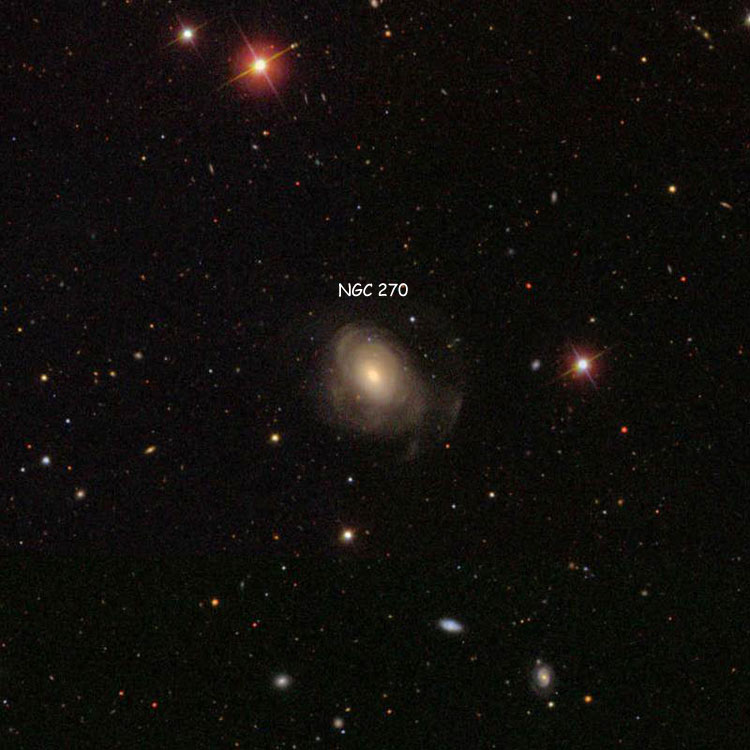
Above, a 12 arcmin wide SDSS image centered on NGC 270
Below, a 2.8 arcmin wide SDSS image of the galaxy
NGC 271
(= PGC 2949 = UGC 519 = CGCG 384-013 = MCG +00-03-012)
Discovered (Oct 1, 1785) by William Herschel
Also observed (Sep 6, 1831) by John Herschel
A magnitude 12.0 spiral galaxy (type (R')SB(rs)ab) in Cetus (RA 00 50 41.9, Dec -01 54 37)
Historical Identification: Per Dreyer, NGC 271 (= GC 154 = JH 67 = WH II 446, 1860 RA 00 43 34, NPD 92 40.4) is "pretty faint, small, a little extended, pretty suddenly brighter middle, 8th magnitude star 5.5 seconds of time following (to the east)."
Physical Information: Apparent size of about 2.6 by 1.75 arcmin (from the images below)

Above, a 12 arcmin wide SDSS image centered on NGC 271
Below, a 2.4 arcmin wide SDSS image of the galaxy

NGC 272
(= OCL 312 = "PGC 5067602")
Discovered (Aug 2, 1864) by Heinrich d'Arrest
A magnitude 8.5 group of stars in Andromeda (RA 00 51 24.0, Dec +35 50 54)
Historical Identification: Per Dreyer, NGC 272 (= GC 5119, d'Arrest, 1860 RA 00 43 41, NPD 54 55.3) is "a cluster, large, a little compressed."
Note About PGC Designation: As in the case of most NGC objects, HyperLEDA assigned a PGC designation to this object, even though it isn't a galaxy; however, a search of the database for that designation returns no result, so it is shown in quotes.
Physical Information: Four moderately bright stars in a curved arc about 2.1 by 1.5 arcmin in size, plus a scattering of fainter stars near those, and a few dimilarly bright stars randomly scattered in the general field of view. Whether any of the latter stars are related to each other or the smaller group seems doubtful.
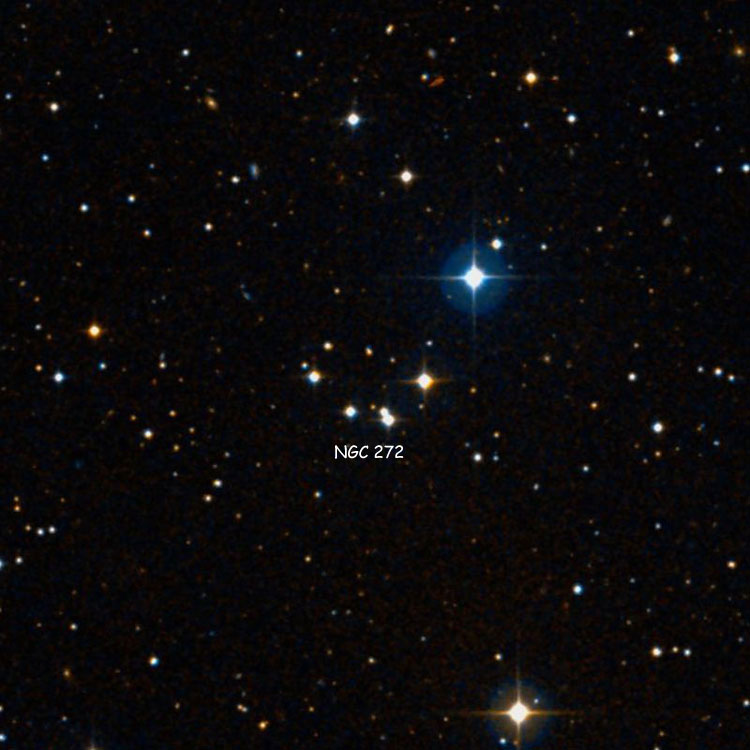
Above, a 12 arcmin wide DSS image centered on NGC 272
NGC 273
(= PGC 2959 = MCG -01-03-019)
Discovered (Sep 10, 1785) by William Herschel
Also observed (date?) by Wilhelm Tempel
A magnitude 12.9 lenticular galaxy (type S0?) in Cetus (RA 00 50 48.5, Dec -06 53 08)
Historical Identification: Per Dreyer, NGC 273 (= GC 155 = WH III 430, Tempel (#??), 1860 RA 00 43 47, NPD 97 39.3) is "very faint, very small."
Physical Information: Apparent size of about 1.8 by 0.5 arcmin (from image below)

Above, a 12 arcmin wide SDSS image centered on NGC 273
Below, a 2.4 arcmin wide SDSS image of the galaxy

NGC 274 (with NGC 275 = Arp 140)
(= PGC 2980 = MCG -01-03-021)
Discovered (Sep 10, 1785) by William Herschel
Also observed (Oct 9, 1828) by John Herschel
A magnitude 11.8 lenticular galaxy (type E/SAB(r)0 pec) in Cetus (RA 00 51 01.8, Dec -07 03 25)
Historical Identification: Per Dreyer, NGC 274 (= GC 156 = JH 69 = WH III 429, 1860 RA 00 43 57, NPD 97 49.7) is "pretty bright, pretty small, suddenly much brighter middle, north-preceding (northwestern) of 2," the other one being NGC 275.
Physical Information: Apparent size 1.4 by 1.2 arcmin?
Use By The Arp Atlas: NGC 274 is used (with NGC 275) by The Arp Atlas of Peculiar Galaxies as an example of material (NGC 275) emanating from an elliptical galaxy (NGC 274).
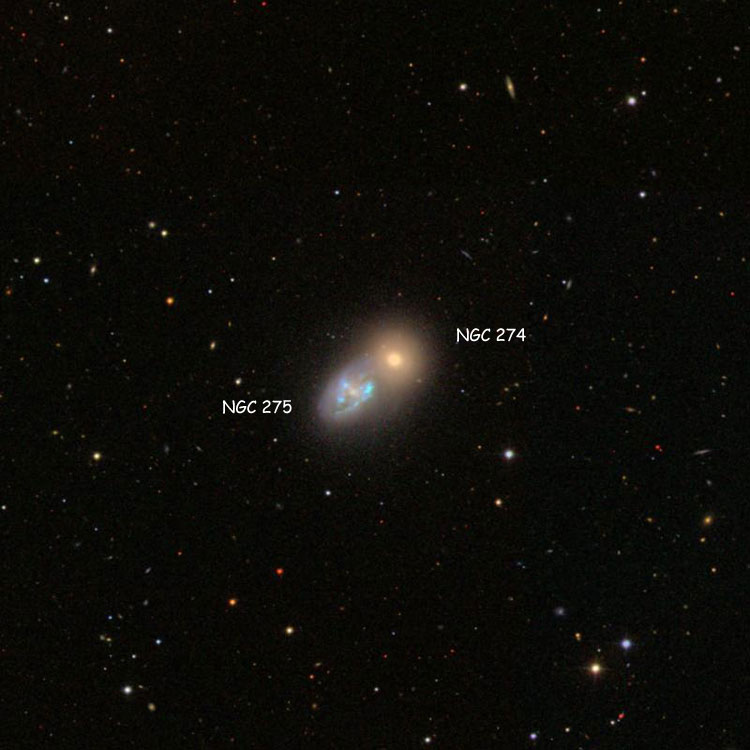
Above, a 12 arcmin wide SDSS image centered on NGC 274 and 275, which comprise Arp 140
Below, a 2.4 arcmin wide SDSS image of the pair

NGC 275 (with NGC 274 = Arp 140)
(= PGC 2984 = MCG -01-03-022)
Discovered (Oct 10, 1828) by John Herschel
A magnitude 12.5 spiral galaxy (type SB(rs)cd pec) in Cetus (RA 00 51 04.5, Dec -07 03 55)
Historical Identification: Per Dreyer, NGC 275 (= GC 157 = JH 70, 1860 RA 00 44 00, NPD 97 50.2) is "very faint, small, round, south-following (southeastern) of 2," the other one being NGC 274.
Physical Information: Apparent size 1.5 by 1.2 arcmin?
Use By The Arp Atlas: NGC 275 is used (with NGC 274) by The Arp Atlas of Peculiar Galaxies as an example of material (NGC 275) emanating from an elliptical galaxy (NGC 274, which see for images).
NGC 276 (= IC 1591)
(= PGC 3054 = ESO 474-034 = MCG -04-03-021)
Discovered (1886) by Frank Muller (and later listed as NGC 276)
Also observed (date?) by Herbert Howe (while listed as NGC 276)
Discovered (Nov 3, 1898) by DeLisle Stewart (and later listed as IC 1591)
A magnitude 14.7 spiral galaxy (type SAB(rs)b? pec) in Cetus (RA 00 52 06.6, Dec -22 40 48)
Historical Identification: Per Dreyer, NGC 276 (Muller list II (#294), 1860 RA 00 44 01, NPD 113 27.9) is "extremely faint, pretty small, extended 265°, 11th magnitude star 3 arcmin to north." The second Index Catalog lists a corrected RA (per Howe) of 00 45 14, and adds "the star to the northeast is an 8th magnitude close double." The corrected position precesses to RA 00 52 07.5, Dec -22 42 10, about 1.3 arcmin south of the galaxy, there is nothing else nearby, and the double star makes the identification certain.
Physical Information: Apparent size of about 1.1 by 0.4 arcmin (from the image below)

Above, a 12 arcmin wide DSS image centered on NGC 276
Below, a 1.5 arcmin wide PanSTARRS image of the galaxy

NGC 277
(= PGC 2995 = MCG -02-03-028)
Discovered (Oct 8, 1864) by Heinrich d'Arrest
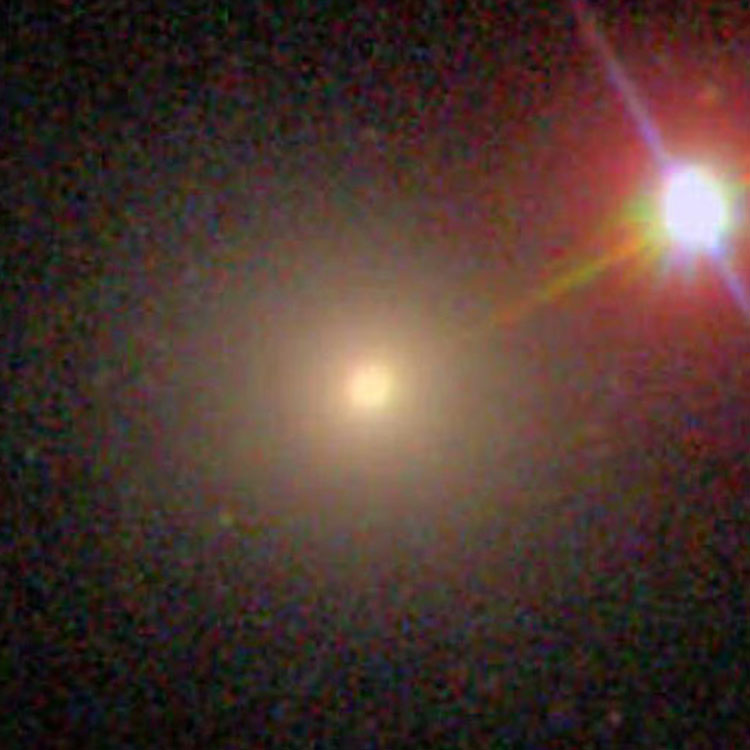
A magnitude 13.7 lenticular galaxy (type E/S0?) in Cetus (RA 00 51 17.2, Dec -08 35 49)
Historical Identification: Per Dreyer, NGC 277 (= GC 5120, d'Arrest, 1860 RA 00 44 12, NPD 99 21.2) is "faint, pretty small, 11th magnitude star north-preceding (to the northwest)."
Physical Information: Apparent size of about 1.3 by 1.1 arcmin (from image below)
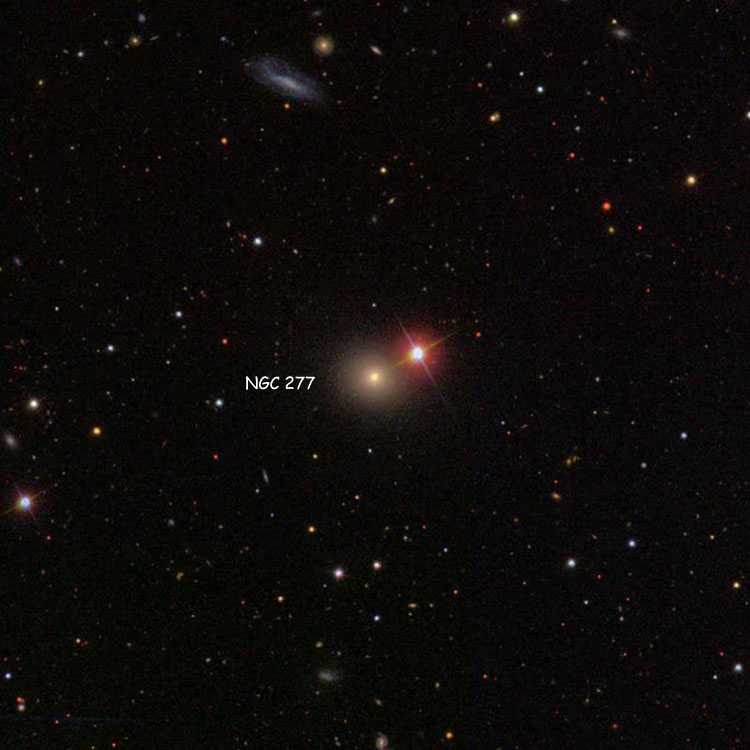
Above, a 12 arcmin wide SDSS image centered on NGC 277
Below, a 1.6 arcmin wide SDSS image of the galaxy
NGC 278
(= PGC 3051 = UGC 528 = CGCG 550-016 = MCG +08-02-016)
Discovered (Dec 11, 1786) by William Herschel
Also observed (Dec 31, 1831) by John Herschel
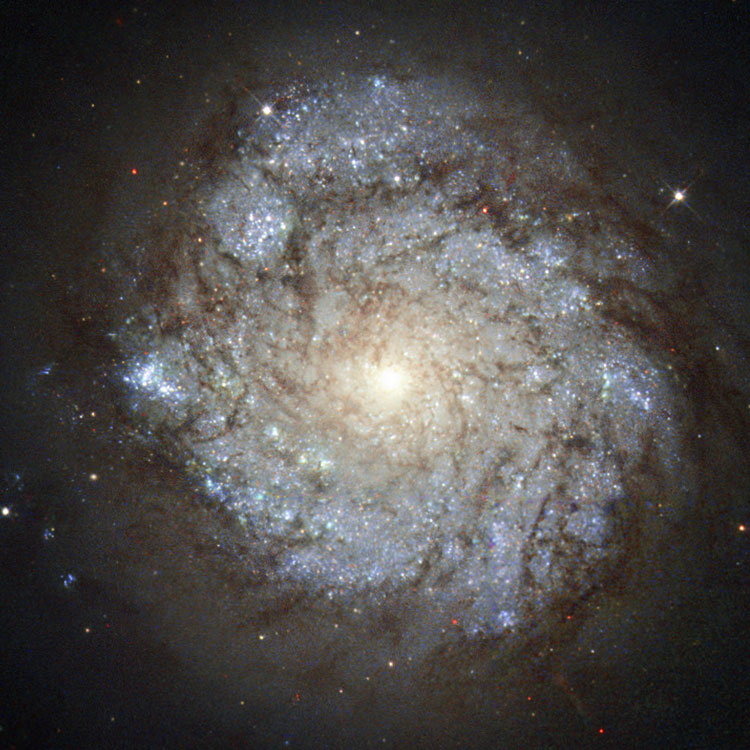
A magnitude 10.8 spiral galaxy (type SA(rs)b?) in Cassiopeia (RA 00 52 04.3, Dec +47 33 02)
Historical Identification: Per Dreyer, NGC 278 (= GC 158 = JH 71 = WH I 159, 1860 RA 00 44 12, NPD 43 12.3) is "considerably bright, pretty large, round, 2 stars of 10th magnitude near." The position precesses to RA 00 52 04.4, Dec +47 33 26, just inside the northern rim of the galaxy listed above, the description fits and there is nothing else nearby, so the identification is certain.
Physical Information: Based on a recessional velocity relative to the Cosmic Microwave Background radiation of 370 km/sec (and H0 = 70 km/sec/Mpc), NGC 278 is about 15 to 20 million light-years away, in poor agreement with redshift-independent distance estimates of about 35 to 95 million light-years, but this is not unusual for galaxies with such small redshifts, beause their peculiar (non-Hubble Flow) velocities can substantially affect their observed recessional velocities. The press release for the HST image at the bottom of this entry uses a distance of 35 to 40 million light-years, which seems a more reasonable estimate (though obviously any value can only be considered an estimate at the moment). Given that and its apparent size of about 2.3 by 2.2 arcmin (from the images below), the galaxy is about 25 thousand light-years across.
Use By The de Vaucouleurs Atlas: NGC 278 is used by the de Vaucouleurs Atlas of Galaxies as an example of galaxy type SA(rs)b. The galaxy has a "nuclear ring" of active star formation surrounding the actual nucleus, and a much larger ring of relatively dark regions filled with gas and dust ("visible" in the infrared), almost certainly as the result of the merger of two former galaxies. If it were visible, the outer region might change the classification to (R)SA(rs)b(?), but since classifications are based on the visible appearance of galaxies, the type shown above is considered the most appropriate one.
Classification Note: NGC 1388, which is usually classified as an elliptical galaxy based on older images, has recently been shown to have a nearly identical structure, and to therefore also be type SA(rs)b. See that entry for another example of this unusual type.

Above, a 12 arcmin wide DSS image centered on NGC 278
Below, a 2.4 arcmin wide DSS image of the galaxy

Below, a 2 arcmin wide image of a similar field of view (Image Credit Hubble Legacy Archive)

Below, a 1.2 arcmin wide image of the core of the galaxy
(Image Credit ESA/Hubble/NASA & S. Smartt (Queen's University Belfast))
NGC 279
(= PGC 3055 = CGCG 384-018 = MCG +00-03-019A)
Discovered (Oct 1, 1785) by William Herschel
Also observed (Oct 16, 1827) by John Herschel
A magnitude 12.7 lenticular galaxy (type (R)SAB(r)0/a pec?) in Cetus (RA 00 52 09.0, Dec -02 13 06)
Historical Identification: Per Dreyer, NGC 279 (= GC 159 = JH 73 = WH III 439, 1860 RA 00 45 00, NPD 92 59.2) is "very faint, small, irregularly round, brighter middle, stellar."
Physical Information: Apparent size of about 2.8 by 2.0 arcmin (from image below)
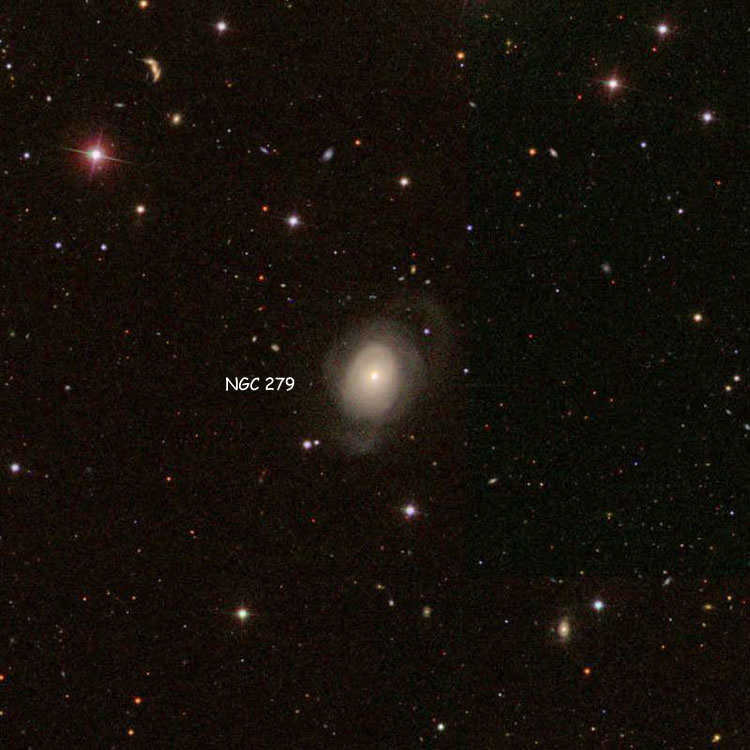
Above, a 12 arcmin wide SDSS image centered on NGC 279
Below, a 3 arcmin wide SDSS image of the galaxy

NGC 280
(= PGC 3076 = UGC 534 = CGCG 480-017 = MCG +04-03-013)
Discovered (Dec 5, 1785) by William Herschel
Also observed (Aug 17, 1828) by John Herschel
A magnitude 13.3 spiral galaxy (type (R)SAB(rs)b pec) in Andromeda (RA 00 52 30.3, Dec +24 21 02)
Historical Identification: Per Dreyer, NGC 280 (= GC 160 = JH 72 = WH III 477, 1860 RA 00 45 00, NPD 66 25.4) is "extremely faint, small, round, 15th magnitude star 30 arcsec following (to the east)."
Physical Information: Apparent size of about 1.8 by 1.0 arcmin (from image below)

Above, a 12 arcmin wide SDSS image centered on NGC 280
Below, a 2 arcmin wide SDSS image of the galaxy

PGC 212612
Not an NGC object but listed here as an apparent companion of NGC 280
A magnitude 16(?) lenticular? galaxy (type S0/a?) in Andromeda (RA 00 52 28.9, Dec +24 20 54)
Physical Information:
LEDA B 16.3 -> V (15.5? 16?); NED no radial velocity anywhere, so whether an actual companion is unknown
NGC 281 (perhaps = IC 11?)
(= "PGC 3517578")
Discovered (Nov 16, 1881) by Edward Barnard (and later listed as NGC 281)
Perhaps reobserved (1890's?) by Edward Barnard (and later listed as IC 11)
An emission nebula in Cassiopeia (RA 00 53 00.0, Dec +56 37 18)
Corwin lists the position of the cluster that presumably lights up much/most of the nebula at RA 00 52 49.2, Dec +56 37 36
Historical Identification: Per Dreyer, NGC 281 (Barnard (a), 1860 00 45 07, NPD 34 10) is "faint, very large, diffuse, small (faint) triple star on north-preceding (northwestern) edge."
Note About PGC Designation: As in the case of most NGC objects, HyperLEDA assigned a PGC designation to this object, even though it isn't a galaxy; however, a search of the database for that designation returns no result, so it is shown in quotes.
Physical Information: The nebula is about 10 thousand light-years away, and based on its 40 arcmin apparent size, is a little over 100 light-years across. It is associated with open cluster OCL 313, and with IC 1590, the open cluster near the center of the nebula, which is responsible for most of the high-energy radiation that energizes the nebula.

Above, a 45 arcmin wide DSS image centered on NGC 281
NGC 282
(= PGC 3090 = CGCG 501-030 = MCG +05-03-015)
Discovered (Oct 13, 1879) by Édouard Stephan
A magnitude 13.7 lenticular galaxy (type E/S0?) in Pisces (RA 00 52 42.1, Dec +30 38 20)
Historical Identification: Per Dreyer, NGC 282 (Stephan list X (#3), 1860 RA 00 45 11, NPD 60 07.4) is "faint, small, round, a little brighter middle."
Physical Information: Apparent size of about 1.15 by 0.7 arcmin (from image below)

Above, a 12 arcmin wide SDSS image centered on NGC 282
Below, a 1.6 arcmin wide SDSS image of the galaxy
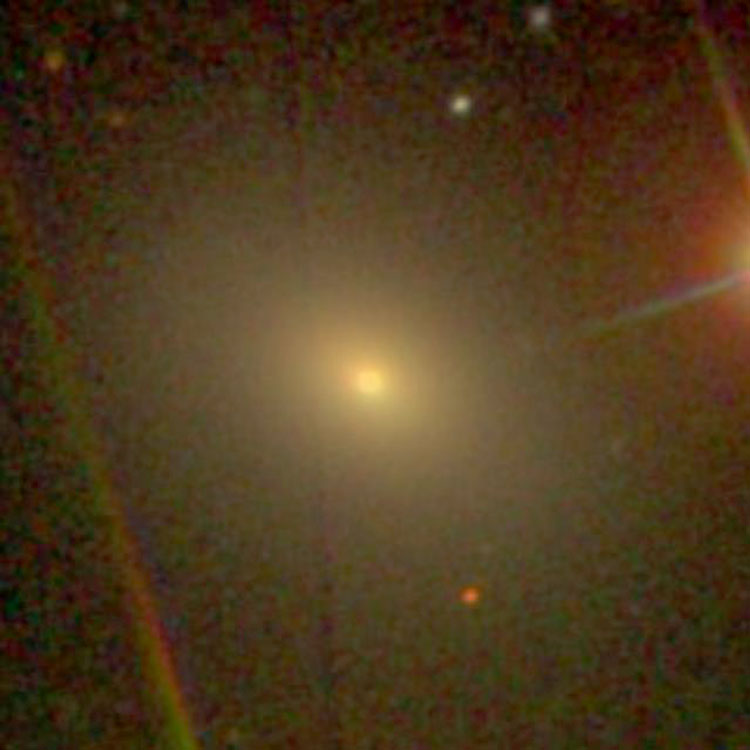
NGC 283
(= PGC 3124 = MCG -02-03-031)
Discovered (Oct 2, 1886) by Francis Leavenworth
Also observed (date?) by Herbert Howe
A magnitude 14.1 spiral galaxy (type SAB(rs)c?) in Cetus (RA 00 53 13.2, Dec -13 09 50)
Historical Identification: Per Dreyer, NGC 283 (Leavenworth list I (#14), 1860 RA 00 45 30, NPD 103 55.8) is "extremely faint, small, round, 1st of 4," the others being NGC 284, 285 and 286, all of which have identical positions and descriptions in the original NGC. The second Index Catalog lists a corrected position (per Howe) of RA 00 46 14, NPD 103 55.5. That precesses to RA 00 53 14.6, Dec -13 09 49, right on the galaxy listed above, so the identification is certain.
Physical Information: Apparent size of about 1.85 by 0.75 arcmin (from images below)
NED Sc, RIDE 166 - 171 (median 168.5) Mpc, 3K Vr 11025 km/sec, z 0.0367756041097

Above, a 12 arcmin wide DSS image centered on NGC 283, also showing NGC 284, 285 and 286
Below, a 1.6 by 2.0 arcmin wide PanSTARRS image of the galaxy

Below, a 6 arcmin wide DSS image showing NGC 283, 284, 285 and 286

PGC 173072
Not an NGC object but listed here as a possible/probable companion of NGC 283
A magnitude 16(?) lenticular galaxy (type SAB0/a?) in Cetus (00 53 16.4, -13 08 10)
Physical Information:
LEDA B 16.8, I 14.6 -> V 16(?); NED 3K Vr 11434 km/sec, z 0.03813961167858
NGC 284
(= PGC 3131 = PGC 3132 = MCG -02-03-032)
Discovered (Oct 2, 1886) by Francis Leavenworth
Also observed (date?) by Herbert Howe
A magnitude 14.4 elliptical galaxy (type E1) in Cetus (RA 00 53 24.2, Dec -13 09 32)
Historical Identification: Per Dreyer, NGC 284 (Leavenworth list I (#15), 1860 RA 00 45 30, NPD 103 55.8) is "extremely faint, small, round, 2nd of 4,", the others being NGC 283, 285 and 286, all of which have identical positions and descriptions in the original NGC. The second Index Catalog lists a corrected position (per Howe) of RA 00 46 25, NPD 103 55.2. That precesses to RA 00 53 25.5, Dec -13 09 32, right on the galaxy listed above, so the identification is certain.
Physical Information: Apparent size of about 0.45 by 0.4 arcmin (from images below).

Above, a 12 arcmin wide DSS image centered on NGC 284, also showing NGC 283, 285 and 286
Below, a 0.75 arcmin wide PanSTARRS image of the galaxy

Below, a 6 arcmin wide DSS image showing NGC 283, 284, 285 and 286
NGC 285
(= PGC 3141 = MCG -02-03-033)
Discovered (Oct 2, 1886) by Francis Leavenworth
Also observed (date?) by Herbert Howe
A magnitude 14.7 lenticular galaxy (type E/S0?) in Cetus (RA 00 53 29.9, Dec -13 09 39)
Historical Identification: Per Dreyer, NGC 285 (Leavenworth list I (#16), 1860 RA 00 45 30, NPD 103 55.8) is "extremely faint, small, round, 3rd of 4," the others being NGC 283, 284 and 286, all of which have identical positions and descriptions in the original NGC. The second Index Catalog lists a corrected position (per Howe) of RA 00 46 31, NPD 103 55.2. That precesses to RA 00 53 31.5, Dec -13 09 32, right on the galaxy listed above, so the identification is certain.
Physical Information: Apparent size of about 0.7 by 0.65 arcmin (from image below)
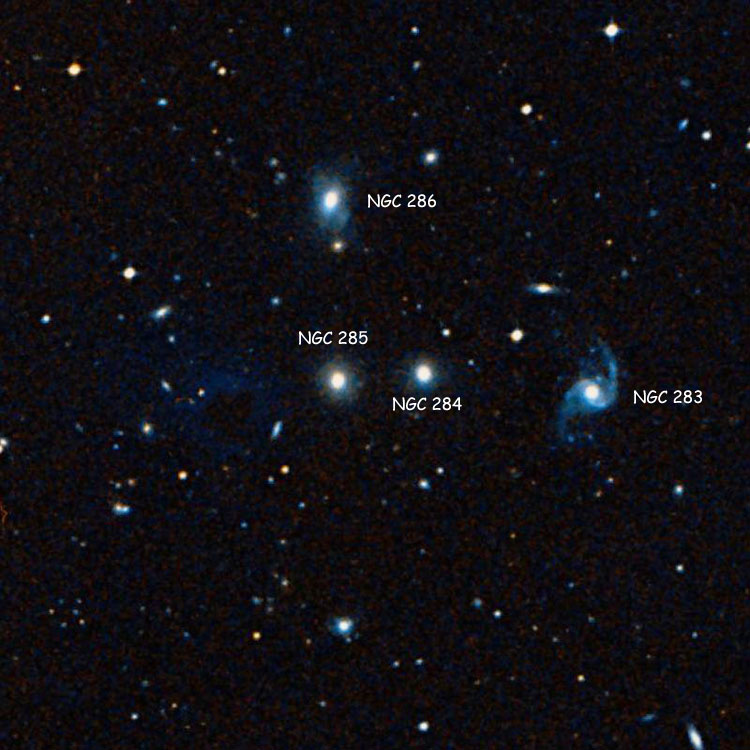
Above, a 12 arcmin wide region centered on NGC 285 and NGC 284, also showing NGC 283 and 286
Below, a 1 arcmin wide PanSTARRS image of NGC 285
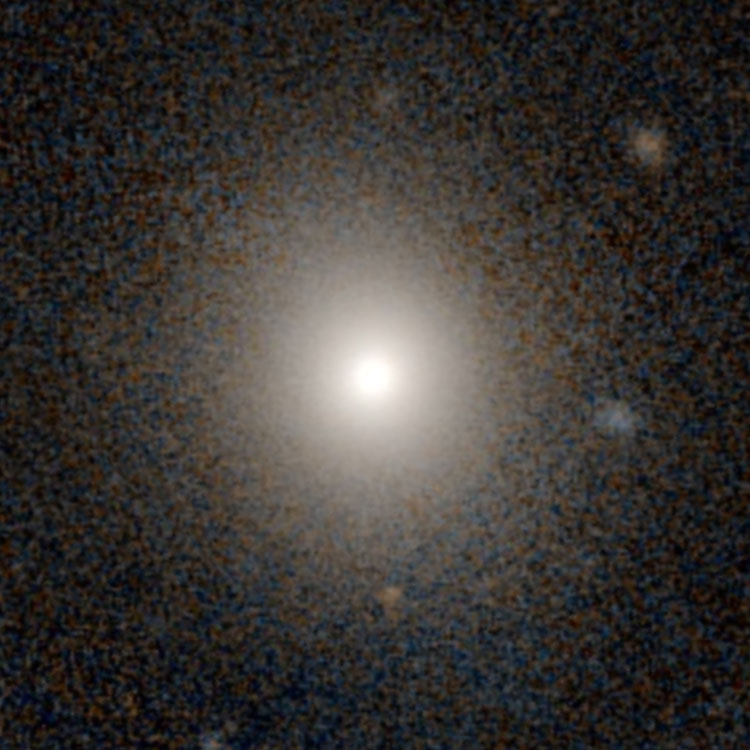
Below, a 6 arcmin wide region showing NGC 283, 284, 285 and 286
NGC 286
(= PGC 3142 = MCG -02-03-034)
Discovered (Oct 2, 1886) by Francis Leavenworth
Also observed (date?) by Herbert Howe
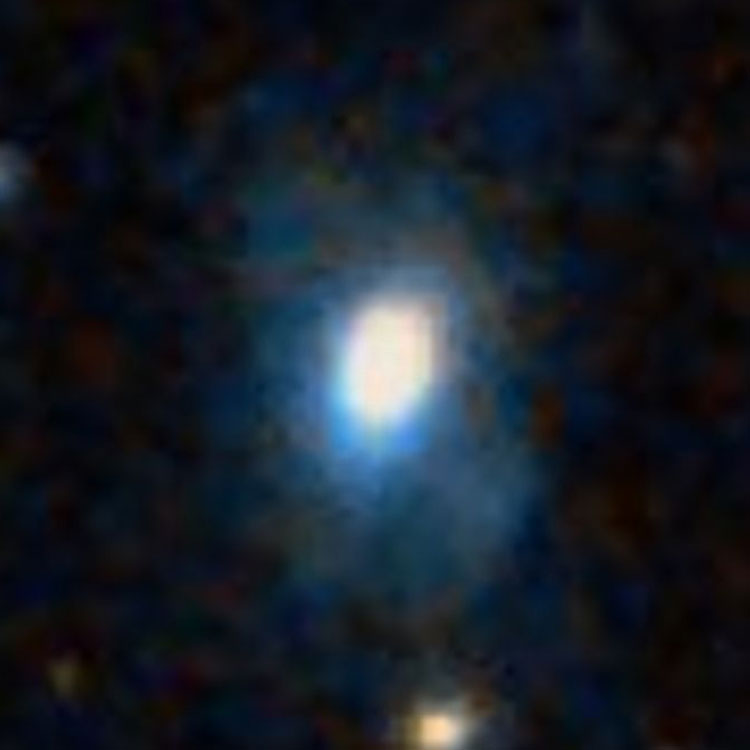
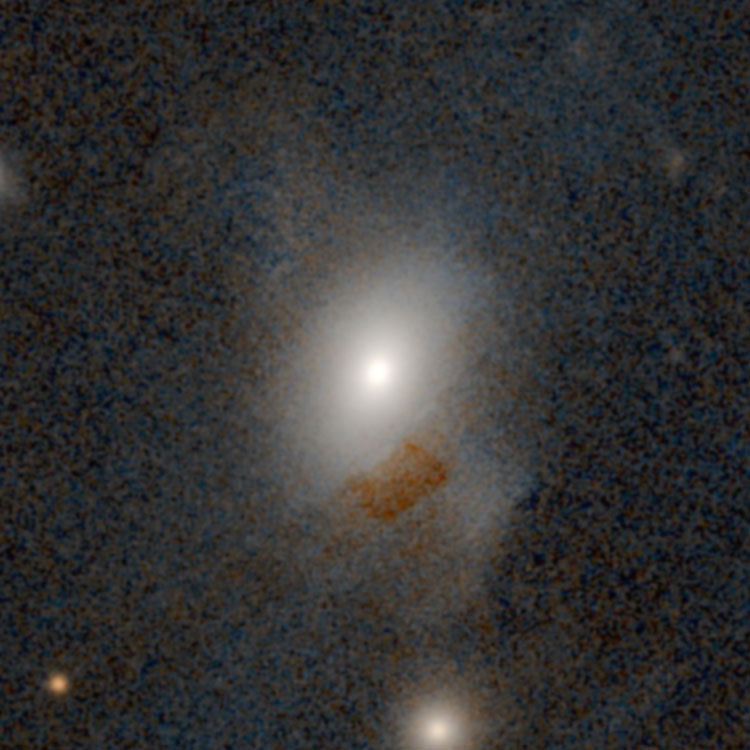
A magnitude 14.1 lenticular galaxy (type SB0/a? pec) in Cetus (RA 00 53 30.4, Dec -13 06 46)
Historical Identification: Per Dreyer, NGC 286 (Leavenworth list I (#17), 1860 RA 00 45 30, NPD 103 55.8) is "extremely faint, small, round, 4th of 4," the others being NGC 283, 284 and 285, all of which have identical positions and descriptions in the original NGC. The second Index Catalog lists a corrected position (per Howe) of RA 00 46 31, NPD 103 52.4. That precesses to RA 00 53 31.5, Dec -13 06 44, right on the galaxy listed above, so the identification is certain.
Physical Information: Apparent size of about 0.95 by 0.55 arcmin for the outer regions and about 0.6 by 0.4 arcmin for the central galaxy (from the images below)
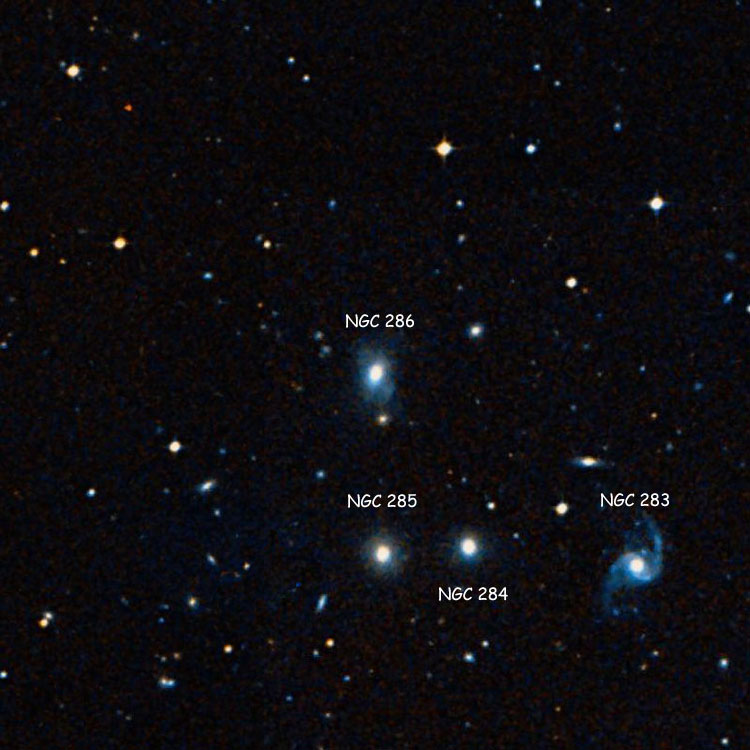
Above, a 12 arcmin wide region centered on NGC 286, also showing NGC 283, 284 and 285
Below, a 1.5 arcmin wide DSS image of NGC 286
Below, a 1.5 arcmin wide PanSTARRS image of NGC 286; unfortunately, the outer regions aren't shown very well
Below, a 6 arcmin wide region showing NGC 283, 284, 285 and 286
NGC 287
(= PGC 3145 = CGCG 501-033)
Discovered (Nov 22, 1827) by John Herschel
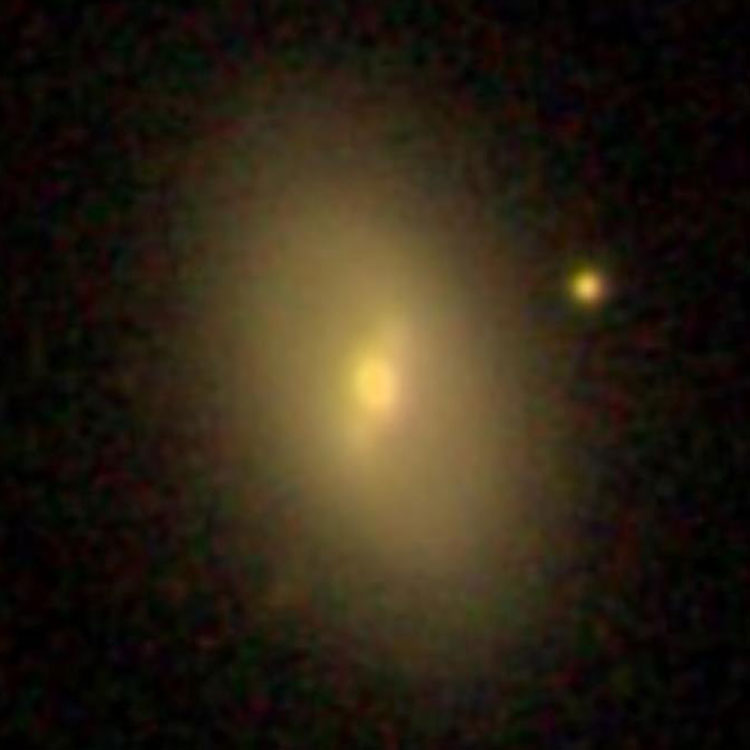
A magnitude 14.0 lenticular galaxy (type SB0/a? pec) in Pisces (RA 00 53 28.3, Dec +32 28 57)
Historical Identification: Per Dreyer, NGC 287 (= GC 161 = JH 75, 1860 RA 00 45 52, NPD 58 17.0) is "extremely faint, small, round (perhaps RA (00) 46 52?)," the query suggesting that the right ascension might have been off by a minute of time.
Physical Information: Apparent size of about 0.85 by 0.55 arcmin (from image below)

Above, a 12 arcmin wide SDSS image centered on NGC 287
Below, a 1 arcmin wide SDSS image of the galaxy
NGC 288
(= GCL 2 = ESO 474-SC037 = PGC 2802614)
Discovered (Oct 27, 1785) by William Herschel
Also observed (Nov 14, 1835) by John Herschel
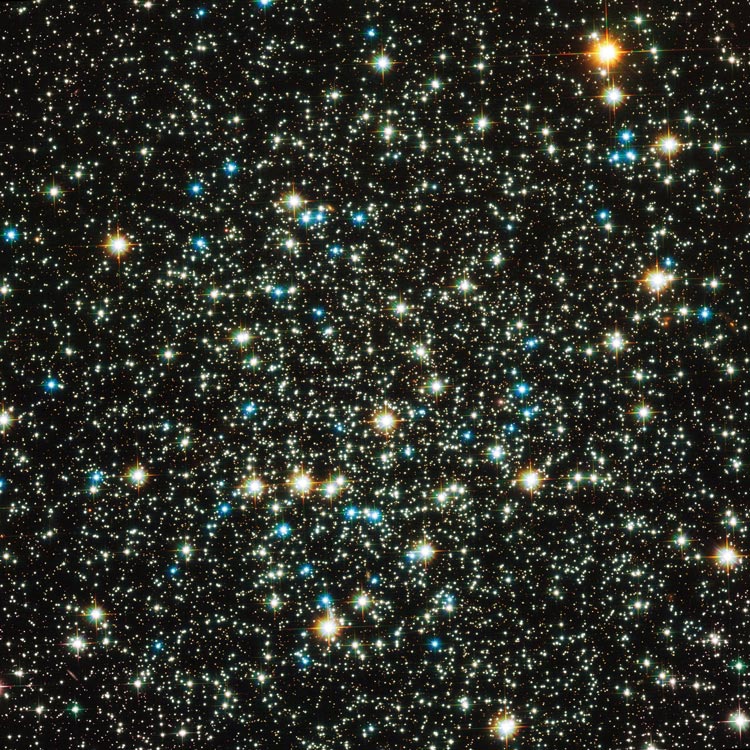
A magnitude 8.2 globular cluster (type X) in Sculptor (RA 00 52 45.2, Dec -26 34 57)
Corwin lists the position of the core of the cluster at RA 00 52 45.2, Dec -26 35 03
Historical Identification: Per Dreyer, NGC 288 (= GC 162 = JH 74 = JH 2354 = WH VI 20, 1860 RA 00 45 52, NPD 117 20.7) is "a globular cluster, bright, large, a little extended, stars from 12th to 16th magnitude". The position precesses to RA 00 52 42.0, Dec -26 35 00, slightly west of the center of the cluster, but well within its boundary, the description fits and there is nothing else nearby, so the identification is certain.
Note About PGC Designation: As for most NGC objects, HyperLEDA assigns a PGC designation to almost all NGC/IC objects, regardless of their nature; but unlike most such cases, a search of the database for PGC 2802614 does return a result.
Physical Information: Like a number of other globular clusters, NGC 288 has an orbit that takes it from well outside the central bulge of our galaxy, to a distance (roughly 3300 light-years) well inside that bulge (as a result, the orientation of its orbit changes at every passage). As a result of gravitational interactions with the stars in the core of our galaxy, NGC 288 has probably lost a substantial fraction of its stars over the roughly 11 billion years since its formation, which is probably why its stars are loosely scattered in comparison to other globular clusters (whence "type X"), though they are still far more densely packed than in open clusters or regions like the one the Sun is in. At a distance from us of just over 30,000 light-years (give or take a thousand light-years), the cluster's apparent size of about 14 to 15 arcmin corresponds to about 130 light-years.

Above, a 24 arcmin wide DSS image centered on NGC 288
Below, a 3.1 arcmin wide HST image of the core of the cluster (Image Credit ESA/Hubble & NASA)
NGC 289
(= PGC 3089 = ESO 411-025 = MCG -05-03-010)
Discovered (Sep 27, 1834) by John Herschel
A magnitude 11.0 spiral galaxy (type SB(rs)bc) in Sculptor (RA 00 52 42.3, Dec -31 12 21)
Historical Identification: Per Dreyer, NGC 289 (= GC 163 = JH 2355, 1860 RA 00 45 58, NPD 121 57.9) is "very bright, large, pretty much extended, gradually brighter middle, 11th magnitude star to northwest".
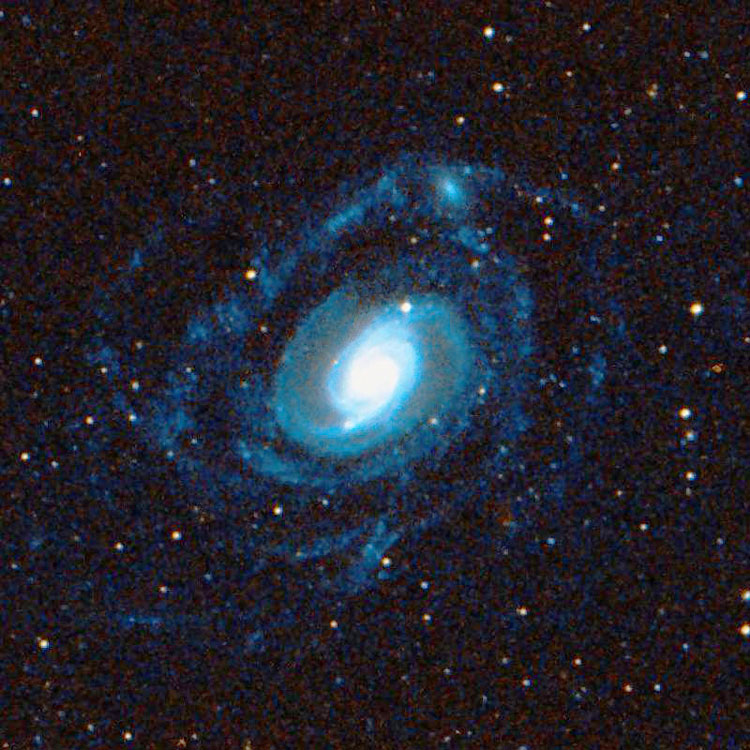
Physical Information: The brighter portion of NGC 289 appears to be a more or less normal spiral galaxy about 3.4 by 2.8 arcmin across; but its wispy outer arms extend across a roughly 9.6 by 8.4 arcmin wide region. A faint elliptically shaped area on one of the northern arms may be a large star-forming region, or an elliptical companion whose interaction with the larger galaxy is responsible for its appearance.
Use By The de Vaucouleurs Atlas: NGC 289 is used by the de Vaucouleurs Atlas of Galaxies as an example of galaxy type SB(r s)bc.
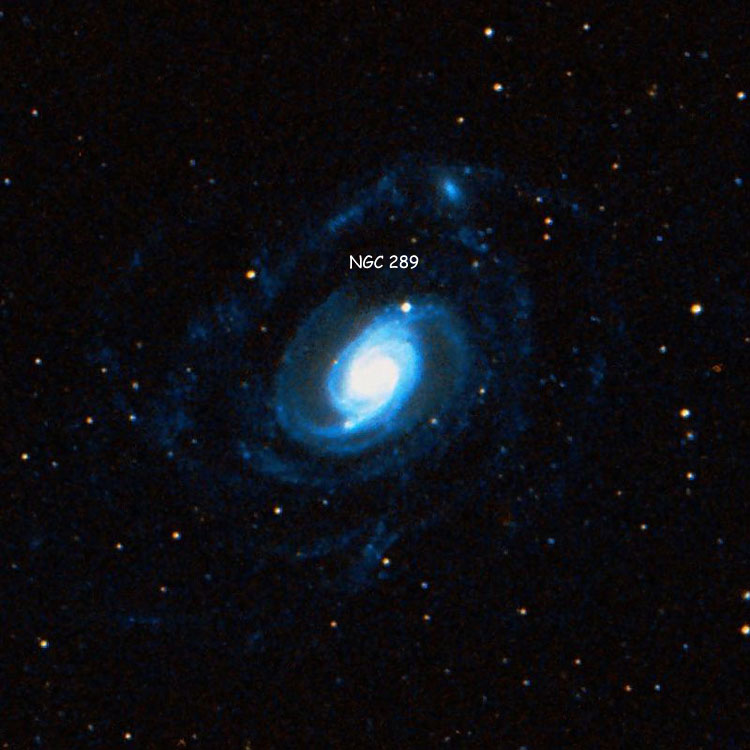
Above, a 12 arcmin wide DSS image centered on NGC 289
Below, an enhanced version of the same image, showing the extended outer arms
Below, a ? arcmin wide HST image of the galaxy's central regions (Image Credit Hubble Legacy Archive)

(Many other images available, of both core and outer regions)
PGC 708504
Not an NGC object but listed here as a probable companion of NGC 289
A magnitude 17(?) lenticular galaxy (type SB(s)0/a?) in Sculptor (RA 00 52 36.6, Dec -31 09 21)
Physical Information: Possibly slightly in front of NGC 289, but certainly interacting with NGC 289 and probably distorted by that interaction.
LEDA "galaxy", B 17.7, I 14.4 -> V 17(?); NED SB(s)00, 3K Vr 1248 km/sec
NGC 290, in the Small Magellanic Cloud
(= "PGC 3517846" = ESO 029-SC019)
Discovered (Sep 5, 1826) by James Dunlop (5)
Discovered (Apr 11, 1834) by John Herschel
A magnitude 12.0 open cluster in Tucana (RA 00 51 14.7, Dec -73 09 40)
Historical Identification: Per Dreyer, NGC 290 (= GC 164 = JH 2357, 1860 RA 00 46 17, NPD 163 54.8) is "extremely faint".
Note About PGC Designation: As in the case of most NGC objects, HyperLEDA assigned a PGC designation to this object, even though it isn't a galaxy; however, a search of the database for that designation returns no result, so it is shown in quotes.
Physical Information: Apparent size of about 0.8 by 0.8 arcmin. About two hundred thousand light-years distant, in the Small Magellanic Cloud, are the 12th magnitude open clusters NGC 265 and NGC 290. Each cluster spans about 65 light-years, and contains hundreds or thousands of brilliant young stars. Most of the stars in the HST image are not cluster members, but lie in front of (in our own galaxy or the Small Magellanic Cloud) or behind (in the Small Magellanic Cloud) the clusters. Listed in LEDA as PGC 3517846, but a search of the database for that designation does not return a result. (The use of PGC numbers beyond the 70-some thousand objects in the original PGC is "deprecated", meaning discouraged; but I plan to leave them out of entry titles only when a search of the LEDA database fails to return an entry.)

Above, a 12 arcmin wide DSS image centered on NGC 290
Below, a 1.2 arcmin wide DSS image of the open cluster
Below, a 68 arcsec wide image of the cluster (Image Credit E. Olszewski (U. Arizona), HST, ESA, NASA, HubbleSite)

NGC 291
(= PGC 3140 = PGC 4126745 = MCG-02-03-035)
Discovered (Sep 27, 1864) by Albert Marth
A magnitude 13.9 spiral galaxy (type (R)SB(r)a?) in Cetus (RA 00 53 29.9, Dec -08 46 04)
Historical Identification: Per Dreyer, NGC 291 (= GC 5121, Marth #17, 1860 RA 00 46 27, NPD 99 32) is "very faint, very small, a little extended, almost stellar".
Physical Information: Apparent size of about 0.9 by 0.5 arcmin (from image below) A Seyfert galaxy (type Sy 2).
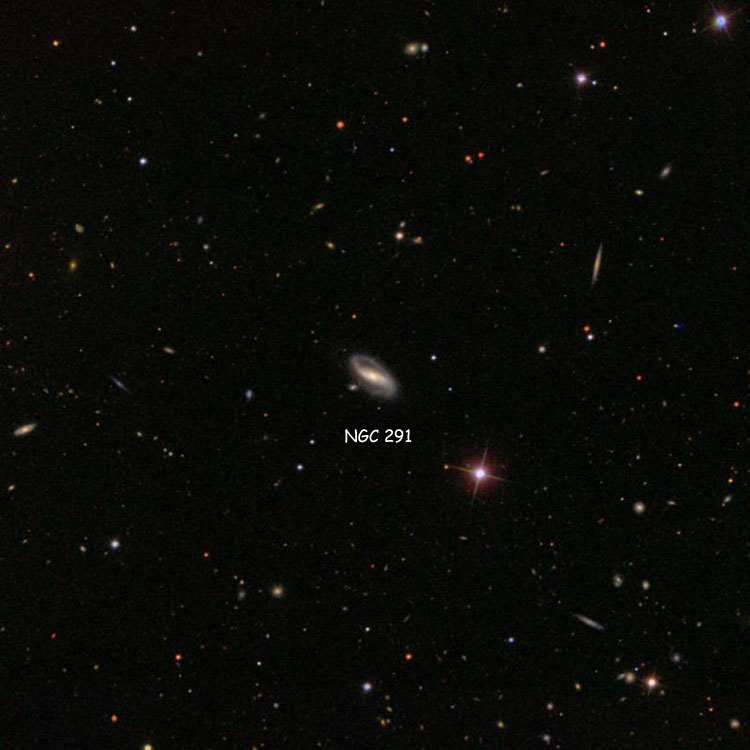
Above, a 12 arcmin wide SDSS image centered on NGC 291
Below, a 1 arcmin wide SDSS image of the galaxy

NGC 292, the Small Magellanic Cloud
(= PGC 3085 = ESO 029-021)
A naked-eye object, so undoubtedly seen by many observers over the ages
First recorded (1501) by Amerigo Vespucci
Also observed (1521) by Ferdinand Magellan
Also observed (Aug 12, 1834) by John Herschel
A magnitude 2.3 spiral galaxy (type SB(s)m pec) in Tucana (RA 00 52 38.0, Dec -72 48 00)
Historical Identification: Per Dreyer, NGC 292 (= GC 165 = JH 2356, 1860 RA 00 46 34, NPD 164 06.6) is "a cluster, faint, most extremely large, round, stars from 12th to 18th magnitude".
Physical Information: The Small Magellanic Cloud is a satellite or companion of our Milky Way Galaxy. Its recessional velocity of 158 km/sec is too small, in comparison to normal peculiar velocities (non-Hubble-redshift motions) to provide a reasonable estimate of distance. Redshift-independent distance estimates range from 160 to 250 thousand light-years distance. At that distance, the SMC's apparent size of 315 by 235 arcmins implies a diameter of 18 thousand light-years.

Above, a 4 degree wide DSS image of NGC 292, the Small Magellanic Cloud
Below, a 3.5 degree wide DSS image using the HST color palette
(Image Credit ESA/Hubble and DSS 2. Acknowledgements Davide De Martin (ESA/Hubble)

Below, a ground-based near infrared view of the galaxy
(Image Credit F. Winkler/Middlebury College, MCELS Team, NOAO/AURA/NSF)

Below, a space-based far infrared image (Image Credit NASA/JPL-Caltech/UCLA/WISE)

NGC 293
(= PGC 3195 = MCG -01-03-030)
Discovered (Sep 27, 1864) by Albert Marth
A magnitude 14.2 spiral galaxy (type (R')SB(rs)b) in Cetus (RA 00 54 16.0, Dec -07 14 07)
Historical Identification: Per Dreyer, NGC 293 (= GC 5122, Marth #18, 1860 RA 00 47 11, NPD 98 00) is "very faint, small".
Physical Information: Apparent size of about 1.3 by 1.1 arcmin (per image below)
NED (R')SB(rs)b, 3K Vr 5415 km/sec
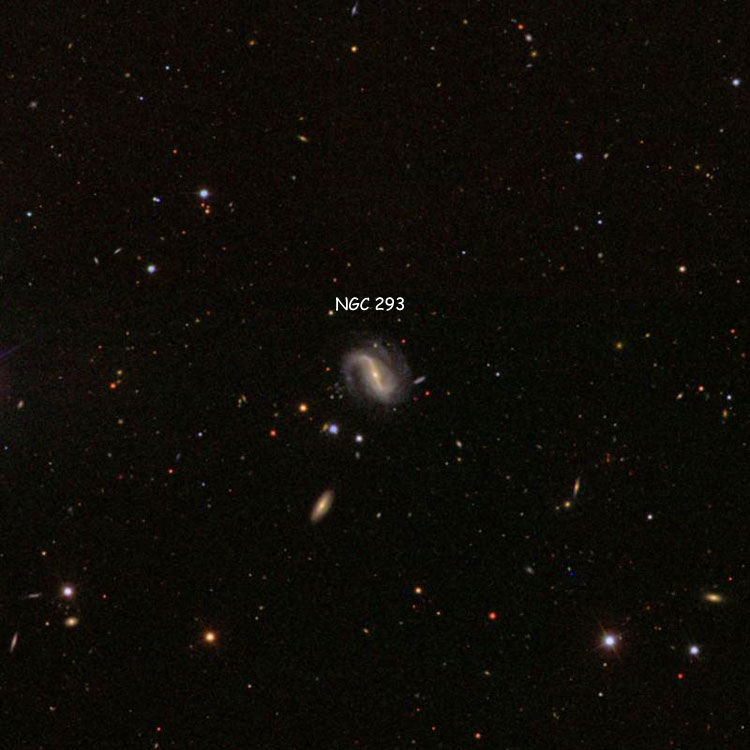
Above, a 12 arcmin wide SDSS image centered on NGC 293
Below, a 1.6 arcmin wide SDSS image of the galaxy

PGC 173140
Not an NGC object but listed here as an apparent companion of NGC 293
A magnitude 16(?) spiral galaxy (type Sab?) in Cetus (RA 00 54 19.4, Dec -07 16 13)
Physical Information:
LEDA Sab, B 16.7, I 14.6 -> V 16(?); NED RIDE1 223 Mpc, 3K Vr 15233 km/sec, z 0.0508122432988, so a very distant background galaxy
NGC 294, in the Small Magellanic Cloud
(= "PGC 3517847" = ESO 029-SC022)
Possibly observed (Sep 5, 1826) by James Dunlop
Discovered (Apr 11, 1834) by John Herschel
A magnitude 12.7 open cluster in Tucana (RA 00 53 05.6, Dec -73 22 48)
Historical Identification: Per Dreyer, NGC 294 (= GC 166 = JH 2358, Dunlop 5, 6?, 1860 RA 00 47 15, NPD 164 08.5) is "very faint, pretty large, round, very gradually a little brighter middle, mottled but not resolved".
Discovery Notes: Although Herschel thought this might correspond to Dunlop's #5 and 6, current thinking is that it only corresponds to Dunlop #6.
Note About PGC Designation: As in the case of most NGC objects, HyperLEDA assigned a PGC designation to this object, even though it isn't a galaxy; however, a search of the database for that designation returns no result, so it is shown in quotes.
Physical Information: Apparent size 0.8 arcmin??

Above, a 12 arcmin wide DSS image centered on NGC 294
Below, a 2.4 arcmin wide DSS image of the region near the cluster
MOST OF HISTORICAL ENTRY NEEDS REPLACING; ID/PHYSICAL INFO NOW AOK
NGC 295 (not = NGC 296)
(= PGC 3555 = CGCG 501-056)
Discovered (Oct 26, 1872) by Ralph Copeland
A magnitude 14.2 spiral galaxy (type Sbc?) in Pisces (RA 00 59 32.3, Dec +31 47 53)
Historical Identification: TBD
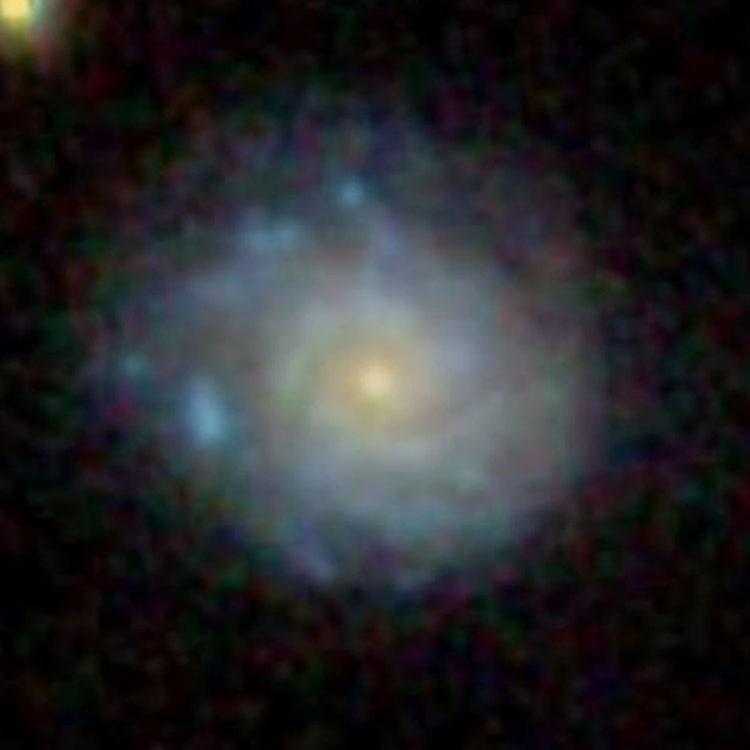
Physical Information: Based on a recessional velocity relative to the Cosmic Microwave Background radiation of 4315 km/sec (and H0 = 70 km/sec/Mpc), NGC 295 is about 200 million light-years away. Given that and its apparent size of about 0.55 by 0.5 arcmin (from the images below), the galaxy is about 30 to 35 thousand light-years across.
Below, a 12 arcmin wide SDSS image centered on the correct NGC 295, also showing PGC 3575
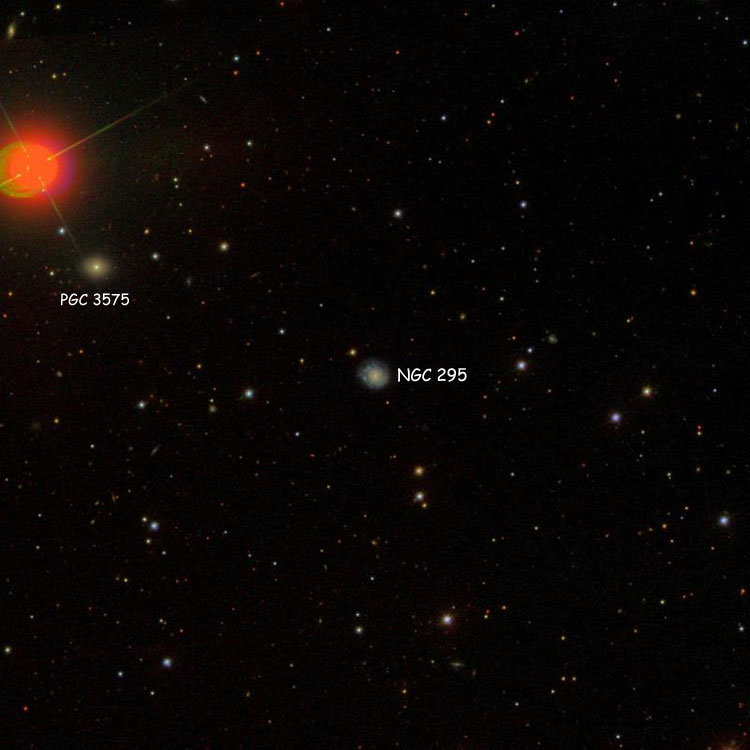
Below, a 0.75 arcmin wide SDSS image of the galaxy
OLDER MATERIAL TO BE MOSTLY REVISED OR REPLACED SHOWN BELOW
Historical Identification: Per Dreyer, NGC 295 (= GC 5123, Copeland using Lord Rosse's 72-inch reflector, 1860 RA 00 47 30, NPD 59 13.8) is "faint, small, round, star 10 arcsec north, II 214 to northeast", (WH) II 214 being NGC 296. The position precesses to RA 00 55 05.4, Dec +31 31 49, whence the position listed above, but there is nothing there, other than NGC 296 (which must be there, since Copeland measured the position relative to what he thought was that nebula). As a result, NGC 295 has long been (and still is, in some places) thought to be the galaxy that should be listed as NGC 296, and NGC 295 was thought to be lost, which is the exact opposite of the truth. Per Corwin, Copeland thought he was observing NGC 296 and another galaxy near it, but it is now clear that he must have been observing a different pair of galaxies, as his description (posted at the end of this entry) does not match anything in the field. THIS PARAGRAPH TO BE SUBSTANTILLY ALTERED: To date, no one has found out which galaxies, but Copeland's notes may enable a future search for suitable candidates. For the presumed but incorrect NGC 296 he wrote: "faint, round, 10th magnitude yellow star at position angle 29.6 degrees, 123.1 arcsec distant". For the "Nova" that became NGC 295 he wrote: "small, round, with a star or another nebula 10 arcsec north. Position angle from (the erroneous NGC 296) 242.0 degrees, 314.6 arcsec distant, or 21.6 seconds of time to the west and 147.6 arcsec south".
Since the above was written, Yann Pothier solved the problem. It turns out that the galaxy Copeland thought was NGC 296 was CGCG 501-058, which is about a degree away from NGC 296. Using that galaxy in place of Copeland's "296" all of Copeland's measurements and comments are easily verified, so there is no doubt that the galaxy listed in the title and description line is the actual NGC 295. However, until the warning at the start of this entry is replaced, almost everything else in the entry (including the images) are subject to removal or alteration.
 Above, a 12 arcmin wide view of spiral galaxy NGC 296 and Herschel and Copeland's positions for NGC 296 and 295 makes it appear that the galaxy should be Copeland's NGC 295, and not Herschel's NGC 296; and that was thought to be the case for a long time. But Copeland's description of the field does not match the galaxy, whereas Herschel's does; so it is now believed that the galaxy is NGC 296, and NGC 295 is lost or nonexistent.
PGC 3575
(= CGCG 501-058)
Not an NGC object but listed here because critical to identifying NGC 295
A magnitude 14.8 lenticular galaxy (type SA0) in Pisces (RA 00 59 53.3, Dec +31 49 37)
Historical Importance: As discussed in the entry for NGC 295, it was Yann Pothier's realization that what Ralph Copeland thought was NGC 296 was actually CGCG 501-058 that led to the correct identification of NGC 295
Physical Information:
LEDA S0, Sy1, V 14.8; NED SA0, Sy1, 3K Vr 4152 km/sec
For now, see the image at the beginning of the entry for NGC 295
NGC 296
(= PGC 3260 = UGC 562 = CGCG 501-042 = MCG +05-03-024)
Discovered (Sep 12, 1784) by William Herschel
A magnitude 12.6 spiral galaxy (type SBb?) in Pisces (RA 00 55 07.5, Dec +31 32 32)
Historical Identification: Per Dreyer, NGC 296 (= GC 167 = WH II 214, 1860 RA 00 47 52, NPD 59 11.3) is "faint, a little extended, 10th magnitude star 2 arcmin to northeast". The position precesses to RA 00 55 27.6, Dec +31 34 38, about 20s of time east-northeast of the correct position. That is close enough to the galaxy that it might have been easily identified as NGC 296 save for one thing, namely the 10th magnitude star supposedly 2 acrmin to the northeast, which does not match the galaxy at all. Per Corwin, the problem is the entry for Copeland's NGC 295 (which see for more about the confounding of these entries), whose incorrect position is considerably closer to the correct NGC 296 than Herschel's position, leading to the presumption that NGC 295 was the galaxy now identified as NGC 296, and Herschel's object was lost or nonexistent. This incorrect identification was partly caused by Dreyer's description of NGC 296, which is not that of either William or John Herschel, but an amalgamation of their descriptions and the one for NGC 295 by Copeland (which as just noted was presumed to be this galaxy). The two Herschels' descriptions, though slightly different, agree that WH II 214 is "faint, extended, with a bright star to the east (and very near)". That is a perfect description of PGC 3260, and despite the error in Herschel's position, makes it certain that NGC 296 is the galaxy formerly identified as NGC 295.
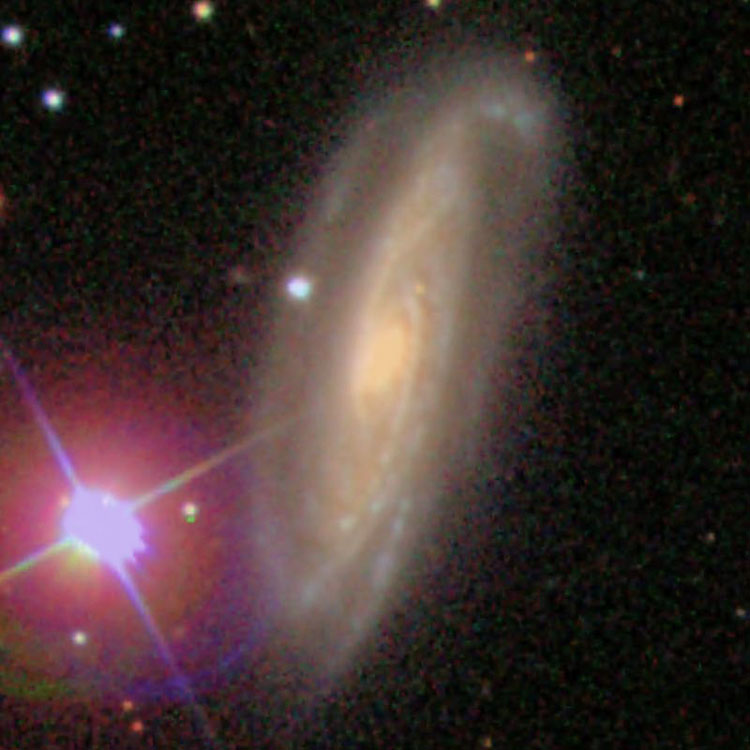
Physical Information: Apparent size of about 2.35 by 0.9 arcmin (from image below)
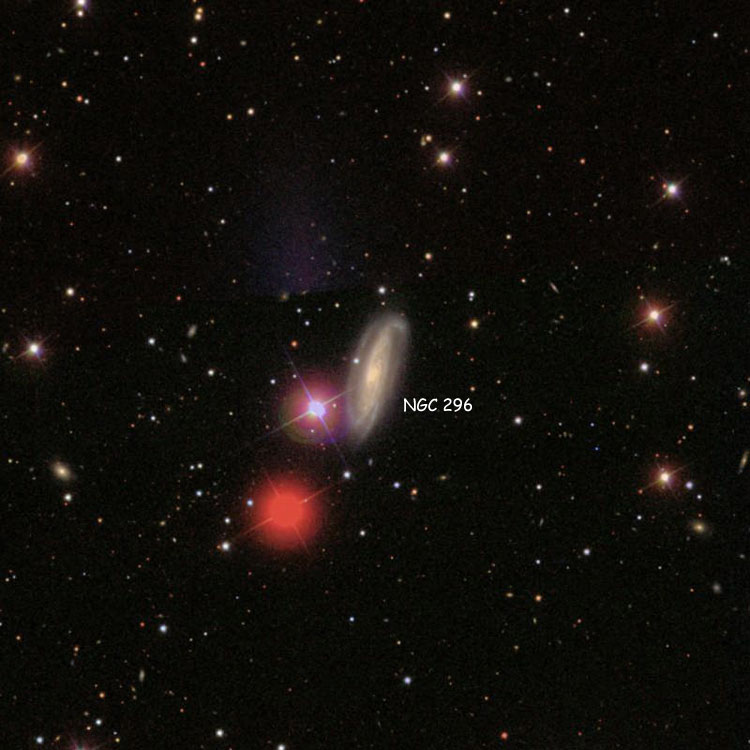
Above, a 12 arcmin wide SDSS image centered on NGC 296 (formerly misidentified as NGC 295)
Below, a 2.4 arcmin wide SDSS image of the galaxy
NGC 297
(= PGC 3243 = PGC 1020464)
Discovered (Sep 27, 1864) by Albert Marth
A magnitude 15.5 elliptical galaxy (type E2? pec?) in Cetus (RA 00 54 58.9, Dec -07 20 59)
Historical Identification: Per Dreyer, NGC 297 (= GC 5124, Marth #19, 1860 RA 00 47 56, NPD 98 07) is "extremely faint".
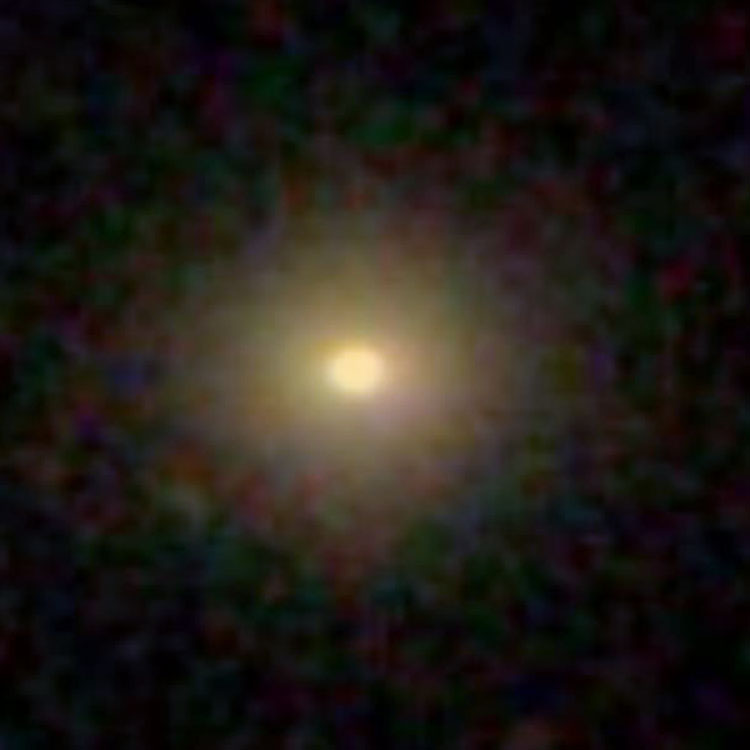
Physical Information: Apparent size of about 0.3 by 0.25 arcmin (from image below)
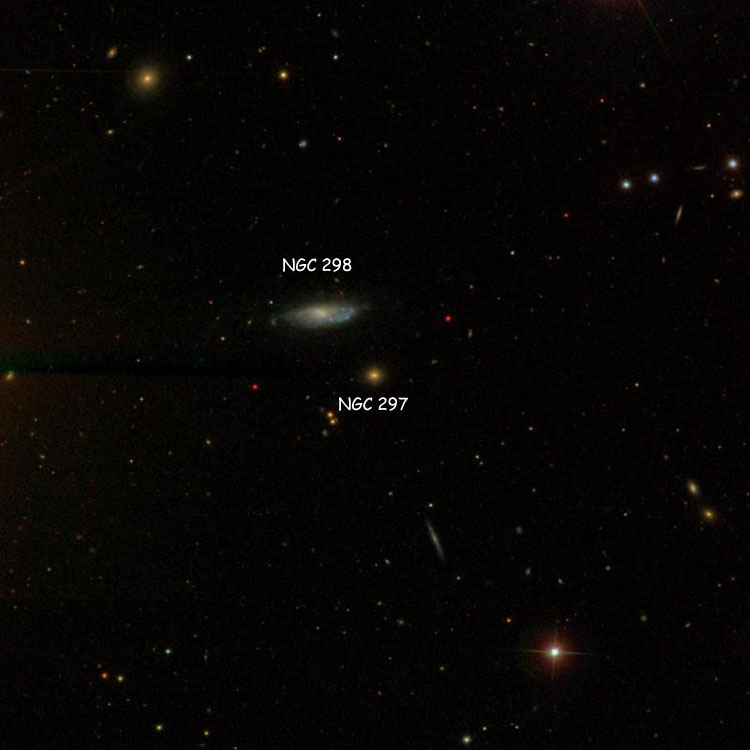
Above, a 12 arcmin wide SDSS image centered on NGC 297, also showing NGC 298
Below, a 0.6 arcmin wide SDSS image of the galaxy
NGC 298
(= PGC 3250 = PGC 1020721 = MCG -01-03-033)
Discovered (Sep 27, 1864) by Albert Marth
A magnitude 13.8 spiral galaxy (type Scd?) in Cetus (RA 00 55 02.3, Dec -07 19 59)
Historical Identification: Per Dreyer, NGC 298 (= GC 5125, Marth #20, 1860 RA 00 47 58, NPD 98 06) is "pretty faint".
Physical Information: Apparent size of about 1.6 by 0.5 arcmin (from image below)
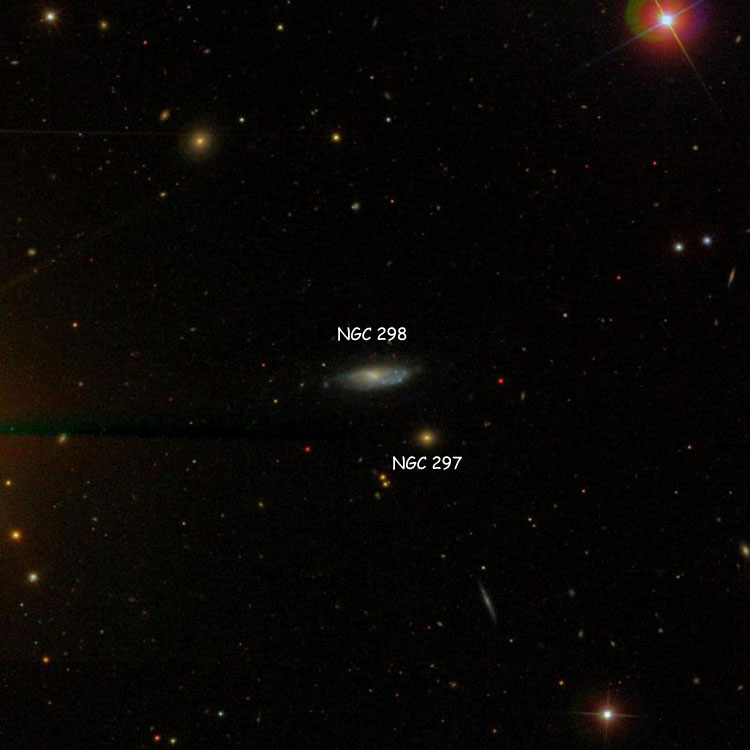
Above, a 12 arcmin wide region centered on NGC 298, also showing NGC 297
Below, a 1.7 arcmin wide SDSS image of the galaxy

NGC 299, in the Small Magellanic Cloud
(= "PGC 3517848" = ESO 051-SC005)
Discovered (Sep 5, 1826) by James Dunlop
Discovered (Aug 12, 1834) by John Herschel
A magnitude 11 open cluster in Tucana (RA 00 53 24.7, Dec -72 11 48)
Historical Identification: Per Dreyer, NGC 299 (= GC 168 = JH 2360, (Dunlop 51), 1860 RA 00 48 23, NPD 162 57.4) is "pretty bright, very small, round, gradually a very little brighter middle, mottled but not resolved" (Dreyer's entry contains a typographical error, substituting "R" for "M" in "brighter middle").
Discovery Notes: Although neither Herschel nor Dreyer was aware of the possibility, it is now thought that Dunlop #51 refers to this object, hence its inclusion in parentheses in the NGC entry.
Note About PGC Designation: As in the case of most NGC objects, HyperLEDA assigned a PGC designation to this object, even though it isn't a galaxy; however, a search of the database for that designation returns no result, so it is shown in quotes.
Physical Information: Apparent size about 0.7 by 0.7 arcmin (from LEDA).

Below, a 12 arcmin wide DSS image centered on NGC 299, also showing NGC 306
Below, a 2 arcmin wide DSS image of the cluster

Below, a 1.1 arcmin wide HST image of the cluster (Image Credit ESA/Hubble/NASA)

|