QuickLinks:
300, 301, 302, 303, 304, 305, 306, 307, 308, 309, 310, 311, 312, 313, 314, 315, 316,
317, 318, 319, 320, 321, 322, 323, 324, 325, 326, 327, 328, 329, 330, 331, 332, 333,
334, 335, 336, 337, 338, 339, 340, 341, 342, 343, 344, 345, 346, 347, 348, 349
Page last updated Aug 23, 2023 (Added Caldwell ID for NGC 300)
Page last updated Feb 3, 2022
Working 323: Doing final check of positions
(All previous updates may need to be rechecked)
Updated designations per Steinicke (later, check w/LEDA, NED, Gottlieb)
Check basic galaxy types, partially update formatting, update UGC pages
Updated images, formatting (to more or less current standard)
WORKING 333: IDs (Corwin+)
NGC 300
(= C70 = PGC 3238 = ESO 295-020 = MCG -06-03-005)
Discovered (Aug 5, 1826) by James Dunlop
Also observed (Sep 1, 1834) by John Herschel
A magnitude 8.1 spiral galaxy (type SA(s)d) in Sculptor (RA 00 54 53.4, Dec -37 41 03)
Historical Identification: Per Dreyer, NGC 300 (= GC 169 = JH 2359, (Dunlop 530), 1860 RA 00 48 25, NPD 128 27.1) is "pretty bright, very large, very much irregularly extended, very gradually pretty much brighter middle".
Discovery Notes: Herschel did not connect this object to any of Dunlop's observations, so Dreyer had no reason to consider that possibility; but it is now thought to correspond to Dunlop 530, hence the addition of that observation to the NGC entry in parentheses.
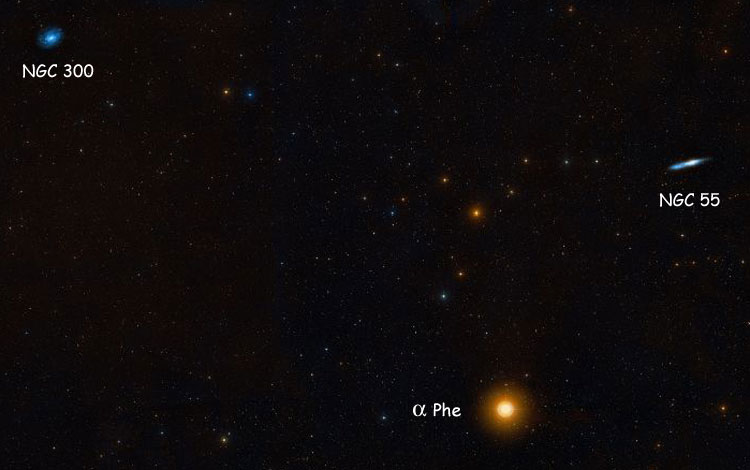
Physical Information: NGC 300 is the brightest of the five larger spiral galaxies in the direction of the Sculptor Group of galaxies. NGC 55 and NGC 300 are only a million or so light-years apart, and are thought be a gravitationally bound pair (the bottom image shows their relative positions). Until recently, they were considered members of the Sculptor group of galaxies, but are now known to be foreground galaxies. The 145 km/sec recessional velocity of NGC 300 is too small to be a reliable distance indicator, and redshift-independent distance estimates range from 4 to 9 million light-years, with 7 or so million light-years being the most accepted guesstimate. Given that, its apparent size of about 22.5 by 16.5 arcmin (from the images below) corresponds to about 45 thousand light-years. It is a relatively diffuse spiral with a poorly defined core, much like M33, in Triangulum. As such, it is an absolutely perfect example of its type. The image immediately below shows the galaxy as it would appear if our eyes were hundreds of times more sensitive to light and color than they are. In that sense, it is a "realistic" image, even though giving a false impression of the actual appearance of the galaxy as it would be seen by the eye, even through a telescope. Used by the de Vaucouleurs Atlas of Galaxies as an example of galaxy type SA(s)d.
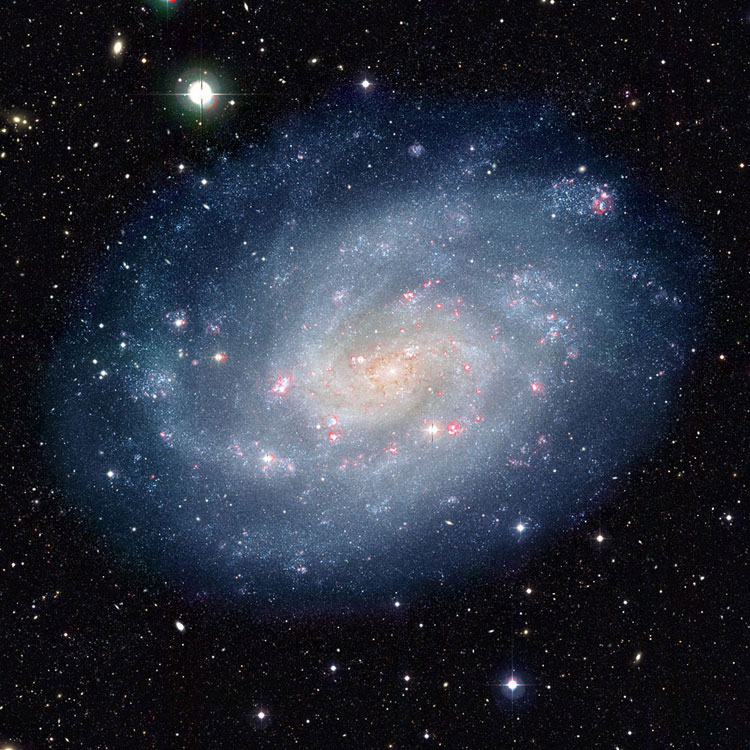
Above, a 25 arcmin wide visible light image of NGC 300 (Image Credit ESO)
Below, an image of NGC 300 viewed through an Hα filter, so that gaseous regions heated by hot young stars or shock waves from stellar explosions stand out, while the visible and ultraviolet radiation of those stars is blocked, making them fade into the background. The image is in black and white, which is the way that all professional astronomical images are actually taken. Colors are added when combining images taken at different wavelengths, to highlight different features. (Image Credit ESO)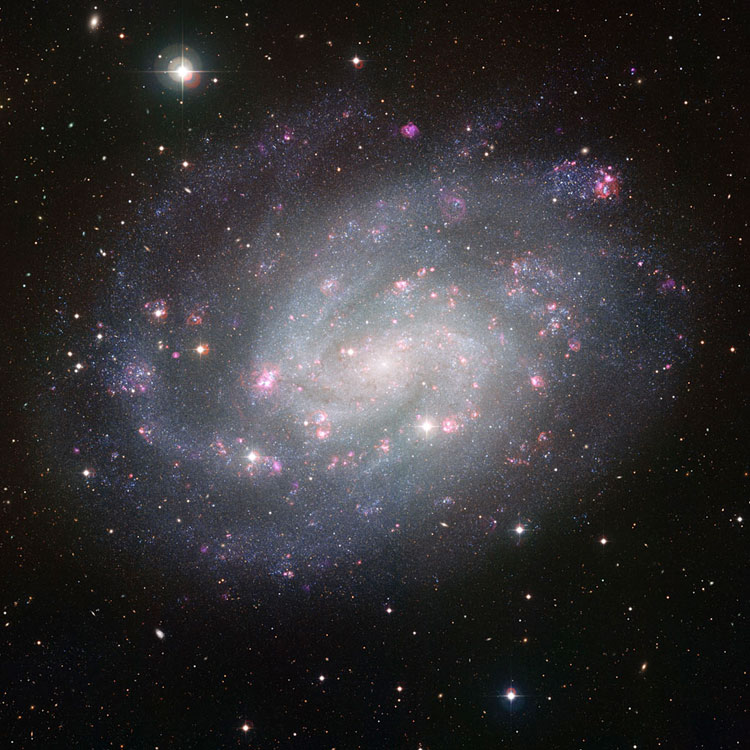
Below, a composite of visible light (colored red and yellow) images of NGC 300 and a far UV GALEX image (colored blue), which emphasizes various features by use of the false colors used for the images. The result is that young hot blue stars stand out in the regions where they recently formed, while gases heated by their ultraviolet radiation and shock waves from stellar explosions appear in pink, and older stars in the core look yellow-green. This reveals more structural information than a "realistic" color choice, but is a "false-color" image in every sense of the phrase. (Image Credit JPL-Caltech/OCIW/GALEX, NASA)
Below, an HST image of the core of NGC 300, in which millions of stars are individually imaged. Studying such images over a period of time should allow the discovery of hundreds of Cepheid variables, and provide a far more accurate estimate of the galaxy's distance than is currently available. (Image Credit Hubble Heritage Team (AURA / STScI), ESA, NASA)
Below, images of NGC 300 at upper left, the region imaged in detail (above) at upper right, and a small inset of the core at the bottom, to show just how detailed the HST image really is. (Image Credit NASA, ESA, and The Hubble Heritage Team (AURA/STScI), HubbleSite)
Below, a 9 degree wide DSS image of the region between NGC 300 and NGC 55
The bright star at the bottom is Ankaa, or α Phoenicis
NGC 301
(= PGC 3345)
Discovered (1886) by Frank Muller
A lost or nonexistent object in Cetus (precessed 1860 position) or perhaps
A magnitude 14.8 lenticular galaxy (type (R?)SB0(r)a?) in (RA 00 56 18.3, Dec -10 40 26)
Historical Identification: Per Dreyer, NGC 301 (Muller list I (#18), 1860 RA 00 48 30, NPD 101 25.8) is "extremely faint, small, irregularly round, gradually brighter middle, 8th magnitude star 30 seconds of time to west".
Physical Information: Apparent size of about 0.7 by 0.5 arcmin (from the images below).

Above, a 12 arcmin wide SDSS image centered on NGC 301, also showing the probable NGC 302
Below, a 0.9 arcmin wide SDSS image of the galaxy

NGC 302
Recorded (1886) by Frank Muller
A lost or nonexistent object in Cetus (at precessed 1860 position), or perhaps
A magnitude 16.1 star in (RA 00 56 25.3, Dec -10 39 48)
Historical Identification: Per Dreyer, NGC 302 (Muller list I (#19), 1860 RA 00 48 30, NPD 24.8) is "extremely faint, very small".
Given the NGC positions, NGC 302 must be one of the stars near NGC 301 (since there are no other galaxies in the region, as shown in the wide-field image of NGC 301). Various stars have been suggested at various times, but since the NGC is supposed to be about clusters and nebulae, the identification of a particular star that was mistaken for a nebula seems of less than earth-shaking importance; so the argument (per Corwin) that posits the one listed above as the correct one will be covered in the next iteration of this page.
NGC 303
(= PGC 3240)
Discovered (1886) by Francis Leavenworth
Also observed (date?) by Herbert Howe
A magnitude 14.3 spiral galaxy (type SBab? pec) in Cetus (RA 00 54 54.7, Dec -16 39 17)
Corwin lists the position of the northern "knot" as RA 00 54 54.4, Dec -16 39 12
and of the southern one as RA 00 54 55.0, Dec -16 39 28
Historical Identification: Per Dreyer, NGC 303 (Leavenworth list I (#20), 1860 RA 00 48 30, NPD 107 25.8) is "extremely faint, very small". The second Index Catalog lists a corrected 1860 RA (per Howe) of 00 47 57, and adds "extended 160 degrees". The corrected position precesses to RA 00 54 54.5, Dec -16 40 12, a little less than an arcmin south of the galaxy, and the description fits its appearance, so the identification is certain.
Physical Information: Apparent size of about 0.45 by 0.15 arcmin (from the images below). (Note: Listed as a contact pair of galaxies in some places, but the image and other references give no indication of that; however, the northwestern rim has a star-forming region that is as bright as the nucleus at some wavelengths, so it could be mistaken as binuclear in some images.)

Above, a 12 arcmin wide DSS image centered on NGC 303
Below, a 0.85 arcmin wide DSS image of the galaxy
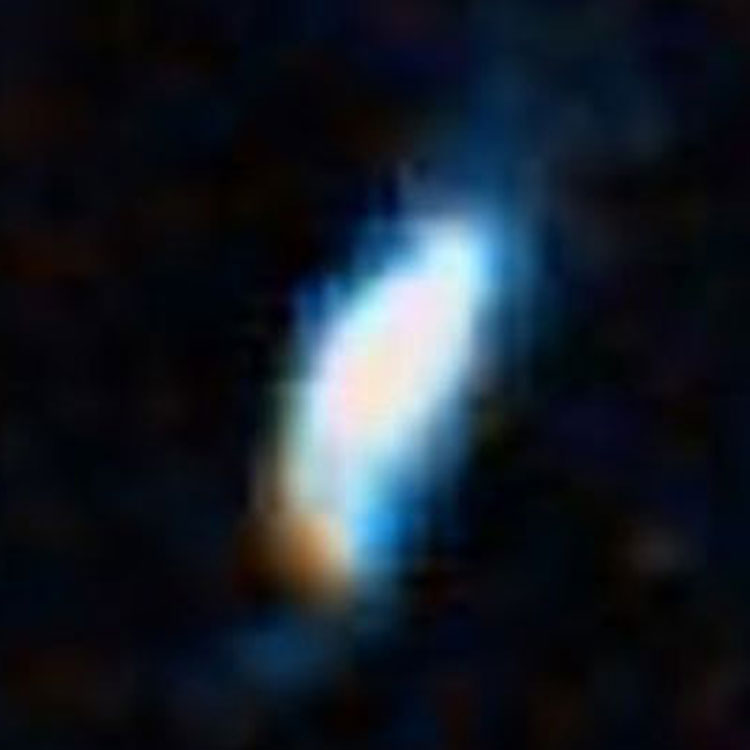
Below, a 0.85 arcmin tall pair of color and monochrome PanSTARRS images of the galaxy

NGC 304
(= PGC 3326 = UGC 573 = CGCG 480-023 = MCG +04-03-018)
Discovered (Oct 23, 1878) by Édouard Stephan
A magnitude 13.1 spiral galaxy (type Sa? pec) in Andromeda (RA 00 56 06.0, Dec +24 07 37)
Historical Identification: Per Dreyer, NGC 304 (Stephan list IX (#2), 1860 RA 00 48 39, NPD 66 37.8) is "pretty faint, small, round, suddenly a very little brighter middle".
Physical Information: Apparent size of about 1.05 by 0.65 arcmin (from the images below).

Above, a 12 arcmin wide SDSS image centered on NGC 304
Below, a 1.4 arcmin wide SDSS image of the galaxy
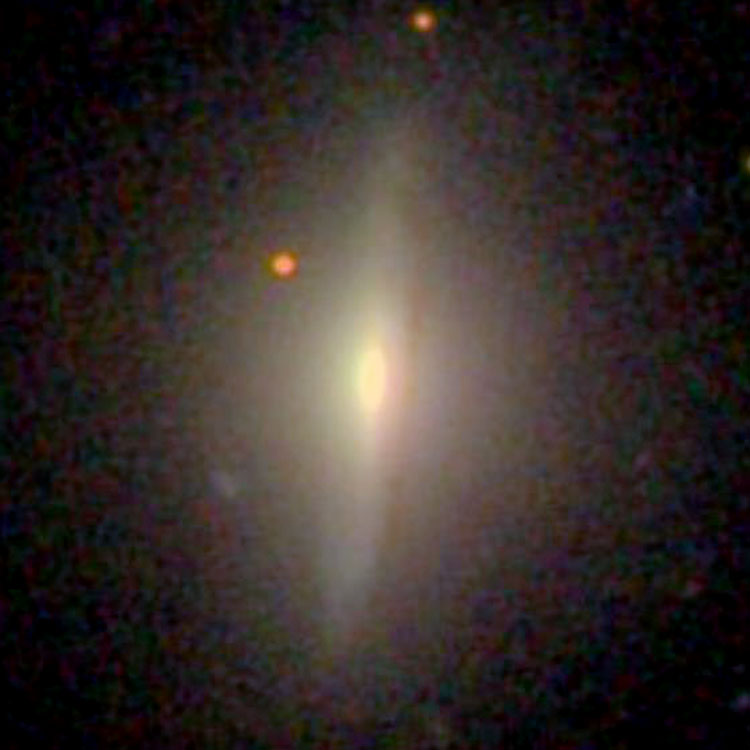
PGC 3302
(= CGCG 480-021 = MCG +04-03-017)
Not an NGC object but listed here as an apparent companion of NGC 304
A magnitude 15(?) lenticular galaxy (type S0/a?) in Andromeda (RA 00 55 48.9, Dec +24 08 51)
Physical Information: At least twice as far away as NGC 304, so only a background galaxy.
Classification Note: Although both HyperLEDA and NED list this as a spiral, its PanSTARRS image clearly shows that it is a lenticular galaxy.
LEDA Sab, B 15.4 -> V 15(?); NED Spiral, 15.4(band?), .6 x .25 arcmin, 3K Vr 10099 km/sec, z 0.03368627
NGC 305 (= PGC 3325922)
Discovered (Oct 17, 1825) by John Herschel
A group of stars in Pisces (00 56 19.4, Dec +12 04 19)
(The position is often given as that of the brightest star in the group, at RA 00 56 20.5, Dec +12 04 32)
Historical Identification: Per Dreyer, NGC 305 (= GC 170 = JH 76, 1860 RA 00 49 00, NPD 78 40.9) is "a cluster, small, scattered stars".
Physical Information: Half a dozen or so loosely scattered stars. (Per Corwin, the PGC listing is due to an error in an early version of the Revised NGC; but LEDA does indicate that the object is stellar.)
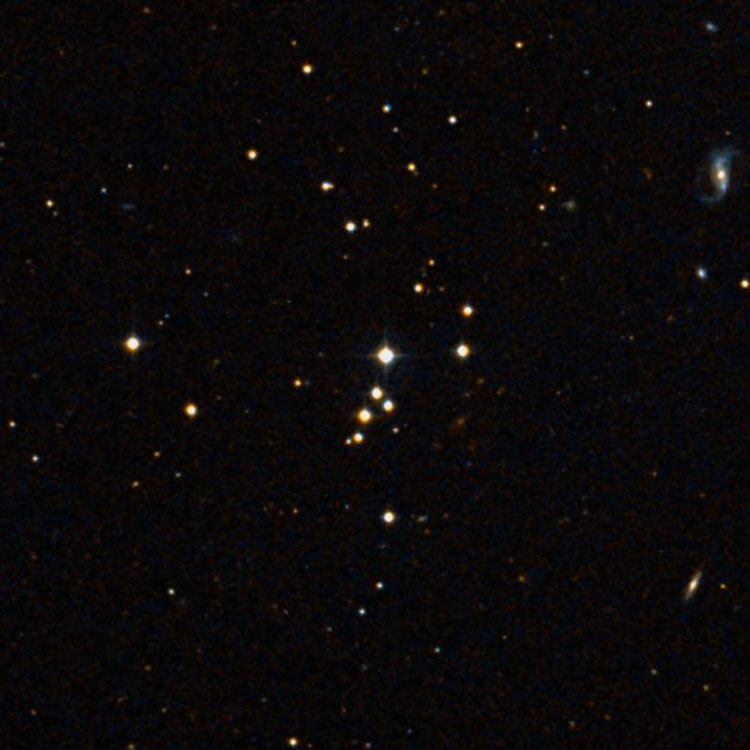
Above, a 12 arcmin wide DSS image centered on NGC 305
NGC 306, in the Small Magellanic Cloud
(= ESO 029-SC023)
Discovered (1826) by James Dunlop
Discovered (Oct 4, 1836) by John Herschel
A magnitude 12(?) open cluster in Tucana (RA 00 54 15.2, Dec -72 14 27)
Historical Identification: Per Dreyer, NGC 306 (= GC 171 = JH 2361, (Dunlop 52), 1860 RA 00 49 16, NPD 163 00 00) is "faint, very small".
Discovery Notes: Steinicke's latest historical database update lists Dunlop 52 as the first observation of this object, hence his credit for the discovery below the title, and the addition of Dunlop's name (albeit in parentheses) to Dreyer's NGC entry.
Physical Information: Apparent size 0.8 arcmin?
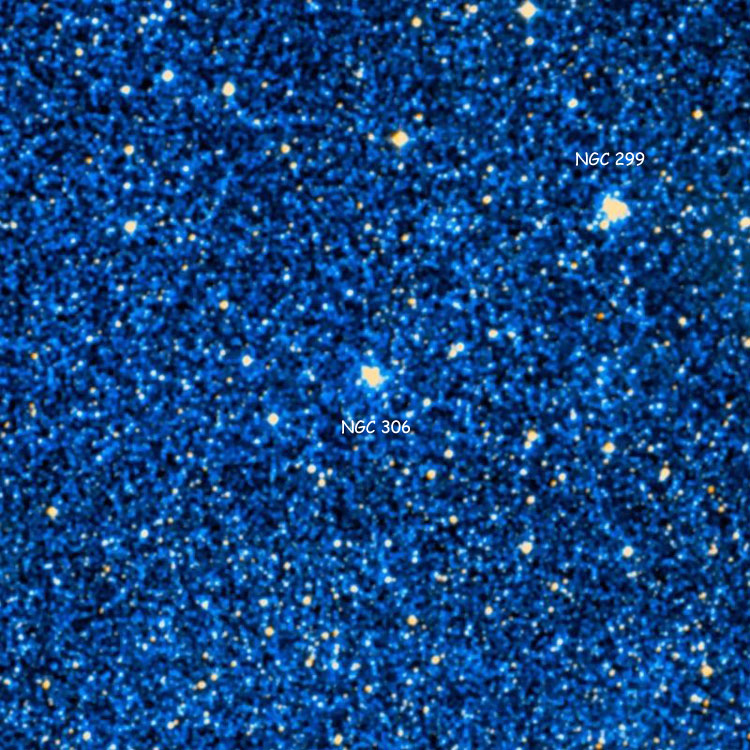
Above, a 12 arcmin wide DSS image centered on NGC 306, also showing NGC 299
Below, a 1.8 arcmin wide DSS image of the cluster

NGC 307
(= PGC 3367 = UGC 584 = CGCG 384-039 = MCG +00-03-035)
Discovered (Sep 6, 1831) by John Herschel
A magnitude 12.8 lenticular galaxy (type S0) in Cetus (RA 00 56 32.6, Dec -01 46 19)
Historical Identification: Per Dreyer, NGC 307 (= GC 172 = JH 77, 1860 RA 00 49 25, NPD 92 31.5) is "pretty faint, small, extended".
Physical Information: Vr = 4010 km/sec. Apparent size 1.6 by 0.7 arcmin? Per Corwin, with a superimposed galaxy at RA 00 56 34.2, Dec -01 46 21.

Above, a 12 arcmin wide SDSS image centered on NGC 307
Also shown are the stars listed as NGC 308 and NGC 310, and PGC 3325895
Below, a 2.4 arcmin wide SDSS image of the galaxy, also showing the star listed as NGC 308
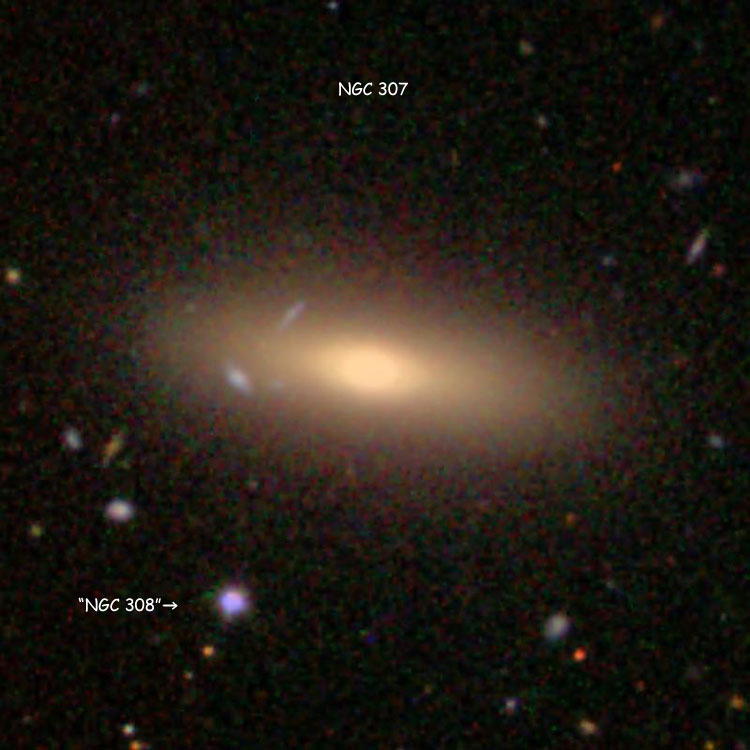
PGC 212626
Not an NGC object but listed here as an apparent companion of NGC 307
A magnitude 16(?) lenticular galaxy (type S0/a?) in Cetus (RA 00 56 25.4, Dec -01 48 50)
Reason For Inclusion Here: Listed as a possible companion of NGC 307 by Corwin. However, it is at least three times more distant, so there is no actual connection between the two galaxies.
Physical Information: Vr = 13900 km/sec, z = 0.046359, apparent size of about 0.4 by 0.15 arcmin (from the images below).

Above, a 12 arcmin wide SDSS image centered on PGC 212626, also showing NGC 307
Below, a 0.6 arcmin wide SDSS image of the galaxy

"PGC 5319308"
(= SDSSJ005634.23-014620.7)
Not an NGC object but listed here as a galaxy supposedly superimposed on NGC 307
A magnitude 18.5(?) galaxy (type S?) in Cetus (RA 00 56 34.2, Dec -01 46 21)
Physical Information: Not superimposed on NGC 307, but seen through it. Relativistic distance about 1780 million light-years, look-back time about 1910 million years.
Classification based partly on its exceptionally blue color, suggesting that it is full of hot bright young stars, and partly on its apparent shape
LEDA B 17.81, I 19.1 -> V 18.5(?), 3K Vr 45476 km/sec; NED 3K Vr 45472 km/sec, z 0.1516795647
NGC 308
Recorded (Dec 31, 1866) by Robert Ball
A magnitude 15.7 star in Cetus (RA 00 56 34.3, Dec -01 47 04)
Historical Identification: Per Dreyer, NGC 308 (= GC 5126, Ball using Lord Rosse's 6-foot telescope, 1860 RA 00 49 27, NPD 92 32.2) is "very faint, extremely small, 1 arcmin southeast of h 77", (JH) 77 being NGC 307. The position precesses to RA 00 56 35.7, Dec -01 46 40, but there is nothing there save for some stars and NGC 307 itself. Therefore one of those stars must be what Ball observed, and mistakenly thought had some nebulosity. Per Corwin, Lord Rosse's detailed records of the object's position relative to NGC 307 (the mean of three nearly identical observations being only 55" distant, at PA 149 degrees) firmly establish that it was the star whose position is listed above, and is shown in the images of NGC 307.
NGC 309
(= PGC 3377 = MCG -02-03-050)
Discovered (1876) by Wilhelm Tempel
A magnitude 11.9 spiral galaxy (type SAB(r)c) in Cetus (RA 00 56 42.7, Dec -09 54 50)
Historical Identification: Per Dreyer, NGC 309 (= GC 5127, Tempel list I (#4), 1860 RA 00 49 30, NPD 100 42.5) is "pretty bright, pretty large, 12th or 13th magnitude star to north".
Physical Information: Apparent size 3.0 by 2.4 arcmin? Used by the de Vaucouleurs Atlas of Galaxies as an example of galaxy type SAB(r)c.
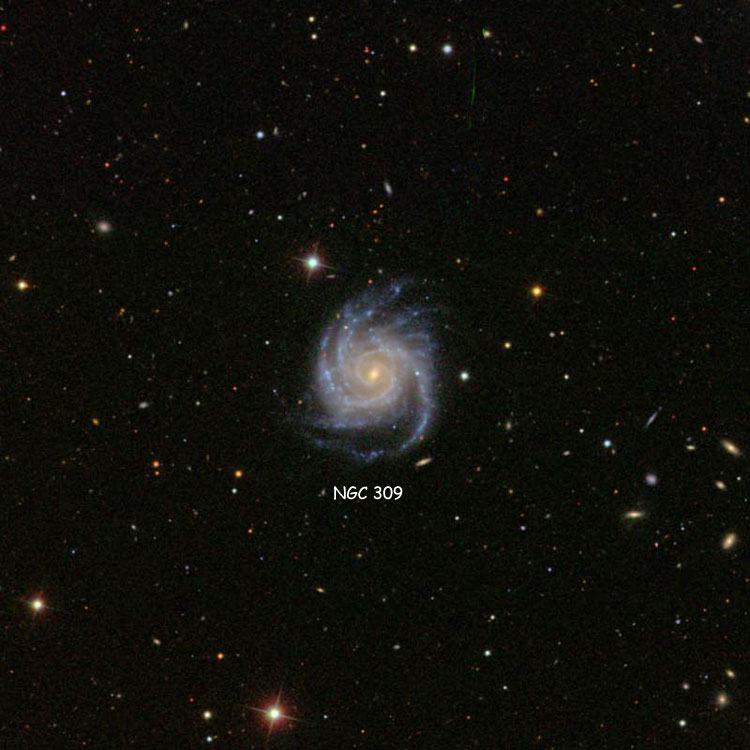
Above, a 12 arcmin wide SDSS image centered on NGC 309
Below, a 3 arcmin wide SDSS image of the galaxy

J00562750-0955562
(= "NGC 309A")
Not an NGC object but listed here because sometimes called NGC 309A
A magnitude 15.8 star in Cetus (RA 00 56 27.5, Dec -09 55 56)
Warning About Non-Standard Designations: This star was listed as NGC 309A in the Revised NGC by Sulentic and Tifft. It is therefore listed as such by Corwin and NED, but it is not listed in LEDA. Since it is not a nebula, galaxy or cluster it does not belong in the NGC/IC in the first place, and its non-standard designation in the Revised NGC simply adds to the confusion, making it a good example of why such non-standard designations should never be used.

Above, a 12 arcmin wide SDSS image centered on "NGC 309A", also showing NGC 309
Also shown is the presumed quasar Q005631.24-095757.5
NGC 310
Recorded (Dec 31, 1866) by Robert Ball
A magnitude 14.6 star in Cetus (RA 00 56 48.1, Dec -01 45 58)
Historical Identification: Per Dreyer, NGC 310 (= GC 5128, Ball using Lord Rosse's 6-foot telescope, 1860 RA 00 49 41, NPD 92 31.1) is "stellar". The position precesses to RA 00 56 49.7, Dec -01 45 35, but there is nothing there save some stars and a 17th magnitude galaxy that is too faint to have been seen by Ball. Despite its faintness the galaxy ( PGC 3325895) is listed as NGC 310 in some places; but per Corwin, Lord Rosse's detailed records of the object's position relative to NGC 307 (the mean of two nearly identical observations being about 232" distant, at PA 83 degrees) firmly establish that it was the substantially brighter star whose position is listed above and shown below.

Above, a 12 arcmin wide SDSS image centered on NGC 310
Also shown are NGC 307 and 308, and PGC 3325895 (which is sometimes misidentified as NGC 310)
PGC 3325895 (not = NGC 310)
(= 2MASXJ00565286-0146246)
Not an NGC object, but listed here because sometimes misidentified as NGC 310
A magnitude 16.8 spiral galaxy (type Sb? pec) in Cetus (RA 00 56 52.9, Dec -01 46 25)
Historical Misidentification: As noted in the entry for NGC 310, the temptation to list a galaxy in place of a stellar or otherwise unidentified NGC object led to this galaxy being incorrectly listed as that object.
Physical Information: Other than an apparent size of about 0.3 by 0.15 arcmin (from the image below), nothing seems to be known about the galaxy.

Above, a 0.5 arcmin wide SDSS image of PGC 3325895; for a wider-field image see NGC 310
NGC 311
(= PGC 3434 = UGC 592 = CGCG 501-049 = MCG +05-03-028)
Discovered (Sep 15, 1828) by John Herschel
A magnitude 13.0 lenticular galaxy (type S0/a?) in Pisces (RA 00 57 32.7, Dec +30 16 51)
Historical Identification: Per Dreyer, NGC 311 (= GC 173 = JH 78, 1860 RA 00 49 58, NPD 60 28.6) is "pretty faint, very small, round, gradually brighter middle".
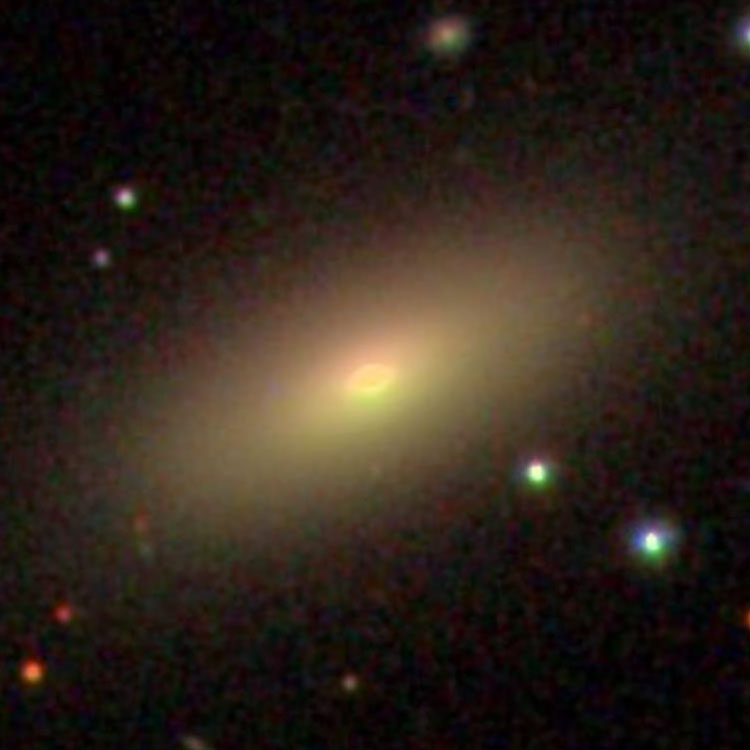
Physical Information: Apparent size of about 1.25 by 0.55 arcmin (from the images below).
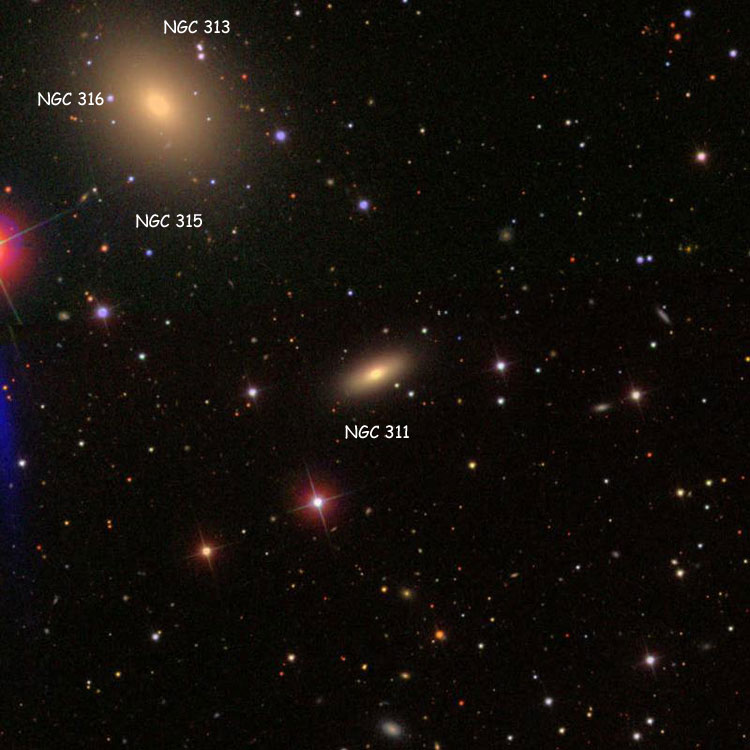
Above, a 12 arcmin wide SDSS image centered on NGC 311, also showing NGC 313, 315 and 316
Below, a 1.5 arcmin wide SDSS image of NGC 311
NGC 312
(= PGC 3343 = ESO 151-006)
Discovered (Oct 3, 1834) by John Herschel
A magnitude 12.4 elliptical galaxy (type E2-3) in Phoenix (RA 00 56 15.9, Dec -52 46 58)
Historical Identification: Per Dreyer, NGC 312 (= GC 174 = JH 2363, 1860 RA 00 50 04, NPD 143 32.1) is "faint, small, round, 12th magnitude star to east".
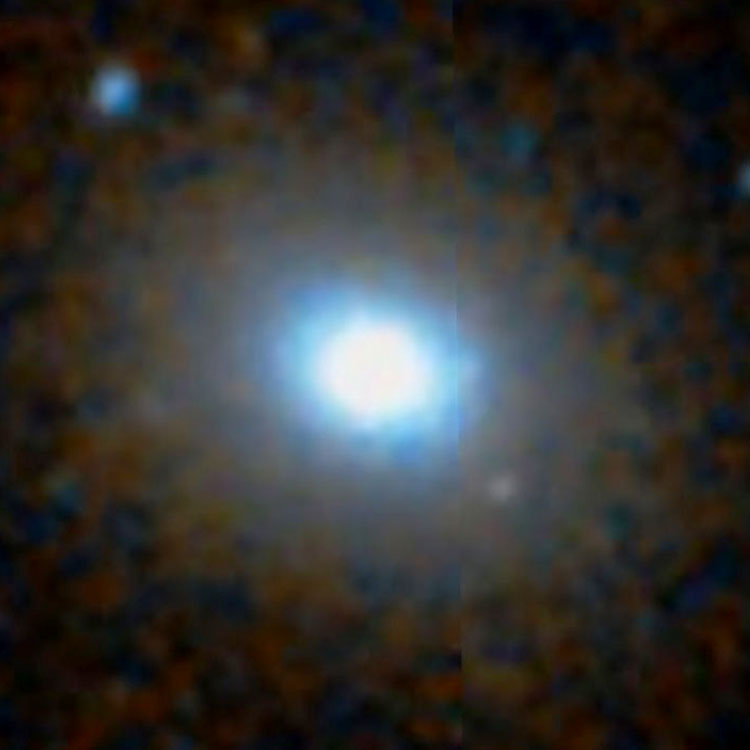
Physical Information: Apparent size of about 2.1 by 1.6 arcmin (from the images below). Thought to be a companion of PGC 3330 and NGC 323, in which case a combination of the information about the three galaxies' distance would be the best indication of their distance. That must wait for the next iteration of this page, but for now, the 3K Vr of NGC 312 iss 7815 km/sec, corresponding to a "redshift" z of about 0.02606495, and redshift-independent distance estimates range from 87 to 168 Mpc.

Above, a 12 arcmin wide DSS image centered on NGC 312, also showing PGC 3330
Below, a 2.75 arcmin wide image of the galaxy (Image Credit DESI Legacy Surveys DR9)
PGC 3330
(= ESO 151-005)
Not an NGC object but listed here as a probable companion of NGC 312 and NGC 323
A magnitude 14(?) lenticular galaxy (type (R')SAB(s)0/a) in Phoenix (RA 00 56 08.3, Dec -52 49 45)
Physical Information: If a companion of NGC 312 and 323, the best estimate of the distance would be based on all three galaxies' recessional velocities and redshift-independent distance estimates. That must wait for the next iteration of this page, but for now, the 3K Vr of PGC 3330 is 8100 km/sec, corresponding to a "redshift" z of about 0.0270189.
The galaxy has an apparent size of about 1.3 by 0.65 arcmin (from the images below).

Above, a 12 arcmin wide DSS image centered on PGC 3330, also showing NGC 312
Below, a 1.35 arcmin wide image of the galaxy (Image Credit DESI Legacy Surveys DR9)

NGC 313
Discovered (Nov 29, 1850) by Bindon Stoney
A triplet of stars in Pisces (RA 00 57 45.7, Dec +30 22 00)
Historical Identification: Per Dreyer, NGC 313 (= GC 5059, 3rd Lord Rosse, 1860 RA 00 50 09, NPD 60 23.5) is "very faint, extremely small, 1 arcmin northwest of II 210", (WH) II 210 being NGC 315 (which see for images). The position precesses to RA 00 57 44.5, Dec +30 21 59, just west of a triplet of stars. Per Corwin, the object was observed at Birr Castle on six occasions, being recorded as nebulous on five of those, but as a double star on the sixth (in lower resolution images, the northern pair looks like a single star, so the triplet would look like a double), so the identification is certain.
Discovery Notes: Although Dreyer credits the discovery to William Parsons, 3rd Earl of Rosse, he notes that many of Rosse's nebular discoveries were actually made by one of his assistants, in this case Bindon Stoney.
NGC 314
(= PGC 3395 = ESO 411-032 = MCG -05-03-015)
Discovered (Sep 27, 1834) by John Herschel
A magnitude 13.4 lenticular galaxy (type (R)SB0(rs)a?) in Sculptor (RA 00 56 52.4, Dec -31 57 47)
Historical Identification: Per Dreyer, NGC 314 (= GC 175 = JH 2362, 1860 RA 00 50 11, NPD 122 43.2) is "extremely faint, very small, round, pretty bright star 2 arcmin to east".
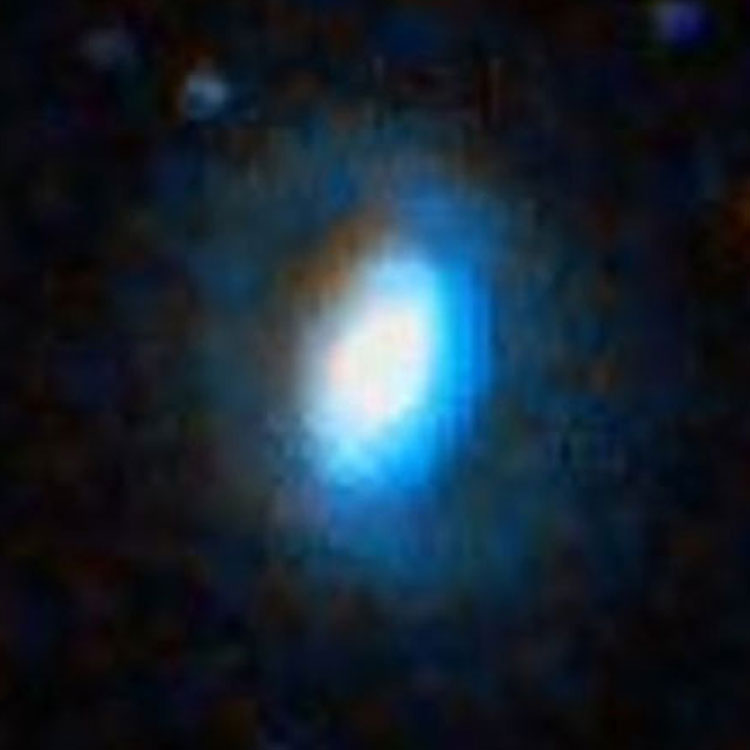
Physical Information: Apparent size of about 0.95 by 0.75 arcmin (from the images below).

Above, a 12 arcmin wide DSS image centered on NGC 314
Below, a 1.4 arcmin wide DSS image of the galaxy
NGC 315
(= PGC 3455 = UGC 597 = CGCG 501-052 = MCG +05-03-031)
Discovered (Sep 11, 1784) by William Herschel
Also observed (Dec 23, 1827) by John Herschel
A magnitude 11.2 elliptical galaxy (type E2?) in Pisces (RA 00 57 48.9, Dec +30 21 09)
Historical Identification: Per Dreyer, NGC 315 (= GC 176 = JH 79 = WH II 210, 1860 RA 00 50 13, NPD 60 24.4) is "pretty bright, pretty large, round, gradually brighter middle, 9th magnitude star 3 arcmin to northeast".
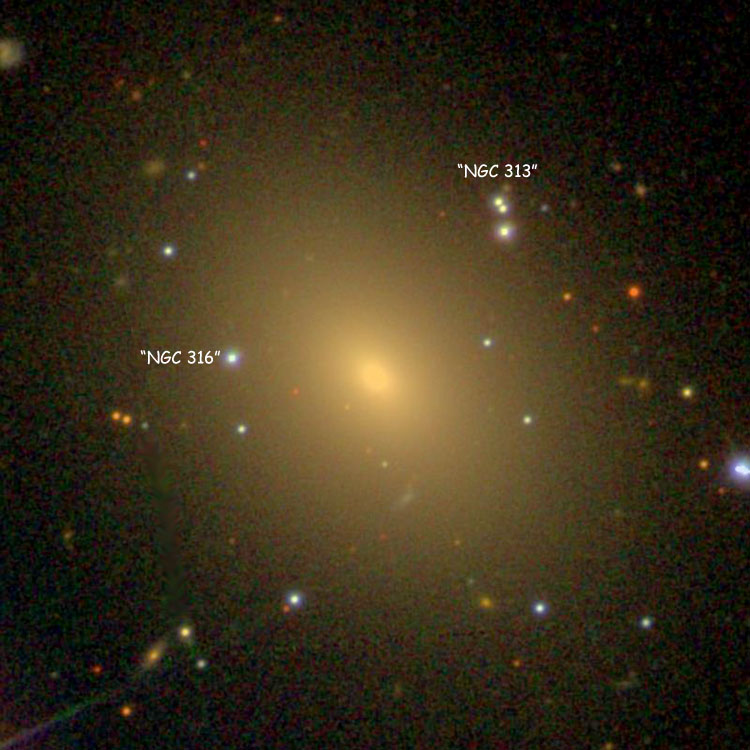
Physical Information: Apparent size of about 4.1 by 2.7 arcmin (from the images below). In looking at the images below, keep in mind that only the bright core of the galaxy can be seen without photography, so the stellar objects which to us seem well within the boundary of the galaxy appeared as separate objects to visual observers of the 19th century. The galaxy is a powerful emitter of radio waves, with strong emission in the plane of the sky, at right angles to the major axis of its elliptical shape.

Above a 12 arcmin wide SDSS image centered on NGC 315, also showing NGC 311, 313, 316 and 318
Below, a 4 arcmin wide SDSS image of the galaxy, also showing NGC 313 and 316
Below, a 15 by 13 arcmin wide unlabeled DSS+radio image of the region near NGC 315
(Image Credit & © AUI/NRAO; click on the credit link for an even wider image)

NGC 316
Discovered (Nov 29, 1850) by Bindon Stoney
A magnitude 13.9 star in Pisces (RA 00 57 52.4, Dec +30 21 15)
Historical Identification: Per Dreyer, NGC 316 (= GC 5129, 3rd Lord Rosse, 1860 00 50 16, NPD 60 24.3) is "very faint, extremely small, stellar, 1 arcmin east of II 210", (WH) II 210 being NGC 315 (which see for images). The position precesses to RA 00 57 51.5, Dec +30 21 11, almost dead center on the star, and given the description of NGC 316 as "stellar", the identification is certain.
Discovery Notes: Although Dreyer credits the discovery to William Parsons, 3rd Earl of Rosse, he notes that many of Rosse's nebular discoveries were actually made by one of his assistants, in this case Bindon Stoney.
NGC 317
(= PGC 3445 = UGC 594 = MCG +07-03-010 = "NGC 317B",
and part of "PGC 3166453" and CGCG 536-013)
Discovered (Oct 1, 1885) by Lewis Swift
A magnitude 13.4 spiral galaxy (type SBbc? pec) in Andromeda (RA 00 57 40.4, Dec +43 47 32)
Corwin lists a knot in PGC 3445 at RA 00 57 40.0, Dec +43 47 34
Historical Identification: Per Dreyer, NGC 317 (Swift list II (#11), 1860 RA 00 50 16, NPD 46 56.7) is "most extremely faint, pretty small, a little extended, double star close following (to the east)." The position precesses to RA 00 58 07.8, Dec +43 48 46, almost half a minute of time to the east and an arcmin to the north of a pair of galaxies that are the only possible candidates for what Swift observed, and since Swift's right ascensions were often well off the mark, the error in the right ascension is not terribly significant, so one galaxy or the other or both must be what Swift observed. The main problem is the "double star to east", as it is actually to the west; but confusion about directions is not uncommon in visual observations reported in the NGC, so that isn't really a problem, either. The main problem is the identification of the proper galaxy (or galaxies) as NGC 317. Per a private communication from Gottlieb, both are visible in a much larger instrument than the one used by Swift, but in a telescope similar to the one used by Swift the northwestern galaxy appears stellar, with only a very faint nebulosity visible only with averted vision, at high magnification. With the low-magnification eyepiece preferred by Swift, it is almost certain that the northwestern galaxy looked like a star to him, so his double star was not the bright star and fainter companion to the west of the pair of galaxies, but the northwestern galaxy and the brighter star. In other words, Swift's nebula must have been the southeastern galaxy, which perfectly fits his description. Admitedly, it cannot be considered absolutely certain that this is the correct interpretation of Swift's observation, but it seems very unlikely that if he saw the northwestern galaxy as a nebula, he would have failed to notice the equally bright galaxy less than an arcminute to its southeast, so it is about as certain as possible without being present at the time Swift made the observation. In other words, the galaxy listed above must be NGC 317, and the one discussed in the following entry ( PGC 3442) must have been one of the "double" stars.
Note About PGC Designations: HyperLEDA assigns the designation PGC 3166453 to the pair, and to NGC 317, but a search of the database for that designation returns no result, so it is shown in quotes.
Physical Information: As shown in the images below the two galaxies must be interacting with each other, as NGC 317 is considerably distorted by its apparent companion. Apparent size of the main galaxy is about 1.05 by 0.4 arcmin, and with its southeastern "tail", about 2.8 by 0.9 arcmin (both from the images below).
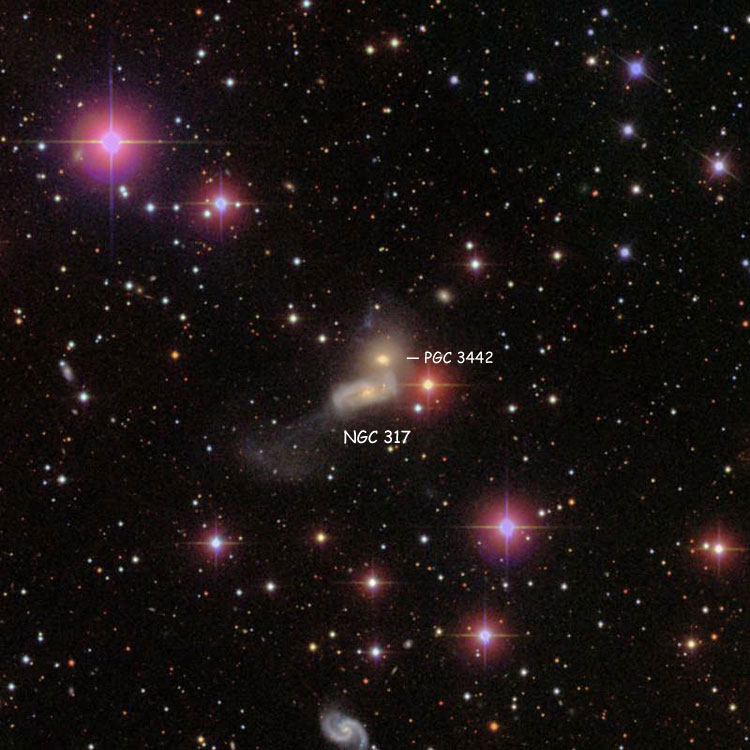
Above, a 12 arcmin wide SDSS image centered on NGC 317, also showing PGC 3442
Below, a 4 arcmin wide SDSS image of the pair, showing their distorted outer regions
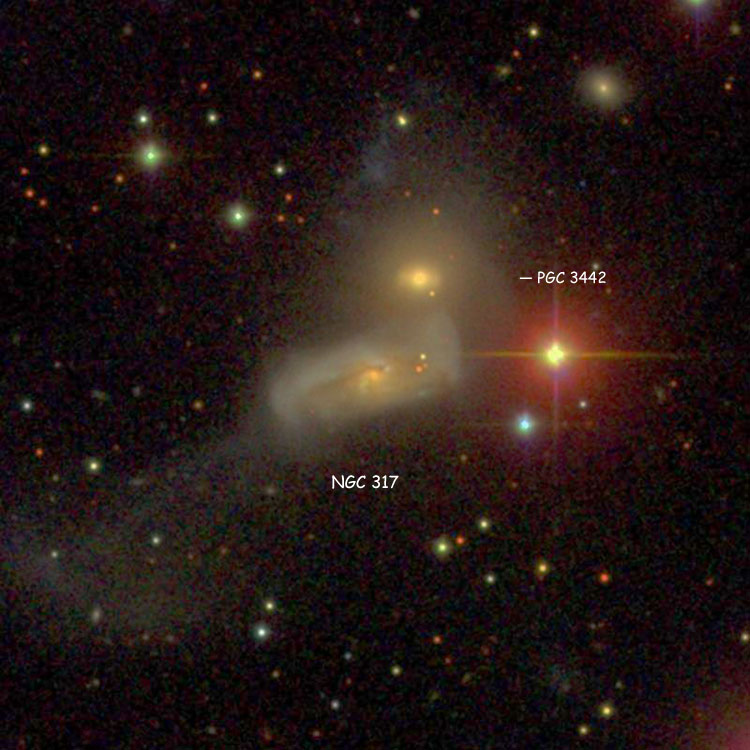
Below, a 1.2 arcmin wide SDSS image of the pair, showing only their central regions

PGC 3442 (not part of NGC 317)
(= UGC 593 = MCG +07-03-009 = "NGC 317A",
and part of "PGC 3166453" and CGCG 536-013)
Not an NGC object but listed here because often treated as part of NGC 317,
and as an interacting companion of the galaxy that is actually NGC 317
A magnitude 13.5 lenticular galaxy (type SB0/a? pec) in Andromeda (RA 00 57 39.1, Dec +43 48 03)
Physical Information: Apparent size of main galaxy about 0.8 by 0.55 arcmin, and with its extended north-south extensions, about 1.75 by 1.0 arcmin (from the images below and in the entry for NGC 317).
NGC 318
(= PGC 3465 = CGCG 501-054)
Discovered (Nov 19, 1850) by Bindon Stoney
Also observed (Nov 6, 1882) by Édouard Stephan
A magnitude 14.4 lenticular galaxy (type SAB0?) in Pisces (RA 00 58 05.2, Dec +30 25 32)
Historical Identification: Per Dreyer, NGC 318 (= GC 177, 3rd Lord Rosse, Stephan list XII (#7), 1860 RA 00 50 28, NPD 60 19.8) is "very faint, very small, round, brighter middle". The position precesses to RA 00 58 03.7, Dec +30 25 40, less than half an arcmin from the galaxy, so the identification is certain.
Discovery Notes: Although Dreyer credits the discovery to William Parsons, 3rd Earl of Rosse, he notes that many of Rosse's nebular discoveries were actually made by one of his assistants, in this case Bindon Stoney.
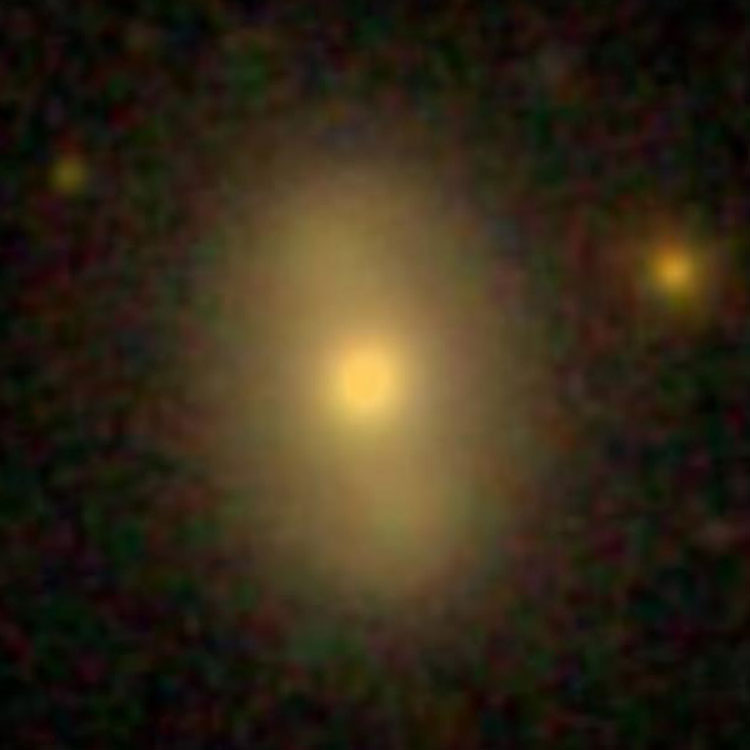
Physical Information: Apparent size of about 0.5 by 0.35 arcmin (from the images below).
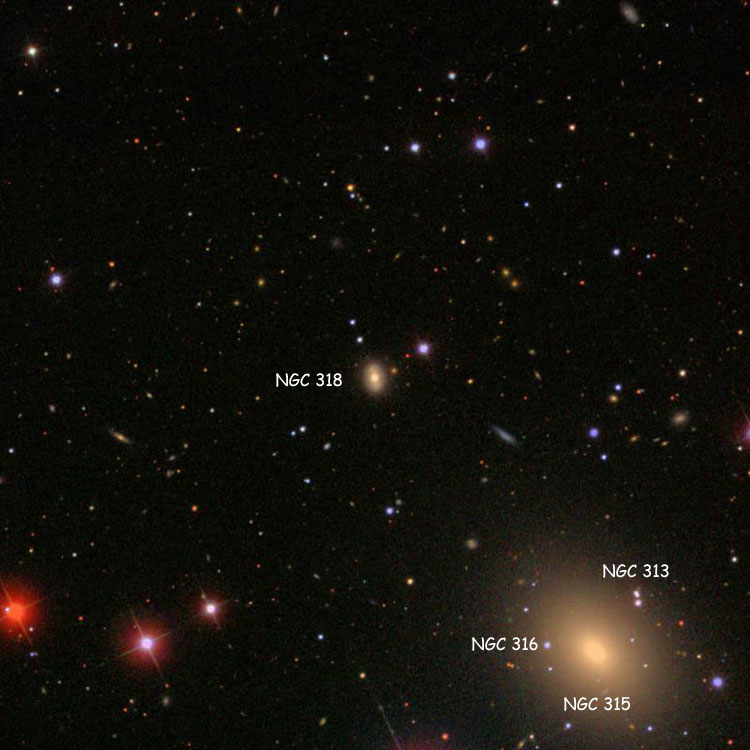
Above, a 12 arcmin wide SDSS image centered on NGC 318, also showing NGC 313, 315 and 316
Below, a 0.75 arcmin wide SDSS image of the galaxy
NGC 319
(= PGC 3398 = ESO 243-013 = MCG -07-03-001)
Discovered (Sep 5, 1834) by John Herschel
A magnitude 13.4 spiral galaxy (type (R)SAB(s)a?) in Phoenix (RA 00 56 57.6, Dec -43 50 20)
Historical Identification: Per Dreyer, NGC 319 (= GC 178 = JH 4007, 1860 RA 00 50 29, NPD 134 35.9) is "extremely faint, very small, round, a little brighter middle".
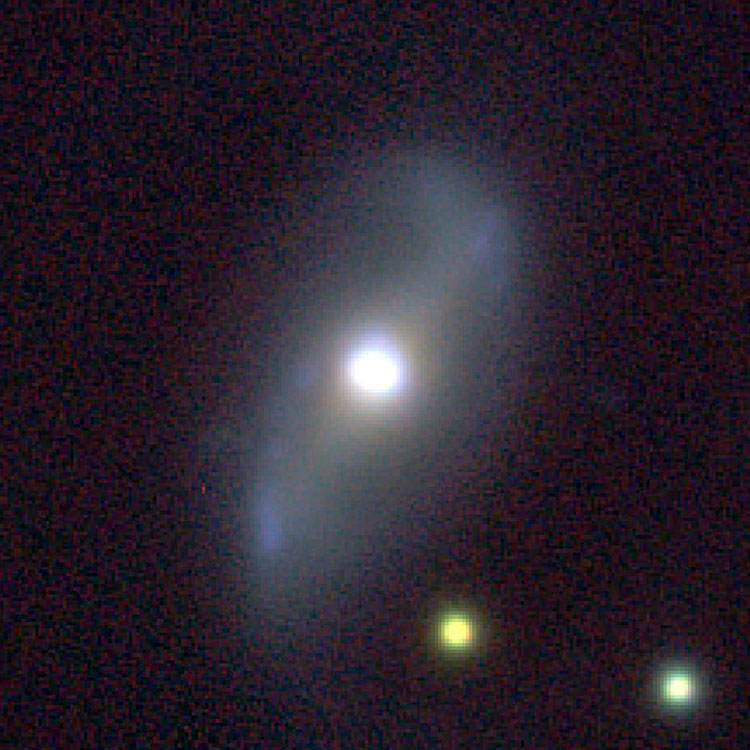
Physical Information: Apparent size of about 0.95 by 0.8 arcmin (from the images below).
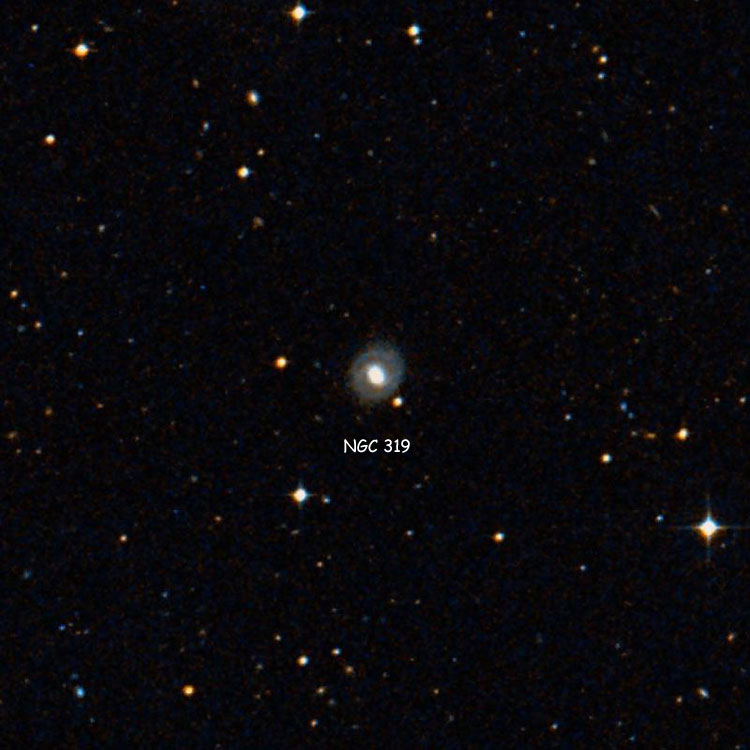
Above, a 12 arcmin wide DSS image centered on NGC 319
Below, a 1.4 arcmin wide DSS image of the galaxy

NGC 320
(= PGC 3510 = ESO 541-003 = MCG -04-03-037)
Discovered (1886) by Francis Leavenworth
Also observed (date?) by Herbert Howe
A magnitude 13.8 spiral galaxy (type (R)SAB(s)ab?) in Cetus (RA 00 58 46.5, Dec -20 50 24)
Historical Identification: Per Dreyer, NGC 320 (Leavenworth list II (#295), 1860 RA 00 50 30, NPD 111 35.8) is "very faint, pretty small, extended 160°, 10th magnitude star to north". The second Index Catalog lists a corrected 1860 RA (per Howe) of 00 51 54. The corrected position precesses to RA 00 58 46.9, Dec -20 50 23, right on the galaxy, and there is a (12th magnitude) star just north of the galaxy, so the identification is certain.
Physical Information: Apparent size of about 0.8 by 0.5 arcmin for the central galaxy, and if the faint (ringlike?) arms that appear to exist to the east and west of the galaxy are real, the overall size of the outer extensions is about 1.0 by 1.0 arcmin (all sizes from the images below).

Above, a 12 arcmin wide DSS image centered on NGC 320
Below, a 1.5 arcmin wide DSS image of the galaxy

Below, a 0.9 arcmin wide PanSTARRS image of the central galaxy
NGC 321 (not = NGC 325)
(= PGC 3443 = MCG -01-03-043)
Discovered (Sep 27, 1864) by Albert Marth
A magnitude 15.0 lenticular galaxy (type E/SB0?) in Cetus (RA 00 57 39.2, Dec -05 05 10)
Historical Identification: Per Dreyer, NGC 321 (= GC 5130, Marth #21, 1860 RA 00 50 34, NPD 95 51) is "extremely faint, very small". The position precesses to RA 00 57 40.1, Dec -05 05 31, less than an arcmin southeast of the galaxy listed above and the description fits, so the identification is certain, and should not have involved any problems. However, careless errors in various databases have led to NGC 321 often being misidentified as NGC 325, and a galaxy to the north ( PGC 3435) being misidentified as NGC 321. As a result, discussions of galaxies in this area often use incorrect NGC designations, and PGC designations are a more certain way of identifying them.
Physical Information: Apparent size of about 0.4 by 0.3 arcmin (from the images below).
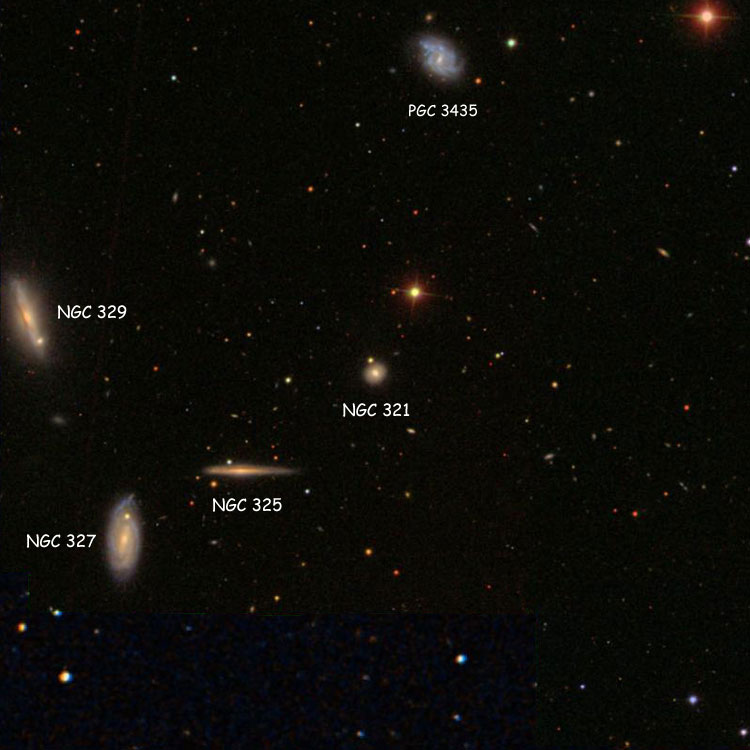
Above, a SDSS image overlaid on a 12 arcmin wide DSS image centered on NGC 321
Also shown are NGC 325, 327 and 329, and PGC 3435
Below, a 0.6 arcmin wide SDSS image of the galaxy

PGC 3435 (not = NGC 321)
Not an NGC object but listed here since often misidentified as NGC 321
A magnitude 14(?) spiral galaxy (type SB(rs)cd? pec) in Cetus (RA 00 57 35.1, Dec -05 00 09)
Historical Misidentification: As noted in the entry for NGC 321, PGC 3435 is often misidentified as that object, despite there being no good reason for the error.
Physical Information: Apparent size of about 0.85 by 0.55 arcmin (from the images below).

Above, a 12 arcmin wide SDSS image centered on PGC 3435, also showing NGC 321
Below, a 1 arcmin wide SDSS image of the galaxy

NGC 322
(= PGC 3412 = ESO 243-015 = MCG -07-03-003)
Discovered (Sep 5, 1834) by John Herschel
A magnitude 13.4 lenticular galaxy (type S0 pec?) in Phoenix (RA 00 57 10.0, Dec -43 43 37)
Historical Identification: Per Dreyer, NGC 322 (= GC 179 = JH 4008, 1860 RA 00 50 36, NPD 134 30.0) is "very faint, very small, round, a little brighter middle, 3 stars to west".
Physical Information: Apparent size of about 1.1 by 0.4 arcmin (from the images below). Apparently interacting with PGC 95427.

Above, a 12 arcmin wide DSS image centered on NGC 322, also showing PGC 95427
Below, a 1.4 arcmin wide DSS image of the pair

PGC 95427
Not an NGC object but listed here because an apparent companion of NGC 322
and sometimes misidentified as part of the NGC object
A magnitude 16.5 lenticular galaxy (type E/S0?) in Phoenix (RA 00 57 09.2, Dec -43 43 47)
Physical Information: Apparent size 0.15 by 0.1 arcmin? Apparently interacting with NGC 322 (which see for images), and if so, presumably at the same distance; but if merely an optical double, nothing else is known.
NGC 323
(= PGC 3374 = ESO 151-009)
Discovered (Oct 3, 1834) by John Herschel
A magnitude 12.6 elliptical galaxy (type E2?) in Phoenix (RA 00 56 41.6, Dec -52 58 33)
Historical Identification: Per Dreyer, NGC 323 (= GC 180 = JH 2365, 1860 RA 00 50 37, NPD 143 44.0) is "pretty faint, small, round, brighter middle, western of 2", the other being NGC 328.
Physical Information: Apparent size of about 1.55 by 1.45 arcmin (from the images below). Per Corwin, part of a trio with NGC 312 and PGC 3330. Need to compare distance estimates of all three to get an appropriate distance for the trio.
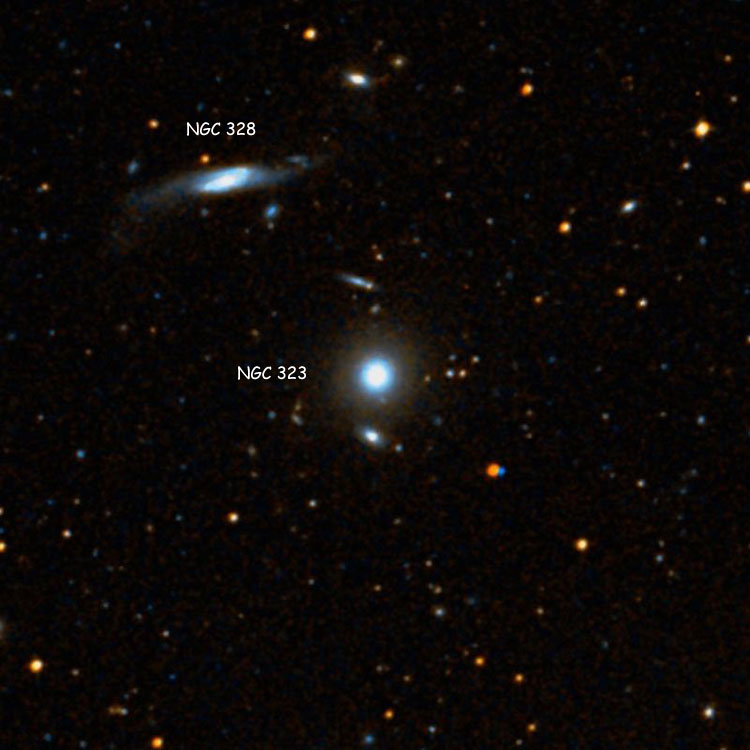
Above, a 12 arcmin wide DSS image centered on NGC 323, also showing NGC 328
Below, a 2.4 arcmin wide DSS image of the galaxy

WORKING HERE
PGC 436263
Not an NGC object but listed here as an apparent companion of NGC 323
in Phoenix (00 56 43.6, -52 57 03)
Physical Information:
PGC 95384
Not an NGC object but listed here as an apparent companion of NGC 323
in Phoenix (00 56 42.1, -52 59 32)
Physical Information:
NGC 324
(probably = PGC 3416 = ESO 295-025 = MCG -07-03-002)
Discovered (Oct 23, 1835) by John Herschel
A magnitude 12.9 lenticular galaxy (type S0/a?) in Phoenix (RA 00 57 14.8, Dec -40 57 33)
Historical Identification: Per Dreyer, NGC 324 (= GC 181 = JH 2364, 1860 RA 00 50 40, NPD 131 12.6) is "questionable?, faint, small, stellar". The position precesses to RA 00 57 12.6, Dec -40 27 06, but there is nothing there. However, per Corwin, if we assume that Herschel made exactly a half-degree error in the declination (a more common error than one might suppose) we land almost exactly on PGC 3416, so that galaxy has been more or less generally adopted as NGC 324. Whether that is what Herschel actually observed cannot be known, but it seems as good a guess as any.
Physical Information: Apparent size of about 1.5 by 0.45 arcmin (from the images below).

Above, a 12 arcmin wide DSS image centered on PGC 3416, which is probably NGC 324
Below, a 1.8 arcmin wide DSS image of the galaxy

NGC 325
(= PGC 3454 = MCG -01-03-045)
Discovered (Sep 27, 1864) by Albert Marth
A magnitude 14.8 spiral galaxy (type Scd?) in Cetus (RA 00 57 47.9, Dec -05 06 44)
Historical Identification: Per Dreyer, NGC 325 (= GC 5131, Marth #22, 1860 RA 00 50 41, NPD 95 53) is "very faint, very small". The position precesses to RA 00 57 47.0, Dec -05 07 31, only 0.8 arcmin south of the galaxy listed above and the description fits, so the identification should be certain. However, as noted in the entry for NGC 321, due to careless errors in some databases that galaxy is often misidentified as NGC 325, so discussions of NGC 325 may refer to PGC 3454, or to the galaxy that is actually NGC 321.
Physical Information: Apparent size of about 1.5 by 0.2 arcmin (from the image below).
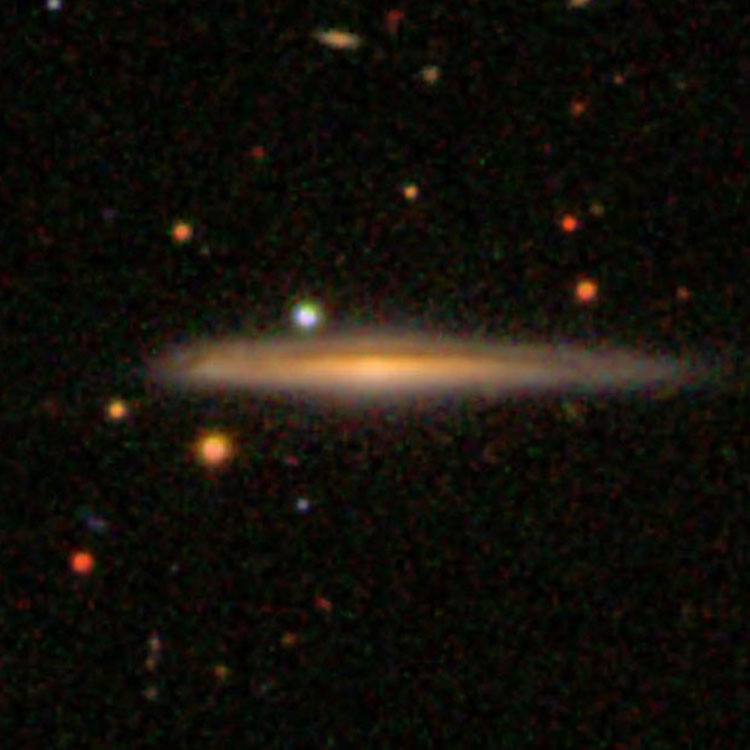
Above, a 2 arcmin wide SDSS image of NGC 325; for wide-field views see NGC 321 or 327
NGC 326
(= PGC 3482 = UGC 601 - CGCG 480-026 = MCG +04-03-025)
Discovered (Aug 24, 1865) by Heinrich d'Arrest
A magnitude 13.2 binuclear galaxy (type E0? pec) in Pisces (RA 00 58 22.7, Dec +26 51 55)
Corwin lists the northern nucleus at RA 00 58 22.6, Dec +26 51 59
and the southern nucleus at RA 00 58 22.9, Dec +26 51 52
Historical Identification: Per Dreyer, NGC 326 (= GC 5132, d'Arrest, 1860 RA 00 50 49, NPD 63 53.1) is "faint, a little extended, 9th or 10th magnitude star to southeast".
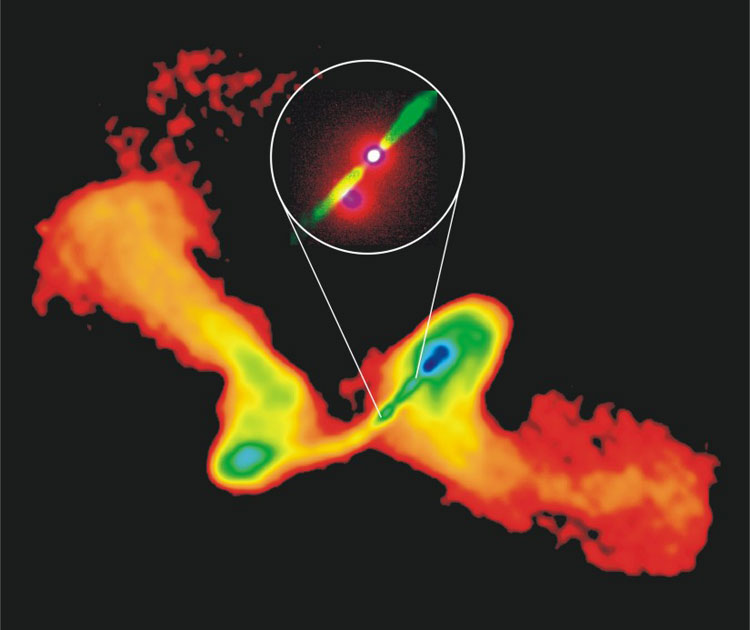
Physical Information: Apparent size 1.4 by 1.4 arcmin? A binuclear object in which black holes at the center of colliding galaxies appear to have merged, creating a complex and powerful radio source.

Above, a 12 arcmin wide SDSS image centered on NGC 326
Below, a 2.4 arcmin wide SDSS image of the galaxy

Below, a ? arcmin wide radio image of the object (Image Credit NRAO/AUI (Inset, STScI))
NGC 327
(= PGC 3462 = MCG -01-03-047)
Discovered (Sep 27, 1864) by Albert Marth
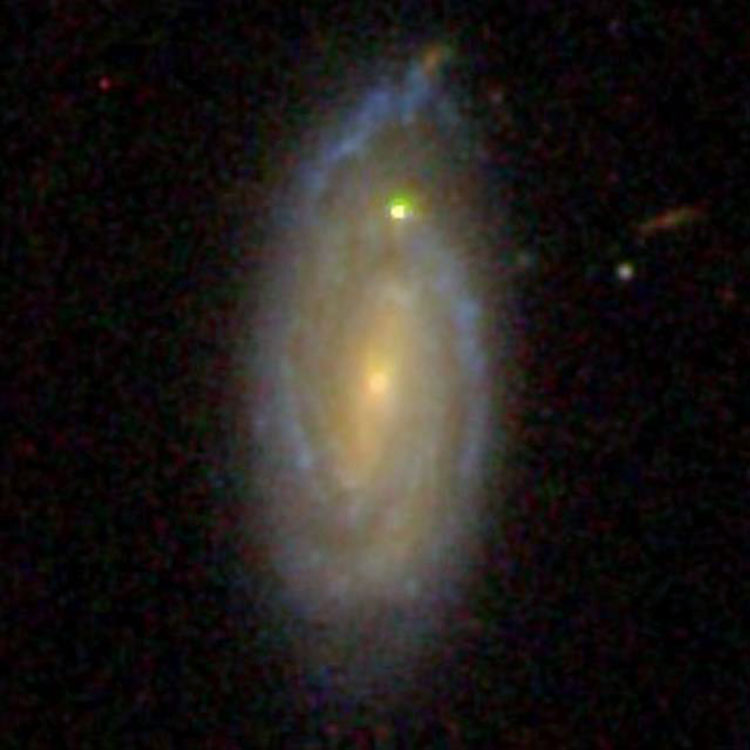
A magnitude 13.4 spiral galaxy (type SB(s)bc?) in Cetus (RA 00 57 55.4, Dec -05 07 50)
Historical Identification: Per Dreyer, NGC 327 (= GC 5133, Marth #23, 1860 RA 00 50 50, NPD 95 54) is "faint, small, extended". The position precesses to RA 00 57 56.0, Dec -05 08 32, on the southern end of the galaxy, so the identification is certain.
Physical Information: Apparent size of about 1.4 by 0.6 arcmin (from the images below).

Above, a SDSS image overlaid on a 12 arcmin wide DSS image centered on NGC 327
Also shown are NGC 321, 325 and 329
Below, a 1.6 arcmin wide SDSS image of the galaxy
NGC 328
(= PGC 3399 = ESO 151-013)
Discovered (Sep 5, 1836) by John Herschel
A magnitude 13.4 spiral galaxy (type SB(rs)a? pec) in Phoenix (RA 00 56 57.5, Dec -52 55 26)
Historical Identification: Per Dreyer, NGC 328 (= GC 182 = JH 2366, 1860 RA 00 50 52, NPD 143 40.0) is "very faint, a little extended, very gradually brighter middle, eastern of 2", the other being NGC 323.
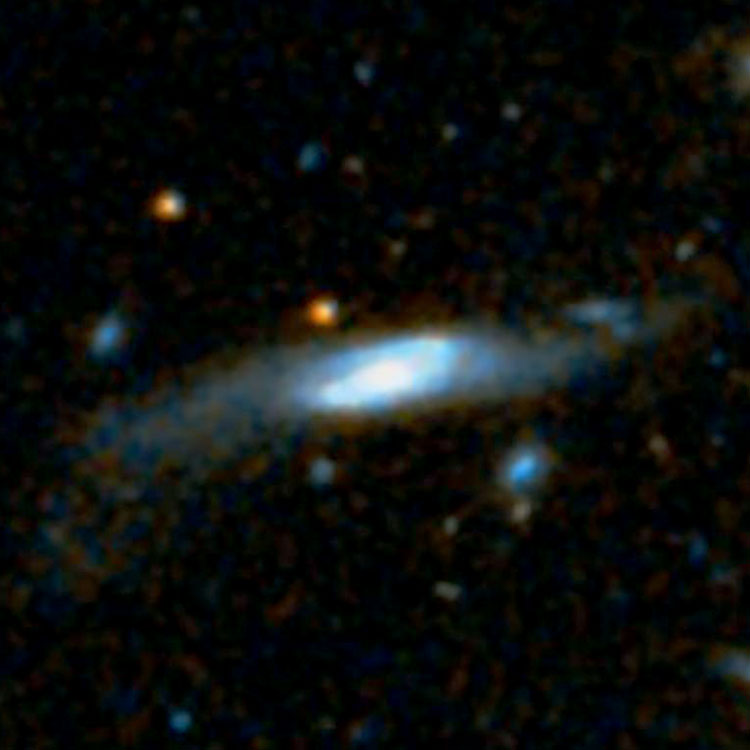
Physical Information: Apparent size of about 2.2 by 0.4 arcmin, and with its fainter extensions, of about 3.5 by 0.9 arcmin (from the images below).
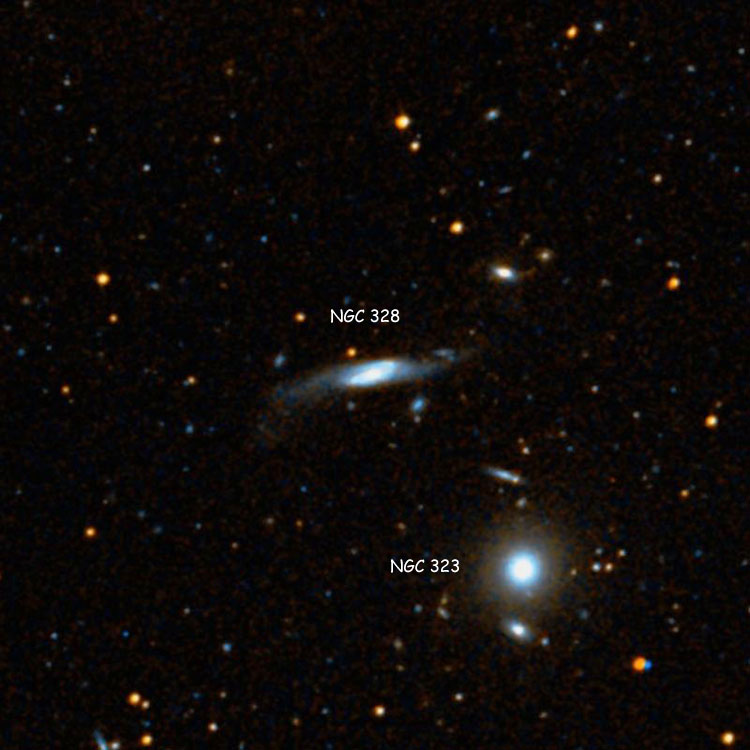
Above, a 12 arcmin wide DSS image centered on NGC 328, also showing NGC 323
Below, a 4 arcmin wide DSS image of the galaxy
NGC 329
(= PGC 3467 = MCG -01-03-048)
Discovered (Sep 27, 1864) by Albert Marth
A magnitude 13.3 spiral galaxy (type Sab? pec) in Cetus (RA 00 58 01.6, Dec -05 04 17)
Historical Identification: Per Dreyer, NGC 329 (= GC 5134, Marth #24, 1860 RA 00 50 56, NPD 95 50) is "faint, extended".
Physical Information: Apparent size of about 1.45 by 0.5 arcmin (from the images below). Its distorted shape may be due to interaction with the (unnamed) smaller galaxy on its southwestern rim.
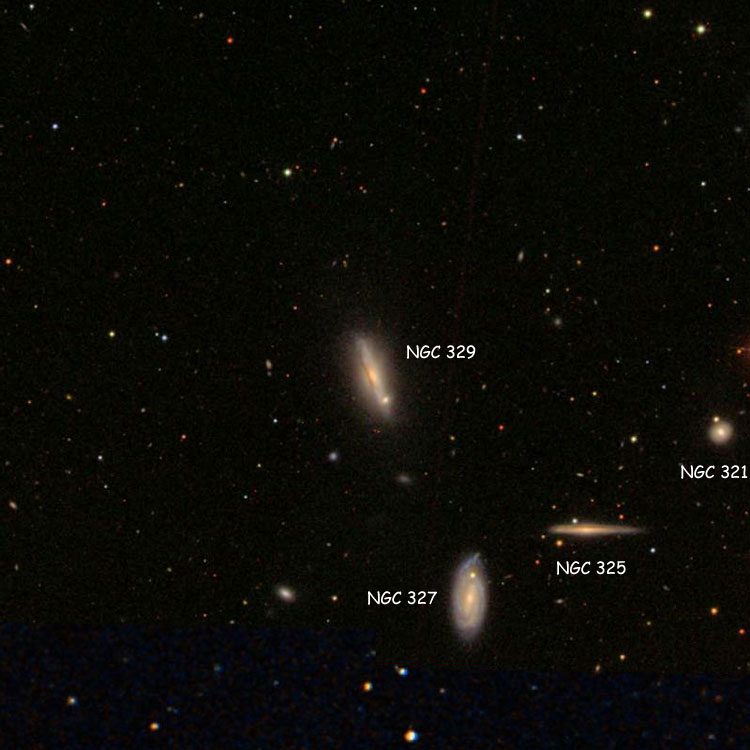
Above, a SDSS image overlaid on a 12 arcmin wide DSS image centered on NGC 329
(Also shown are NGC 321, 325 and 327)
Below, a 1.75 arcmin wide SDSS image of the galaxy

Not an NGC object but listed here as a superimposed companion of NGC 329
(00 58 00.8, -05 04 39)
Physical Information:
NGC 330 (in the Small Magellanic Cloud)
(= "PGC 3517850" = ESO 029-SC024)
Discovered (Aug 1, 1826) by James Dunlop
Also observed (Apr 11, 1834) by John Herschel
A magnitude 9.6 globular cluster in Tucana (RA 00 56 17.9, Dec -72 27 48)
Historical Identification: Per Dreyer, NGC 330 (= GC 183 = JH 2367, Dunlop #23, 1860 RA 00 51 27, NPD 163 13.6) is "a globular cluster, very bright, small, a little extended, stars from 13th to 15th magnitude". The position precesses to RA 00 56 16.1, Dec -72 28 06, barely south of the center of the cluster listed above and well within its outline, the description fits and there is nothing comparable nearby, so the identification is certain.
Note About The PGC/ESO Designations: For purposes of completeness, LEDA assigns a PGC designation for almost every NGC object, regardless of its nature. In this case, a search of the database for that designation returns no result, so it is placed in quotes. The ESO designation is used for star clusters, and is shown in the NED.
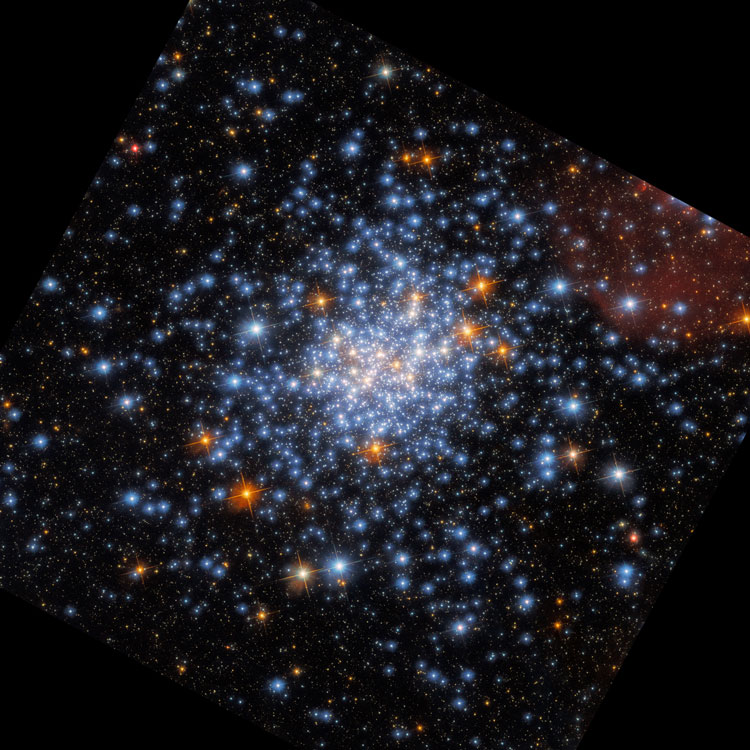
Physical Information: The Small Magellanic Cloud is thought to be a little over 200 thousand light-years distant, and NED lists distance estimates for NGC 330 ranging from about 170 to 200 thousand light years, with a median value of about 180 to 185 thousand light-years (the HST press release says it is about 180 thousand light-years away), placing it on the near side of the Local Group galaxy. Given that and its apparent size of about 2.8 by 2.5 arcmin (per SIMBAD), the globular cluster is about 145 light-years in diameter. The HST images were taken from studies meant to determine how the evolution of globular cluster stars differs from that of "field" stars, and the maximum mass that stars can have and not be doomed to end their lives in a supernova explosion.
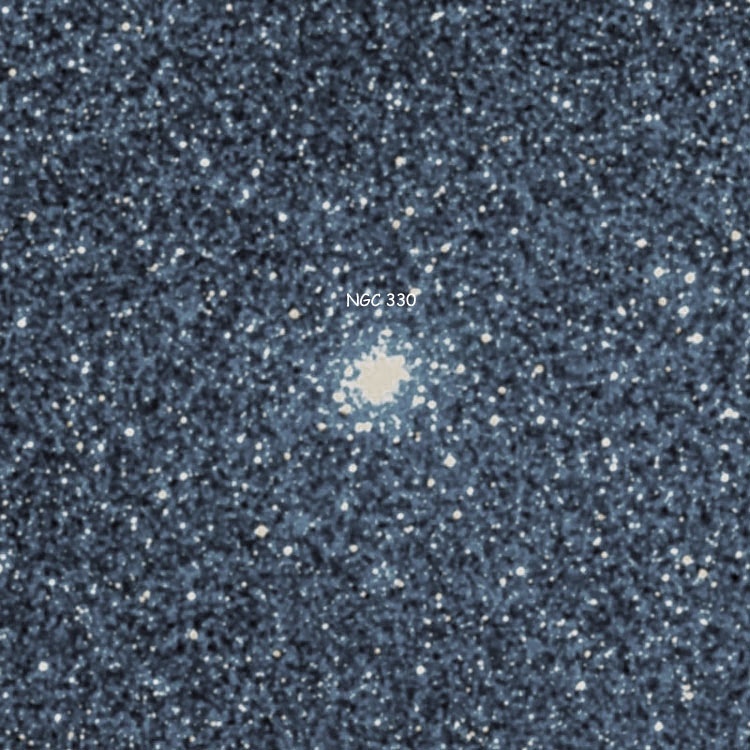
Above, a 12 arcmin wide DSS image centered on NGC 330
Below, a 2.75 arcmin wide DSS image of the cluster

Below, a 2.75 arcmin wide image of the region shown above (Image Credit ESA/Hubble & NASA, J. Kalirai, A. Milone)
PGC 2759 (probably but not certainly = NGC 331)
(= MCG -01-03-012)
Discovered (1886) by Francis Leavenworth
A magnitude 14.6 spiral galaxy (type SB(rs)bc?) in Cetus (RA 00 47 06.9, Dec -02 43 52)
Historical Identification: Per Dreyer, NGC 331 (Leavenworth list II (#296), 1860 RA 00 51 30±, NPD 93 28.8) is "extremely faint, very small, round, a little brighter middle, 12th magnitude star 3 arcmin northeast". The position precesses to RA 00 58 37.9, Dec -02 43 22, but there is nothing there, which might be expected given the disclaimer about the right ascension. The question is, can a reasonably certain identification be made under such circumstances? Presuming the declination is more or less accurate, we could scan east and west for a nebula that fits the description, but others have already done that for us. Per Corwin there are at least two galaxies that might fit the bill, PGC 3406 and PGC 2759. The former is closer to the NGC position, but has a 7th magnitude star to the northwest that Corwin feels Leavenworth would certainly have mentioned, so he rejects it while noting that others have adopted it as NGC 331 despite that problem. The latter is further (11 1/2 minutes of time to the west), but has a star of about the right brightness 3 arcmin north-northeast of the galaxy, so Corwin feels it is the most suitable candidate for the NGC listing, and most references have followed his suggestion (and I find it very convincing). For that reason this entry discusses NGC 331 as if it is PGC 2759; but since it is also commonly identified as PGC 3406, that galaxy is covered in the following entry.
Physical Information: Based on a recessional velocity of 7140 km/sec, PGC 2759 is about 330 million light-years away. Given that and its apparent size of about 0.9 by 0.5 arcmin (from the images below), it is about 75 thousand light-years across. (Listed as NGC 331 in NED, but not in LEDA.)

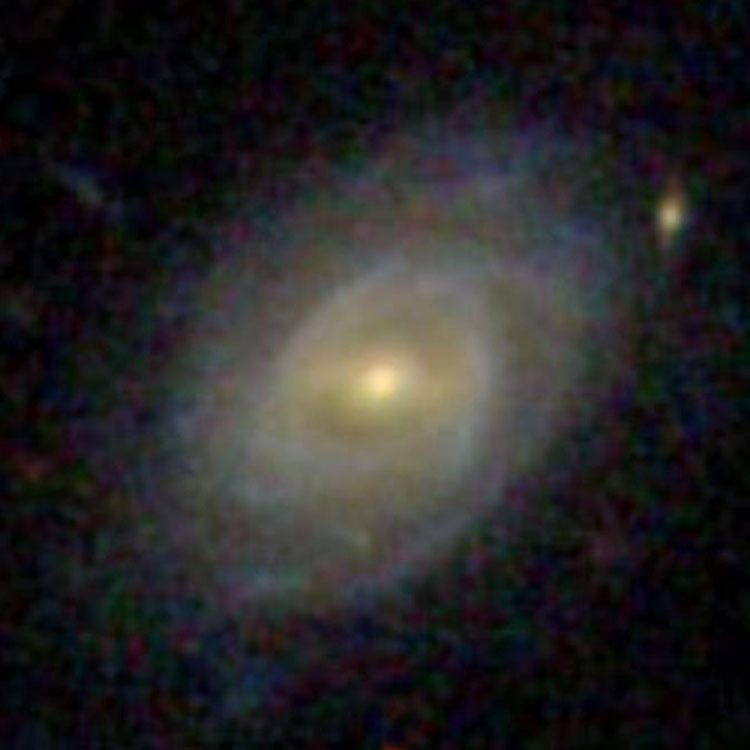
Above, a 12 arcmin wide SDSS image centered on PGC 2759, which is probably NGC 331
Below, a 1 arcmin wide SDSS image of the galaxy
PGC 3406 (possibly but not likely = NGC 331)
Probably not an NGC object, but listed here because sometimes (mis?)identified as NGC 331
A magnitude 15(?) spiral galaxy (type SB(rs)bc?) in Cetus (RA 00 57 04.9, Dec -02 46 12)
Historical Identification: As noted in the entry for NGC 331, the identification with PGC 2759 is uncertain, and it is possible (although unlikely) that PGC 3406 is the correct identification; but whether it is or not, it is treated as NGC 331 in some places, so it is appropriate to discuss it here.
Physical Information: Based on a recessional velocity of 13765 km/sec (and H0 = 70 km/sec/Mpc), a straightforward calculation indicates that PGC 3406 is about 640 million light-years away. However, for objects at such distances we should take into account the Universal expansion during the time it took their light to reach us. Doing that shows that the galaxy was about 610 million light-years away at the time the light by which we see it was emitted, about 620 million years ago (the difference between the two numbers being due to the expansion of the intervening space during the light-travel time). Given that and its apparent size of about 0.8 by 0.7 arcmin, it is about 140 to 145 thousand light-years across. (Listed as NGC 331 in LEDA, but not in NED.)

Above, a 12 arcmin wide SDSS image centered on PGC 3406, which is often (mis?)identified as NGC 331
Below, a 1 arcmin wide SDSS image of the galaxy

NGC 332
(= PGC 3511 = UGC 609 = CGCG 410-021)
Discovered (Oct 22, 1886) by Lewis Swift
A magnitude 14.0 lenticular galaxy (type E/S0?) in Pisces (RA 00 58 49.1, Dec +07 06 41)
Historical Identification: Per Dreyer, NGC 332 (Swift list V (#10), 1860 RA 00 51 32, NPD 83 38.5) is "very faint, small, round, several stars near to south".
Physical Information: Apparent size of about 0.95 by 0.7 arcmin (from the images below).

Above, a 12 arcmin wide SDSS image centered on NGC 332
Below, a 1.2 arcmin wide SDSS image of the galaxy
NGC 333
(= PGC 3519 = MCG -03-03-013)
Discovered (1877) by Wilhelm Tempel
Also observed (date?) by Herbert Howe
A magnitude 13.9 lenticular galaxy (type SB0(r)a?) in Cetus (RA 00 58 51.3, Dec -16 28 09)
Historical Identification: Per Dreyer, NGC 333 (Tempel list I (#5), 1860 RA 00 51 54, NPD 107 18) has "no description". The second Index Catalog lists a corrected 1860 NPD (per Howe) of 107 13.5. The corrected position precesses to RA 00 58 50.7, Dec -16 28 05, right on the galaxy, so the identification is certain.
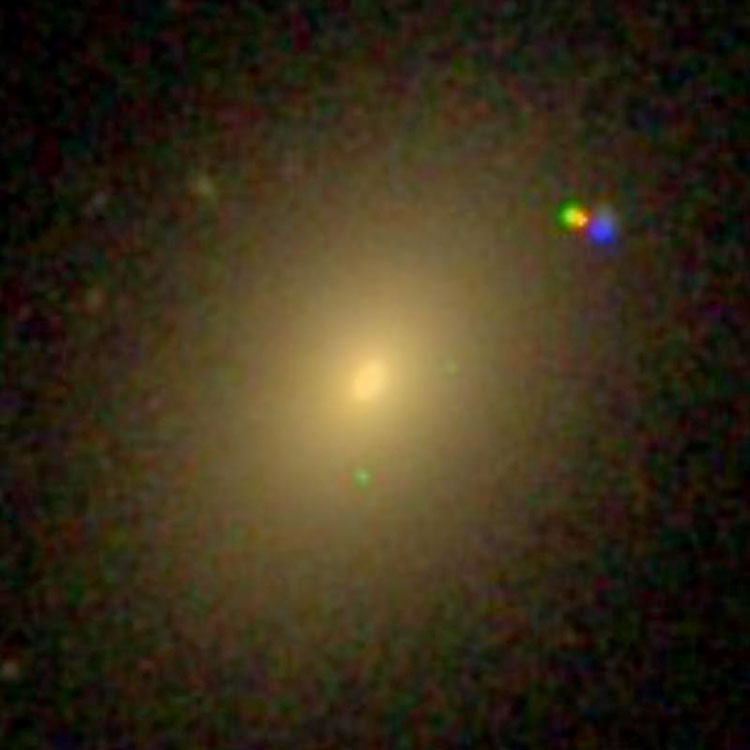
Physical Information: Based on a recessional velocity of 16210 km/sec, a straightforward calculation indicates that NGC 333 is about 755 million light-years away. However, for galaxies at such distances we should take into account the Universal expansion during the time it took their light to reach us. Doing that shows that the galaxy was about 710 million light-years away when the light by which we see it was emitted, about 728 million years ago (the difference between the two numbers being due to the expansion of the intervening space during the light-travel time. Given that and its apparent size of about 1.3 by 0.7 arcmin (from the images below), it is about 265 to 270 thousand light-years across. It appears to have a faint companion ( PGC 3073571); whether they are actually related or merely an optical double is unknown, but they are generally presumed to be a physical pair.

Above, a 12 arcmin wide DSS image centered on NGC 333, also showing PGC 3518 and 3073571
Below, a 1.75 arcmin wide DSS image of the galaxy, also showing PGC 3518 and 3073571
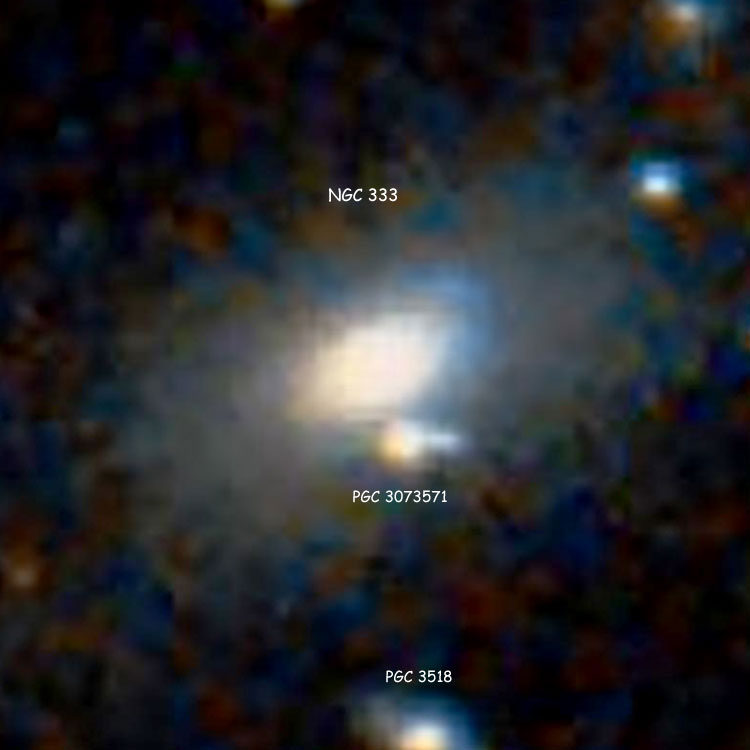
Below, a 1 arcmin wide PanSTARRS image of the galaxy, also showing PGC 3073571

PGC 3518 (= "NGC 333A"/"NGC 333B")
Not an NGC object but listed here since sometimes called NGC 333A or NGC 333B
A magnitude 16.5? lenticular galaxy (type S0/a?) in Cetus (RA 00 58 50.9, Dec -16 29 00)
This object is not listed in Corwin's positions for NGC objects, but it is listed as shown in other references
Warning About Non-Standard Designations: This galaxy and the following one ( PGC 3073571) are good examples of why non-standard NGC designations should be strongly discouraged, as they and NGC 333 itself are all called NGC 333A in one reference or another, and PGC 3073571 is also called NGC 333B in other places, making it very likely that data belonging to one of them will end up being applied to another in numerous references, leading to hopeless confusion.
Physical Information: Apparent size of about 0.35 by 0.15 arcmin (from the images below) (See NGC 333 for images.) No position listed by Corwin.
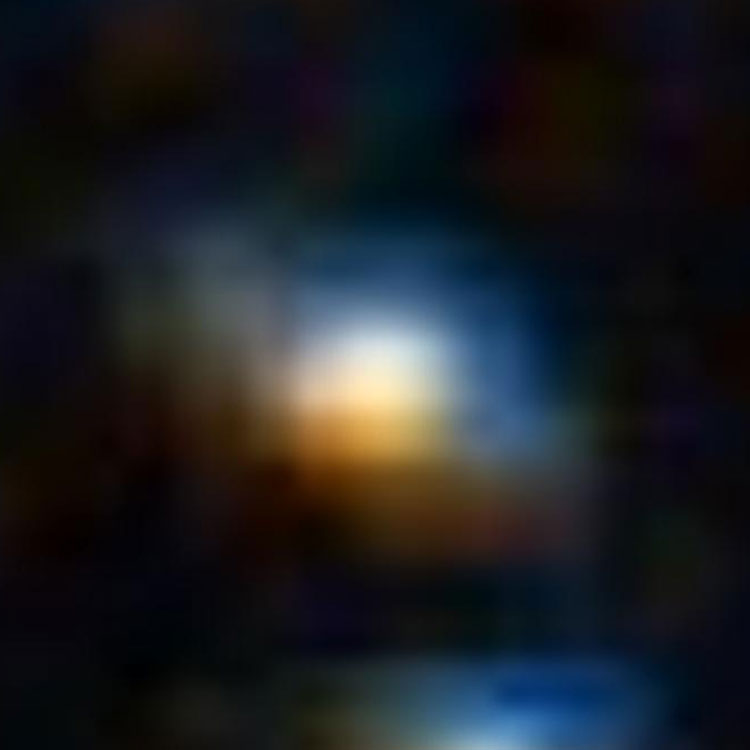
Above, a 0.5 arcmin wide DSS image of PGC 3518 (see NGC 333 for a wider view)
Below, a 0.5 arcmin wide PanSTARRS image of the galaxy
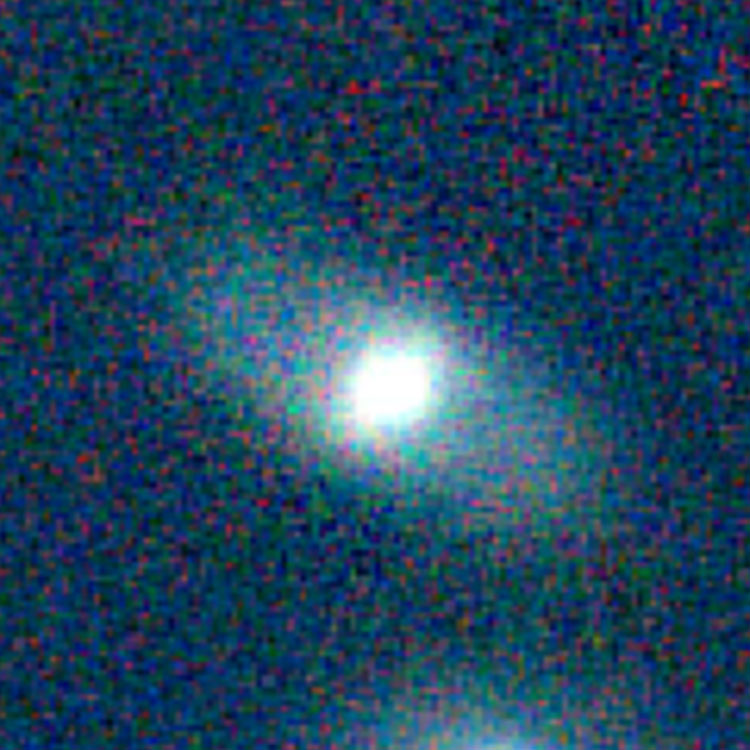
PGC 3073571 (= "NGC 333B" / "NGC 333A")
Not an NGC object, but listed here since sometimes called NGC 333B or NGC 333A
A magnitude 14.7 elliptical galaxy (type E0?) in Cetus (RA 00 58 50.7, Dec -16 28 19)
Warning Against Non-Standard Designations: This is perhaps the best example of why non-standard NGC designations should be avoided, as the term NGC 333A has been applied to three different galaxies: NGC 333 itself (which see for images), PGC 3518 and PGC 3073571, which as shown above is also called NGC 333B. Talk about a recipe for confusion! In fact, one result of the double designation is that this galaxy is even given the wrong PGC designation (namely PGC 3518) in NED, and I suspect that if any data were available for the galaxy, they would be more likely than not to be assigned to the wrong galaxy.
Physical Information: Apparent size of about 0.06 by 0.06 arcmin (from the images at NGC 333. Nothing else is known, or if so, what is known has been mis-assigned to one of the other "333A"s.
NGC 334
(= PGC 3514 = ESO 351-026 = MCG -06-03-012)
Discovered (Sep 25, 1834) by John Herschel
A magnitude 13.6 spiral galaxy (type (R)SB(s)ab pec?) in Sculptor (RA 00 58 49.8, Dec -35 06 58)
Historical Identification: Per Dreyer, NGC 334 (= GC 184 = JH 2368, 1860 RA 00 52 11, NPD 125 53.4) is "very faint, small, round, gradually a little brighter middle, 2 stars of 11th magnitude to south".
Physical Information: Apparent size of about 1.0 by 0.6 arcmin (from the images below).

Above, a 12 arcmin wide DSS image centered on NGC 334
Below, a 1.4 arcmin wide DSS image of the galaxy

NGC 335
(= PGC 3544 = ESO 541-006 = MCG -03-03-015)
Discovered (Oct 9, 1885) by Francis Leavenworth
A magnitude 14.0 spiral galaxy (type Sbc?) in Cetus (RA 00 59 19.8, Dec -18 14 05)
Historical Identification: Per Dreyer, NGC 335 (Leavenworth list I (#21), 1860 RA 00 52 30, NPD 109 01.8) is "very faint, pretty small, extended, brighter middle".
Physical Information: Apparent size of about 1.25 by 0.2 arcmin (from the images below).

Above, a 12 arcmin wide DSS image centered on NGC 335
Below, a 1.25 arcmin wide DSS image of the galaxy
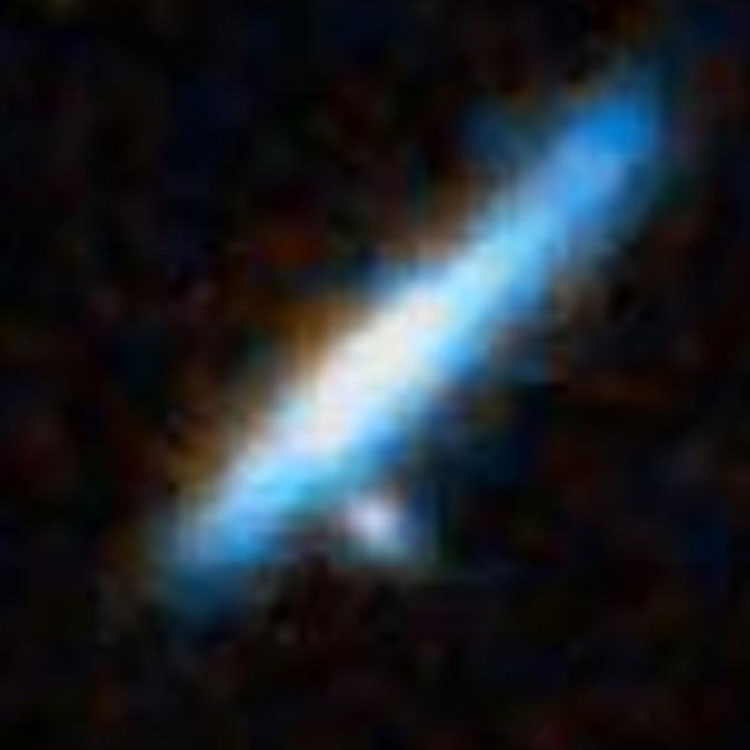
Below, a 1.25 arcmin wide PanSTARRS image of the galaxy
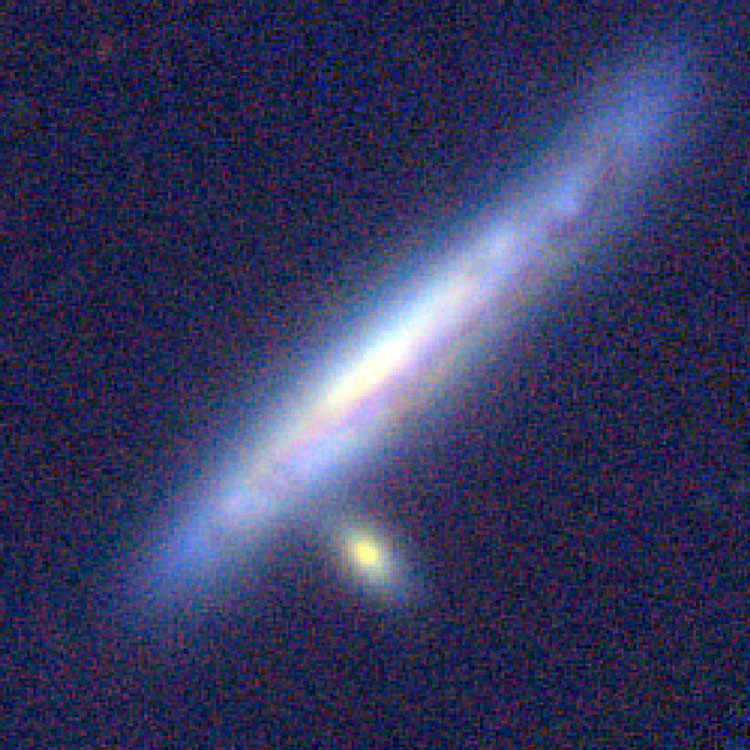
Not an NGC object but listed here as an apparent companion of NGC 335
(00 59 17.2, -18 12 41)
Physical Information:
Not an NGC object but listed here as an apparent companion of NGC 335
(00 59 19.9, -18 14 20)
Physical Information:
Not an NGC object but listed here as an apparent companion of NGC 335
(00 59 23.0, -18 15 19)
Physical Information:
NGC 336
(= PGC 3470 = ESO 541-002)
Discovered (Oct 31, 1885) by Francis Leavenworth
A magnitude 14.7 irregular galaxy (type IB? pec) in Cetus (RA 00 58 02.6, Dec -18 23 07)
Corwin also lists the position of a northern knot at RA 00 58 02.9, Dec -18 23 03
and of a southern knot at RA 00 58 02.4, Dec -18 23 11 (listed as a double system by Steinicke)
Historical Identification: Per Dreyer, NGC 336 (Leavenworth list I (#22), 1860 RA 00 52 30, NPD 109 10.8) is "very faint, very small, round, suddenly brighter middle". The position precesses to RA 00 59 24.9, Dec -18 25 24, or about 9 arcmin south of NGC 335, but there is nothing there. The effort to identify what Leavenworth saw has led to several candidates, including a double star, a galaxy still further to the south ( PGC 3526), and most recently one only 7 arcmin south of NGC 335, but more than 10 arcmin to the west (namely, the one listed as the NGC object in this entry). Given only the description in the NGC, any of these could be correct; but fortunately (per Corwin), there is a sketch of area observed by Leavenworth whose star field only matches the one near PGC 3470, so despite the unfortunate error in its right ascension, the identification of NGC 336 as PGC 3470 seems certain, and has been adopted by most major databases (although in the case of LEDA, a search for NGC 336 provides an identifier which is the same as for PGC 3470, but the entry for that object does not specifically state that it is NGC 336).
Physical Information: Based on a recessional velocity of 5500 km/sec, PGC 3470 is about 255 to 260 million light-years away. Given that and its apparent size of about 0.5 by 0.15 arcmin, it is about 35 to 40 thousand light-years across. Its peculiar appearance has led to suggestions that it may be a double system or a colliding pair of galaxies, but the PanSTARRS image below suggests that it is merely an example of an exceptionally irregular distribution of star-forming regions.
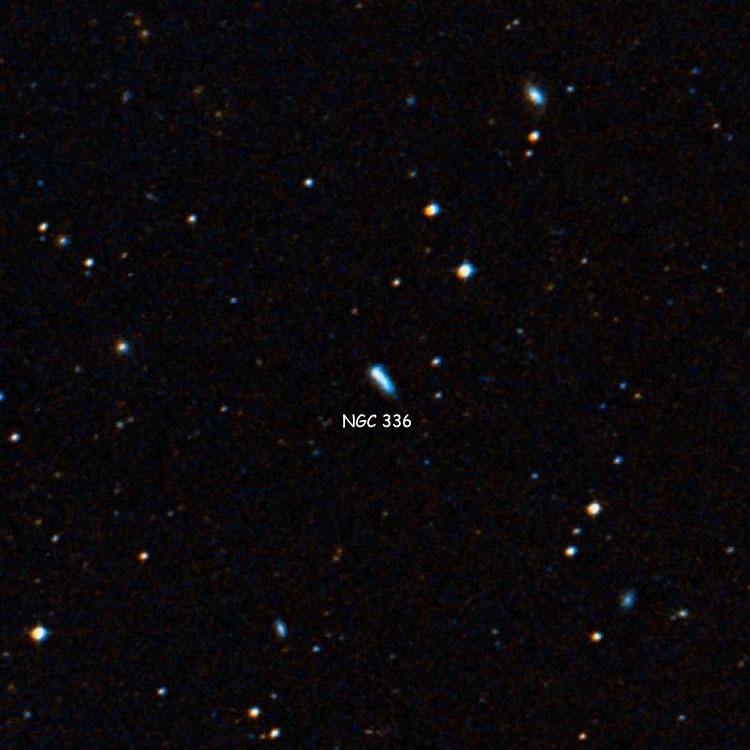
Above, a 12 arcmin wide DSS image centered on NGC 336
Below, a 0.75 arcmin wide DSS image of the galaxy

Below, a 0.75 arcmin wide PanSTARRS image of the galaxy

PGC 3526 (not = NGC 336)
Not an NGC object, but listed here because sometimes misidentified as NGC 336
A magnitude 12.4 spiral galaxy (type SAB(rs)bc?) in Cetus (RA 00 58 58.0, Dec -18 44 34)
Historical Misidentification: As noted at the entry for NGC 336, PGC 3526 is identified as NGC 336 in various places (for instance, a Wikisky search for NGC 336 shows PGC 3526, albeit with only its PGC label); but its star field does not match a sketch by the discoverer of NGC 336, so its identification with that object is almost certainly wrong.
Physical Information: Based on a recessional velocity of 2000 km/sec, PGC 3526 is about 95 million light-years away. Given that and its apparent size of 3.0 by 1.4 arcmin, it is about 80 thousand light-years across.
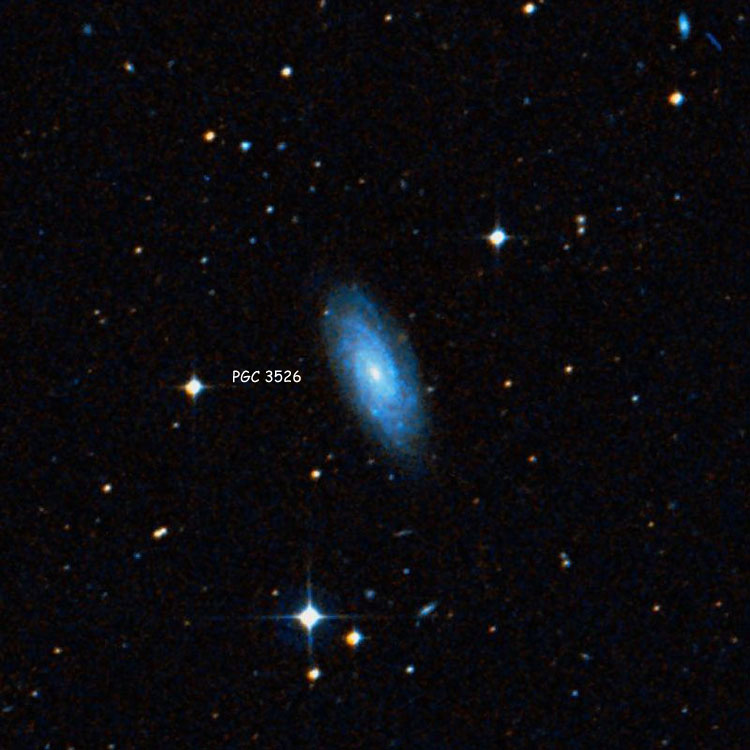
Above, a 12 arcmin wide DSS image centered on PGC 3526 (sometimes misidentified as NGC 336)
Below, a 3.6 arcmin wide DSS image of the galaxy

Below, a 1.6 by 2.0 arcmin wide monochrome PanSTARRS image of the galaxy's center
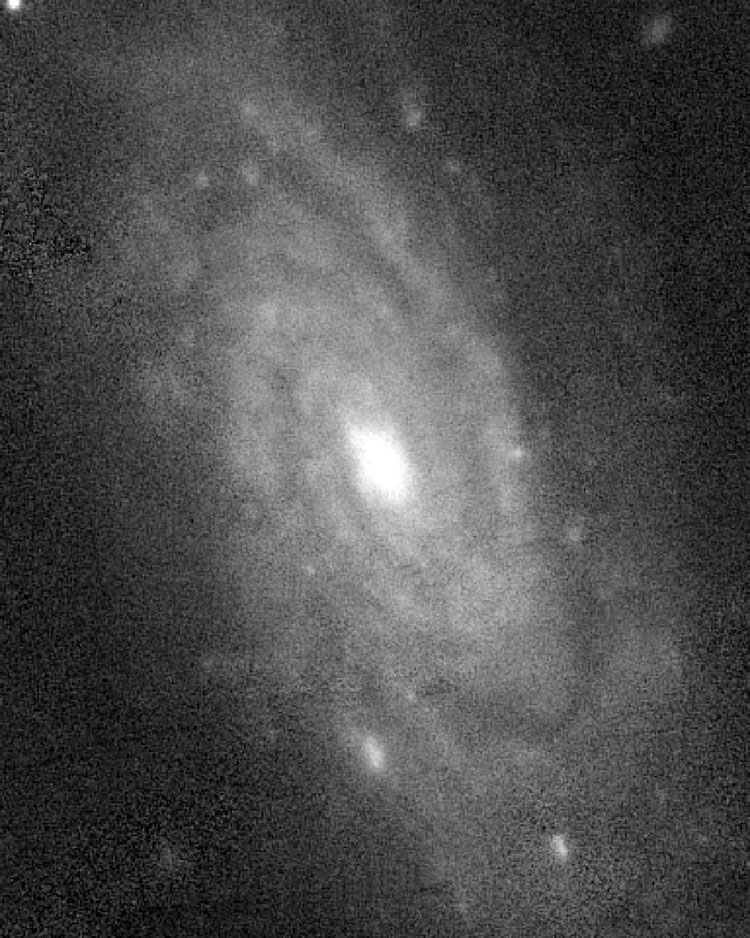
NGC 337
(= PGC 3572 = MCG -01-03-053)
Discovered (Sep 10, 1785) by William Herschel
Also observed (Oct 9, 1828) by John Herschel
A magnitude 11.6 spiral galaxy (type SB(s)d?) in Cetus (RA 00 59 50.0, Dec -07 34 39)
Corwin also lists the position of a knot at RA 00 59 50.0, Dec -07 34 34
Historical Identification: Per Dreyer, NGC 337 (= GC 185 = JH 80 = WH II 433, 1860 RA 00 52 46, NPD 98 19.9) is "pretty faint, large, extended, gradually a little brighter middle, 10th magnitude star 21 seconds of time to the east".
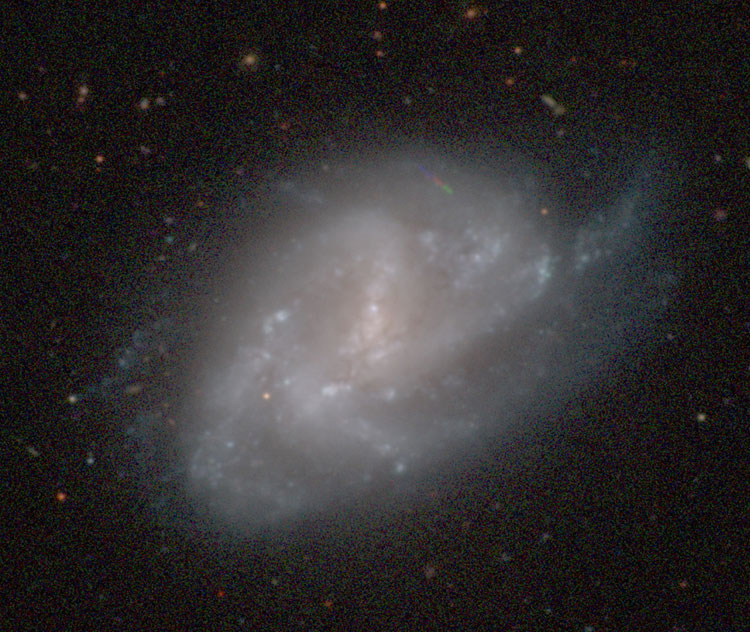
Physical Information: Apparent size of about 3.45 by 1.85 arcmin (from the images below).

Above, a 12 arcmin wide SDSS image centered on NGC 337
Below, a 3.2 arcmin wide SDSS image of the galaxy

Below, a 3.8 by 3.2 arcmin wide image of the galaxy
(Image Credit & © Carnegie-Irvine Galaxy Survey; used by permission)
PGC 3671
(= MCG -01-03-065 = "NGC 337A")
Not an NGC object but listed here since sometimes called NGC 337A
A magnitude 12.2 spiral galaxy (type SAB(s)dm?) in Cetus (RA 01 01 33.8, Dec -07 35 18)
Corwin also lists the position of a knot at RA 01 01 34.0, Dec -07 35 15
Physical Information: Apparent size of about 6.75 by 5.65 arcmin (from the images below). A very low surface brightness object.

Above, a 12 arcmin wide SDSS image centered on PGC 3671
Below, a 7.5 arcmin wide SDSS image of the galaxy (with enhanced contrast to make it easier to see)

NGC 338
(= PGC 3611 = UGC 624 = CGCG 501-061 = MCG +05-03-034)
Discovered (1877) by Wilhelm Tempel
Also observed (Nov 6, 1882) by Édouard Stephan
A magnitude 12.8 spiral galaxy (type Sab?) in Pisces (RA 01 00 36.4, Dec +30 40 08)
Historical Identification: Per Dreyer, NGC 338 (Tempel list I (#6), Stephan list XII (#8), 1860 RA 00 53 00, NPD 60 05.2) is "very faint, very small, irregular figure, brighter middle".
Physical Information: Apparent size of about 2.05 by 0.85 arcmin (from the images below).

Above, a 12 arcmin wide SDSS image centered on NGC 338
Below, a 2.4 arcmin wide SDSS image of the galaxy

NGC 339 (in the Small Magellanic Cloud)
(= ESO 029-SC025)
Discovered (Sep 18, 1835) by John Herschel
A magnitude 12.8 globular cluster in Tucana (RA 00 57 46.7, Dec -74 28 17)
Corwin lists the position of the core as RA 00 57 45.4, Dec -74 28 11
Historical Identification: Per Dreyer, NGC 339 (= GC 186 = JH 2369, 1860 RA 00 53 13, NPD 165 12.5) is "faint, large, round, very gradually brighter middle".
Physical Information: Apparent size of about 2.2 by 2.0 arcmin (from the images below). About 6.5 billion years old (only about half the age of most of the globular clusters in our own galaxy). Distance 190 to 200 thousand light-years. (Corwin lists the position of the core as RA 00 57 45.4, Dec -74 28 11)
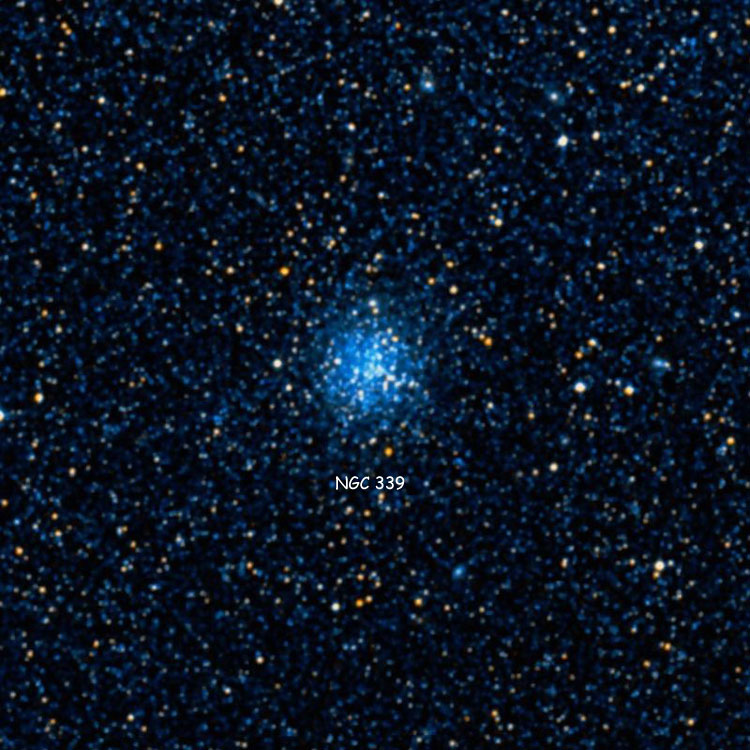
Above, a 12 arcmin wide DSS image centered on NGC 339
Below, a 3 arcmin wide DSS image of the globular cluster

Below, a 2.8 arcmin wide HST image of the cluster (Image Credit ESA/Hubble/NASA, Judy Schmidt)

NGC 340
(= PGC 3610 = MCG -01-03-055)
Discovered (Sep 27, 1864) by Albert Marth
A magnitude 13.7 spiral galaxy (type Sbc? pec) in Cetus (RA 01 00 34.9, Dec -06 51 59)
Corwin also lists the position of a knot at RA 01 00 34.4, De -06 52 05
Historical Identification: Per Dreyer, NGC 340 (= GC 5135, Marth #25, 1860 RA 00 53 30, NPD 97 37) is "very faint, small, extended".
Physical Information: Apparent size of about 0.9 by 0.35 arcmin (from the images below).

Above, a 12 arcmin wide SDSS image centered on NGC 340, also showing NGC 342
Below, a 1 arcmin wide SDSS image of the galaxy

Not an NGC object but listed here as an apparent companion of NGC 340
(01 00 41.4, -06 52 33)
Physical Information:
Not an NGC object but listed here as an apparent companion of NGC 340
(01 00 49.0, Dec -06 55 05)
Physical Information:
NGC 341
(with PGC 3627 = Arp 59)
(= PGC 3620 = MCG -02-03-063)
Discovered (Oct 21, 1881) by Édouard Stephan
A magnitude 13.0 spiral galaxy (type SAB(r)bc?) in Cetus (RA 01 00 45.8, Dec -09 11 09)
Historical Identification: Per Dreyer, NGC 341 (Stephan list XII (#9), 1860 RA 00 53 44, NPD 99 56.6) is "faint, pretty large, round, a little brighter middle, mottled but not resolved".
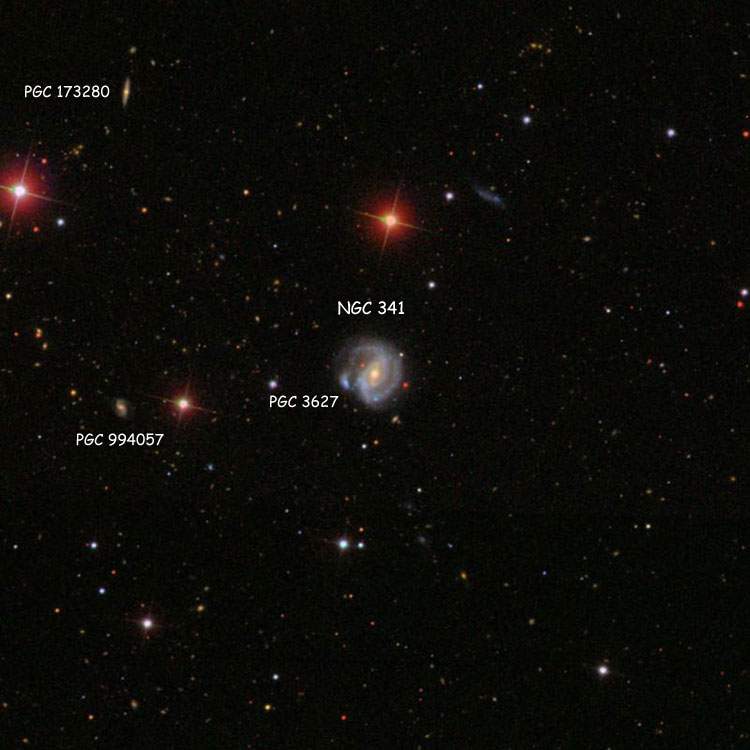
Physical Information: Based on a recessional velocity of 4555 km/sec (and H0 = 70 km/sec/Mpc), NGC 341 is about 210 to 215 million light-years away. Given that and its apparent size of about 1.1 by 0.9 arcmin (from the images below), it is about 65 to 70 thousand light-years across. NGC 341 is a starburst galaxy, presumably as a result of its interaction with its companion. Used by the Arp Atlas as an example of a spiral galaxy (NGC 341) with a small high surface brightness companion ( PGC 3627).
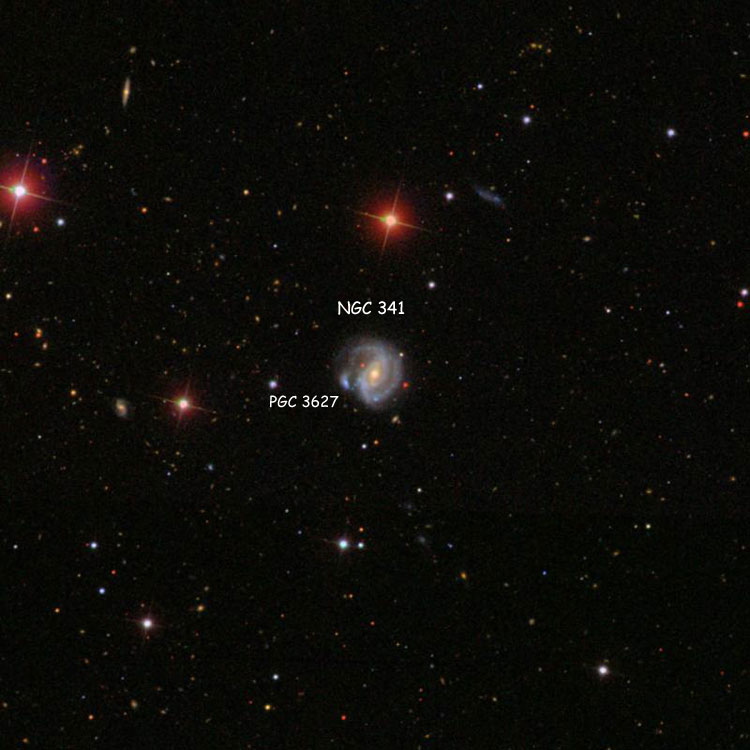
Above, a 12 arcmin wide SDSS image centered on NGC 341 and its companion, PGC 3627
Below, a 2.4 arcmin wide SDSS image of the pair, also known as Arp 59
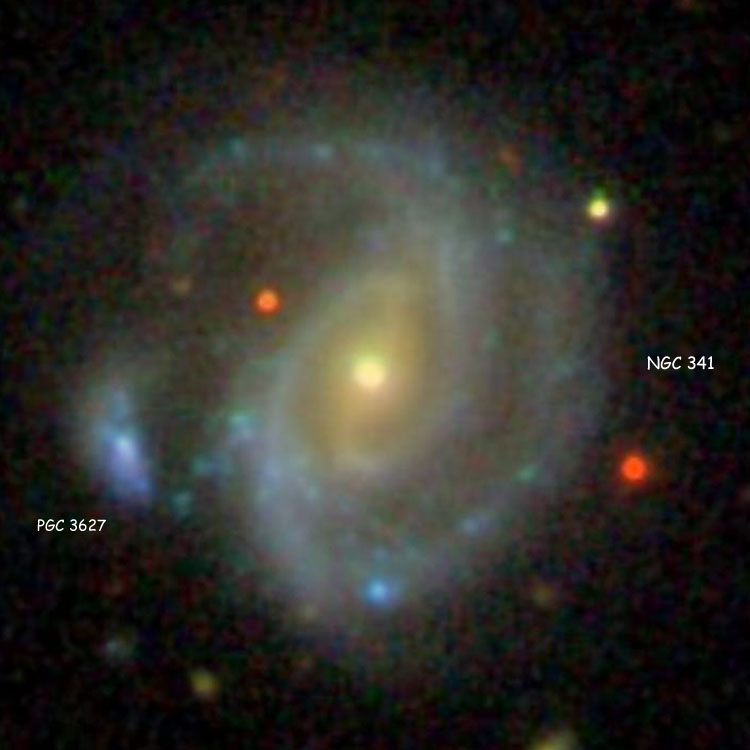
Below, the 12 arcmin wide image above, also showing labels for PGC objects 173280 and 994057
PGC 3627 (with NGC 341 = Arp 59)
(= MCG -02-03-064 = "NGC 341B")
Not an NGC object but listed here since sometimes called NGC 341B, and as a part of Arp 59
A magnitude 15.8 irregular galaxy (type Irr?) in Cetus (RA 01 00 47.7, Dec -09 11 16)
Physical Information: Located at the end of one arm of NGC 341, which see for images. Given that, presumably at the same distance of about 210 to 215 million light-years, in which case its apparent size of about 0.2 by 0.1 arcmin (from the images above) corresponds to about 10 to 15 thousand light-years. Used by the Arp Atlas as an example of a spiral galaxy ( NGC 341) with a small high surface brightness companion (PGC 3627).
NGC 342
(= PGC 3631 = MCG -01-03-058)
Discovered (Sep 27, 1864) by Albert Marth
A magnitude 14.4 lenticular galaxy (type E/S0?) in Cetus (RA 01 00 49.9, Dec -06 46 21)
Historical Identification: Per Dreyer, NGC 342 (= GC 5136, Marth #26, 1860 RA 00 53 46, NPD 97 32) is "very faint, very small".
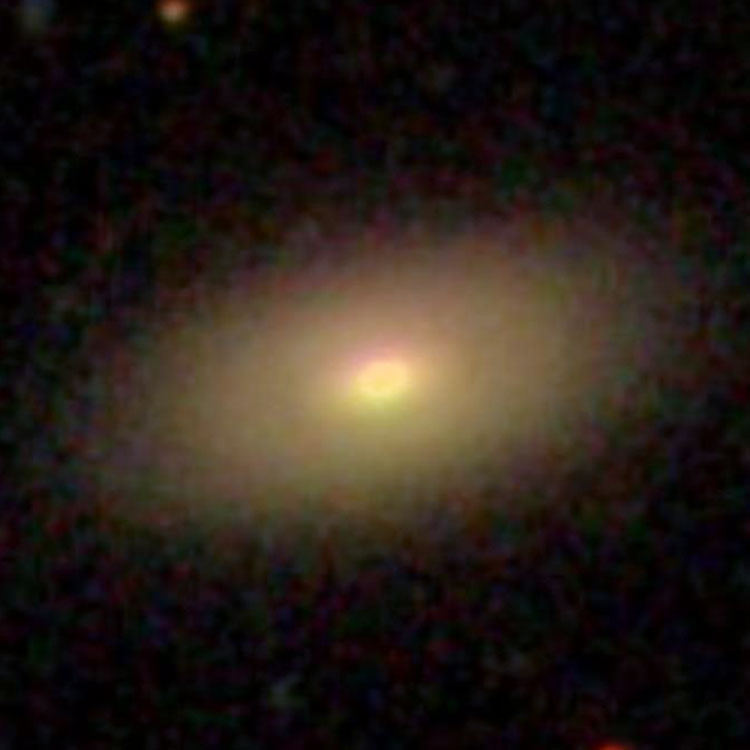
Physical Information: Apparent size of about 0.9 by 0.45 arcmin (from the images below).

Above, a 12 arcmin wide SDSS image centered on NGC 342, also showing NGC 340
Below, a 1 arcmin wide SDSS image of the galaxy
NGC 343
(probably = PGC 133741)
Discovered (1886) by Frank Muller
Probably a magnitude 15.5 spiral galaxy (type SABa? pec) in Cetus (RA 00 58 24.0, Dec -23 13 30)
Historical Identification: Per Dreyer, NGC 343 (Muller list II (#297), 1860 RA 00 54 02, NPD 113 58.8) is "extremely faint, very small, irregularly round, suddenly brighter middle and nucleus (perhaps a star?)". The position and description are identical to NGC 344 save for being 1 arcmin further north, so NGC 343 and 344 should be a pair of nebulae separated by about an arcmin in the north-south direction. The positions precess to RA 01 00 52.0, Dec -23 13 29 and RA 01 00 52.0, Dec -23 14 29, but there is nothing there. This is unfortunately common with Leander-McCormick Observatory observations, which often have errors in right ascension of 2 or more minutes of time, and means that a painstaking assessment of possible objects along a more or less east-west line has to be undertaken to decide what, if anything, fits the observations. Per Corwin, the most likely pair appears to be PGC 133741 for NGC 343, and PGC 198261 for NGC 344. Their right ascensions are about twice as far "off" as usual (4m of time), and their relative positions are not perfect, but their appearance and declinations more or less accurately fit Muller's observation, and do so better than anything else along the east-west line; so for lack of a better choice I have accepted his suggestion. (NED also adopts Corwin's identifications, though with a note stating that the NGC identification is uncertain, as other candidates have been suggested elsewhere; but LEDA and Wikisky assign the same object (PGC 133741) to both NGC entries.)
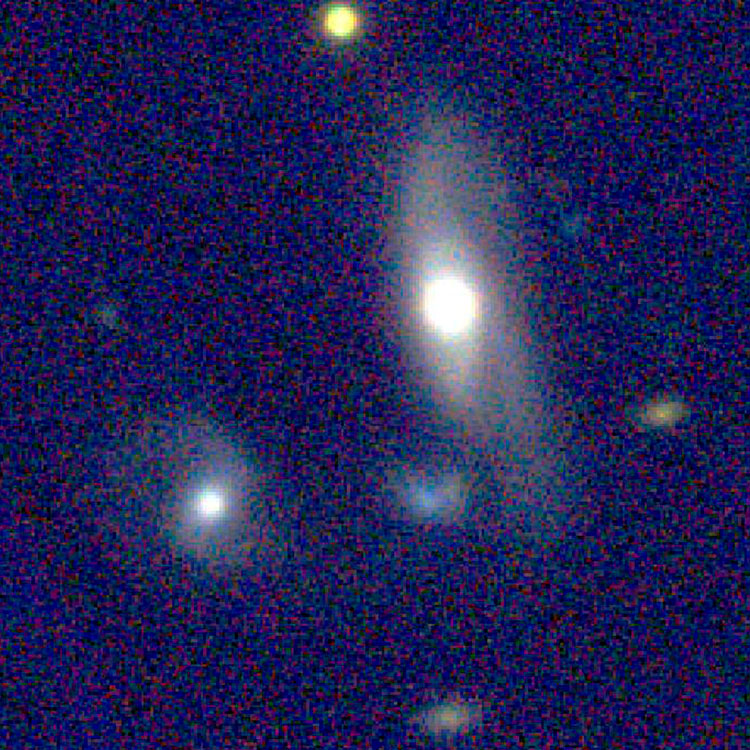
Physical Information: An interacting pair with PGC 198261, which is probably NGC 344. Apparent size of about 0.6 by 0.2 arcmin (from the images below), so about ? thousand light-years across. Vr 16575 km/sec, z 0.055288
The smudge just west of the southern rim of the galaxy is listed as GALEXASC J005824.25-231344.6, but nothing appears to be known about it save for its position (as indicated by its "title", RA 00 58 24.2, Dec -23 13 45), so whether it is a separate object or simply part of the distorted form of PGC 133741 is also unknown.
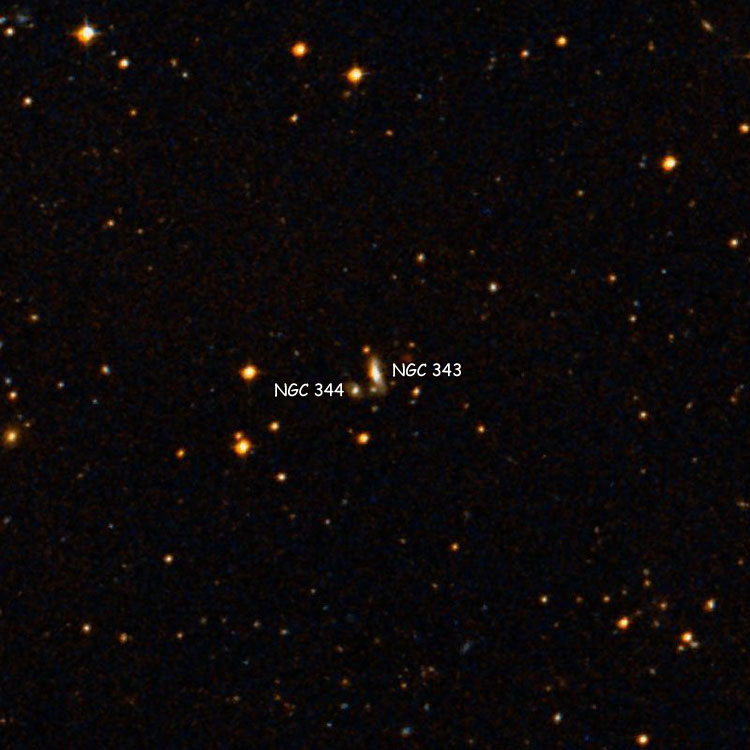
Above, a 12 arcmin wide DSS image centered on the probable NGC 343 and 344
Below, a 1 arcmin wide DSS image centered on the pair
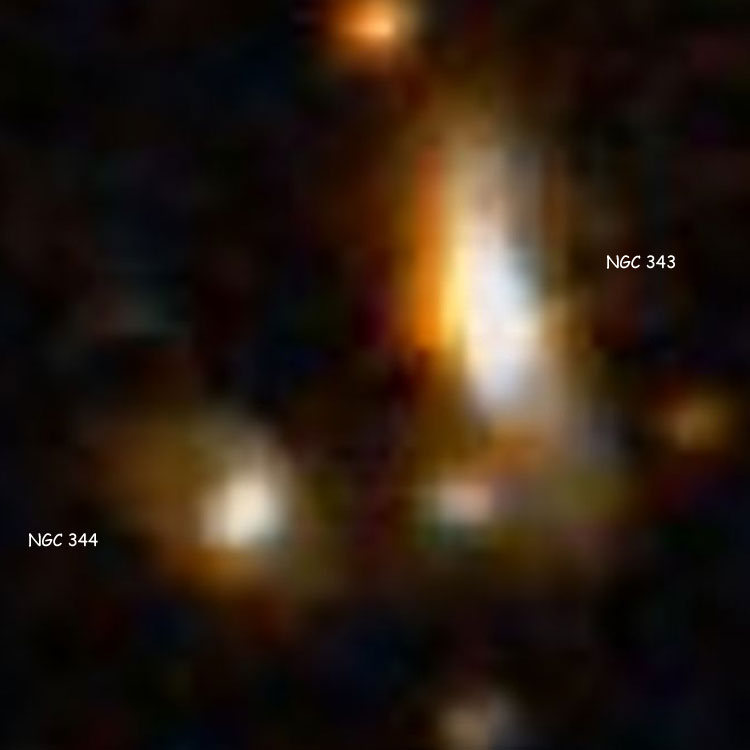
Below, a 1 arcmin wide PanSTARRS image of nearly the same region
Not an NGC object but listed here as an apparent companion of the putative NGC 343
(00 58 24.2, -23 13 45)
Physical Information:
NGC 344
(probably = PGC 198261 = PGC 803236)
Discovered (1886) by Frank Muller
Probably a magnitude 16.1 spiral galaxy (type SBb? pec) in Cetus (RA 00 58 25.4, Dec -23 13 45)
Historical Identification: Per Dreyer, NGC 344 (Muller list II (#298), 1860 RA 00 54 02, NPD 113 59.8) is "extremely faint, very small, irregularly round, suddenly brighter middle and nucleus (perhaps a star?)". The position and description are identical to NGC 343 save for being 1 arcmin further south, so NGC 343 and 344 should be a pair of nebulae separated by about an arcmin in the north-south direction. For that reason, see the entry for NGC 343 for a discussion of the NGC objects' more or less probable identification with PGC 133741 and 198261, and for images of the pair.
Physical Information: An interacting pair with PGC 133741, which is probably NGC 343. Apparent size of about 0.35 by 0.2 arcmin (from the images of NGC 343), so about ? thousand light-years across. Vr 16785 km/sec, z 0.055992
NGC 345
(= PGC 3665 = MCG -01-03-064)
Discovered (Sep 27, 1864) by Albert Marth
A magnitude 13.9 lenticular galaxy (type S0(rs)a?) in Cetus (RA 01 01 22.1, Dec -06 53 03)
Historical Identification: Per Dreyer, NGC 345 (= GC 5137, Marth #27, 1860 RA 00 54 17, NPD 97 38) is "very faint, very small, gradually brighter middle".
Physical Information: Apparent size of about 1.25 by 0.65 arcmin (from the images below).
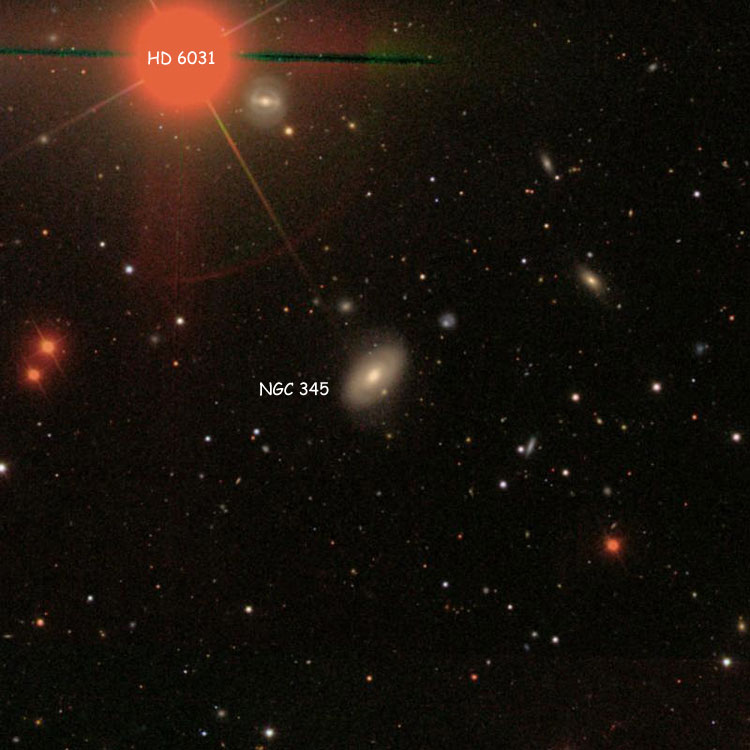
Above, a 12 arcmin wide SDSS image centered on NGC 345, also showing 7th magnitude HD 6031
Below, a 1.4 arcmin wide SDSS image of the galaxy

WORKING HERE: MULLING OVER THE FOLLOWING QUESTION
Note: The galaxy near HD 6031 is PGC 1028378; should I create an entry for it in the PGC pages?
NGC 346, in the Small Magellanic Cloud
(= ESO 051-SC010)
Discovered (Aug 1, 1826) by James Dunlop
Also observed (Apr 11, 1834) by John Herschel
An open cluster and emission nebula in Tucana (RA 00 59 04.2, Dec -72 10 41)
Historical Identification: Per Dreyer, NGC 346 (= GC 187 = JH 2370, Dunlop 25 (& 27), 1860 RA 00 54 20, NPD 162 56.1) is "bright, large, very irregular figure, much brighter middle similar to double star, mottled but not resolved".
Discovery Notes: Herschel (and therefore Dreyer) identify this as Dunlop 25, but Steinicke also lists Dunlop 27 as an observation of this object, hence the inclusion of that number in the NGC entry in parentheses.
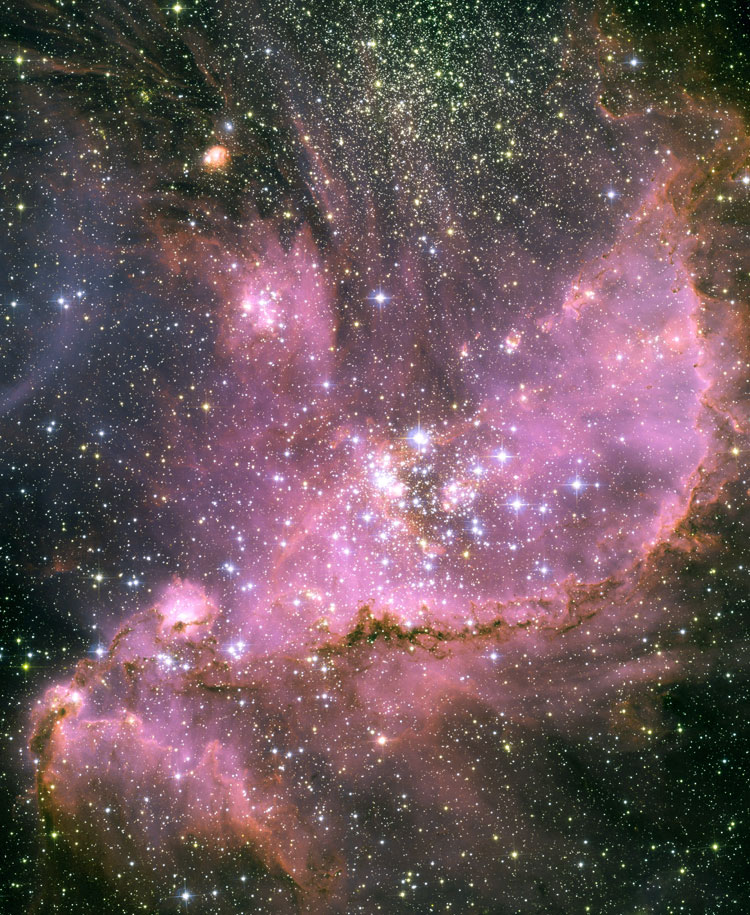
Physical Information: Apparent size 9.0 by 8.5 arcmin? The largest emission nebula in the Small Magellanic Cloud.

Above, a 12 arcmin wide DSS image of the region near NGC 346
Below, a 4 arcmin wide HST image of the central region (Image Credit NASA, ESA and A. Nota (STScI/ESA))
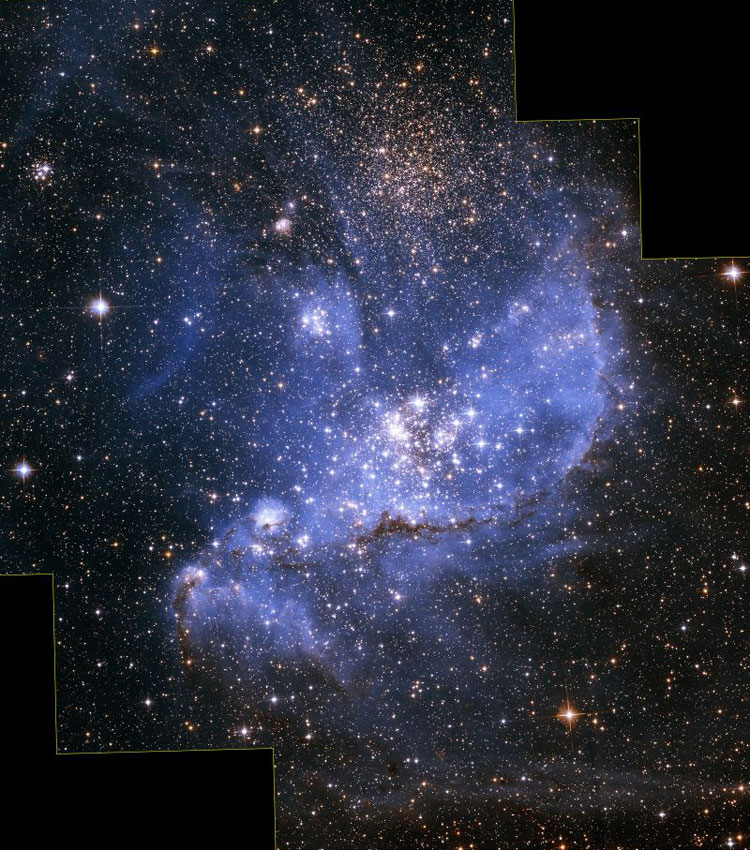
Below, a 2.5 arcmin wide HST image of the central region (Image Credit NASA/ESA/A. Nota (ESA/STScI/AURA))
NGC 347
(= PGC 3673 = MCG -01-03-063)
Discovered (Sep 27, 1864) by Albert Marth
A magnitude 14.8 spiral galaxy (type SBcd?) in Cetus (RA 01 01 35.1, Dec -06 44 01)
Corwin lists the position of a northwestern component at RA 01 01 35.1, Dec -06 44 01
and of a southeastern component at RA 01 01 35.2, Dec -06 44 01
Historical Identification: Per Dreyer, NGC 347 (= GC 5138 = Marth #28, 1860 00 54 31, NPD 97 30) is "very faint, very small". The position precesses to RA 01 01 35.4, Dec -06 44 43, right on the galaxy listed above, so the identification is certain. (Despite that, some references list other objects as NGC 347, so as is often the case, reading about some NGC object doesn't necessarily mean that the writer is referring to the same object as other authors; that is one reason for using a photographic as well as a text description for each entry.)
Note To Self: After finishing Historical Identification, should create entries for the objects misidentified as NGC 347.
Physical Information: Based on a recessional velocity of 5585 km/sec (and H0 = 70 km/sec/Mpc), NGC 347 is about 260 million light-years away. Given that and its apparent size of about 0.55 by 0.45 arcmin (from the images below), it is about 40 to 45 thousand light-years across.

Above, a 12 arcmin wide SDSS image centered on NGC 347, also showing NGC 349 and 350
The 'bright' star is 7th magnitude HD 6031 (also shown in the wide-field view of NGC 345)
Below, a 0.75 arcmin wide SDSS image of the galaxy
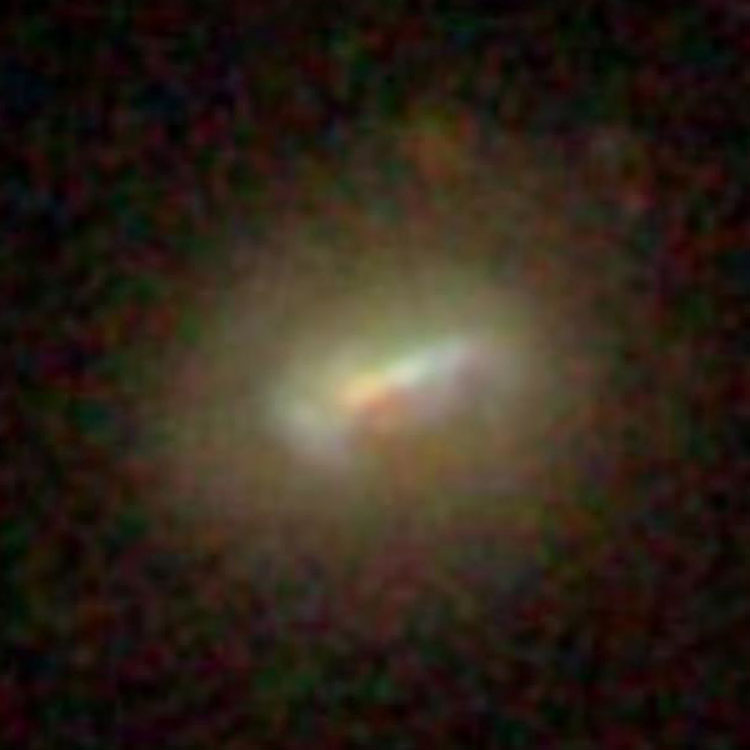
Not an NGC object but listed here as an apparent companion of NGC 347
(01 01 42.3, -06 42 53)
Physical Information:
NGC 348
(= PGC 3632 = ESO 151-017)
Discovered (Oct 3, 1834) by John Herschel
A magnitude 13.8 spiral galaxy (type Sb?) in Phoenix (RA 01 00 52.0, Dec -53 14 40)
Historical Identification: Per Dreyer, NGC 348 (= GC 188 = JH 2371, 1860 RA 00 54 45, NPD 143 59.8) is "extremely faint, small, round".
Physical Information: Apparent size of about 0.8 by 0.5 arcmin (from the images below).

Above, a 12 arcmin wide DSS image centered on NGC 348
Below, a 0.9 arcmin wide DSS image of the galaxy

NGC 349
(= PGC 3687 = MCG -01-03-068)
Discovered (Sep 27, 1864) by Albert Marth
A magnitude 13.1 lenticular galaxy (type E/S0?) in Cetus (RA 01 01 50.8, Dec -06 47 59)
Historical Identification: Per Dreyer, NGC 349 (= GC 5139, Marth #29, 1860 RA 00 54 47, NPD 97 34) is "very faint, very small".
Physical Information: Apparent size of about 1.45 by 1.4 arcmin (from the images below).

Below, a 12 arcmin wide SDSS image centered on NGC 349, also showing NGC 347 and 350
Below, a 2 arcmin wide SDSS image of the galaxy

|