QuickLinks:
6500, 6501, 6502, 6503, 6504, 6505, 6506, 6507, 6508, 6509, 6510, 6511, 6512, 6513, 6514, 6515, 6516,
6517, 6518, 6519, 6520, 6521, 6522, 6523, 6524, 6525, 6526, 6527, 6528, 6529, 6530, 6531, 6532, 6533,
6534, 6535, 6536, 6537, 6538, 6539, 6540, 6541, 6542, 6543, 6544, 6545, 6546, 6547, 6548, 6549
Page last updated Oct 2, 2023 (Working on fully completing the entry for NGC 6543 = Caldwell 6)
Page last updated Sep 5, 2023
(Added HST image for NGC 6541)
Page last updated Aug 25, 2023
(Added Caldwell Catalog & other IDs for NGC 6541)
Page last updated Aug 12, 2023
(Added Caldwell Catalog ID for NGC 6543)
Last prior update Aug 24, 2022
Updated and completed entry for globular cluster NGC 6540
Last prior update Oct 24, 2018 (some steps will have to be repeated beccause of updates)
Added Dreyer NGC entries
WORKING 6500: Add/update Steinicke listings/data, check IDs
WORKING: Try to make sense of the multitudinous entries (and discoverers) for various parts of M8
WORKING: Add labeled image of every wide-field Lagoon view and/or create page devoted to Lagoon
NGC 6500 (= PGC 61123)
Discovered (Jun 29, 1799) by William Herschel
Also observed (date?) by Édouard Stephan
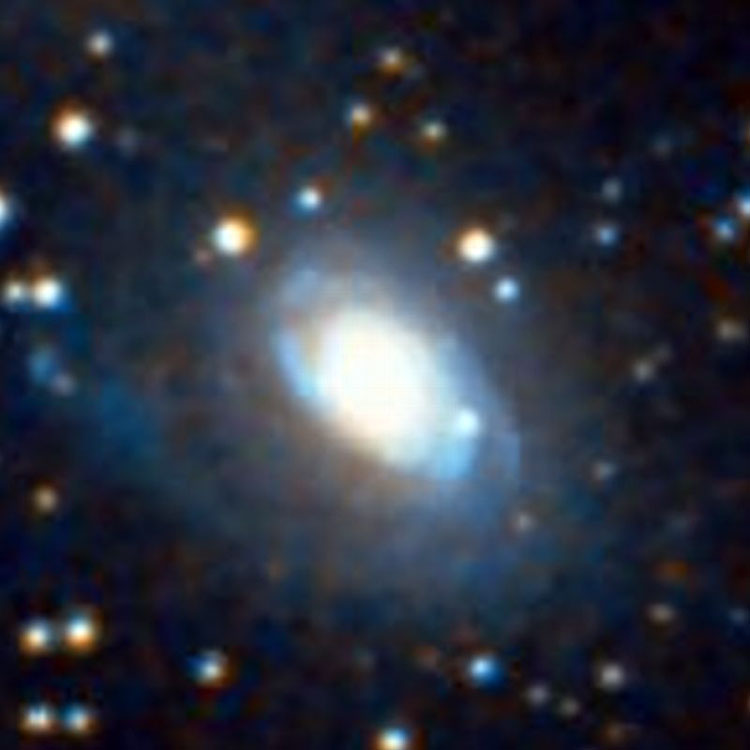
A 12th-magnitude spiral galaxy (type SAab?) in Hercules (RA 17 55 59.7, Dec +18 20 20)
Historical Identification: Per Dreyer, NGC 6500 (= GC 4348 = WH III 957, Stephan list XII (#??), 1860 RA 17 49 52, NPD 71 38.3) is "very faint, very small, southwestern of 2", the other being NGC 6501.
Physical Information: Based on a recessional velocity of 3005 km/sec, NGC 6500 is about 140 million light-years away. Given that and its apparent size of 2.2 by 1.6 arcmin, it is about 90 thousand light-years across. Since they are in nearly the same direction and at nearly identical distances, NGC 6500 and 6501 are almost certainly a physical pair.
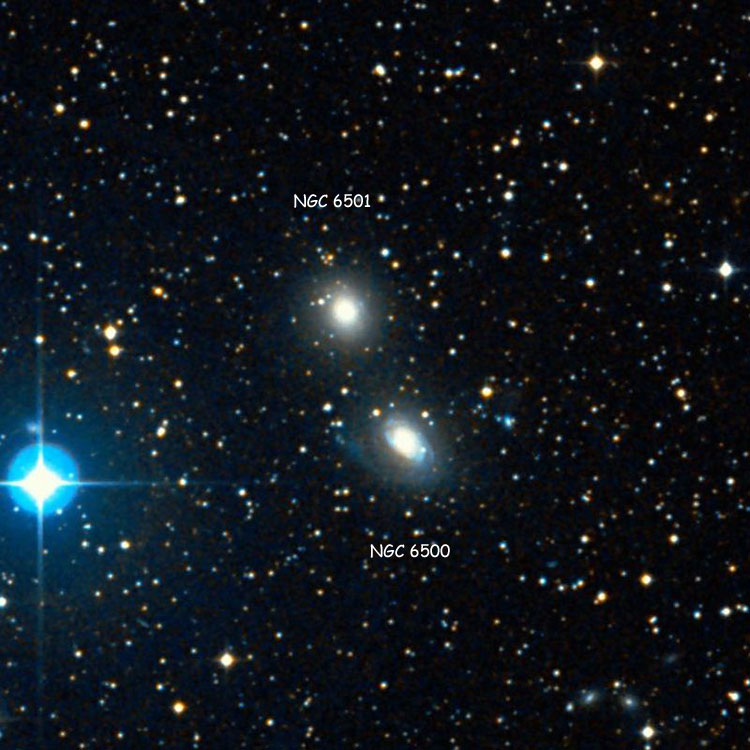
Above, a 12 arcmin wide DSS image centered between NGC 6500 and NGC 6501
Below, a 2.4 arcmin wide DSS image of NGC 6500
NGC 6501 (= PGC 61128)
Discovered (Jun 29, 1799) by William Herschel
Also observed (date?) by Édouard Stephan
A 12th-magnitude lenticular galaxy (type SA0) in Hercules (RA 17 56 03.7, Dec +18 22 25)
Historical Identification: Per Dreyer, NGC 6501 (= GC 4349 = WH III 958, Stephan list XII (#??), 1860 RA 17 49 56, NPD 71 36.2) is "very faint, very small, northeastern of 2", the other being NGC 6500.
Physical Information: Based on a recessional velocity of 3070 km/sec, NGC 6501 is about 145 million light-years away. Given that and its apparent size of 2.0 by 1.8 arcmin, it is about 85 thousand light-years across. Since they are in nearly the same direction and at nearly identical distances, NGC 6500 and 6501 are almost certainly a physical pair.
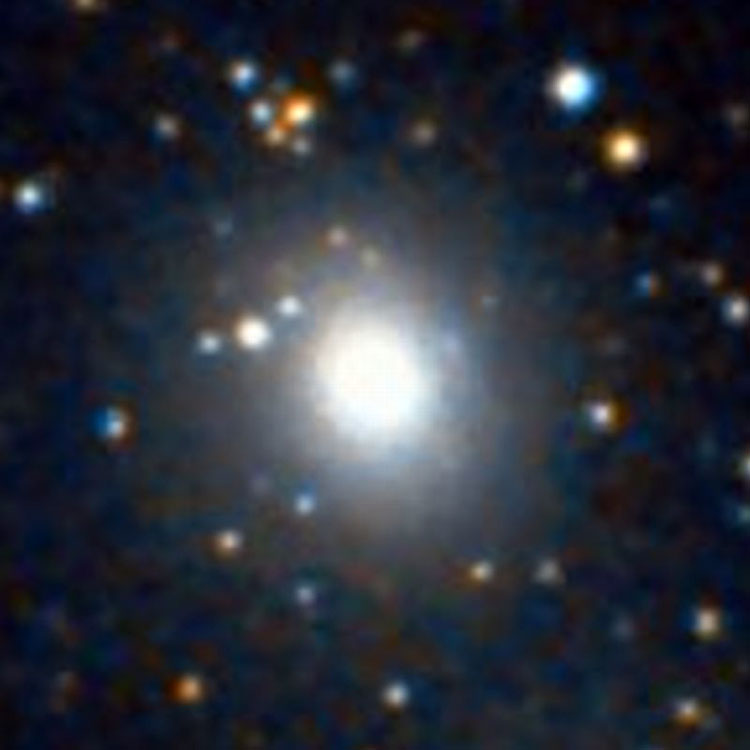
Above, a 2.4 arcmin wide DSS image of NGC 6501; see NGC 6500 for a wide-field image of the pair
NGC 6502 (= PGC 61352)
Discovered (Jun 20, 1835) by John Herschel
A 13th-magnitude lenticular galaxy (type E/S0?) in Pavo (RA 18 04 14.0, Dec -65 24 35)
Historical Identification: Per Dreyer, NGC 6502 (= GC 4350 = JH 3716, 1860 RA 17 50 20, NPD 155 24.0) is "very faint, very small, eastern star of double star involved".
Physical Information: Apparent size 1.3 by 1.1? arcmin
NGC 6503 (= PGC 60921)
Discovered (Jul 22, 1854) by Arthur von Auwers
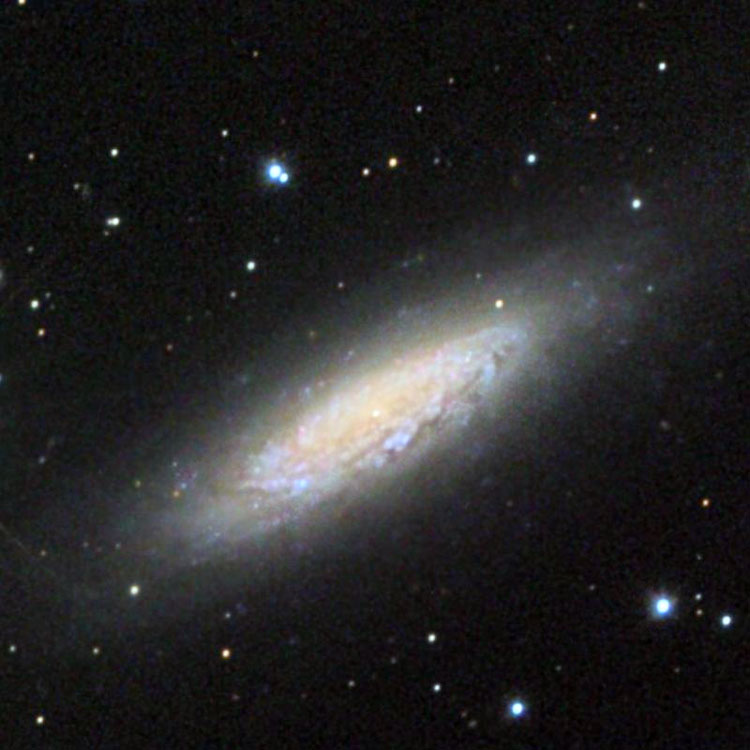
A 10th-magnitude spiral galaxy (type Sc?) in Draco (RA 17 49 27.5, Dec +70 08 37)
Historical Identification: Per Dreyer, NGC 6503 (= GC 4351, Auwers, 1860 RA 17 50 51, NPD 19 49.2) is "pretty faint, large, much extended, 9th magnitude star 4 arcmin to east (Auwers 37)". The second IC adds "is bright or pretty bright" (Dreyer gives no reference for the statement, but since the brightness is not specified in the NGC entry, it is probably also from Auwers, and merely accidentally omitted in the original entry).
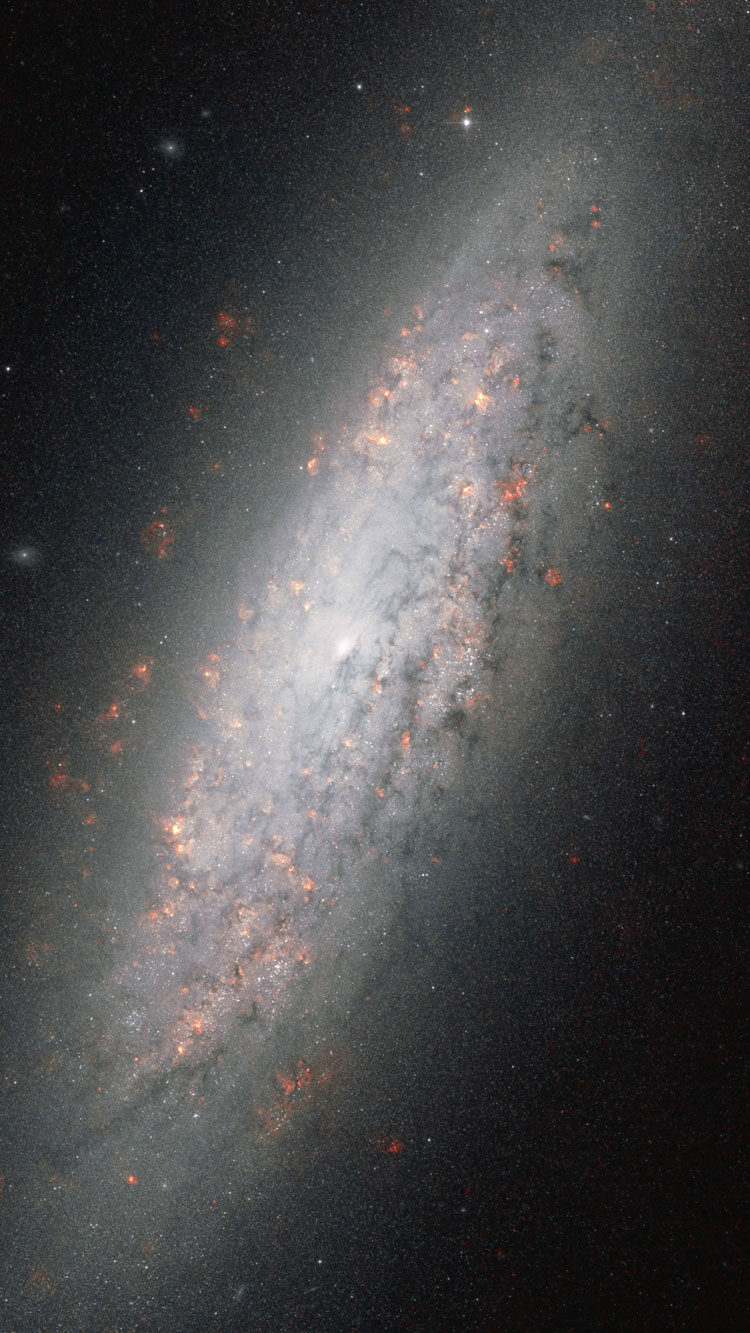
Physical Information: Apparent size 7.0 by 2.5? arcmin. Approximately 30 thousand light-years across and 17 million light-years away, this dwarf spiral lies in solitary splendor just inside the Local Void, a nearly empty region of space several tens of millions of light-years across bounded by our Local Group, the Hercules Cluster and the Coma Cluster.
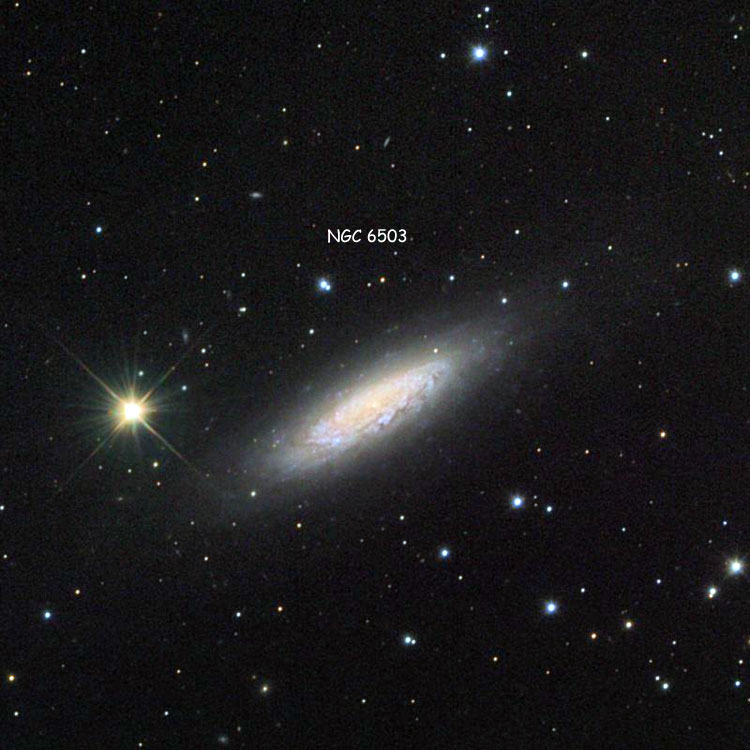
Above, a 12 arcmin wide image centered on NGC 6503
(Image Credit & © above and below Jim Misti, Misti Mountain Observatory; used by permission)
Below, a 6 arcmin wide image of the galaxy
Below, a 3.3 by 1.8 arcmin wide view of the central half of the galaxy (Image Credit ESA/Hubble, NASA)
(Only H-α (shown as red) and near-infrared radiation (shown as blue) was used to create the image)
NGC 6504 (= PGC 61129)
Discovered (Jul 27, 1864) by Albert Marth
A 13th-magnitude spiral galaxy (type S??) in Hercules (RA 17 56 05.6, Dec +33 12 31)
Historical Identification: Per Dreyer, NGC 6504 (= GC 5888, Marth #358, 1860 RA 17 50 55, NPD 56 46) is "faint, very much extended, suddenly brighter middle".
Physical Information: Apparent size 2.2 by 0.5? arcmin
NGC 6505 (= PGC 60995)
Discovered (Jun 27, 1884) by Lewis Swift
A 14th-magnitude lenticular galaxy (type E/S0?) in Draco (RA 17 51 07.3, Dec +65 31 53)
Historical Identification: Per Dreyer, NGC 6505 (Swift list IV (#60), 1860 RA 17 51 02, NPD 24 25.5) is "most extremely faint, very small, round".
Physical Information: Apparent size 1.1 by 1.0? arcmin
NGC 6506 (= OCL 16)
Discovered (Jul 29, 1834) by John Herschel
An open cluster (type III2p) in Sagittarius (RA 17 59 53.4, Dec -24 41 07)
Historical Identification: Per Dreyer, NGC 6506 (= GC 4352 = JH 3717, 1860 RA 17 51 11, NPD 114 38.4) is "a cluster, rich, extremely large, very little compressed".
Physical Information:
NGC 6507 (= OCL 32)
Discovered (Jun 27, 1786) by William Herschel
A 9th-magnitude open cluster (type IV2p) in Sagittarius (RA 17 59 50.0, Dec -17 27 00)
Historical Identification: Per Dreyer, NGC 6507 (= GC 4353 = WH VIII 53, 1860 RA 17 51 30, NPD 107 23.3) is "a cluster, pretty small, a little rich, a little compressed".
Physical Information: Apparent size 7.0? arcmin
NGC 6508 (= PGC 60938)
Discovered (Sep 19, 1883) by Ernst Hartwig
Also observed (date?) by Lewis Swift
A 13th-magnitude elliptical galaxy (type E0?) in Draco (RA 17 49 46.3, Dec +72 01 18)
Historical Identification: Per Dreyer, NGC 6508 (Swift list I (#??), Hartwig, 1860 RA 17 52 12, NPD 17 56.9) is "very faint, small, 3 stars near".
Physical Information: Apparent size 1.3 by 1.3? arcmin
NGC 6509 (= PGC 61230)
Discovered (Jul 20, 1879) by Édouard Stephan
A 13th-magnitude spiral galaxy (type SBcd?) in Ophiuchus (RA 17 59 25.3, Dec +06 17 14)
Historical Identification: Per Dreyer, NGC 6509 (Stephan list X (#36), 1860 RA 17 52 37, NPD 83 42.0) is "very faint, pretty large, irregularly round, a little brighter middle".
Physical Information: Apparent size 1.6 by 1.2? arcmin
NGC 6510 (= NGC 6511 = PGC 61086)
Discovered (Oct 9, 1884) by Lewis Swift (and later listed as NGC 6511)
Discovered (May 30, 1886) by Lewis Swift (and later listed as NGC 6510)
Also observed (date?) by Guillaume Bigourdan (while listed as NGC 6510 and NGC 6511)
A 14th-magnitude spiral galaxy (type SBc?) in Draco (RA 17 54 39.2, Dec +60 49 02)
Historical Identification: Per Dreyer, NGC 6510 (Swift list IV (#61), 1860 RA 17 52 43, NPD 29 10.2) is "most extremely faint, pretty small, a little extended, very difficult."
Physical Information: Apparent size 1.0 by 0.6? arcmin.
NGC 6511 (= NGC 6510 = PGC 61086)
Discovered (Oct 9, 1884) by Lewis Swift (and later listed as NGC 6511)
Discovered (May 30, 1886) by Lewis Swift (and later listed as NGC 6510)
Also observed by Guillaume Bigourdan (while listed as NGC 6510 and NGC 6511)
A 14th-magnitude spiral galaxy (type SBc?) in Draco (RA 17 54 39.2, Dec +60 49 02)
Historical Identification: Per Dreyer, NGC 6511 (Swift list I (#83), 1860 RA 17 53 23, NPD 29 10.3) is "faint, pretty large, brighter middle, (? = last one)", the last comment indicating that Dreyer thought it might be the same as NGC 6510, which turned out to be the case. However, the second IC listed a corrected RA (per Bigourdan) for NGC 6511 of 17 53 06, and added "6510 is 44 seconds to the west", so the suspected duplication of the entries was (incorrectly) abandoned for a long time.
Physical Information: Given the duplicate entry, see NGC 6510 for anything else.
NGC 6512 (= PGC 61089)
Discovered (Oct 27, 1861) by Heinrich d'Arrest
Also observed (date?) by Lewis Swift
A 14th-magnitude lenticular galaxy (type E/S0?) in Draco (RA 17 54 50.2, Dec +62 38 44)
Historical Identification: Per Dreyer, NGC 6512 (= GC 4354, d'Arrest, Swift list III (#??), 1860 RA 17 53 43, NPD 27 20.5) is "very faint, round, 1st of 3", the others being NGC 6516 and 6521.
Physical Information: Apparent size 0.5 by 0.4? arcmin
NGC 6513 (= PGC 61235)
Discovered (Aug 7, 1864) by Albert Marth
Also observed (date?) by Édouard Stephan
A 13th-magnitude lenticular galaxy (type SB0?) in Hercules (RA 17 59 34.3, Dec +24 53 15)
Historical Identification: Per Dreyer, NGC 6513 (= GC 5889, Marth #359, Stephan list I (#??), 1860 RA 17 53 51, NPD 65 06.1) is "very faint, very small, stellar".
Physical Information: Apparent size 1.2 by 0.9? arcmin
NGC 6514 (= M20 = OCL 23) -- The Trifid Nebula
Discovered (Jun 5, 1764) by Charles Messier
Also observed (date?) by William Herschel
Also observed (date?) by John Herschel
An 8th-magnitude emission nebula and open cluster in Sagittarius (RA 18 02 42.0, Dec -22 58 18)
Historical Identification: Per Dreyer, NGC 6514 (= GC 4355 = JH 1991 = JH 3718 = WH IV 41, WH V 10 & 11 & 12, M 20, 1860 RA 17 53 54, NPD 113 01.5) is "a magnificent or otherwise interesting object, very bright, very large, trifid, double star involved".
Physical Information: The name of the nebula refers to the way that dust lanes lying in front of it seem to divide it into three lobes. It consists of emission and reflection nebulae energized and lit up by hot, bright young stars recently formed from the gas and dust in the nebula, and actively heating and eating away at the remaining gas. The Trifid Nebula is probably around 6000 light-years away, but distance estimates range from 3000 to 9000 light-years, so the distance is very uncertain. If at 6000 light-years distance, the 20 arcmin apparent size of the nebula would correspond to about 100 light-years.
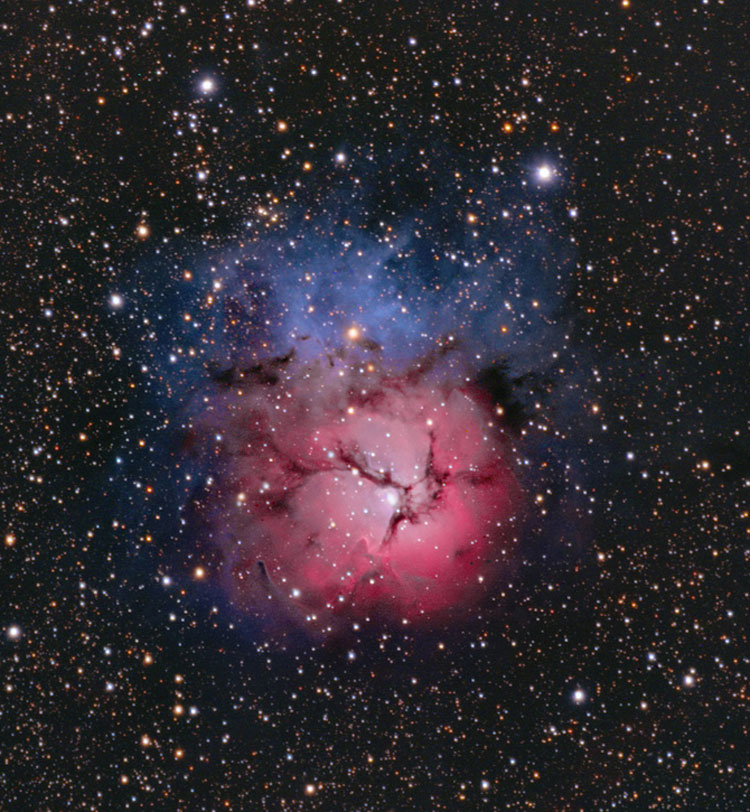
Above, a ? arcmin wide image of the region near NGC 6514 (Credit Hunter Wilson, Wikimedia Commons)
Below, a half degree wide DSS image of the nebula

Below, a ? arcmin wide image of the nebula (Credit and © Jim Misti, Misti Mountain Observatory; used by permission)
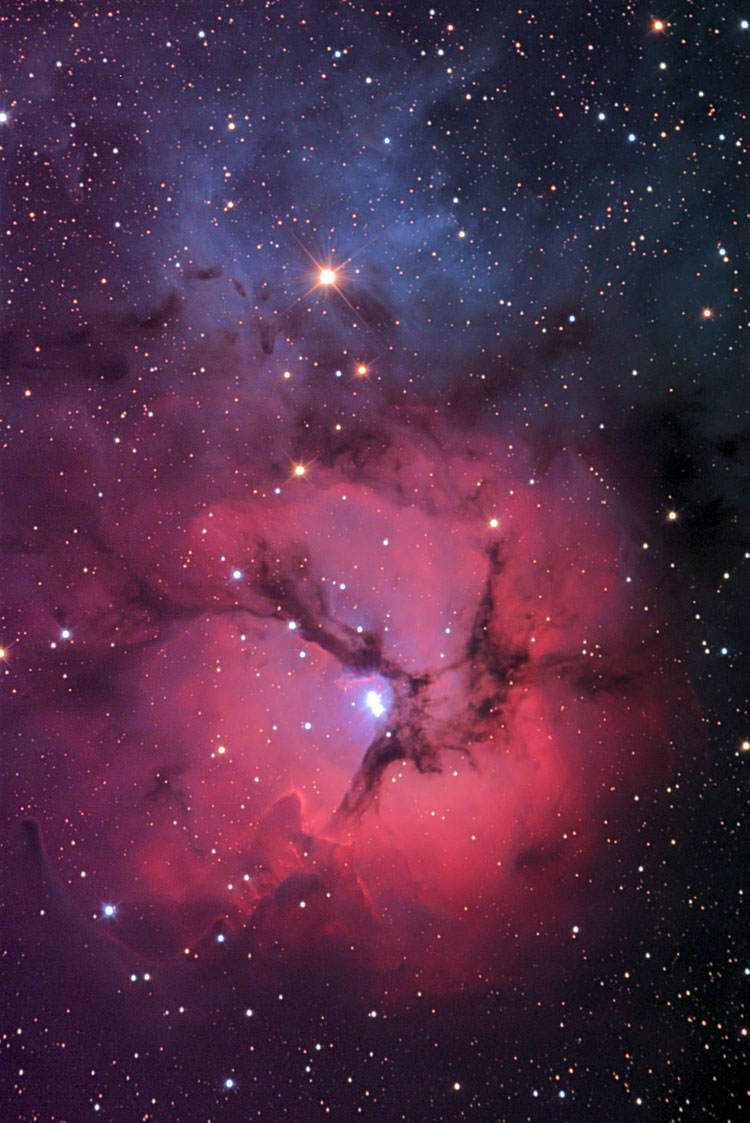
Below, a ? arcmin wide "finding chart" for the the WFPC2 image field that follows
(Credit: Jeff Hester (Arizona State University), Palomar Observatory, HubbleSite)

Below, a ? arcmin wide HST image of a stellar nursery being torn apart by radiation from nearby stars
The stellar "jets" represent dense regions of gas and dust being evaporated by the radiation
(Credit: Jeff Hester (Arizona State University), NASA)

Below, a ? arcmin wide infrared view of M20 penetrates its dusty cocoon (Image Credit IRAC/MIPS/Spitzer)

NGC 6515 (= PGC 61167)
Discovered (Jul 2, 1884) by Lewis Swift
A 13th-magnitude elliptical galaxy (type E4?) in Draco (RA 17 57 25.3, Dec +50 43 39)
Historical Identification: Per Dreyer, NGC 6515 (Swift list III (#99), 1860 RA 17 54 08, NPD 39 14.6) is "very faint, very small, round, 2 bright stars near".
Physical Information: Apparent size 1.6 by 1.0? arcmin
NGC 6516 (= PGC 61109)
Discovered (Oct 27, 1861) by Heinrich d'Arrest
Also observed (date?) by Lewis Swift
A 15th-magnitude spiral galaxy (type S??) in Draco (RA 17 55 16.6, Dec +62 40 10)
Historical Identification: Per Dreyer, NGC 6516 (= GC 4356, d'Arrest, Swift list III (#??), 1860 RA 17 54 09, NPD 27 18.5) is "very faint, very small, 2nd of 3", the others being NGC 6512 and 6521.
Physical Information: Apparent size 0.5 by 0.2? arcmin
NGC 6517 (= GCL 81)
Discovered (Jun 16, 1784) by William Herschel
Also observed (date?) by John Herschel
A 10th-magnitude globular cluster (type IV) in Ophiuchus (RA 18 01 50.6, Dec -08 57 30)
Historical Identification: Per Dreyer, NGC 6517 (= GC 4357 = JH 3719 = WH II 199, 1860 RA 17 54 11, NPD 98 57.2) is "pretty bright, pretty large, round, partially resolved (some stars seen)".
Physical Information: Apparent size 4.0? arcmin
NGC 6518 (= PGC 61238)
Discovered (Jun 18, 1884) by Édouard Stephan
A 14th-magnitude compact galaxy (type C??) in Hercules (RA 17 59 43.6, Dec +28 52 02)
Historical Identification: Per Dreyer, NGC 6518 (Stephan list XIII (#87), 1860 RA 17 54 17, NPD 61 07.5) is "Two very faint close stars in very faint, very small nebula".
Physical Information: Apparent size 0.4 by 0.4? arcmin
NGC 6519
Discovered (October, 1860) by Julius Schmidt
A group of stars in Sagittarius (RA 18 03 20.1, Dec -29 48 14)
Historical Identification: Per Dreyer, NGC 6519 (= GC 5890, J. Schmidt, 1860 RA 17 54 23, NPD 119 48.1) is "very faint, northwest of I 49", (WH) I 49 being NGC 6522.
Physical Information:
NGC 6520 (= OCL 10)
Discovered (May 24, 1784) by William Herschel
Also observed (date?) by John Herschel
An 8th-magnitude open cluster (type I2m) in Sagittarius (RA 18 03 25.0, Dec -27 53 28)
Historical Identification: Per Dreyer, NGC 6520 (= GC 4358 = JH 3721 = WH VII 7, 1860 RA 17 54 36, NPD 117 53.5) is "a cluster, pretty small, rich, a little compressed, stars from 9th to 13th magnitude".
Physical Information: Apparent size 5.0? arcmin
NGC 6521 (= PGC 61121)
Discovered (Oct 27, 1861) by Heinrich d'Arrest
Also observed (date?) by Lewis Swift
A 13th-magnitude elliptical galaxy (type E2?) in Draco (RA 17 55 48.3, Dec +62 36 42)
Historical Identification: Per Dreyer, NGC 6521 (= GC 4360, d'Arrest, Swift list III (#??), 1860 RA 17 54 38, NPD 27 22.0) is "faint, pretty large, 3rd of 3", the others being NGC 6512 and 6516.
Physical Information: Based on a recessional velocity of 8235 km/sec, NGC 6521 is about 380 million light-years away. Given that and its apparent size of 1.6 by 1.3? arcmin, it is about 180 thousand light-years across. It is a Seyfert galaxy (type Sy 1.9).
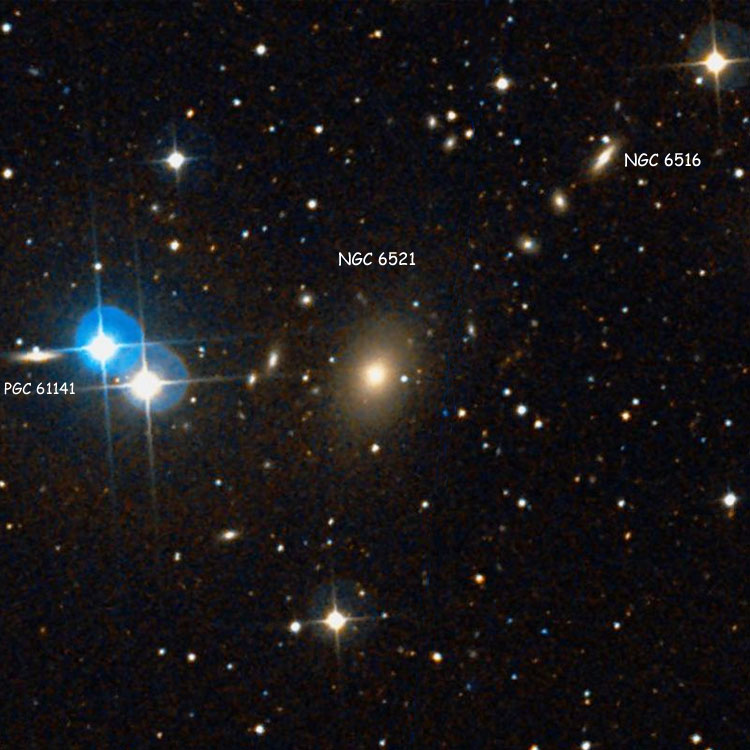
Above, a 12 arcmin wide DSS image centered on NGC 6521, also showing NGC 6516 and PGC 61141
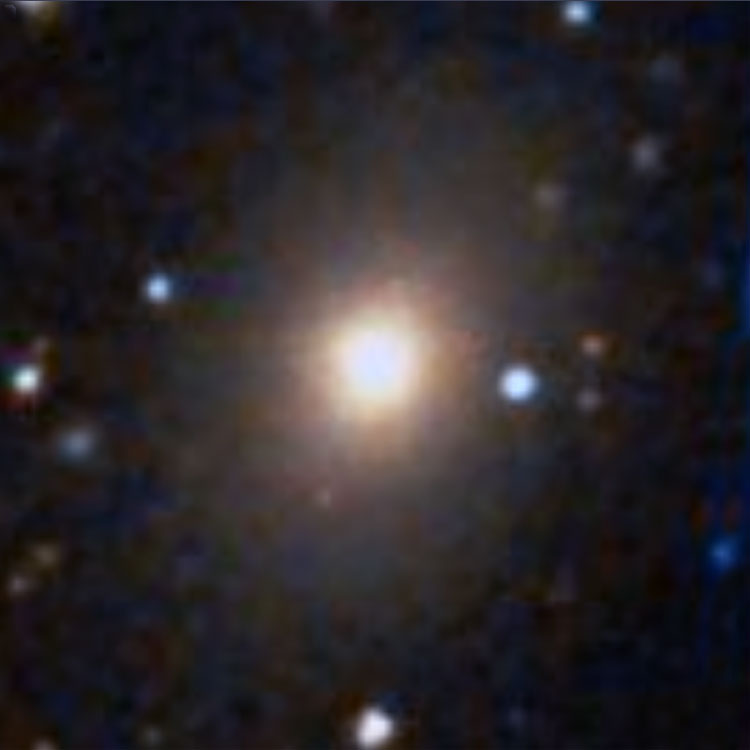
Below, a 2.4 arcmin wide DSS image of the galaxy
PGC 61141 (= "NGC 6521A")
Not an NGC object but listed here since sometimes called NGC 6521A
A 15th-magnitude spiral galaxy (type Sc?) in Draco (RA 17 56 34.8, Dec +62 37 01)
Physical Information: Based on a recessional velocity of 7685 km/sec, PGC 61141 is about 360 million light-years away. Given that and its apparent size of 0.8 by 0.25 arcmin, it is about 85 thousand light-years across. The difference in the radial velocities of PGC 61141 and NGC 6521 suggests that they are merely an optical double. Even in the unlikely event that they are at the same distance and their different radial velocities represent a peculiar (non-Hubble expansion) relative velocity, the large difference in recessional velocity means they cannot be gravitationally bound.
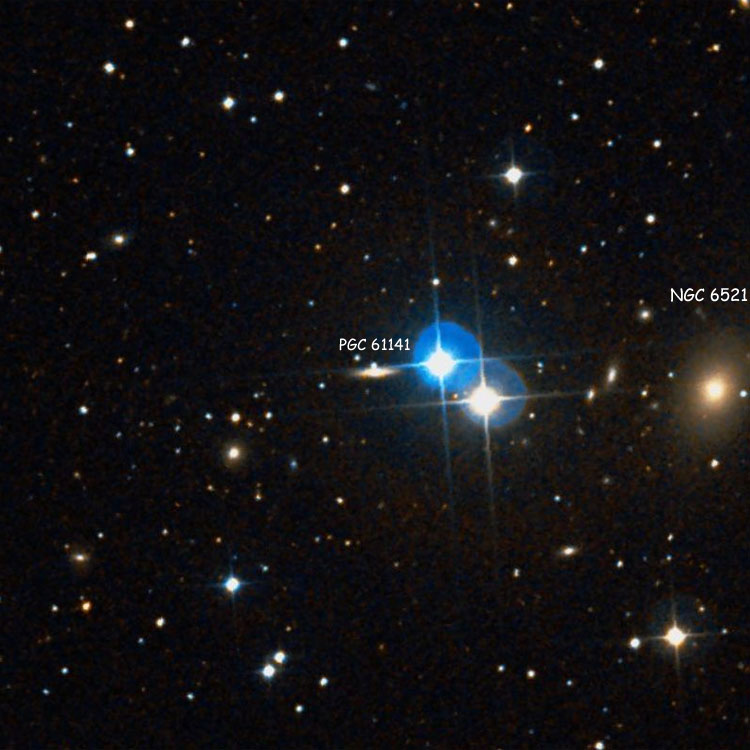
Above, a 12 arcmin wide DSS image centered on PGC 61141, also showing NGC 6521
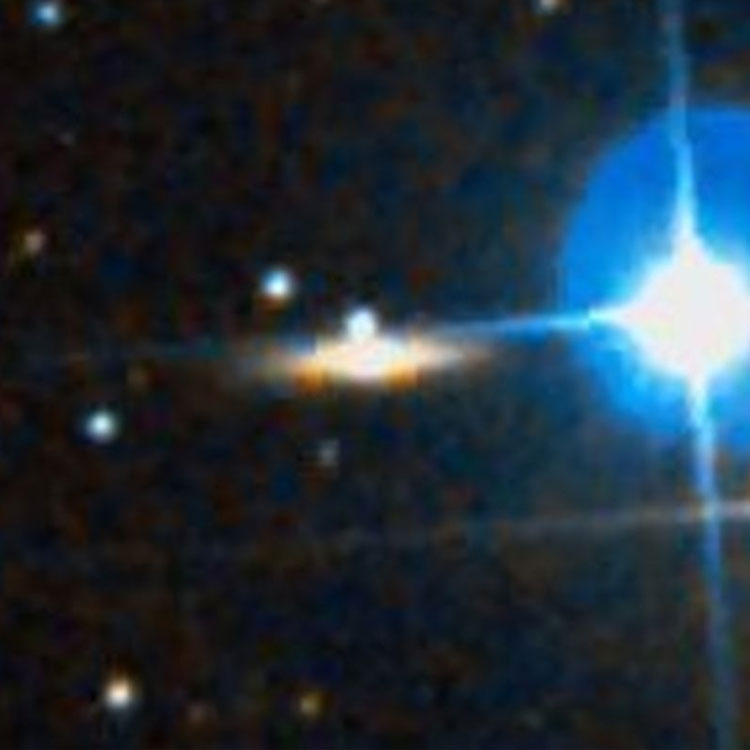
Below, a 2.4 arcmin wide DSS image of the galaxy
NGC 6522 (= GCL 82)
Discovered (Jun 24, 1784) by William Herschel
Also observed (date?) by John Herschel
A 10th-magnitude globular cluster (type VI) in Sagittarius (RA 18 03 34.2, Dec -30 02 00)
Historical Identification: Per Dreyer, NGC 6522 (= GC 4359 = JH 3720 = WH I 49, 1860 RA 17 54 40, NPD 120 02.0) is "a globular cluster, bright, pretty large, round, gradually very much brighter middle, well resolved, clearly consisting of stars, stars from 16th magnitude".
Physical Information: Apparent size 9.4? arcmin. Located within Baade's Window, a region where the Milky Way is less obscured by dust than usual.

Above, a 12 arcmin wide region centered on NGC 6522
(Image Credit above and below NOAO/AURA/NSF)
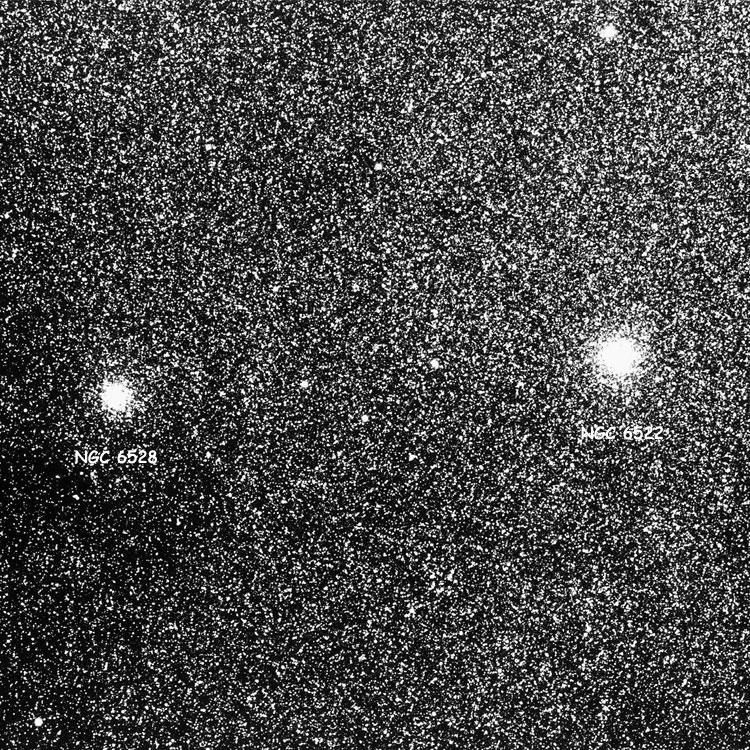
Below, a 24 arcmin wide region centered between NGC 6522 and NGC 6528
NGC 6523 (part of M8, the Lagoon Nebula)
Recorded (before 1654) by Giovanni Hodierna (II 6)
Discovered (1680) by John Flamsteed (2446)
Discovered (1746) by Philippe de Ch seaux
Discovered (1747) by Guillaume Le Gentil
Discovered (1751-52) by Nicolas Lacaille
Recorded (May 23, 1764) by Charles Messier as M8
Also observed (May 13, 1834) by John Herschel
An emission nebula and stellar birthplace in Sagittarius (RA 18 03 42.0, Dec -24 22 48)
Historical Identification: (See Giovanni Hodierna for a discussion of why none of his discoveries were credited in the NGC/IC catalogs.) Per Dreyer, NGC 6523 (= GC 4361 = JH 3722, Lacaille III 13, M 8, 1860 RA 17 55 06, NPD 114 22.8) is "a magnificent or otherwise interesting object, very bright, extremely large, extremely irregular figure, with large cluster". (Dreyer's ignoring Le Gentil's observation in favor of Lacaille's of 1751 is the least of many unkind fates visited upon Le Gentil during and after his eleven year expedition to observe the transits of Venus.) The position precesses to (2000) RA 18 03 41.1, Dec -24 22 56, dead center on the brightest part of the Lagoon Nebula, so the identification is certain. The only question is how the numerical listings should be used. It should be kept in mind that in Dreyer's day, "The Lagoon Nebula" only referred to the brighter regions visible with the eye (admittedly, with the aid of a telescope). The much larger luminous structure visible with modern photographic technology, which has usurped the title, was not part of the original Lagoon; so although the Lagoon is often referred to as NGC 6523 or M8, neither of those terms included the fainter regions which make up the modern Lagoon. Instead, several NGC/IC listings refer to various parts of what is now referred to as "M8", "NGC 6523", or "The Lagoon Nebula":
The brightest part of the nebula, to the northwest of its historical center, is NGC 6523. The fainter region to the southeast is NGC 6526. The combination of those two regions is William Herschel's NGC 6533, and in Dreyer's day would have been considered the entire Lagoon Nebula. In fact the open cluster NGC 6530 was listed as being to the east of M8, despite being more nearly in the center of the "modern" Lagoon. (The labeled image below shows the three distinct structures, but does not indicate the identity of NGC 6533, which see for further discussion. Additional regions located still further to the east, IC 1271 and 4678, are not labeled in the current version of the image but will be added when the entries for the Lagoon are finalized.)
Discovery Notes: Given the difficulties involved in separating faint nebulous objects from faint clusters, which of the parts of M8 should be attributed to a given discoverer is not clear. The list of discoverers above includes all known observers of the region prior to and including Messier; but some of them might need to have their observations assigned to different parts of the nebula (to be dealt with in a later iteration of this page).
Physical Information:
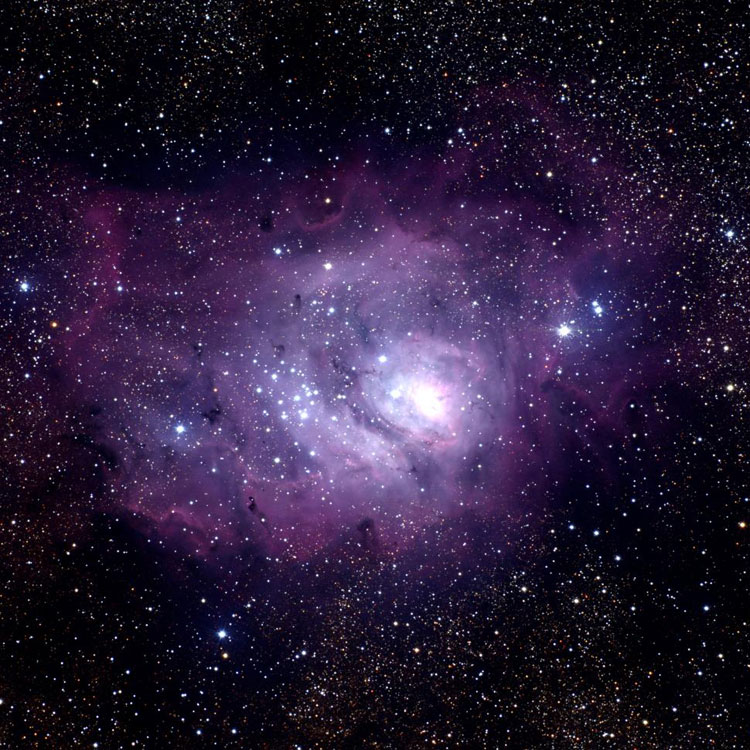
Above, a ? arcmin wide view of the Lagoon Nebula (Image Credit N.A.Sharp, REU program/NOAO/AURA/NSF)
Below, a labeled version of the image above, showing NGC 6523, 6526, and 6530

Below, a ? arcmin wide image of NGC 6523
(Image Credit Jack Harvey and Tom Doughtery/Adam Block/NOAO/AURA/NSF)

Below, a 7.5 arcmin wide image showing the location of the following HST images (Image Credit TBA)
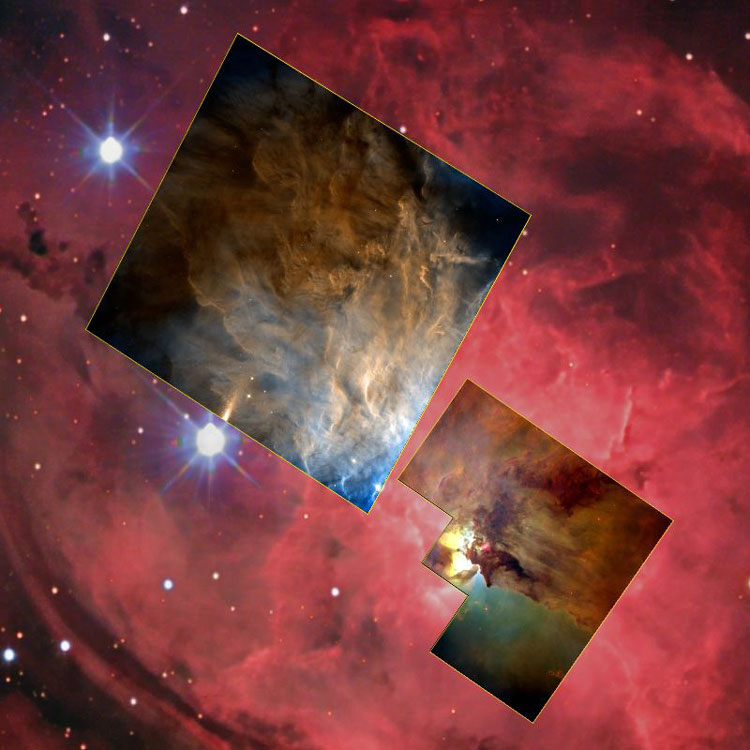 Below, a ? arcmin wide HST image of the region near the "Hourglass" (shown in the upper left corner of the image), the brightest part of the Lagoon Nebula. The reddish star near the Hourglass is actually a very hot bluish-white star seen through clouds of obscuring dust. The star is heating up the surrounding gas, evaporating and blowing it away, and apparently contorting it into "twisters" (at the far upper left); but whether the gas in the twisters is actually spiraling as in an earthly tornado or is simply evaporating in what appears to be a twisted shape remains to be determined by a future generation of telescopes. (Image Credit A. Caulet (ST-ECF, ESA) and NASA)
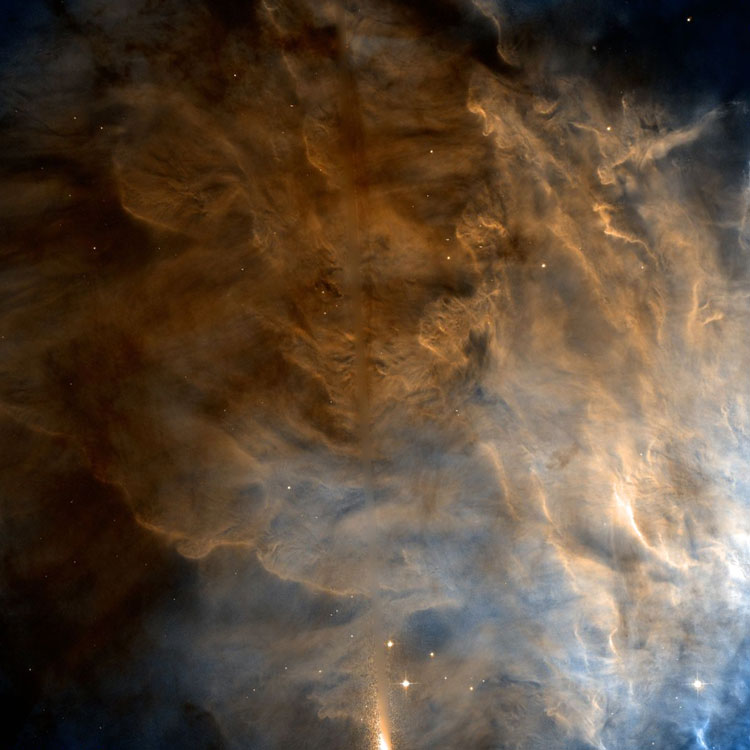
Below, a ? arcmin wide image of the upper left corner of the HST image above (Image credit as above)

Below, complex structures caused by heat-driven gas flow (Image Credit NASA, ESA, HST)
NGC 6524 (= PGC 61221)
Discovered (Oct 22, 1886) by Lewis Swift
A 13th-magnitude lenticular galaxy (type E/S0?) in Hercules (RA 17 59 14.8, Dec +45 53 17)
Historical Identification: Per Dreyer, NGC 6524 (Swift list V (#82), 1860 RA 17 55 12, NPD 44 04.8) is "pretty faint, pretty small, a little extended".
Physical Information: Apparent size 1.4 by 1.0? arcmin
NGC 6525
Discovered (Jul 29, 1829) by John Herschel
An open cluster in Ophiuchus (RA 18 02 06.0, Dec +11 01 31)
Historical Identification: Per Dreyer, NGC 6525 (= GC 4362 = JH 1992, 1860 RA 17 55 28, NPD 78 57.1) is "a cluster, poor, stars large".
Physical Information: Apparent size 4.0? arcmin
NGC 6526 (part of M8, the Lagoon Nebula)
Discovered (May 22, 1784) by William Herschel
Looked for but not observed (date?) by Herbert Howe
An emission nebula and stellar birthplace in Sagittarius (RA 18 04 06.0, Dec -24 26 30)
Historical Identification: Per Dreyer, NGC 6526 (= GC 4363 = WH V 9, 1860 RA 17 55 40, NPD 113 27.5) is "faint, large, extremely extended". The second IC added (per Howe) "Only very faint stars", the reason being that the position was off by a degree, as discussed in the next sentence. The position precesses to (2000) RA 18 04 11.5, Dec -23 27 31, a degree north of the proper place; but (per Corwin) although not mentioned in the NGC, Dreyer (later) wrote a separate paper about Herschel's observations, in which he noted a one degree error in Caroline Herschel's reduction of her brother's data for this object, so the identification is certain (presuming an error of exactly one degree, a corrected precessed position would be RA 18 04 15.4, Dec -24 27 31, well within the region considered to be NGC 6526). As noted at NGC 6523, there are several NGC/IC listings for the "modern" Lagoon Nebula. NGC 6526 is the moderately bright region between NGC 6523, the brightest part of the nebula, and NGC 6530, an open cluster recently formed from the gas and dust surrounding it. The labeled image below shows their relative positions.
Physical Information:
Above, a ? arcmin wide labeled image of the Lagoon, showing NGC 6523, 6526, and 6530
(Image Credit N.A.Sharp, REU program/NOAO/AURA/NSF)
Below, the "Southern Cliff" in the Lagoon (Image Credit Julia I. Arias and Rodolfo H. Barb
(Dept. Fisica, Univ. de La Serena), ICATE-CONICET, Gemini Observatory/AURA)
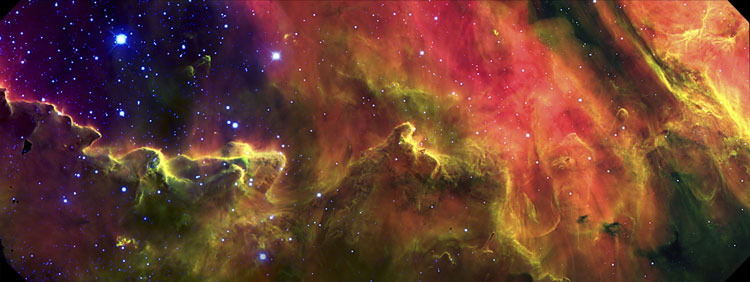
Below, a finding chart for the image above (Image Credit as above, and NOAO; also see NGC 6533)
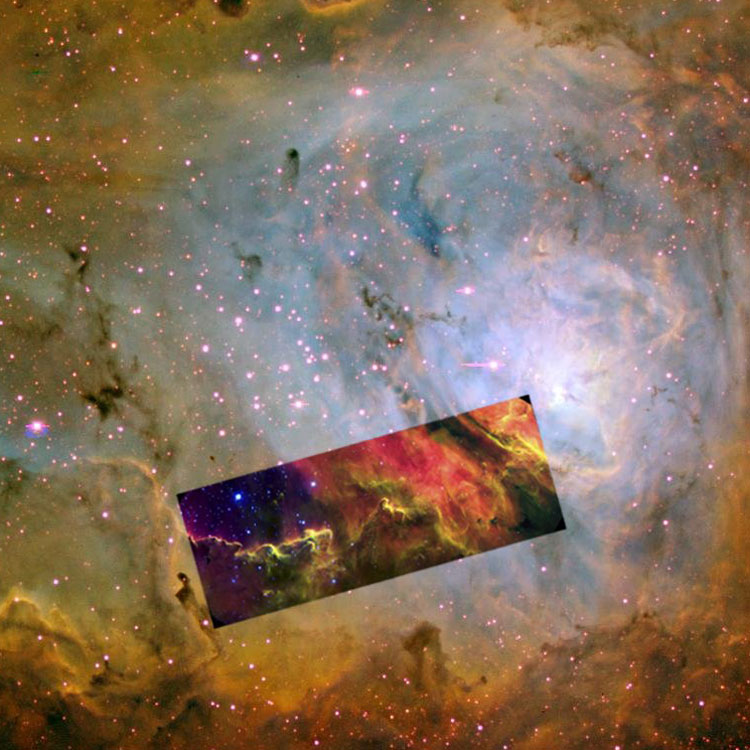
Below, a cropped Misti Mountain image of M8 shows NGC 6526 at bottom right, NGC 6530 at top left, and the "Southern Cliff" stretching across the bottom of the cutout (Image Credit and © Jim Misti, Misti Mountain Observatory; used by permission)
NGC 6527 (= PGC 61297)
Discovered (Aug 1, 1866) by Truman Safford
Also observed (date?) by Lewis Swift
A 13th-magnitude spiral galaxy (type Sa?) in Hercules (RA 18 01 46.2, Dec +19 43 45)
Historical Identification: Per Dreyer, NGC 6527 (Swift list IV (#??), (Safford 46), 1860 RA 17 55 40, NPD 70 17.6) is "most extremely faint, very small, round".
Discovery Notes: Dreyer did not become aware of Safford's observations until the NGC was nearly ready for publication; as a result, Safford's work was only noted in an appendix and none of the NGC entries mentioned his observations (hence the reference to his observation being placed in parentheses).
Physical Information: Apparent size 1.4 by 1.0? arcmin
NGC 6528 (= GCL 84)
Discovered (Jun 24, 1784) by William Herschel
Also observed (date?) by John Herschel
A 10th-magnitude globular cluster (type V) in Sagittarius (RA 18 04 49.6, Dec -30 03 19)
Historical Identification: Per Dreyer, NGC 6528 (= GC 4364 = JH 3723 = WH II 200, 1860 RA 17 55 51, NPD 120 03.5) is "a globular cluster, pretty faint, considerably small, round, gradually brighter middle, well resolved, clearly consisting of stars, stars from 16th magnitude".
Physical Information: Apparent size 5.0? arcmin. Located within Baade's Window, a region of the Milky Way relatively unobscured by dust.

Above, a 12 arcmin wide region centered on NGC 6528; see NGC 6522 for a wide-field view
(Image Credit NOAO/AURA/NSF)
NGC 6529
Recorded (Sep 3, 1826) by James Dunlop
Also observed (date?) by John Herschel
A lost or nonexistent object in Sagittarius (RA 18 05 29.0, Dec -36 17 48)
Historical Identification: Per Dreyer, NGC 6529 (= GC 4365 = JH 3724, Dunlop 569, 1860 RA 17 56 02, NPD 126 18.1) is "a cluster in the Milky Way".
NGC 6530 (= OCL 19, part of M8, the Lagoon Nebula)
Recorded (before 1654) by Giovanni Hodierna
Also observed (date?) by John Herschel
A 5th-magnitude open cluster (type II2mn) in Sagittarius (RA 18 04 30.0, -24 21 30)
Historical Identification: Per Dreyer, NGC 6530 (= GC 4366 = JH 3725, 1860 RA 17 56 06, NPD 114 20.0) is "a cluster, bright, large, pretty rich, to the east of M8", meaning to the east of the brighter regions of the Lagoon Nebula, listed as NGC 6523 and 6526. The position precesses to (2000) RA 18 04 40.9, Dec -24 19 55, which is well within the bounds of the cluster; but even if it were not, the description of the location makes the identification certain. As noted at NGC 6523, there are several NGC/IC listings for the "modern" Lagoon Nebula. NGC 6523 and NGC 6526 comprise the historical definition of the Lagoon, while NGC 6530 lies to their east, as noted by Dreyer. The labeled image below shows their relative positions.
Physical Information: The cluster has an apparent size of 15 arcmin.
Above, a ? arcmin wide labeled image of the Lagoon Nebula, showing NGC 6523 (which see for image credits), 6526, and 6530. Note that although NGC 6530 is to the east of the "original" Lagoon, the much larger luminous region that is now called the Lagoon Nebula fills most of this image and extends well to the east of the cluster and well to the west of the brighter regions which used to hold that title. Below, an image of the historical Lagoon and NGC 6530 (Image Credit & © Jim Misti, Misti Mountain Observatory; used by permission)
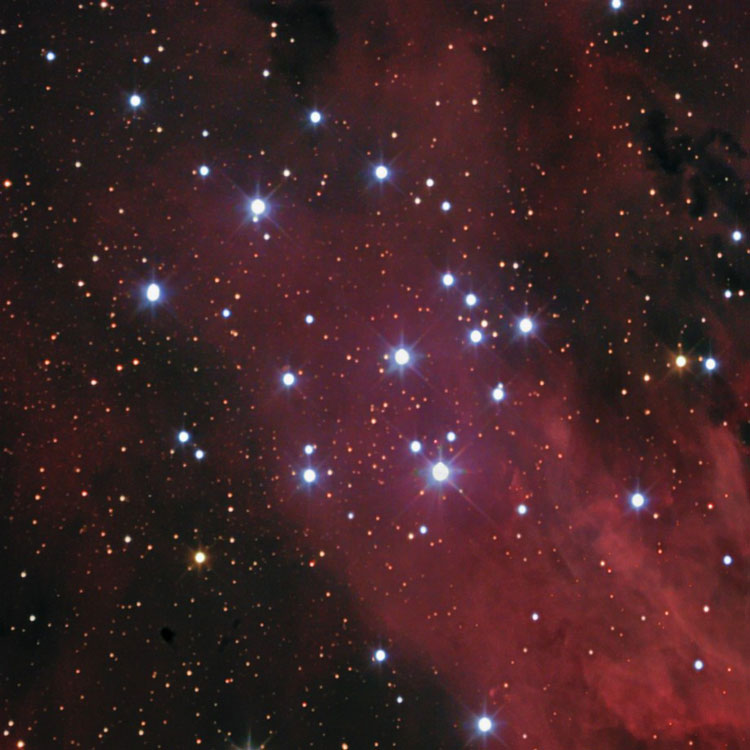
Below, a ? arcmin wide portion of the image above showing only NGC 6530 (Image credit & © as above)
NGC 6531 (= M21 = OCL 26)
Discovered (Jun 5, 1764) by Charles Messier (and recorded as M21)
Also observed (date?) by John Herschel
A 6th-magnitude open cluster (type I3m) in Sagittarius (RA 18 04 13.3, Dec -22 30 00)
Historical Identification: Per Dreyer, NGC 6531 (= GC 4367 = JH 1993, M 21, 1860 RA 17 56 14, NPD 112 30.1) is "a cluster, pretty rich, a little compressed, stars from 9th to 12th magnitude".
Physical Information: M21 is a tightly compacted cluster of about 60 stars scattered across a region 16 arcmin wide. Most of the stars in the cluster are relatively faint, but there is a central concentration of B-type giants. The true brightness of these giants is uncertain, and as a result the distance of the cluster is uncertain, with estimates ranging from just over 2000 light-years to more than 4000 light-years. The lifetimes of such blue giants are only about 1/1000th of the age of the Solar System, so the cluster must have been formed no more than 4 to 5 million years ago.
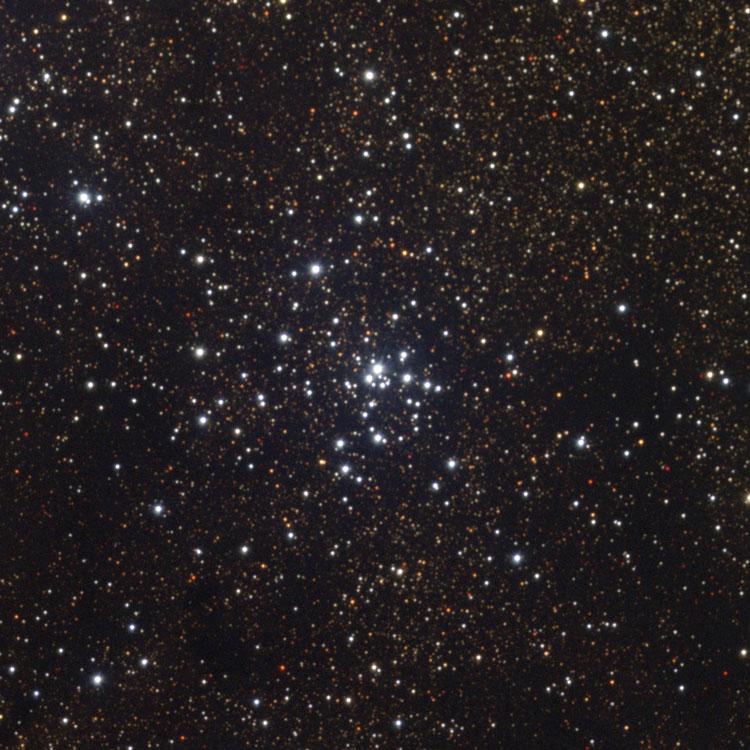
Above, a ? arcmin wide image of NGC 6531 (Image Credit REU program/NOAO/AURA/NSF)
NGC 6532 (= PGC 61220)
Discovered (Sep 19, 1886) by Edward Swift
Also observed (date?) by Guillaume Bigourdan
A 14th-magnitude spiral galaxy (type Sc?) in Draco (RA 17 59 13.8, Dec +56 13 55)
Historical Identification: Per Dreyer, NGC 6532 (Swift list V (#83), 1860 RA 17 56 23, NPD 33 45.2) is "most extremely faint, pretty small, round". The second IC lists a corrected RA (per Bigourdan) of 17 56 43.
Physical Information: Apparent size 1.8 by 0.9? arcmin.
WORKING HERE
NGC 6533 (= M8, the Lagoon Nebula)
Discovered (before 1654) by Hodierna
Discovered (1680) by John Flamsteed
Discovered (Jul 12, 1784) by William Herschel
Also observed (May 13, 1834) by John Herschel (see NGC 6523)
A magnitude 5.8 emission nebula and open cluster in Sagittarius (RA 18 03 42.0, Dec -24 22 48)
Historical Identification: Per Dreyer, NGC 6533 (= GC 4368 = (WH) V 13, 1860 RA 17 56 32, NPD 114 53.4) is "extremely large, extremely irregular figure, stars to east". (Note: V 13 is in Dreyer's column for "other observers", and as a result is listed as such in some references, such as the NGC/IC Project. However, it is a printing error, and actually refers to William Herschel's list V#13, as indicated above.) Why Dreyer did not give credit to the earlier observations by Le Gentil and Messier (as he did for NGC 6523) is unknown; but as noted in other places, the NGC was an updating of the GC, and in many cases only lists John and William Herschel's observations. Aside from that, NGC 6533 refers to the combined region also cataloged as NGC 6523 and 6526, so Dreyer may have been noting that Herschel was the first to assign a position to the overall structure. The position listed in the NGC precesses to (2000) RA 18 05 09.1, Dec -24 53 14, which is half a degree south of the correct position; but a detailed drawing of the region by John Herschel and the description provided in Dreyer's catalog make the identification certain (per Corwin, the error can be reduced to zero by assuming that Herschel misidentified the comparison star as 5 Sgr instead of 4 Sgr). The only question is, as noted for the other NGC listings corresponding to the Lagoon Nebula, which numbers apply to which regions. As shown in the labeled drawing below (and at the individual listings), NGC 6523 applies to the brightest part of the Lagoon, which is the western portion of Herschel's nebula. NGC 6526 applies to the fainter region to its east, which is the eastern portion of Herschel's nebula. NGC 6530 is the cluster of stars to their east, which with visual observations appears to be to the east of the Lagoon; but in the photographic images shown below, the Lagoon is a much larger structure than anything visible with the eye, and as a result, the cluster is more nearly in the center of the "modern" Lagoon. Two IC listings also apply to fainter regions off to the east, as shown in the very wide field image at the end of this entry.
Physical Information: The Lagoon Nebula lies about 5000 light-years from the Earth, in the direction of the constellation of Sagittarius (and hence, toward the center of our galaxy). It is best seen telescopically at very low power, as its 100 span is nearly three times the half-degree diameter of the Moon (although the part referred to as NGC 6533 is only about 45 by 30 arcmin, or half again the size of the Moon). Its visual appearance is of a ghostly gray cloud spread across the starry background formed by stars lying between us and it, and within its star-forming regions. As shown by the varying appearance of the images below, its photographic appearance depends upon the artistic whims of the the person who chose the colors representing different wavelengths inside or outside the visible spectrum.

Above, a ? arcmin wide image of NGC 6533 (Image Credit N. A. Sharp, REU Program, AURA, NOAO, NSF)
Below, a labeled ? arcmin wide image of the region (Image Credit N.A.Sharp, REU program/NOAO/AURA/NSF)
NGC 6533 is the combination of NGC 6523 (to the west) and 6526 (to the east)
Below, a ? arcmin wide image of the Lagoon (Image Credit ESO)
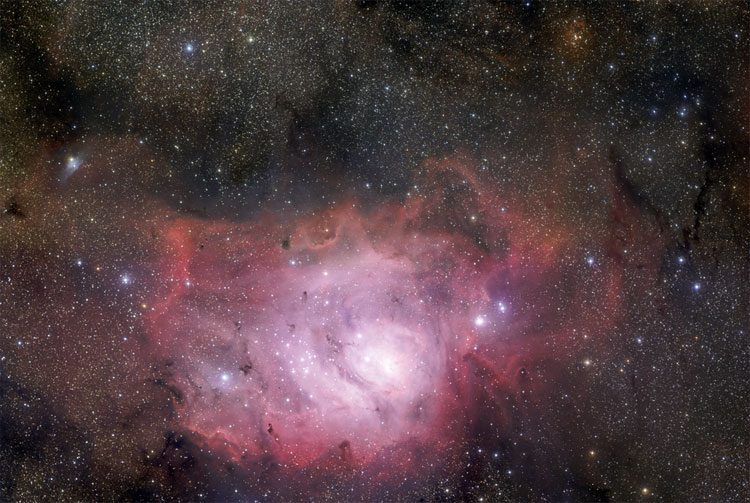 Below, a comparison of part of the visible-light image above to an infrared view of the same region, showing the stars hidden within and behind the Lagoon, and clouds of dark dusty material which are normally lost in the glow of the emission nebula (Image Credit ESO/VVV, Acknowledgment: Cambridge Astronomical Survey Unit)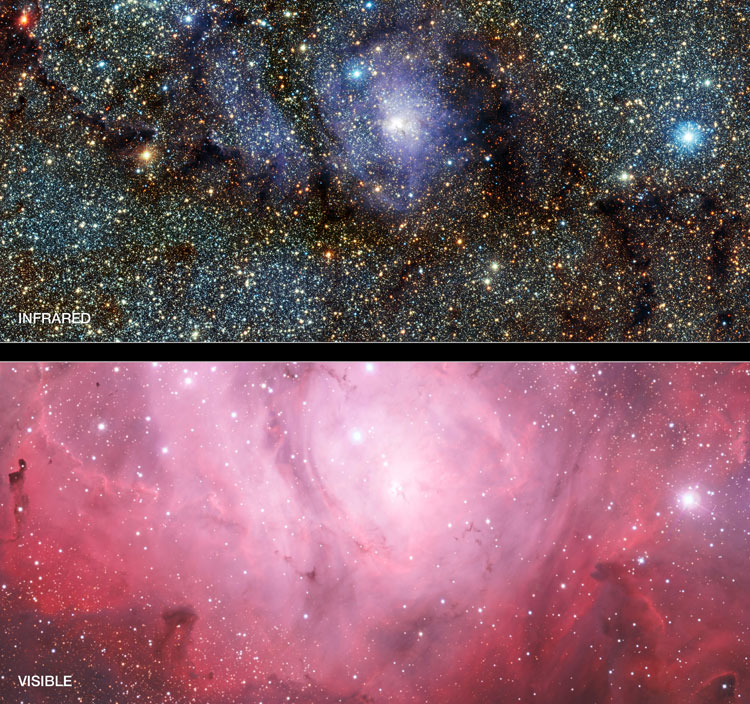
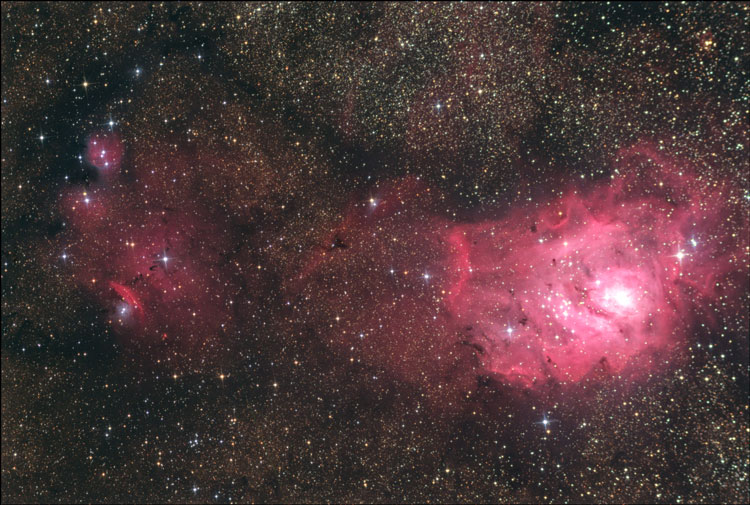
Below, a ? arcmin wide image of the region containing the Lagoon Nebula
(Image Credit Jeff and Paul Neumann/Adam Block/NOAO/AURA/NSF)
NGC 6534
Recorded (Jun 28, 1886) by Lewis Swift
A lost or nonexistent object in Draco (RA 17 57 18.9, Dec +64 18 12)
Historical Identification: Per Dreyer, NGC 6534 (Swift list IV (#63), 1860 RA 17 56 38, NPD 2 5 41.2) is "most extremely faint, pretty small, round".
NGC 6535 (= GCL 83)
Discovered (Apr 26, 1852) by John Hind
Also observed (date?) by Arthur von Auwers
A 9th-magnitude globular cluster (type XI) in Serpens (RA 18 03 50.7, Dec -00 17 47)
Historical Identification: Per Dreyer, NGC 6535 (= GC 4369, Hind, 1860 RA 17 56 40, NPD 90 17.7) is "pretty faint, very small, very small nebulous star to west (Auwers 38)". The second IC added "is large, 1 or 2 arcmin diameter, not very small", without any mention of where the information came from.
Physical Information: Apparent size 3.4? arcmin.
NGC 6536 (= PGC 61166)
Discovered (Aug 18, 1884) by Edward Swift
A 13th-magnitude spiral galaxy (type SBb?) and Draco (RA 17 57 16.3, Dec +64 56 16)
Historical Identification: Per Dreyer, NGC 6536 (Swift list I (#84), 1860 RA 17 56 55, NPD 25 04.0) is "very faint, pretty large, round".
Physical Information: Apparent size 1.2 by 1.1? arcmin
NGC 6537 (= P-K 010+00.1 = "PGC 3517786")
Discovered (Jul 15, 1882) by Edward Pickering
A 12th-magnitude planetary nebula in Sagittarius (RA 18 05 13.0, Dec -19 50 32)
Historical Identification: Per Dreyer, NGC 6537 (Pickering (HN 45), 1860 RA 17 56 55, NPD 109 51) is "a planetary nebula, bright, small, stellar".
PGC Designation Note: For purposes of completeness, LEDA assigned a PGC designation to this object, even though it is not a galaxy; but a search of the database for that designation returns no result, so it is shown in quotes.
Physical Information: Apparent size 0.17? arcmin
NGC 6538 (= PGC 61072)
Discovered (May 30, 1886) by Lewis Swift
A 13th-magnitude spiral galaxy (type S??) and Draco (RA 17 54 17.1, Dec +73 25 27)
Historical Identification: Per Dreyer, NGC 6538 (Swift list IV (#62), 1860 RA 17 57 10, NPD 16 34.4) is "extremely faint, very small, a little extended, between two extremely faint stars".
Physical Information: Apparent size 1.0 by 0.5? arcmin
NGC 6539 (= GCL 85)
Discovered (September, 1856) by Theodor Brorsen
Also observed (date?) by Arthur von Auwers
A 9th-magnitude globular cluster (type X) in Serpens (RA 18 04 49.8, Dec -07 35 07)
Historical Identification: Per Dreyer, NGC 6539 (= GC 4370, Brorsen, 1860 RA 17 57 15, NPD 97 35.0) has "no description (Auwers 39)".
Physical Information: Apparent size 7.9? arcmin
NGC 6540
(= OCL 11 = "PGC 3517740" = ESO 456-SC053 = Djorgovski 3)
Discovered (May 24, 1784) by William Herschel
Also observed (July 5, 1886) by Guillaume Bigourdan
A magnitude 9.7 globular cluster in Sagittarius (RA 18 06 08.6, Dec -27 45 53)
Historical Identification: Per Dreyer, NGC 6540 (= GC 4371 = WH II 198, 1860 RA 17 57 27, NPD 117 49.3) is "pretty faint, small, irregularly extended, extremely mottled but not resolved or a cluster." The position precesses to (2000) RA 18 06 16.0, Dec -27 48 55, just under 3.8 arcmin south-southeast of the cluster listed above, the description fits and there is nothing comparable nearby, so the identification is considered certain.
Discovery Notes: Gottlieb states that the most obvious feature in the region of the cluster is the half dozen moderately bright stars aligned in a shallow east-west arc about 1.5 arcmin wide, and that the 20 arcsec wide "knot" just east of the midpoint of that arc is probably the core of the globular cluster. He also writes that Bigourdan stated that the cluster was about 1.5 arcmin by 20 arcsec in size, so Bigourdan must have included the half dozen stars in the NGC object (and they may be part of the actual cluster). Gottlieb finishes with a bit of history that clears up the confusion in the object's classification: namely, since the half dozen stars are its most obvious feature, NGC 6540 was originally classified as an open cluster (OCL 11), but Djorgovski wrote that it is actually a globular cluster in 1987.
Note About PGC Designation: As usual for NGC/IC objects, HyperLEDA assigned a PGC designation for this object, even though it isn't a galaxy; and as usual in such cases, a search of the database for that designation returns no result, so it is shown in quotes.
Note About OCL Designation: Although this is a globular cluster, it is often left out of lists of Milky Way globular clusters, and is instead found in various lists of open clusters (though not in all such lists), with the designation OCL 11.
Observational Note: As discussed below, the globular cluster is a visually unobservable structure more than half the diameter of the wide-field image shown below, and all that Herschel or Bigourdan could have seen is the small group of stars near the center of the field of view, so the historical NGC object is only that small portion of the cluster. However, since that small portion is the core of the globular cluster discussed here, the entire cluster is considered to be the NGC object, just as when the historical visual observation of a galaxy was actually only its bright central region, the entire galaxy is now considered to be the NGC object.
Physical Information: As stated above NGC 6540 looks like a small group of just a few slightly brighter stars surrounded by the multitudinous background of Milky Way stars in any visual observation, and was therefore misclassified as a very sparse open cluster until 1987, when Djorgovski stated that it is actually a globular cluster. One reference states that the cluster is about 12 thousand light-years from the Sun and about halfway between the Sun and the center of our Galaxy. However, Baumgardt's globular cluster catalog places it about 19 thousand light-years from the Sun, and only about 7500 light-years from the center of our galaxy (both numbers having an uncertainty of nearly a thousand light-years). It contains about 30 thousand solar masses, but since it is about 12 billion years old, most of its still-shining stars are considerably less massive than the Sun, so it probably has at least twice that many stars within a region about 30 to 40 light-years across. The cluster has a moderately elliptical orbit around the center of our galaxy, with an orbital period of about 35 million years. At perigalaxion it is roughly 2500 to 3500 light-years from the galactic center, while at apogalaxion it is about 7000 to 8000 light-years from the center (all distance estimates are uncertain, and the range of values for apogalaxion and perigalaxion is partly due to that, and partly to orbital calculations which suggest that it is sometimes closer or further than on the average at both ends of its orbit). Its orbit rotates around the galaxy, more or less in the plane of the disc, in a manner similar to that of the galaxy's central bar. At the moment it is on its way outward, but nearly as far from the center of the galaxy as it can ever get, so within a few million years it will be on its way back toward the center. The HST press release says nothing about the physical properties or distance of the cluster, but the central cluster's elongated appearance has led to speculation that it is the product of a merger of two smaller clusters (of course if its elongated appearance is not the same as its actual structure, that speculation would become irrelevant, and based on estimates of the cluster's size (discussed below) there is probably no real basis for that speculation).
Given the cluster's uncertain distance (between 12 and 20 thousand light-years from us), and its apparent size of about 2.5 arcmin (from the images below), the central and by far the most obvious part of the cluster is probably only 10 to 12 light-years in diameter. This is much smaller than Baumgardt's 30 to 40 light-years for the inner half of the cluster's mass, but Corwin lists an apparent diameter of over 7 arcmin, taking into account the entire region where there is an excess of very faint stars compared to the background of Milky Way stars, and that corresponds to about 30 or so light-years; so the elongated appearance of the shallow arc does not define the cluster's size or structure, and any speculation about its being a merger of two smaller clusters probably has no relationship to the cluster's actual history.
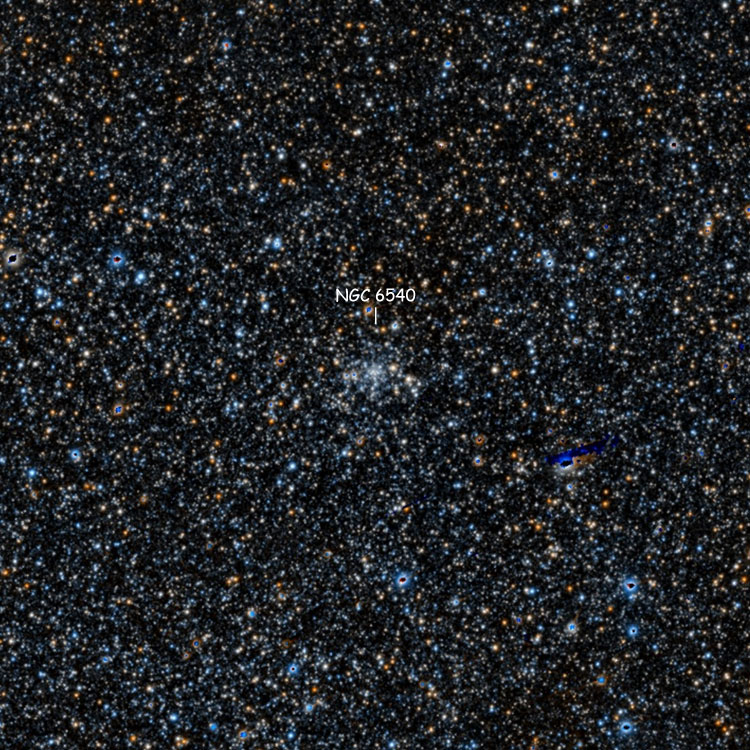
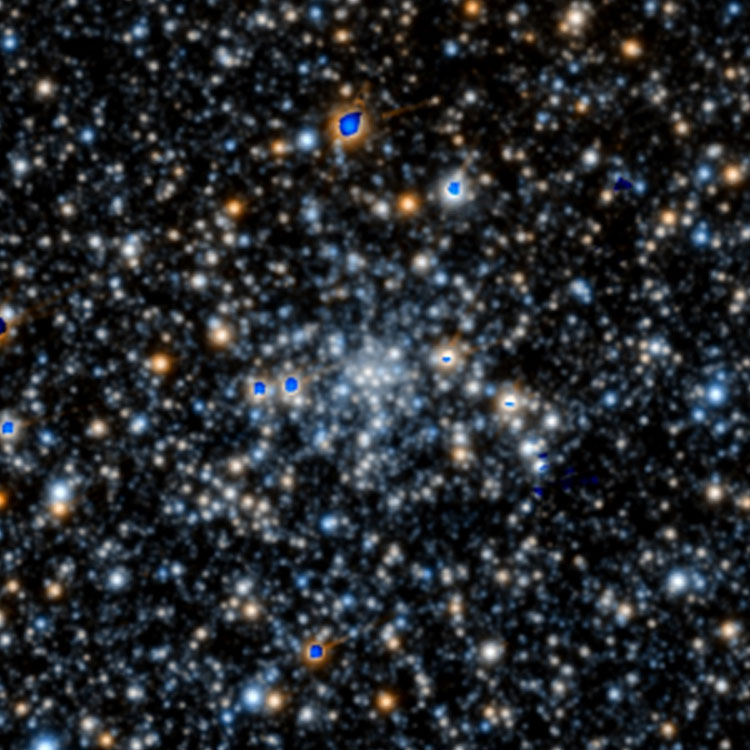
Above, a 12 arcmin wide PanSTARRS image centered on NGC 6540
The cluster looks small but is actually more than half the diameter of the image
Below, a 3 arcmin wide PanSTARRS image of the central part of the cluster
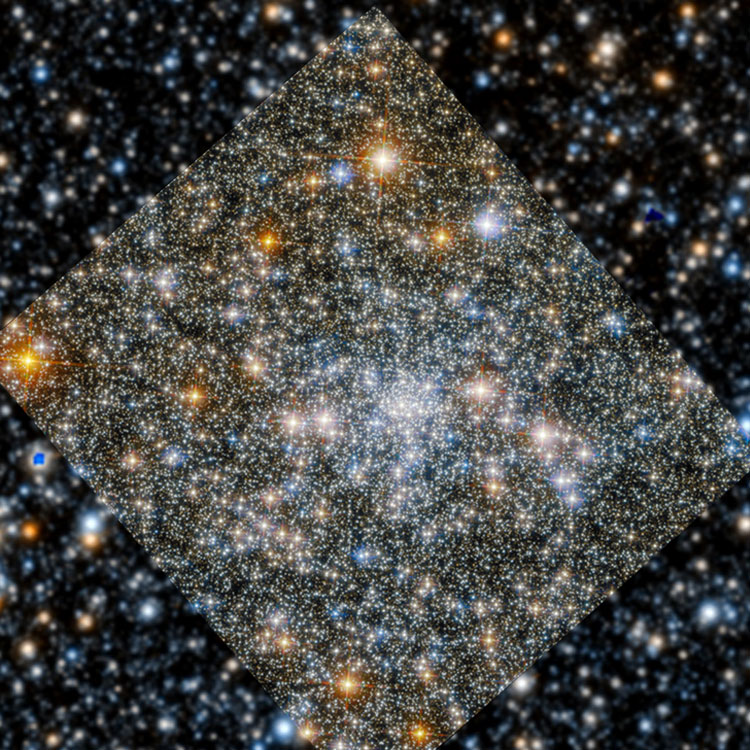
Below, a 3 arcmin wide composite HST/PanSTARRS image of the cluster
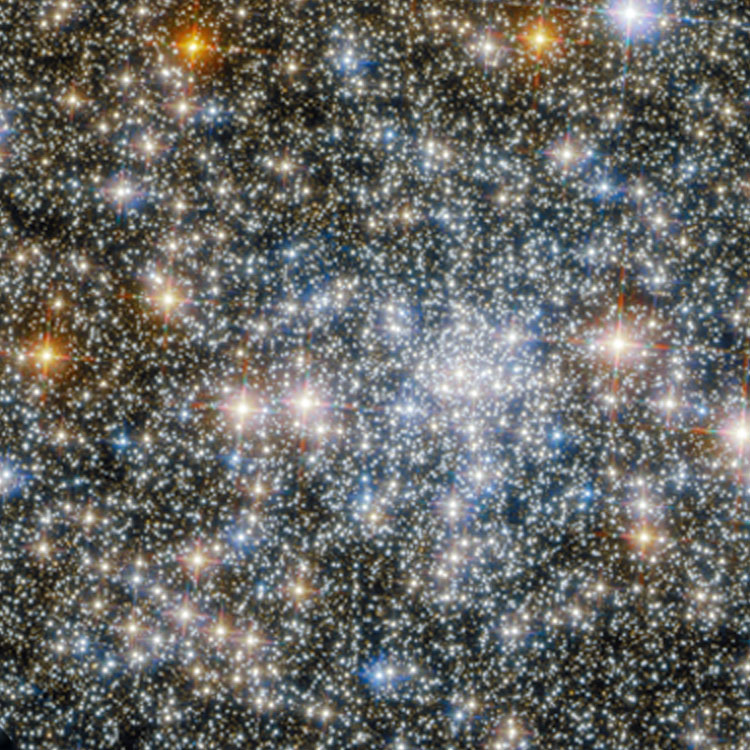
(Image Credit ESA/Hubble & NASA, R. Cohen)
Below, a 1.5 arcmin wide HST image of the central cluster (Image Credit as above)
NGC 6541
(= GCL 86 = C78 = ESO 280-SC004= PGC2802683)
Discovered (Mar 19, 1826) by Niccol Cacciatore
Also observed (Jun 2, 1826) by James Dunlop
Also observed (Jun 1, 1834) by John Herschel
A magnitude 6.3 globular cluster (type III) in Corona Australis (RA 18 08 02.4, Dec -43 42 54)
Historical Identification: Per Dreyer, NGC 6541 (= GC 4372 = JH 3726, Cacciatore, Dunlop #473, 1860 RA 17 57 51, NPD 133 43.4) is "a globular cluster, bright, round, extremely compressed, gradually brighter middle, well resolved, clearly consisting of stars, stars from 15th to 16th magnitude."
Physical Information: Apparent size 15? arcmin
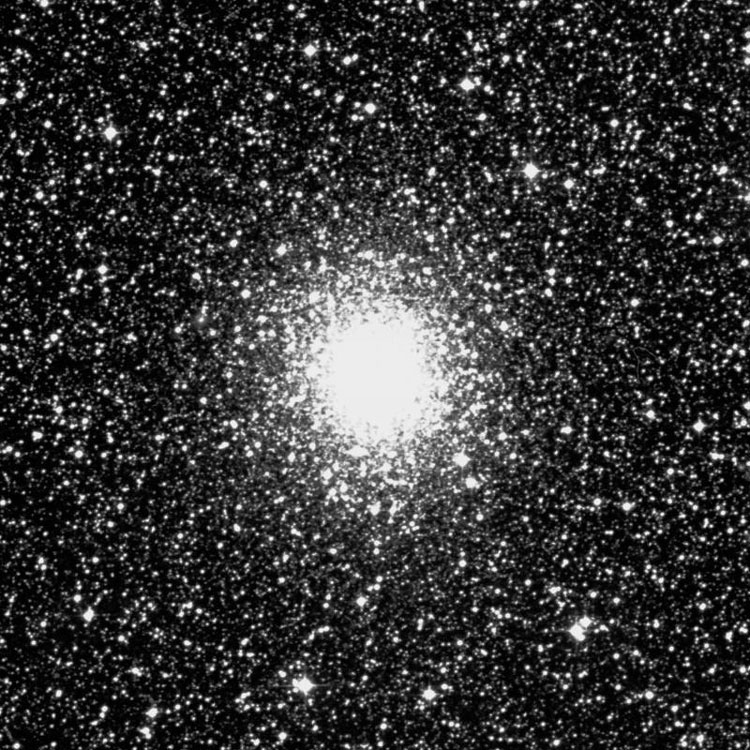
Above, a 20 arcmin wide DSS image centered on NGC 6541
Below, a ? arcmin wide HST image of the center of the cluster
(Image Credit NASA, ESA, and G. Piotto (Università degli Studi di Padova); Processing: Gladys Kober (NASA/Catholic University of America))
(Orientation and actual size not given, but will be posted sooner or later)

NGC 6542 (= PGC 61239)
Discovered (Jul 22, 1886) by Lewis Swift
A 13th-magnitude lenticular galaxy (type S0/a?) in Draco (RA 17 59 39.0, Dec +61 21 32)
Historical Identification: Per Dreyer, NGC 6542 (Swift list IV (#65), 1860 RA 17 58 10, NPD 28 37.9) is "extremely faint, small, much extended, 2 stars to southwest".
Physical Information: Apparent size 1.3 by 0.4? arcmin
WORKING HERE: re-edit entire entry, add sizes for last two images
NGC 6543, The Cat's Eye Nebula = The Helical Nebula
(= C6 = PK 096+29.1 = "PGC 2921944" = HD 164963)
Discovered (Feb 15, 1786) by William Herschel
Also observed (1790) by Joseph Lalande (as a 9th magnitude star, LL 38303)
Also observed (Aug 22, 1863) by Heinrich d'Arrest
Also observed (Aug 29, 1864) by William Huggins (spectroscopically, as a glowing cloud of gas)
Also observed (Jul 27, 1888) by Edward Holden (while listed as GC 4373)
Also observed (Apr 24, 1900) by Edward Barnard (leading to Dreyer's entry for IC 4677)
A magnitude 8.1 planetary nebula in Draco (RA 17 58 33.4, Dec +66 37 59)
Historical Identification: Per Dreyer, NGC 6543 (= GC 4373 = WH IV 37, d'Arrest, 1860 RA 17 58 36, NPD 23 21.7) is "a planetary nebula, very bright, pretty small, suddenly brighter middle and very small nucleus." The position precesses to (2000) RA 17 58 33.3, Dec +66 38 01, essentially dead center on the nebula listed above, the description fits and there is nothing comparable nearby, so the identification is certain.
Discovery Notes: Per Gottlieb, John Herschel's Slough Catalogue did not contain his father's observation of this object, so Lalande had no reason to think it was anything but a star; and as a result d'Arrest was the first observer to connect it to William Herschel's observation. Still later observers are noted because of their unique contributions. Huggins' observation was the very first use of a spectroscope to determine the nature of what Herschel called a planetary nebula (in a pair of papers Huggins discussed the spectra emitted by stars [continuous spectra with some dark absorption lines], whereas NGC 6543 [and similar nebulae typically] exhibits only a single bright-line emission spectrum like that of glowing gases studied in laboratories (in this case, doubly ionized oxygen, or OIII, is the main source of the radiation), which led Huggins to propose that NGC 6543 and similar objects were huge masses of glowing gas that would never be resolved into stars [until his observation it was thought that all so-called "nebulae", most of which we now call "galaxies", were ordinary clusters of stars too distant to be resolved into stars, and that it wouldn't be long before they would be resolved]). Holden is listed because of the diagram and discussion of this nebula in the paper noted in the following paragraph, and Barnard because his photograph revealed one of the bright knots (a shock-wave structure) in the outer part of the "halo", and that knot was later listed as IC 4677.
Nickname Note: Per Gottlieb, Holden's paper was titled "Helical Nebula in Draco", whence that name. Gottlieb also writes that "Cat's Eye Nebula", which is the name usually used today, was first published in a 1976 Astronomy magazine article, but had probably been in use for some time prior to that.
PGC Designation Note: As for most NGC objects, HyperLEDA assigned a PGC designation to this object, even though it is not a galaxy; but a search of the database for that designation returns no result, so it is shown in quotes.
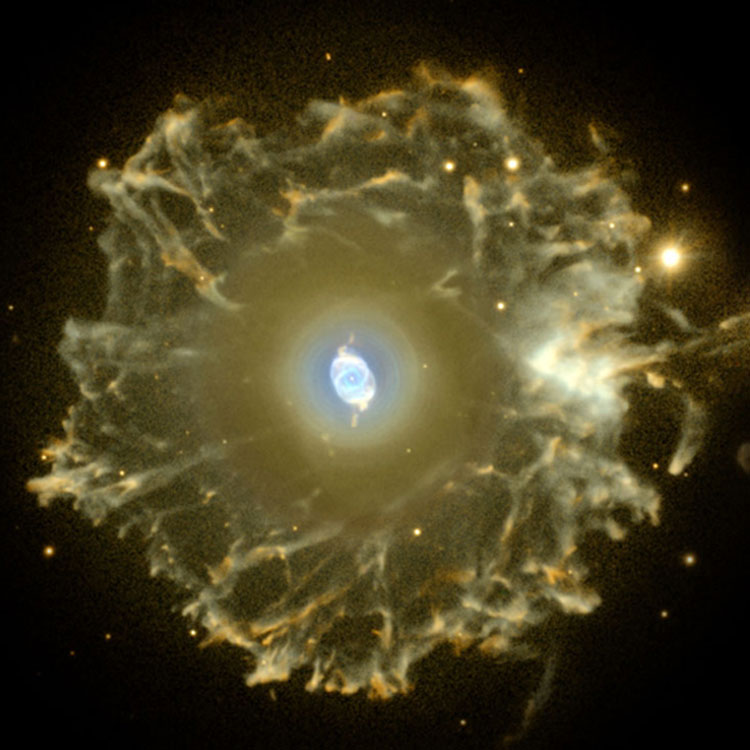
Physical Information: The Cat's Eye Nebula has long been recognized as one of the most complex planetary nebulae known (it has been suggested that the uniquely complex structure of the central nebula could be explained by assuming that the central star is actually a binary star with too small an orbit for the HST to resolve). Aside from the spectacular lobes and arcs near its center, it is surrounded by a series of concentric spherical shells (ring-like structures, as seen from our point of view) which indicate fairly regular ejections of mass into space. Based on the size and rate of expansion of the shells, it is estimated that they were ejected at 1500 year intervals, with about 1% of a solar mass (or a mass equal to that of all the planets in our Solar System) thrown into space with each ejection. Still farther out, but not visible in closeup images of the nebula, is an "outer halo" of chaotically dispersed gas which testifies to a still earlier stage of mass loss. The Cat's Eye was the first planetary nebula in which the central star was observed, and the first to reveal its nature as a cloud of rarefied gas; and its multilayered structure still makes it an object of intense interest and continued study. The distance to the nebula has been estimated by measuring the (very slow) rate of increase of its apparent size, and the difference in the radial velocities of regions moving toward or away from us (this also yields an estimate of the time required to create the central concentric shells (about 15,000 years), and a passage of about 1,000 years since the ejection of the gas in the bright central region); because of an unknown rate of slowing of the gases in the outermost halo due to collision with interstellar gases (which is what provides the energy lighting up that part of the nebula, whereas the innermost region obtains its energy by absorbing the radiation of the central star), the age of the overall structure is too uncertain to give any estimate, but the central star has certainly been ejecting large amounts of mass for several tens of thousands of years. The rate of apparent and physical expansion of the central regions suggests that NGC 6543 is about 3300 &@177; 900 light-years from us. Given that, the bright central region's apparent size of about 0.3 arcmin, the roughly 0.6 arcmin size of the surrounding group of more or less concentric circular "shells", and the roughly 5.1 arcmin size of the chaotic extended halo (all apparent sizes determined from the images below) correspond to about 0.25, 0.5 and 5 light-years, respectively.

Above, a 12 arcmin wide DSS image centered on NGC 6543
Below, a 6 arcmin wide image of the planetary nebula and its outer halo
(Image Credit Nordic Optical Telescope and Romano Corradi (Isaac Newton Group of Telescopes, Spain))
Below, a roughly 0.45 arcmin wide HST image in visible light reveals the complex structure of the nebula
(Image Credit J. P. Harrington (U. Maryland) & K. J. Borkowski (NCSU) HST, NASA)
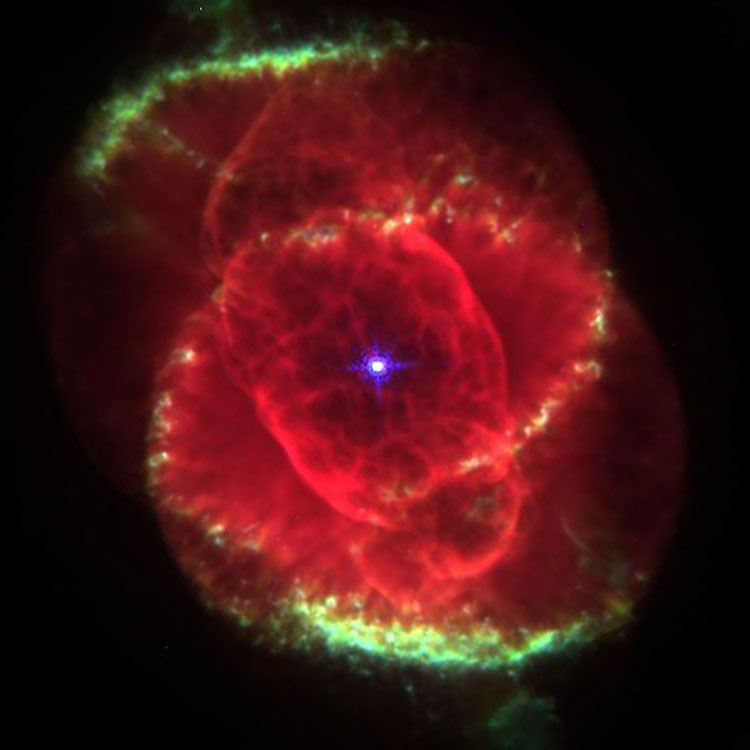
Below, a ? arcmin wide Chandra X-ray image (in blue) is superimposed on the visible structure
(Image Credit X-ray: UIUC/Y.Chu et al., Optical: HST, NASA)

Below, the faint concentric rings surrounding the nebula are revealed in a ? arcmin wide HST image.
(Image Credit ESA, HEIC, and The Hubble Heritage Team (STScI/AURA), NASA)

NGC 6544 (= GCL 87)
Discovered (May 22, 1784) by William Herschel
Also observed (date?) by John Herschel
An 8th-magnitude globular cluster (type V) in Sagittarius (RA 18 07 20.6, Dec -24 59 49)
Historical Identification: Per Dreyer, NGC 6544 (= GC 4374 = JH 1994 = WH II 197, 1860 RA 17 58 42, NPD 115 00.9) is "considerably faint, pretty large, irregularly round, mottled but not resolved".
Physical Information: Apparent size 9.2? arcmin
NGC 6545 (= PGC 61551)
Discovered (Jun 20, 1835) by John Herschel
A 13th-magnitude elliptical galaxy (type E1?) in Pavo (RA 18 12 14.9, Dec -63 46 33)
Historical Identification: Per Dreyer, NGC 6545 (= GC 4375 = JH 3727, 1860 RA 17 58 46, NPD 153 47.5) is "most extremely faint, most extremely small, round".
Physical Information: Apparent size 1.1 by 0.9? arcmin
NGC 6546 (= OCL 24)
Discovered (Jun 27, 1837) by John Herschel
An 8th-magnitude open cluster (type III2m) in Sagittarius (RA 18 07 22.0, Dec -23 17 48)
Historical Identification: Per Dreyer, NGC 6546 (= GC 4376 = JH 3729, 1860 RA 17 58 48, NPD 113 14.0) is "a cluster, very large, very rich".
Physical Information: Apparent size 15? arcmin
NGC 6547 (= PGC 61378)
iscovered (Aug 7, 1864) by Albert Marth
A 14th-magnitude lenticular galaxy (type S0/a?) in Hercules (RA 18 05 10.0, Dec +25 13 58)
Historical Identification: Per Dreyer, NGC 6547 (= GC 5891, Marth #360, 1860 RA 17 59 26, NPD 64 46.0) is "faint, very small, extended, much brighter middle".
Physical Information: Apparent size 1.3 by 0.4? arcmin
NGC 6548 (= PGC 61404)
Discovered (Sep 20, 1786) by William Herschel
A 12th-magnitude lenticular galaxy (type SB0?) in Hercules (RA 18 05 59.2, Dec +18 35 14)
Historical Identification: Per Dreyer, NGC 6548 (= GC 4377 = WH III 555, 1860 RA 17 59 39, NPD 71 27.1) is "considerably faint, small, a little extended, mottled but not resolved". The second IC states (erroneously) "6548 = 6550, Swift in Cat. XI.".
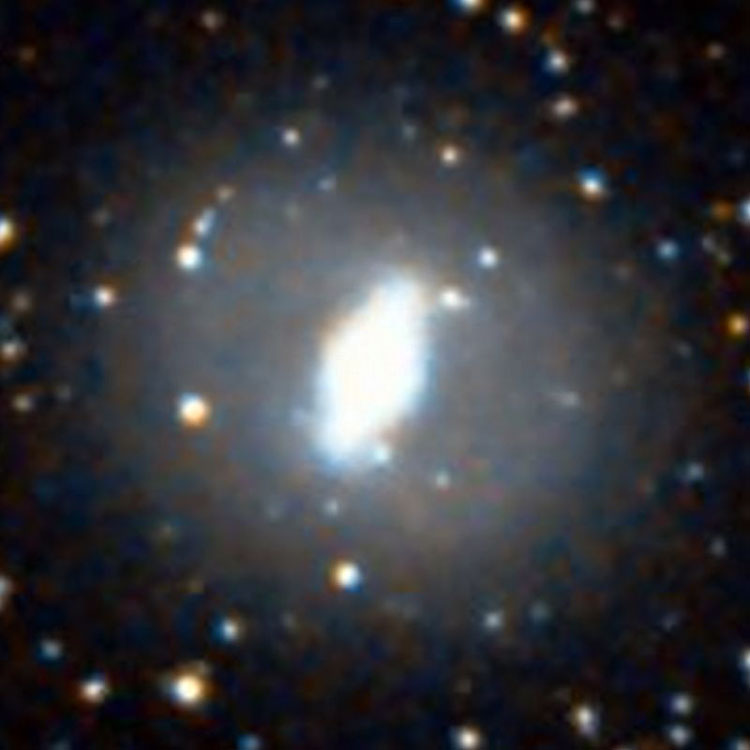
Physical Information: An optical double with NGC 6549 (which is over three times further away), and historically often confused with NGC 6550 due to more than a century of mistaken identity (for a discussion of that, see NGC 6550). Given the confusion between the various identifications, which data applies to which galaxy is hard to determine. (For instance, the HyperLeda database lists the recessional velocity of NGC 6548 as 2190 km/sec, while the NED database lists a recessional velocity of 2210 km/sec, but lists the galaxy as NGC 6550, although the image and position are those shown in the data above and the images below for NGC 6548.) In any event, based on a presumably accurate recessional velocity of 2200 km/sec, the Hubble expansion distance is about 100 million light-years, in which case the apparent size of 3.0 by 2.8? arcmin would correspond to a diameter of 90 thousand light-years.

Above, a 12 arcmin wide DSS image centered between NGC 6548 and 6549
Below, a 3 arcmin wide DSS image of NGC 6548
NGC 6549 (= NGC 6550 = PGC 61399)
Discovered (Jul 27, 1864) by Albert Marth (and later listed as NGC 6549)
Discovered (Jul 19, 1882) by Édouard Stephan (and later listed as NGC 6550)
A 14th-magnitude spiral galaxy (type Sbc?) in Hercules (RA 18 05 49.4, Dec +18 32 16)
Historical Identification: Per Dreyer, NGC 6549 (= GC 5892, Marth #361, 1860 RA 17 59 40, NPD 71 28) is "very faint, pretty large, irregularly round, near III 555", (WH) III 555 being NGC 6548.
Physical Information: An optical double with NGC 6548 (which is over three times closer), and identical to NGC 6550, which see for a discussion of the more than a century of mistaken identity involving the NGC listings for NGC 6548, 6549 and 6550. HyperLeda lists the recessional velocity of NGC 6549 as 6670 km/sec, while NED lists a recessional velocity of 6705 km/sec, but incorrectly identifies the galaxy as NGC 6548, despite using an image and position identical to those shown here for NGC 6549. Using an intermediate recessional velocity of 6690 km/sec, the Hubble expansion distance is about 310 million light-years, in which case the apparent size of 1.4 by 0.4? arcmins would correspond to a diameter of 125 thousand light-years.
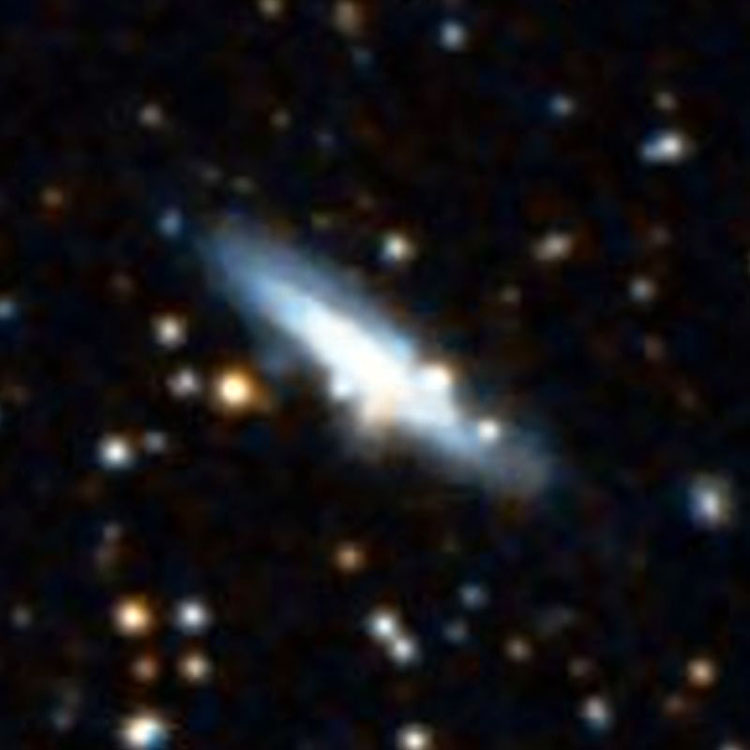
Above, a 2.4 arcmin wide DSS image of NGC 6549; for a wide-field view, see NGC 6548
|