QuickLinks:
6850, 6851, 6852, 6853, 6854, 6855, 6856, 6857, 6858, 6859, 6860, 6861, 6862, 6863, 6864, 6865, 6866,
6867, 6868, 6869, 6870, 6871, 6872, 6873, 6874, 6875, 6876, 6877, 6878, 6879, 6880, 6881, 6882, 6883,
6884, 6885, 6886, 6887, 6888, 6889, 6890, 6891, 6892, 6893, 6894, 6895, 6896, 6897, 6898, 6899
Page last updated Oct 31, 2023
WORKING 6865: Checking Dreyer entries and precessing where not already done, and adding some of Gottlieb's comments
NEXT: Check Steinicke Modern/Historic databases
Need to update and complete NGC 6872 (new ESO/VLT image added, too)
NGC 6850
(= PGC 64043 = ESO 185-056)
Discovered (Jun 9, 1836) by John Herschel
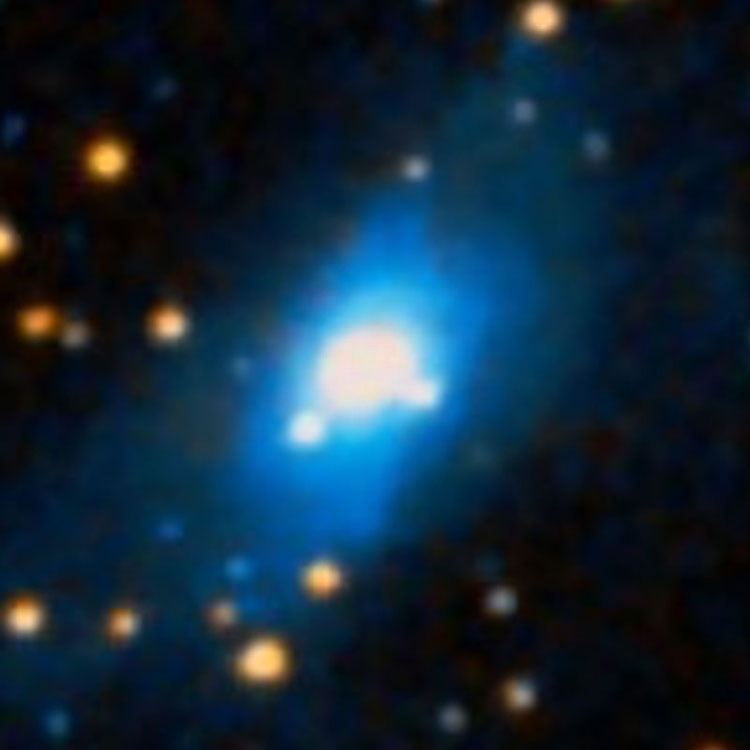
A 13th-magnitude lenticular galaxy (type SB0/a?) in Telescopium (RA 20 03 30.1, Dec -54 50 41)
Historical Identification: Per Dreyer, NGC 6850 (= GC 4530 = JH 3806, 1860 RA 19 52 28, NPD 145 13.8) is "very faint, small, round, brighter middle." The position precesses to (2000) RA 20 03 31.2, Dec -54 50 46, less than 0.2 arcmin east-southeast of the center of the galaxy listed above and well within its outline, the description is reasonable and there is nothing else nearby, so the identification is certain.
Physical Information: Apparent size 2.1 by 1.1? arcmin
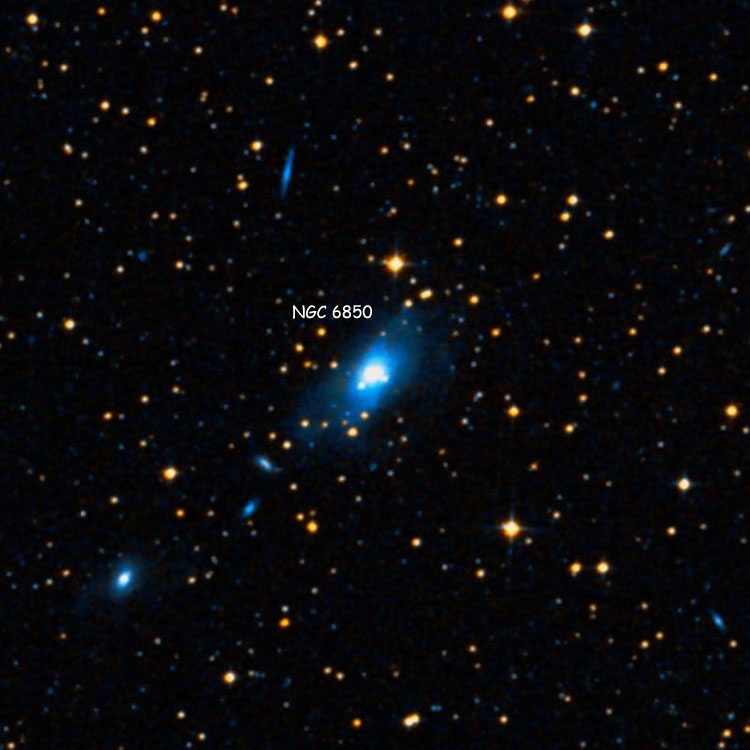
Above, a 12 arcmin wide DSS image centered on NGC 6850
Below, a 2.4 arcmin wide DSS image of the galaxy
NGC 6851
(= PGC 64044 = ESO 233-021)
Discovered (Sep 5, 1836) by John Herschel
A 12th-magnitude elliptical galaxy (type E3?) in Telescopium (RA 20 03 34.4, Dec -48 17 04)
Historical Identification: Per Dreyer, NGC 6851 (= GC 4531 = JH 3807, 1860 RA 19 53 19, NPD 138 39.2) is "pretty faint, small, very little extended, pretty suddenly brighter middle." The position precesses to (2000) RA 20 03 32.9, Dec -48 16 05, about 1 arcmin north-northwest of the center of the galaxy listed above, the description fits and there is nothing else nearby, so the identification is certain.
Physical Information: Apparent size 2.0 by 1.5? arcmin
PGC 64086
(= ESO 233-025 = "NGC 6851A" = "NGC 6861A")
Not an NGC object but listed here since sometimes called NGC 6851A or NGC 6861A
A magnitude 14.1 spiral galaxy (type Sbc?) in Telescopium (RA 20 05 48.7, Dec -47 58 39)
Warning About Non-Standard Designations: As the double listing for this object shows, there is nothing standard about "non-standard" letter designations for galaxies. This often causes confusion, and occasionally results in data for one object being incorrectly assigned to a completely different object. Because of this, such designations should never be used, except for warnings such as this one.
Physical Information: Since also listed as NGC 6861A, see that entry for anything else.
PGC 64082
(= ESO 233-023 = "NGC 6851B")
Not an NGC object but listed here since sometimes called NGC 6851B
A magnitude 15.3 spiral galaxy (type SBcd?) in Telescopium (RA 20 05 39.9, Dec -47 58 45)
Warning About Non-Standard Designations: There are no standards for letter designations for galaxies. This often causes confusion, and occasionally results in data for one object being incorrectly assigned to a completely different object. Because of this, such designations should never be used, except for warnings such as this one.
Physical Information: Apparent size 1.1 by 0.2? arcmin
NGC 6852 (= PK 042-14.1 = "PGC 3517809")
Discovered (Jun 25, 1863) by Albert Marth
A 13th-magnitude planetary nebula in Aquila (RA 20 00 39.2, Dec +01 43 41)
Historical Identification: Per Dreyer, NG 6852 (= GC 5949, Marth #404, 1860 RA 19 53 28, NPD 88 39) is "a faint nebula, among stars." The position precesses to (2000) RA 20 00 33.9, Dec +01 43 51, about 1.3 arcmin west-northwest of the nebula listed above, the description fits and there is nothing else nearby, so the identification is certain.
Discovery Note: Gottlieb notes that despite its presence in the NGC, this planetary was independently "rediscovered" in 1963 by Lubos Kohoutek (and listed as K 1-18) while examining one of the plates later digitized for the DSS (Digital Sky Survey).
PGC Designation Note: For purposes of completeness, LEDA assigned a PGC designation to this object, even though it isn't a galaxy; however, a search of the database for that designation returns no result, so it is shown in quotes.
Physical Information: Apparent size 0.47? arcmin

Above, a 12 arcmin wide DSS image centered on NGC 6852
Below, a 2.4 arcmin wide DSS image of the planetary nebula

NGC 6853 (= M27), the Dumbbell Nebula
(= PK 060-03.1 = "PGC 3517810")
Discovered (Jul 12, 1764) by Charles Messier and listed as M27
Rediscovered (Sep 30, 1782) by Caroline Herschel
Also observed (Jul 19, 1784) by William Herschel
Also observed (Aug 24, 1827) by John Herschel
Sketched (Sep 21, 1843) by William Parsons, 3rd Lord Rosse
Sketched (Sep 9 & 16, 1849) by George Stoney
Sketched (1850 - 1851) by Bindon Stoney
Reobserved (Aug 29, 1854) by George Stoney and "Dr. Robinson"
Also observed (1864) by William Huggins (with a spectroscope)
A 7th-magnitude planetary nebula in Vulpecula (RA 19 59 36.4, Dec +22 43 16)
Historical Identification: Per Dreyer, NGC 6853 (= GC 4532 = JH 2060, M 27, 1860 RA 19 53 33, NPD 67 39.6) is "a magnificent or otherwise interesting object, very bright, very large, binuclear, irregularly extended (Dumbbell)." The position precesses to (2000) RA 19 59 35.5, Dec +22 43 11, nearly dead center on the nebula listed above, the description fits and there is nothing comparable nearby, so the identification is certain.
Discovery Notes: Gottlieb notes that although Caroline Herschel independently discovered the nebula, she and her brother William immediately realized that it was M27 when they compared its position to their map showing the position of Messier's objects, so her and William's observations were not included in his list of 1000 new nebulae and clusters (though a detailed discussion of his own observation was presented in his 1785 Philosophical Transactions paper). While Messier described it as oval, the Herschels noticed that it was divided into the two patches that gave it its nickname, and although William described its outer regions as resembling the Orion Nebula, he presumed that such nebulae were simply composed of stars too faint to be seen as individual objects, the use of the spectroscope to show that some nebulae were clouds of glowing gas being decades in the future (by William Huggins, in 1864). John Herschel is responsible for its description as "something like an hour glass," and as "like a double-headed shot or a dumb-bell." The former description led to NGC 6853 sometimes being referred to as the Hour-Glass Nebula. Lord Rosse's sketch was published in 1844, while George Stoney's sketch was published in 1850, Bindon Stoney's sketch (including a large number of stars whose position relative to the nebula were micrometrically measured) was published in 1861, and George Stoney's observation with "Doctor Robinson" noted that the nebula extended further to the southwest than in Bindon's sketch (and included mention of the fact that he and his brother had already agreed that the 1861 sketch should have shown the further extension). [All of the Stoneys' observations were made with Lord Rosse's 72-inch "Leviathan".) Finally, in his first use of a spectroscope to examine planetary nebulae, William Huggins noted that the nebula's spectrum consisted of only a single bright line, proving that it was glowing gas (later spectroscopic observations showed that many "nebulae" had a stellar spectrum, and therefore were made of stars too faint to see individually, as assumed by Herschel and his contemporaries; those "nebulae" are now called galaxies).
PGC Designation Note: For purposes of completeness, HyperLEDA assigned a PGC designation to this object, even though it isn't a galaxy; however, a search of the database for that designation returns no result, so it is shown in quotes.
Physical Information: Apparent size 6.7? arcmin
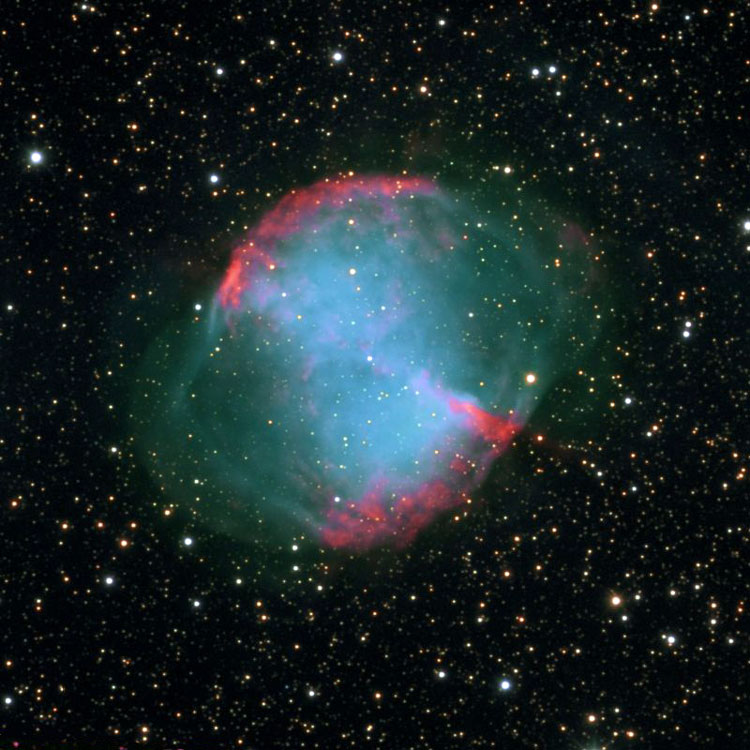
Above, a 12 arcmin wide image of M27 (Image Credit & © Jim Misti, Misti Mountain Observatory; used by permission)
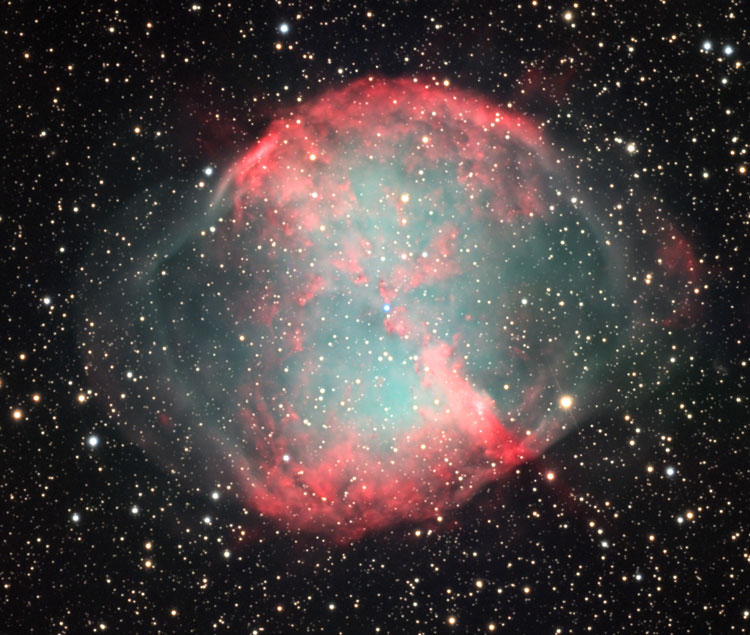
Below, a ? arcmin wide image of the nebula (Image Credit Joe & Gail Metcalf, Adam Block, NOAO, AURA, NSF)
NGC 6854
(= ESO 185-061 (= PGC 64080 + PGC 64081))
Discovered (Jul 9, 1834) by John Herschel
A magnitude 12.2 pair of galaxies in Telescopium (RA 20 05 38.6, Dec -54 22 28)
PGC 64080 (nw comp) A magnitude 15.5(?) "spiral" galaxy (type S?) RA 20 05 38.4, Dec -54 22 24
PGC 64081 (se comp) A magnitude 12.4(?) "lenticular" galaxy (type E/SB0?) RA 20 05 38.8, Dec -54 22 32 (in LEDA)
Listed as only a single E/SAB(s)0 galaxy in NED, with PGC 64080 listed as "NGC 6854B"
Historical Identification: Per Dreyer, NGC 6854 (= GC 4533 = JH 3808, 1860 RA 19 54 41, NPD 144 45.7) is "faint, small, very little extended, gradually a little brighter middle." The position precesses to RA 20 05 38.9, Dec -54 22 17, about 1/4 arcmin nearly due north of the center of the brighter member of the pair listed above, the description fits and there is nothing else nearby, so the identification is certain. (Note: Although several databases list the northwestern component as a separate object, the description of Herschel's object as a little extended means that NGC 6854 consists of both components.)
Physical Information: Apparent size 2.0 by 1.3? arcmin; GAIA agrees with the identification as a pair
NED 20.2 - 76.7 Mpc, SAB(s)0- pec, 2.0 x 1.3 arcmin, 13.2b, 3K Vr 5607 km/sec, only one position given
Steinicke lists as only a single galaxy (PGC 64080); Corwin as a pair
PGC 64080
(= ESO-LV1850611 = "NGC6854B", but actually part of the Historical NGC 6854)
The northwestern component of NGC 6854, mistakenly listed as a separate object in several databases
A magnitude 15.0(?) galaxy (type ?) in Telescopium (RA 20 05 38.4, Dec -54 22 24)
NED: called a star in RC1 & ESO-B; "pair member"; mag (no filter specified) 13.39; 3K Vr 5210 km/sec
LEDA: B 13.40, I 11.18, -> V 12.5(?) *probably for 6854 itself*
PGC 161899
Not an NGC object but listed here as a possible companion of NGC 6854
A magnitude 15.5(?) galaxy (type ?) in Telescopium (RA 20 05 49.1, Dec -54 21 29)
Physical Information: NED 16.1b, 3K Vr 5818 km/sec, so quite possibly an actual companion
SIMBAD V 12.3
NGC 6855
(= PGC 64116 = ESO 185-063)
Discovered (Jul 10, 1834) by John Herschel
A 13th-magnitude lenticular galaxy (type SB0/a?) in Telescopium (RA 20 06 49.9, Dec -56 23 24)
Historical Identification: Per Dreyer, NGC 6855 (= GC 4534 = JH 3809, 1860 RA 19 55 32, NPD 146 47.0) is "pretty faint, small, round." The position precesses to (2000) RA 20 06 47.2, Dec -56 23 24, less than 0.4 arcmin due west of the center of the galaxy listed above and well within its outline, the description fits and there is nothing comparable nearby, so the identification is certain.
Physical Information: Apparent size 1.5 by 1.3? arcmin
NED (R')SB0^+(rs)?, R)SB(rl)0^+, 3K Vr 4228 km/sec
PGC 161935
Not an NGC object but listed here as an apparent companion of NGC 6855
A magnitude ? elliptical galaxy (type E0?) in Telescopium (RA 20 06 56.5, Dec -56 25 18)
Physical Information: LEDA B 15.3; NED 3K 15470 km/sec, z 0.05160242856. Since it is at least three times further from us than NGC 6855, it is only a distant background object (an optical double).
NGC 6856
Discovered (Sep 24, 1829) by John Herschel
A group of stars in Cygnus (RA 19 59 17.3, Dec +56 07 33)
Historical Identification: Per Dreyer, NGC 6856 (= GC 4535 = JH 2063, 1860 RA 19 56 09, NPD 34 15.2) is "a cluster, pretty small, pretty much compressed, irregularly round, stars from 12th to 16th magnitude." The position precesses to (2000) RA 19 59 18.3, Dec +56 07 47, a smidgen northeast of the position listed for the cluster, but well within its central region, the description fits and although not a notable cluster (as stated in the NGC), per Gottlieb the group stands out from the surrounding star field, making the identification certain.
Physical Information: Apparent size 3.0? arcmin. Possibly a physically connected group, or the remains of an ancient open cluster.
NGC 6857
(= "PGC 3517682" = Sh 2-100)
Discovered (Sep 6, 1784) by William Herschel
Also observed (Aug 19, 1828) by John Herschel
An emission nebula in Cygnus (RA 20 01 47.7, Dec +33 31 38)
Historical Identification: Per Dreyer, NGC 6857 (= GC 4536 = JH 2062 = WH III 144, 1860 RA 19 56 24, NPD 56 51.6) is "faint, among Milky Way stars." The position precesses to (2000) RA 20 01 47.5, Dec +33 31 38, barely west of the center of the emission nebula listed above, the description fits and there is nothing comparable nearby, so the identification is certain.
Discovery Notes: Per Gottlieb, John Herschel made 3 observations of the nebula, noting that it was an ill defined patch containing some nebulosity; and one attempt to observe it with the 72-inch "Leviathan" at Birr Castle failed to find it.
PGC Designation Note: As usual for NGC objects, HyperLEDA assigned a PGC designation to this object even though it isn't a galaxy; but as also usual in such cases, a search of the database for that designation returns no result, hence its being in quotes.
Physical Information: NGC 6857 is the brightest part of the westermost portion of a very large region of emission nebulae extending more than a minute of time to the west and roughly 8 arcmin from north to south. Most of the nebulosity is very faint, but there is a small fairly bright patch to the northeast of NGC 6857, and a larger brighter one near the western end of the regionl; however, neither of those are in the NGC/IC, presumably being too faint to be noticed at that time. NGC 6857 itself is.
The nebula is lit by the light of numerous young stars, presuming a star cluster in the early stages of its formation, but as of this date (Oct 31, 2023) I have been unable to find anything to indicate the distance of the cluster (which would be the same as that of the nebula), so although the brightest part of the nebula spans a region about 0.6 arcmin in size (once images are posted, a size based on those will replac that value), its actual physical size is unknown.
Note About Classification: Early studies suggested that this was a planetary nebula, and some references still list it as such; and there are actual planetary nebulae near it (at least as far as our field of view is concerned; but they may be well in front of or behind the NGC object, and not connected with it or the star cluster lighting it up); but there is no doubt that the NGC object itself is not a planetary nebula, and simply an HII emission region.

Above, a 12 arcmin wide DSS image centered on NGC 6857; a closer image will be posted later.
NGC 6858
("PGC 5067454")
Discovered (Jul 29, 1829) by John Herschel
A group of stars in Aquila (RA 20 02 55.0, Dec +11 14 18)
Historical Identification: Per Dreyer, NGC 6858 (= GC 4537 = JH 2061, 1860 RA 19 56 24, NPD 79 07.4) is "a cluster, considerably large, extended, pretty rich, stars from 13th magnitude." The position precesses to (2000) RA 20 03 02.6, Dec +11 15 56, about 2.5 arcmin southwest of the modern position for the cluster listed above, but the description is a reasonable fit and there is nothing nearby that suggests the identification is incorrect, so it is almost certainly correct.
Discovery Notes: Per Gottlieb, Herschel described this as "A pretty rich oblong cluster, 10' long, 5' broad, stars equal and of 13th magnitude." Gottlieb's description of his own visual observation states that it is an elongated group of 35 stars in a 10 x 4 arcmin group oriented north-south, with most stars of magnitude of 12th to 13th magnitude. Since what he saw matches Herschel's description in both appearance and position, he considers the identification "definite".
PGC Designation Note: As usual for NGC objects, HyperLEDA assigned a PGC designation to this object even though it isn't a galaxy; but as also usual in such cases, a search of the database for that designation returns no result, hence its being in quotes.
Physical Information: Apparent size roughly 10 by 4 or 5 arcmin, but with no known distance, the actual physical size of the cluster is unknown.

Above, a 12 arcmin wide DSS image centered on NGC 6858; the ellipse is an approximate outline of the group
NGC 6859
Recorded (Nov 24, 1852) by George Bond
Also observed (prior to 1862) by Arthur Auwers
Three stars in Aquila (RA 20 03 49.5, Dec +00 26 41)
Historical Identification: Per Dreyer, NGC 6859 (= GC 4538, G. P. Bond (24, HN 6), 1860 RA 19 56 40, NPD 89 56.7) is "a very small cluster, 10th magnitude star 1 second of time to west, 1' 29" to south (Auwers 46)", Auwers 46 meaning that John Herschel obtained the information about the discovery from Auwers' catalog, which states that Bond discovered the group, and includes a note by Auwers stating that it is a faint nebulous star of magnitude 11 or 12, plus a double star with components of magnitude 10 and 11 or 12. The position precesses to (2000) RA 20 03 49.6, Dec +00 26 44, nearly dead center on the triplet of stars listed above, the description fits (except that the stars are fainter than stated and there is no nebulosity, which is a common case of seeing more than is there even in modern observations) and no other group of stars in the vicinity fits the description, so the identification is certain.
Discovery Note: Per Gottlieb, Bond's desription stated that there was a faint nebula to the north-northeast of the 10th magnitude star referred to by Auwers. His position for the "nebula" relative to the brighter star falls exactly on the triplet now listed as NGC 6859, so he simply mistook the faint group for a nebulous object. Auwers also observed the group (whence his correction of Bond's description), but although he specifies the telescope he used, he does not give the date of his observation, so it is obtained from the publication date for his immense catalog of all nebulae and clusters discovered prior to its publication. Auwers' note does state that the position of the triplet relative to the brighter star was taken from Bond's paper.
PGC Designation Note: As usual for NGC objects, HyperLEDA assigned a PGC designation to this object even though it isn't a galaxy; but as also usual in such cases, a search of the database for that designation returns no result, hence its being in quotes.
Position Note: Most positions for this group fall on the southeastern member of the triplet, but HyperLEDA's position falls in the center of the group, and since that seems a more reasonable way of specifying the position, that is the position I have used above.
Physical InformationThe 'faint' star to the west is magnitude 14.6, while the double star has magnitude 12.8 (southern star) and 13.6 (northern star). The "10th magnitude" star used to specify the position of the group is magnitude 9.6.

Above, a 12 arcmin wide DSS image centered on NGC 6859; the star used to identify the triplet is just south-southwest
NGC 6860
(= PGC 64166 = ESO 143-009)
Discovered (Aug 11, 1836) by John Herschel
A 13th-magnitude spiral galaxy (type Sb?) in Pavo (RA 20 08 46.9, Dec -61 06 00)
Historical Identification: Per Dreyer, NGC 6860 (= GC 4539 = JH 3810, 1860 RA 19 56 41, NPD 151 29.5) is "faint, pretty small, gradually brighter middle." The position precesses to (2000) RA 20 08 45.1, Dec -61 05 38, on the northeastern edge of the galaxy listed above, the description fits and there is nothing else nearby, so the identification is certain.
Physical Information: Apparent size 1.3 by 0.8? arcmin
NGC 6861 (= IC 4949)
(= PGC 64136 = ESO 233-032)
Discovered (Jul 30, 1826) by James Dunlop (and later listed as NGC 6861)
Also observed (Jul 7, 1834) by John Herschel (and later listed as NGC 6861)
Discovered (Jul 8, 1897) by Lewis Swift (and later listed as IC 4949)
An 11th-magnitude lenticular galaxy (type E/S0(s)? pec) in Telescopium (RA 20 07 19.4, Dec -48 22 13)
Historical Identification: Per Dreyer, NGC 6861 (= GC 4540 = JH 3811, Dunlop #425, 1860 RA 19 57 05, NPD 138 46.1) is "bright, small, considerably extended, gradually pretty much brighter middle." The position precesses to (2000) RA 20 07 17.9, Dec -48 22 20, well within the western boundary of the galaxy lsited above, the description fits and there is nothing comparable nearby, so the identification is certain.
Discovery Note: Per Gottlieb, Herschel suggested that Dunlop might have made a 1 degree error in the position (hence Dreyer's giving Dunlop credit for the discovery), and in his doctoral thesis, Glen Cozens confirmed that there was a mis-transcription from Dunlop's logbook, leading to the error in Dunlop's published paper. Swift's position was only off by 3 arcmin, but he (and Dreyer) must have failed to notice the NGC listing, so the galaxy also ended up with an IC entry.
Physical Information: Apparent size 3.0 by 2.0? arcmin
*Carnegie and HLA have images of the galaxy and its core, respectively*
PGC 64086 (= "NGC 6861A" = "NGC 6851A")
Not an NGC object but listed here since sometimes called NGC 6861A or NGC 6851A
A magnitude 14.1 spiral galaxy (type Sbc?) in Telescopium (RA 20 05 48.7, Dec -47 58 39)
Warning About Non-Standard Designations: As the double listing for this object shows, there is nothing standard about "non-standard" letter designations for galaxies. This often causes confusion, and occasionally results in data for one object being incorrectly assigned to a completely different object. Because of this, such designations should never be used, except for warnings such as this one.
Physical Information: Apparent size 1.3 by 0.6? arcmin
PGC 64094 (= "NGC 6861B")
Not an NGC object but listed here since sometimes called NGC 6861B
A magnitude 15.3 spiral galaxy (type SBcd?) in Telescopium (RA 20 06 05.4, Dec -48 28 29)
Warning About Non-Standard Designations: There are no standards for letter designations for galaxies. This often causes confusion, and occasionally results in data for one object being incorrectly assigned to a completely different object. Because of this, such designations should never be used, except for warnings such as this one.
Physical Information: Apparent size 1.2 by 0.3? arcmin
PGC 64107 (= "NGC 6861C")
Not an NGC object but listed here since sometimes called NGC 6861C
A 14th-magnitude lenticular galaxy (type S0?) in Telescopium (RA 20 06 41.5, Dec -48 38 54)
Warning About Non-Standard Designations: There are no standards for letter designations for galaxies. This often causes confusion, and occasionally results in data for one object being incorrectly assigned to a completely different object. Because of this, such designations should never be used, except for warnings such as this one.
Physical Information: Apparent size 1.2 by 0.5? arcmin
PGC 64153 (= "NGC 6861D")
Not an NGC object but listed here since sometimes called NGC 6861D
A 12th-magnitude lenticular galaxy (type E/S0?) in Telescopium (RA 20 08 19.5, Dec -48 12 41)
Warning About Non-Standard Designations: There are no standards for letter designations for galaxies. This often causes confusion, and occasionally results in data for one object being incorrectly assigned to a completely different object. Because of this, such designations should never be used, except for warnings such as this one.
Physical Information: Apparent size 2.1 by 0.7? arcmin
PGC 64216 (= "NGC 6861E")
Not an NGC object but listed here since sometimes called NGC 6861E
A 14th-magnitude spiral galaxy (type Sab?) in Telescopium (RA 20 11 01.8, Dec -48 41 23)
Warning About Non-Standard Designations: There are no standards for letter designations for galaxies. This often causes confusion, and occasionally results in data for one object being incorrectly assigned to a completely different object. Because of this, such designations should never be used, except for warnings such as this one.
Physical Information: Apparent size 1.4 by 0.3? arcmin
PGC 64219 (= "NGC 6861F")
Not an NGC object but listed here since sometimes called NGC 6861F
A 15th-magnitude spiral galaxy (type SBd?) in Telescopium (RA 20 11 11.7, Dec -48 16 32)
Warning About Non-Standard Designations: There are no standards for letter designations for galaxies. This often causes confusion, and occasionally results in data for one object being incorrectly assigned to a completely different object. Because of this, such designations should never be used, except for warnings such as this one.
Physical Information: Apparent size 1.6 by 0.3? arcmin
NGC 6862
(= PGC 64168 = ESO 186-002)
Discovered (Jul 9, 1834) by John Herschel
Photographed (before 1902) by DeLisle Stewart
A 13th-magnitude spiral galaxy (type SBbc?) in Telescopium (RA 20 08 54.9, Dec -56 23 32)
Historical Identification: Per Dreyer, NGC 6862 (= GC 4541 = JH 3812, 1860 RA 19 57 40, NPD 146 47.3) is "faint, small, a little extended, gradually a little brighter middle." The position precesses to (2000) RA 20 08 53.9, Dec -56 23 20, barely northeast of the center of the galaxy listed above and well within its northern boundary, the description fits and there is nothing comparable nearby, so the identification is certain.
Discovery Note: Per Gottlieb, Stewart photographed the region at Harvard's Arequipa Station (in Peru) between 1898 and 1901 and noted that NGC 6862 was "a small, 2-branch spiral."
Physical Information: Apparent size 1.6 by 1.3? arcmin
NGC 6863
(= "PGC 5067456")
Discovered (Jul 25, 1827) by John Herschel
A group of stars in Aquila (RA 20 05 07.3, Dec -03 33 18)
Historical Identification: Per Dreyer, NGC 6863 (= GC 4542 = JH 2065, 1860 RA 19 57 47, NPD 93 57.0) is "a cluster, small, very much compressed, stars of 19th magnitude." The position precesses to (2000) RA 20 05 07.9, Dec -03 33 21, barely southwest of the center of the group of stars listed above, and well within its boundary, the description fits (though the stars are considerably brighter) and there is nothing comparable nearby, so the identification is certain.
Discovery Note: Per Gottlieb, Herschel wrote "A little compact know of 7 or 8 stars taken at first for a nebula (and liable to be taken as one hereafter). Stars 19m." In his 1926 photographic survey Die Herschel-Nebel Karl Reinmuth described "4-5 very small stars almost in a line 85 degrees [nearly east-west], 14th magnitude star near to north"; as a result of this description, some sources list this as a chain of stars, instead of as a group or cluster. Corwin identifies this as a group of 8 stars, at the position shown in the description line. Finally, Moni et al (2010) concluded that this is not a cluster but a random enhancement of field stars.
PGC Designation Note: As usual for NGC objects, HyperLEDA assigned a PGC designation to this object even though it isn't a galaxy; but as also usual in such cases, a search of the database for that designation returns no result, hence its being in quotes.
NGC 6864 (= M75)
(= GCL 116 = PGC 2802697 = ESO 595-SC013)
Discovered (Aug 27, 1780) by Pierre Méchain
Confirmed (Oct, 1780) by Charles Messier and recorded as M75
Also observed (Aug 7, 1784) by William Herschel
Also observed (Jul 28, 1830) by John Herschel
A magnitude 8.6 globular cluster (type I) in Sagittarius (RA 20 06 04.9, Dec -21 55 18)
Historical Identification: Per Dreyer, NGC 6864 (= GC 4543 = JH 2064, Méchain, M 75, 1860 RA 19 57 49, NPD 112 19.0) is "a globular cluster, bright, pretty large, round, very much brighter middle and bright nucleus, partially resolved (some stars seen)." The position precesses to (2000) RA 20 06 04.8, Dec -21 55 16, almost dead center on the cluster listed above, the description fits and there is nothing comparable nearby, so the identification is certain.
Discovery Note: Per Steinicke, this was one of the first objects observed by William Herschel through his 24 inch telescope, and that he wrote "composed of stars; and is a miniature of the 3rd [M3] near 9 Boo."
Physical Information: Over 100 light-years across, and 60 to 100 thousand light-years away (apparent size 6.8? arcmin).
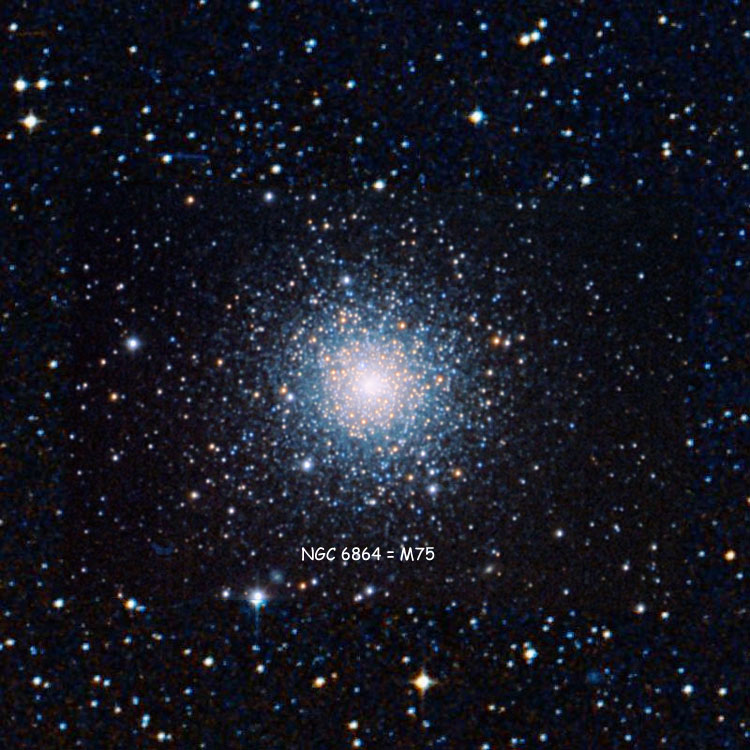
Above, a 12 arcmin wide composite image centered on NGC 6864
(Foreground image Misti Mountain Observatory (as shown below); superimposed on a DSS background)
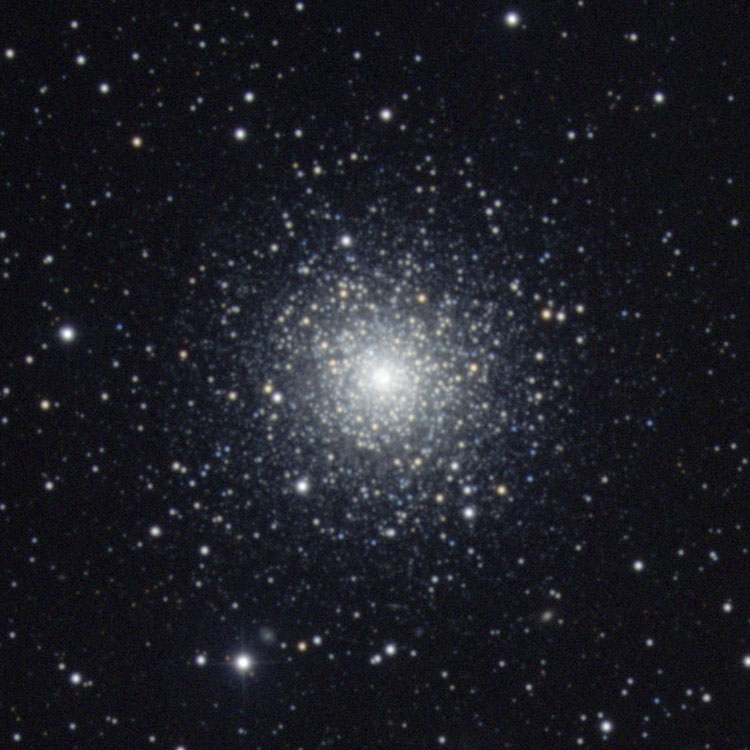
Below, a ? arcmin wide image of the cluster
(Image Credit & © Jim Misti, Misti Mountain Observatory; used by permission)

Below, a ? arcmin wide image of the cluster (Image Credit WIYN, AURA, NSF, NOAO)
NGC 6865 (= PGC 64089)
Discovered (Jun 28, 1863) by Albert Marth
A 15th-magnitude lenticular galaxy (type S0?) in Aquila (RA 20 05 56.5, Dec -09 02 27)
Historical Identification: Per Dreyer, NGC 6865 (= GC 5950, Marth #405, 1860 RA 19 58 20, NPD 99 26) is "faint, small, extended".
Physical Information: Apparent size 0.8 by 0.6? arcmin
NGC 6866 (= OCL 183)
Discovered (Jul 23, 1783) by Caroline Herschel
Also observed (Sep 11, 1790) by William Herschel
Also observed (Aug 21, 1829) by John Herschel
An 8th-magnitude open cluster (type II2m) in Cygnus (RA 20 03 58.0, Dec +44 10 00)
Historical Identification: Per Dreyer, NGC 6866 (= GC 4544 = JH 2066 = WH VII 59, (Caroline Herschel), 1860 RA 19 59 11, NPD 46 23.8) is "a cluster, large, very rich, considerably compressed".
Discovery Notes: Although Caroline Herschel discovered this cluster in 1783, William Herschel's published paper only lists his own (later) observation of the cluster; hence her absence in Dreyer's entry for this object, and her inclusion here in parentheses.
Physical Information: Apparent size 7.0? arcmin
NGC 6867 (= PGC 64203)
Discovered (Jun 9, 1836) by John Herschel
A 13th-magnitude spiral galaxy (type SBbc?) in Telescopium (RA 20 10 29.7, Dec -54 47 01)
Historical Identification: Per Dreyer, NGC 6867 (= GC 4545 = JH 3813, 1860 RA 19 59 32, NPD 145 11.1) is "most extremely faint, large, pretty much extended".
Physical Information: Apparent size 2.0 by 0.7? arcmin
NGC 6868 (= PGC 64192)
Discovered (Jul 7, 1834) by John Herschel
An 11th-magnitude elliptical galaxy (type E2?) in Telescopium (RA 20 09 54.1, Dec -48 22 46)
Historical Identification: Per Dreyer, NGC 6868 (= GC 4546 = JH 3814, 1860 RA 19 59 41, NPD 138 46.4) is "very bright, small, round, pretty gradually very much brighter middle".
Physical Information: Apparent size 3.6 by 2.8? arcmin
3K Vr 2716 km/sec
"PGC 3918606"
(= 2MASX J20095889-4821262)
Not an NGC object but listed here as a probable companion of NGC 6868
A magnitude 13.9 galaxy (type E?) in Telescopium (RA 20 09 58.9, Dec -48 21 27)
Note About PGC Designation: Although HyperLEDA assigns the PGC designation shown above to this object, a search of the database for that designation returns no result; the 2MASX designation must be used for such a search to succeed, hence the quotes placed around the PGC designation (the same thing is true for a search of the NED).
Physical Information: 3K Vr 2714 km/sec; almost certainly a physical pair
NGC 6869 (= PGC 63972)
Discovered (Aug 26, 1884) by Lewis Swift
A 12th-magnitude lenticular galaxy (type S0?) in Draco (RA 20 00 42.4, Dec +66 13 39)
Historical Identification: Per Dreyer, NGC 6869 (Swift list II (#83) and IV (#??), 1860 RA 19 59 48, NPD 24 09.1) is "pretty bright, pretty small, round".
Physical Information: Apparent size 1.6 by 1.3? arcmin
NGC 6870 (= PGC 64197)
Discovered (Jul 7, 1834) by John Herschel
A 12th-magnitude spiral galaxy (type Sab?) in Telescopium (RA 20 10 10.9, Dec -48 17 13)
Historical Identification: Per Dreyer, NGC 6870 (= GC 4547 = JH 3815, 1860 RA 19 59 58, NPD 138 41.3) is "considerably faint, considerably small, extended 90 , gradually brighter middle".
Physical Information: Apparent size 2.6 by 1.3? arcmin
PGC 489181
Not an NGC object but listed here as an apparent companion of NGC 6870
A magnitude 16.0(?) galaxy (type ?) in Telescopium (RA 20 10 02.9, Dec -48 16 42)
Physical Information: NED 3K Vr 17208 km/sec, z 0.05739968. A far more distant galaxy, so only an "optical double"
NGC 6871 (= OCL 148)
First observed (Sep 23, 1783) by William Herschel
Discovered (1825) by Wilhelm Struve
Also observed (Aug 19, 1828) by John Herschel
A 5th-magnitude open cluster (type IV3p) in Cygnus (RA 20 05 59.3, Dec +35 46 27)
Historical Identification: Per Dreyer, NGC 6871 (= GC 4548 = JH 2067, Struve 2630, 1860 RA 20 00 38, NPD 54 37.2) is "a cluster, stars large and small, double star involved".
Discovery Notes: For more than a century it was thought that Struve was the first to observe this object; but per Steinicke, Herschel had already observed the cluster (but not recorded it as such) during his early studies of double stars, whence the date of observation shown above.
Physical Information: Apparent size 30? arcmin
NGC 6872 (= PGC 64413)
Discovered (Jun 27, 1835) by John Herschel
A 12th-magnitude spiral galaxy (type SB(s)b? pec) in Pavo (RA 20 16 56.4, Dec -70 46 05)
Historical Identification: Per Dreyer, NGC 6872 (= GC 4549 = JH 3816, 1860 RA 20 02 03, NPD 161 11.9) is "faint, pretty small, a little extended, gradually a little brighter middle, 9th magnitude star 10.5 seconds of time to west, 1st of 4", the others being NGC 6876, 6877 and 6880.
Physical Information: Based on a recessional velocity of 4555 km/sec, NGC 6872 is about 210 million light-years away. Given that and its apparent size of 7.0 by 1.0 arcmin, it is about 430 thousand light-years across. This is the extent of its wide-spread arms, which are caused by its gravitational interaction with lenticular galaxy IC 4970; the central portion of the galaxy, which is only 2.0 by 0.9 arcmin, is only about 125 thousand light-years across. Still, our own Milky Way galaxy is only about 100 thousand light-years across, so NGC 6872 is an unusually large galaxy (in fact, according to a 2013 NASA report, perhaps the largest known spiral galaxy).

Above, a 12 arcmin wide image centered on NGC 6872, showing IC 4970 and part of NGC 6876
(Image Credit & © above & below Capella Observatory (superimposed on DSS background); used by permission)
Below, a 6 arcmin wide closeup of the image above
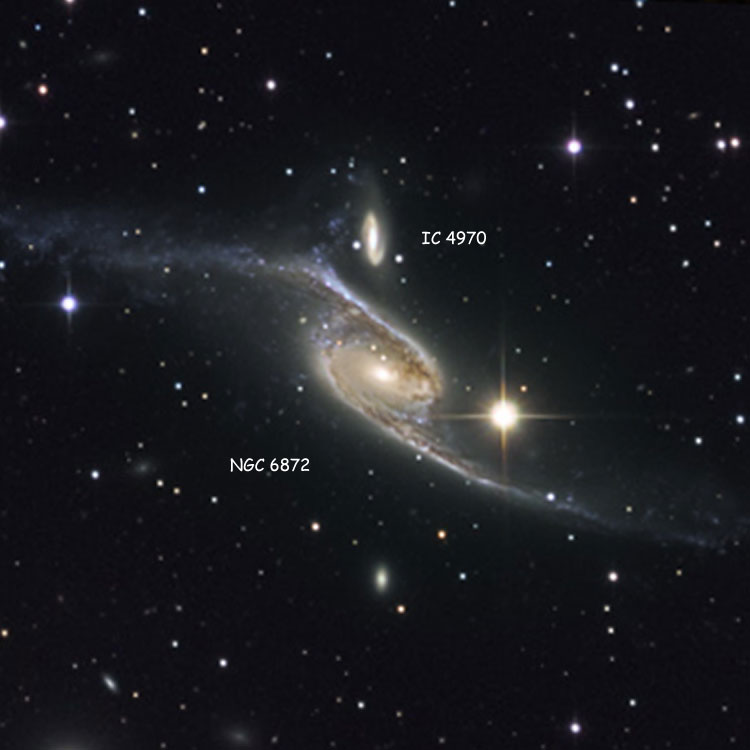
Below, a 6.5 by 3.0 arcmin Gemini Observatory image of NGC 6872 and IC 4970 (north on upper right)
(Image Credit & © Sydney Girls High School Astronomy Club, Travis Rector (University of Alaska, Anchorage),
ngel L pez-S nchez (Australian Astronomical Observatory/Macquarie University), and the Australian Gemini Office)

NGC 6873
Discovered (1825) by Wilhelm Struve
Also observed (Aug 5, 1831) by John Herschel
A group of stars in Sagitta (RA 20 07 08.0, Dec +21 05 18)
Historical Identification: Per Dreyer, NGC 6873 (= GC 4550 = JH 2068, Struve 2631, 1860 RA 20 02 05, NPD 69 17.9) is "a cluster, a little compressed, stars from 10th to 13th magnitude, double star involved".
Physical Information: Apparent size 14? arcmin
NGC 6874 (= OCL 157.1)
Discovered (Sep 15, 1792) by William Herschel
Also observed (Aug 6, 1829) by John Herschel
An open cluster (type IV1m) in Cygnus (RA 20 07 34.0, Dec +38 15 36)
Corwin's position is RA 20 07 34.0, Dec +38 15 36
Historical Identification: Per Dreyer, NGC 6874 (= GC 4551 = JH 2069 = WH VIII 86, 1860 RA 20 02 44, NPD 52 09.6) is "a cluster, poor, a little compressed."
Physical Information: Apparent size 7.0? arcmin
NGC 6875 (= PGC 64296)
Discovered (Jul 1, 1834) by John Herschel
Also observed (date?) by DeLisle Stewart
A 12th-magnitude lenticular galaxy (type E/SB0?) in Telescopium (RA 20 13 12.6, Dec -46 09 42)
Historical Identification: Per Dreyer, NGC 6875 (= GC 4552 = JH 3819, 1860 RA 20 03 15, NPD 136 34.4) is "faint, very small, round, very gradually much brighter middle, 7th magnitude star to northeast". The second IC adds "7th magnitude star 3 arcmin to southwest, not northeast (DeLisle Stewart). h. in Cape Obs. has southeast," ("h." being John Herschel = JH in most modern catalogues).
Physical Information: Apparent size 2.4 by 1.4? arcmin.
PGC 518461
Not an NGC object but listed here as a probable companion of NGC 6875
A magnitude ? galaxy (type ?) in ? (RA 20 13 15.3, Dec -46 08 43)
Physical Information: NED 3K Vr 3206 km/sec
"PGC 3919572"
(= 2MASXJ20130498-4611208)
Not an NGC object but listed here as an apparent companion of NGC 6875
A magnitude ? galaxy (type ?) in ? (RA 20 13 05.0, Dec -46 11 20)
Note About PGC Designation: Although HyperLEDA assigns the PGC designation shown above to this object, a search of the database for that designation returns no result; the 2MASX designation must be used for such a search to succeed, hence the quotes placed around the PGC designation (the same thing is true for a search of the NED).
Physical Information: NED 16.7b, 3K Vr 9203 km/sec, z 0.030697988. A far more distant galaxy, so only an "optical double"
PGC 64240 (= "NGC 6875A")
Not an NGC object but listed here since sometimes called NGC 6875A
A 13th-magnitude spiral galaxy (type SBbc?) in Telescopium (RA 20 11 55.8, Dec -46 08 40)
Warning About Non-Standard Designations: There are no standards for letter designations for galaxies. This often causes confusion, and occasionally results in data for one object being incorrectly assigned to a completely different object. Because of this, such designations should never be used, except for warnings such as this one.
Physical Information: Apparent size 2.7 by 0.4? arcmin
NGC 6876 (= PGC 64447)
Discovered (Jun 27, 1835) by John Herschel
An 11th-magnitude elliptical galaxy (type E??) in Pavo (RA 20 18 19.2, Dec -70 51 32)
Historical Identification: Per Dreyer, NGC 6876 (= GC 4553 = JH 3817, 1860 RA 20 03 28, NPD 161 17.1) is "pretty bright, small, round, extremely small (faint) star to southeast, 2nd of 4", the others being NGC 6872, 6877 and 6880.
Physical Information: Apparent size 2.7 by 2.4? arcmin
IC 4945 (= PGC 64222 = "NGC 6876A")
Not an NGC object but listed here since sometimes called NGC 6876A
Discovered (Sep 21, 1900) by DeLisle Stewart
A magnitude 13.9 spiral galaxy (type Sb?) in Pavo (RA 20 11 16.9, Dec -71 00 46)
Warning About Non-Standard Designations: There are no standards for letter designations for galaxies. This often causes confusion, and occasionally results in data for one object being incorrectly assigned to a completely different object. Because of this, such designations should never be used, except for warnings such as this one. (In this case, where there is already a perfectly good IC designation, the use of the non-standard "NGC 6876A" is even more egregious.)
Physical Information: Since there is a perfectly good IC designation, see IC 4945for anything else.
NGC 6877 (= PGC 64457)
Discovered (Jun 27, 1835) by John Herschel
A 12th-magnitude elliptical galaxy (type E??) in Pavo (RA 20 18 36.1, Dec -70 51 12)
Historical Identification: Per Dreyer, NGC 6877 (= GC 4554 = JH 3818, 1860 RA 20 03 45, NPD 161 17.2) is "very faint, very small, round, 3rd of 4", the others being NGC 6872, 6876 and 6880.
Physical Information: Apparent size 1.1 by 0.6? arcmin
NGC 6878 (= PGC 64317)
Discovered (Jul 27, 1834) by John Herschel
A 13th-magnitude spiral galaxy (type SBb?) in Sagittarius (RA 20 13 53.3, Dec -44 31 36)
Historical Identification: Per Dreyer, NGC 6878 (= GC 4555 = JH 3821, 1860 RA 20 04 03, NPD 134 56.5) is "very faint, pretty large, round, gradually a little brighter middle".
Physical Information: Apparent size 1.6 by 1.3? arcmin
PGC 64314 (= "NGC 6878A")
Not an NGC object but listed here since sometimes called NGC 6878A
A 13th-magnitude spiral galaxy (type SBb?) in Sagittarius (RA 20 13 36.0, Dec -44 48 58)
Warning About Non-Standard Designations: There are no standards for letter designations for galaxies. This often causes confusion, and occasionally results in data for one object being incorrectly assigned to a completely different object. Because of this, such designations should never be used, except for warnings such as this one.
Physical Information: Apparent size 1.8 by 0.8? arcmin
PGC 533724
Not an NGC object, but listed here as a possible companion of PGC 64314
A magnitude ? galaxy (type ?) in ? (RA 20 13 23.5, Dec -44 46 46)
Physical Information:
NGC 6879 (= PK 057-08.1 = "PGC 3517811")
Discovered (May 8, 1883) by Edward Pickering
Discovered (Sep 9, 1884) by Ralph Copeland
A 13th-magnitude planetary nebula in Sagitta (RA 20 10 26.7, Dec +16 55 21)
Historical Identification: Per Dreyer, NGC 6879 (Pickering (HN 55), Copeland, 1860 RA 20 04 04, NPD 73 29.3) is "a planetary nebula, stellar, equivalent to 10th-magnitude star". The position precesses to (2000) RA 20 10 26.6, Dec +16 55 22, dead center on the star in question, so the identification is certain. As in the case of Pickering's other "stellar" planetaries, NGC 6879 is only a few arcsec across, and appears almost perfectly stellar even under high magnification; however, using a filter (such as an OIII filter) that blocks out all radiation save that emitted by clouds of interstellar gas it is possible to "blink" the object. Switching the filter in and out causes stars, which emit only a small portion of their light at the wavelengths passed by the filter, look markedly fainter when the filter is in place, while nebulae look nearly as bright with the filter as without.
PGC Designation Note: For purposes of completeness, LEDA assigned a PGC designation to this object, even though it isn't a galaxy; however, a search of the database for that designation returns no result, so it is shown in quotes.
Physical Information: Apparent size 9 arcsec.

Above, a 12 arcmin wide DSS image centered on NGC 6879
Below, even a 2.4 arcmin wide DSS image shows little evidence of its nebular nature

NGC 6880 (= PGC 64479)
Discovered (Jun 27, 1835) by John Herschel
A 12th-magnitude lenticular galaxy (type SB0/a?) in Pavo (RA 20 19 29.6, Dec -70 51 35)
Historical Identification: Per Dreyer, NGC 6880 (= GC 4556 = JH 3820, 1860 RA 20 04 41, NPD 161 17.1) is "faint, small, round, mottled but not resolved, very small (faint) star attached, 4th of 4", the others being NGC 6872, 6876 and 6877.
Physical Information: Apparent size 2.0 by 0.9? arcmin
NGC 6881 (= PK 074+02.1 = "PGC 3517812")
Discovered (Nov 25, 1881) by Edward Pickering
A 14th-magnitude planetary nebula in Cygnus (RA 20 10 52.4, Dec +37 24 42)
Historical Identification: Per Dreyer, NGC 6881 (Pickering (HN 44), 1860 RA 20 05 43, NPD 53 00) is "a planetary nebula, stellar". The position precesses to (2000) RA 20 10 52.9, Dec +37 24 50, within 0.1 arcmin of the star in question, so the identification is certain. As in the case of Pickering's other "stellar" planetaries (such as NGC 6879), NGC 6881 is only a few arcsec across and appears almost perfectly stellar even under high magnification; however, using a filter (such as an OIII filter) which blocks out all radiation save that emitted by clouds of interstellar gas, it is possible to "blink" the object. Switching the filter in and out causes stars, which emit only a small portion of their light at the wavelengths passed by the filter, look markedly fainter when the filter is in place, while nebulae look nearly as bright with the filter as without.
PGC Designation Note: For purposes of completeness, LEDA assigned a PGC designation to this object, even though it isn't a galaxy; however, a search of the database for that designation returns no result, so it is shown in quotes.
Physical Information: Apparent size 16? arcsec.

Above, a 12 arcmin wide DSS image centered on NGC 6881
Below, even a 2.4 arcmin wide DSS image barely suggests the planetary's nebular nature
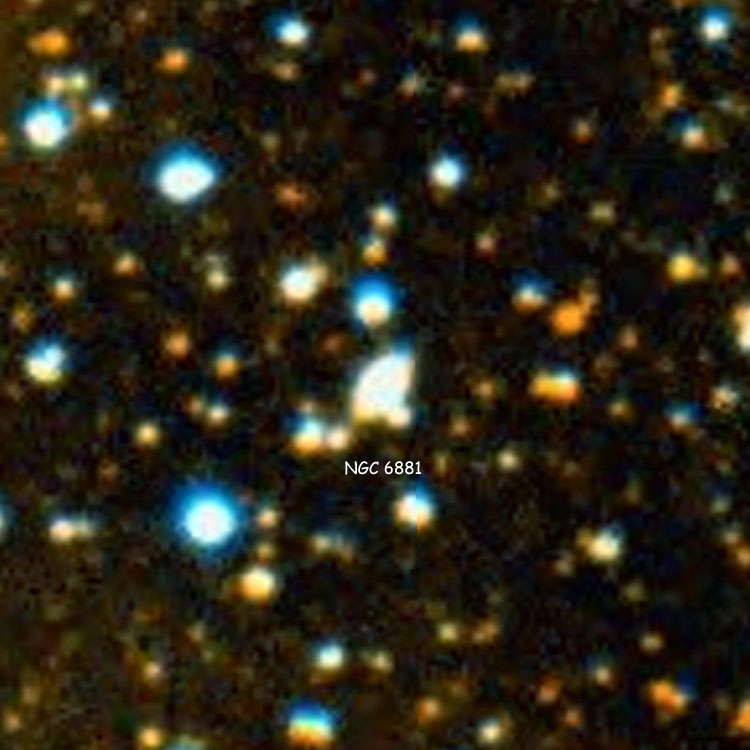
Below, a ? arcmin wide image of the nebula (Image Credit Joseph Schulman, ESA/ESO/NASA, Hubble Legacy Archive)

NGC 6882 (probably = NGC 6885)
(= C37? = OCL 132? = "PGC 5067758")
Discovered? (Sep 9, 1784) by William Herschel (and later listed NGC 6885)
Also observed? (Aug 18, 1828) by John Herschel (and later listed as NGC 6885)
Also observed? (1823) by Karl Harding (and later listed as NGC 6885)
Discovered (Sep 10, 1784) by William Herschel (and later listed NGC 6882)
An 8th-magnitude open cluster (type III2p) in Vulpecula (RA 20 12 00.0, Dec +26 30 12)
Historical Identification: Per Dreyer, NGC 6882 (= GC 4557 = WH VIII 22, 1860 RA 20 05 58, NPD 63 42.6) is "a cluster, poor, a little compressed."
Discovery Note: As will be discussed in detail when this page is brought up to snuff, this is generally thought to be a duplicate observation of NGC 6885; with an error of 15 arcmin in the declination, or a smaller part of the larger cluster, about 5 arcmin north of the center of that clsuter, but there are other suggestions about what Herschel observed, and those will also be noted when time allows.
Note About PGC Designation: As usual for NGC objects, HyperLEDA assigned a PGC designation to this object, even though it isn't a galaxy; but also as usual, a search of the database for that designation returns no result, hence its being placed in quotes.
Physical Information: TBA when page completed (in the meantime, see NGC 6885)
(unknown designation; TBD?)
A possible candidate for NGC 6882, other than as a duplicate of NGC 6885
A magnitude ? open cluster (type ??) in Vulpecula (RA 20 11 45, Dec +26 49 06)
(unknown designation; TBD?)
Another possible candidate for NGC 6882, other than as a duplicate of NGC 6885
A magnitude ? open cluster (type ??) in Vulpecula (RA 20 11 56.3, Dec +26 44 00)
NGC 6883 (= OCL 152)
Discovered (Aug 19, 1828) by John Herschel
An 8th-magnitude open cluster (type I3p) in Cygnus (RA 20 11 06.0, Dec +35 51 42)
Historical Identification: Per Dreyer, NGC 6883 (= GC 4558 = JH 2070, 1860 RA 20 05 59, NPD 54 34.3) is "a cluster, pretty rich, double star involved".
Physical Information: Apparent size 35? arcmin
NGC 6884 (= NGC 6766 = PK 082+07.1 = "PGC 3517813")
Discovered (May 8, 1883) by Edward Pickering (and later listed as NGC 6766)
Discovered (Sep 20, 1884) by Ralph Copeland (and later listed as NGC 6884)
An 11th-magnitude planetary nebula in Cygnus (RA 20 10 23.6, Dec +46 27 40)
Historical Identification: Per Dreyer, NGC 6884 (Copeland, 1860 RA 20 05 59, NPD 43 57.2) is "a planetary nebula, stellar." The position precesses to (2000) RA 20 10 23.6, Dec +46 27 37, dead on the star in question, so the identification is certain. (For a discussion of the double listing, and of Pickering's ingenious way of detecting "stellar" planetaries, see NGC 6766.)
PGC Designation Note: For purposes of completeness, HyperLEDA assigned a PGC designation to this object, even though it isn't a galaxy; but a search of the database for that designation returns no result, so the designation is shown in quotes.
Physical Information: As for many of the "stellar" planetaries discovered by Pickering and Copeland, NGC 6884 is hardly discernible from an ordinary star except with the use of filters. A "blink" comparison, in which a filter which blocks out light not given off by clouds of interstellar gas, is the easiest way for an amateur observer to tell which of the numerous stars in the region is the planetary nebula. When using such a filter (an OIII filter is the one most commonly used) stars appear noticeably fainter, while nebulous objects are nearly as bright as without the filter; so switching back and forth, the observer looks for objects which "blink" brighter than their neighbors when using the filter. However, as shown in the images below, NGC 6884 does exhibit a nebular ring around the central star. The ring is so much fainter than the star that it would not be visible either visually or in photographs taken with most amateur telescopes. The "normal" planetary nebula (such as imaged by the HST in the last image below) is part of the stellar object at the center of the ring, and I have yet to find any reference to the ring in the literature. This does not mean that it does not exist, and is merely an "artifact"; it is probably a roughly spherical cloud of material ejected by the central star a few thousand years ago, now faded to insignificance. If so, it represents the eventual fate of all planetary nebulae -- to become so large, rarefied, and poorly illuminated that they fade and disappear even as they continue to expand into interstellar space. The distance of objects such as NGC 6884 is typically more a matter of guesswork than direct observation, as the stars at their center are not Main Sequence stars, and have no "standard candle" to help us determine how bright they really are, and from that how far away they might be. In this case, studies of the expansion of the nebula (using HST images) by Palen et al yield distance estimates of 4 to 8 thousand light-years; not a terribly precise value, but still better than nothing. Given that and the approximately 1.2 arcmin size of the outer ring, the outer structure is about 2 light-years across, while the few arcsec apparent size of the "stellar" planetary corresponds to about a tenth of that value.

Above, a 12 arcmin wide DSS image centered on NGC 6884
Below, a 2.4 arcmin wide DSS image of the nebula shows a faint outer ring

Below, a ? arcmin wide image of the nebula's core (Image Credit Howard Bond (STScI), NASA/ESA/HST)

NGC 6885 (probably = NGC 6882)
(= C37 = OCL 132 = "PGC 3518405")
Discovered (Sep 9, 1784) by William Herschel (and later listed NGC 6885)
Also observed (Aug 18, 1828) by John Herschel (and later listed as NGC 6885)
Also observed (1823) by Karl Harding (and later listed as NGC 6885)
Discovered (Sep 10, 1784) by William Herschel (and later listed NGC 6882)
A magnitude 6 or 8 open cluster (type III2p) in Vulpecula (RA 20 12 00, Dec +26 30 12)
Historical Identification: Per Dreyer, NGC 6885 (= GC 4559 = JH 2071 = WH VIII 20, 1860 RA 20 06 07, NPD 63 55.7) is "a cluster, very bright, very large, rich, a little compressed, stars from 6th to 11th magnitude." The position precesses to (2000) RA 20 11 59.2, Dec +26 29 16, about 0.6 arcmin northwest of the magnitude 5.9 star 20 Vulpeculae (whence the greater assigned brightness of the cluster, even though that star is probably not a physical member of the group), which John Herschel used for the position of the cluster, the description of the surrounding (much fainter) stars fits and there is nothing else nearby, so the identification is certain.
Discovery Note: Per Gottlieb, Karl Harding discovered this object using an 8.5 inch reflector built (per Steinicke) by William Herschel, but rather than publishing the result, included it in a list of discoveries sent to Johann Bode.
Note About PGC Designation: As usual for NGC objects, HyperLEDA assigned a PGC designation to this object, even though it isn't a galaxy; but also as usual, a search of the database for that designation returns no result, hence its being placed in quotes.
Physical Information: As noted above, the presence of 20 Vul often leads to this cluster being assigned a magnitude of about 6, but since the much fainter stars surrounding that star probably represent the actual cluster, its magnitude is probably about 8. (More TBA ASAP)

Above, a 25 arcmin wide PanSTARRS image more or less centered on NGC 6885, also showing 20 Vul
NGC 6886 (= PK 060-07.2 = "PGC 3517814")
Discovered (Sep 17, 1884) by Ralph Copeland
An 11th-magnitude planetary nebula in Sagitta (RA 20 12 42.8, Dec +19 59 23)
Historical Identification: Per Dreyer, NGC 6886 (Copeland, 1860 RA 20 06 29, NPD 70 25.7) is "a planetary nebula, stellar, equivalent to 10th magnitude". The position precesses to (2000) RA 20 12 42.5, Dec +19 59 22, dead on the star in question, so the identification is certain.
PGC Designation Note: For purposes of completeness, LEDA assigned a PGC designation to this object, even though it isn't a galaxy; however, a search of the database for that designation returns no result, so it is shown in quotes.
Physical Information: Like most of Copeland's stellar planetaries, NGC 6886 is essentially indistinguishable from an ordinary star using ordinary methods of observation (its apparent size of 0.17 arcmin = only 10 arcsec); but see NGC 6884 for a discussion of the "blink" method used by amateur observers to identify such objects, or NGC 6766 for a discussion of the spectroscopic method used by observers of the late 1800's and early 1900's.

Above, a 12 arcmin wide DSS image centered on NGC 6886
Below, a 2.4 arcmin wide DSS image only hints at the nature of the planetary nebula

Below, a ? arcmin wide image of the nebula's core (Image Credit ESA/NASA/HST)

NGC 6887 (= PGC 64427)
Discovered (Jul 24, 1835) by John Herschel
A 12th-magnitude spiral galaxy (type Sbc?) in Telescopium (RA 20 17 17.4, Dec -52 47 48)
Historical Identification: Per Dreyer, NGC 6887 (= GC 4560 = JH 3822, 1860 RA 20 06 38, NPD 143 12.5) is "pretty faint, considerably large, pretty much extended, gradually a little brighter middle".
Physical Information: Apparent size 3.2 by 1.3? arcmin
NGC 6888, the Crescent Nebula
(= C27 = "PGC 3518626")
Discovered (Sep 15, 1792) by William Herschel
Also observed (Oct 18, 1895) by Guillaume Bigourdan
A 7th-magnitude emission nebula in Cygnus (RA 20 12 03.0, Dec +38 25 06)
Historical Identification: Per Dreyer, NGC 6888 (= GC 4561 = WH IV 72, 1860 RA 20 07 22, NPD 52 01.5) is "faint, very large, very much extended, double star attached". The second IC lists a corrected 1860 RA (per Bigourdan) of 20 07 01.
Note About The Position: The nebula is lit by several stars, with the "central" star being at RA 20 12 06.5, Dec +38 21 18, almost 4 arcmin south of the brightest part of the nebula.
Discovery Notes: Bigourdan also observed the region on Jun 30, 1884, and stated that the region was "rich in stars", but that he could find no sign of the nebula; it was only on the date shown above that he found the nebula "20 seconds of time preceding" the NGC position (whence the correction in the IC2).
Note About PGC Designation: As for most NGC objects, HyperLEDA assigned a PGC designation to this object, even though it isn't a galaxy; but as is usually the case in such situations, a search of the database for that designation returns no result, as indicated by it being placed in quotes.
Physical Information: The Crescent Nebula is an emission nebula caused by the collision of two waves of gaseous emissions by the "bright" (7th-magnitude) star near its center, WR 136. The star is an approximately 4.5 million year old Wolf-Rayet star of perhaps 40 to 80 solar masses. Wolf-Rayet stars are very massive, extremely hot stars (originally O-type Main Sequence stars) which are near the end of their lives. A few hundred thousand years ago the star swelled up to become a red super-giant, and ejected a few tenths of a solar mass of gas at about 20 thousand miles per hour. About 200 thousand years later, it heated up to several hundred thousand degrees, and began ejecting about a solar mass of super-heated gas per ten thousand years, at nearly 1% the speed of light (3 to 4 million miles per hour). As the faster moving, hotter gas reached the shower-moving, cooler gas previously released, it created a supersonic shock wave, causing the nebula to emit visible (primarily red H ‘) light, as well as ultraviolet and X-radiation. The complex filamentary structure of the nebula is real, but its spherical structure is tissue-thin in comparison to its size. Only the surface of the structure is glowing; the hot gas streaming away from the star is essentially invisible. Within a few thousand years the current nebula will fade away, as its gas disperses into the surrounding space; but within a hundred thousand years, a new and even more spectacular nebula will form when the star supernovas. WR 136 and its nebula are about 4700 light-years away. Given that and the approximately 18 by 12 arcmin apparent size of the nebula, NGC 6888 is about 25 light-years across.
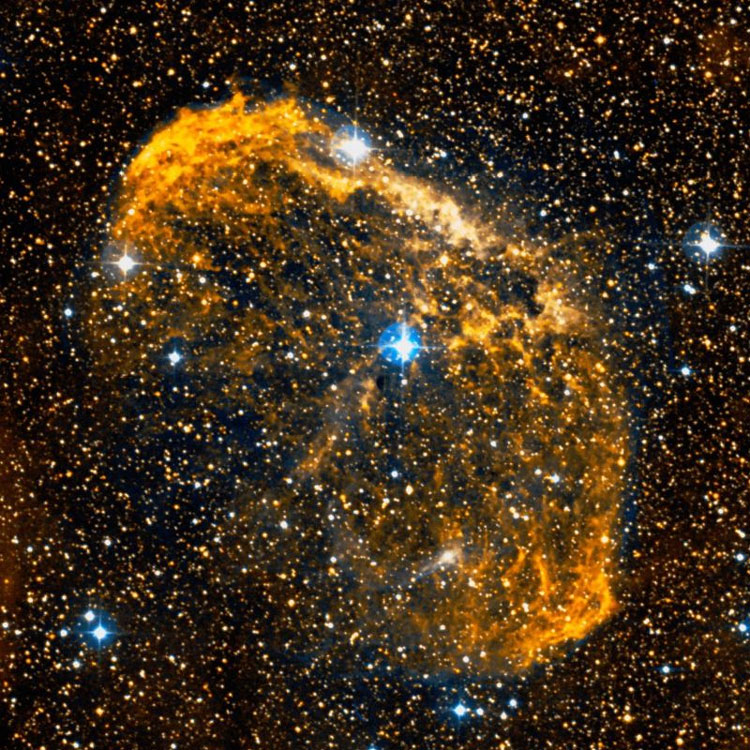
Above, a 20 arcmin wide view of NGC 6888
Below, a ? arcmin wide image of the nebula (Image Credit T. A. Rector (NRAO), NOAO, AURA, NSF)
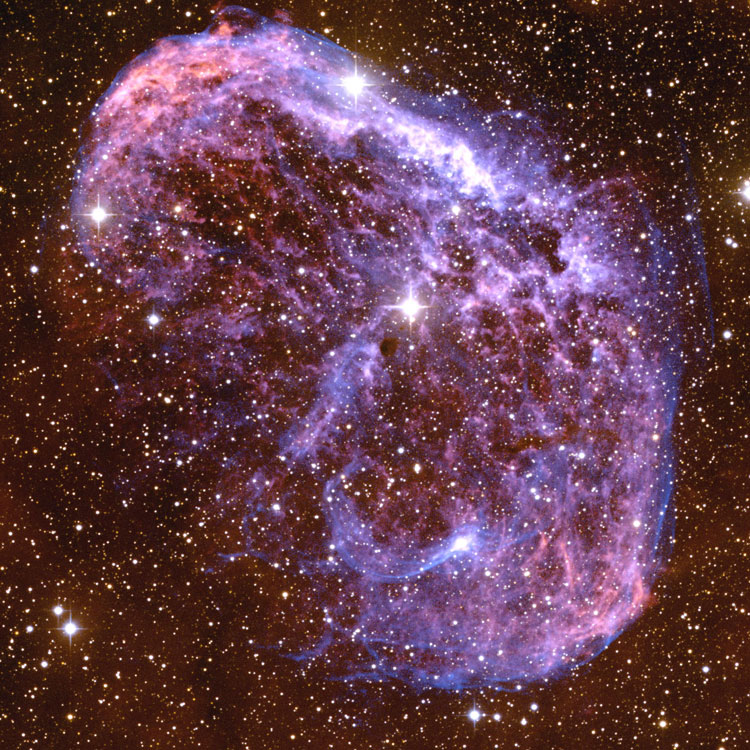 Below, a HST false-color image of a shock-heated portion of the nebula. The black and white visible-light image shows the region covered by the HST closeup. (Image Credit NASA, Brian D. Moore, Jeff Hester, Paul Scowen (Arizona State University), Reginald Dufour (Rice University)) Below, a Chandra space telescope X-ray image of a region which includes the HST image above, superimposed on a ground-based image of the whole nebula. The X-radiation detected by Chandra (shown in false-color blue) represents gas shock-heated to about 2 million Fahrenheit degrees. (Image Credits: X-ray: NASA/UIUC/Y. Chu & R. Gruendl et al. Optical: SDSU/MLO/Y. Chu et al.)
NGC 6889 (= PGC 64464)
Discovered (Jun 9, 1836) by John Herschel
A 13th-magnitude spiral galaxy (type SBbc?) in Telescopium (RA 20 18 53.2, Dec -53 57 25)
Historical Identification: Per Dreyer, NGC 6889 (= GC 4562 = JH 3823, 1860 RA 20 08 06, NPD 144 23.0) is "very faint, large, a little extended".
Physical Information: Apparent size 0.9 by 0.7? arcmin
PGC 3098364
Not an NGC object, but listed here as an apparent companion of NGC 6889
A magnitude 15.0(?) spiral galaxy (type (R?)Sb? pec) in Telescopium (RA 20 18 39.0, Dec -54 00 24)
NED: 3K Vr 12784 km/sec, z = 0.043046*12784/12905, 0.45 x 0.42 arcmin, Rmag 14.8
LEDA: 3K 12784 km/sec, B 15.6, I 14.6 -> V 15.0(?)
NGC 6890 (= PGC 64446)
Discovered (Jul 1, 1834) by John Herschel
A 12th-magnitude spiral galaxy (type SBb?) in Sagittarius (RA 20 18 18.1, Dec -44 48 25)
Historical Identification: Per Dreyer, NGC 6890 (= GC 4563 = JH 3824, 1860 RA 20 08 30, NPD 135 13.9) is "pretty faint, small, round, very gradually a little brighter middle".
Physical Information: Apparent size 1.6 by 1.3? arcmin
NGC 6891 (= PK 054-12.1 = "PGC 3517815")
Discovered (Sep 22, 1884) by Ralph Copeland
An 11th-magnitude planetary nebula in Delphinus (RA 20 15 08.8, Dec +12 42 16)
Historical Identification: Per Dreyer, NGC 6891 (Copeland, 1860 RA 20 08 32, NPD 77 41.2) is "a planetary nebula, stellar, equivalent to 9.5 magnitude". The position precesses to (2000) RA 20 15 07.4, Dec +12 44 15, about 2 arcmin north northwest of the star in question, but there is nothing else nearby which in any way matches the description, so the identification is certain.
PGC Designation Note: For purposes of completeness, LEDA assigned a PGC designation to this object, even though it isn't a galaxy; however, a search of the database for that designation returns no result, so it is shown in quotes.
Physical Information: Like many of Copeland's "stellar" planetary nebulae, the central portion of NGC 6891 looks very much like a star (its 0.35 arcmin apparent size corresponding to only 21 arcsec), but there is a faint outer ring visible in long-exposure photographs, which (as in the case of NGC 6884) was presumably ejected by the central star several thousand years ago, and is now fading from view; and even the inner region displays a complex structure in high-resolution images, such as the HST image below. The distance of planetary nebulae is typically more a matter of guesswork than direct observation, as the stars at their center are not Main Sequence stars, and provide no "standard candle" to help us determine how bright they really are. In the case of NGC 6891, the distance has been estimated from studies of the expansion of the nebula, as measured with HST images spaced over a period of about four years. The expansion rate for NGC 6891 turned out to be so slow that it could not be measured in the brief time involved; but comparison with the other objects studied suggests that it is at least 3000 light-years away, as any closer distance would have yielded measurable results (closer distances making the nebula and its expansion rate appear larger).

Above, a 12 arcmin wide DSS image centered on NGC 6891
Below, a 2.4 arcmin wide DSS image of the nebula shows a faint outer halo

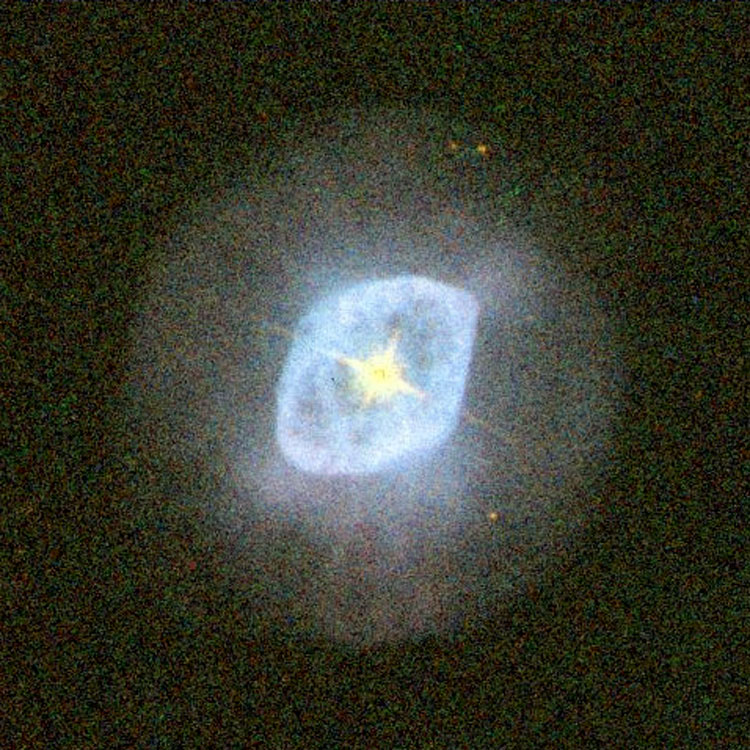
Below, a ? arcmin wide HST image of the central nebula (Image Credit Hubble Legacy Archive)
NGC 6892
Recorded (Jul 19, 1865) by Heinrich d'Arrest
Four stars in Sagitta (RA 20 16 57.2, Dec +18 01 11)
Historical Identification: Per Dreyer, NGC 6892 (= GC 5951, d'Arrest, 1860 RA 20 10 33, NPD 72 23.9) is "an extremely faint nebulous star (perhaps an extremely small cluster?)" (the parentheses being in the original NGC entry).
Physical Information:
NGC 6893 (= PGC 64507)
Discovered (Jul 7, 1834) by John Herschel
A 12th-magnitude lenticular galaxy (type SB0?) in Telescopium (RA 20 20 49.6, Dec -48 14 21)
Historical Identification: Per Dreyer, NGC 6893 (= GC 4564 = JH 3825, 1860 RA 20 10 43, NPD 138 40.9) is "pretty faint, small, round, suddenly very bright middle equivalent to 12th magnitude star".
Discovery Notes: In the NGC entry Dreyer copies John Herschel's GC description of "svbM*12". This would normally be read "suddenly very brighter middle equivalent to 12th magnitude star", but that is not consistent with Herschel's typical descriptions, so he probably meant to write "svBM*12", which would translate as "suddenly very bright middle equivalent to 12th magnitude star", as shown in the Historical Identification above.
Physical Information: Apparent size 2.6 by 1.7? arcmin
NGC 6894 (= PK 069-02.1 = "PGC 3517816")
Discovered (Jul 17, 1784) by William Herschel
Also observed (Sep 4, 1825) by John Herschel
A 12th-magnitude planetary nebula in Cygnus (RA 20 16 24.0, Dec +30 33 54)
Historical Identification: Per Dreyer, NGC 6894 (= GC 4565 = JH 2072 = WH IV 13, 1860 RA 20 10 45, NPD 59 51.8) is "a very remarkable object, an annular nebula, faint, small, very very little extended".
PGC Designation Note: For purposes of completeness, LEDA assigned a PGC designation to this object, even though it isn't a galaxy; however, a search of the database for that designation returns no result, so it is shown in quotes.
Physical Information: Apparent size 0.92? arcmin
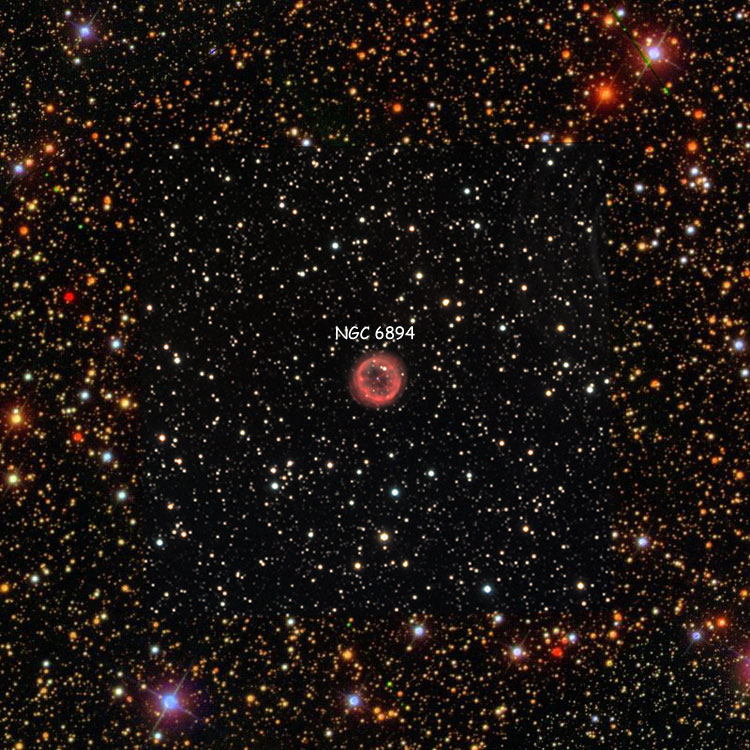
Above, a 12 arcmin wide SDSS/NOAO composite centered on NGC 6894 (NOAO Image Credit as below)
Below, a 2.4 arcmin wide image of the planetary (Image Credit Adam Block/NOAO/AURA/NSF)

Below, a ? arcmin wide HST image of part of the nebula (Image Credit Hubble Legacy Archive)

NGC 6895
Discovered (Sep 30, 1790) by William Herschel
A group of stars in Cygnus (RA 20 15 50.0, Dec +50 14 12)
Historical Identification: Per Dreyer, NGC 6895 (= GC 4566 = WH VIII 83, 1860 RA 20 12 24, NPD 40 12.1) is "a cluster, pretty rich, a little compressed".
Physical Information: Apparent size 15? arcmin
NGC 6896
Recorded (Apr 16, 1862) by Heinrich d'Arrest
Two stars in Cygnus (RA 20 18 03.5, Dec +30 38 23)
Historical Identification: Per Dreyer, NGC 6896 (= GC 4567, d'Arrest, 1860 RA 20 12 26, NPD 59 47.4) is "a cluster (plus a nebula), small, stars very small (faint)", "plus a nebula?" being in parenthese in the original entry.
NGC 6897
(= PGC 64513 = MCG -02-52-001)
Discovered (Jun 28, 1863) by Albert Marth
Discovered (Aug 24, 1867) by Truman Safford
A magnitude 13.8 spiral galaxy (type SAB(r?s)bc pec?) in Capricornus (RA 20 21 01.3, Dec -12 15 17)
Historical Identification: Per Dreyer, NGC 6897 (= GC 5952, Marth #406, (Safford #80), 1860 RA 20 13 18, NPD 102 42) is "very faint, small." The position precesses to (2000) RA 20 21 02.5, Dec -12 15 39, less than 0.5 arcmin southeast of the galaxy listed above and not far beyond its outline, the description fits and there is nothing comparable nearby, so the identification is certain.
Discovery Notes: Safford's observations were not published until many years after the fact, so Dreyer was not aware of them until the NGC was in the last stages of preparation. As a result, Safford's discoveries were partially noted in an appendix, and not at all in the individual NGC entries (hence his inclusion here in parentheses). Gottlieb notes that it is a pair with NGC 6898, which lies just under 6.5 arcmin to the south-southeast.
Physical Information: Not only is NGC 6897 an apparent pair with NGC 6898, but they have nearly identical recessional velocities relative to the Cosmic Microwave Background Radiation (5500 km/sec for NGC 6897, and between 5490 and 5495 km/sec for NGC 6898), so they are probably at nearly identical distances from us, which (given their close position in our field of view) implies that are a gravitationally interacting pair. Given an average recessional velocity of a little over 5495 km/sec (and H0 = 70 km/sec/Mpc), the pair is about 255 million light-years from us, a bit further than but in reasonable agreement with redshift-independent distance estimates of about 185 to 230 million light-years. Given that and its apparent size of about 0.8 by 0.5 arcmin (from the images below), NGC 2897 is about 60 thousand light-years across. This fairly small size suggests a similarly small mass, which argues against the possibility of an interaction with its neighbor, but if the estimated distance is correct, their separation is only about 480 to 490 thousand light-years, less than half the size of our Milky Way galaxy, and for galaxies within that distance of each other in our Local Group interactions appear to be fairly common, so the apparent pair is probably a physically interacting pair, after all.
Classification Note: NED lists this as type SAB:(rs?)bc: pec:. The numerous colons and question marks indicate that the type is far from certain. The type shown above is my nearly identical suggestion, based on the images below.

Above, a 12 arcmin wide SDSS image centered on NGC 6897
Below, a 1.0 arcmin wide SDSS image of the galaxy

Below, a 7.5 by 10 arcmin wide SDSS image of NGC 6897 and 6898

NGC 6898
(= PGC 64517 = MCG -02-52-002)
Discovered (Jun 28, 1863) by Albert Marth
Discovered (Aug 24, 1867) by Truman Safford
A -magnitude 13.1 spiral galaxy (type (R'?)SAB(rs)ab? pec) in Capricornus (RA 20 21 08.0, Dec -12 21 32)
Historical Identification: Per Dreyer, NGC 6898 (= GC 5953, Marth #407, (Safford #79), 1860 RA 20 13 24, NPD 102 48) is "faint, small, irregularly round." The position precesses to (2000) RA 20 21 08.8, Dec -12 21 38, about 0.2 arcmin southeast of the center of the galaxy listed above and well within its southeastern boundary, the description fits and there is nothing comparable nearby, so the identification is certain.
Discovery Notes: Safford's observations were not published until many years after the fact, so Dreyer was not aware of them until the NGC was in the last stages of preparation. As a result, Safford's discoveries were partially noted in an appendix, and not at all in the individual NGC entries (hence his inclusion here in parentheses). Gottlieb notes that it is a pair with NGC 6897, which lies just under 6.5 arcmin to the north-northwest.
Physical Information: As discussed in some detail in the entry for NGC 6897, that galaxy and NGC 6898 are almost certainly a physically interacting pair, separated by less than half the size of our Milky Way galaxy, at a distance of roughly 255 million light-years from us. Given that and its apparent size of about 1.15 by 1.0 arcmin (from the images below, including the northern partial arm/ring), NGC 6898 is about 85 thousand light-years across.
Classification Note: NED lists this as type (R')SB(rs)a?. The type shown above is my similar suggestion, based on the images below.

Above, a 12 arcmin wide SDSS image centered on NGC 6898
Below, a 1.6 arcmin wide SDSS image of the galaxy; see NGC 6897 for an image of the pair

NGC 6899 (= PGC 64630)
Discovered (Jul 24, 1835) by John Herschel
A 13th-magnitude spiral galaxy (type SBbc?) in Telescopium (RA 20 24 22.2, Dec -50 26 02)
Historical Identification: Per Dreyer, NGC 6899 (= GC 4568 = JH 3826, 1860 RA 20 14 04, NPD 140 52.0) is "faint, small, round, gradually a little brighter middle, among stars".
Physical Information: Apparent size 1.7 by 1.0? arcmin
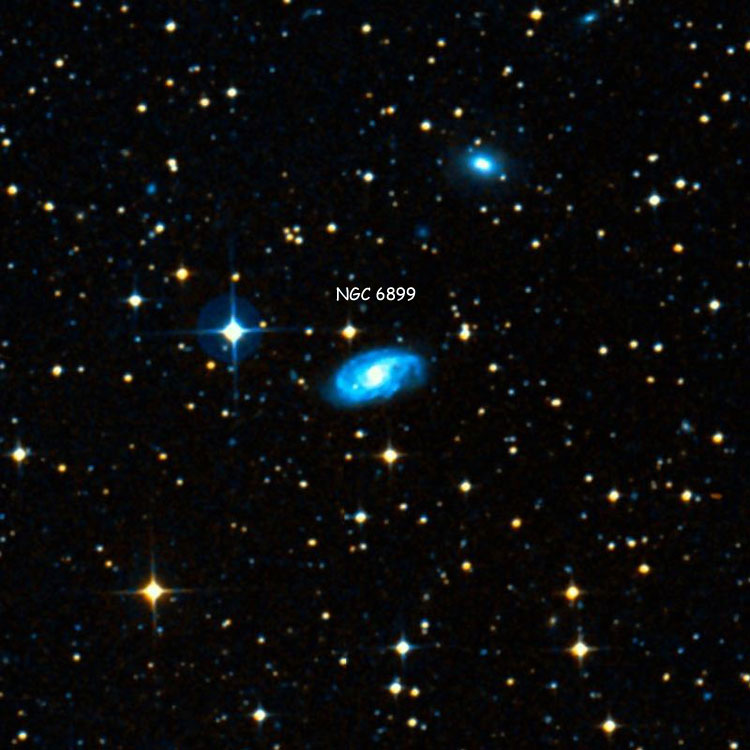
Above, a 12 arcmin wide DSS image centered on NGC 6899
Below, a 2.4 arcmin wide DSS image of the galaxy

|