A Brief Note On The "Super" Moon of March 19, 2011
References to the "super" full Moon of March 19, 2011 (and any other so-called "super" full Moons) doesn't mean the Moon is any bigger than usual -- just closer. The Moon's orbit has an eccentricity of nearly 6%, which means its distance can vary by nearly 12% from perigee (the closest point in its orbit) to apogee (the furthest point in its orbit). Every time the Moon goes around us it passes through perigee and apogee (namely, once every 27.3 days, which is the orbital period of the Moon). However, the cycle of lunar phases (the length of the day on the Moon; see Rotation Period and Day Length) is 29 1/2 days, so each time the Moon goes through a cycle of phases it reaches a particular phase over 2 days further along in its orbit, and is at a different distance than the previous month. Every year there is a full Moon which is fairly close (within a day or two) of perigee, and bigger than usual; and about half a year earlier and later, there is a full Moon which is fairly close (within a day or two) of apogee, and smaller than usual. What was unusual about the full Moon of March 19, 2011 is that it occured almost exactly at the same time as perigee, so it was a smidgen closer than usual for a perigee full Moon, and therefore a smidgen bigger.
As shown in the images below, the perigee Moon looks quite a bit larger than the apogee Moon, both in height (as shown clearly in the composite image) and in width (which isn't as obvious, but is just as big a difference). Since the perigee Moon is almost 12% larger in diameter than the apogee Moon, it has an area which is 25% larger (1.12 squared times as big). Being that much larger makes it look that much brighter as well. (Unfortunately, a recent NASA press release image comparing the apparent size and brightness of the perigee and apogee Moon correctly showed the two as being of different sizes, but incorrectly showed the smaller Moon as also looking darker. The actual brightness per unit of area, which is determined by the Moon's distance from the Sun, is almost exactly the same, as is more or less obvious in the images below; it is only the larger size which makes it look brighter at perigee.) (Note: Two sets of images are shown. In the upper set two "quarter" Moons are shown, so that the width of the image doesn't have to be much larger than that of the Moon. In the lower set, two images of the full Moon are used, which means they have to be smaller to fit within the space provided for the images.)
On a final note, it should be pointed out that news reports which stated that the Moon was closer on March 19, 2011 than at any time since 1993 were wrong. The Moon has that same distance every 27.3 days, when it reaches perigee. It just happened that the previous time the Moon was at perigee within an hour or so of full Moon was in 1993. Similar full Moons have occured since then, but at distances a few hundred miles further away, because they were four to ten hours away from the exact moment of perigee. However, in comparison to the nearly 240,000 miles to the Moon even at its closest approach (and for that matter, the fact that the side of the Earth facing the Moon is 8000 miles closer to it than the opposite side), a few hundred miles are of no significance. And the charlatans who try to frighten the public with predictions of doom due to "super" full moons are merely scoundrels taking advantage of the situation to get their names in the news (and their hands in the pockets of the credulous).
The Moon's distance from the Earth changes by more than 5% of its average distance as it moves toward perigee or apogee. As a result, the apparent size increases or decreases by a little over 5% as well. These images show the apparent size of the Moon at apogee (on the left), and at perigee (on the right). (The change in size is not so obvious when the time between the extremes is two weeks, as when images are placed side by side.) When at apogee the Moon moves less than 12 degrees per day to the East among the stars, whereas at perigee it moves nearly 15 degrees per day. (António Cidadão, apod041021)
A comparison of the apparent size of perigee and apogee full moons (Image Credit JPL/USGS/NASA)
An image of the full Moon of December 7, 1992, taken by the Galileo spacecraft as a test of its camera systems as it left the Earth on its three year trip to Jupiter. Since the image was taken from space, the northern side of the Moon (at the top of the image) is shown in more detail than is usual from Earth, while the southern side (at the bottom) is partially hidden from view. Still, this image approximates the appearance of the full Moon as seen from the Earth adequately for the purpose of this image. Namely, the right-hand version of the image, which represents the apparent size of the Moon at apogee, is only 89.5% as wide (and high) as the left-hand version, which represents the apparent size of the Moon at perigee. As a result the perigee Moon appears to have a 25% larger surface area and brightness than the apogee Moon. (Note: The original image, being a test of the spacecraft's cameras, used an exaggerated (false-color) color scale; since the Moon is essentially colorless, these images have had the color data removed.)
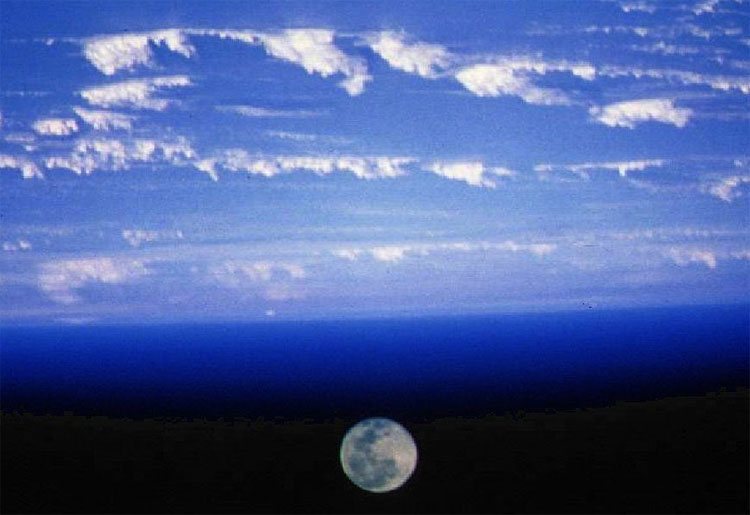
The full moon of December 1990 setting, as seen from the STS-35 Space Shuttle mission (the setting being due to the motion of the spacecraft around the Earth). The image posted on APoD was taken as the shuttle passed "under" the Earth. To make it look more normal APoD rotated the image by 180 degrees; however, that made the features on the Moon backwards from their actual appearance, so the image posted here has been restored to its original appearance. The space-based image has an advantage over Earth-based pictures of the rising moon due to the relative lack of air between the Shuttle and the Moon. Namely, the rising or setting Moon often looks reddish due to scattering of the shorter wavelengths of light by our atmosphere, while in this image it is shown in its natural (nearly colorless) color. (STS-35 Crew, NASA, apod020921)
Above, an exaggerated-color image of the Moon taken by the Galileo spacecraft, centered near Mare Orientale (which is on the eastern limb of the Moon as seen from the Earth), when the spacecraft passed the Earth and Moon on its way to Jupiter in 1990. The near side of the Moon, which is always visible from the Earth, is on the right; while the far side, which is never visible from the Earth, is on the left. Note that at the time this image was taken ("third" or "last" quarter Moon), parts of both the near and far sides were in sunlight; so "the dark side of the Moon" is not an accurate description of the far side, save in the sense of dark meaning unknown or unexplored, and luna incognita would have been a better term for the far side prior to the space age. For other false-color and exaggerated-color images of the Moon (which are more useful for some purposes than "true-color" images), see A Colorful Moon.
The very first image of the Earth from lunar orbit.
Taken by one of the Lunar Orbiters on August 23, 1966, this image and at least 1500 others languished on decades-old two-inch magnetic tape (equivalent to 70-mm film images) unreadable by modern equipment, for over 40 years. Recent efforts to decipher the tapes, once destined for landfills, finally succeeded in recovering this first-ever image of Earthrise from lunar orbit. (NASA, LOIRP)
Lunar Sample Disk 137 (click on image for detailed discussion). One of a number of disks used by NASA to promote public understanding of the Moon. Samples of moon rocks and moon soil are embedded in a clear plastic disk for convenient viewing.
The Earth and Moon as seen by the NEAR spacecraft as it passed beneath their South poles (note Antarctica at center Earth image) in January of 1998. As dark as the Moon appears in comparison to the Earth, it is actually five times darker yet, as its brightness was enhanced by that much in creating this picture. (NEAR Spacecraft Team, JHUAPL, NASA, apod980129)
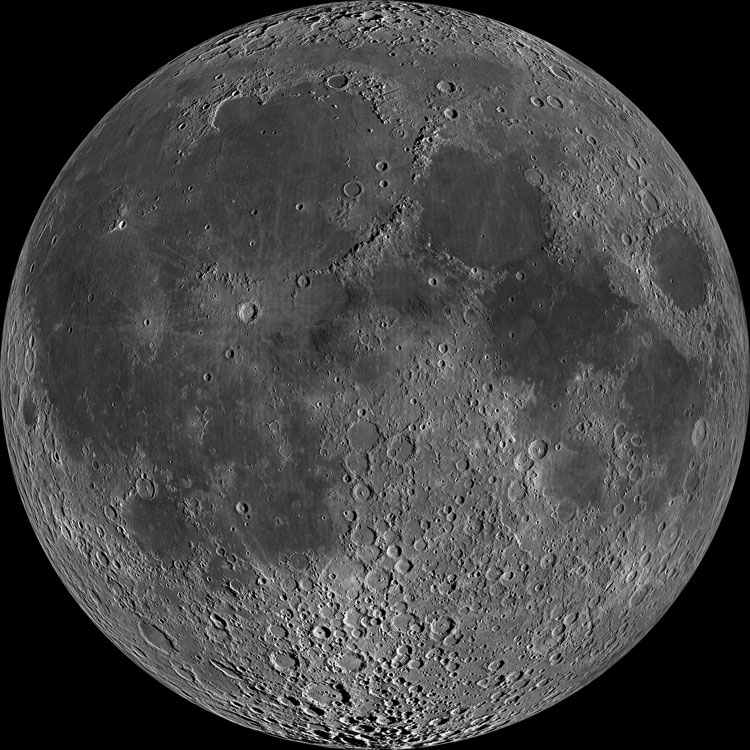
Above, an Earth-based image of the full moon (Consolidated Lunar Atlas, USNO, Lunar and Planetary Institute) Note the lack of shadows, and the presence of bright rays, in contrast to the mosaic images below
A lunar nearside mosaic (Image Credit GSFC / Arizona State Univ. / Lunar Reconnaissance Orbiter
NASA)
Usually, images of the full moon show no shadows and relatively little contrast because we are viewing the Moon from the same direction as the Sun, and there are no shadows visible from the Sun or our location. The above mosaic of thousands of Lunar Reconnaissance Orbiter images, adjusted for foreshortening (near the limb) and taken slightly away from local lunar noon (so that there are some shadows) provides an enhanced view of the lunar nearside, similar to that in the best hand-drawn maps. The same image is also shown below, but with some of the more prominent features (easily visible with binoculars, and at least detectable even with the unaided eye) labeled.
Closer view of the area near Tycho (rayed crater near bottom). The large crater near top left is Copernicus, which is shown in more detail below. (Steve Mandel, Hidden Valley Observatory, apod010809)
Eagle's-eye image of Copernicus, taken by Apollo 17 astronauts in 1972. The nearly 60-mile wide crater has terraced walls and central peaks, both of which are characteristic of craters of this size. (Apollo 17, NASA, apod010513)
A portion of a Lunar Orbiter picture of Copernicus obtained in 1966. Click on the image for a more detailed look at its structure. (USGS, JPL, NASA)
A third-quarter moon unlike any ever seen from Earth. The western "limb" of the Moon, photographed by the Galileo spacecraft as it flew by the Earth. (Galileo Project, JPL, NASA, apod990326)
The far side of the Moon as seen by Apollo 16 astronauts in April of 1972. Since the Moon is locked in synchronous rotation with the Earth and always keeps the same side toward us, the appearance of the far side was completely unknown until the space age. Surprisingly, unlike the near side, which has many large maria, the far side is almost entirely lacking in maria, and is instead completely covered by ancient craters, dating back to nearly the beginning of the Solar System. The reason for the difference between the near and far sides is not known, but it is suspected that the crust on the far side is thicker, making it harder for the molten material which formed the maria to force its way through cracks in the lunar crust and reach the surface. (Apollo 16, NASA, apod981008)
An earlier (July 1969) closeup of twenty-mile wide "Crater 308", on the lunar farside, taken by the Apollo 11 crew, emphasizes the extreme cratering typical of lunar highlands and, particularly, the almost entirely cratered "dark side" of the Moon. Obviously, at the time this image was taken it wasn't at all dark in this part of the Moon. Every part of the Moon, save for some of the deeper craters near the Poles, sees the Sun slowly rise, cross the sky, and set, then rise again 29 1/2 days after the previous sunrise. When we see the Moon going through a cycle of phases, we are seeing daylight slowly move across the front side of the Moon, during its waxing phases (from new to quarter to full Moon), then slowly move across the back side of the Moon, while darkness creeps across the front side during its waning phases (from full to quarter to new Moon again). (Apollo 11, NASA, apod030312)
Mare Orientale, one of the most striking lunar features, as photographed by Lunar Orbiter 4 in 1967. Because it is located on the extreme western edge of the "near side" of the Moon, it is difficult to see from the Earth. The 600-mile wide structure was formed by the impact of an asteroid-sized (probably 20 to 40 miles in diameter) object more than three billion years ago. The shock of the collision created ripples in the lunar crust, resulting in three sets of concentric circular features centered on the mare. The sudden removal of hundreds of miles of crustal material caused the subsurface rocks to melt, and also allowed already partially molten material in the Moon's mantle to reach the surface and flood the interior of the impact site. A similar impact on Mercury, closer to 4 billion years ago, created a similar structure, the Caloris Basin. (NASA, Lunar Orbiter 4, apod021123)
A labeled view of a portion of the same Lunar Orbiter image of Mare Orientale. (NASA, Lunar Orbiter 4, Sky and Telescope)
Mare Orientale as seen from the Earth, during a favorable libration (as the Moon goes around us its orbital speed varies, but its rotation doesn't, so sometimes we can see a little around one side or the other; this change in our view is called libration). Even though very little of the Mare is shown in this view, it is still a much better view than usual, as you can tell by comparing how much further Grimaldi is from the limb ("edge") of the Moon in this image, compared to its more normal position in the full-moon view near the top of this page. (Gary Seronik, Sky and Telescope)
A Lunar Reconnaissance orbiter image of Mare Orientale shows almost the entire crater in detail. (The black lines at far right are used for image calibration, and might be removed in a future image release.) The 600 mile wide crater is believed to be one of the youngest "basin" craters on the Moon, having formed near the end of the age of lunar volcanism (a little over 3 billion years ago), and is only partially filled with the basaltic lavas characteristic of the prior billion years. As a result, the basin retains an unusually large difference in height from its floor to the surrounding highlands -- more than two miles from top to bottom.
An animation showing how the Moon changes during a cycle of phases. Created by superimposing daily images throughout one lunation, the animation shows how the Moon gets bigger and smaller as it nears us and goes away from us, and tilts (librates) north and south as it moves above and below our Equator, and tilts east and west as its orbital motion speeds and slows. (António Cidadão, apod991108) (Click on the image to open a large version in a new window)
Note how even low features near the terminator (the day-night "line" on the right of this 3rd-quarter image) have long, jagged shadows, while even with the Sun low on the lunar horizon, the lunar maria appear almost completely smooth (showing only the faintest traces of ancient lava flows).
The waning crescent moon as photographed with the ESO 2.2 meter wide field camera. (WFI Team, ESO, MPI-A, OAC, apod990129)
Most lunar craters (and those on other planets and moons) are round, as they are formed by explosions which throw material in all directions, rather than being "dug" out. However, if the object which creates a crater hits the surface at a very low angle it may skip across the surface, producing elongated craters such as shown in this Apollo 11 image. Moving from left to right, their impactor gouged out the 5 by 10 mile wide Messier on the left, then the 7 by 10 mile wide Messier A on the right, spraying material over a large area, and causing the pair of craters and their ejecta field to look very much like a comet. This is why they are named after one of the most famous comet-hunters of all time, Charles Messier. (Apollo 11, NASAApollo Image Atlas)
A close-up of Mare Humorum. The large crater at the top left is Gassendi. (WFI Team, ESO, MPI-A, OAC, apod990212)
Ariadeus Rille, photographed by Apollo 10 astronauts. Linear rilles are created by tectonic deformations of unknown nature and origin. (Apollo 10, NASA, apod)
A Chandrayaan-1 Moon Mineralogy Mapper infrared image (left) of a lunar farside crater indicates the presence of water (shown by blue tint at right). The "water" is not liquid, but individual molecules stuck to the surface, and may be simply due to hydrogen atoms from the solar wind interacting with oxygen atoms from the surface rocks (rocks are made of various metals combined with oxygen). (ISRO/NASA/JPL-Caltech/USGS/Brown University, apod090928)
The interior of the lunar crater Cabeus, near the Moon's South Pole, is in perpetual darkness. Theoretically, it could contain water ice deposited by cometary impacts and flash frozen by the crater's nearly 400 degrees below zero Fahrenheit temperature. The LCROSS impactor crashed into Cabeus in the pre-dawn hours of October 9, 2009, hopefully throwing a debris plume 5 or 6 miles high into space. The plume was to be carefully examined for evidence of water or organic compounds by another craft which will was to pass through the plume on its way to an impact a few minutes later, and by numerous telescopes on the surface of the Earth and in Earth-orbit. Unfortunately the impactor did not produce as large a plume as expected, and the attempted observations were mostly futile. (NMSU/MSFC Tortugas Observatory, apod091008)
A quarter-millimeter (one-hundredth of an inch) glass spherule brought back from the Moon by Apollo 11 astronauts. Produced when a meteorite hit the Moon, splattering melted surface rocks in all directions, the spherule was subsequently impacted by microscopic meteoroids, creating the small craters visible on its surface. The crater near top left, being only a few thousandths of an inch across, was probably made by a meteoroid only a tenth of a thousandth of an inch in diameter. On the Earth, such micrometeoroids would be slowed to negligible speeds by our atmosphere and simply float to the surface. But the absence of a lunar atmosphere allows them to hit the surface at tens of thousands of miles per hour. (Timothy Culler (UCB) et al., Apollo 11 Crew, NASA, apod030112)