Last update Mar 16, 2022
Fixed broken links, added 2013 model of Mars

Older models of Martian structure had relatively small, solid cores.The low density of Mars suggested that Mars' core must contain considerably less iron (in comparison to the overall mass of the planet) than the other Terrestrial planets. Meanwhile, the lack of a global magnetic field suggested that the core, such as it is, was completely solid. Estimates of core size ranged from less than 30% of the size of the planet (if similar to iron meteorites) to a maximum of 60% of the size of the planet (if rich in sulfur and other lighter materials). (NASA, JPL, Voyager Team, Calvin Hamilton)
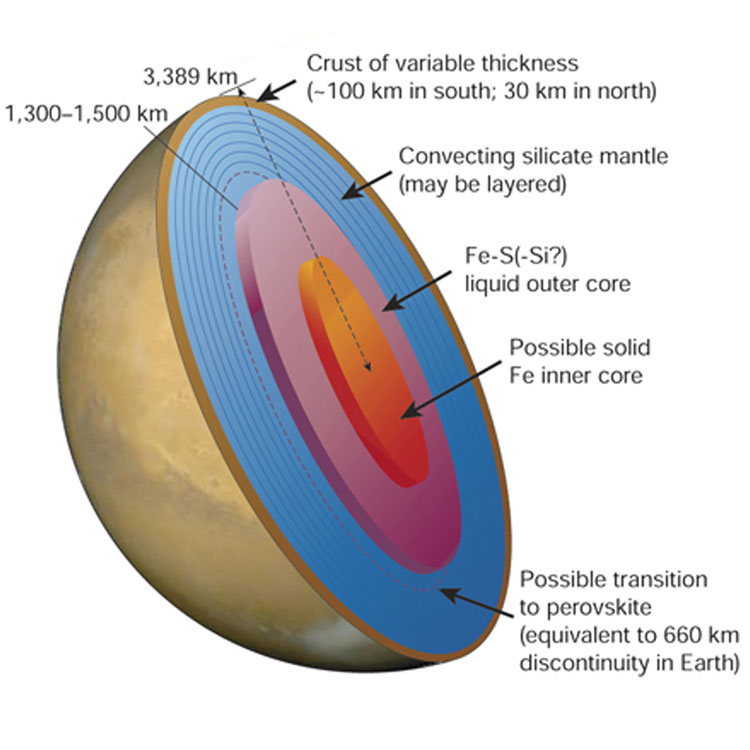
A 2001 model of Mars, based on its paleomagnetic field.Studies of "fossil" magnetism in Martian surface rocks show that a liquid or partially liquid (primarily iron) core produced global magnetic fields in the past, and fossil magnetism in rocks formed at that time. However, lack of recent geological activity and any significant magnetic field indicate that the core has cooled to the point where although still partially liquid, it no longer has a large enough heat flow to be convective, and cannot support a planet-wide magnetic field. The estimated size of the core remains smallish (38 to 44% of the size of the planet), depending on the amount of sulfur presumed to lie in the core. (David Stevenson, Cal Tech)

A 2003 model of Mars, based on flexing caused by Solar tidal forcesA wholly liquid core, about half the size of the planet and of necessity containing substantial amounts of sulfur to allow it to remain liquid despite temperatures too low to produce substantial geological activity at the surface, also fails to produce any significant magnetic field. (C. F. Yoder, A. S. Konopliv, D. N. Yuan, E. M. Standish, W. M. Folkner, NASA/JPL )

A 2013 model of Mars is similar in some ways but otherwise very different
A solid core is overlain by a hot but also solid mantle and a very thin crust
(Image Credit NASA/JPL-Caltech)
|