(this page is mostly a placeholder and very brief introduction to the topic at the moment; for an exhaustive (and exhausting) explanation of the moon illusion, visit
Donald Simanek's discussion; for a summary of my personal views, which will be turned into a more thorough discussion as this page is revised and completed, see the next couple of paragraphs)
To most people the Moon appears much larger when rising or setting than when it is higher in the sky. This effect is particularly pronounced when the horizon appears far away, as in a desert wasteland. In reality, the Moon's image is actually
smaller when it is on the horizon than when it is higher in the sky; as a result, the Moon's apparently larger size is an illusion. No explanation of the Moon Illusion has general acceptance, but this page (when revised and completed) will hew to the following theory:
Things seen at large distances appear smaller than nearby things (that tiny lion sitting over there is probably just as big but further away than that much larger and presumably much closer one, hungrily eyeing us). Almost everyone is aware of this "perspective" effect; but not as many are aware that our brain automatically corrects for the effect to a certain extent -- that is, things that are further away look smaller than nearby things, but not as small to our brain as on our retinas. For reasons to be discussed below, which are more or less obvious without discussion, the horizon appears further away than the sky appears high, so when the Moon is on the horizon it appears further away, and our brain "adjusts" the image sent to it by our eyes to tell us that it must really be larger than its apparent size.
I favor this theory because (1) when we look at distant mountains they appear larger when directly viewed than they do in snapshots taken at the same place and (2) on planetarium domes, showing the Moon and Sun at their correct size makes them look much smaller than they do in the sky. In the planetarium we can tell that the images are much closer to us than in the sky, and even though they are the right size on our retina, they look far too small to our brains. (In the LBCC planetarium, we had to show the Moon and Sun four times their correct size to approximate their appearance in the sky.) This seems to be corroborated by the fact that constellations also look smaller on the planetarium dome than in the real sky, even though their angular size is actually the same.
The Flattened Appearance of the SkyTo be written when time permits, but to summarize, the sky appears to be a flattened dome, which is much wider at the horizons than directly above us. As a result, things that are "high" in the sky look closer to us than things that are near the horizon. The natural correction by the brain of the apparent size of things known to be at different distances therefore makes things that are high in the sky to look smaller than things that are near the horizon. This is especially true if the horizon seems to be very far away. (Note: The same correction by the brain, added to our familiarity with "square" rooms, is the reason that in fun-houses, people at the far end of a room that is deliberately
not "square" can be made to appear much taller or much shorter than they actually are.) A more detailed discussion of the following would naturally lead into a detailed discussion of...
The Moon IllusionTo be written when time permits, primarily as a more thorough explanation, with diagrams and photographs, of the summary above.
Images Related to the Moon Illusion (and Atmospheric Refraction)
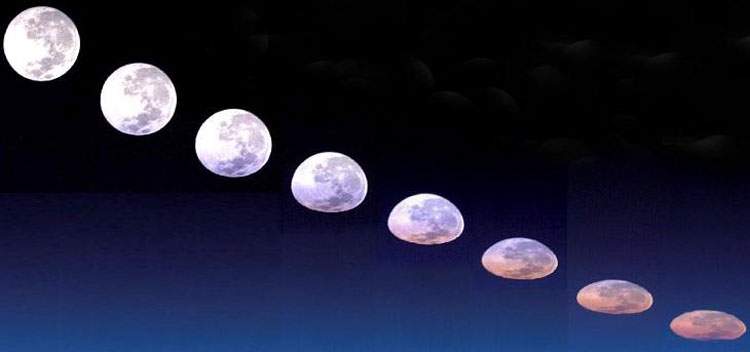
A series of images taken by astronaut Don Pettit from the International Space Station showing the full moon "setting" on April 16, 2003 (the "setting" being caused by the orbital motion of the Space Station). As a celestial object's light passes through our atmosphere it is bent, or refracted, making it appear higher than it really is. As the object nears the horizon the amount of refraction rapidly increases, so as the Moon sets its lower limb is "lifted" more than the top, making the Moon appear vertically squashed (but leaving its horizontal width unchanged). Scattering of light by the atmosphere, greater at shorter wavelengths than longer ones, also makes the Moon look redder as it descends. The same phenomena are observable on the Earth, but because the setting Moon is "below" the Space Station and its light has to pass into the atmosphere and then out again before reaching the Space Station, the effects are doubled compared to the view from the ground (shown below). (Don Pettit, Les Cowley, ISS, NASA)
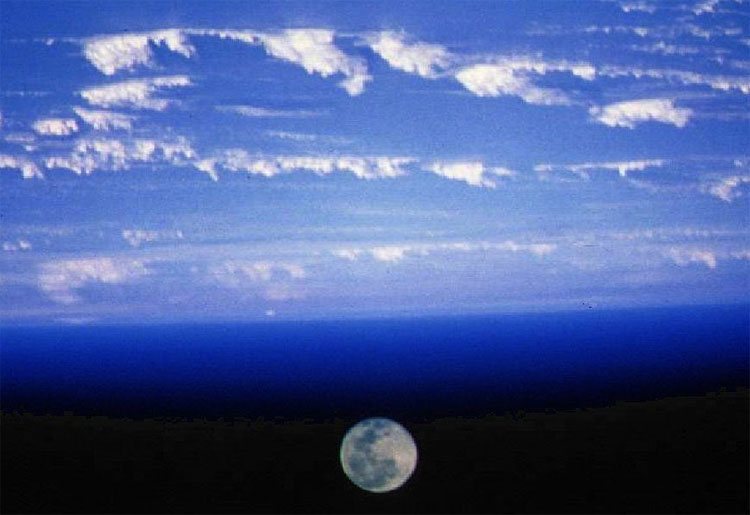
The full moon of December 1990 setting, as seen from the STS-35 Space Shuttle mission (the setting being due to the motion of the spacecraft around the Earth).
The image posted on APoD was taken as the shuttle passed "under" the Earth. To make it look more normal the APoD editors rotated it 180 degrees; however, that made the features on the Moon backwards from their actual appearance, so the image posted here has been restored to its original appearance. The space-based image has an advantage over Earth-based pictures of the rising moon due to the relative lack of air between the Shuttle and the Moon. Namely, the rising or setting Moon often looks reddish due to scattering of the shorter wavelengths of light by our atmosphere (see the image below, taken from the Earth's surface); while in this image it is shown in its natural color.
(STS-35 Crew, NASA, apod020921)
The full moon of November 16, 2005 setting in the North, as viewed from Antarctica.
(James Behrens (IGPP, Scripps Institution of Oceanography), apod051125)
Other topics to be covered here or on related pages once this page has been properly completed: atmospheric refraction: flattening of Moon/Sun when near the horizon, color fringing of objects near the horizon, atmospheric extinction. Example: image of Moon showing orange color due to extreme scattering of shorter wavelengths, flattening and color fringing due to atmospheric refraction.