The Πλανητες (Planetes)
The stars all cross the sky in absolutely parallel circular paths, in exactly the same way day after day. Because of this we often refer to them as the
fixed stars. But there are a number of celestial objects which, although they rise and set in almost the same way as the stars, gradually change their position relative to neighboring stars. These objects were referred to in Hellenic (ancient Greek) times as the
πλανητες (planetes), or "wanderers". This is where we get the word "planets", which we use to describe a large body moving around the Sun. But in ancient times the term meant any of the seven objects known to move among the stars — the Sun, the Moon, and the five naked-eye modern-day planets — Mercury, Venus, Mars, Jupiter and Saturn (of course, the ancient names of these objects were different from these English names). We no longer think of the Sun and Moon as planets, but in terms of their sky motions they are as much "wanderers" as the other planets (hence the reference to pages about their motions above).
The Motions of the Sun and Moon
We will cover the motions of the "planetes" in more detail in the next few pages (as of the date of this post, those pages do not exist, and though that situation will eventually be rectified, the brief discussion here will have to do for now), but for now let's consider their motions in the simplest of terms.
For the Sun and Moon the motions are quite simple. Each day they rise in the east, cross the sky and set in the west, just as the stars do. But in addition they gradually move to the east among the stars. For the Moon, the motion is relatively easy to see, because it is possible to see stars when the Moon is up and its motion is quite fast — going all the way around the sky in only 27.3 days. For the Sun the motion is harder to see, because when the Sun is up the sky is too bright to see any stars, and the motion of the Sun among the stars is much slower, requiring a full year. But even for the Sun it is possible to tell, by careful measurement of its position and a comparison of that position with stellar positions (as briefly discussed in the otherwise incomplete page about its motion), that it is moving along a particular path in the sky, referred to as the Ecliptic, a little faster when we are closer to it (in January) and a little slower when we are further from it (in July).
The paths that the Sun and Moon follow in the sky are very nearly the same, being exactly circular paths which are tilted, on the average, about 23 1/2 degrees relative to the Celestial Equator (their actual paths in space are ellipses, but since just looking at them we cannot see their distances, the projection of their paths onto the stellar background are perfect circles). As a result they are sometimes in the northern half of the sky, sometimes in the southern half, and sometimes in-between. Since, as discussed on the page about
The Motions of the Sky at Different Latitudes, for people in the Northern hemisphere, stars which are in the northern half of the sky are up more than half the time and those in the southern half of the sky are up less than half the time, the Sun and Moon are up longer at those times when they are in the north, and up less when they are in the south. In addition, when in the north they rise north of east and set north of west, whereas when they are in the south they rise south of east and set south of west.
These changes in position were well known even in prehistoric times, and ancient monuments such as Stonehenge are believed to have been, in addition to possible religious purposes, astronomical observatories of a sort, being used to keep track of the north-south motion of the Sun and in some cases, the Moon.
The Motions of the Other "Planets"
For the remaining "wanderers" the motions are far more complicated. On the average they also follow the tilted circular paths that the Sun and Moon follow, albeit over different periods of time — about a year for Mercury and Venus, almost two years for Mars, nearly twelve years for Jupiter, and nearly thirty years for Saturn. As a result, the changing positions of Mercury, Venus and Mars are noticeable within just a few nights, while weeks or months might be required to see a substantial change in the position of Jupiter and Saturn.
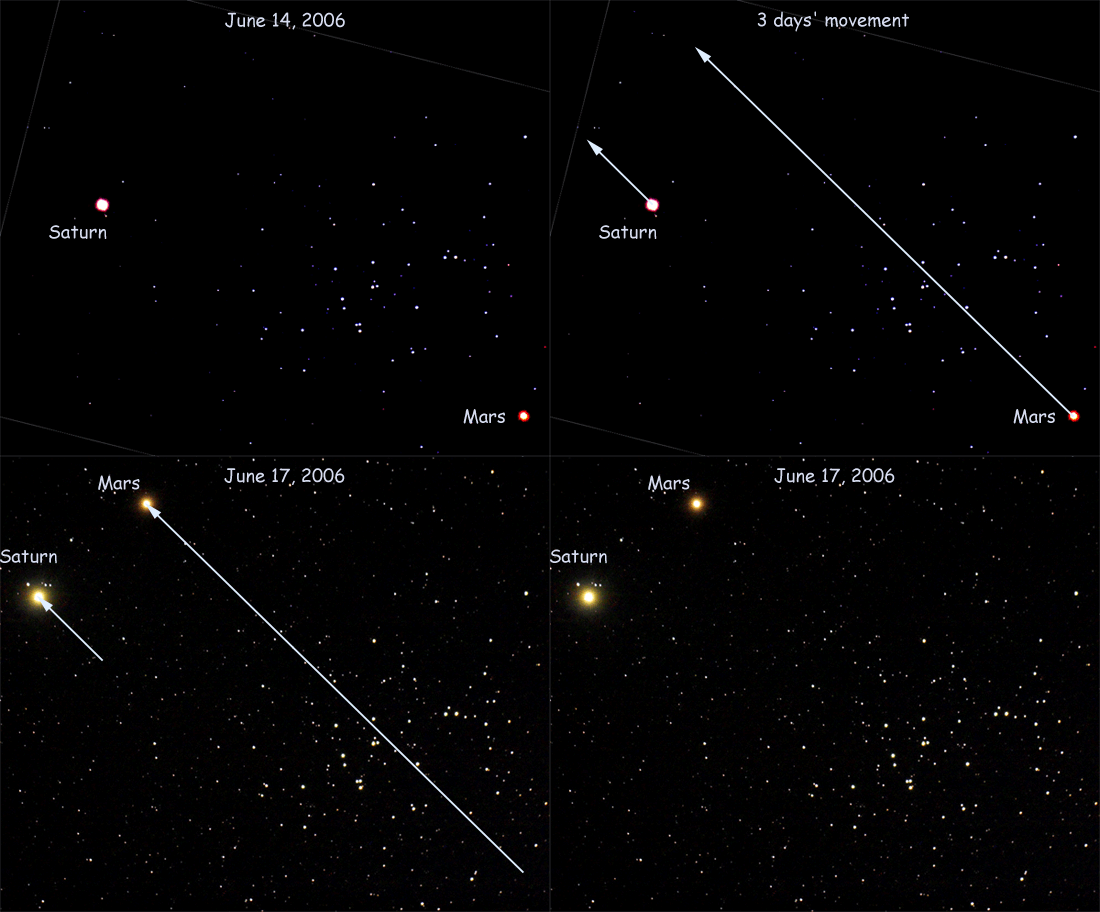
The motion of Mars and Saturn over a three-day period in June of 2006. Each planet is moving to the east among the stars (in this case near the Beehive Cluster, or M44), but since Mars takes less than two years to go around the Sun and Saturn takes nearly thirty years, the motion of Mars is much faster.
(June 14 image Tunc Tezel, apod060617; June 17 image Chris Schur, apod060622); animation by Courtney Seligman)
Below, the August 2014 conjunction of Venus and Jupiter in the morning sky, as an animated diagram showing their relative position at 5:30 am each morning from Aug 14 to Aug 22. An effort has been made to center Jupiter's gradually changing position in each frame, so the few stars visible seem to gradually move up and to the right (to the west) as Jupiter slowly moves to the east. Meanwhile, Venus, moving much faster to the east, moves from the western (upper) side of Jupiter to the eastern (lower) side. Their closest approach involved a separation of only 0.2 degrees on August 18. Since, depending on where it is in its orbit, Venus can be several degrees to the North or South of the Ecliptic, and Jupiter is always within a degree or two of the Ecliptic, such a close approach takes place very rarely, even though Venus passes Jupiter almost every year (namely, about every 13 months or so).
The motion of Mars, during its retrograde motion of 1965. The normal direction of motion is to the east (on the left), but as noted in the diagram, when Mars is near opposition (that is, opposite the Sun in the sky), its motion turns to the west (on the right), becoming retrograde, and performing a retrograde loop or ess.