Page last updated Dec 12, 2019 (needs considerable updating, especially for M16)
Quick Links:
M6, M7, M11, M16, M18, M21, M23, M24, M25, M26, M29, M34, M35, M36, M37, M38,
M39, M40, M41, M44, M45, M46, M47, M48, M50, M52, M67, M73, M93, M103
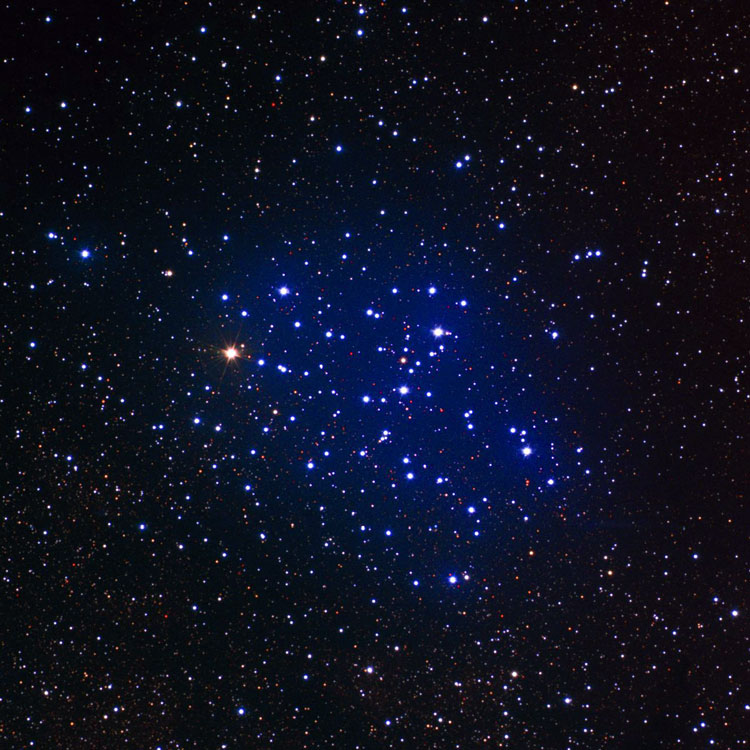
M6 (= NGC 6405) -- The Butterfly Cluster
Discovered (before 1654) by Giovanni Hodierna
Recorded (1764) by Messier as M6
A 4th-magnitude open cluster in Scorpius (RA 17 40 20, Dec -32 15 30)
Click on the image (below) or the NGC link (above) for more information
(Credit: AURA, NOAO, NSF, apod990106)
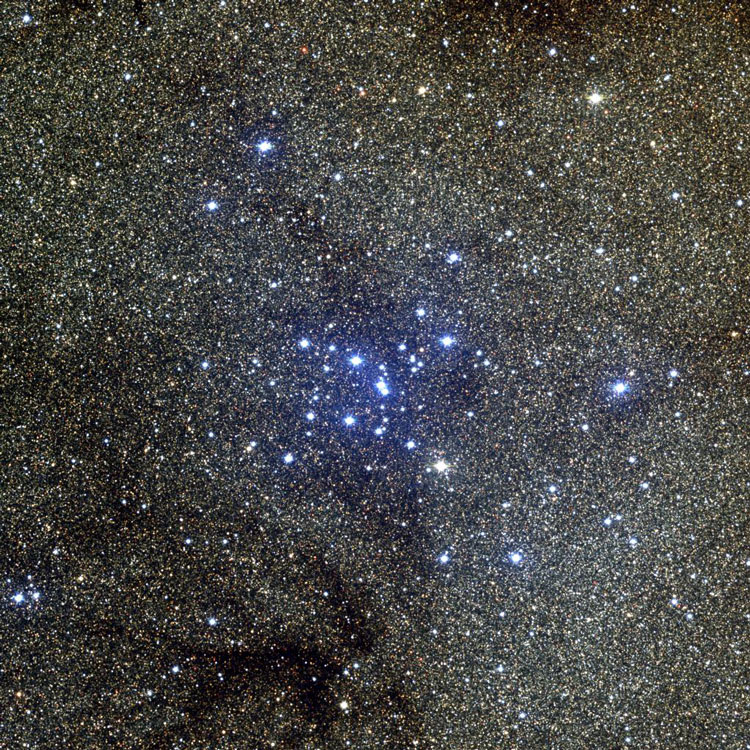
M7 (= NGC 6475)
Discovered (~138) by Ptolemy (Recorded by Messier in 1764)
A 3rd-magnitude open cluster in Scorpius (RA 17 53 50, Dec -34 47 36)
Click on the image (below) or the NGC link (above) for more information
(Credit: N.A.Sharp, REU program/AURA/NSF/NOAO)
M11 (= NGC 6705) -- The Wild Duck Cluster
Discovered (1681) by Gottfried Kirch (Recorded by Messier in 1764)
A 6th-magnitude open cluster in Scutum (RA 18 51 05, Dec -06 16 12)
Click on the image (below) or the NGC link (above) for more information
Approximately 5000 light-years distant, M11 is one of the richest and most compact open clusters, with nearly 3000 stars concentrated in a region only twenty light-years across, many of which are upper Main Sequence blue giants, or more highly evolved yellow and red giants. As a result, an observer in the center of the cluster would see several hundred first magnitude stars scattered around the sky. Given the presence of Main Sequence stars up to spectral class B8, the age of the cluster is estimated at 250 million years, or only about 5% the age of our solar system. As is the case with many of the objects in Messier's catalog, M11 was first noticed (as a fuzzy patch in the sky) nearly a century earlier, in this case by German astronomer Gottfried Kirch, in 1681. William Derham was probably the first to see that it consisted of a cloud of faint stars, in 1733. Messier added it to his catalog in 1764. (Jean-Charles Cuillandre (CFHT), Hawaiian Starlight, CFHT; © CFHT)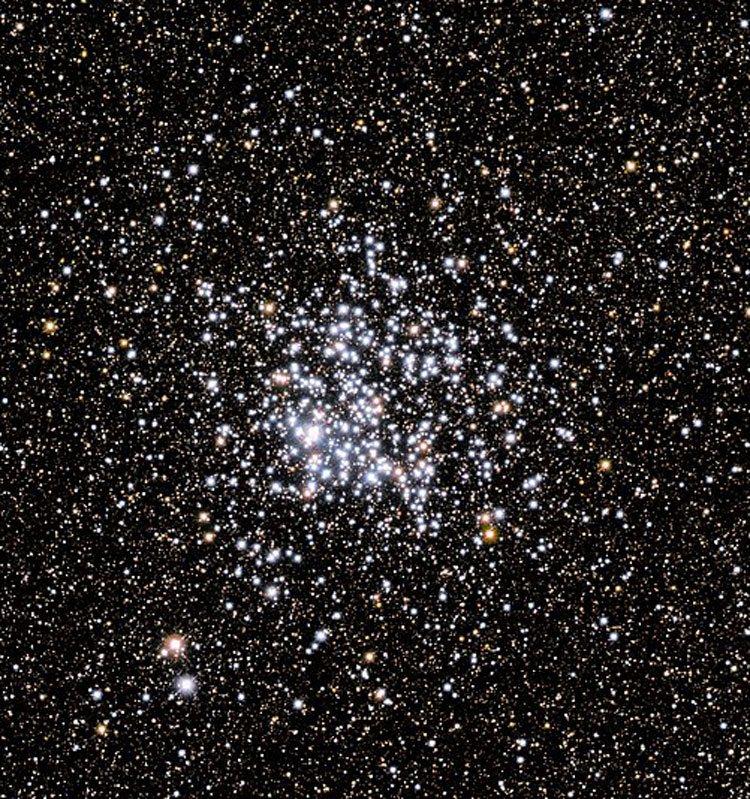
WORKING HERE
M16 (= NGC 6611 + IC 4703), the Eagle Nebula and star cluster
Discovered (1745-46) by Philippe de Chéseaux (Recorded by Messier in 1764)
A 6th-magnitude open cluster in Serpens Cauda (RA 18 18 48, Dec -13 48 26)
Associated with the Eagle Nebula (IC 4703), and usually stated as being that nebula
Click on the image (below) or the NGC link (above) for more information
M16 consists of the star cluster (NGC 6611) which illuminates the Eagle Nebula (IC 4703), and (particularly in modern usage) the Nebula itself. Given the double listing in the NGC/IC, and the difficulty of knowing exactly what historical observers saw or thought they saw, it is sometimes listed as only the cluster or only the nebula, and sometimes as the combination of the two. As a result, this entry and the associated links need considerable work before they can be considered more or less definitive, and this is the first object I will deal with when I update this and the linked pages in January 2015.
A nearly true-color image of the region near M16, in the Eagle Nebula (which see, for more pictures of the region). True-color, in this case, means the color that the gas, dust and stars in the region would appear to have, if they were bright enough to display color; in reality, only the stars are bright enough to display any color, and the glowing clouds of gas would appear to be gray or grayish-green (green being the color to which our eyes are most sensitive). When first discovered, M16 was described only as the cluster of bright stars shown at upper right, but it is now usually considered to include the clouds of gas and dust from which the cluster recently formed, and within which new stars are still forming. The existing cluster is about 15 light-years across, and about six to seven thousand light-years distant. The hottest (spectral type O6), brightest stars in the cluster are around ten thousand times brighter than the Sun, and must be among the youngest stars known -- certainly, less than a million years old -- but the oldest cluster members are thought to be five or six million years old. Despite their relative youth, some of the brighter stars have already died, and a supernova shock wave sweeping through the region probably destroyed the Pillars about a thousand years after the light we now see left the nebula; so a thousand years hence, our descendants may see that event. (T.A.Rector (NRAO/AUI/NSF and NOAO/AURA/NSF) and B.A.Wolpa (AURA/NSF/NOAO)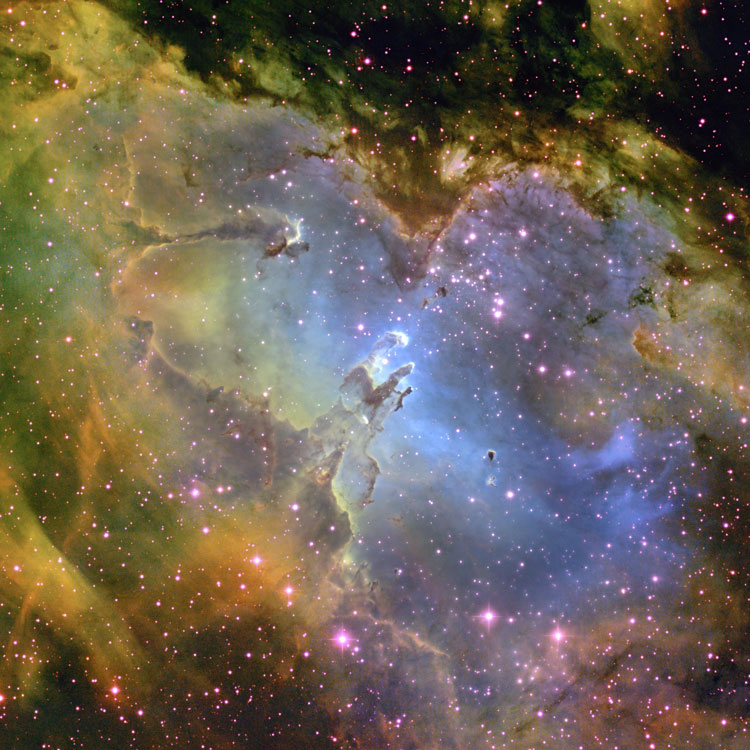
M18 (= NGC 6613)
Discovered (1764) by Charles Messier
A 7th-magnitude open cluster in Sagittarius (RA 18 19 58, Dec -17 06 06)
Click on the image (below) or the NGC link (above) for more information
M18 is a loose collection of about 20 stars, spread over a region about 15 to 20 light-years in diameter, four to six thousand light-years from the Sun. Its hottest, brightest members are of the relatively 'early' spectral type B3, which means it is probably about 30 million years old. (Image Credit: Hillary Mathis, REU program, AURA, NSF, NOAO)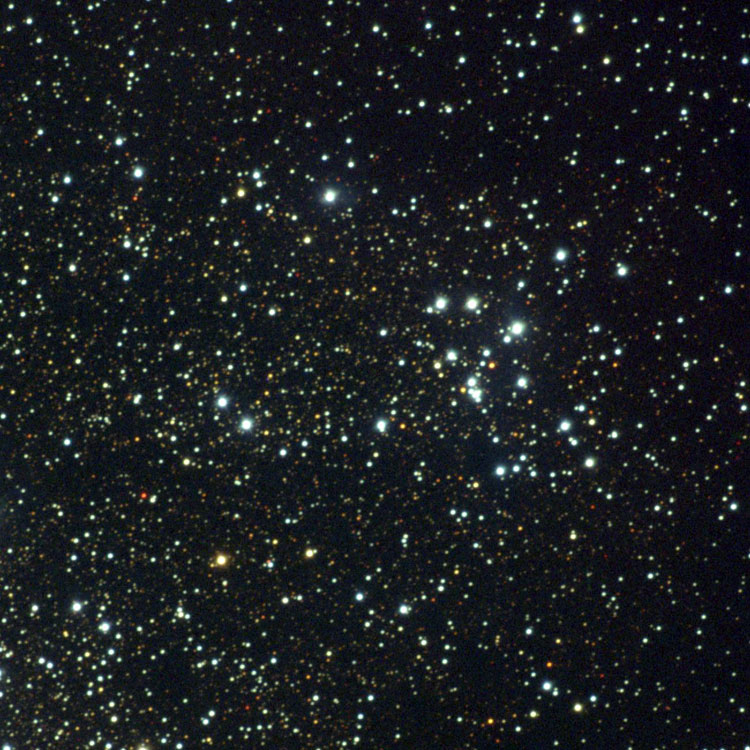
M21 (= NGC 6531)
Discovered (1764) by Charles Messier
A 6th-magnitude open cluster in Sagittarius (RA 18 04 13, Dec -22 30 00)
Click on the image (below) or the NGC link (above) for more information M21 is a tightly compacted cluster of about 60 stars. Most of the stars in the cluster are relatively faint, but there is a central concentration of B-type giants. The true brightness of these giants is uncertain, and as a result, the distance of the cluster is very uncertain, with estimates ranging from just over 2000 light-years to more than 4000 light-years. The lifetimes of such blue giants are only about 1/1000th of the age of the Solar System, so the cluster must have been formed no more than 4 to 5 million years ago. (Image Credit: REU Program, AURA, NSF, NOAO)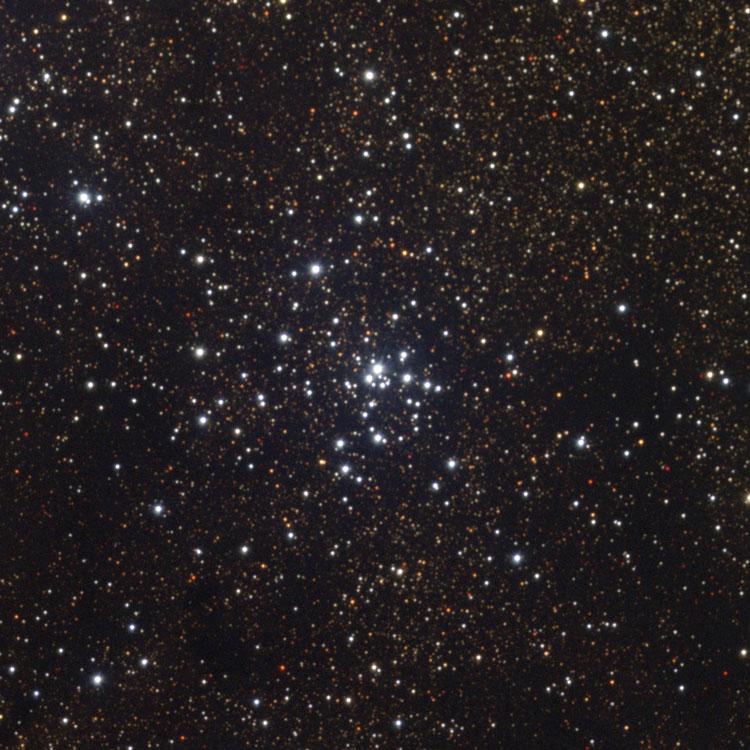
M23 (= NGC 6494)
Discovered (1764) by Charles Messier
A 6th-magnitude open cluster in Sagittarius (RA 17 56 56, Dec -19 00 42)
Click on the image (below) or the NGC link (above) for more information M23 is an irregular cluster of stars 15 to 20 light-years in diameter, about 2200 light-years from the Sun. The brightest of its approximately 150 stars are almost 9th magnitude, or -- taking the distance of the cluster into account -- about 60 times brighter than the Sun. This implies an age for the cluster of about two to three hundred million years. (Image Credit: N. A. Sharp, REU Program, AURA, NSF, NOAO)

M24 (= IC 4715)
Discovered (Jun 20, 1764) by Charles Messier
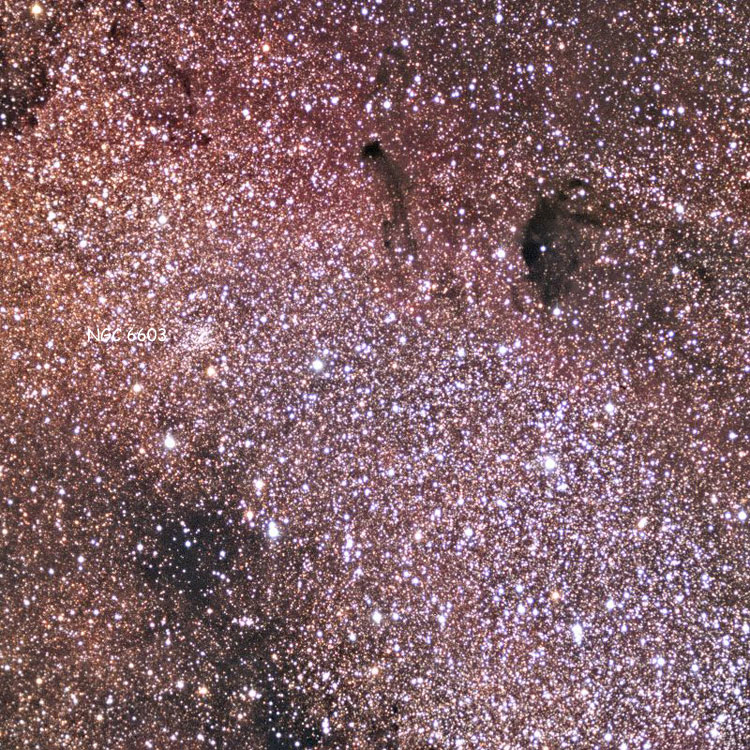
Star clouds in Sagittarius (RA 18 17, Dec -18 29)
Click on the image (below) or the IC link (above) for more information
(A wider-field image was replaced because it didn't make it clear what part of the image was M24)
(Image Credit: Fred Calvert/Adam Block/NOAO/AURA/NSF)
M25 (= IC 4725)
Discovered (1745) by Philippe de Cheseaux
Also observed (Jun 20, 1764) by Charles Messier (and listed as M25)
Also observed (1896) by Solon Bailey (and later listed as IC 4725)
A magnitude 4.6 open cluster (type I2p) in Sagittarius (RA 18 31 45, Dec -19 07 12)
Click on the image (below) or the IC link (above) for more information
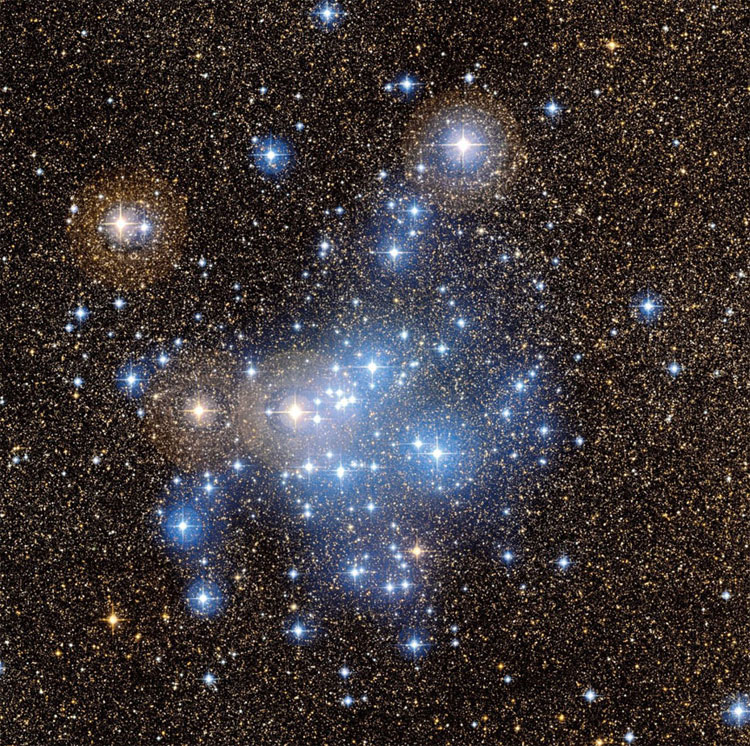
(J-C. Cuillandre (CFHT) & Giovanni Anselmi (Coelum Astronomia), Hawaiian Starlight, apod090831; Copyright CFHT)
M26 (= NGC 6694)
Discovered (1764) by Charles Messier
An 8th-magnitude open cluster in Scutum (RA 18 45 15, Dec -09 23 06)
Click on the image (below) or the NGC link (above) for more information
(Image Credit: Hillary Mathis, Vanessa Harvey, REU program, AURA, NSF, NOAO)
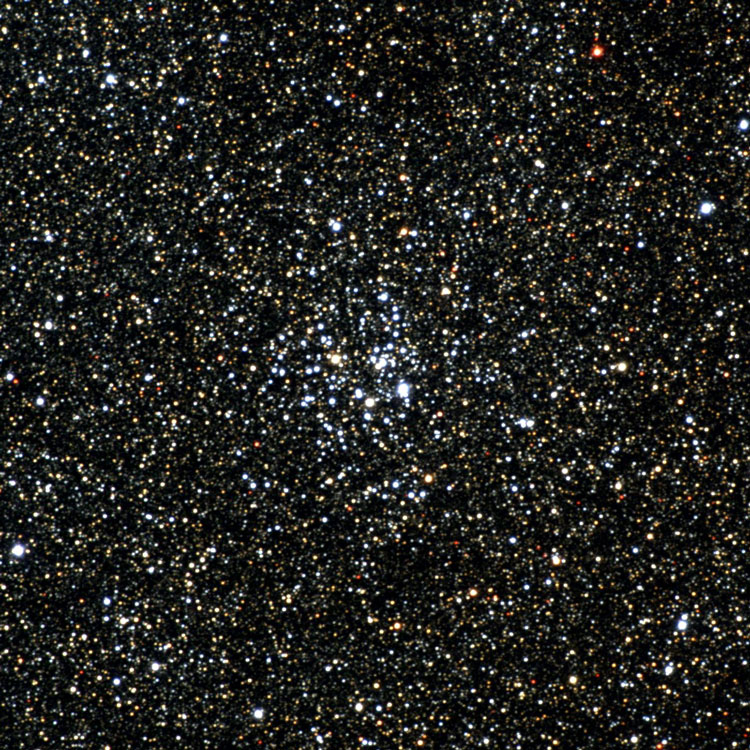
M29 (= NGC 6913)
Discovered (Jul 29, 1764) by Charles Messier (and listed as M29)
Discovered (Dec 5, 1774) by Johann Bode
Discovered (Apr 6, 1783) by Caroline Herschel
Also observed (Aug 6, 1829) by John Herschel
A 7th-magnitude open cluster in Cygnus (RA 20 24 06, Dec +38 29 36)
Click on the image (below) or the NGC link (above) for more information
(Image Credit: Hillary Mathis, AURA, NSF, NOAO)
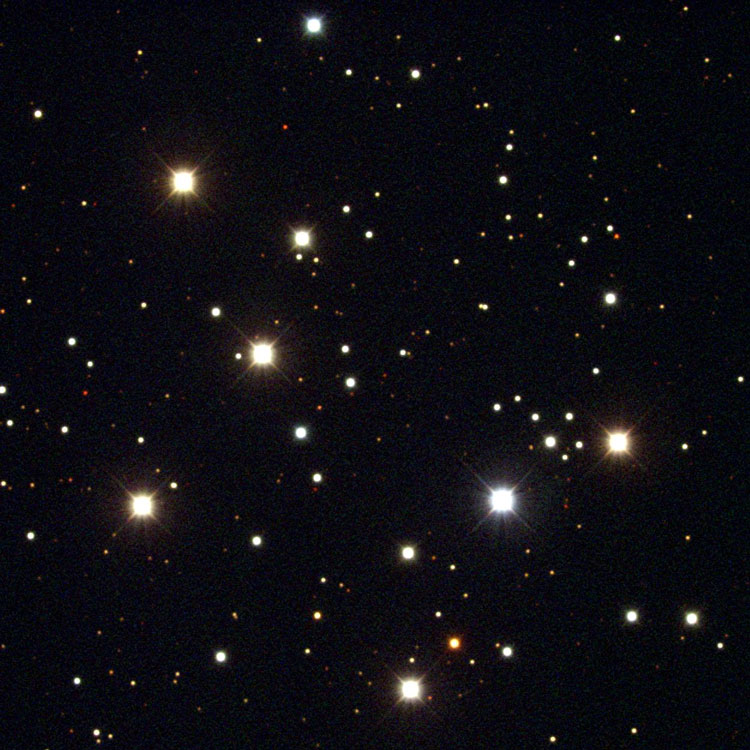
M34 (= NGC 1039)
Recorded (1654) by Giovanni Hodierna
Recorded (Aug 25, 1764) by Charles Messier as M34
Observed (Sep 2, 1774) by Johann Bode
Also observed (Oct 29, 1828) by John Herschel
A 5th-magnitude open cluster in Perseus (RA 02 42 05, Dec +42 45 42)
Click on the image (below) or the NGC link (above) for more information
M34 consists of a hundred or so stars formed at the same time, about 200 million years ago. At its distance of about 1400 light years, its 15 light year diameter makes it appear nearly the same size as the full Moon (about half a degree across). An easy object to observe with binoculars or a small telescope, M34 will gradually disintegrate as it moves around the galaxy, due to the gravitational effects of passing stars and star clusters. More massive clusters can survive such interactions for long periods of time, but small ones, like M34, don't last more than a few hundred million years, as a cluster. However, its stars will continue to live out their lives, unaffected by the loss of their siblings. (REU program, AURA, NSF, NOAO)
M35 (= NGC 2168)
Discovered (1745) by Philippe de Cheseaux (Recorded by Messier in 1764)
A 5th-magnitude open cluster in Gemini (RA 06 09 04, Dec +24 21 00)
Click on the image (below) or the NGC link (above) for more information
M35 is the larger cluster on the left half of this image (the "smaller" cluster on the right is NGC 2158). However, M35 appears larger mostly because it is about 2800 light years away, while NGC 2158 is 10 to 15 thousand light years away. (Image Credit: N. A. Sharp, AURA, NSF, NOAO)
M36 (= NGC 1960)
Recorded (1654) by Giovanni Hodierna
Discovered (1764) by Messier
A 6th-magnitude open cluster in Auriga (RA 05 36 18, Dec 34 08 27)
Click on the image (below) or the NGC link (above) for more information
(Image Credit: AURA, NSF, NOAO)
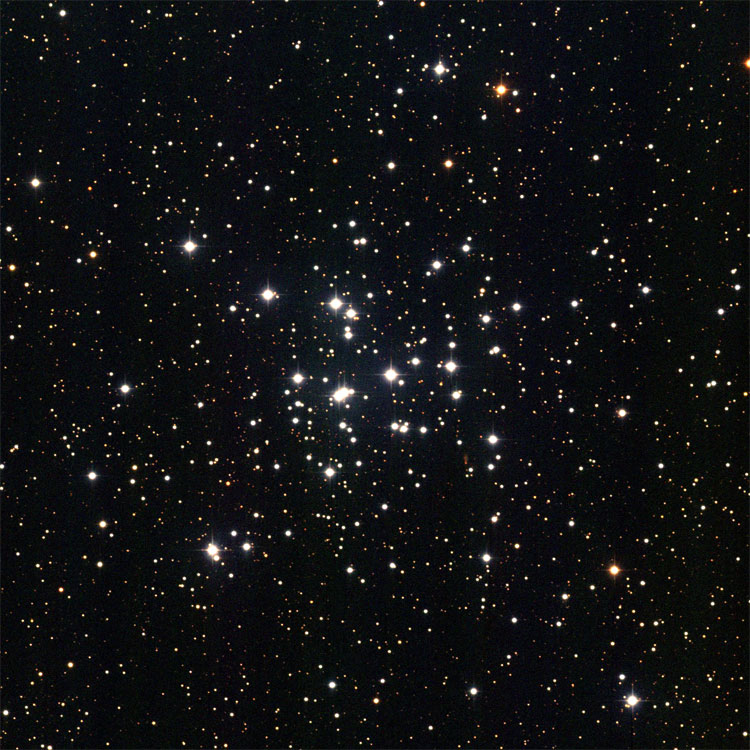
M37 (= NGC 2099)
Recorded (1654) by Giovanni Hodierna
Discovered (Sep 2, 1764) by Charles Messier
Also observed (Nov 2, 1774) by Johann Bode
Also observed (Jan 22, 1827) by John Herschel
A 6th-magnitude open cluster in Auriga (RA 05 52 18, Dec +32 33 11)
Click on the image (below) or the NGC link (above) for more information
(Image Credit: AURA/NSF/NOAO)
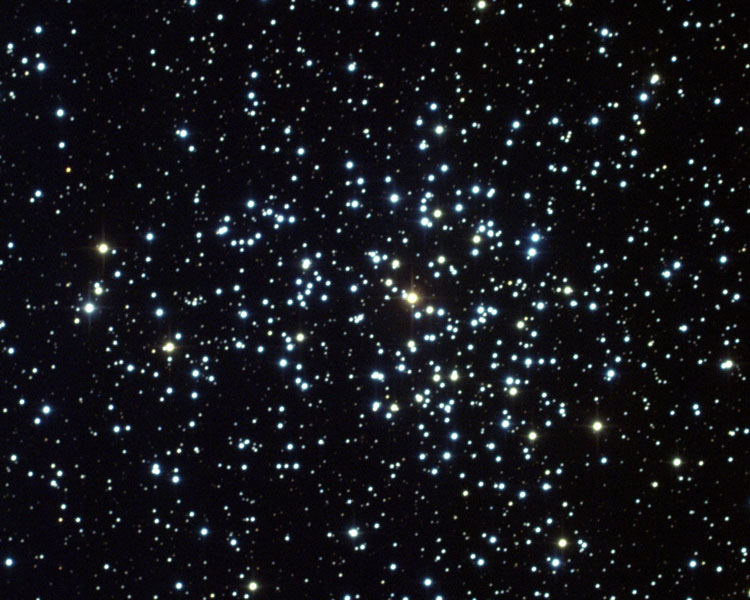
M38 (= NGC 1912)
Discovered (before 1654) by Giovanni Hodierna
Rediscovered (1749) by LeGentil
Rediscovered (Sep 25, 1764) by Charles Messier
A 6th-magnitude open cluster in Auriga (RA 05 28 43, Dec +35 51 18)
Click on the image (below) or the NGC link (above) for more information
M38 is a moderately dense open cluster, about 25 light years in diameter, and 4000 light years from the Sun. Based on the "turnoff" point of the bright blue stars still on the Main Sequence, the cluster must be about 200 million years old. Over long periods of time, open clusters are disrupted by stars passing through the cluster, so moderately dense clusters are rarely more than a few hundred million years old. 
M39 (= NGC 7092)
Recorded (325 B.C.E.) by Aristotle
Recorded (Oct 24, 1764) by Charles Messier as M39
Also observed (Oct 27, 1774) by Johann Bode
Also observed (Sep 27, 1788) by William Herschel
Also observed (Sep 14, 1829) by John Herschel
A 5th-magnitude open cluster in Cygnus (RA 21 35 52, Dec +48 25 30)
Click on the image (below) or the NGC link (above) for more information
(Heidi Schweiker, WIYN, AURA, NSF, NOAO)

M40
Recorded (1764) by Charles Messier
A double star in Ursa Major (RA 12 22 13, Dec +58 04 59)
Sometimes regarded as a "mistake" because not a nebula, M40 represents a situation where Messier was checking lists of nebulae seen by other observers (in this case, a 1660 observation by Johannes Hevelius). Messier stated that this was not a nebula, but only a double star; but having measured its position, he included it in his catalog, presumably so that others looking for the nebula would know that it didn't exist (it had been included in previous lists of nebulae on the strength of Hevelius' incorrect assessment). The two stars have magnitudes of about 9.5 and 10.0, and are of spectral types G0 and F8, respectively. For many years they were assumed to be a binary system, but if that were true the later-type (G0) star should be less evolved and fainter, instead of brighter. In addition, the stars have been observed to have a relative motion which appears to be consistent with a straight-line proper motion, rather than an orbital motion. This and recent Hipparcos satellite estimates of their parallax (although of very poor quality) has led to the conclusion that the brighter star is a subgiant perhaps 40 times brighter than the Sun, and 1.2 times the Sun's mass; while the fainter star is a Main Sequence star perhaps twice the Sun's brightness, and 1.1 Solar masses. The brighter one's distance is estimated at 1 to 3 thousand light years (as already noted, the data are very poor; which means the brightness and mass estimates are also very uncertain), while the fainter one is only 300 to 800 light years distant, or perhaps a quarter the distance of the brighter star. The image below is a 12 arcmin wide SDSS image centered on the double star. 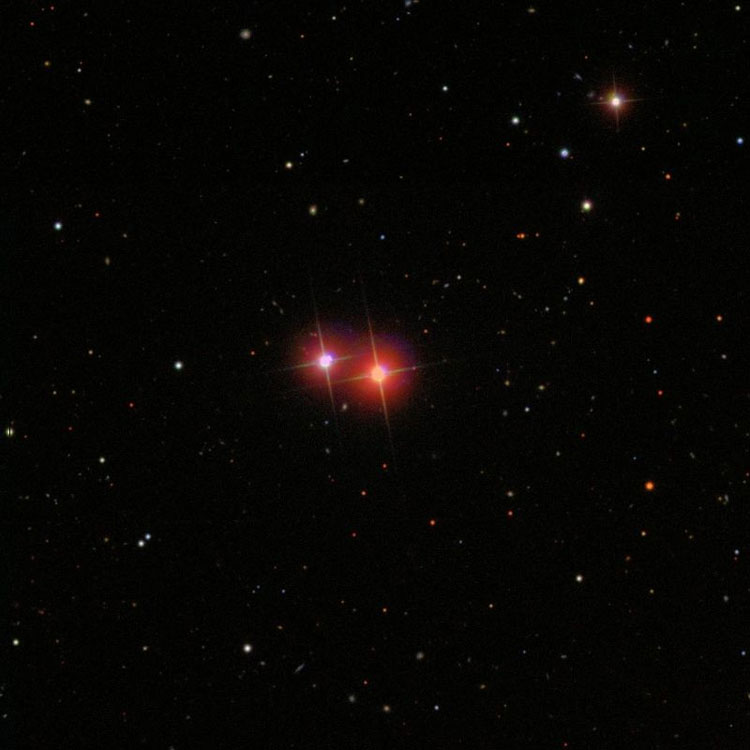
M41 (= NGC 2287)
Discovered (or recorded) (325 B.C.E.) by Aristotle (Recorded by Messier in 1765)
A 5th-magnitude open cluster in Canis Major (RA 06 46 00, Dec -20 45 24)
Click on the image (below) or the NGC link (above) for more information
(AURA, NSF, NOAO)
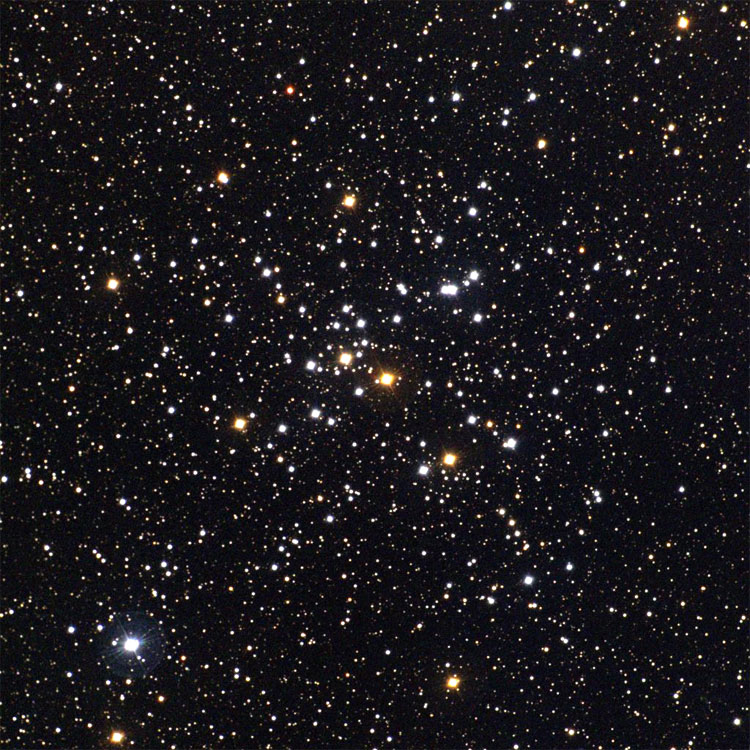
M44 (= NGC 2632) -- Praesepe, the Beehive Cluster
Recorded (360 to 380 B.C.E.) by Eudoxus of Cnidus
Earliest extant mention (260 B.C.E.) by Aratos
Recorded (130 B.C.E.) by Hipparchus
Recorded (March 4, 1769) by Charles Messier
A 3rd-magnitude open cluster in Cancer (RA 08 40 24.0, Dec +19 40 12)
Click on the image (below) or the NGC link (above) for more information

M45: The Pleiades, the Seven Sisters, Subaru
Known in antiquity (before 1600 B.C.E.)
Recorded (1654) by Giovanni Hodierna (#I.1)
Recorded (1769) by Messier
An open cluster in Taurus (RA 03 47 24, Dec +24 07)
Note: Most Messier Catalog objects are also NGC or IC objects, so detailed information for them is (or will be) posted on the appropriate NGC/IC pages. However, as in the case of M40 (discussed above), the Pleiades have no other catalog entry. As a result, they will be discussed in detail on a page of their own when time permits. (Image Credit DSS2) 
M46 (= NGC 2437)
Discovered (Feb 19, 1771) by Messier
A 4th-magnitude open cluster in Puppis (RA 07 36 35, Dec -14 28 47)
Click on the image (below) or the NGC link (above) for more information
(Image Credit: N.A.Sharp/AURA/NSF/NOAO)
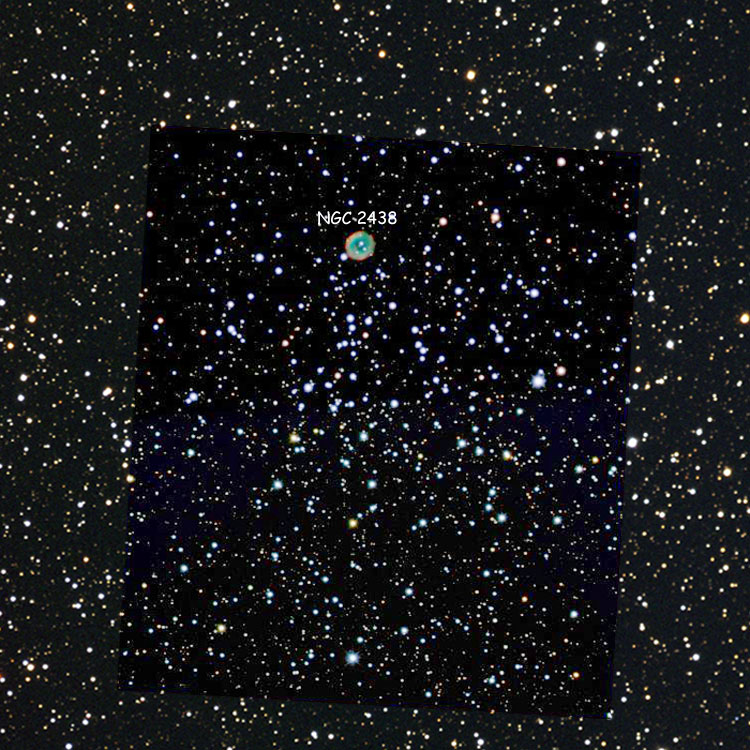
M47 (= NGC 2422 = NGC 2478)
Recorded (1654) by Giovanni Hodierna
Discovered (1771) by Messier
A 4th-magnitude open cluster in Puppis (RA 07 36 35, Dec -14 28 47)
Click on the image (below) or the NGC link (above) for more information
(Image Credit: AURA/NSF/NOAO)

M48 (= NGC 2548)
Discovered (Feb 19, 1771) by Charles Messier (but "lost" until 1934)
Discovered (before 1782) by Johann Bode (unnoticed by Dreyer)
Discovered (Mar 8, 1783) by Caroline Herschel (and later listed as NGC 2548)
Also observed (Feb 1, 1786) by William Herschel (and later listed as NGC 2548)
Also observed (Mar 12, 1826) by John Herschel (and later listed as NGC 2548)
A 6th-magnitude open cluster in Hydra (RA 08 13 43.1, Dec -05 45 02)
Click on the image (below) or the NGC link (above) for more information

M50 (= NGC 2323)
Discovered (before 1709) by Giovanni Cassini
Recorded (April 5, 1772) by Charles Messier as M50
Also observed (Feb 12, 1774) by Johann Bode
Also observed (Feb 13, 1826) by John Herschel
A 6th-magnitude open cluster in Monoceros (RA 07 02 48, Dec -08 22 33)
Click on the image (below) or the NGC link (above) for more information
(Image Credit: AURA/NSF/NOAO)
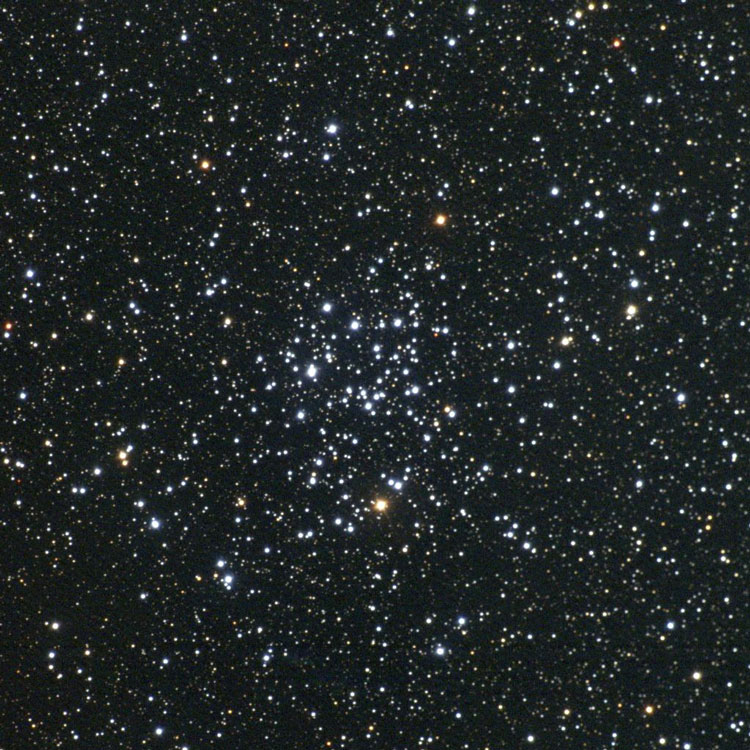
M52 (= NGC 7654)
Discovered (1774) by Charles Messier
A 7th-magnitude open cluster in Cassiopeia (RA 23 24 48, Dec +61 36 00)
Click on the image (below) or the NGC link (above) for more information
(Image Credit: AURA/NSF/NOAO)
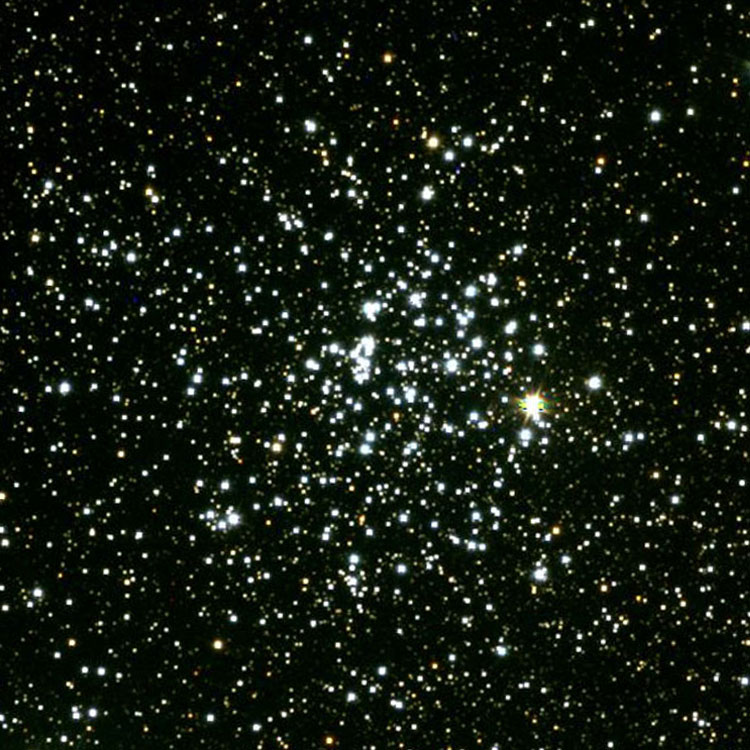
M67 (= NGC 2682 = OCL 549)
Discovered (1779) by Johann Koehler
Recorded (April 6, 1780) by Charles Messier
Also observed (Mar 3, 1826) by John Herschel
A magnitude 6.9 open cluster (type II2m) in Cancer (RA 08 51 20.0, Dec +11 49 30)
Click on the DSS image (below) or the NGC link (above) for more information

M73 (= NGC 6994)
Discovered (1780) by Charles Messier
A 9th-magnitude group of stars in Aquarius (RA 20 58 56, Dec -12 38 00)
Click on the image (below) or the NGC link (above) for more information
(Image Credit: REU program, AURA, NSF, NOAO)

M93 (= NGC 2447 = OCL 649)
Discovered (Mar 20, 1781) by Charles Messier
A 6th-magnitude open cluster in Puppis (RA 07 44 30.0, Dec -23 51 24)
Click on the image (below) or the NGC link (above) for more information

M103 (= NGC 581)
Discovered (1781) by Pierre Méchain (Recorded by Messier after 1781)
A 7th-magnitude open cluster in Cassiopeia (RA 01 33 23, Dec +60 39 30)
Click on the image (below) or the NGC link (above) for more information
(Image Credit: Hillary Mathis & N. A. Sharp, AURA, NSF, NOAO)
|