QuickLinks:
550, 551, 552, 553, 554, 555, 556, 557, 558, 559, 560, 561, 562, 563, 564, 565, 566,
567, 568, 569, 570, 571, 572, 573, 574, 575, 576, 577, 578, 579, 580, 581, 582, 583,
584, 585, 586, 587, 588, 589, 590, 591, 592, 593, 594, 595, 596, 597, 598, 599
Page last updated Mar 17, 2024 (Fully completed per all current goals)
IC 550
(= PGC 27607 = MCG -01-25-014)
Discovered (Feb 18, 1893) by Stephane Javelle
A magnitude 13.5 lenticular galaxy (type SAB0 pec?) in Hydra (RA 09 40 28.6, Dec -06 56 46)
Historical Identification: Per Dreyer, IC 550 (Javelle #640), 1860 RA 09 33 31, NPD 96 18.8) is "faint, extremely small, stellar." The position precesses to (2000) RA 09 40 28.6, Dec -06 56 46, dead-center on the galaxy listed above, the description fits and there is nothing comparable nearby, so the identification is certain.
Physical Information: Based on a recessional velocity relative to the Cosmic Microwave Background of 5275 km/sec (and H0 = 70 km/sec/Mpc), IC 550 is about 245 million light-years away, in fair agreement with a single redshift-independent distance estimate of about 215 million light-years. Given that and its apparent size of 1.05 by 1.0 arcmin (from the images below), it is about 75 thousand light-years across.
Classification Note: In the close-up image below, there is a faint extension of the halo of IC 550 in the direction of the very faint object near the right-hand boundary of the image; but whether that object is in any way connected to IC 550 cannot be known, as no reference even lists it, or anything about its nature. However, the apparent extension (and a smaller one on the opposite side of IC 550) is the reason for my adding "pec?" to the type shown in the description line above.
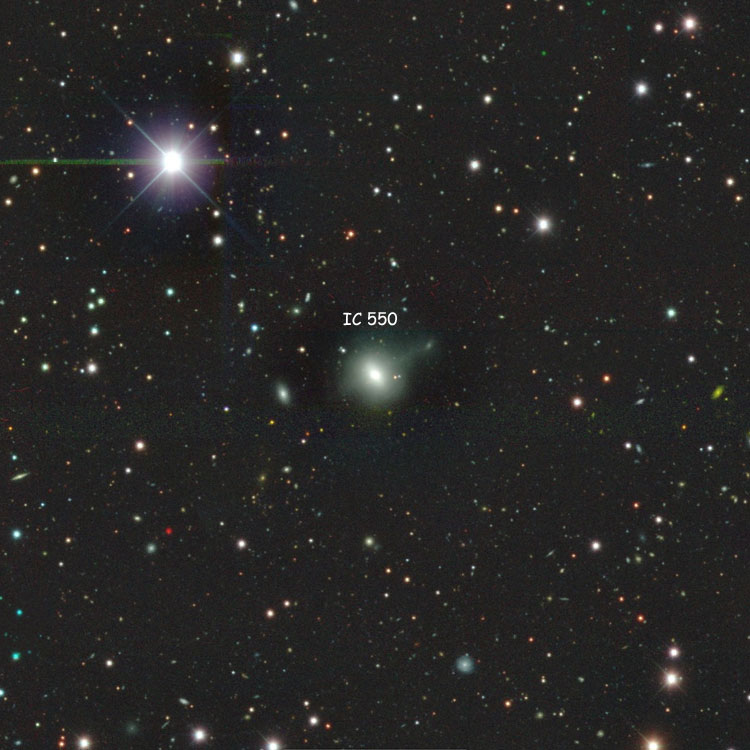
Above, a 12 arcmin wide DECaLS image centered on IC 550; the overexposed star is magnitude 7.7 HD 83792
Below, a 2.0 arcmin wide DECaLS image of the galaxy

IC 551
(= PGC 27645 = UGC 5168 = CGCG 035-029 = MCG +01-25-012)
Discovered (Apr 10, 1893) by Stephane Javelle
A magnitude 13.6 spiral galaxy (type (R')SB(rs?)a? pec?) in Leo (RA 09 41 00.1, Dec +06 56 10)
Historical Identification: Per Dreyer, IC 551 (Javelle #641, 1860 RA 09 33 36, NPD 82 26.3) is "faint, very small, round, nucleus = 13th magnitude." The position precesses to (2000) RA 09 41 00.1, Dec +06 55 42, less than 0.5 arcmin due south of the galaxy listed above, the description fits and there is nothing comparable nearby, so the identification is certain.
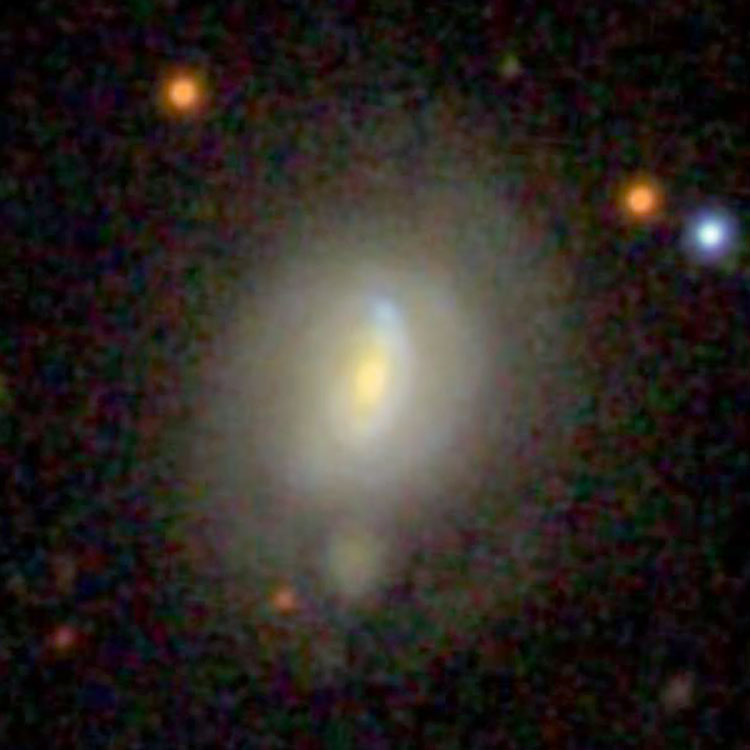
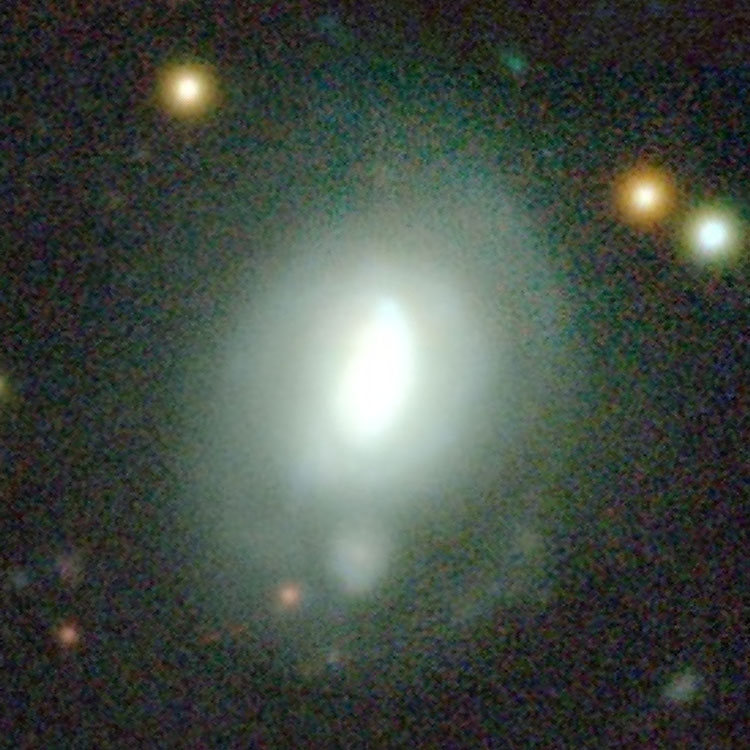
Physical Information: Based on a recessional velocity relative to the Cosmic Background Radiation of about 8905 km/sec (and H0 = 70 km/sec/Mpc), a straightforward calculation indicates that IC 550 is about 415 million light-years away. However, for objects at such distances we should take into account the expansion of the Universe during the time it took their light to reach us. Doing that shows that the galaxy was about 400 million light-years away at the time the light by which we see it was emitted, about 405 million years ago (the difference between the two numbers being due to the expansion of the intervening space during the light-travel time). Given that and its apparent size of about 0.95 by 0.65 arcmin (from the images below), the galaxy is about 110 thousand light-years across.
Classification Note: LEDA lists this as type Sbc (and because of the blob at its bottom, a possible multiple galaxy), and SIMBAD as Scd, while NED only has S? However, I see no sign of actual arms, but simply a substantially distorted structure, with a possible outer partial arm. And given the extremely bright nucleus (the galaxy has very strong emission lines, making it a so-called LINER), I feel it is probably a poorly resolved "peculiar" Sa, as shown by the "type" in its description line.
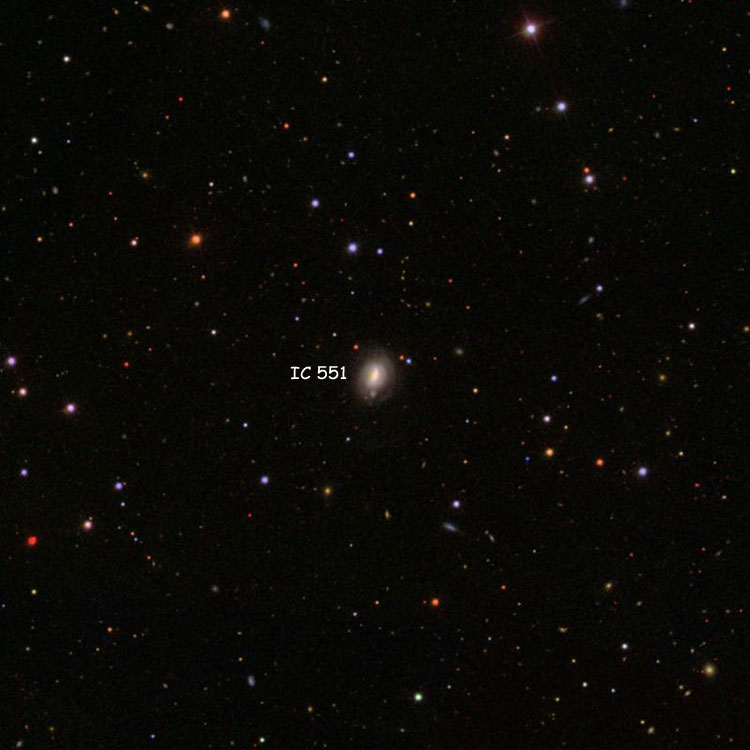
Above, a 12 arcmin wide SDSS image centered on IC 551
Below, a 1.2 arcmin SDSS image of the galaxy
Below, a 1.2 arcmin DECaLS image of the galaxy
IC 552
(= PGC 27665 = UGC 5171 = CGCG 063-038 = MCG +02-25-017)
Discovered (Apr 23, 1892) by Stephane Javelle
A magnitude 13.4 lenticular galaxy (type S0?) in Leo (RA 09 41 16.6, Dec +10 38 49)
Historical Identification: Per Dreyer, IC 552 (Javelle #166, 1860 RA 09 33 44, NPD 78 43.1) is "faint, very small, stellar, nucleus = 14th magnitude." The position precesses to (2000) RA 09 41 15.4, Dec +10 38 53, less than 0.3 arcmin west-northwest of the center of the galaxy listed above, the description is reasonable (taking into consideration the visual appearance of such faint objects when compared with modern photographs) and there is nothing comparable nearby, so the identification is certain.
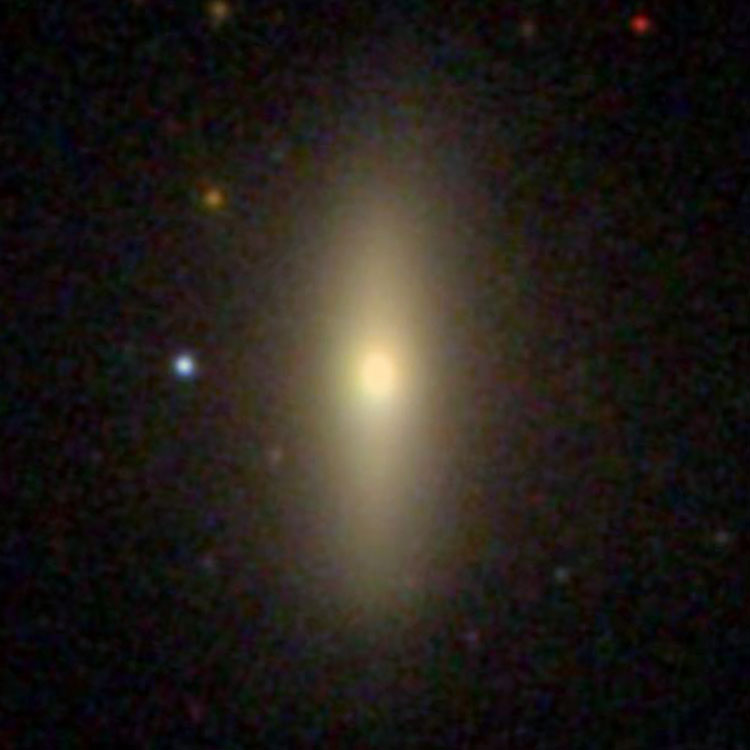
Physical Information: Based on a recessional velocity relative to the Cosmic Microwave Background of about 6115 km/sec (and H0 = 70 km/sec/Mpc), IC 552 is about 285 million light-years away, in good agreement with redshift-independent distance estimates of about 265 to 295 million light-years. Given that and its apparent size of 1.05 by 0.5 arcmin (from the images below), it is about 85 to 90 thousand light-years across.
Possible Companionship: See PGC 27862, an apparent companion of IC 552, for a discussion of the possibility that the two galaxies are actually a physical pair.
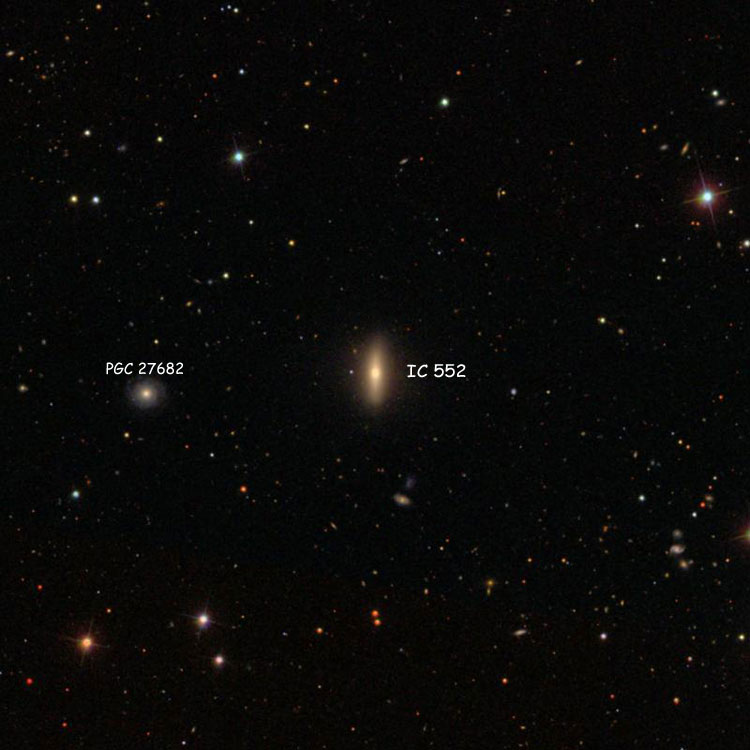
Above, a 12 arcmin wide SDSS image centered on IC 552, also showing PGC 27862
Below, a 1.5 arcmin wide SDSS image of the galaxy
PGC 27682
(= CGCG 063-042)
Not an IC object but listed here as a possible companion of IC 552
A magnitude 15.0(?) spiral galaxy (type SAcd?) in Leo (RA 09 41 31.5, Dec +10 38 29)
Physical Information: Based on a recessional velocity relative to the Cosmic Microwave Background radiation of about 5870 km/sec (and H0 = 70 km/sec/Mpc), PGC 27682 is about 270 to 275 million light-years away. Given that and its apparent size of about 0.65 by 0.55 arcmin (from the images below), the galaxy is about 50 thousand light-years across.
Possibility of Companionship: Given its 245 km/sec smaller recessional velocity, PGC 27682 is probably a slightly foreground object, and not a companion of IC 552; but although the difference in their recessional velocities is larger than usual peculiar velocities (random motions of galaxies relative to their neighbors), it's not much larger, so there is a possibility that the two galaxies are actually a physical pair. That may (or may not) be why Mahtessian lists IC 552 as #267 in a list of members of radial-velocity-based groups.
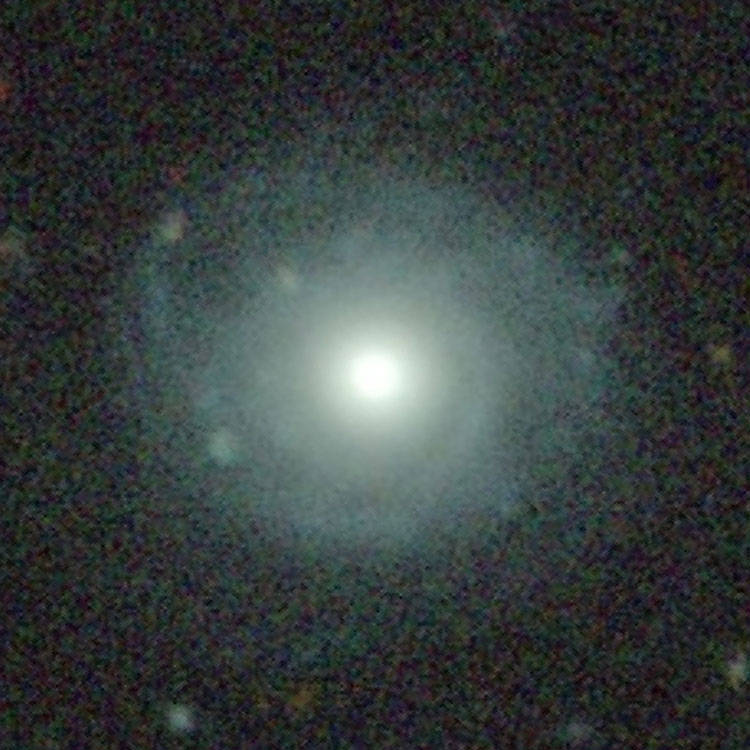
Classification Note: LEDA lists this as a type S0/a? lenticular, and NED as a type E/S0 lenticular; but as the images below show, although the galaxy's nucleus resembles an elliptical or lenticular galaxy, its outer regions strongly suggest that it is a late-type spiral with an unusually bright core, whence the "type" shown in the description line above.
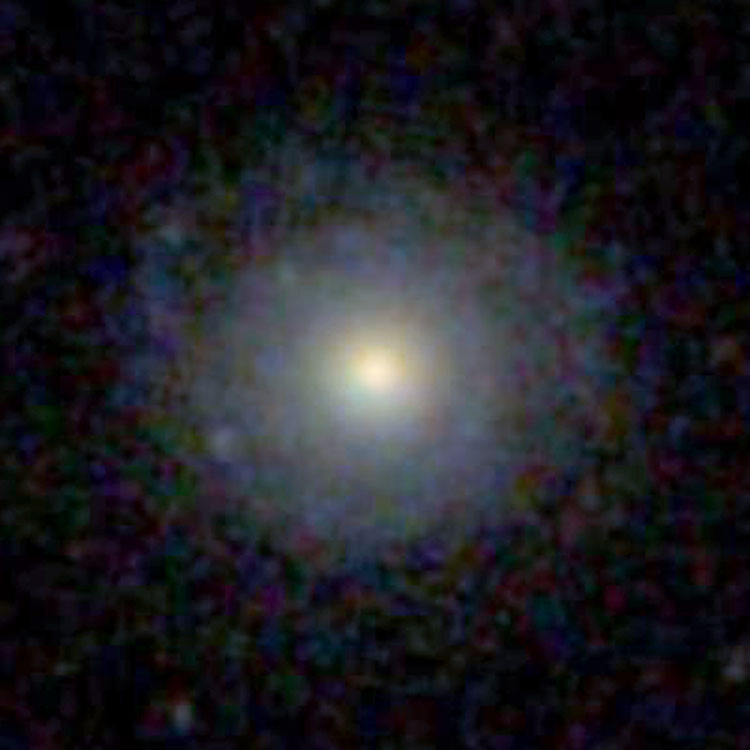
Above, a 1.0 arcmin wide SDSS image centered on PGC 27682 (for wider-field images, see IC 552)
Below, a 1.0 arcmin wide DECaLS image of the galaxy
IC 553
(= PGC 27625 = MCG -01-25-016)
Discovered (Feb 18, 1893) by Stephane Javelle (642)
A magnitude 13.7 spiral galaxy (type (R')SB(rs)a pec?) in Hydra (RA 09 40 45.1, Dec -05 26 07)
Historical Identification: Per Dreyer, IC 553 (Javelle #642, 1860 RA 09 33 46, NPD 94 48.1) is "very faint, very small, round, diffuse." The position precesses to (2000) RA 09 40 46.5, Dec -05 26 05, about 0.35 arcmin east-northeast of the center of the galaxy listed above, the description fits and there is nothing comparable nearby, so the identification is certain.
Physical Information: Based on a recessional velocity relative to the Cosmic Microwave Background radiation of 6955 km/sec (and H0 = 70 km/sec/Mpc), a straightforward calculation indicates that IC 553 is about 320 to 325 million light-years away, in fair agreement with a single redshift-independent distance estimate of about 265 million light-years. However, for objects at such distances we should take into account the expansion of the Universe during the time it took their light to reach us. Doing that shows that the galaxy was about 315 million light-years away at the time the light by which we see it was emitted, about 320 million years ago (the difference between the two numbers being due to the expansion of the intervening space during the light-travel time). Given that and its apparent size of about 1.5 by 1.15 arcmin (from the images below), the galaxy and its outer regions span about 135 to 140 thousand light-years.

Above, a 12 arcmin wide PanSTARRS image centered on IC 553
Below, a 2 arcmin wide PanSTARRS image of the galaxy

Below, a 1.75 arcmin wide DECaLS image of the galaxy

IC 554 (perhaps = IC 555, but probably lost or nonexistent)
Recorded (Mar 28, 1892) by Lewis Swift
Probably a lost or nonexistent object in Leo (RA 09 41 47.9, Dec +12 26 01)
but usually (mis?)identified as a duplicate listing of IC 555
Historical Identification: Per Dreyer, IC 554 (Swift list X (#1), 1860 RA 09 34 13, NPD 76 55.9) is "most extremely faint, extremely small, almost stellar." The position precesses to (2000) RA 09 41 47.9, Dec +12 26 01 (whence the position above), but there is nothing there. It is generally assumed that Swift actually observed Javelle's IC 555, which lies 8.4 arcmin south-southeast of Swift's position, and simply made an error of 10 arcmin in its declination (a not uncommon error for Swift). If so, this would put Swift's position about 3 arcmin southwest of IC 555, which wouldn't be unreasonable, given the fact that Swift's later observations tended to have poor positions, but the descriptions of the two objects are completely different (Javelle described IC 555 as "pretty bright"). Gottlieb suggests that might be due to the fact that Javelle used a much larger telescope, so IC 554 might be a mis-recorded observation of the object Javelle discovered a few nights earlier; but it is also possible that what Swift observed was some truly stellar object, in which case identifying what he observed would be impossible. So although I have changed this entry to give a more favorable opinion of the identification as IC 555, I feel that the possibility that IC 554 is either lost or nonexistent should not be completely abandoned.
A Final Note: As an example of what Swift might have observed if he did not mis-record an observation of IC 555, I have pointed out the faint group of stars just to the south of Swift's position on the image below; however, such groups are so common that even if IC 554 is such a group, whether it is the one on the image or something completely different cannot be known.

Above, a 20 arcmin wide SDSS image centered on Swift's position for IC 554, also showing IC 555
Also shown is the sort of faint stellar grouping that might or might not be Swift's object
IC 555
(= PGC 27716 = UGC 5178 = CGCG 063-047 = MCG +02-25-020
and possibly but probably not = IC 554)
Discovered (Mar 22, 1892) by Stephane Javelle and later listed as IC 555)
Perhaps mis-recorded (Mar 28, 1892) by Lewis Swift (and later listed as IC 554)
A magnitude 13.3 lenticular galaxy (type S0?) in Leo (RA 09 41 56.9, Dec +12 17 47)
Historical Identification: Per Dreyer, IC 555 (Javelle #167, 1860 RA 09 34 20, NPD 77 04.3) is "pretty bright, very small, round, brighter middle." The position presses to (2000) RA 09 41 54.6, Dec +12 17 37, just west of the galaxy listed above, the description fits (Javelle would only have seen the bright nucleus), and there is nothing else nearby, so the identification is certain.
(Mis?)identification as IC 554: See the entry for IC 554 for a detailed discussion of why, although that might be a duplicate observation of IC 555, it is just as (or more) likely to be a lost or nonexistent object.
PGC Designation Note: Since IC 554 is usually treated as a duplicate observation of IC 555, some references list PGC 27716 as IC 554, and others list it as IC 555. If the two objects are identical, although confusing, this would not be a serious problem; but since their supposed identity cannot be considered certain, listing PGC 27716 as IC 554 is at best unwise, and at worst completely wrong.
Physical Information: Based on a recessional velocity relative to the Cosmic Background Radiation of 7070 km/sec (and H0 = 70 km/sec/Mpc), a straightforward calculation indicates that IC 555 is about 330 million light-years away. However, for objects at such distances we should take into account the expansion of the Universe during the time it took their light to reach us. Doing that shows that the galaxy was about 320 million light-years away at the time the light by which we see it was emitted, about 325 million years ago (the difference between the two numbers being due to the expansion of the intervening space during the light-travel time). Given that its apparent size of about 1.25 by 0.5 arcmin (from the images below), the galaxy spans about 115 thousand light-years.
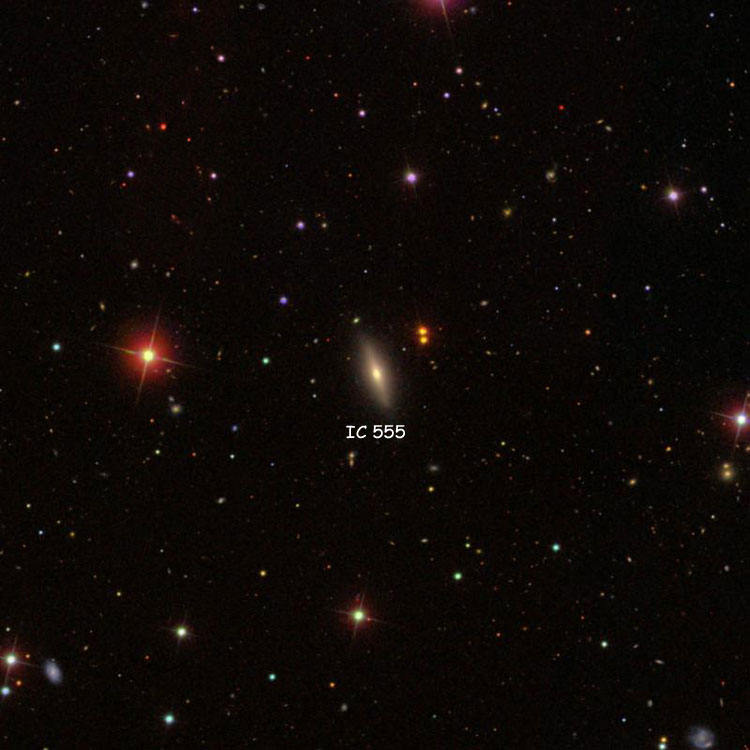
Above, a 12 arcmin wide SDSS image centered on IC 555
Below, a 1.75 arcmin wide SDSS image of the galaxy

IC 556 (= NGC 2984)
(= PGC 27838 = UGC 5200 = CGCG 063-053 = MCG +02-25-025)
Discovered (Mar 15, 1784) by William Herschel (and later listed as NGC 2984)
Also observed (January, 1828) by John Herschel (and later listed as NGC 2984)
Discovered (Apr 22, 1892) by Stephane Javelle (and later listed as IC 556)
A magnitude 13.4 lenticular galaxy (type S0?) in Leo (RA 09 43 40.4, Dec +11 03 39)
Historical Identification: Per Dreyer, IC 556 (Javelle #168, 1860 RA 09 36 09, NPD 78 17.9) is "faint, very small, round, nucleus equivalent to 14th-magnitude star." The position precesses to (2000) RA 09 43 40.9, Dec +11 03 48, on the periphery of the galaxy listed above, the description fits and there is nothing comparable nearby, so the identification is certain.
Identification As NGC 2984: Gottlieb writes that Karl Reinmuth was the first to suggest the duplicate entry, but despite that only the often unreliable RNGC listed it as NGC 2984, while UGC, CGCG and MCG only list it as IC 556. Corwin comments that the Herschels' positions must have been unusually poor, but since both of them observed something, and there is nothing else anywhere in the area, NGC 2984 must be the same object as IC 556.
Physical Information: Given the duplicate listing, see NGC 2984 for anything else.
IC 557
(= PGC 27866 = CGCG 063-055 = MCG +02-25-027)
Discovered (Apr 22, 1892) by Stephane Javelle)
A magnitude 13.9 spiral galaxy (type SB0/a pec?) in Leo (RA 09 44 02.4, Dec +10 59 17)
Historical Identification: Per Dreyer, IC 557 (Javelle #169, 1860 RA 09 36 30, NPD 78 22.3) is "faint, very small, round, a very little brighter middle." The position precesses to (2000) RA 09 44 01.7, Dec +10 59 21, barely outside the western outline of the galaxy, the description is reasonable and there is nothing else nearby, so the identification is certain.
Physical Information: Based on a recessional velocity relative to the Cosmic Microwave Background radiation of 6405 km/sec (and H0 = 70 km/sec/Mpc), IC 557 is about 295 to 300 million light-years away. Given that and its apparent size of about 0.77 by 0.47 arcmin for the bright central regions and about 1.28 by 0.85 arcmin for the outer halo (from the images below), the central galaxy is about 65 thousand light-years across, while its halo spans about 110 thousand light-years.
Classification Note: LEDA lists this as a spiral (type SBab), while NED calls it a high surface brightness lenticular (type S0/a). The images below show that it is a peculiar lenticular, hence the type shown in the description line.

Above, a 12 arcmin wide SDSS image centered on IC 557, also showing NGC 2984
Below, a 1.75 arcmin wide SDSS image of the galaxy

Below, a 1.5 arcmin wide DECaLS image of the galaxy
IC 558
(= PGC 27931 = CGCG 152-063 = MCG +05-23-033)
Discovered (Feb 23, 1889) by Rudolf Spitaler
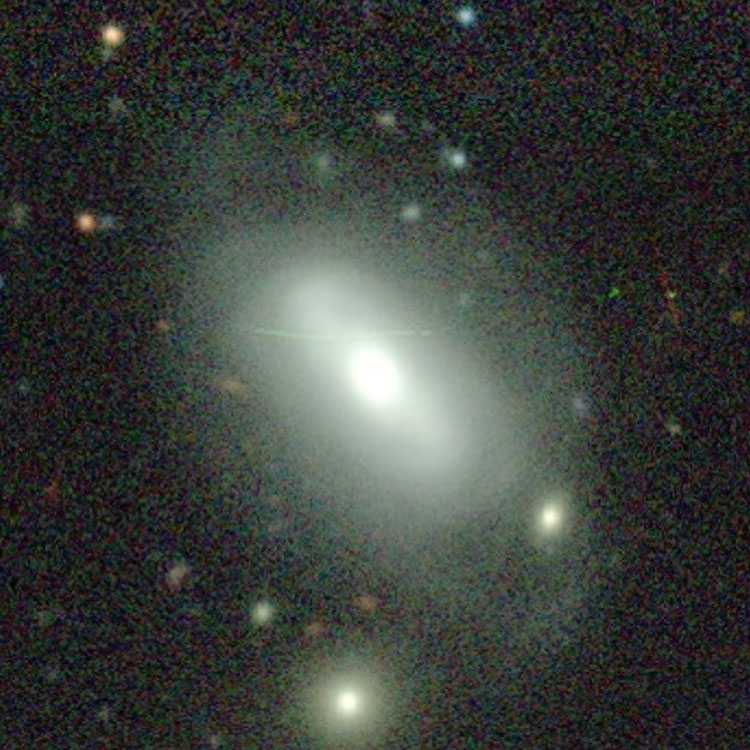
A magnitude 13.6 elliptical galaxy (type E2?) in Leo (RA 09 45 00.3, Dec +29 27 08)
Historical Identification: Per Dreyer, IC 558 (Spitaler (A.N. 2992 (#113)), 1860 RA 09 36 47, NPD 59 54.1) is "faint, round, brighter middle." The position precesses to (2000) RA 09 44 58.3, Dec +29 27 29, about 0.55 arcmin northwest of the center of the galaxy listed above (and near the northwestern edge of its halo), the description fits and there is nothing else nearby, so the identification is certain.
Physical Information: Based on a recessional velocity relative to the Cosmic Background Radiation of 9585 km/sec (and H0 = 70 km/sec/Mpc), a straightforward calculation indicates that IC 558 is about 445 million light-years away, in reasonable agreement with a single redshift-independent distance estimate of about 480 million light-years. However, for objects at such distances we should take into account the expansion of the Universe during the time it took their light to reach us. Doing that shows that the galaxy was about 430 million light-years away at the time the light by which we see it was emitted, a little over 435 million years ago (the difference between the two numbers being due to the expansion of the intervening space during the light-travel time). Given that and its apparent size of about 0.7 by 0.6 arcmin (from the images below), the galaxy is about 85 to 90 thousand light-years across.
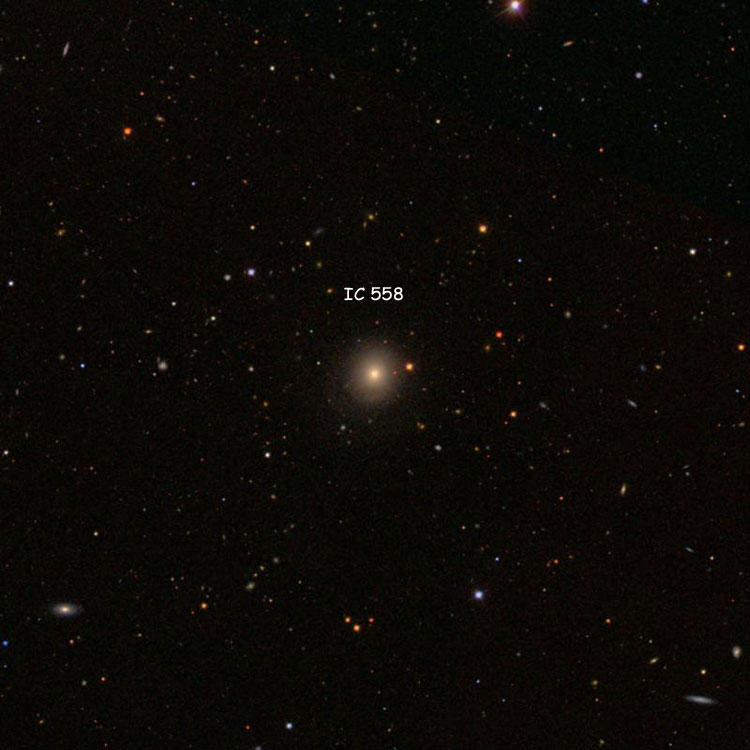
Above, a 12 arcmin wide SDSS image centered on IC 558
Below, a 1.5 arcmin wide SDSS image of the galaxy

IC 559
(= PGC 27910 = CGCG 063-057 = MCG +02-25-029)
Discovered (Apr 13, 1893) by Stephane Javelle
A magnitude 14.2 spiral galaxy (type dS(B?)m?) in Leo (RA 09 44 43.9, Dec +09 36 54)
Historical Identification: Per Dreyer, IC 559 (Javelle #643, 1860 RA 09 37 13, NPD 79 44.6) is "faint, pretty small, round, diffuse." The position precesses to (2000) RA 09 44 42.0, Dec +09 36 59, about 0.45 arcmin west-northwest of the center of the galaxy listed above (barely outside its western boundary), the description fits and there is nothing else nearby, so the identification is certain.
Physical Information: Based on a recessional velocity relative to the Cosmic Microwave Background radiation of 870 km/sec (and H0 = 70 km/sec/Mpc), IC 559 is about 40 million light-years away, a little furthan than redshift-independent distance estimates of about 31 to 33 million light-years. For such close objects, peculiar velocities (random motions relative to neighboring galaxies) can be a substantial part of the recessional velocity, so some kind of average of the two methods of determining the distance is probably most appropriate. Assuming a distance of about 35 million light-years and given its apparent size of about 0.7 by 0.5 arcmin (from the images below), IC 559 is only about 7 thousand light-years across.
Classification Note: LEDA lists this as an Irregular galaxy, while NED calls it an Sc dwarf with no central bulge. Based on the images below, something in-between the two types seems most likely, so Sm, which is the most irregular variation of a spiral galaxy, is the basic "type" shown in the description line above. The (B?) was added because the brighter "star-forming" regions lie along a line, implying either an edge-on disk, which is unlikely for such a galaxy, or some kind of linear structure, and "d" stands for dwarf, because of the galaxy's extremely small size.
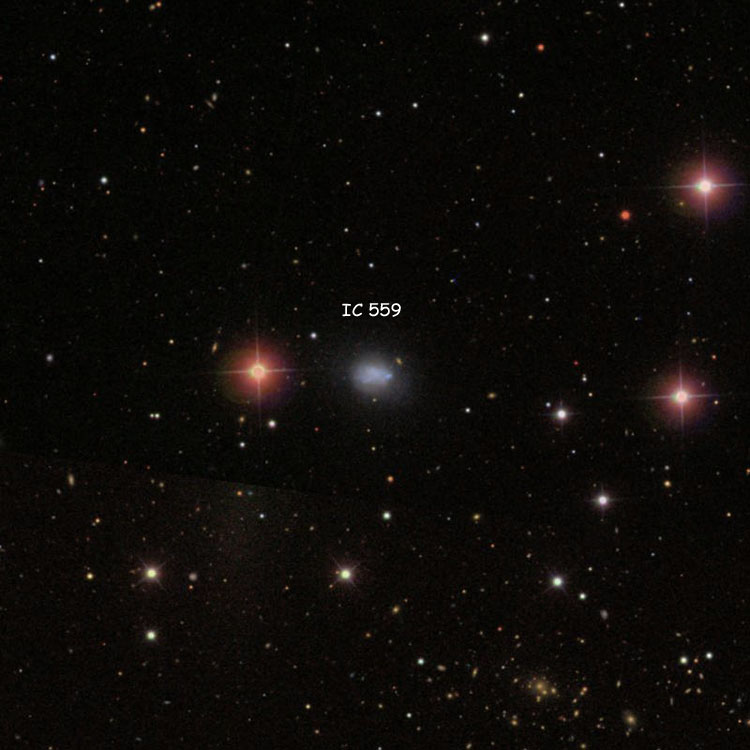
Above, a 12 arcmin wide SDSS image centered on IC 559
Below, a 1.0 arcmin wide SDSS image of the galaxy

Below, a 0.9 arcmin wide HST image of the galaxy (Image Credit ESA/Hubble, NASA, D. Calzetti (UMass) and the LEGUS Team)

IC 560
(= PGC 27998 = UGC 5223 = CGCG 007-030 = MCG +00-25-013)
Discovered (Mar 9, 1893) by Stephane Javelle
A magnitude 13.3 lenticular galaxy (type S0/a?) in Sextans (RA 09 45 53.4, Dec -00 16 06)
Historical Identification: Per Dreyer, IC 560 (Javelle #644, 1860 RA 09 38 42, NPD 89 38.7) is "faint, small, diffuse, 10th magnitude star near." The position precesses to (2000) RA 09 45 52.3, Dec -00 17 17, about 1.2 arcmin south-southwest of the galaxy listed above, the description fits and there is nothing else nearby, so the identification is certain.
Discovery Note: Gottlieb notes that Javelle's comparison star had an error of an arcmin in declination, so "His position is 1' too far south". In other words, his measurement was accurate to 0.2 arcmin.
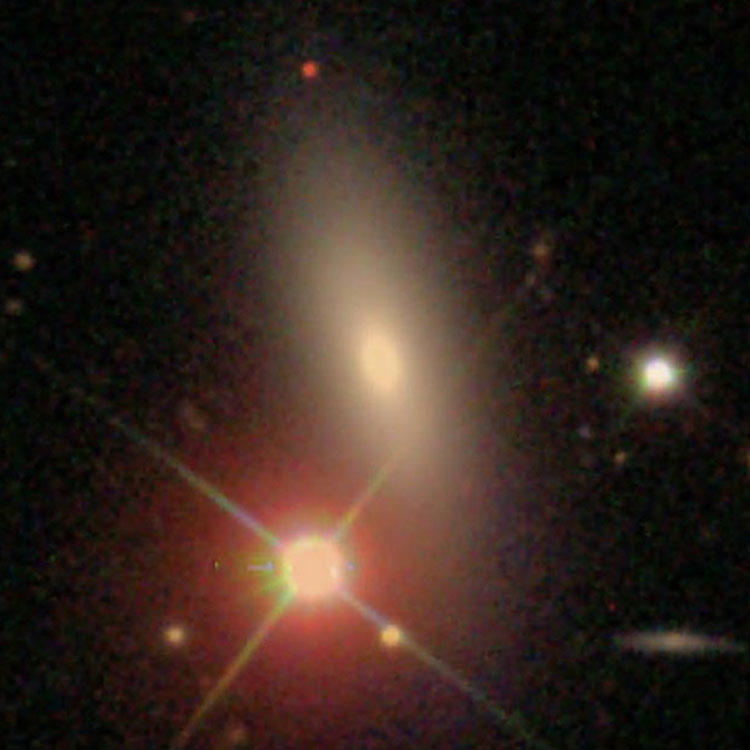
Physical Information: Based on a recessional velocity relative to the Cosmic Microwave Background radiation of 2195 km/sec (and H0 = 70 km/sec/Mpc), IC 560 is about 100 to 105 million light-years away. Given that and its apparent size of about 1.6 by 0.6 arcmin (from the images below), the galaxy is about 45 to 50 thousand light-years across.

Above, a 12 arcmin wide SDSS image centered on IC 560
Below, a 2 arcmin wide SDSS image of the galaxy and the magnitude 10.9 star
IC 561
(= PGC 28002 = CGCG 035-049 = MCG +01-25-019)
Discovered (Mar 21, 1893) by Stephane Javelle
A magnitude 14.6 spiral galaxy (type Sc?) in Sextans (RA 09 45 58.8, Dec +03 08 43)
Historical Identification: Per Dreyer, IC 561 (Javelle #645, 1860 RA 09 38 43, NPD 86 12.6) is "pretty faint, diffuse." The position precesses to (2000) RA 09 45 59.7, Dec +03 08 49, less than 0.25 arcmin east-northeast of the center of the galaxy listed above, the description fits and there is nothing comparable nearby, so the identification is certain.
Physical Information: Based on a recessional velocity relative to the Cosmic Microwave Background radiation of about 6255 km/sec (and H0 = 70 km/sec/Mpc), IC 561 is about 290 million light-years away. Given that and its apparent size of about 0.5 by 0.4 arcmin (from the images below), the galaxy is about 40 to 45 thousand light-years across.
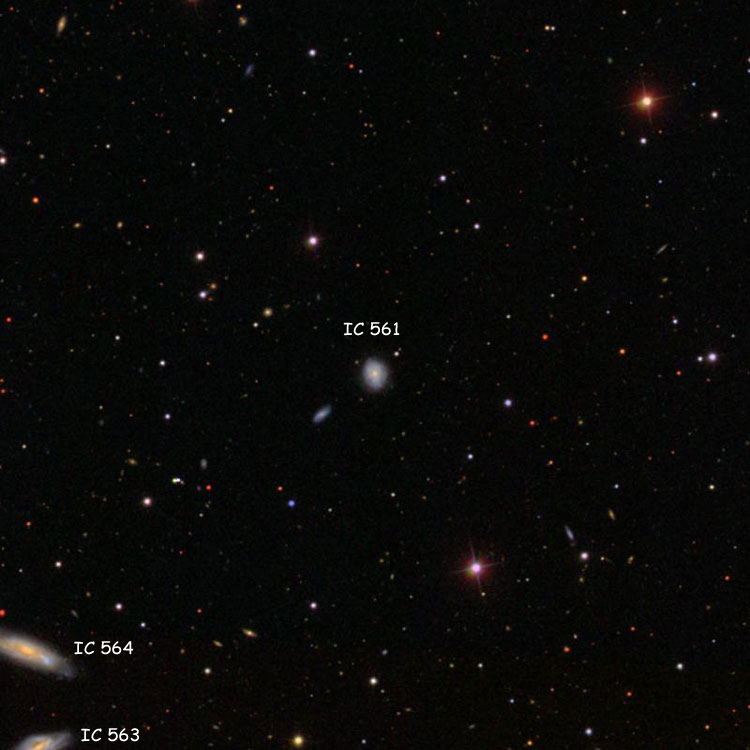
Above, a 12 arcmin wide SDSS image centered on IC 561, also showing IC 563 and 564
Below, a 0.75 arcmin wide SDSS image of IC 561
IC 562
(= PGC 28011 = MCG -01-25-036)
Discovered (Mar 8, 1893) by Stephane Javelle
A magnitude 14.2 spiral galaxy (type S(B?)bc?) in Sextans (RA 09 46 04.1, Dec -03 58 19)
Historical Identification: Per Dreyer, IC 562 (Javelle #646, 1860 RA 09 39 01, NPD 93 19.8) is "very faint, pretty large, extended north-south, gradually brighter middle." The position precesses to (2000) RA 09 46 04.5, Dec -03 58 25, less than 0.2 arcmin south-southeast of the center of the galaxy listed above and well within its eastern outline, the description fits and there is nothing else nearby, so the identification is certain.
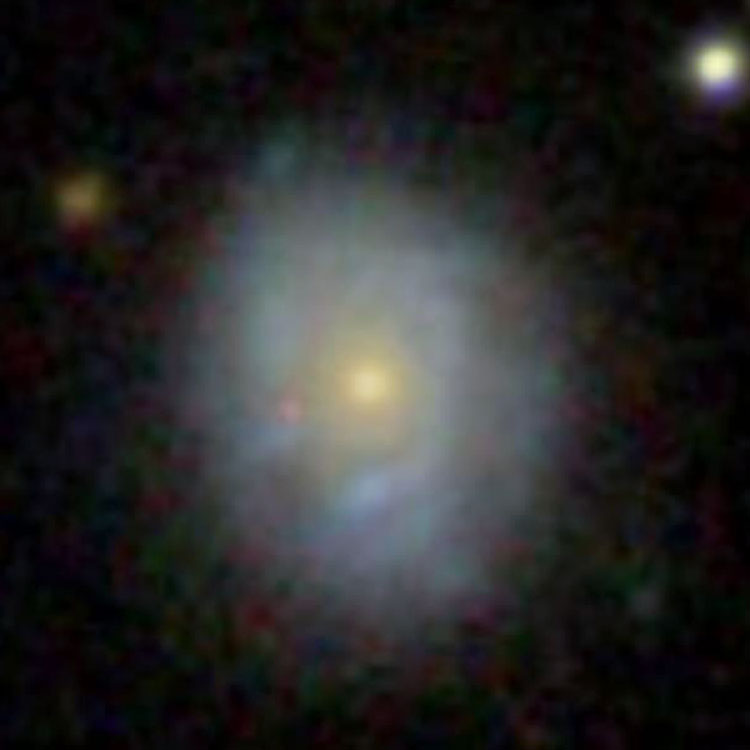
Physical Information: Based on a recessional velocity relative to the Cosmic Microwave Background radiation of 5145 km/sec (and H0 = 70 km/sec/Mpc), IC 562 is about 240 million light-years away, in reasonable agreement with redshift-independent distance estimates of 205 to 360 million light-years. Given that and its apparent size of about 1.1 by 0.25 arcmin (from the images below), the galaxy is about 75 thousand light-years across.
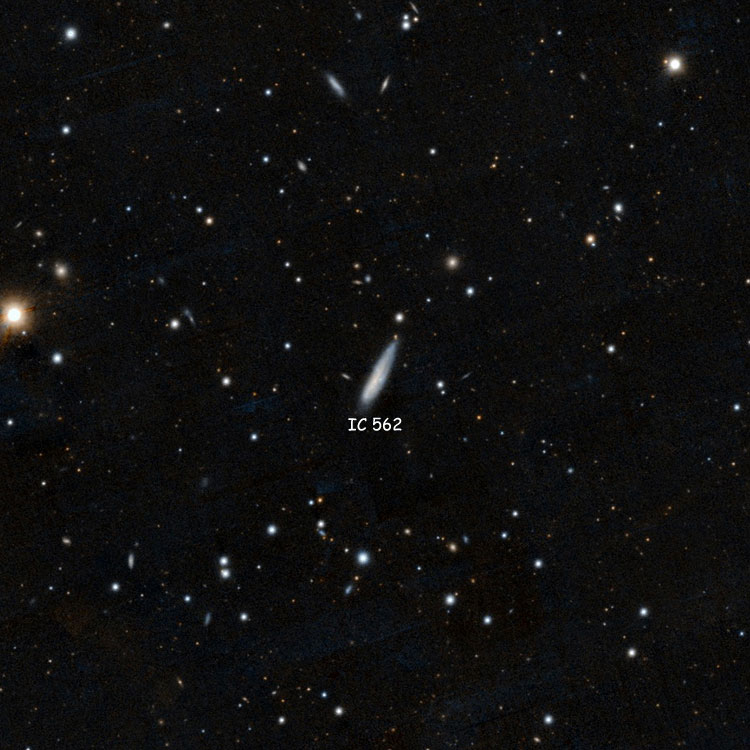
Above, a 12 arcmin wide PanSTARRS image centered on IC 562
Below, a 1.5 arcmin wide PanSTARRS image of the galaxy
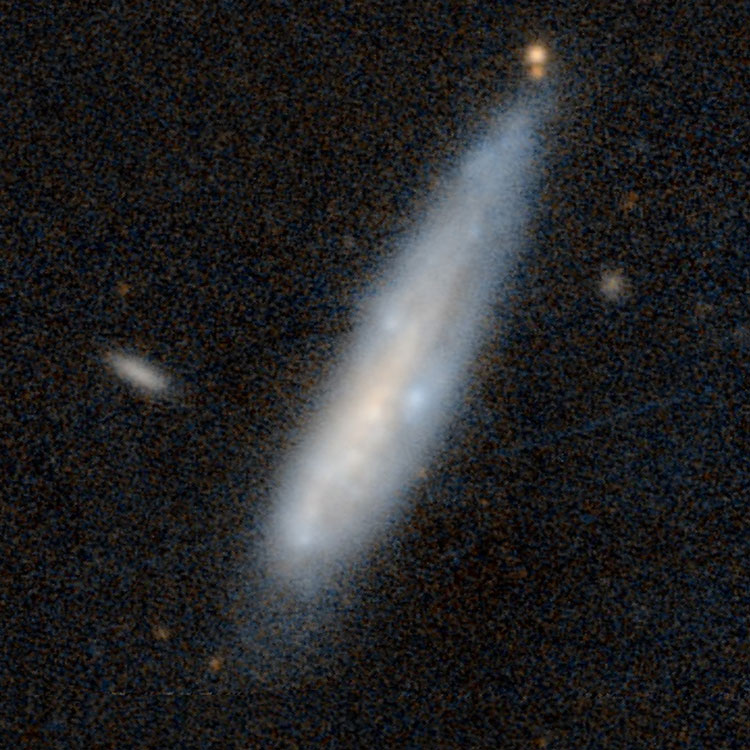
IC 563 (with IC 564 = Arp 303)
(= PGC 28032 = CGCG 035-053 = MCG +01-25-022)
Discovered (Mar 21, 1893) by Stephane Javelle
A magnitude 13.9 spiral galaxy (type SB(r)ab? pec) in Sextans (RA 09 46 20.3, Dec +03 02 44)
Historical Identification: Per Dreyer, IC 563 (Javelle #647, 1860 RA 09 39 04, NPD 86 18.6) is "pretty bright, small, diffuse, gradually brighter middle." The position precesses to (2000) RA 09 46 20.5, Dec +03 02 46, almost dead center on the galaxy listed above, the description fits and the only other object nearby is Javelle's #648 (IC 564), so the identification is certain.
Physical Information: Since IC 563 and 564 have similar radial velocities and are almost certainly a physical pair, the appropriate recessional velocity for estimating their distance is the average of their individual values (about 6360 km/sec for IC 563, and 6330 for IC 564, or an average of about 6345 km/sec relative to the Cosmic Microwave Background Radiation). Using that and H0 = 70 km/sec/Mpc), the two galaxies are about 295 million light-years away, somewhat farther than a single redshift-independent distance estimate of about 185 million light-years for IC 563, and redshift-independent distance estimates of 230 to 245 million light-years for IC 564. Using a slightly compromised distance of about 280 million light-years for the pair, and an apparent size of about 0.9 by 0.35 arcmin for IC 563 (from the images below), that galaxy is about 70 to 75 thousand light-years across.
Usage By The Arp Atlas: The Arp Atlas of Peculiar Galaxies uses IC 563 and 564 as an example of unclassified double galaxies, with the only note being that the recorded position was between the pair.

Above, a 12 arcmin wide SDSS image centered on Arp 303, also showing IC 561
Below, a 2.5 arcmin wide SDSS image of IC 563 and 564, which comprise Arp 303
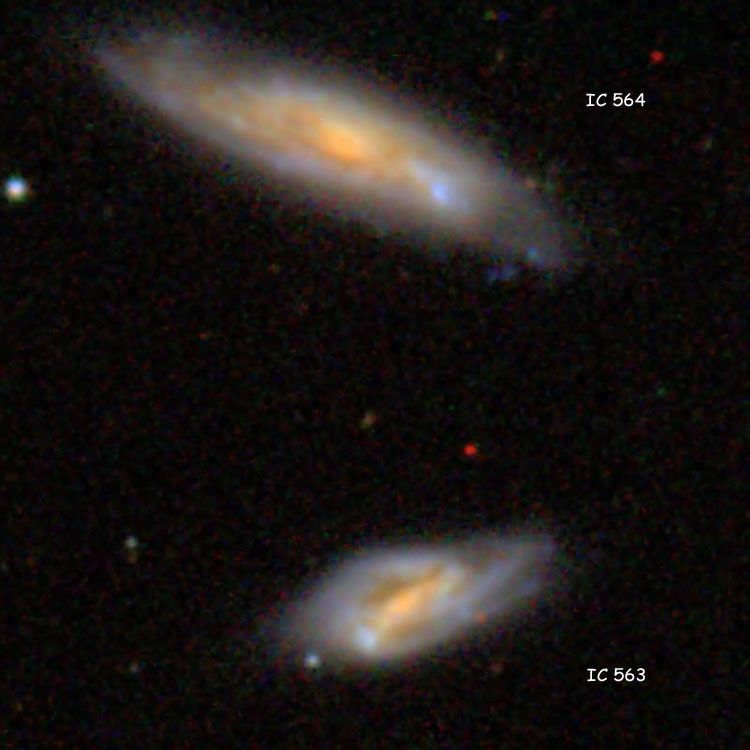
Below, a 2.1 by 2.5 arcmin wide HST image of the galaxies' brighter regions
(Image Credit NASA, ESA, K. Larson (STScI), J. Dalcanton (Univ. of Washington); Image Processing G. Kober (NASA Goddard/Catholic Univ. of America))

Below, a 1.2 arcmin wide SDSS image of IC 563
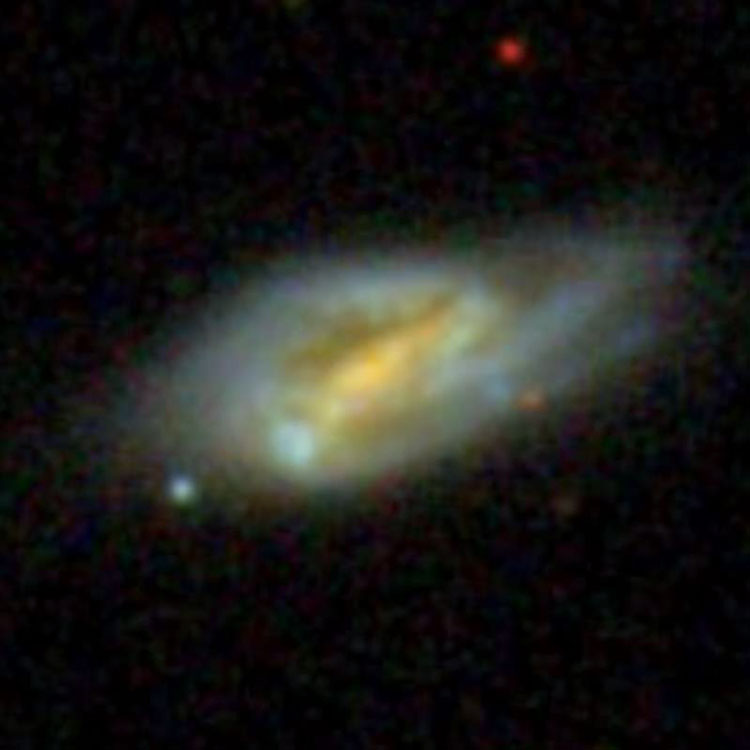
Below, a 1.2 by 1.0 arcmin HST image of IC 563 (Image Credit as for HST image above)

Below, the image above overexposed to show faint outer regions of the galaxy (Image Credit as above; post-processing Courtney Seligman)

IC 564 (with IC 563 = Arp 303)
(= PGC 28033 = UGC 5230 = CGCG 035-054 = MCG +01-25-023)
Discovered (Mar 21, 1893) by Stephane Javelle
A magnitude 13.4 spiral galaxy (type SA(s)cd? pec) in Sextans (RA 09 46 21.1, Dec +03 04 17)
Historical Identification: Per Dreyer, IC 564 (Javelle #648, 1860 RA 09 39 05, NPD 86 17.0) is "pretty bright, pretty large, extended preceding-following (east-west)." The position precesses to (2000) RA 09 46 21.5, Dec +03 04 22, on the northeastern rim of the nucleus of the galaxy listed above, the description fits and there is nothing nearby except for Javelle #647 (IC 563), so the identification is certain.
Physical Information: Based on the arguments presented in the entry for IC 563, it and IC 564 are probably around 280 million light-years away. Given that and an apparent size of about 1.85 by 0.5 arcmin for IC 564 (from the images below), that galaxy is about 150 thousand light-years across.
Usage By The Arp Atlas: The Arp Atlas of Peculiar Galaxies uses IC 563 and 564 as an example of unclassified double galaxies, with the only note being that the recorded position was between the pair.
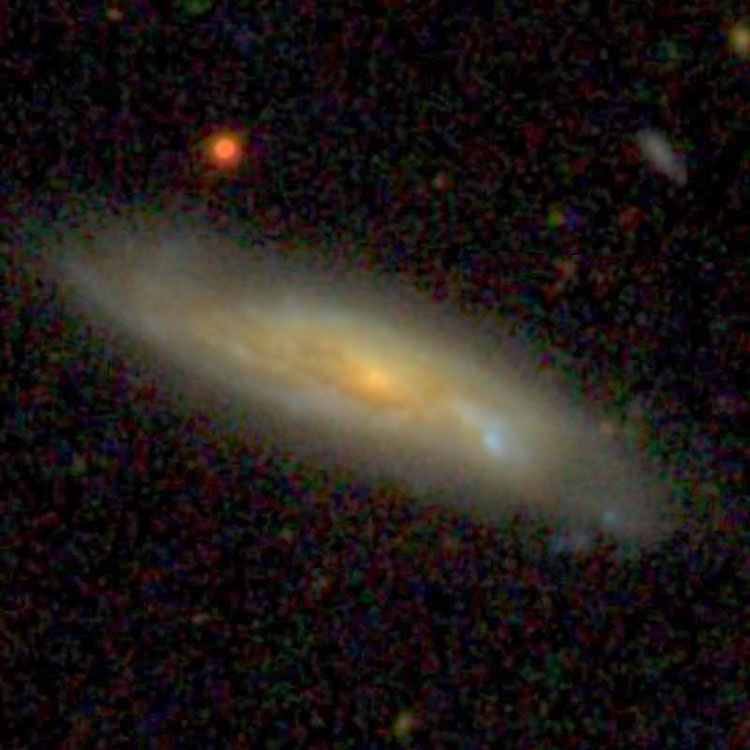
Above, a 2 arcmin wide SDSS image of IC 564
Below, a 2.0 by 1.0 arcmin wide HST image of the galaxy's brighter inner region
(Image Credit NASA, ESA, K. Larson (STScI), J. Dalcanton (Univ. of Washington); Image Processing G. Kober (NASA Goddard/Catholic Univ. of America))

Below, the image above overexposed to show faint outer regions (Image Credit as above; post-processing Courtney Seligman)
For wider=field images of Arp 303, see IC 563

IC 565
(= PGC 28159 = UGC 5248 = CGCG 092-052 = MCG +03-25-028)
Discovered (Dec 16, 1893) by Stephane Javelle
A magnitude 14.4 spiral galaxy (type Sbc? pec) in Leo (RA 09 47 50.5, Dec +15 51 06)
Historical Identification: Per Dreyer, IC 565 (Javelle #649, 1860 RA 09 40 10, NPD 73 30.0) is "faint, small, diffuse." The position precesses to (2000) RA 09 47 50.6, Dec +15 51 14, on the northern rim of the nucleus of the galaxy listed above, the description fits and there is nothing comparable nearby, so the identification is certain.
Physical Information: Based on a recessional velocity relative to the Cosmic Microwave Background radiation of about 6170 km/sec (and H0 = 70 km/sec/Mpc), IC 565 is about 285 to 290 million light-years away. Given that and its apparent size of about 1.45 by 0.15 arcmin (from the images below), the galaxy is about 120 thousand light-years across. IC 565 is accompanied by a compact companion, but whether there is any actual connection between them is unknown; however, the distorted appearance of IC 565 suggests that they may indeed be physical companions.
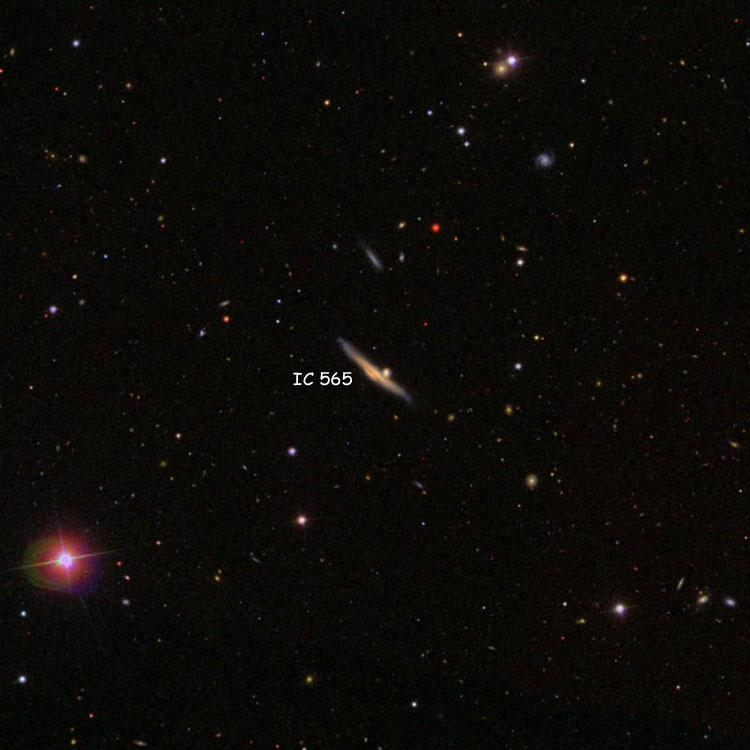
Above, a 12 arcmin wide SDSS image centered on IC 565 (and an apparent companion)
Below, a 1.75 arcmin wide SDSS image of IC 565 and its apparent companion

2MASX J09474970+1551068
(= "PGC 4666085")
Not an IC object, but listed here as a possible companion of IC 565
A magnitude 16.0(?) lenticular galaxy (type dE/S0? pec?) in Leo (RA 09 47 49.7, Dec +15 51 07)
PGC Designation: HyperLEDA assigned a PGC designation to this object, but a search of the database for that designation returns no result, hence its being placed in quotes. The 2MASX designation does bring up the appropriate pages for the galaxy in both LEDA and NED.
Physical Information: Based on a recessional velocity relative to the Cosmic Microwave Background radiation of about 6455 km/sec (and H0 = 70 km/sec/Mpc), this galaxy is about 300 million light-years away, and if so, may lie 10 to 15 million light-years beyond IC 565. However, the difference in their recessional velocities (about 290 km/sec), although larger than typical "peculiar velocities" (random motions of galaxies relative to their neighbors), is small enough that the smaller galaxy and its much larger apparent neighbor (IC 565) might be a physical pair, and if they are, that might explain the obviously distorted shape of the larger galaxy, and some minor distortion of the smaller galaxy. Given that possibility, a distance estimate of about 290 million light-years might be more appropriate; and if so, its apparent size of about 0.14 by 0.125 arcmin (from the image below) would suggest that the possible companion is about 10 to 12 thousand light-years across (whence the "d" in the type shown in the description line)
Classification Note: HyperLEDA lists this galaxy as S?, which is obviously wrong, and NED lists no classification, so the type shown in the description line above is based on the image below. My choice of E/S0? instead of E1 is based on the unusually bright nucleus, which is more typical of lenticular than elliptical galaxies, particularly "dwarf" ellipticals.

Above, a 0.4 arcmin wide SDSS image of part of IC 565 and its possible companion, "PGC 4666085"
IC 566
(= PGC 28279 = CGCG 007-044)
Discovered (Mar 9, 1893) by Stephane Javelle
A magnitude 14.5 spiral galaxy (type S(rs)ab pec?) in Sextans (RA 09 49 56.4, Dec -00 13 53)
Historical Identification: Per Dreyer, IC 566 (Javelle #650, 1860 RA 09 42 47, NPD 89 35.2) is "very faint, very small, round, brighter middle." The position precesses to (2000) RA 09 49 57.4, Dec -00 14 15, less than 0.5 arcmin southeast of the galaxy listed above, the description fits and there is nothing else nearby, so the identification is certain.
Physical Information: Based on a recessional velocity relative to the Cosmic Background Radiation of about 11300 km/sec (and H0 = 70 km/sec/Mpc), a straightforward calculation indicates that IC 566 is about 525 million light-years away, considerably furthan than a single redshift-independent distance estimate of about 385 million light-years. However, for objects at such distances we should take into account the expansion of the Universe during the time it took their light to reach us. Doing that shows that the galaxy was almost 505 million light-years away at the time the light by which we see it was emitted, almost 515 million years ago (the difference between the two numbers being due to the expansion of the intervening space during the light-travel time). Given that and its apparent size of about 0.5 by 0.4 arcmin for the central region and about 1.8 by 0.8 arcmin for the faint extensions (from the images below), the central galaxy is about 70 to 75 thousand light-years across, and its faint arms span almost 265 thousand light-years.
Classification Note: HyperLEDA and NED both classify this as a lenticular galaxy (type S0/a), and the bright central region fits that description; but as shown in the images below, the "lenticular" galaxy is actually just the nucleus of an unusual spiral, with faint northwestern and southeastern arms, the latter with a relatively bright connection to the nuclear region, and (possibly) a faint northeastern "fuzz" adjoining the nucleus, whence the "type" shown in the description line above.

Above, a 12 arcmin wide SDSS image centered on IC 566
Below, a 2 arcmin wide PanSTARRS image of the galaxy

IC 567
Recorded (Mar 18, 1890) by Guillaume Bigourdan
A magnitude 15.4 star in Leo (RA 09 50 33.8, Dec +12 47 05)
Historical Identification: Per Dreyer, IC 567 (Bigourdan #156, 1860 RA 09 42 57, NPD 76 32) is "very faint, suspected, 2 arcmin from III 52," III 52 being NGC 3024. The position precesses to (2000) RA 09 50 31.3, Dec +12 48 55, about 3 arcmin north of NGC 3024, and just over an arcmin west of PGC 1416616. However, that galaxy cannot be Bigourdan's object, because extended objects such as galaxies, which have their light spread out over their entire surface area, look far fainter to visual observers than stars, which have all their light concentrated in a nearly pointlike image. As a result, even though PGC 1416616 looks like a reasonable candidate in modern photographs, Bigourdan could not possibly have seen it with his 12-inch telescope, and what he actually saw must have been one of the faint stars in the region. Which star would be a mystery if not for the fact that per his usual practice, Bigourdan published his offsets from NGC 3024 as well as his calculated position. Per Thomson, Bigourdan's position is wrong because the coordinates listed for his comparison star were based on an incorrect position for BD+31 2162; but the offsets from NGC 3024 (6.3 seconds of time east and 1' 17" north of that galaxy) fall almost exactly on the star listed above, making its identity as IC 567 certain.
Discovery Note: Corwin also writes that Bigourdan's offsets from NGC 3024 make the identification of the star as IC 567 certain, and adds that Bigourdan looked for it on two other occasions, being unable to find it on his first try, and only catching occasional glimpses of it during his last observation.

Above, a 12 arcmin wide region centered on IC 567, also showing NGC 3020 and NGC 3024
(PGC 1416616 is also shown, because it is mentioned in the discussion above)
PGC 1416616
Not an IC object but listed here since involved in the discussion of IC 567
A magnitude 16.5(?) dwarf elliptical galaxy (type dE1?) in Leo (RA 09 50 36.3, Dec +12 48 33)
Physical Information: Based on a recessional velocity relative to the Cosmic Microwave Background radiation of about 1745 km/sec (and H0 = 70 km/sec/Mpc), PGC 1416616 is about 80 million light-years away. Given that and its apparent size of about 0.45 by 0.35 arcmin (from the image below), the galaxy is about 10 thousand light-years across. That makes it a dwarf galaxy, and given its lack of any apparent structure, probably a dwarf elliptical
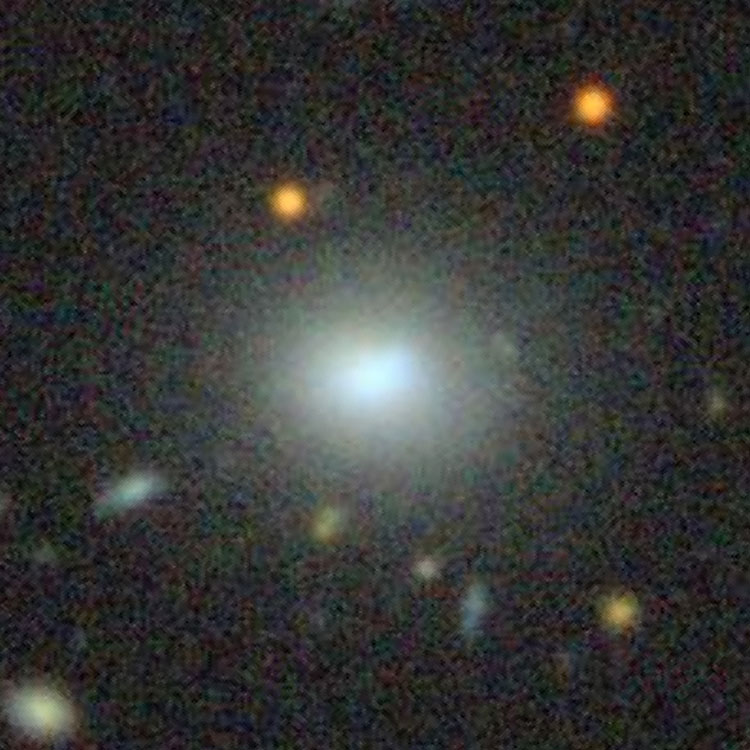
Above, a 1 arcmin wide DESI Legacy image of PGC 1416616; for a wider-field image see IC 567
IC 568
(= PGC 28368 = UGC 5285 = CGCG 092-057 = MCG +03-25-031)
Discovered (Jan 15, 1894) by Stephane Javelle
A magnitude 13.5 spiral galaxy (type SB(rs)b) in Leo (RA 09 51 08.3, Dec +15 43 49)
Historical Identification: Per Dreyer, IC 568 (Javelle #651, 1860 RA 09 43 30, NPD 73 37.0) is "faint, pretty large, extended preceding-following (east-west), gradually brighter middle." The position precesses to (2000) RA 09 51 09.7, Dec +15 43 51, only about 0.3 arcmin east of the center of the galaxy listed above and at the east end of the galaxy's central bar, the description fits and there is nothing else nearby, so the identification is certain.
Physical Information: Based on a recessional velocity relative to the Cosmic Background Radiation of about 9055 km/sec (and H0 = 70 km/sec/Mpc), a straightforward calculation indicates that IC 568 is about 420 million light-years away, in good agreement with redshift-independent distance estimates of 410 to 440 million light-years. However, for objects at such distances we should take into account the expansion of the Universe during the time it took their light to reach us. Doing that shows that the galaxy was a little less than 410 million light-years away at the time the light by which we see it was emitted, a little less than 415 million years ago (the difference between the two numbers being due to the expansion of the intervening space during the light-travel time). Given that and its apparent size of about 1.9 by 1.35 arcmin (from the images below), the galaxy and its arms span about 225 thousand light-years.

Above a 12 arcmin wide SDSS image centered on IC 568
Below, a 2.4 arcmin wide SDSS image of the galaxy

IC 569
(= PGC 28391 = CGCG 063-086 = MCG +02-25-048)
Discovered (Jan 27, 1892) by Stephane Javelle
A magnitude 14.1 lenticular galaxy (type S0?) in Leo (RA 09 51 28.1, Dec +10 55 12)
Historical Identification: Per Dreyer, IC 569 (Javelle #170, 1860 RA 09 43 58, NPD 78 25.0) is "very faint, diffuse, a very little brighter middle." The position precesses to (2000) RA 09 51 28.6, Dec +10 55 48, less than 0.6 arcmin north-northeast of the galaxy listed above, the description fits and there is nothing else nearby, so the identification is certain.
Physical Information: Based on a recessional velocity relative to the Cosmic Background Radiation of about 10740 km/sec (and H0 = 70 km/sec/Mpc), a straightforward calculation indicates that IC 569 is about 500 million light-years away, in good agreement with a single redshift-independent distance estimate of just under 500 million light-years. However, for objects at such distances we should take into account the expansion of the Universe during the time it took their light to reach us. Doing that shows that the galaxy was 480 million light-years away at the time the light by which we see it was emitted, almost 490 million years ago (the difference between the two numbers being due to the expansion of the intervening space during the light-travel time). Given that and its apparent size of about 0.45 by 0.35 arcmin (from the images below), the galaxy is about 60 to 65 thousand light-years across.

Above, a 12 arcmin wide SDSS image centered on IC 569
Below, a 1 arcmin wide SDSS image of the galaxy

IC 570
(= PGC 28407 = CGCG 092-060 = MCG +03-25-032)
Discovered (Jan 15, 1894) by Stephane Javelle
A magnitude 14.8 spiral galaxy (type S(rs)bc? pec) in Leo (RA 09 51 51.0, Dec +15 45 21)
Historical Identification: Per Dreyer, IC 570 (Javelle #652, 1860 RA 09 44 13, NPD 73 35.4) is "pretty faint, small, round, gradually brighter middle." The position precesses to (2000) RA 09 51 52.6, Dec +15 45 22, only 0.4 arcmin east of the center of the galaxy listed above, the description fits and there is nothing else nearby, so the identification is certain.
Physical Information: Based on a recessional velocity relative to the Cosmic Background Radiation of about 8755 km/sec (and H0 = 70 km/sec/Mpc), a straightforward calculation indicates that IC 570 is about 405 to 410 million light-years away. However, for objects at such distances we should take into account the expansion of the Universe during the time it took their light to reach us. Doing that shows that the galaxy was about 395 million light-years away at the time the light by which we see it was emitted, about 400 million years ago (the difference between the two numbers being due to the expansion of the intervening space during the light-travel time). Given that and its apparent size of about 0.65 by 0.5 arcmin (from the images below), the galaxy is about 75 thousand light-years across.

Above, a 12 arcmin wide SDSS image centered on IC 570
Below, a 1 arcmin wide SDSS image of the galaxy
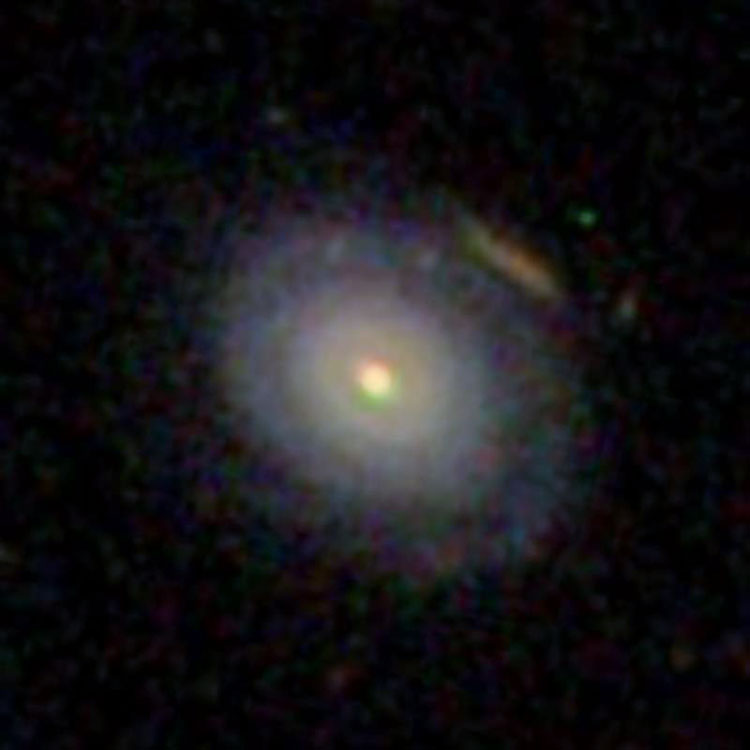
Below, a 1 arcmin wide DESI Legacy image of the galaxy

IC 571
(= PGC 28445 = CGCG 092-063 = MCG +03-25-035)
Discovered (Dec 16, 1893) by Stephane Javelle
A magnitude 15.1 spiral galaxy (type (R)SB(rs)ab?) in Leo (RA 09 52 31.6, Dec +15 46 32)
Historical Identification: Per Dreyer, IC 571 (Javelle #653, 1860 RA 09 44 53, NPD 73 34.2) is "pretty bright, small, round, nucleus = 12.5 magnitude star." The position precesses to (2000) RA 09 52 32.5, Dec +15 46 30, right on the galaxy listed above, the description fits and there is nothing else nearby except Javelle #654 ( IC 572), so the identification is certain.
Physical Information: Based on a recessional velocity relative to the Cosmic Background Radiation of 8830 km/sec (and H0 = 70 km/sec/Mpc), a straightforward calculation indicates that IC 571 is about 410 million light-years away. However, for objects at such distances we should take into account the expansion of the Universe during the time it took their light to reach us. Doing that shows that the galaxy was just over 395 million light-years away at the time the light by which we see it was emitted, almost 405 million years ago (the difference between the two numbers being due to the expansion of the intervening space during the light-travel time). Given that and its apparent size of about 0.95 by 0.8 arcmin (from the images below), the galaxy is almost 110 thousand light-years across.

Above, a 12 arcmin wide region centered on IC 571, also showing IC 572
Below, a 1.2 arcmin wide SDSS image of IC 571

Below, a 1.2 arcmin wide DESI Legacy image of IC 571

IC 572
(= PGC 28456 = CGCG 092-064 = MCG +03-25-036)
Discovered (Dec 16, 1893) by Stephane Javelle
A magnitude 14.8 spiral galaxy (type Sbc?) in Leo (RA 09 52 32.8, Dec +15 49 37)
Historical Identification: Per Dreyer, IC 572 (Javelle #654, 1860 RA 09 44 54, NPD 73 31.1) is "faint, small, round, gradually brighter middle." The position precesses to (2000) RA 09 52 33.6, Dec +15 49 36, on the eastern rim of the galaxy listed above, the description fits and there is nothing else nearby except Javelle #653 ( IC 571), so the identification is certain.
Physical Information: Based on a recessional velocity relative to the Cosmic Background Radiation of about 8800 km/sec (and H0 = 70 km/sec/Mpc), a straightforward calculation indicates that IC 572 is about 410 million light-years away. However, for objects at such distances we should take into account the expansion of the Universe during the time it took their light to reach us. Doing that shows that the galaxy was about 395 million light-years away at the time the light by which we see it was emitted, just over 400 million years ago (the difference between the two numbers being due to the expansion of the intervening space during the light-travel time). Given that and its apparent size of about 0.45 by 0.4 arcmin (from the images below), the galaxy is about 50 thousand light-years across.

Above, a 12 arcmin wide SDSS image centered on IC 572, also showing IC 571
Below, a 0.75 arcmin wide SDSS image of IC 572

IC 573 (= NGC 3058)
(= PGC 28513 (= MCG -02-25-026) + PGC 3442467)
Discovered (May 6, 1886) by Francis Leavenworth (and later listed as NGC 3058)
Discovered (Apr 20, 1892) by Stephane Javelle (and later listed as IC 573)
Also observed (Jul 1898 to Jun 1899) by Herbert Howe (while listed as NGC 3058)
A pair of galaxies in Hydra (RA 09 53 36.2, Dec -12 28 57)
PGC 28513 = A magnitude 13.5 spiral galaxy (type Sc? pec) at RA 09 53 36.2, Dec -12 28 56
PGC 3442467 = A magnitude 14.8 spiral galaxy (type Sa? pec) at RA 09 53 35.1, Dec -12 28 45
Historical Identification: Per Dreyer, IC 573 (Javelle #171, 1860 RA 09 46 45, NPD 101 49 .6) is "extremely faint, very small, round, very small (faint) star close." The position precesses to (2000) RA 09 53 33.6, Dec -12 29 04, barely west of a pair of galaxies which are also listed as NGC 3058. The description is reasonable and there is nothing else nearby, so the identification is certain, although there is some uncertainty about whether IC 573 is the pair of galaxies, or just one component of NGC 3058.
Identification Note: As noted above, the exact nature of IC 573 is a bit controversial, because "small star close" could be interpreted in several ways: (1) IC 573 could be only the brighter southern member of NGC 3058, and the small star might be the fainter northern member. (2) However, visual observations of galaxies are very different from modern photographs, and although the southern galaxy is larger and brighter in photographs, visually only its small nucleus would have been observable. And Javelle estimated the size of the object as about 10 arcsec, which fits the northern member, in which case it could be IC 573, and the "small star close" could be the partially hidden nucleus of the southern galaxy (though it is larger and brighter overall, its visual appearance would be nearly stellar). (3) Or the "small star close" could be the star about 1 arcmin to the west of the pair, in which case IC 573 would be identical to NGC 3058 (that is, both galaxies, seen as a single object). If Javelle had stated how near the "small star" was, and given its direction, the correct answer would be certain; but since he didn't, the least controversial choice is to assume that IC 573 is identical to NGC 3058, as shown in the title of this entry. (Gottlieb, Corwin and Steinicke all list IC 573 as equal to or probably equal to NGC 3058, despite the former pair expressing some uncertainty about that choice.)
Cause of the Duplicate Listing: The cause of the duplicate listing is that Leavenworth's right ascension was 2 minutes of time too large (to the east of the correct position. However, he noted that it was double or bi-nuclear, which makes the identification of the pair listed above as NGC 3058 certain. As shown by the list of observers, Howe discovered Leavenworth's error, but Javelle rediscovered the pair before Howe's correction was published, so Dreyer was not aware of it when he published the Index Catalog (though he did include Howe's correction in the second Index Catalog).
Discovery Note: Howe wrote that the "following" (eastern) nucleus is the brighter one; so he saw both members of the pair. And as stated above, Leavenworth also saw both nuclei. So only the nature of Javelle's observation is unclear.
Note About Designations: Since Leavenworth's position was poor, the MCG lists the object as IC 573; but most other references identify it as NGC 3058.
Physical Information: Given the duplicate entry, see NGC 3058 for anything else.
IC 574
(= PGC 28569 = MCG -01-25-056)
Discovered (Mar 9, 1893) by Stephane Javelle
A magnitude 13.7 lenticular galaxy (type E/SA0?) in Sextans (RA 09 54 27.0, Dec -06 57 12)
Historical Identification: Per Dreyer, IC 574 (Javelle #655, 1860 RA 09 47 28, NPD 96 17.8) is "pretty bright, small, round, much brighter middle, 12th-magnitude star to south." The position precesses to (2000) RA 09 54 26.7, Dec -06 57 21, within the southwestern outline of the galaxy listed above, the description fits (though the star to the southeast is actually magnitude 14.6) and there is nothing else nearby, so the identification is certain.
Physical Information: Based on a recessional velocity relative to the Cosmic Microwave Background radiation of about 6395 km/sec (and H0 = 70 km/sec/Mpc), IC 574 is about 295 to 300 million light-years away. Given that and its apparent size of about 1.05 by 1.0 arcmin (from the images below), the galaxy is about 90 thousand light-years across.

Above, a 12 arcmin wide PanSTARRS image centered on IC 574, also showing IC 575
Below, a 1.5 arcmin wide PanSTARRS image of IC 574 (Post-processing by Courtney Seligman)

IC 575 (= Arp 292)
(= PGC 28575 = MCG -01-25-058)
Discovered (Mar 9, 1893) by Stephane Javelle
A magnitude 13.2 spiral galaxy (type Sa? pec) in Sextans (RA 09 54 32.9, Dec -06 51 27)
Historical Identification: Per Dreyer, IC 575 (Javelle #656, 1860 RA 09 47 35, NPD 96 12.0) is "faint, small, round, gradually brighter middle." The position precesses to (2000) RA 09 54 33.9, Dec -06 51 34, on the southeastern rim of the nucleus of the galaxy listed above, the description fits and there is nothing else nearby, so the identification is certain.
Physical Information: Based on a recessional velocity relative to the Cosmic Microwave Background Radiation of about 6325 km/sec (and H0 = 70 km/sec/Mpc), IC 575 is about 295 million light-years away. Given that and its apparent size of about 1.45 by 1.05 arcmin (from the images below, counting its extended halo), it is about 125 thousand light-years across.
Classification Note: Gottlieb states that "this unusual system has a dust lane along the major axis and a polar-ring like disc." He also notes that it is listed as a polar-ring "candidate" in a paper by Whitmore et al (1990 A.J.). That, its edge-on orientation, and the Arp Atlas description are the basis for the "type" shown above. Corwin points out the strong resemblance to Saturn when seen with rings edge-on, and adds "the corona is somewhat distorted with faint extensions to the north and south," which is mostly similar to the description noted in the Arp Atlas (see the following paragraph).
Usage By The Arp Atlas: IC 575 is used by the Arp Atlas of Peculiar Galaxies as an example of a galaxy with the appearance of wind effects, with the note "Edge-on Sa, some indication of absorption streaming off edges." Given the possibility that PGC 1028040 is a physical companion, a past or present gravitational interaction with that galaxy may be responsible for IC 575's appearance.

Above, a 12 arcmin wide PanSTARRS image centered on IC 575, also showing IC 574, PGC 28567, PGC 28586 and PGC 1028040
Below, a 1.2 arcmin wide PanSTARRS image of the galaxy
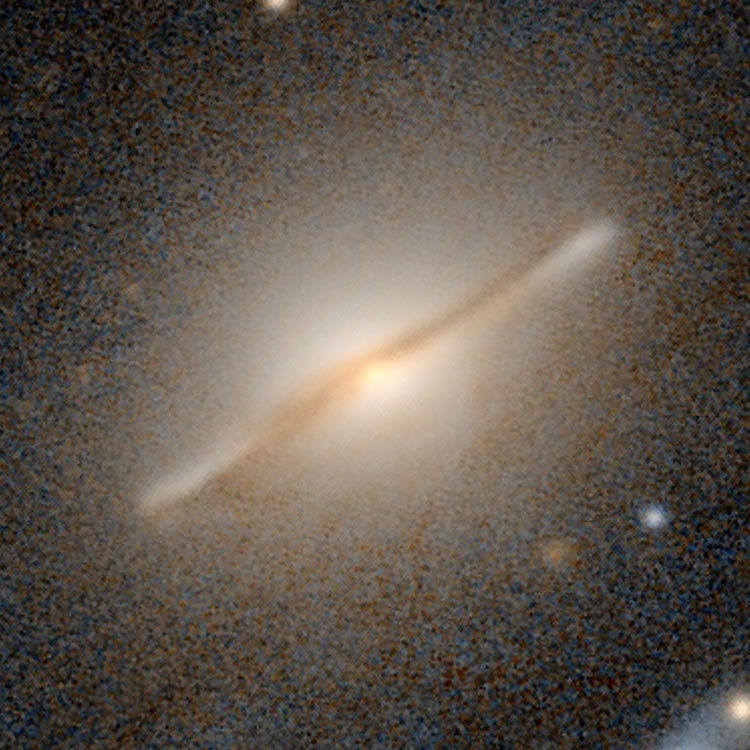
Below, a 1.75 arcmin wide DECaLS image of the galaxy and PGC 28567 (Image Credit DECam Legacy Survey DR 5)
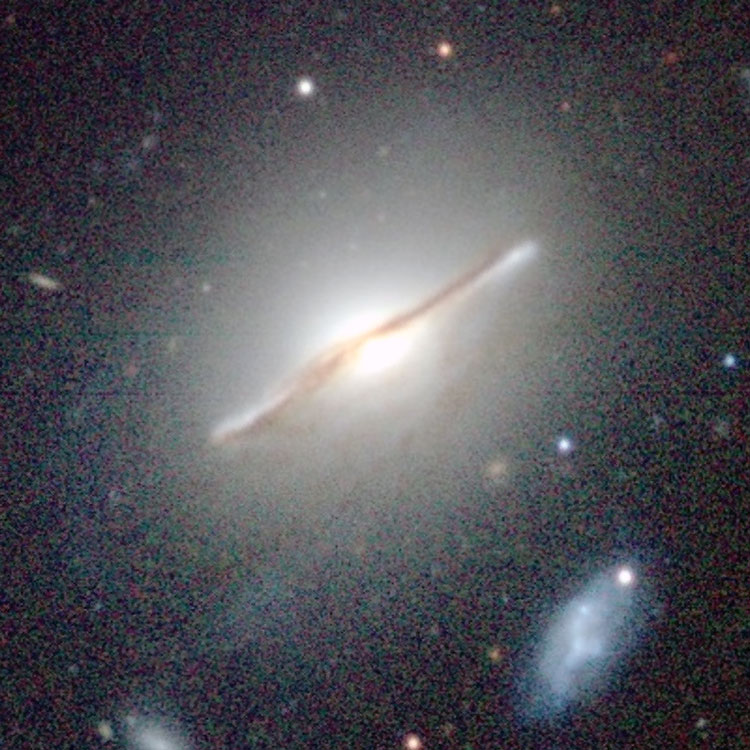
Below, part of an image from Arp's original publication (Image Credit Arp Atlas of Peculiar Galaxies)

PGC 28567
(= MCG-01-25-057)
Not an IC object but listed here as an apparent companion of IC 575
A magnitude 16.0(?) irregular galaxy (type IBm?) in Sextans (RA 09 54 31.0, Dec -06 52 09)
Physical Information: There appears to be no measurement of this galaxy's recessional velocity, so whether it is in any way associated with IC 575 is unknown. It could be a physical companion, a foreground galaxy, or a background galaxy. The only certain thing is its apparent size of about 0.38 by 0.18 arcmin (from the image below).
Classification Note: The image of PGC 28567 (below) shows no obvious structure, suggesting that it is an irregular galaxy, but the arrangement of its brighter star-forming regions is roughly along a line, hence (per Corwin) the tentative type in the description line for this entry.
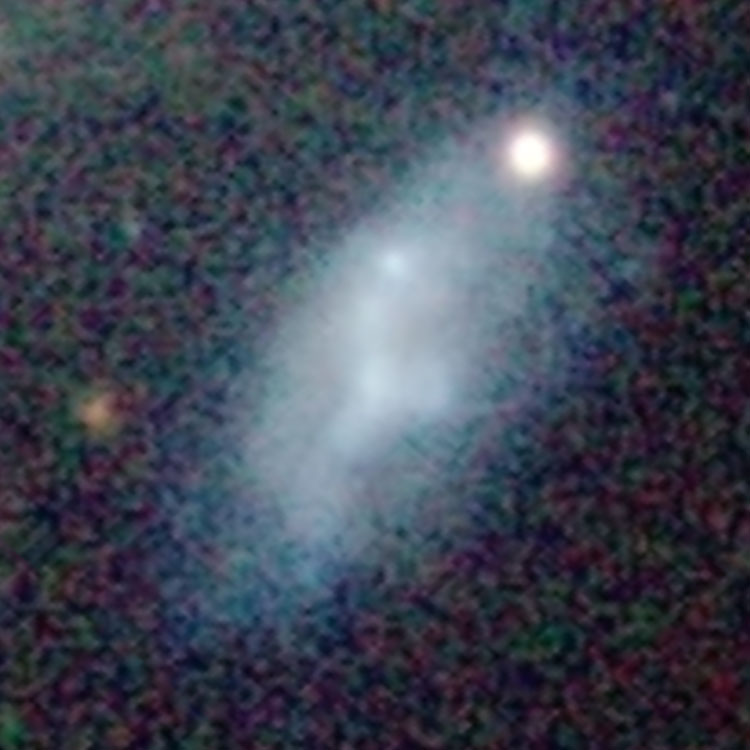
Above, a 0.5 arcmin wide DECaLS image of PGC 28567 (Image Credit DECam Legacy Survey DR 5); for a wider-field image, see IC 575
PGC 28586
(= MCG -01-25-059)
Not an IC object but listed here as an apparent companion of IC 575
A magnitude 14.5(?) spiral galaxy (type S(rs?)dm?) in Sextans (RA 09 54 47.6, Dec -06 47 35)
Physical Information: Based on a recessional velocity relative to the Cosmic Background Radiation of 6930 km/sec (and H0 = 70 km/sec/Mpc), a straightforward calculation indicates that PGC 28586 is about 320 to 325 million light-years away. However, for objects at such distances we should take into account the expansion of the Universe during the time it took their light to reach us. Doing that shows that the galaxy was about 315 million light-years away at the time the light by which we see it was emitted, not quite 320 million years ago (the difference between the two numbers being due to the expansion of the intervening space during the light-travel time). Given that and its apparent size of about 0.98 by 0.49 arcmin (from the image below), the galaxy is about 90 thousand light-years across. Although an apparent companion of IC 575, the difference in the recessional velocities of the two galaxies is much larger than typical "peculiar velocities" (random motions relative to neighboring galaxies), so PGC 28586 is almost certainly a background object, and not an actual companion of IC 575.
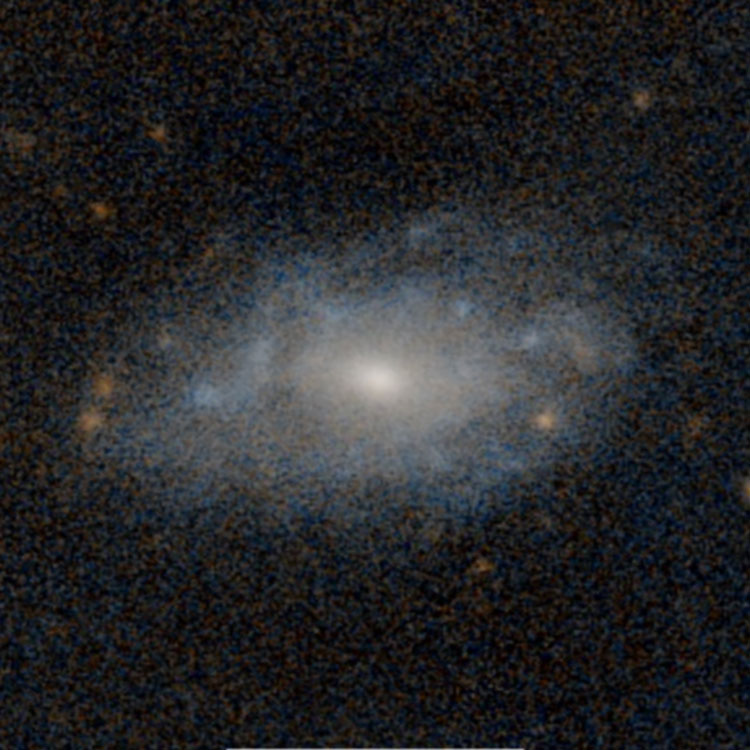
Above, a 1.2 arcmin wide PanSTARRS image of PGC 28586; for a wider-field view, see IC 575
PGC 1028040
Not an IC object but listed here as a possible physical companion of IC 575
A magnitude 16.0(?) elliptical galaxy (type E4?) in Sextans (RA 09 54 33.2, Dec -06 50 14)
Physical Information: Based on a recessional velocity relative to the Cosmic Microwave Background Radiation of about 5855 km/sec (and H0 = 70 km/sec/Mpc), PGC 1028040 is about 270 to 275 million light-years away. This may mean that PGC 1028040 is a slightly foreground object and not physically interacting with IC 575, but the difference in their recessional velocities is well within the range of typical "peculiar velocities" (random motions of galaxies relative to their neighbors), so there is an equally good chance that PGC 1028040 is a physical companion of IC 575, and if so, it may be responsible for the peculiar appearance of its larger "companion". Based on its apparent size of about 0.35 by 0.20 arcmin (from the image below) and a distance similar to that of IC 575, PGC 1028040 is about 30 thousand light-years across.

Above, a 0.75 arcmin wide PanSTARRS image of PGC 1028040; for a wider-field view, see IC 575
IC 576
(= PGC 28603 = CGCG 063-104)
Discovered (Jan 27, 1892) by Stephane Javelle
A magnitude 14.3 spiral galaxy (type S(rs)ab?) in Leo (RA 09 55 07.01, Dec +11 02 22)
Historical Identification: Per Dreyer, IC 576 (Javelle #172, 1860 RA 09 47 36, NPD 78 18.1) is "very faint, very small, round." The position precesses to (2000) RA 09 55 06.3, Dec +11 02 18, only 0.2 arcmin west-southwest of the galaxy listed above and within its halo, the description fits and there is nothing else nearby, so the identification is certain.
Physical Information: Based on a recessional velocity relative to the Cosmic Background Radiation of 12395 km/sec (and H0 = 70 km/sec/Mpc), a straightforward calculation indicates that IC 576 is about 575 to 580 million light-years away. However, for objects at such distances we should take into account the expansion of the Universe during the time it took their light to reach us. Doing that shows that the galaxy was about 550 million light-years away at the time the light by which we see it was emitted, about 560 million years ago (the difference between the two numbers being due to the expansion of the intervening space during the light-travel time). Given that and its apparent size of about 0.65 by 0.6 arcmin (from the images below), the galaxy is about 80 thousand light-years across.
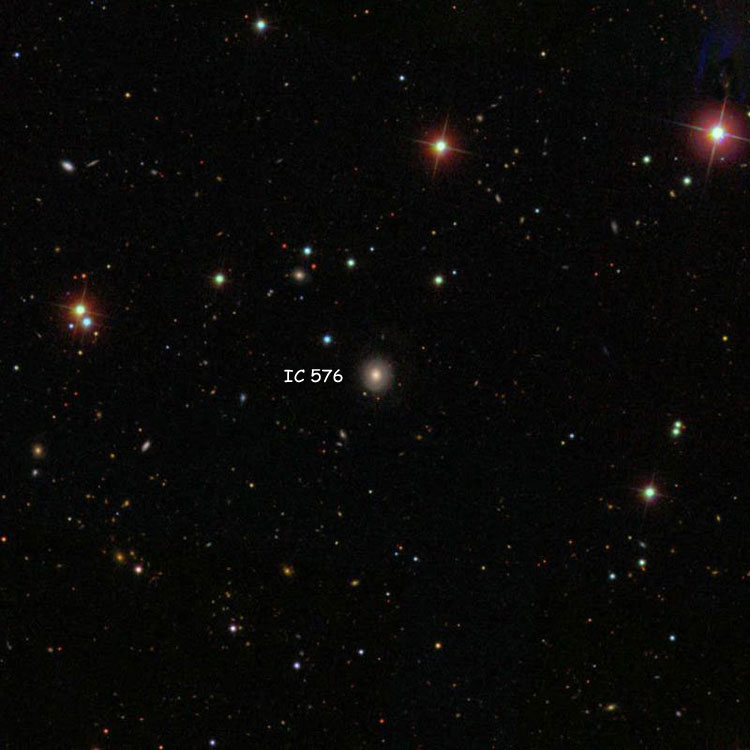
Above, a 12 arcmin wide SDSS image centered on IC 576
Below, a 0.75 arcmin wide SDSS image of the galaxy (Post-processing by Courtney Seligman)

Below, a 0.75 arcmin wide DESI Legacy image of the galaxy

IC 577
(= PGC 28662 = UGC 5334 = CGCG 064-002 = MCG +02-26-001)
Discovered (Mar 22, 1892) by Stephane Javelle
A magnitude 14.0 spiral galaxy (type Sbc?) in Leo (RA 09 56 04.0, Dec +10 29 56)
Historical Identification: Per Dreyer, IC 577 (Javelle #173, 1860 RA 09 48 34, NPD 78 50.1) is "faint, very small, irregular figure, faint star to north." The position precesses to (2000) RA 09 56 03.2, Dec +10 30 12, less than 0.3 arcmin northwest of the center of the galaxy listed above, the description fits (though the "faint" (magnitude 14) star is to the south, the inverted images seen with telescopes makes that sort of error common) and the only other object in the region is Javelle #174 ( IC 578), so the identification is certain.
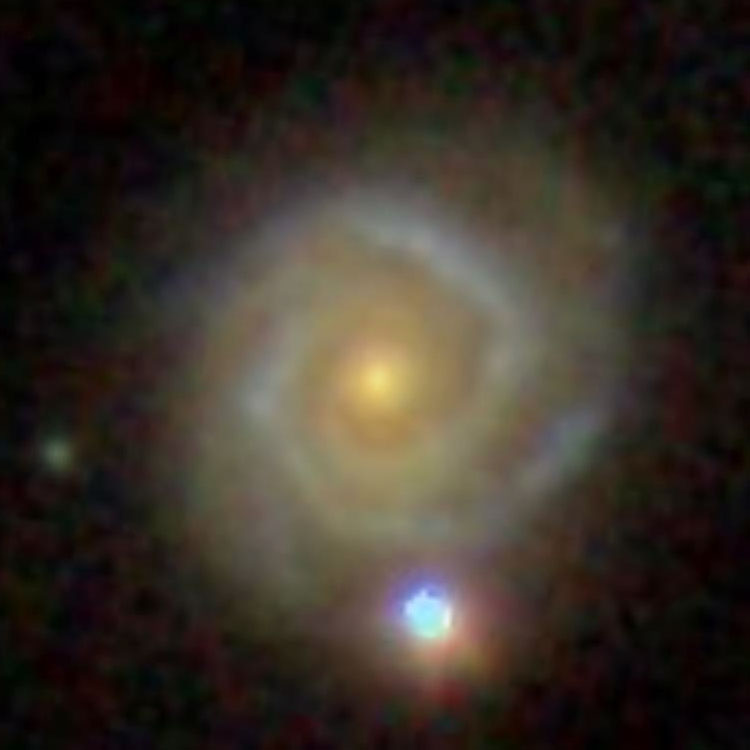
Physical Information: Since IC 577 and 578 are not only in nearly the same direction but also have similar recessional velocities, they are almost certainly a gravitationally bound physical pair. In such a case, the best way to estimate their distance is to use an average of the data available for both of them. In the case of IC 577, all we know is that the recessional velocity relative to the Cosmic Microwave Background radiation is about 9335 km/sec, while in the case of IC 578, we have a recessional velocity value of 9265 km/sec, and a single redshift-independent distance estimate of about 485 million light-years. Using the average recessional velocity for the two galaxies of about 9300 km/sec, a straightforward calculation (using H0 = 70 km/sec/Mpc) yields a distance of about 435 million light-years, smaller than but in reasonable agreement with the redshift-independent distance estimate. However, for objects at such distances the calculations for the recessional velocity should take into account the expansion of the Universe during the time it took their light to reach us. Doing that shows that the pair was actually about 415 to 420 million light-years away at the time the light by which we see them was emitted, about 425 million years ago (the difference between the two numbers being due to the expansion of the intervening space during the light-travel time). Given that and its apparent size of about 0.5 by 0.4 arcmin (from the images below), IC 577 is about 60 thousand light-years across.

Above, a 12 arcmin wide SDSS image centered on IC 577, also showing IC 578
Below, a 0.75 arcmin wide SDSS image of IC 577
IC 578
(= PGC 28674 = UGC 5337 = CGCG 064-004 = MCG +02-26-002)
Discovered (Mar 22, 1892) by Stephane Javelle
A magnitude 13.9 spiral galaxy (type SBb?) in Leo (RA 09 56 16.1, Dec +10 29 10)
Historical Identification: Per Dreyer, IC 578 (Javelle #174, 1860 RA 09 48 46, NPD 78 50.7) is "faint, very small, round, a little brighter middle." The position precesses to (2000) RA 09 56 15.2, Dec +10 29 35, about 0.45 arcmin north-northwest of the center of the galaxy listed above, the description is a reasonable fit and the only other object in the region is Javelle #173 ( IC 577), so the identification is certain.
Physical Information: As noted in the entry for IC 577, it and IC 578 are almost certainly a physical pair, with a probable distance of 415 to 420 million light-years at the time the light by which we see them was emitted, about 425 million years ago (see IC 577 for the gory destails). Given that and its apparent size of about 1.05 by 0.4 arcmin (from the images below), IC 578 is about 125 to 130 thousand light-years across.

Above, a 12 arcmin wide SDSS image centered on IC 578, also showing IC 577
Below, a 1.25 arcmin wide SDSS image of IC 578

IC 579
Recorded (Mar 25, 1889) by Lewis Swift
A lost or nonexistent object in Hydra (RA 09 56 34.1, Dec -14 09 00)
Historical Identification: Per Dreyer, IC 579 (Swift list VIII (#50), 1860 RA 09 49 48, NPD 103 29.2) is "pretty faint, pretty small, round." The position precesses to (2000) RA 09 56 34.1, Dec -14 09 00 (whence the position above), but there is nothing there or anywhere near there. As a result some references list the object as lost or nonexistent; however, others identify PGC 28702 as IC 579, so although there is no good reason to believe that that really is the IC object, it is discussed in the following entry.
The Meaning of Lost or Nonexistent: As shown in the image below, there are several stars of magnitude 13 or 14 within a few arcminutes of Swift's position that would fit Swift's description, and it is possible that one of them might be what he observed; but there also numerous cases of would-be discoverers "seeing" things that don't exist at all, in an effort to go beyond the limits of their instruments and their eyes. If Swift did see something like one of the aforementioned stars, it would be "lost", since although it exists there is no way to correctly identify it; while if Swift thought he saw something that wasn't really there, it would be "nonexistent". And since Dreyer's additions to earlier catalogs were primarily based on reports of objects not previously observed according to their reported positions, rather than on objects verified by additional observations, there is a substantial minority of NGC/IC objects, particularly supposedly very faint ones, that are "lost or nonexistent".

Above, a 12 arcmin wide DSS image centered on the position of the lost or nonexistent IC 579
PGC 28702 (almost certainly not = IC 579)
(= MCG -02-26-005)
Not an IC object, but listed here since often misidentified as IC 579
A magnitude 13.9 spiral galaxy (type SB(rs)ab?) in Hydra (RA 09 56 39.4, Dec -13 46 31)
Historical (Mis)Identification: There is no good reason to believe that PGC 28702 is IC 579, but it is listed as such in a number of databases (albeit usually with a warning that the identification is uncertain). The identification of PGC 28702 as IC 579 is based on the galaxy having roughly the same right ascension as Swift's measurement, and being the brightest object anywhere near his position. However, in almost all cases Swift's declinations were far more accurate than his right ascensions, and when his declinations were wrong, they were usually off by a simple multiple of one or ten arcminutes, or whole or half degrees (errors that would be easy to make by misreading the setting circles on his telescope). The 23 arcmin error in declination required to make PGC 28702 equal to IC 579 would be unique, and although a stretch of the imagination might make it conceivable that the identification is correct, it is almost certainly wrong.
A Warning About the (Mis)identification: Although all reputable sources of the suggestion that PGC 28702 is IC 579 make it clear that the identification is very uncertain, far more online sites neglect to mention that. Hence the need for this entry as a warning about the almost certain misidentification.
Physical Information: Based on a recessional velocity relative to the Cosmic Background Radiation of 9850 km/sec (and H0 = 70 km/sec/Mpc), a straightforward calculation indicates that PGC 28702 is about 455 to 460 million light-years away. However, for objects at such distances we should take into account the expansion of the Universe during the time it took their light to reach us. Doing that shows that the galaxy was about 440 million light-years away at the time the light by which we see it was emitted, about 450 million years ago (the difference between the two numbers being due to the expansion of the intervening space during the light-travel time). Given that and its apparent size of about 1.05 by 0.37 arcmin (from the images below), the galaxy is about 135 thousand light-years across.
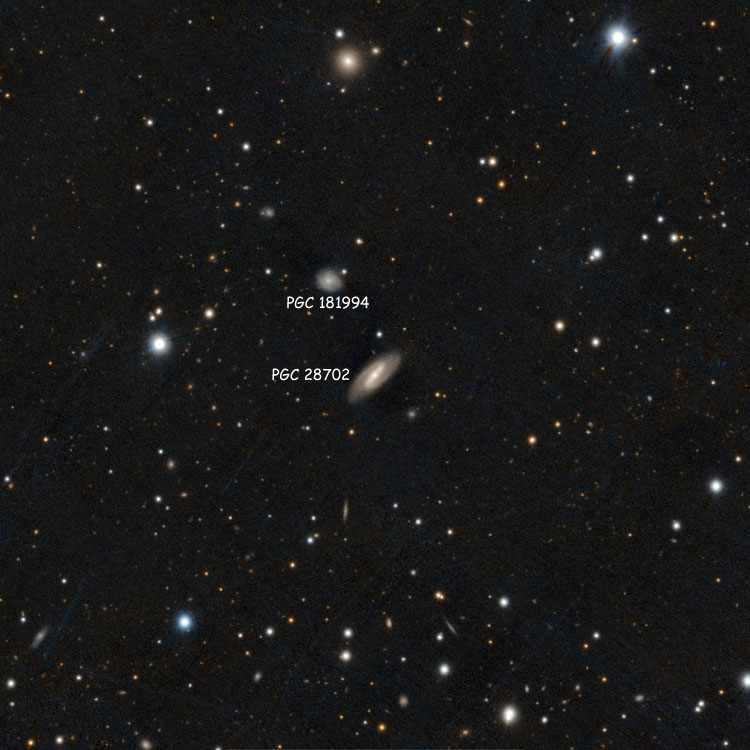
Above, a 12 arcmin wide PanSTARRS image centered on PGC 28702 (often misidentified as IC 579), also showing PGC 181994
Below, a 1 arcmin wide PanSTARRS image of the galaxy

PGC 181994
Not an IC object but listed here as a possible companion of PGC 28702
A magnitude (15.5)? spiral galaxy (type SA(s)ab?) in Hydra (RA 09 56 42.5, Dec -13 44 59)
Justification for This Entry: If PGC 28702 was an IC object, it would be appropriate for any apparent companion to be listed following its entry. As discussed in its entry, PGC 28702 is almost certainly not an IC object, but since it is often misidentified as one, it seems appropriate to apply the same rule about apparent companions as if it were an IC object.
Physical Information: Based on a recessional velocity relative to the Cosmic Background Radiation of 10155 km/sec (and H0 = 70 km/sec/Mpc), a straightforward calculation indicates that PGC 181994 is about 470 to 475 million light-years away. However, for objects at such distances we should take into account the expansion of the Universe during the time it took their light to reach us. Doing that shows that the galaxy was about 455 million light-years away at the time the light by which we see it was emitted, about 460 to 465 million years ago (the difference between the two numbers being due to the expansion of the intervening space during the light-travel time). Given that and its apparent size of about 0.45 by 0.35 arcmin (from the image below), the galaxy is about 60 thousand light-years across.
"Companion" Status: Although the calculated distance for PGC 181994 is more than that of PGC 28702, the difference in their recessional velocities is not much larger than typical ranges for "peculiar velocities" (random motions of galaxies relative to their neighbors), so although PGC 181994 may merely be a background optical double of PGC 28702, it is almost as likely that they are a gravitationally bound pair; hence my listing this as a "possible" companion of its apparent neighbor.

Above, a 0.75 arcmin wide PanSTARRS image of PGC 181994; for a wider-field view see PGC 28702
IC 580 (= NGC 3069)
(= PGC 28788 = CGCG 064-010 = MCG +02-26-005)
Discovered (Mar 15, 1877) by John Dreyer (and later listed as NGC 3069)
Discovered (Mar 22, 1892) by Stephane Javelle (and later listed as IC 580)
A magnitude 14.2 spiral galaxy (type Sa?) in Leo (RA 09 57 56.7, Dec +10 25 57)
Historical Identification: Per Dreyer, IC 580 (Javelle #175, 1860 RA 09 50 28, NPD 78 53.7) is "pretty faint, very small, irregular figure." The position precesses to (2000) RA 09 57 56.8, Dec +10 26 24, on the northern edge of the galaxy listed above, and the description fits, so the identification is certain.
Duplicate Entry Notes: Per Corwin, the duplicate listing was due to an error in Dreyer's position for NGC 3069, some uncertainty on Dreyer's part as to exactly what he had seen (due to scattered clouds on the night of his discovery), and some confusion on Javelle's part as to which nebulae in the region were already known, and which were 'novae'. If Dreyer's position had been better, he would probably have realized that Javelle's #175 was a duplication of his own discovery, but he did not, whence the duplicate listing. Corwin adds that Javelle must have made some mistake related to NGC 3069 (presumably caused by Dreyer's error), since in a footnote to his #176 [= IC 584], Javelle states that that nebula is "Distinct from NGC 3069 and 3070," which implies that Javelle mistook some other pair of nebulae as 3069 and 3070; for if he had correctly identified 3069, he would have realized that his #175 was the same object.
Physical Information: Given the duplicate entry, see NGC 3069 for anything else.
IC 581
(= PGC 28800 = UGC 5352 = CGCG 093-010 = MCG +03-26-008)
Discovered (Dec 16, 1893) by Stephane Javelle
A magnitude 14.1 spiral galaxy (type (R')SA(rs)b? pec) in Leo (RA 09 58 11.6, Dec +15 56 49)
(and probably the chief galaxy in a quartet, as noted below)
Historical Identification: Per Dreyer, IC 581 (Javelle #657, 1860 RA 09 50 34, NPD 73 23.0) is "pretty bright, small, diffuse, nucleus = 13th magnitude involved." (Javelle's description was slightly different from Dreyer's, and makes more sense: "Quite bright, not large, ill-defined, envelops a core of 13th magnitude.") The position precesses to (2000) RA 09 58 12.7, Dec +15 57 05, about 0.35 arcmin northeast of the center of the galaxy listed above, the description fits and there is nothing comparable nearby, so the identification is certain.
A Possible Quartet?: There are at least three smaller galaxies in the vicinity, as shown in the image below and the following entries, which may be part of a physically bound quartet with IC 581. All four galaxies have recessional velocities within about 200 km/sec of their average recessional velocity, and it is not unusual for "peculiar velocities" (random motions of galaxies relative to their neighbors) to be even larger than that, so the following discussion assumes that they are a gravitationally bound group, with IC 581 as the largest and brightest member of the group.
Physical Information: Presuming that the four galaxies are a group, the best way to estimate their distance is to use the average of their recessional velocities. Their individual recessional velocities relative to the Cosmic Microwave Background radiation are about 8210 km/sec (for PGC 1497460), 8310 km/sec (for IC 581), 8495 km/sec (for PGC 1497285), and 8525 km/sec (for "PGC 5075148"), so their average recessional velocity is about 8385 km/sec. A straightforward calculation of their distance based on that average (8385 km/sec) and H0 = 70 km/sec/Mpc yields a distance of about 390 million light-years, in fair agreement with the only redshift-independent distance estimate for any of the galaxies (namely, PGC 1497460) b. However, for objects at such distances we should take into account the expansion of the Universe during the time it took their light to reach us. Doing that implies that the group was about 375 to 380 million light-years away at the time the light by which we see it was emitted, about 380 to 385 million years ago (the difference between the two values being due to the expansion of the intervening space during the light-travel time). Given that and its apparent size of about 1.05 by 0.8 arcmin (from the images below), IC 581 is about 115 thousand light-years across.
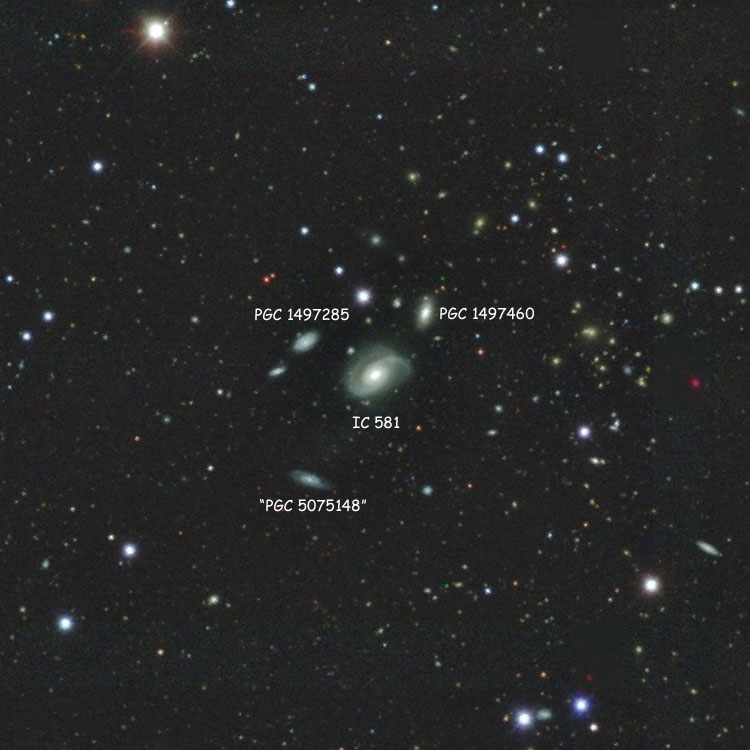
Above, a 12 arcmin wide DECaLS image centered on IC 581
Below, a 1.5 arcmin wide DECaLS image of IC 581
PGC 1497285
Not an IC object but listed here as a probable companion of IC581
A magnitude 16.0(?) spiral galaxy (type (R?)SABbc?) in Leo (RA 09 58 16.2, +15 57 20)
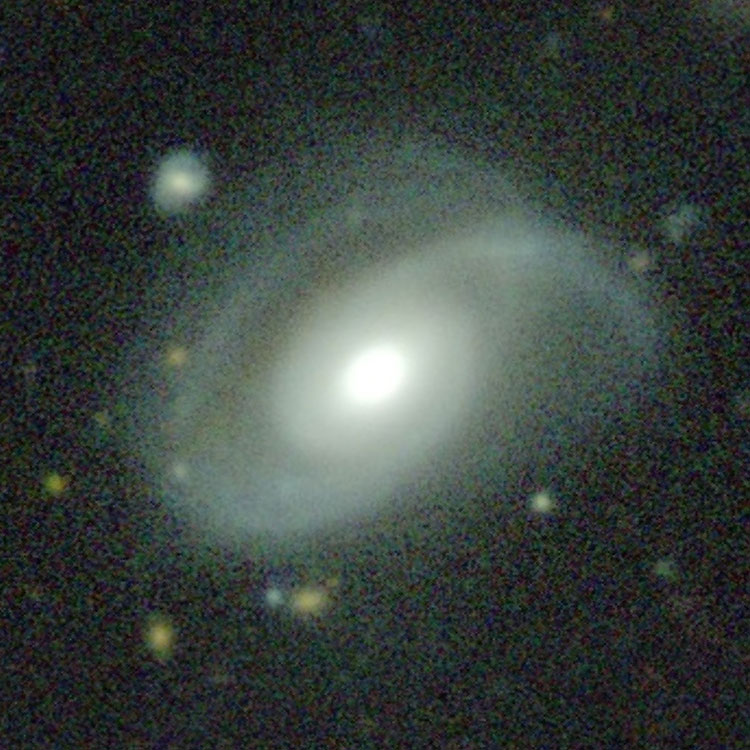
Physical Information: As discussed in the entry for IC 581, PGC 1497285 is probably part of a quartet about 375 to 380 million light-years away. Given that and its apparent size of about 0.45 by 0.25 arcmin (based on the image below), it is about 50 thousand light-years across.

Above, a 0.5 arcmin wide DECaLS image of PGC 1497285, a possible companion of IC581, which see for a wider-field view
PGC 1497460
Not an IC object but listed here as a probable companion of IC581
A magnitude 15.5(?) lenticular galaxy (type S0?) in Leo (RA 09 58 08.2, +15 57 49)
Physical Information: As discussed in the entry for IC 581, PGC 1497460 is probably part of a quartet about 375 to 380 million light-years away. Given that and its apparent size of about 0.28 by 0.14 arcmin (based on the image below), it is about 30 thousand light-years across.

Above, a 0.5 arcmin wide SDSS image of PGC 1497460, a possible companion of IC581, which see for a wider-field image
"PGC 5075148"
Not an IC object but listed here as a probable companion of IC581
A magnitude 17.0(?) spiral galaxy (type SABb?) in Leo (RA 09 58 15.9, Dec +15 55 09)
PGC Designation Note: Although HyperLEDA assigned a PGC designation to this galaxy, a search of the database for that designation returns no result, hence its being placed in quotes. To find it in the LEDA database, use SDSSJ095815.94+155508.4
Physical Information: As discussed in the entry for IC 581, "PGC 5075148" is probably part of a quartet about 375 to 380 million light-years away. Given that and its apparent size of about 0.6 by 0.2 arcmin (based on the image below), it is about 45 to 50 thousand light-years across.

Above, a 0.75 arcmin wide DECaLS image of "PGC 5075148", a possible companion of IC581, which see for a wider-field view
IC 582
(= PGC 28838 = UGC 5362 = CGCG 093-016 = MCG +03-26-011)
Discovered (Dec 16, 1893) by Stephane Javelle
A magnitude 14.0 spiral galaxy (type SAB(rs)c?) in Leo (RA 09 59 00.2, Dec +17 49 02)
Historical Identification: Per Dreyer, IC 582 (Javelle #658, 1860 09 51 18, NPD 71 31.6) is "pretty bright, small, irregular figure, gradually brighter middle." The position precesses to (2000) RA 09 59 00.0, Dec +17 48 24, about 0.65 arcmin nearly due south of the galaxy listed above, the description fits and the only comparable object nearby is Javelle #659 ( IC 583), discovered on the same night, so the identification is certain.
Physical Information: Based on a recessional velocity relative to the Cosmic Background Radiation of 7945 km/sec (and H0 = 70 km/sec/Mpc), a straightforward calculation indicates that IC 582 is about 370 million light-years away, in reasonable agreement with redshift-independent distance estimates of about 265 to 405 million light-years. However, for objects at such distances we should take into account the expansion of the Universe during the time it took their light to reach us. Doing that shows that the galaxy was about 355 to 360 million light-years away at the time the light by which we see it was emitted, about 360 to 365 million years ago (the difference between the two numbers being due to the expansion of the intervening space during the light-travel time). Given that and its apparent size of about 0.85 by 0.8 arcmin (from the images below), the galaxy is about 85 to 90 thousand light-years across.
Relationship With IC 583: There is a good chance that IC 582 and 583 are not separated by the 10 to 15 million light-years based on their recessional velocities, as the difference in those values is not much larger than typical "peculiar velocities" (random motions of galaxies relative to their neighbors), so they may be a gravitationally bound pair separated by considerably less than 10 million light-years, even though I have not treated them as such in the calculation of their distances. However, the lack of any obvious interaction between them suggests that even if they are a pair, they have either never interacted with each other, or if they have, it was so many billions of years ago that they have had time to settle into normal-looking galaxies.
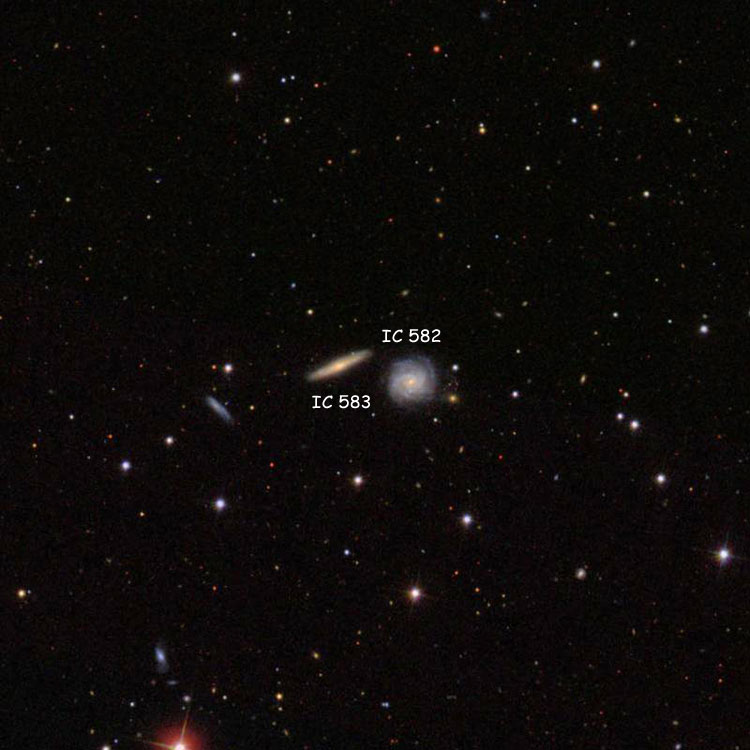
Above, a 12 arcmin wide SDSS image centered on IC 582 and 583
Below, a 2.4 arcmin wide SDSS image of IC 582 and 583
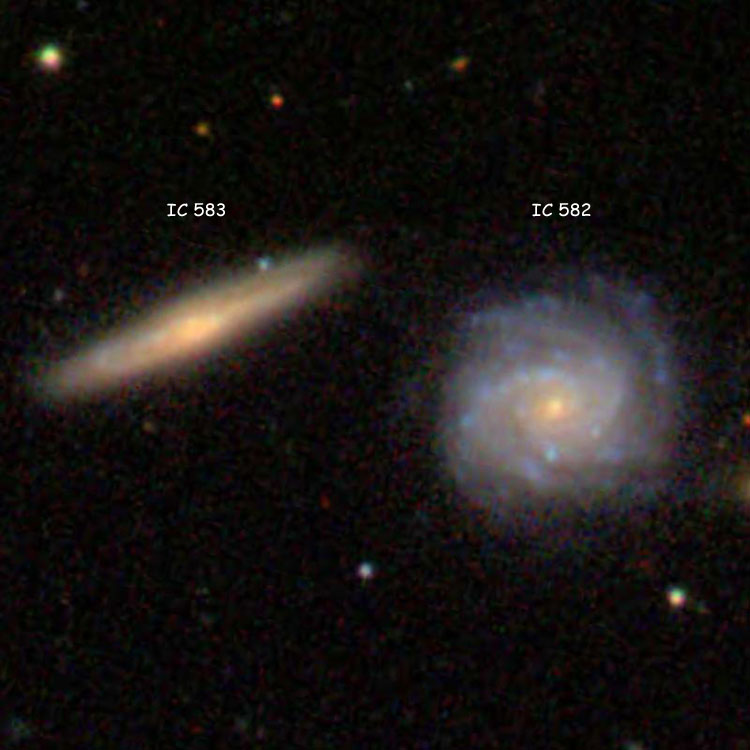
Below, a 1 arcmin wide SDSS image of IC 582

IC 583
(= PGC 28844 = UGC 5363 = CGCG 093-017 = MCG +03-26-012)
Discovered (Dec 16, 1893) by Stephane Javelle
A magnitude 14.5 spiral galaxy (type Sbc?) in Leo (RA 09 59 05.1, Dec +17 49 18)
Historical Identification: Per Dreyer, IC 583 (Javelle #659, 1860 RA 09 51 23, NPD 71 31.3) is "faint, very small, gradually brighter middle." The position precesses to (2000) RA 09 59 05.0, Dec +17 48 41, just under 0.65 arcmin due south of the galaxy listed above, the description is reasonable and the only comparable object nearby is Javelle #658 ( IC 582), discovered on the same night, so the identification is certain.
Physical Information: Based on a recessional velocity relative to the Cosmic Background Radiation of 8230 km/sec (and H0 = 70 km/sec/Mpc), a straightforward calculation indicates that IC 583 is about 380 to 385 million light-years away. However, for objects at such distances we should take into account the expansion of the Universe during the time it took their light to reach us. Doing that shows that the galaxy was about 370 million light-years away at the time the light by which we see it was emitted, about 375 million years ago (the difference between the two numbers being due to the expansion of the intervening space during the light-travel time). Given that and its apparent size of about 1.0 by 0.2 arcmin (from the images below), the galaxy is about 105 thousand light-years across.
Relationship With IC 582: There is a good chance that IC 582 and 583 are not separated by the 10 to 15 million light-years based on their recessional velocities, as the difference in those values is not much larger than typical "peculiar velocities" (random motions of galaxies relative to their neighbors), so they may be a gravitationally bound pair separated by considerably less than 10 million light-years, even though I have not treated them as such in the calculation of their distances. However, the lack of any obvious interaction between them suggests that even if they are a pair, they have either never interacted with each other, or if they have, it was so many billions of years ago that they have had time to settle into normal-looking galaxies.
Above, a 12 arcmin wide SDSS image centered on IC 582 and 583
Below, a 2.4 arcmin wide SDSS image of IC 582 and 583
Below, a 1 arcmin wide SDSS image of IC 583

IC 584
(= PGC 28839 = CGCG 064-015 = MCG +02-26-010)
Discovered (Jan 28, 1892) by Stephane Javelle
A magnitude 14.6 spiral galaxy (type Sc?) in Leo (RA 09 59 05.1, Dec +10 21 40)
Historical Identification: Per Dreyer, IC 584 (Javelle #176, 1860 RA 09 51 37, NPD 78 58.0) is "extremely faint, small, round, diffuse, II 59 preceding (to the west)," (WH) II 59 being NGC 3070. The position precesses to (2000) RA 09 59 05.6, Dec +10 21 59, about 0.3 arcmin north-northeast of the galaxy listed above, the description fits (including the position of NGC 3070) and there is nothing else nearby, so the identification is certain.
Physical Information: Based on a recessional velocity relative to the Cosmic Microwave Background radiation of 5690 km/sec (and H0 = 70 km/sec/Mpc), IC 584 is about 265 million light-years away. Given that and its apparent size of about 0.35 by 0.3 arcmin (from the images below), the galaxy is about 25 to 30 thousand light-years across.
Classification Note: HyperLEDA and NED list this as a type Sa spiral; but such galaxies typically have smooth, tightly wound arms, while IC 584 has loose, flocculent arms. For that reason I have adopted the "Sc?" classification shown in the description line.

Above, a 12 arcmin wide SDSS image centered on IC 584; the "bright" star to the northwest is magnitude 7.1
Below, a 0.5 arcmin wide SDSS image of IC 584

IC 585
(= PGC 28897 =UGC 5371 = CGCG 064-022 = MCG +02-26-014)
Discovered (Mar 18, 1890) by Guillaume Bigourdan
A magnitude 13.4 lenticular galaxy (type E/S0?) in Leo (RA 09 59 44.1, Dec +12 59 19)
Historical Identification: Per Dreyer, IC 585 (Bigourdan #157, 1860 RA 09 52 11, NPD 76 19) is "a 13th magnitude star in extremely faint, small nebulosity." The position precesses to (2000) RA 09 59 44.1, Dec +13 00 55, about 1.6 arcmin due north of the galaxy listed above, the description fits and since the only comparable object in the region ( NGC 3080) was also observed by Bigourdan on the same evening, the identification is certain.
Discovery Note: Bigourdan's note assigned the star a magnitude of 13.4, surrounded by a nebulosity of about 0.5 arcmin in diameter. Since the galaxy is magnitude 13.4, he must have seen the nucleus and brighter inner portion of the galaxy, and mistook the nucleus for a star.
Physical Information: Based on a recessional velocity relative to the Cosmic Background Radiation of about 7460 km/sec (and H0 = 70 km/sec/Mpc), a straightforward calculation indicates that IC 585 is about 345 to 350 million light-years away, in good agreement with a single redshift-independent distance estimate of about 350 to 355 million light-years. However, for objects at such distances we should take into account the expansion of the Universe during the time it took their light to reach us. Doing that shows that the galaxy was about 335 to 340 million light-years away at the time the light by which we see it was emitted, about 340 to 345 million years ago (the difference between the two numbers being due to the expansion of the intervening space during the light-travel time). Given that and its apparent size of about 0.95 by 0.7 arcmin (from the images below), the galaxy is about 90 to 95 thousand light-years across.

Above, a 12 arcmin wide SDSS unage centered on IC 585, also showing NGC 3080
Below, a 1.25 arcmin wide SDSS image of IC 585

IC 586
(= PGC 28906 = MCG -01-26-004)
Discovered (Mar 9, 1893) by Stephane Javelle
A magnitude 13.5 lenticular galaxy (type E/S0?) in Sextans (RA 09 59 50.3, Dec -06 55 22)
Historical Identification: Per Dreyer, IC 586 (Javelle #660, 1860 RA 09 52 51, NPD 96 15.1) is "faint, very small, mottled." The position precessed to (2000) RA 09 59 50.2, Dec -06 55 14, within the northern outline of the galaxy listed above, the description fits and there is nothing else nearby, so the identification is certain.
Physical Information: Based on a recessional velocity relative to the Cosmic Background Radiation of about 6295 km/sec (and H0 = 70 km/sec/Mpc), a straightforward calculation indicates that IC 586 is about 290 to 295 million light-years away. However, for objects at such distances we should take into account the expansion of the Universe during the time it took their light to reach us. Doing that shows that the galaxy was about 285 million light-years away at the time the light by which we see it was emitted, about 290 million years ago (the difference between the two numbers being due to the expansion of the intervening space during the light-travel time). Given that and its apparent size of about 0.85 by 0.8 arcmin (from the images below), the galaxy is about 70 thousand light-years across.
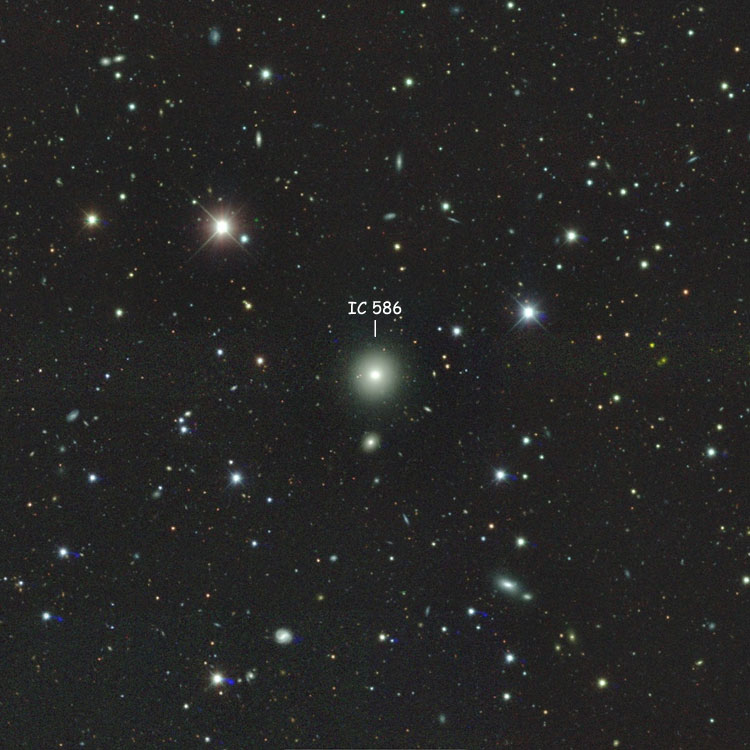
Above, a 12 arcmin wide DECaLS image centered on IC 586
Below, a 1.5 arcmin wide DECaLS image of IC 586

IC 587
(= PGC 29127 = UGC 5411 = CGCG 008-028 = MCG +00-26-012)
Discovered (Mar 20, 1893) by Stephane Javelle
A magnitude 13.4 spiral galaxy (type SAB(r)bc pec?) in Sextans (RA 10 03 05.2, Dec -02 24 00)
Historical Identification: Per Dreyer, IC 587 (Javelle #661, 1860 RA 09 53 00, NPD 91 47.8) is "faint, pretty large, round." The position precesses to (2000) RA 10 00 06.7, Dec -02 27 57, but there is nothing there nor anywhere near there. Fortunately, Javelle published not only the position he calculated for the object, but also the position of his comparison star, and its offsets from his #661. Thanks to that, Gottlieb was able to notice that if the signs of Javelle's offsets are reversed, the position becomes (1860) RA 09 55 56.9, NPD 91 43.8, which precesses to (2000) 10 03 03.8, Dec -02 24 15, only 0.45 arcmin southwest of the galaxy listed above, which more or less fits the description, and is the only "nebula" in a large region near Javelle's published position. So Javelle must have observed this galaxy, correctly measured its offsets from his comparison star, then made the common error of reversing the directions in his telescope, leading to a reversal of the signs of the offsets, and making what should have been an easy identification a difficult (albeit still certain) one.
Discovery Note: Corwin writes that Gottlieb noticed the problem, then adds that using modern, more accurate measurements for the position of the comparison star, the error in the position becomes only a few arcseconds, which is well within the outline of the galaxy. Gottlieb also notes that neither MCG nor CGCG list the galaxy as IC 587, but NED, SIMBAD and HyperLEDA do. Since Gottlieb discovered the error in Javelle's position after the former catalogues were published, there wouldn't have been a chance for them to identify the galaxy as the IC object; but NED, SIMBAD and HyperLEDA are online catalogues that are continually updated, so when such errors are discovered, they can be corrected (or not, since there are still numerous errors in each of those catalogues, which is one of the reasons I decided to create this catalogue).
Physical Information: Based on a recessional velocity relative to the Cosmic Background Radiation of about 6595 km/sec (and H0 = 70 km/sec/Mpc), a straightforward calculation indicates that IC 587 is about 305 to 310 million light-years away, in good agreement with redshift-independent distance estimates of about 205 to 365 million light-years. However, for objects at such distances we should take into account the expansion of the Universe during the time it took their light to reach us. Doing that shows that the galaxy was nearly 300 million light-years away at the time the light by which we see it was emitted, nearly 305 million years ago (the difference between the two numbers being due to the expansion of the intervening space during the light-travel time). Given that and its apparent size of about 1.28 by 0.57 arcmin (from the images below), the galaxy is about 110 thousand light-years across.

Above, a 12 arcmin wide SDSS image centered on IC 587
Below, a 1.6 arcmin wide SDSS image of IC 587
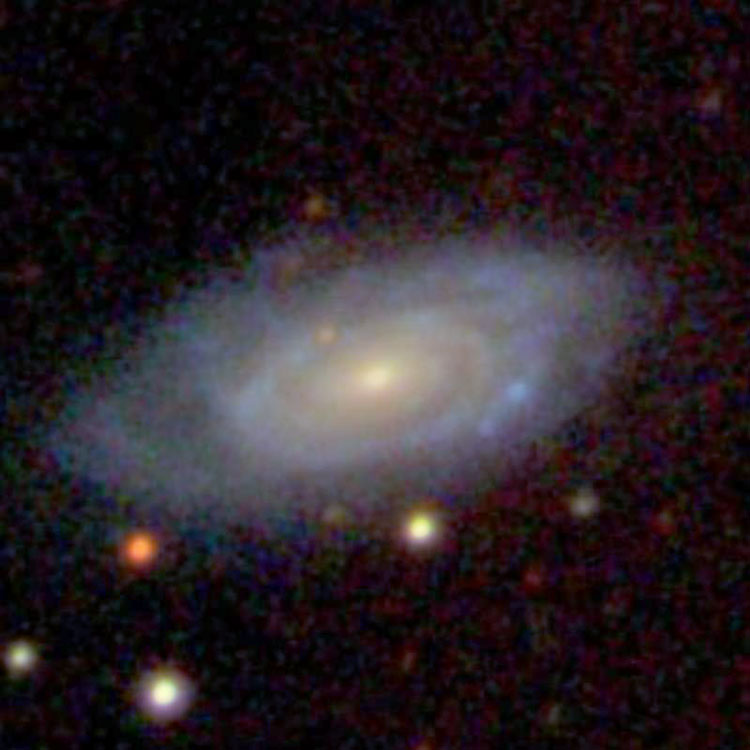
IC 588
(= PGC 29057 = UGC 5399 = CGCG 036-023 = MCG +01-26-010)
Discovered (Mar 17, 1893) by Stephane Javelle
A magnitude 13.7 spiral galaxy (type (R)SB(r)a) in Sextans (RA 10 02 07.0, Dec +03 03 28)
Historical Identification: Per Dreyer, IC 588 (Javelle #662, 1860 RA 09 54 51, NPD 86 16.2) is "faint, small, round, mottled." The position precesses to (2000) RA 10 02 06.9, Dec +03 03 27, dead-center on the galaxy listed above, the description is reasonable and there is nothing comparable nearby, so the identification is certain.
Physical Information: Based on a recessional velocity relative to the Cosmic Background Radiation of 7350 km/sec (and H0 = 70 km/sec/Mpc), a straightforward calculation indicates that IC 588 is about 340 to 345 million light-years away. However, for objects at such distances we should take into account the expansion of the Universe during the time it took their light to reach us. Doing that shows that the galaxy was about 330 to 335 million light-years away at the time the light by which we see it was emitted, about 335 to 340 million years ago (the difference between the two numbers being due to the expansion of the intervening space during the light-travel time). Given that and its apparent size of about 0.5 by 0.35 arcmin for the central galaxy and 1.05 by 0.9 arcmin for the outer ring (from the images below), the central galaxy is about 45 to 50 thousand light-years across and the outer ring spans about 100 thousand light-years.

Above, a 12 arcmin wide SDSS image centered on IC 588, also showing PGC 90978
Below, a 1.5 arcmin wide SDSS image of the galaxy
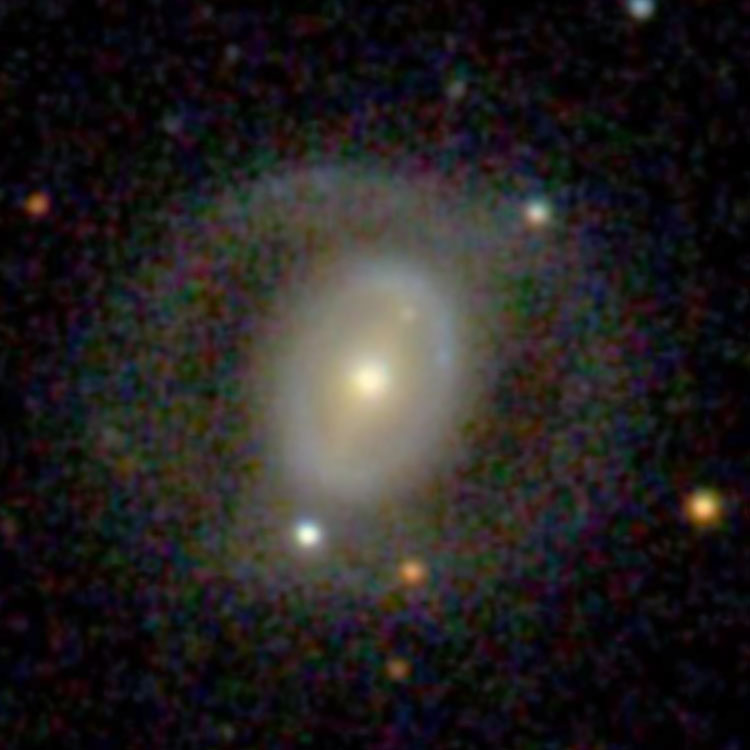
PGC 90978
Not an IC object but listed here as an apparent companion to IC 588
A magnitude 17.0(?) spiral galaxy (type Sd?) in Sextans (10 02 12.1, +03 03 12)
Physical Information: Based on a recessional velocity relative to the Cosmic Background Radiation of 9305 km/sec (and H0 = 70 km/sec/Mpc), a straightforward calculation indicates that pgc 90978 is about 430 to 435 million light-years away. However, for objects at such distances we should take into account the expansion of the Universe during the time it took their light to reach us. Doing that shows that the galaxy was about 415 to 420 million light-years away at the time the light by which we see it was emitted, about 425 million years ago (the difference between the two numbers being due to the expansion of the intervening space during the light-travel time). Given that and its apparent size of about 0.7 by 0.1 arcmin (from the image below), the galaxy is about 85 thousand light-years across.
"Companion" Note: Since PGC 90978 is about 100 million light-years more distant than IC 588, it is a background galaxy, and not an actual "companion" of its apparent neighbor.

Above, a 0.75 arcmin wide DECaLS image of PGC 90978; see IC 588 for a wider view
IC 589
(= PGC 154597)
Discovered (Mar 9, 1893) by Stephane Javelle
A magnitude 14.5 lenticular galaxy (type (R')S0/a? pec) in Sextans (RA 10 04 23.9, Dec -05 40 44)
Historical Identification: Per Dreyer, IC 589 (Javelle #663, 1860 RA 09 57 23, NPD 95 00.3) is "very faint, very small, binary nucleus?" The position precesses to (2000) RA 10 04 24.6, Dec -05 40 54, only 0.25 arcmin southeast of the center of the galaxy listed above and barely outside its southeastern outline, the description is reasonable and there is nothing else nearby, so the identification is certain.
Identification Note: Gottlieb notes that neither SIMBAD nor HyperLEDA identify PGC 154597 as IC 589. However, a search of HyperLEDA for IC 589 returns PGC 154597 as the only object in the region, and NED agrees with that identification.
Physical Information: Based on a recessional velocity relative to the Cosmic Background Radiation of 10390 km/sec (and H0 = 70 km/sec/Mpc), a straightforward calculation indicates that IC 589 is about 480 to 485 million light-years away, considerably further than a single redshift-independent distance estimate of about 325 million light-years. However, for objects at such distances we should take into account the expansion of the Universe during the time it took their light to reach us. Doing that shows that the galaxy was about 465 million light-years away at the time the light by which we see it was emitted, almost 475 million years ago (the difference between the two numbers being due to the expansion of the intervening space during the light-travel time). Given that and its apparent size of about 0.55 by 0.35 arcmin for the central galaxy and about 1.35 by 1.05 arcmin for its partial ring (from the images below), the central galaxy is about 75 thousand light-years across, and the ring is 180 to 185 thousand light-years wide.
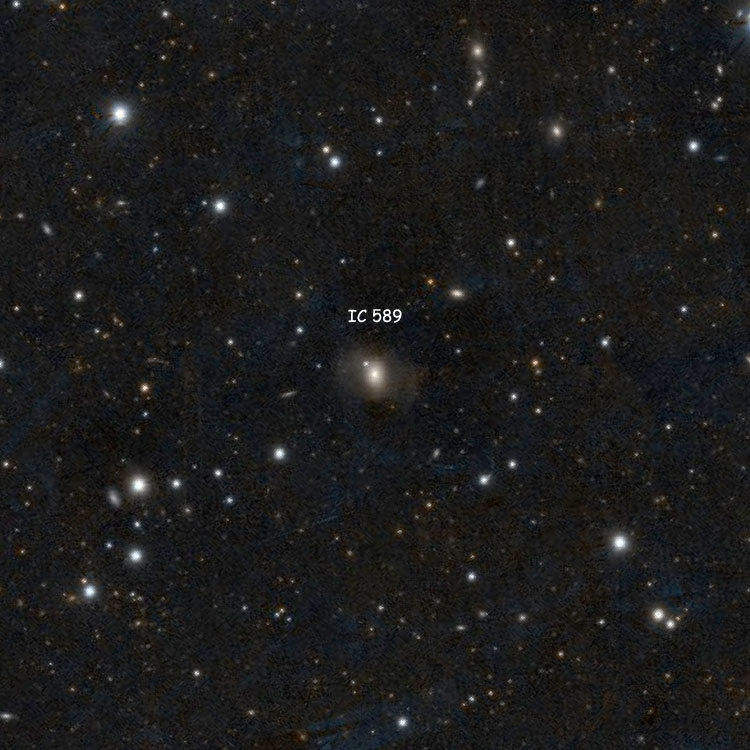
Above, a 12 arcmin wide PanSTARRS image centered on IC 589
Below, a 2 arcmin wide PanSTARRS image of the galaxy
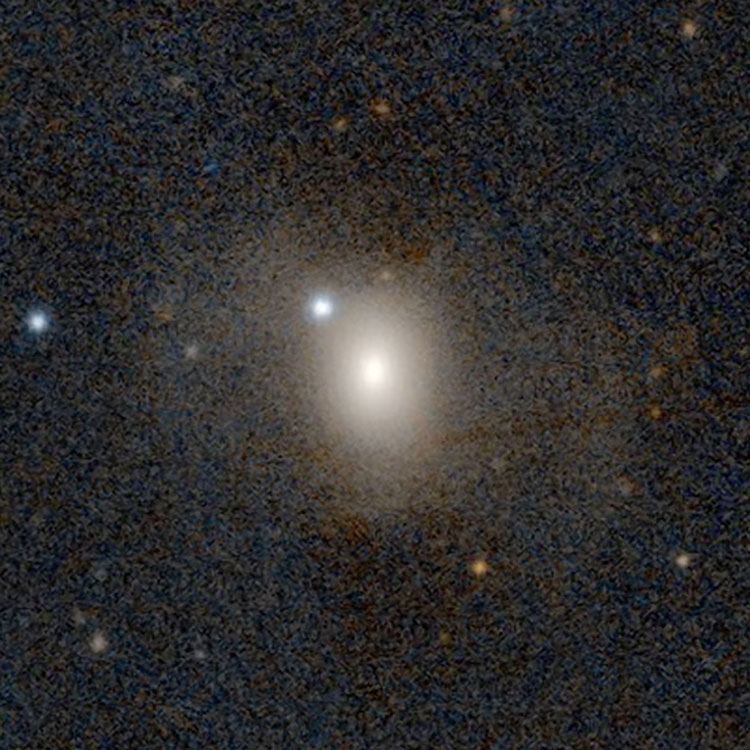
Below, a 2 arcmin wide DESI Legacy image of the galaxy

IC 590
((= PGC 29316 + PGC 93102) = UGC 5443, CGCG 008-037 and MCG +00-26-018)
Discovered (Mar 11, 1893) by Stephane Javelle
A pair of galaxies in Sextans at RA 10 05 50.3, Dec +00 37 57
PGC 29316 = A magnitude 13.8 lenticular galaxy (type SAB0? pec) at RA 10 05 49.8, Dec +00 38 00
PGC 93102 = A magnitude 13.5 lenticular galaxy (type SAB0? pec) at RA 10 05 50.7, Dec +00 37 54
Historical Identification: Per Dreyer, IC 590 (Javelle #664, 1860 09 58 38, NPD 88 41.2) is "faint, diffuse; nebulous double star?" The position precesses to (2000) RA 10 05 49.8, Dec +00 38 04, within the northern outline of the western member of the pair of galaxies listed above, the description is a perfect fit and there is nothing else nearby, so the identification is certain.
Discovery Note: Gottlieb points out that since Javelle wrote "appears as a double star surrounded by nebulosity", though he didn't realize the nature of the "stars" he did see both galaxies, so both components are part of IC 590.
Physical Information: Because this is an interacting pair of galaxies, the best estimate of its distance is the average of any information available for the individual galaxies. For PGC 29316, the recessional velocity relative to the Cosmic Background Radiation is about 6570 km/se, and it has a single redshift-independent distance estimate of about 315 million light-years; while for PGC 93102, the recessional velocity is 6725 km/sec. Using the average recessional velocity of a little over 6645 km/sec (and H0 = 70 km/sec/Mpc), a straightforward calculation indicates that the pair is about 310 million light-years away, in reasonable agreement with the redshift-independent distance estimate. However, for objects at such distances we should take into account the expansion of the Universe during the time it took their light to reach us. Doing that shows that the galaxies were about 300 million light-years away at the time the light by which we see them was emitted, about 305 million years ago (the difference between the two numbers being due to the expansion of the intervening space during the light-travel time). Given that, the apparent size of about 0.3 by 0.1 arcmin for the central part of PGC 29316 and about 0.45 by 0.4 arcmin for its "halo", and about 0.45 by 0.15 arcmin for the central part of PGC 93102 and about 0.7 by 0.45 arcmin for its "halo" (from the images below) implies that the central part of PGC 29316 is about 25 thousand light-years across, and its outer regions span about 40 thousand light-years, and the central part of PGC 93102 is about 40 thouand light-years across, and its outer regions span about 60 thousand light-years. The entire structure (both galaxies and their outer regions) covers about 0.85 by 0.7 arcmin (again, from the images below), which corresponds to about 75 thousand light-years.
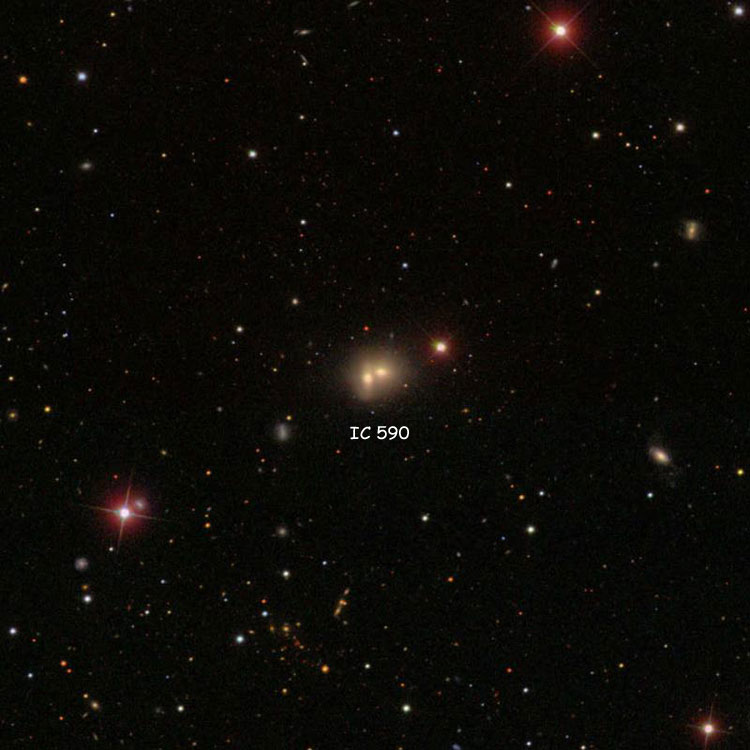
Above, a 12 arcmin wide SDSS image centered on IC 590
Below, a 1.25 arcmin wide SDSS image of the pair
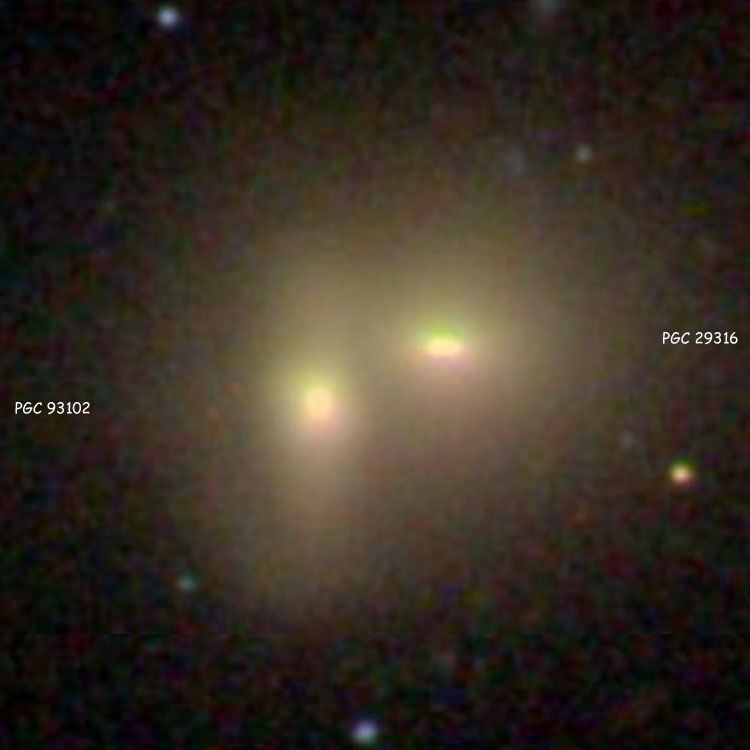
IC 591
(= PGC 29435 = UGC 5458 = CGCG 064-069 = MCG +02-26-025)
Discovered (Feb 6, 1878) by David Todd
Discovered (Mar 31, 1892) by Stephane Javelle
Also observed (Mar 13, 1899) by Johann Palisa
A magnitude 13.2 spiral galaxy (type SBc?) in Leo (RA 10 07 27.7, Dec +12 16 28)
Historical Identification: Per Dreyer, IC 591 (Javelle #177, (Todd #22), 1860 RA 09 59 58, NPD 77 02.9) is "pretty faint, small, round." The position precesses to (2000) RA 10 07 28.6, Dec +12 16 13, barely to the southeast of the galaxy listed above, the description is reasonable and there is nothing comparable nearby, so the identification is certain.
Designation Note: Gottlieb states that although IC 591 is UGC 5458 the UGC catalog does not include the IC designation.
My Blunder With Todd 22: As shown in the Discoverers list above, Todd observed IC 591 long before Javelle, and published his observation (in 1885) prior to the publication of the NGC. However, Dreyer ignored Todd's observation in all his catalogues, probably because Todd gave no coordinates for the object (though it has been noted that he also ignored other Todd entries that did have coordinates, but like #22, were only "suspected"). When I first worked on this entry in 2015, I found one reference that said IC 591 might be Todd 21, and another that suggested it was Todd 22. It was easy to use the coordinates for Todd 21 to see that it wasn't anywhere near IC 591, so I rejected that; but since no coordinates were given for Todd 22, and I forgot that Todd's sketches were inverted relative to maps of the sky (this is normal when looking through a telescope or its finder, but papers published in his era usually showed sketches aligned like sky maps, with North on top and East on the left, or used arrows to show their alignment). Todd's unconventional alignment confused me, so although I supposed that IC might be Todd 22, my 2015 entry expressed doubt that that could ever be proven.
Apparently I realized my error almost immediately, as Dr. Corwin informs me that I sent him the identification shown below in July of 2015; but for some reason I failed to correct the entry, and although a page dated Sept 2017 said that I was working on IC 591, I still failed to correct it. So it wasn't until November of 2023, when Steve Gottlieb sent me essentially the same thing I had sent Dr. Corwin, and having read my wishy-washy 2015 entry, asked what I thought about his identification of Todd 22, that I realized that I had never corrected the original entry. (My reaction was chagrin at having left an incorrect entry online for more than eight years, and thankful that someone caught my mistake while I was still around to correct it.)
Confirming That Todd 22 = IC 591: As noted above and shown in an image below, both Todd's finder view and "strip sketch" of the field of view through the telescope show South at the top and West to the left of his "suspect" nebula. That means that "a" in the sketch (a star) should be 86 seconds of time to the west of Todd 22, not to the east, as I had earlier thought. And there is a "reasonably bright" (magnitude 13) star almost exactly 86 seconds to the west of IC 591. What's more, there are additional considerably fainter stars located exactly as shown in Todd's strip sketch, which Gottlieb circled in the DSS image he sent me. Since that helped to confirm the identification, in the SDSS "strip" image shown below, which is inverted to match Todd's drawing, I have also circled those stars. I have also added an SDSS image of part of the view seen through Todd's finder, also oriented the same way as in the finder, to show that everything in Todd's sketches matches what we can see in the sky, proving that Todd 22 is indeed IC 591; and as a result I have added credit for Todd to Dreyer's entry (in parentheses, to show that it was not part of the original IC entry).
Images Proving That Todd 22 = IC 519: Todd's observations of the regions he studied in his unsuccessful search for a trans-Neptunian planet were made with the US Naval Observatory 26-inch telescope, usually at 400 power. Todd's entry for Todd 22 is shown in the first image below. The "records" in his 1885 paper (a "verbatim" copy of his logbook) included a "strip" sketch of the object and one or more "nearby" stars, with distances between the objects listed, and a circular view of the region as shown in the telescope's finder. (Usually, the coordinates are shown next to the finder image, but in this case Todd failed to provide coordinates.) As noted above, the images are inverted relative to most sky maps, so I have labeled the finder image for Todd 22 with N, E, S and W letters, which show that the object in question lies to the northwest of α (Alpha) Leonis, or Regulus. The "strip sketch" represents an observation made near the small square in the field of view of the finder (which is also inverted relative to most sky maps). The lines in the finder sketch represent 'hairlines' inside the finder separated by 12 arcmin, so that the central square is 12 arcmin wide. As suggested by the large distance between "a" and "b" in the "strip sketch" for Todd 22, it covers a much wider field of view (in fact approximately 30 arcmin), so the strip is considerably wider than the central square in the finder, but more or less corresponds to part of the horizontal band in the center of the finder image.
 Above, the strip sketch and notes for Todd 22, and the finder view, with positions for N, E, S and W added. That shows that α Leonis (Regulus) is to the southeast of Todd 22.
In the 30 arcmin wide SDSS image below, the star labeled "a" lies at (2000) RA 10 06 01.3, Dec +12 16 08, while IC 591 ("b") is at (2000) RA 10 07 27.6, Dec +12 16 28, so it lies 86.3 seconds of time to the east of "a", and the circled stars correspond to the other stars shown in Todd's sketch, proving that this is indeed the correct field of view. Note: Since there are small specks scattered all over the online archive of Todd's paper, the two faintest dots in his strip sketch may or may not be stars that he observed. I have circled the one down and to the left of IC 591, as it seems to perfectly correspond to a reasonably bright star; but the one to the east (right) of "a" has no corresponding star in the SDSS image, so I feel certain that it is just a random speck, like those outside Todd's sketches.

Below, a 45 by 30 arcmin wide SDSS image corresponding to part of Todd's finder view, with the region of his strip sketch outlined (as in his finder view, North is on the bottom, and East is on the right). The large, very faint 'open cluster' below (north of) Regulus and to the right (east) of IC 591 is the Local Group galaxy Leo I, first observed in the early 1950's on one of the Schmidt telescope plates taken at Palomar Observatory (which form the basis for the northern 2/3 of the DSS image database), but not visually observed, because its stars are so faint and it is so close to the glare of Regulus, until the 1990's.
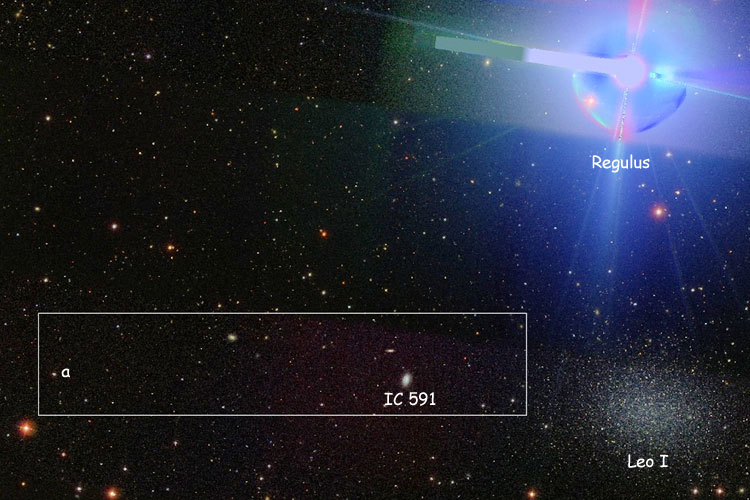 Physical Information
: Based on a recessional velocity relative to the Cosmic Microwave Background Radiation of about 3150 - 3155 km/sec (and H 0 = 70 km/sec/Mpc), IC 591 is about 145 to 150 million light-years away, in reasonable agreement with a single redshift-independent distance estimate of about 130 to 135 million light-years. Given that and its apparent size of about 0.85 by 0.55 arcmin (from the images below), the galaxy is about 35 to 40 thousand light-years across.
Classification Note: NED merely lists the galaxy as type S?, while HyperLEDA's "average" type is SBc, as shown in the description line, and the close-up image below seems to confirm that classification. The question mark represents the fact that even HyperLEDA's database lists several variations from that average.
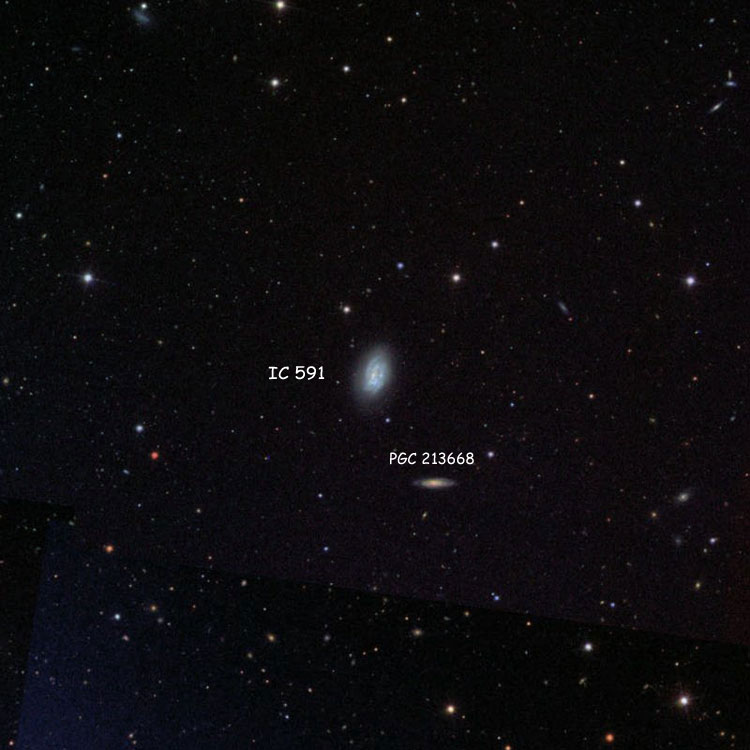
Above, a 12 arcmin wide SDSS image (with North on top) centered on IC 591, also showing PGC 213668
Below, a 1.25 arcmin wide SDSS image of the galaxy

PGC 213668
Not an IC object but listed here as an apparent companion of IC 591
A magnitude 16.0(?) spiral galaxy (type (R?)Sb?) in Leo (RA 10 07 23.7, Dec +12 14 45)
Physical Information: Based on a recessional velocity relative to the Cosmic Background Radiation of 15945 km/sec (and H0 = 70 km/sec/Mpc), a straightforward calculation indicates that PGC 213668 is about 740 to 745 million light-years away. However, for objects at such distances we should take into account the expansion of the Universe during the time it took their light to reach us. Doing that shows that the galaxy was about 695 to 700 million light-years away at the time the light by which we see it was emitted, about 715 million years ago (the difference between the two numbers being due to the expansion of the intervening space during the light-travel time). Given that and its apparent size of about 0.73 by 0.22 arcmin (from the image below), the galaxy is about 145 to 150 thousand light-years across.
Note About "Companionship": Since PGC 213668 is so far away, it is not an actual companion of IC 591, but only a much more distant background galaxy. And although it looks smaller because of its distance, it is actually much larger than IC 591.

Above, a 1.0 arcmin DECaLS image of PGC 213668; see IC 591 for a wider view
IC 592
(= PGC 29465 = UGC 5465 = CGCG 008-045 = MCG +00-26-020)
Discovered (Mar 21, 1893) by Stephane Javelle
A magnitude 13.4 spiral galaxy (type SAB(rs)c? pec) in Sextans (RA 10 07 58.7, Dec -02 29 52)
Historical Identification: Per Dreyer, IC 592 (Javelle #665, 1860 RA 10 00 54, NPD 91 49.8) is "faint, small, round, diffuse." The position precesses to (2000) RA 10 08 00.8, Dec -02 30 45, about 1 arcmin southeast of the galaxy listed above, the desription fits and the only other object in the region is Javelle #666 ( IC 593), discovered on the same night, so the identification is certain.
Physical Information: Based on a recessional velocity relative to the Cosmic Background Radiation of 6405 km/sec (and H0 = 70 km/sec/Mpc), a straightforward calculation indicates that IC 592 is about 295 to 300 million light-years away. However, for objects at such distances we should take into account the expansion of the Universe during the time it took their light to reach us. Doing that shows that the galaxy was about 290 million light-years away at the time the light by which we see it was emitted, about 295 million years ago (the difference between the two numbers being due to the expansion of the intervening space during the light-travel time). Given that and its apparent size of about 0.95 by 0.65 arcmin (from the images below), the galaxy is about 80 thousand light-years across.
Probable Companionship With IC 593: Although I have chosen to deal with them separately, their nearly identical recessional velocities and close apparent proximity imply that IC 592 and 593 are a physical pair.

Above, a 12 arcmin wide SDSS image centered on IC 592, also showing IC 593 and 8th-magnitude HD 87888
Below, a 1.2 arcmin wide SDSS image of IC 592
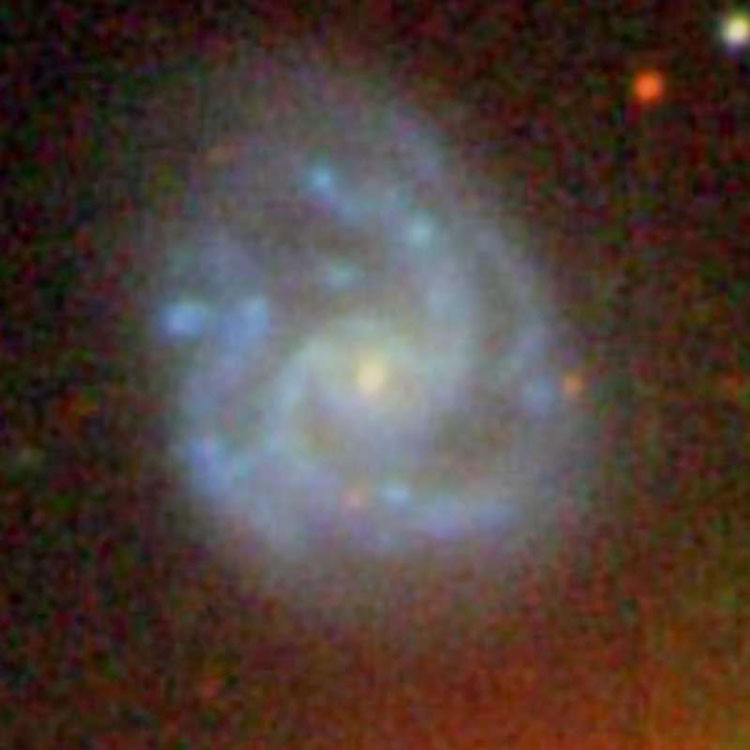
IC 593
(= PGC 29482 = UGC 5469 = CGCG 008-047 = MCG +00-26-021)
Discovered (Mar 21, 1893) by Stephane Javelle
A magnitude 13.6 spiral galaxy (type S(rs)c? pec) in Sextans (RA 10 08 18.1, Dec -02 31 36)
Historical Identification: Per Dreyer, IC 593 (Javelle #666, 1860 RA 10 01 13, NPD 91 51.4) is "faint, small, round, gradually brighter middle." The position precesses to (2000) RA 10 08 19.8, Dec -02 32 23, about 0.9 arcmin southeast of the galaxy listed above, the description fits and the only other object in the region is Javelle #665 ( IC 592), discovered on the same night, so the identification is certain.
Physical Information: Based on a recessional velocity relative to the Cosmic Background Radiation of about 6435 km/sec (and H0 = 70 km/sec/Mpc), a straightforward calculation indicates that IC 593 is about 300 million light-years away. However, for objects at such distances we should take into account the expansion of the Universe during the time it took their light to reach us. Doing that shows that the galaxy was about 290 to 295 million light-years away at the time the light by which we see it was emitted, about 295 million years ago (the difference between the two numbers being due to the expansion of the intervening space during the light-travel time). Given that and its apparent size of about 0.7 by 0.53 arcmin (from the images below), the galaxy is about 60 thousand light-years across.
Probable Companionship With IC 592: Although I have chosen to deal with them separately, their nearly identical recessional velocities and close apparent proximity imply that IC 592 and 593 are a physical pair.

Above, a 12 arcmin wide SDSS image centered on IC 593, also showing IC 592
Below, a 1 arcmin wide SDSS image of IC 593

IC 594
(= PGC 29496 = UGC 5472 = CGCG 008-049 = MCG +00-26-023)
Discovered (Mar 17, 1893) by Stephane Javelle
A magnitude 13.8 spiral galaxy (type SAB(rs)bc) in Sextans (RA 10 08 32.0, Dec -00 40 01)
Historical Identification: Per Dreyer, IC 594 (Javelle #667, 1860 RA 10 01 21, NPD 89 59.7) is "faint, small, round, gradually brighter middle, mottled but not resolved." The position precesses to (2000) RA 10 08 30.7, Dec -00 40 42, about 0.75 arcmin south-southwest of the galaxy listed above, the description fits and there is nothing else nearby, so the identification is certain.
Physical Information: Based on a recessional velocity relative to the Cosmic Background Radiation of 6765 km/sec (and H0 = 70 km/sec/Mpc), a straightforward calculation indicates that IC 594 is about 315 million light-years away, in reasonable agreement with redshift-independent distance estimates of about 315 to 370 million light-years. However, for objects at such distances we should take into account the expansion of the Universe during the time it took their light to reach us. Doing that shows that the galaxy was a little over 305 million light-years away at the time the light by which we see it was emitted, about 310 million years ago (the difference between the two numbers being due to the expansion of the intervening space during the light-travel time). Given that and its apparent size of about 1.05 by 0.45 arcmin (from the images below), the galaxy is about 90 to 95 thousand light-years across.
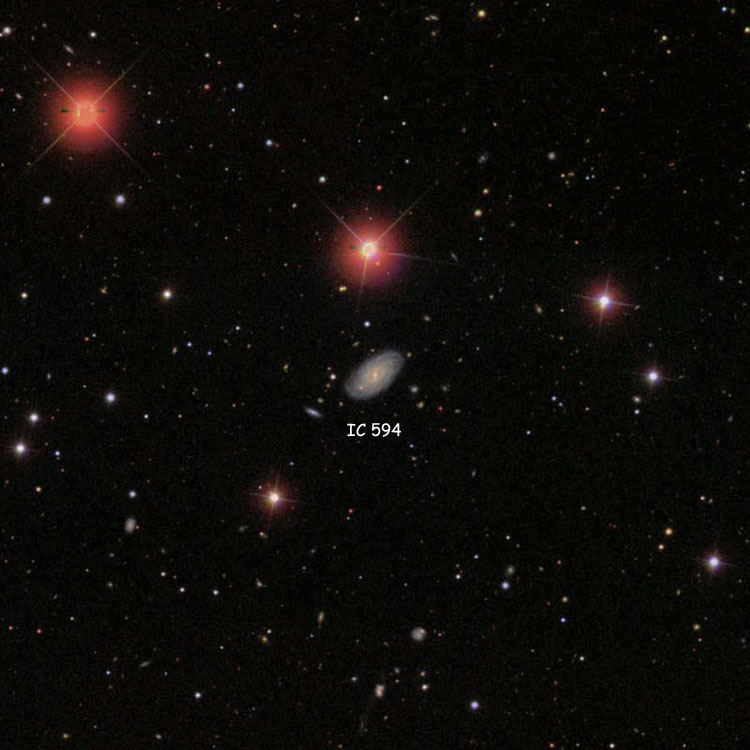
Above, a 12 arcmin wide SDSS image centered on IC 594
Below, a 1.2 arcmin wide SDSS image of IC 594
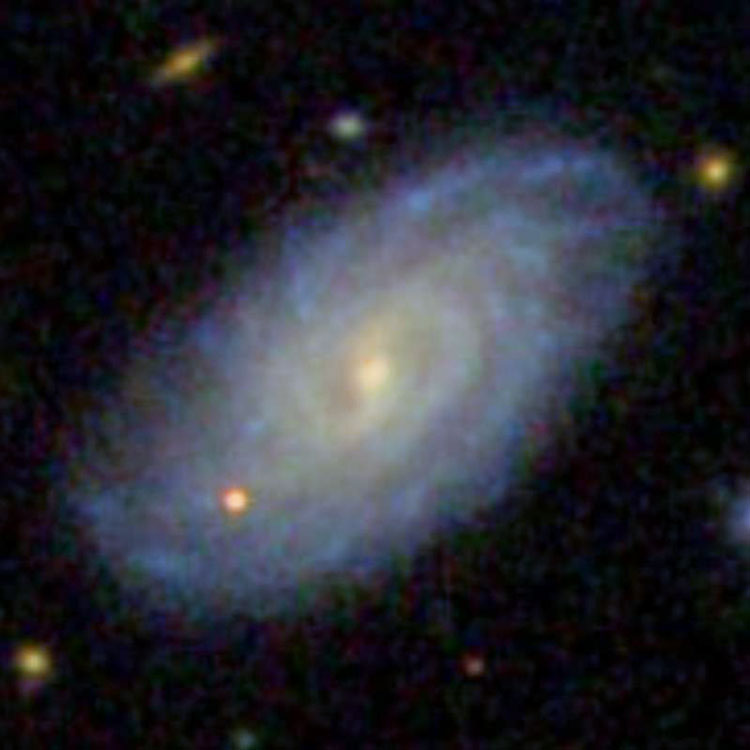
IC 595
(= PGC 29555 = CGCG 064-081)
Discovered (Jan 28, 1892) by Stephane Javelle
A magnitude 14.0 lenticular galaxy (type S0?) in Leo (RA 10 09 38.1, Dec +11 00 01)
Historical Identification: Per Dreyer, IC 595 (Javelle #178, 1860 RA 10 02 10, NPD 78 18.6) is "faint, very small, round, a little brighter middle." The position precesses to (2000) RA 10 09 38.2, Dec +11 00 18, less than 0.3 arcmin nearly due north of the galaxy listed above, the description fits and there is nothing else nearby, so the identification is certain.
Physical Information: Based on a recessional velocity relative to the Cosmic Background Radiation of about 8765 km/sec (and H0 = 70 km/sec/Mpc), a straightforward calculation indicates that IC 595 is about 405 to 410 million light-years away, somewhat farther than a single redshift-independent distance estimate of about 345 million light-years. However, for objects at such distances we should take into account the expansion of the Universe during the time it took their light to reach us. Doing that shows that the galaxy was about 395 million light-years away at the time the light by which we see it was emitted, about 400 million years ago (the difference between the two numbers being due to the expansion of the intervening space during the light-travel time). Given that and its apparent size of about 0.75 by 0.55 arcmin (from the images below), the galaxy is about 85 thousand light-years across.

Above, a 12 arcmin wide SDSS image centered on IC 595
Below, a 1 arcmin wide SDSS image of IC 595
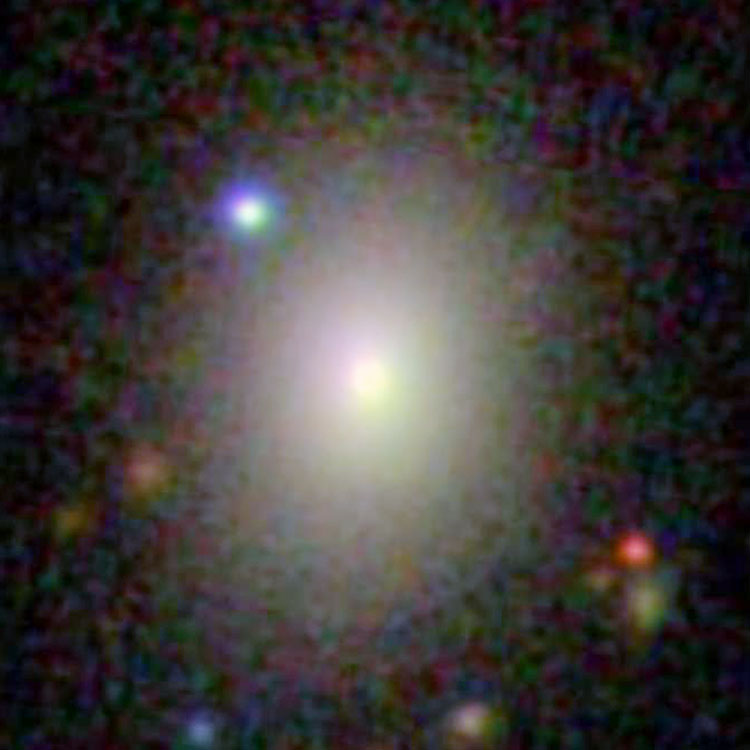
IC 596
(= PGC 29621 = CGCG 064-084 = MCG +02-26-030)
Discovered (Apr 18, 1893) by Stephane Javelle
A magnitude 14.9 spiral galaxy (type SABb?) in Leo (RA 10 10 31.4, Dec +10 02 33)
Historical Identification: Per Dreyer, IC 596 (Javelle #668, 1860 RA 10 03 06, NPD 79 16.3) is "faint, small, diffuse." The position precesses to (2000) RA 10 10 32.5, Dec +10 02 31, less than 0.3 arcmin nearly due east of the galaxy listed above, the desription fits and there is nothing else nearby, so the identification is certain.
Physical Information: Based on a recessional velocity relative to the Cosmic Background Radiation of 9835 km/sec (and H0 = 70 km/sec/Mpc), a straightforward calculation indicates that IC 596 is about 455 to 460 million light-years away. However, for objects at such distances we should take into account the expansion of the Universe during the time it took their light to reach us. Doing that shows that the galaxy was just over 440 million light-years away at the time the light by which we see it was emitted, almost 450 million years ago (the difference between the two numbers being due to the expansion of the intervening space during the light-travel time). Given that and its apparent size of about 0.85 by 0.25 arcmin (from the images below), the galaxy is about 110 thousand light-years across.
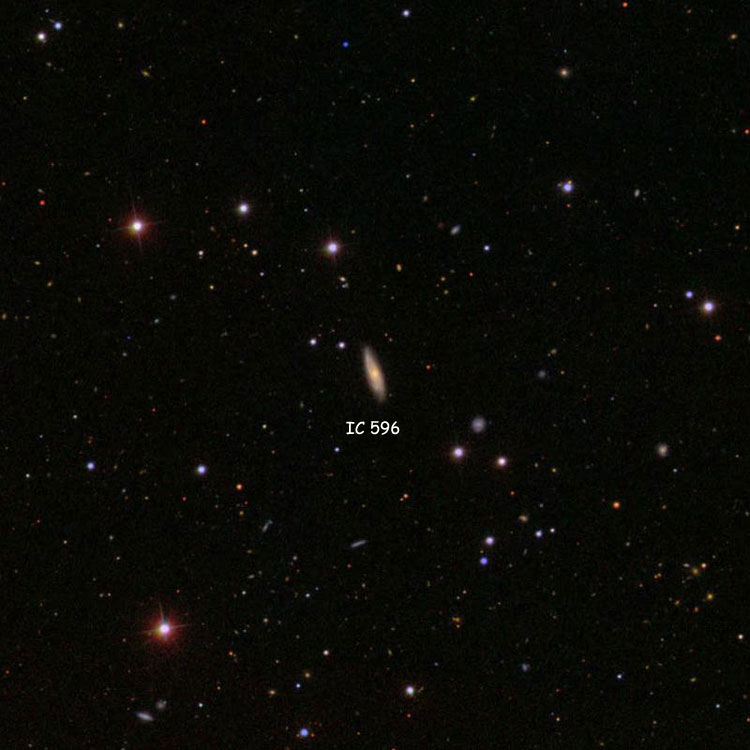
Above, a 12 arcmin wide SDSS image centered on IC 596
Below, a 1 arcmin wide SDSS image of IC 596

IC 597
(= PGC 154761)
Discovered (May 4, 1893) by Stephane Javelle
A magnitude 15.0 lenticular galaxy (type S0?) in Sextans (RA 10 10 12.0, Dec -06 53 57)
Historical Identification: Per Dreyer, IC 597 (Javelle #669, 1860 RA 10 03 13, NPD 96 12.6) is "faint, very small, round." The position precesses to (2000) RA 10 10 13.1, Dec -06 53 46, about 0.35 arcmin northeast of the galaxy listed above, the description is reasonable and there is nothing else nearby, so the identification is certain.
Identification Note: HyperLEDA does not list PGC 154761 as IC 597, but a search of that database for IC 597 returns the entry for PGC 154761, since it is the only object of note in the region. NED does equate the two identifications, but as noted by Gottlieb, because of LEDA's omission, SIMBAD has no entry for IC 597.
Physical Information: Based on a recessional velocity relative to the Cosmic Microwave Background radiation of 5275 km/sec (and H0 = 70 km/sec/Mpc), IC 597 is about 245 million light-years away. Given that and its apparent size of about 0.65 by 0.25 arcmin (from the images below), the galaxy is about 45 to 50 thousand light-years across.

Above, a 12 arcmin wide PanSTARRS image centered on IC 597
Below, a 1 arcmin wide PanSTARRS image of IC 597

IC 598
(= PGC 29745 = UGC 5502 = CGCG 211-017 = MCG +07-21-016)
Discovered (Mar 27, 1889) by Lewis Swift
A magnitude 13.0 lenticular galaxy (type SB0?) in Ursa Major (RA 10 12 48.6, Dec +43 08 44)
Historical Identification: Per Dreyer, IC 598 (Swift list VIII (#51), 1860 RA 10 04 34, NPD 46 04.2) is "very faint, very small, round, brighter middle, almost stellar." The position precesses to (2000) RA 10 13 07.3, Dec +43 14 26, but there is nothing there. However, the galaxy listed above is a reasonable candidate for what Swift saw, as the error in Swift's right ascension is fairly typical for his observations, and a 5 arcmin error in reading his declination circle (a typical error as well) would place Swift's object at (2000) RA 10 13 07.0, Dec +43 09 26, about 1.7 arcmin east-northeast of the galaxy listed above. The description is reasonable (the galaxy is elongated, but as the close-up image below shows, its bright nucleus would appear more round to a visual observer than the galaxy itself does in modern photographs) and there is nothing else is a very large region centered on Swift's position, so the identification is considered essentially certain.
Discovery Note: Gottlieb notes that that there is nothing at Swift's position, but continues with the statement that UGC 5502, only 6.6 arcmin to the south-southwest of Swift's position, is a good fit to the description and the only nebulous object in the region, so he considers the identification certain. Corwin doesn't make any comment about IC 598, so he presumably agrees with the identification, and as explained in the paragraphs above and below, given the assumption of a typical error in Swift's position, I also consider the identification to be sufficiently certain.
Observational Note: Swift's positions are usually off in right ascension, and frequently off in declination because he usually worked alone, standing at the top of a tall ladder to make his observation, then climbing down to the base of the telescope to examine the setting circles, using as faint a light as possible to read them, so that by the time he returned to the top of the ladder, his night vision was more or less back to normal. As a result, due to the motion of the sky while he was doing this, and the difficulty of reading the setting circles without a brighter light, his right ascensions are almost always too far east, and he frequently made errors that were a small multiple of 1 or 5 arcmin in reading the declination circle.
Physical Information: Based on a recessional velocity relative to the Cosmic Microwave Background radiation of 2475 km/sec (and H0 = 70 km/sec/Mpc), IC 598 is about 115 million light-years away. Given that and its apparent size of about 1.4 by 0.5 arcmin (from the images below), the galaxy is about ? thousand light-years across.

Above, a 12 arcmin wide SDSS image centered on IC 598
Below, a 1.75 arcmin wide SDSS image of IC 598
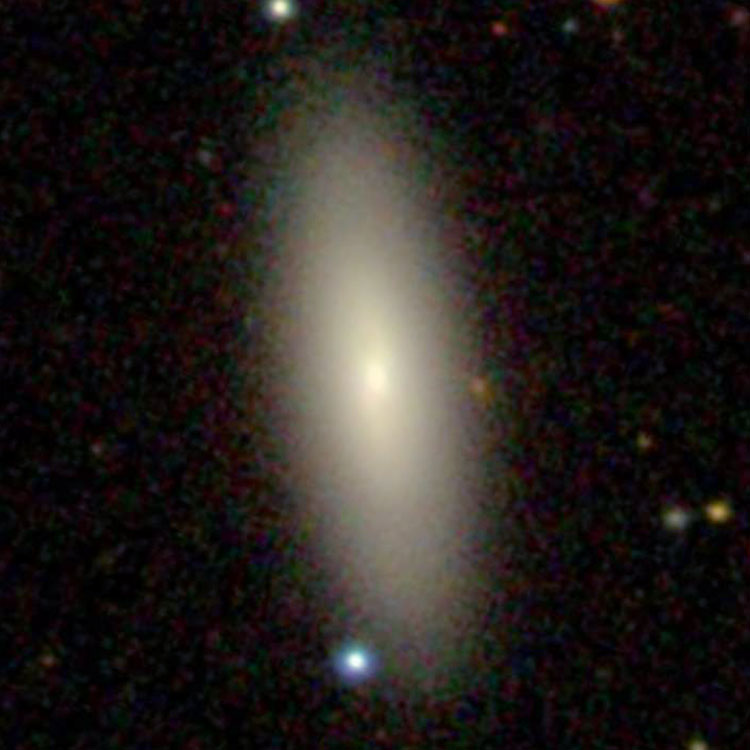
IC 599
(= PGC 29771 = MCG -01-26-032)
Discovered (May 4, 1890) by Stephane Javelle
A magnitude 14.3 spiral galaxy (type Sb?) in Sextans (RA 10 13 12.5, Dec -05 37 44)
Historical Identification: Per Dreyer, IC 599 (Javelle #670, 1860 RA 10 06 10, NPD 94 56.5) is "pretty faint, small, a very little brighter middle." The position precesses to (2000) RA 10 13 12.3, Dec -05 37 57, only 0.2 arcmin south-southwest of the center of the galaxy listed above and despite its small size, almost on the southeastern rim of the galaxy, the description fits and there is nothing else nearby, so the identification is certain.
Physical Information: Based on a recessional velocity relative to the Cosmic Microwave Background radiation of about 5505 km/sec (and H0 = 70 km/sec/Mpc), IC 599 is about 255 million light-years away. Given that and its apparent size of about 1.15 by 0.3 arcmin (from the images below), the galaxy is about 85 thousand light-years across.
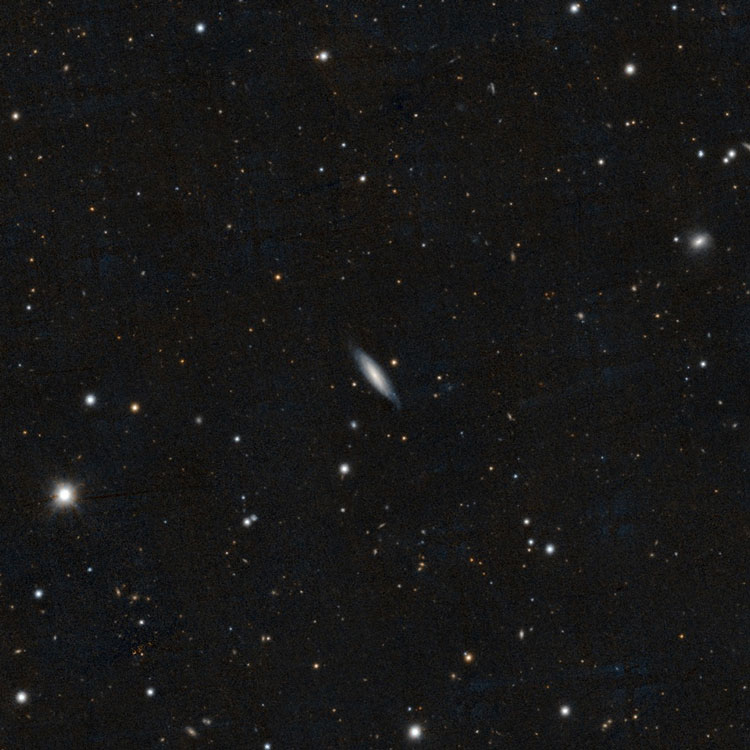
Above, a 12 arcmin wide PanSTARRS image centered on IC 599
Below, a 1.2 arcmin wide PanSTARRS image of IC 599

|